UNITED STATES
SECURITIES AND EXCHANGE COMMISSION
Washington, D.C. 20549
FORM 20-F
(Mark One)
☐ REGISTRATION STATEMENT PURSUANT TO SECTION 12(B) OR 12(G) OF THE SECURITIES EXCHANGE ACT OF 1934
OR
☒ ANNUAL REPORT PURSUANT TO SECTION 13 OR 15(D) OF THE SECURITIES EXCHANGE ACT OF 1934
For the fiscal year ended June 30, 2026
OR
☐ TRANSITION REPORT PURSUANT TO SECTION 13 OR 15(D) OF THE SECURITIES EXCHANGE ACT OF 1934
OR
☐ SHELL COMPANY REPORT PURSUANT TO SECTION 13 OR 15(D) OF THE SECURITIES EXCHANGE ACT OF 1934
For the transition period from to
Commission file number: 001-42803
BUUU Group Limited
(Exact name of Registrant as specified in its charter)
British Virgin Islands
(Jurisdiction of incorporation or organization)
Flat B, 16/F, Ford Glory Plaza
37 Wing Hong Street
Cheung Sha Wan, Hong Kong
(Address of principal executive offices)
Wai Kwong, POON
+852 3705 5244
Flat B, 16/F, Ford Glory Plaza
37 Wing Hong Street
Cheung Sha Wan, Hong Kong
(Name, Telephone, E-mail and/or Facsimile number and Address of Company Contact Person)
Securities registered or to be registered pursuant to Section 12(b) of the Act:
| Title of each class | Trading Symbol(s) | Name of each exchange on which registered | ||
| Class A Ordinary Shares, of no par value | BUUU | The Nasdaq Stock Market LLC (Nasdaq Capital Market) |
Securities registered or to be registered pursuant to Section 12(g) of the Act: None
Securities for which there is a reporting obligation pursuant to Section 15(d) of the Act: None
Indicate the number of outstanding shares of each of the issuer’s classes of capital or common stock as of the close of the period covered by the annual report: 148,780,000 Class A Ordinary Shares and 50,000,000 Class B Ordinary Shares, no par value, as of June 30, 2026, after giving effect to the Share Subdivision effective October 26, 2026 (14,878,000 Class A Ordinary Shares and 5,000,000 Class B Ordinary Shares before giving effect to the Share Subdivision).
Indicate by check mark if the registrant is a well-known seasoned issuer, as defined in Rule 405 of the Securities Act.
☐ Yes ☒ No
If this report is an annual or transition report, indicate by check mark if the registrant is not required to file reports pursuant to Section 13 or 15(d) of the Securities Exchange Act of 1934.
☐ Yes ☒ No
Indicate by check mark whether the registrant: (1) has filed all reports required to be filed by Section 13 or 15(d) of the Securities Exchange Act of 1934 during the preceding 12 months (or for such shorter period that the registrant was required to file such reports), and (2) has been subject to such filing requirements for the past 90 days.
☒ Yes ☐ No
Indicate by check mark whether the registrant has submitted electronically and posted on its corporate Web site, if any, every Interactive Data File required to be submitted and posted pursuant to Rule 405 of Regulation S-T (§232.405 of this chapter) during the preceding 12 months (or for such shorter period that the registrant was required to submit and post such files).
☒ Yes ☐ No
Indicate by check mark whether the registrant is a large accelerated filer, an accelerated filer, a non-accelerated filer, or an emerging growth company. See definition of “large accelerated filer,” “accelerated filer,” and “emerging growth company” in Rule 12b-2 of the Exchange Act.
| Large accelerated filer ☐ | Accelerated filer ☐ | Non-accelerated filer ☒ | ||
| Emerging growth company ☒ |
If an emerging growth company that prepares its financial statements in accordance with U.S. GAAP, indicate by check mark if the registrant has elected not to use the extended transition period for complying with any new or revised financial accounting standards† provided pursuant to Section 13(a) of the Exchange Act. ☐
Indicate by check mark whether the registrant has filed a report on and attestation to its management’s assessment of the effectiveness of its internal control over financial reporting under Section 404(b) of the Sarbanes-Oxley Act (15 U.S.C. 7262(b)) by the registered public accounting firm that prepared or issued its audit report. ☐
Indicate by check mark which basis of accounting the registrant has used to prepare the financial statements included in this filing:
| ☒ | International Financial Reporting Standards as issued | Other ☐ | ||
| by the International Accounting Standards Board ☐ |
| * | If “Other” has been checked in response to the previous question, indicate by check mark which financial statement item the registrant has elected to follow. |
☐ Item 17 ☐ Item 18
If securities are registered pursuant to Section 12(b) of the Act, indicate by check mark whether the financial statements of the registrant included in the filing reflect the correction of an error to previously issued financial statements. ☐
Indicate by check mark whether any of those error corrections are restatements that required a recovery analysis of incentive-based compensation received by any of the registrant’s executive officers during the relevant recovery period pursuant to §240.10D-1(b). ☐
If this is an annual report, indicate by check mark whether the registrant is a shell company (as defined in Rule 12b-2 of the Securities Exchange Act of 1934).
☐ Yes ☒ No
Table of Contents
i
INTRODUCTION
Except where the context otherwise requires and for purposes of this annual report only the term:
| ● | “Amended and Restated Memorandum and Articles of Association” refers to the current amended and restated memorandum and articles of association of BUUU (as defined below), as filed with the Registry of Corporate Affairs in the British Virgin Islands on October 18, 2024; |
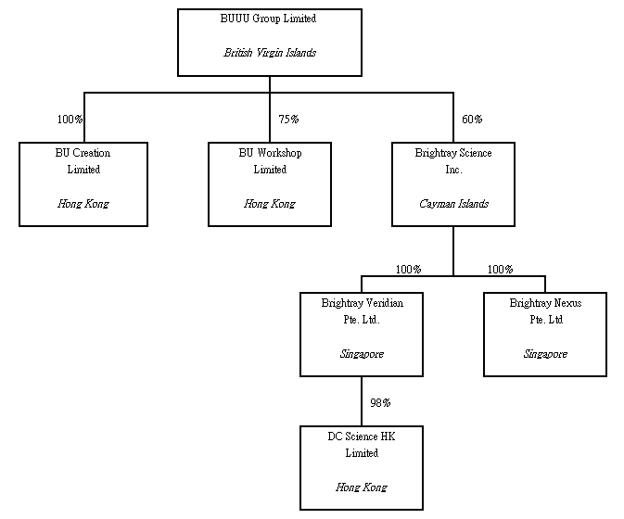
| ● | “Brightray” refers to Brightray Science Inc. (formerly known as Sunburst Ventures Inc.), an exempted company incorporated under the laws of the Cayman Islands, 60% of the issued share capital of which we acquired from DeedTech Inc. (“DeedTech”) on September 15, 2026 pursuant to the Share Purchase Agreement (the “Acquisition”), and, where the context requires, its subsidiaries; |
| ● | “BUUU” and “Company” refers to BUUU Group Limited, a BVI business company with limited liability incorporated under the laws of BVI, and the holding company of our businesses; |
| ● | “BVI” refers to the British Virgin Islands; |
| ● | “BVI Act” refers to the BVI Business Companies Act, 2020 (as amended); |
| ● | “CAGR” refers to compounded annual growth rate, the year-on-year growth rate over a specific period of time; |
| ● | “Controlling Shareholder” refers to BUBI Services Limited, or BUBI, a company incorporated under the laws of British Virgin Islands; |
| ● | “Class A Ordinary Shares” refers to the Class A Ordinary Shares of BUUU (as defined below) of no par value and entitled to one (1) vote per share; |
| ● | “Class B Ordinary Shares” refers to the Class B Ordinary Shares of BUUU (as defined below) of no par value and entitled to twenty (20) votes per share; |
| ● | “Hong Kong dollar(s)”, or “HK$” refer to the legal currency of Hong Kong; |
| ● | “Hong Kong” or “HKSAR” refers to the Hong Kong Special Administrative Region of the People’s Republic of China; |
| ● | “Mainland China” refers to the mainland of the People’s Republic of China; excluding Taiwan, Hong Kong and the Macau Special Administrative Regions of the People’s Republic of China for the purposes of this annual report only; |
| ● | “MICE” refers to meetings, incentives, conferences and exhibitions; |
| ● | “Operating Subsidiaries” refers to BU Creation Limited and BU Workshop Limited, both of which are companies with limited liability incorporated under the laws of Hong Kong and subsidiaries of BUUU, and, since September 15, 2026, Brightray Veridian Pte. Ltd., a company incorporated in Singapore and a subsidiary of Brightray; |
| ● | “Ordinary Shares” refers to Class A and Class B Ordinary Shares; |
| ● | “P-Note” refers to the non-negotiable, non-transferable, non-interest-bearing promissory note with an initial face amount of US$200,000,000 issued by BUUU to DeedTech on September 15, 2026 pursuant to the Share Purchase Agreement, which is to be settled solely in Class A Ordinary Shares at a fixed issue price of US$20.00 per share (US$2.00 after giving effect to the Share Subdivision), in annual instalments determined by reference to Brightray’s net profit for the fiscal years ending June 30, 2027, 2028 and 2029; |
| ● | “PRC” refer to the People’s Republic of China, including Hong Kong and the Macau Special Administrative Regions of the People’s Republic of China; |
ii
| ● | “PRC government” are to the government and governmental authorities of Mainland China for the purposes of this annual report only; |
| ● | “Private Placement” refers to our private placement under Regulation S under the Securities Act of units (the “Purchaser Units”) at a purchase price of US$10.00 per Purchaser Unit (US$1.00 after giving effect to the Share Subdivision), under a subscription agreement dated September 3, 2026 with a non-U.S. investor, as amended by an addendum dated September 25, 2026, under which 1,000,000 Purchaser Units (10,000,000 Purchaser Units after giving effect to the Share Subdivision), for gross proceeds of US$10,000,000, were issued at a first closing on September 16, 2026, each Purchaser Unit consisting of one Class A Ordinary Share and one-half of one warrant to purchase one Class A Ordinary Share at an exercise price of US$10.00 per share, exercisable for cash only through September 2, 2027 (the “Purchaser Warrants”), such that Purchaser Warrants to purchase 500,000 Class A Ordinary Shares (5,000,000 Class A Ordinary Shares at an exercise price of US$1.00 per share after giving effect to the Share Subdivision) were issued; |
| ● | “SEC” refers to the United States Securities and Exchange Commission; |
| ● | “Share Purchase Agreement” refers to the share purchase agreement dated September 3, 2026 among BUUU, DeedTech and Mr. WANG Bin relating to the Acquisition, pursuant to which, on September 15, 2026, BUUU issued to DeedTech 2,000,000 Class A Ordinary Shares (20,000,000 after giving effect to the Share Subdivision) at a fixed issue price of US$20.00 per share (US$2.00 after giving effect to the Share Subdivision) (the “Consideration Shares”) and the P-Note; |
| ● | “US$”, “$”, or “U.S. dollar(s)” refer to the legal currency of the United States; |
| ● | “U.S.”, or “United States” refers to the United States of America; |
| ● | “U.S. GAAP” refers to generally accepted accounting principles in the United States; and |
| ● | “We”, “BUUU”, “us”, “or “our” refer to BUUU Group Limited, the BVI holding company and do not include its subsidiaries, BU Creation Limited, BU Workshop Limited, Brightray and Brightray’s subsidiaries. Where appropriate, we shall refer to the subsidiaries by their legal names, collectively as “our subsidiaries”, or “Operating Subsidiaries”, as the case may be, and clearly identify the entity in which investors are purchasing an interest. |
BUUU is a holding company that does not have any material operations of its own, with its operations conducted in Hong Kong through its Operating Subsidiaries BU Creation and BU Workshop, using Hong Kong dollars. Since September 15, 2026, we also hold a 60% interest in Brightray, which through its subsidiaries provides prefabricated modular data center solutions. The reporting currency of BUUU is the U.S. dollar and the functional currency of our Operating Subsidiaries in Hong Kong is the Hong Kong dollar. This annual report contains translations of certain foreign currency amounts into U.S. dollars for the convenience of the reader. The assets and liabilities are translated into U.S. dollars from Hong Kong dollars at the year-end exchange rate. Its revenues and expenses are translated at the average exchange rate during the year. Capital accounts are translated at their historical exchange rates when the capital transactions occurred. The year-end and year-average exchange rates are as follows:
| June 30, | ||||||||||||||||||||||||
| 2026 | 2025 | 2024 | ||||||||||||||||||||||
| Year-end | Year-average | Year-end | Year-average | Year-end | Year-average | |||||||||||||||||||
| U.S. dollars: Hong Kong dollars | 0.1276 | 0.1280 | 0.1274 | 0.1284 | 0.1281 | 0.1279 | ||||||||||||||||||
We make no representation that the Hong Kong or U.S. dollar amounts referred to in this annual report could have been or could be converted into U.S. dollars or Hong Kong dollars, as the case may be, at any particular rate or at all.
On September 28, 2026, our board of directors approved a 10-for-1 forward subdivision of our shares, under which each issued Class A Ordinary Share and Class B Ordinary Share was subdivided into ten shares of the same class and our authorised share capital was increased from 500,000,000 to 5,000,000,000 no par value shares, effective on October 26, 2026, with our Class A Ordinary Shares trading on a split-adjusted basis from market open on that date (the “Share Subdivision”). Unless otherwise indicated, the numbers of shares outstanding as of the date of this annual report and as stated on the cover page of this annual report give effect to the Share Subdivision. Share and per share information in our consolidated financial statements included in this annual report has been retroactively adjusted to give effect to the Share Subdivision. Numbers of shares and prices relating to issuances, grants and agreements made before the Share Subdivision are stated as at the time, followed in parentheses by the number or price after giving effect to the Share Subdivision, except for our initial public offering and our reorganization before it, which are stated as at the time only.
We obtained the industry and market data used in this annual report or any document incorporated by reference from industry publications, research, surveys and studies conducted by third parties and our own internal estimates based on our management’s knowledge and experience in the markets in which we operate. We did not, directly or indirectly, sponsor or participate in the publication of such materials, and these materials are not incorporated in this annual report other than to the extent specifically cited in this annual report. We have sought to provide current information in this annual report and believe that the statistics provided in this annual report remain up-to-date and reliable, and these materials are not incorporated in this annual report other than to the extent specifically cited in this annual report.
iii
FORWARD-LOOKING STATEMENTS
This annual report on Form 20-F contains forward-looking statements that involve risks and uncertainties, including statements based on our current expectations, assumptions, estimates and projections about us and our industry. All statements other than statements of historical facts are forward-looking statements. These statements involve known and unknown risks, uncertainties and other factors that may cause our actual results, performance or achievements to be materially different from those expressed or implied by the forward-looking statements. In some cases, these forward-looking statements can be identified by words or phrases such as “may,” “will,” “expect,” “anticipate,” “aim,” “estimate,” “intend,” “plan,” “believe,” “potential,” “continue,” “is/are likely to” or other similar expressions. The forward-looking statements included in this annual report relate to, among others:
| ● | future financial and operating results, including revenues, income, expenditures, cash balances and other financial items; |
| ● | our need to raise additional financing to fund daily operations and successfully grow; |
| ● | our ability to execute our growth, expansion and acquisition strategies, including our ability to meet our growth strategies; |
| ● | our ability to realize the anticipated benefits of the Acquisition and to integrate and manage the prefabricated modular data center business of Brightray; |
| ● | current and future economic and political conditions; |
| ● | expected changes in our revenues, costs or expenditures; |
| ● | the trends in, and size of, the event management and stage production markets in Hong Kong and the data center market in the jurisdictions in which Brightray operates; |
| ● | our expectations regarding demand for, and market acceptance of, our products and services; |
| ● | demand for AI computing infrastructure and data center capacity, the availability of power and components, and the execution of Brightray’s data center projects; |
| ● | our expectations regarding our relationships with customers, suppliers, third-party service providers, strategic partners and other stakeholders; |
| ● | our expectations regarding our customer base; |
| ● | our ability to obtain, maintain or procure all necessary government certifications, approvals, and/or licenses to conduct our business, and in the relevant jurisdictions in which we operate; |
| ● | our ability to operate in jurisdictions in which we have no prior operating history, including Singapore and Malaysia; |
| ● | competition in our industry; |
| ● | relevant laws, regulations, and policies relating to the event management industry in Hong Kong and the data center industry in the jurisdictions in which we operate; |
| ● | our capital requirements and our ability to raise any additional financing which we may require; |
| ● | the dilution to our shareholders that may result from the issuance of Class A Ordinary Shares in settlement of the P-Note and upon exercise of the Purchaser Warrants; |
iv
| ● | our ability to hire and retain qualified management personnel and key employees; |
| ● | our ability to retain the services of Mr. WANG Bin and other key personnel of Brightray; |
| ● | overall industry, economic and market performance; |
| ● | the effect of the Share Subdivision on the market price and liquidity of our Class A Ordinary Shares; and |
| ● | the other factors described in “Item 3. Key Information-3.D. Risk Factors”. |
You should read this annual report and the documents that we refer to in this annual report and have filed as exhibits to this annual report completely and with the understanding that our actual future results may be materially different from what we expect. Factors that may cause actual results to differ materially from current expectations include, among other things, those listed under the heading “Risk Factors” and elsewhere in this annual report. If one or more of these risks or uncertainties occur, or if our underlying assumptions prove to be incorrect, actual events or results may vary significantly from those implied or projected by the forward-looking statements. No forward-looking statement is a guarantee of future performance.
You should not rely upon forward-looking statements as predictions of future events. The forward-looking statements made in this annual report relate only to events or information as of the date on which the statements are made in this annual report. Except as required by law, we undertake no obligation to update or revise publicly any forward-looking statements, whether as a result of new information, future events or otherwise, after the date on which the statements are made or to reflect the occurrence of unanticipated events.
We would like to caution you not to place undue reliance on these forward-looking statements and you should read these statements in conjunction with the risk factors disclosed in “Item 3. Key Information-3.D. Risk Factors.” Those risks are not exhaustive. We operate in an evolving environment. New risks emerge from time to time and it is impossible for our management to predict all risk factors, nor can we assess the impact of all factors on our business or the extent to which any factor, or combination of factors, may cause actual results to differ from those contained in any forward-looking statement. We do not undertake any obligation to update or revise the forward-looking statements except as required under applicable law. You should read this annual report and the documents that we reference in this annual report completely and with the understanding that our actual future results may be materially different from what we expect.
v
PART I
Item 1. Identity of Directors, Senior Management and Advisers
Not applicable for annual reports on Form 20-F.
Item 2. Offer Statistics and Expected Timetable
Not applicable for annual reports on Form 20-F.
Item 3. Key Information
3.A. [Reserved]
3.B. Capitalization and Indebtedness
Not applicable for annual reports on Form 20-F.
3.C. Reasons for the Offer and Use of Proceeds
Not applicable for annual reports on Form 20-F.
1
3.D. Risk Factors
You should carefully consider the following risk factors, together with all of the other information included in this Annual Report. Investment in our securities involves a high degree of risk. You should carefully consider the risks described below together with all of the other information included in this Annual Report before making an investment decision. The risks and uncertainties described below represent our known material risks to our business. If any of the following risks actually occurs, our business, financial condition or results of operations could suffer. In that case, you may lose all or part of your investment.
Risks Related to our MICE Business and MICE Industry
Our MICE business is project-based and profitability is dependent on the negotiated terms under each of the agreement through our Operating Subsidiaries, and may vary from project to project. There is no assurance that our customers will continue to retain our services.
We offer our MICE services to clients on an individual project basis and typically do not enter into long-term contracts with them. The MICE customers normally engage us on an as-needed basis and suit their event management needs for each project. As a result, the amount of work our clients commission us for can fluctuate, and they are under no obligation to hire us for future projects. The terms of the project agreements for our MICE service engagement are negotiated independently. Therefore, the key terms of the agreements, namely, the scope of services, fees, the method and timing of payment vary from project to project. Moreover, various factors, such as the budget of the customers and the general market conditions, are unpredictable and beyond our control. As such, there is no assurance that we will be able to retain enough clients to sustain our current financial performance. Our ability to keep existing clients and attract new ones depends on various factors, such as the quality of our services, our marketing efforts, market demand for our offerings, and industry competition, many of which are beyond our control. Consequently, we might face challenges in maintaining our MICE client base or attracting new business, which could lead to an adverse impact on our operations and financial results.
Customer retention is a critical component of our strategic business plan for our MICE business. There is no guarantee that our customers will continue to utilize our MICE services to fulfil their ongoing needs, particularly in the face of offerings from competitors. Various factors may contribute to a decline in our customer retention rates, including:
| ● | our inability to demonstrate the value of our MICE services to customers; |
| ● | the pricing, performance, and functionality of our MICE services; |
2
| ● | the availability, pricing, performance, and functionality of competing services; |
| ● | clients discontinuing the use of or anticipating a decreased need for our services in their operations; |
| ● | consolidation within our customer base; |
| ● | the impact of economic downturns and global economic conditions; or |
| ● | reductions in our customers’ spending levels. |
If our customer retention rates are lower than expected or decline for any reason, it may result in a decrease in our sales of our MICE services and adversely affect our profitability. Such outcomes could negatively impact our results of operations, financial position, and cash flow.
The quality of our MICE customer support and service offerings is paramount to our clients, and any failure to maintain high standards could result in clients discontinuing the use of our services, potentially leading to a decline in our sales.
Providing quality customer support is essential for the successful promotion of our services. If we are unable to deliver a level of customer support and service that meets or exceeds our clients’ expectations, we may experience adverse consequences, including loss of clients and market share, inability to attract new customers, increased costs associated with service and support, and diversion of resources. Such outcomes could have a negative impact on our results of operations, financial position, and cash flow.
We are exposed to credit risks with our MICE customers.
For our MICE services, we typically grant our customers a credit period ranging from 60 to 90 days from the invoice date. Our average accounts receivable turnover days were approximately 57.5 days and 63.6 days for the financial years ended June 30, 2026 and 2025, respectively. We do not have access to all the information necessary to form a comprehensive view on creditworthiness, as the complete financial and operational conditions of customers are not always available to us, and we may not be in any position to obtain such information.
Our MICcustomers may be unable to meet their contractual payment obligations to us, either in a timely manner or at all. The reasons for payment delays, cancellations, or default by our customers may include insolvency or bankruptcy, or insufficient financing or working capital due to late payments by their respective customers. While we did not experience any material cancellations by our customers during the financial years ended June 30, 2026 and 2025, there is no assurance that our customers will not cancel their contracts and/or refuse to make payment in the future in a timely manner or at all.
We may not be able to enforce our contractual rights to receive payment through legal proceedings. In the event that we are unable to collect payments from our MICE customers, we are still obliged to pay our suppliers in a timely manner. As a result, if any of our major customers experience any financial difficulty and fail to settle the outstanding amounts due to us in accordance with the agreed credit terms, our working capital position may be adversely affected and our business, financial condition and results of operations may be adversely affected.
3
Our revenue and cost of sales for our MICE services may experience fluctuations from period to period due to variations in the services required by our customers and the timing of event completions.
For our MICE services, we generally derive our revenue from service contracts, with each contract sum being determined with reference to quotations that are formulated on a cost-plus margin basis and substantially agreed upon between customers and us at the time when a project is awarded to us. Our revenue for the MICE services can vary significantly from period to period depending on the specific services requested by our customers. While our fee under such service contracts with our customers are generally due for payment at the end of our MICE services, some of our suppliers may require an upfront payment at the time of their engagement. This timing discrepancy creates potential cash flow challenges. There can be no assurance that we will have sufficient cash flow to meet our obligations to suppliers, or that our customers will pay us on time to satisfy the amount due to our suppliers. If we are unable to generate enough cash flow, our suppliers may cease their provision of goods and services to us, which will materially and adversely affect our business operations and hence our business performance and financial condition. Furthermore, since our fees for our MICE engagements are generally pre-determined when a project is awarded, any substantial increase in the cost of sales may materially and adversely affect the results of operations and financial condition. Our Operating Subsidiaries do not enter into long-term supply contracts with its suppliers or subcontractors, so there is no assurance that they will not significantly increase the prices of their labor, materials and subcontracting charges in the future. There is also no assurance that our Operating Subsidiaries will be able to pass any increase in costs of sales to the customers in order to maintain gross profit margins. If we experience any significant/material increase in cost of sales, our gross profit margin might decrease and the business operations and financial position might be materially and adversely affected.
Additionally, the progress of our events during the course of our MICE services , is subject to various factors beyond our control, such as obtaining the necessary licenses or permits from respective authorities and postponements of events. These factors can further influence the cash flow generated from our operations. Any delays in the completion of our events may result in deferred payments from our customers, thereby adversely affecting our cash flow and results of operations. If projects remain incomplete after a substantial amount of time and costs have been incurred by our Operating Subsidiaries, our results of operations and financial position may be adversely affected.
Our failure to maintain the confidentiality, integrity, and availability of our systems, software, and solutions could seriously damage our reputation and affect our ability to retain customers and attract new business.
Ensuring the confidentiality, integrity, and availability of our systems, software, and work processes is critical to our operations and to our customers, as we store and exchange proprietary and confidential information of our customers from time to time, including material non-public information. Maintaining effective and up-to-date security measures requires significant capital expenditures. Despite having backup capabilities for all critical systems and facilities, certain emergencies or contingencies, such as a computer virus attack, natural disaster, widespread power outage, or terrorist attack, could temporarily disrupt our operations and computer systems.
The inadvertent disclosure of information stored on our systems due to human error, security breaches through hacking or cybercrime, or leaks resulting from employee misconduct could severely damage our reputation and cause significant reputational harm to our clients. Techniques used to gain unauthorized access to, or to sabotage, systems evolve rapidly and are often undetected until executed. As with all software solutions, our software may be vulnerable to such attacks. These attacks could disrupt the proper functioning of our IT infrastructure, introduce errors in the output of our clients’ work, allow unauthorized access to sensitive, proprietary, or confidential information, and result in other undesirable or destructive outcomes.
Furthermore, during our production process, third-party service providers may access confidential customer information, exposing us to additional risks of information leaks or breaches of confidentiality obligations. An actual or perceived information leak or security breach could result in significant reputational damage, loss of clients, legal actions, and potential liability, any of which could materially and adversely affect our financial performance.
4
We engage our MICE suppliers on an individual project basis, and their failure to meet our requirements may affect the quality of our services.
We engage our suppliers on an individual project basis and do not enter into long-term agreements with them. Consequently, the availability and willingness of our suppliers to provide services to us are only known when we request their services. We cannot guarantee that we will be successful in maintaining our working relationships with our suppliers. Additionally, we do not have direct control over the prices charged by our suppliers. Our suppliers typically have prescribed price lists, which are revised periodically. We cannot ensure that we will be able to secure quotations at current price levels for our outsourced works in the future. In the event that our suppliers refuse or are unavailable to provide services to us or significantly increase their prices, we may be unable to provide timely services to our customers or meet their requirements if we cannot engage alternative service providers at a reasonable price. Furthermore, we may incur additional operational costs, which may not be passed on to our customers. Consequently, our operations, business, reputation, and profitability may be adversely affected.
We have no control over the operations of our suppliers and cannot guarantee that we will be able to monitor their work processes as directly and effectively as monitoring our own staff. Our suppliers may fail to meet our requirements, which may lead to our failure to provide timely and quality services to our customers. Any failure of our suppliers to meet our requirements or schedule may materially and adversely affect our reputation and operational results. If our suppliers fail to meet our expectations or provide services, and we receive complaints from our customers, we may incur extra costs to rectify the works, or incur litigation costs and possible damages, which would adversely and materially affect our financial performance.
Our insurance coverage may be inadequate to protect us from potential losses.
We have obtained insurance to cover certain potential risks and liabilities, and we believe that our insurance coverage is in line with the industry standard. We provide work-related injury insurance for our employees, director life insurance and property all risks insurance for our office facilities. We have also obtained one-off insurances for our events on an as-needed basis, such as contractors’ all risks insurance and public liability insurance. There can be no assurance that our insurance coverage is sufficient to prevent us from any loss or that we will be able to successfully claim our losses under our current insurance policies on a timely basis or at all. Even if the insurance is sufficient, such claims may damage our reputation. In addition, there is no guarantee that the insurance premiums, which are generally dependent on various factors, such as the scope and value of the project and insurance claim record, will not increase in the future. If we incur any loss that is not covered by our insurance policies, or the compensated amount is significantly less than our actual loss, our business, financial condition, and results of operations could be materially and adversely affected.
There is no guarantee that safety measures and procedures implemented by our Operating Subsidiaries at works or event sites could prevent the occurrence of industrial accidents of all kinds, which in turn might lead to claims and legal proceedings against us, arising from work injuries or accidents, and/or property damage.
Owing to the nature of our business, there are inherent risks of work injuries or accidents occurring in the course of our operations, particularly in carrying out physical works at the event sites by our subcontractors and their workers. If the safety measures and procedures implemented at the work sites are insufficient or not strictly adhered to by our subcontractors or their workers, it may result in accidents which would in turn lead to claims and legal proceedings against us for employees’ compensation, common law personal injury claims, fatal accidents, and/or property damage against us. If we are involved in any litigation or legal proceedings, the outcome of such proceedings could result in settlements or results which could adversely affect our financial condition. In addition, any litigation or legal proceedings could involve in substantial legal expenses as well as significant time and attention of our management, diverting their attention from our operations, and result in negative publicity against us. These would result in significant financial loss, damages to our reputation in the industry, and adversely affect our financial condition.
5
Our final billings to our MICE customers may differ from the initial quotations and we may encounter disagreements with our customers in relation to the final billings.
Our customers may on occasions request for additional services, such as add-on requests, and accordingly the respective final billings may differ from the initial quotations we provided. Additional charges may also be incurred due to increases and variations in the requirements of our customers in relation to the specifications of the documents after commencement of the projects. We usually request confirmations or acknowledgements from them prior to providing those additional or varied services. However, we cannot guarantee that our customers would not disagree on the sum charged in the final billings. Our customers may refuse to pay the additional charges, which may affect our cash flow and financial performance.
Our MICE service fees are determined based on the estimated time and costs involved in a project, which may deviate from the actual time and costs incurred, and as a consequence, an inaccurate estimation of costs to be incurred may adversely affect our financial results.
Our fee quotations provided to our customers are derived after taking into consideration, among others, labour costs, costs charged by our suppliers, the prevailing market rate of similar services offered in the market and length of our business relationship with the customer. Save for any add-on requests from our customers, our service fee will be fixed once the contract has been signed and any additional costs incurred during the service period would be borne by us. As such, cost management is critical in ensuring that each of our project meets its budgeted profit margin. There is no assurance that the costs estimated at the beginning of a contract will not be exceeded during the course of the contract period as the duration of our projects may vary. Cost overruns may arise from an increase in costs of material, increase in manpower requirements to cope with any unexpected delays so that the project may be completed in accordance with customer’s target schedule, and other unforeseen circumstances. The duration of a project may also affect the risk of cost overruns, and the longer the duration, the higher the risk of cost overruns. If we are unable to keep our costs within our original estimates, or we are not able to fully cover the increases in costs, our business operations, financial results and profitability may be adversely affected. In the event that we fail to properly or accurately estimate the time and costs of a project, or if there is any unforeseen factor leading to any substantial increase in such time and costs, we may be subject to cost overruns and liquidated damages or compensation claimed by customers. This will result in a lower profit margin and the financial performance may be materially and adversely affected.
Our MICE business is subject to seasonality.
Our business has experienced seasonality. The demand of our services highly depends on the activity during major festivals, holidays, and the summer season in Hong Kong. During the years ended June 30, 2026, 2025 and 2024, we experienced higher demands for our services during Easter, the summer holiday, and Christmas. Accordingly, the demand for our services during such peak periods is generally higher and our financial performance may be better than the other seasons and may not accurately indicate our overall performance for the entire year. During non-peak seasons, we face certain fixed-cost expenses, such as rental and staff expenses, thereby our financial performance may be affected if there is less demand for our services during the relevant non-peak periods.
Undetected errors or failures in our MICE services could adversely affect our reputation and profitability, potentially causing significant harm to our business.
Our MICE services and deliverables may contain undetected errors at various stages of the process. Some of our customers require it to commit to technical standards with respect to design, safety or environmental requirements. We employ rigorous quality assurance procedures to ensure that our services and deliverables meet our customers’ needs and requirements. However, despite these procedures, errors may go unnoticed until after the services have been delivered to customers. Any such defects could also cause reputational harm, which could discourage business opportunities or new customers. This could adversely affect our reputation and profitability, cause client dissatisfaction, and result in a reduction in net sales and margins, all of which could adversely affect our business. Moreover, severe technical defects could lead to incidents of personal injuries or property damages, which could result in expensive and time-consuming litigation and damage payments. If any of the foregoing events occur, our business and financial performance could be materially and adversely affected.
6
We currently do not own the properties on which we carry out our business, and we are exposed to the risks associated with the commercial real estate rental market.
The properties occupied by us for our office and business purposes is leased from an independent third party. Our current leases for our office premises and warehouse expire on various dates through March 2029. Consequently, we are susceptible to rental fluctuations from time to time. Should there be a significant increase in the rental expenses for our existing leased properties, our operating expenses and pressure on our operating cash flow will increase, thereby materially and adversely affecting our business, results of operations, financial position, and prospects.
Additionally, there is no assurance that we will successfully renew the tenancy agreements for the relevant premises on commercially acceptable terms, or at all. There is also no assurance that such tenancy agreements will not be terminated before their expiration. Termination of our leases may occur beyond our control, such as breaches of agreements by the lessor of the premises. In such cases, we may need to relocate to another location, and additional costs would be incurred, adversely affecting our results of operations.
Furthermore, any disruption to our business operations due to relocation could lead to loss of productivity, interruption of services to our customers, and potential reputational damage. Finding suitable alternative premises on short notice may also be challenging and may come at a higher cost. These factors could collectively impair our ability to operate efficiently, thus negatively impacting our financial performance and overall business stability.
The commercial real estate rental market is influenced by various external factors, including economic conditions, changes in property market dynamics, and regulatory developments. Any adverse changes in these factors could further complicate our leasing situation, making it more difficult to secure favorable terms for our office space. Consequently, maintaining our current property or relocating to a new one may involve substantial financial and operational challenges, potentially hindering our growth and profitability.
The highly competitive and fragmented market for our MICE services may continue to create adverse price pressures.
The MICE industry is highly competitive, and the industry remains highly fragmented in Hong Kong and internationally. Management expects that competition will increase from existing competitors, as well as new and emerging entrants. Additionally, as we expand our service offerings, we may face competition from new and existing competitors. As a result, competition may lead to additional pricing pressure on our services, which could negatively impact our results of operations, financial position and cash flow.
If we are unable to anticipate or tailor our event management solutions to our customers’ preferences, our financial performance could be adversely affected.
Customers generally compare proposals, solutions, and quotations of various MICE service providers and select the plans and works which are the most suitable for them. Our success depends on our capability to anticipate customer preferences and develop proposals or ideas which are suitable and preferred by its customers or potential customers. Our Operating Subsidiaries in Hong Kong continuously monitor changes in trends through attendance at international industry events, internal marketing research, and regular communication with its suppliers and professionals who provide valuable input on market trends. However, as customer preferences are highly subjective in nature, we may fail to anticipate or respond effectively to customer preferences or changes to their preferences. In such event, its financial performance could be adversely affected.
7
Risks Relating to the Acquisition and Our Data Center Business
We may not realize the anticipated benefits of the Acquisition, and the integration of Brightray’s data center business into our group may be more difficult, costly or time-consuming than we expect.
On September 15, 2026, we completed the Acquisition of a 60% equity interest in Brightray, a provider of fully integrated, prefabricated modular data center solutions, pursuant to the Share Purchase Agreement dated September 3, 2026 among us, DeedTech and Mr. Wang Bin. Brightray’s business differs significantly from our historical MICE business in Hong Kong. The Acquisition occurred after the end of our fiscal year, and our consolidated financial statements for the year ended June 30, 2026 included in this annual report do not include Brightray’s results of operations or financial position.
The success of the Acquisition will depend on our ability to integrate Brightray’s operations, personnel, financial reporting and internal controls with our own, including our ability to prepare consolidated financial statements that include Brightray in accordance with U.S. GAAP on a timely basis. Integration will require significant management attention and resources and may divert attention from our MICE business. We may encounter difficulties in integrating accounting and information systems, retaining key employees of Brightray, maintaining Brightray’s customer and supplier relationships and managing a larger and geographically dispersed business. If we are unable to integrate Brightray successfully, or if Brightray’s business does not perform as expected, we may not realize the anticipated benefits of the Acquisition, and our business, financial condition and results of operations could be materially and adversely affected.
The settlement of the P-Note and any further consideration under the Share Purchase Agreement may result in the issuance of a substantial number of additional Class A Ordinary Shares, which would dilute our existing shareholders.
As consideration for the Acquisition, we issued to DeedTech 2,000,000 Class A Ordinary Shares (20,000,000 after giving effect to the Share Subdivision) as Consideration Shares at a fixed issue price of US$20.00 per share (US$2.00 after giving effect to the Share Subdivision) and the P-Note, with an initial face amount of US$200,000,000. The P-Note is settled solely in Class A Ordinary Shares at the fixed issue price in annual instalments determined by reference to Brightray’s Net Profit (as defined in the Share Purchase Agreement) for the fiscal years ending June 30, 2027, 2028 and 2029, and its face amount adjusts automatically by reference to Brightray’s cumulative Net Profit over that period. Class A Ordinary Shares that become eligible for issuance in respect of a fiscal year are issued in stages in proportion to the cash actually collected from customers in respect of Brightray’s revenue for that fiscal year, and our obligation to issue any Class A Ordinary Shares after the Consideration Shares is conditional on the transfer of Brightray’s core trade marks to, and the grant of licences of its other core intellectual property to, the Brightray group.The base portion of the P-Note corresponds to up to 10,000,000 Class A Ordinary Shares (100,000,000 after giving effect to the Share Subdivision), and the aggregate number of Class A Ordinary Shares issuable as consideration for the 60% interest in Brightray, including the Consideration Shares, is subject to a share cap of 24,000,000 Class A Ordinary Shares (240,000,000 after giving effect to the Share Subdivision). Additional Class A Ordinary Shares issuable as an uplift for late issuance, of 0.5% per month of delay up to a maximum of 10%, are not subject to that cap.
The number of Class A Ordinary Shares we issue depends on Brightray’s audited Net Profit and is not tied to the market price of our Class A Ordinary Shares. Issuances are subject to a limitation under which DeedTech and its affiliates may not beneficially own more than 19.99% of our total outstanding shares or voting power, and any excess entitlement is deferred and issued as headroom becomes available. Any issuance of Class A Ordinary Shares in settlement of the P-Note, and any consideration payable in Class A Ordinary Shares for the remaining 40% interest in Brightray if we exercise our call option, would dilute the economic and voting interests of our existing shareholders. Sales of such shares after the expiry of the applicable lock-up periods, or the perception that such sales may occur, could depress the market price of our Class A Ordinary Shares.
The Class A Ordinary Shares issued as consideration for the Acquisition are issued at a fixed price that does not adjust to the market price of our Class A Ordinary Shares.
Under the Share Purchase Agreement, the Consideration Shares were issued, and any Class A Ordinary Shares issued in settlement of the P-Note will be issued, at a fixed issue price of US$20.00 per share (US$2.00 after giving effect to the Share Subdivision), which is not subject to adjustment by reference to the market price of our Class A Ordinary Shares, other than equitable adjustments for share splits and similar events. As a result, the market value of the Class A Ordinary Shares we issue as consideration may be significantly higher or lower than the value attributed to them under the Share Purchase Agreement, and the value we transfer to DeedTech may exceed the value of the interest in Brightray that we receive. The aggregate consideration is determined by a formula based on Brightray’s cumulative Net Profit for the fiscal years ending June 30, 2027, 2028 and 2029, subject to a floor by reference to Brightray’s audited consolidated net assets, and the profit guarantee given by DeedTech under the Share Purchase Agreement is a mechanism for adjusting the consideration, not a forecast of Brightray’s results.
8
If a Breach Event occurs under the Share Purchase Agreement, DeedTech may accelerate the settlement of the P-Note, which could result in the issuance of a substantial number of Class A Ordinary Shares and the lapse of lock-up restrictions.
The Share Purchase Agreement provides that certain events constitute Breach Events, including our failure to issue Class A Ordinary Shares within ten business days after they become due, the delisting of our Class A Ordinary Shares or the suspension of their trading for more than 30 consecutive trading days, our failure to maintain sufficient authorized shares or required approvals (subject to a six-month grace period for regulatory matters), our material breach or repudiation of the Share Purchase Agreement and our insolvency. Upon a Breach Event, DeedTech may accelerate the P-Note at an amount equal to the greater of the Attributable Consideration (as defined in the Share Purchase Agreement) and US$240,000,000, being 60% of the base consideration, less amounts previously settled, and all lock-up restrictions under the Share Purchase Agreement would lapse. The P-Note may also be accelerated upon a Liquidity Event (as defined in the Share Purchase Agreement). We have also agreed to maintain the listing of our Class A Ordinary Shares on Nasdaq until the later of the third anniversary of the closing of the Acquisition and the final settlement date under the Share Purchase Agreement. An acceleration of the P-Note, which is settled solely in Class A Ordinary Shares, could result in substantial dilution to our shareholders and in a large number of Class A Ordinary Shares becoming available for sale, which could depress the market price of our Class A Ordinary Shares.
We hold only a 60% interest in Brightray, our call option over the remaining 40% interest may not be exercised, and our control over Brightray is subject to approval rights of DeedTech.
DeedTech holds the remaining 40% equity interest in Brightray. Under the Share Purchase Agreement, we have a call option, exercisable on one or more occasions during the three years following the closing of the Acquisition, to acquire all or part of that interest for consideration equal to 40% of the aggregate consideration determined under the Share Purchase Agreement, on settlement terms to be set out in separate definitive agreements. We may not exercise the call option, and the consideration payable on any exercise may be significant. During the option period, Brightray may not issue securities or pay dividends without the consent of both us and DeedTech. In addition, until June 30, 2029, Brightray’s annual budget, capital expenditure exceeding US$20 million, external guarantees and related party transactions exceeding US$20 million require the approval of both our board of directors and DeedTech, each deemed given if not refused within five business days. These arrangements may limit our ability to direct Brightray’s business, to use its cash elsewhere in our group or to take actions we consider to be in our best interests, and the interests of DeedTech may differ from ours.
Brightray’s business depends on its founder, Mr. Wang Bin, and on other key personnel, and the loss of their services could harm our data center business.
Brightray was founded by Mr. Wang Bin. Under the Share Purchase Agreement, Mr. Wang Bin is required to enter into, and maintain until June 30, 2029, an employment agreement with the Brightray group, which had not been entered into as of the date of this annual report. The success of Brightray’s business depends significantly on the continued service of Mr. Wang Bin and of other key members of Brightray’s management and technical personnel. If Mr. Wang Bin or other key personnel cease to provide services to Brightray, or join or form a competitor, we may be unable to find suitable replacements in a timely manner, and our business, financial condition and results of operations could be materially and adversely affected. The non-competition and non-solicitation covenants given by DeedTech and Mr. Wang Bin under the Share Purchase Agreement are limited in duration and scope and may not be enforceable in every jurisdiction.
9
Brightray’s results depend on demand for AI computing infrastructure and are subject to risks relating to power availability, component supply, customer concentration, project execution and trade measures.
Brightray designs, manufactures and delivers prefabricated modular data center solutions, and its results depend on the level of investment by its customers in data center and AI computing infrastructure. Demand for such infrastructure may fluctuate significantly as a result of changes in technology, the capital expenditure plans of technology companies, the availability and cost of financing and general economic conditions. The development of data center projects depends on the availability of land, electricity supply and grid connections and on governmental approvals, any of which may be limited or delayed. Brightray relies on third-party suppliers for components and equipment, and shortages, price increases or delays could affect its ability to deliver projects on schedule and within budget. Project delays, cost overruns, defects or warranty claims could reduce Brightray’s margins and harm its reputation.
Brightray has not yet commenced business and has no binding customer contracts, and its results will depend on its ability to secure definitive contracts. Brightray’s project pipeline includes projects that are not subject to definitive contracts. For example, the prefabricated module sales framework agreement entered into by a subsidiary of Brightray on September 25, 2026 for a planned AI data center project in Macao does not create any obligation to purchase or supply modules, provides only for provisional and non-binding pricing and terminates automatically if its conditions are not satisfied by September 30, 2027. Similarly, the letter of intent entered into by a subsidiary of Brightray on October 6, 2026 for a planned data center project in Indiana, United States, is non-binding as to its principal cooperation terms, creates no obligation to purchase, supply or pay and will expire 12 months after signing unless replaced by a definitive agreement. Such projects may not result in definitive contracts or revenue.
In addition, the data center industry is subject to export controls, sanctions, tariffs and other trade measures, including the U.S. Export Administration Regulations governing advanced computing items. Changes in such measures, or their application to Brightray’s customers, suppliers or projects, could restrict Brightray’s ability to deliver projects, increase its costs or reduce demand for its solutions.
Following the Acquisition, we may be exposed to legal, regulatory, tax, political and economic risks in Singapore, Malaysia and other jurisdictions in which we have no operating history.
Prior to the Acquisition, all of our operations were conducted in Hong Kong. The Brightray group has subsidiaries in Singapore and Hong Kong, and its main business is to supply prefabricated modules for data center projects. It has entered into non-binding arrangements for planned projects in Macao and the United States, and Brightray may pursue projects in other jurisdictions. Other than in Hong Kong, we have no operating history in these jurisdictions, and we are subject to their laws and regulations governing, among other things, data center development, electricity supply, land use and planning, environmental protection, data protection and cybersecurity, employment, foreign investment and taxation, all of which may change. Transfer pricing and permanent establishment rules in the jurisdictions in which the Brightray group operates may also affect our tax position. Any failure to obtain or maintain required licences, permits and approvals, or any adverse political, economic or regulatory developments in these jurisdictions, could materially and adversely affect our data center business.
We have also announced our intention to relocate our corporate headquarters to Singapore. The relocation may affect our tax residence and the tax treatment of our group, increase our costs and require significant management attention.
Brightray depends on intellectual property licensed from affiliates of Mr. Wang Bin, and our arrangements with Mr. Wang Bin and DeedTech involve potential conflicts of interest.
Under the Share Purchase Agreement, Brightray’s core trade marks are to be transferred to the Brightray group, and its other core intellectual property is to be made available to the Brightray group under royalty-bearing licences from affiliates of Mr. Wang Bin on arm’s-length terms, and such transfer and licences are conditions to the settlement of the P-Note. Brightray’s use of the licensed intellectual property depends on the continued effectiveness of those licences, and any termination of, dispute under or change to them could impair Brightray’s ability to conduct its business. Mr. Wang Bin is a party to the Share Purchase Agreement, and his interests, including in the determination of Brightray’s Net Profit, the settlement of the P-Note and the exercise of our call option, may conflict with the interests of our Company and our other shareholders. In addition, certain members of Brightray’s management are bound by non-competition obligations under a shareholders’ agreement dated March 12, 2021 referred to in the Share Purchase Agreement as the Shanghai Deheng Shareholders’ Agreement, and any claim under that agreement could disrupt BrightRay’s management, notwithstanding the indemnity given by DeedTech and Mr. Wang Bin under the Share Purchase Agreement.
10
Brightray relies on third-party manufacturers, including companies affiliated with Mr. Wang Bin, for its prefabricated modules.
In the near term, Brightray may continue to rely on third-party manufacturers for its prefabricated modules, including companies that were affiliates of Brightray before the Acquisition and remain affiliated with Mr. Wang Bin. As a result, Brightray’s supply chain is exposed to the laws and regulations of the jurisdictions in which its modules are manufactured and delivered, including those relating to exports, foreign exchange and taxation, to tariffs and other trade measures, and to the operations and financial condition of these third parties, over which we have no control. Transactions between the Brightray group and Mr. Wang Bin, DeedTech or their affiliates are related party transactions, which may not be conducted on terms as favorable to us as those obtainable from unrelated parties, and, under the Share Purchase Agreement, the effect of any related party transaction that is not on arm’s-length terms is eliminated or restated in determining Brightray’s Net Profit for purposes of the P-Note. Any disruption to the supply of modules by these manufacturers, any dispute with Mr. Wang Bin or his affiliates, or any determination that these transactions were not conducted on arm’s-length terms could materially and adversely affect Brightray’s business, the determination of its Net Profit and our results of operations. In the longer term, we plan to nearshore production by establishing our own manufacturing facility closer to our customers’ projects. Doing so would require significant capital expenditure, and we may not be able to complete such a facility on schedule, within budget or at all, in which case Brightray would continue to depend on third-party manufacturers.
The Private Placement and any exercise of the Purchaser Warrants will dilute our shareholders, and we may be required to refund the subscription proceeds of the Private Placement in certain circumstances.
On September 3, 2026, we entered into subscription agreements with two non-U.S. investors for the Private Placement, under Regulation S, of Purchaser Units at US$10.00 per Purchaser Unit (US$1.00 after giving effect to the Share Subdivision), each Purchaser Unit consisting of one Class A Ordinary Share and one-half of a Purchaser Warrant. One of these agreements expired without any Purchaser Units being issued. We completed a first closing of 1,000,000 Purchaser Units (10,000,000 after giving effect to the Share Subdivision) with the other investor, for gross proceeds of US$10,000,000, on September 16, 2026, and under an addendum to its subscription agreement any further closing is to occur by November 9, 2026. There can be no assurance that any further Purchaser Units will be subscribed and paid for. The Purchaser Warrants issued at the first closing entitle their holder to purchase 500,000 Class A Ordinary Shares (5,000,000 after giving effect to the Share Subdivision) at an exercise price of US$10.00 per share (US$1.00 after giving effect to the Share Subdivision), for cash only, until September 2, 2027, which would provide US$5,000,000 of additional gross proceeds if exercised in full. The issuance of Class A Ordinary Shares in the Private Placement and upon any exercise of the Purchaser Warrants dilutes the ownership interests of our existing shareholders, and we may undertake further equity financings, which would result in further dilution. There can be no assurance that any Purchaser Warrants will be exercised.
Under the subscription agreements, we are required to procure the removal of the restrictive legends on the Class A Ordinary Shares issued in the Private Placement within 30 days after the end of a restricted period of six months following the closing. If our transfer agent fails to remove the legends, we are required to refund all of the subscription proceeds, together with any interest generated on them, to the relevant purchasers against the return of their shares. Any such refund could materially and adversely affect our liquidity and our ability to fund the capacity expansion and working capital requirements of Brightray’s business, for which we intend to use the proceeds of the Private Placement.
We relied on home country practice in lieu of Nasdaq shareholder approval requirements for the issuance of securities in the Acquisition and the Private Placement, and we may continue to do so.
Nasdaq Listing Rule 5635 requires shareholder approval, in certain circumstances, before the issuance of securities in connection with the acquisition of the stock or assets of another company that would result in the issuance of 20% or more of the shares or voting power outstanding before the issuance, and before the issuance, other than in a public offering, of 20% or more of the shares or voting power outstanding before the issuance at a price less than the Minimum Price as defined in Nasdaq Listing Rule 5635(d). As a foreign private issuer, we may follow home country practice in lieu of these requirements under Nasdaq Listing Rule 5615(a)(3). In reliance on home country practice in the BVI, we did not seek shareholder approval for the issuance of the Consideration Shares, the P-Note and the Class A Ordinary Shares issuable in its settlement, or, to the extent Nasdaq Listing Rule 5635(d) applies, for the Private Placement. As a result, our shareholders did not vote on transactions that may result in the issuance of up to 24,000,000 Class A Ordinary Shares (240,000,000 after giving effect to the Share Subdivision) as consideration for the Acquisition, and we may issue further securities in the future without shareholder approval. If Nasdaq were to determine that any such issuance did not comply with its rules, Nasdaq could take action with respect to the continued listing of our Class A Ordinary Shares, and a delisting would constitute a Breach Event under the Share Purchase Agreement. See “Item 16G. Corporate Governance.”
11
The accounting for the Acquisition may cause volatility in our reported results, and any impairment of goodwill or intangible assets could be material.
The Acquisition will be reflected in our consolidated financial statements for the year ending June 30, 2027, and its accounting treatment is currently being evaluated, including, but not limited to, the purchase price allocation and the classification and measurement of the P-Note. An acquisition of this nature may give rise to goodwill and intangible assets, and consideration that depends on future performance, such as the P-Note, may be required to be remeasured at fair value in each reporting period, with changes recognized in our results of operations, which could cause significant volatility in our reported results. We will also be required to test goodwill for impairment at least annually, and if Brightray’s business does not perform as expected, we may be required to record impairment charges, which could be material.
Our business strategy has changed significantly within a short period and may continue to change, and our new strategy may not succeed.
Until the Acquisition, our business consisted of providing MICE services in Hong Kong. On May 4, 2026, we announced that we had entered into a non-binding memorandum of understanding to explore a potential acquisition of PINK 308 LLC, a holding company for film and screenplay assets, as part of a planned expansion into AI-driven short-form drama. As of the date of this annual report, the proposed acquisition remains pending, and its expected closing date has been extended from July 2026 to December 2026. On September 3, 2026, we announced the Acquisition and that industrialized AI data center delivery would become our core growth business. These changes in strategy require significant management attention and capital, involve businesses that differ from our historical MICE business, and may not succeed. We may change our strategy again, pursue further acquisitions or dispose of businesses, and investors may find it difficult to evaluate our business and prospects.
Risks Related to Our Business Generally
Our operations may be interrupted by malfunctions or deficiencies in our IT infrastructure.
Our operations depend largely on the reliability and integrity of our IT infrastructure, which we rely on to electronically (i) communicate with our customers and suppliers; and (ii) carry out our design works. Accordingly, any interruption to our IT infrastructure may disrupt our operations and the continuous provision of our services.
We also rely on our IT infrastructure to protect the confidential and price-sensitive information we handle from unauthorized access. While we strive to maintain high standards of performance, reliability, and security of our IT infrastructure, we may still experience unexpected network interruptions, security breaches, or other system malfunctions, which may lead to leakage of such confidential and price sensitive information, and interruptions to the provision of our services. In such event, we may be susceptible to liabilities, such as complaints, claims or legal actions, which may also adversely affect our reputation and our business.
Our operations and provision of services may be disrupted if our office premises or our IT infrastructure are required to suspend operations due to the occurrence of events such as fires, power outages, hardware and software failures, terrorist attacks or other natural or man-made disasters. If such event happens and we are unable to respond promptly, we may have to suspend our operations and accordingly, our business may be adversely affected and the confidence of our customers in us may also be negatively affected.
12
Some of our systems and services are developed by third parties or supported by third-party hardware and software, and our business and reputation could be negatively impacted if these third-party systems and services fail to perform properly or are no longer available to us.
Certain systems and services that we provide are developed by third parties or rely on hardware we purchase or lease, as well as software licensed from third parties. The continued availability of these systems and services, as well as the hardware and software necessary for their operation, is not guaranteed on commercially reasonable terms, or at all. Any loss of the right to use this hardware or software could cause delays in the provisioning of our services, negatively impacting our business until we develop equivalent technology or identify, obtain, and integrate alternative solutions, if available. Additionally, our hardware vendors or software licensors may increase their prices, adversely affecting our business, operating results, and financial condition. Transitioning to new hardware vendors or software licensors could also detract our management’s focus from ongoing operations and cause operational delays.
Furthermore, third-party software underlying our services may contain undetected errors or bugs. We may be required to delay the commercial release of our services until any identified issues are resolved, and in some cases, we may need to implement enhancements or modifications to correct errors that are not detected until after deployment. Such delays and modifications could adversely affect our business, reputation, and financial performance.
Failing to keep pace with technological advancements and evolving client needs could adversely affect our business. If we are unable to effectively develop, launch, or integrate new technologies into our services, it may harm our reputation, reduce our sales, and negatively impact our operating income.
Our success in attracting new customers and increasing sales to existing ones heavily depends on our ability to improve and enhance our current services through technological innovation, whether through acquisitions or internal development. Our financial performance could suffer if our technological development does not meet our clients’ requirements, is not synchronized with market opportunities, or is not efficiently launched.
When developing new services or upgrading existing ones, there is no guarantee that these services or upgrades will be released on time or will be free from defects due to poor planning, execution, or other issues during development. If such problems occur, we could face negative publicity, damage to our reputation, loss of net sales, delays in market acceptance, or client claims against us. Moreover, significant investments in technological upgrades and enhancements may not yield a sustainable competitive edge. If clients do not widely adopt our services or innovations, the investments we have made may not be justified.
Should we fail to develop, license, or acquire new technological solutions or enhancements to our current services in a timely and cost-effective manner, or if our new or enhanced technological solutions do not gain market acceptance, our business, operational results, and financial condition could be materially and negatively impacted.
Our business is dependent on information technology and is subject to cybersecurity risks. A cyberattack may disrupt our operations and compromise the personal data of our customers.
We rely on information technology to maintain our electronic systems and database in the course of our business operations. Our suppliers’ and customers’ information, communications of our clients and our design artworks are electronically recorded in our systems. While we take measures to ensure the security of our information technology systems, our systems are susceptible to outages from fire, floods, power loss, telecommunications failures, data leakage, human error, hacking and break-ins, cyber-attacks and similar events. The occurrence of any of these events could disrupt or damage our information technology systems and hamper our internal operations, disable our ability to handle the requests of customers efficiently or at all, and adversely impact our customer service, volumes, and revenues and result in increased cost.
13
Furthermore, threats to information technology systems, including as a result of cyberattacks and cyber incidents, continue to grow. Cybersecurity risks could include, but are not limited to, malicious software, attempts to gain unauthorized access to our data, and the unauthorized release, corruption, or loss of our data and personal information, interruptions in communication, loss of our intellectual property or theft of our sensitive or proprietary technology, loss or damage to our data delivery systems or other electronic security, including with our property and equipment.
If a cybersecurity event occurs, it could harm our business and reputation and could result in a loss of customers. Likewise, data privacy breaches by employees and others who access our systems may pose a risk that sensitive customer data may be exposed to unauthorized persons or to the public, adversely impacting our customer service, employee relationships, and our reputation.
While we continue to make efforts to evaluate and improve our systems and particularly the effectiveness of our security program, procedures, and systems, it is possible that our business, financial, and other systems could be compromised, which could go unnoticed for a prolonged period of time, and there can be no assurance that the actions and controls that we implement, or which we cause third-party service providers to implement, will be sufficient to protect our systems, information, or other property. Additionally, customers or third parties upon whom we rely face similar threats, which could directly or indirectly impact our business and operations. The occurrence of a cyber incident or attack could have a material adverse effect on our business, financial condition, and results of operations.
Assertions by a third party that we have infringed, misappropriated, or otherwise violated their intellectual property could subject us to costly and time-consuming litigation and adversely impact our business.
While we take measures to ensure that our business does not infringe the intellectual property of third parties, third parties have asserted, and may in the future assert, that we have infringed, misappropriated, or otherwise violated their patents or other intellectual property rights. There may be intellectual property rights held by others, including issued or pending trademarks or patents, that cover significant aspects of our operations, and we cannot assure you that we are not infringing, misappropriating, or violating, and have not infringed, misappropriated, or violated, any third-party intellectual property rights or that we will not be held to have done so or be accused of doing so in the future.
In the event of disputes over the use of any intellectual property in our services, there is a risk that claims may be made against us for intellectual property infringement. Any claim that we have violated intellectual property or other proprietary rights of third parties, with or without merit, could be time-consuming and costly to address and resolve, could divert the time and attention of management and technical personnel from our business, could place limitations on our ability to deliver our services to customers within the required timeframe. Also, we could be required to pay substantial monetary damages, including treble damages and attorneys’ fees if we are found to have willfully infringed a party’s intellectual property rights. We may also be required to enter into a royalty or licensing agreement that could include significant upfront and future licensing fees, which efforts may not be timely or prove successful at all and require us to indemnify customers or other third parties. Royalty or licensing agreements may be unavailable on terms acceptable to us, or at all. Any of these events could have a material adverse effect on our business and our results of operations.
We may be subject to litigation, arbitration, or other legal proceeding risk.
We may be subject to arbitration claims and lawsuits in the ordinary course of our business. As of the date of this annual report, the Company, BU Creation and BU Workshop are not a party to, and are not aware of any threat of, any legal proceeding that, in the opinion of our management, is likely to have a material adverse effect on our business, financial condition, or operations. Actions brought against us may result in settlements, awards, injunctions, fines, penalties, and other results adverse to us. A substantial judgment, settlement, fine, or penalty could be material to our operating results or cash flow for a particular period, depending on our results for that period, or could cause us significant reputational harm, which could harm our business prospects.
14
In addition, even if we prevail in any litigation or enforcement proceedings against us, we could incur significant legal expenses defending against the claims, even those without merit. Moreover, because even claims without merit can damage our reputation or raise concerns among our clients, we may feel compelled to settle claims at significant cost.
Increasing labor costs and labor shortages in our industries may affect our business, financial condition, and results of operations.
As of June 30, 2026 and 2025, we had 21 and 16 employees, respectively. As at the date of this annual report, we have 25 employees. We intend to hire additional staff in Hong Kong, Singapore, Southeast Asia and the United States to facilitate our expansion plans.
The economy in Hong Kong and globally has experienced general increases in inflation and labor costs in recent years. As a result, average wages in Hong Kong and certain other regions (such as the United States) are expected to continue to increase. In addition, we are required by Hong Kong laws and regulations to pay various statutory employee benefits, including a mandatory provident fund to designated government agencies for the benefit of our employees. The relevant government agencies may examine whether an employer has made adequate payments to the statutory employee benefits, and those employers who fail to make adequate payments may be subject to fines and other penalties.
Although we have not experienced any labor shortage to date, we have observed an overall tightening and increasingly competitive labor market. We have experienced, and expect to continue to experience, increases in labor costs due to increases in salary, social benefits, and employee headcount. We and our service providers compete with other companies in our industry and other labor-intensive industries for labor, and we may not be able to offer competitive salaries and benefits compared to them.
Since we operate in a labor-intensive industry, we may face a shortage of labor in the future or experience increasing labor costs. If we fail to recruit sufficient staff or retain our existing employees at an acceptable cost, we may not be able to shift the extra costs to our customers due to their bargaining power or the competitive pricing model adopted by our competitors. Therefore, the increase in labor costs and labor shortage may adversely impact our business, expansion plans, financial condition, and results of operations.
We may not be able to attract and retain our core management team and other key personnel for our operations.
Our success and growth depend on our on the knowledge, experience, and expertise of our management team, who is responsible for overseeing financial condition and performance, sales and marketing, operational process, and business strategy formulation, as well as the ability to identify, hire, train, and retain suitable, skilled, and qualified employees. In particular, Ms. Nana CHAN, our Director, and Chairperson of the Board, who has over 9 years of experience in the MICE industry and Mr. Wai Kwong POON, our Director, and Chief Executive Officer, who has more than 21 years of experience in the MICE industry in Hong Kong. See “Item 6. - Directors, Senior Management and Employees”. Ms. Chan and Mr. Poon have made significant contribution to our success and have an indispensable value in guiding our future development. There is no assurance that we will be able to continue to retain the services of any or all of our management team and key personnel, particularly our customer service, technical and sales personnel. If any of these personnel is unable or unwilling to continue to serve in his or her present position, and we are unable to find a suitable replacement in a timely manner, at acceptable cost or at all, the loss of their services may cause disruption to our business and may have an adverse impact on our ability to manage or operate our business effectively. The results of our operations may be adversely affected as a result. Our business operation is generally manual in nature, and any deterioration of labor relations may adversely affect our operational stability and efficiency. We cannot give any assurance that favorable labor relations can be maintained. Any industrial action or strike by our labor force beyond our control may also cause temporary or prolonged disruption to our business operation.
15
Our management team lacks experience in managing a U.S. public company and complying with laws applicable to such company, the failure of which may adversely affect our business, financial condition and results of operations.
Our current management team lacks experience in managing a U.S. publicly traded company, interacting with public company investors and complying with the increasingly complex laws pertaining to U.S. public companies. Prior to the initial public offering we completed on August 15, 2025, we were a private company mainly operating our businesses in Hong Kong. As a result of the initial public offering, our Company are subject to significant regulatory oversight and reporting obligations under the federal securities laws and the scrutiny of securities analysts and investors, and our management had no experience in complying with such laws, regulations and obligations. Our management team may not successfully or efficiently manage our transition to becoming a U.S. public company. These new obligations and constituents require significant attention from our senior management and could divert their attention away from the day-to-day management of our business, which could adversely affect our business, financial condition and results of operations.
We incurred a net loss for the year ended June 30, 2026, and there can be no assurance that we will return to profitability.
During the years ended June 30, 2026 and 2025, we recorded a net loss of approximately US$4.8 million and net income after taxation of approximately US$0.8 million, respectively. There is no assurance that the Company will return to profitability. Its ability to remain profitable depends in material part on success in growing and expanding the Company’s products and services. There can be no assurance that this will occur. Unanticipated problems and expenses often encountered in offering new and unique services may impact whether the Company is successful. Furthermore, the Company may encounter substantial delays and unexpected expenses related to development, technological changes, marketing, insurance, legal or regulatory requirements and changes to such requirements or other unforeseen difficulties. There can be no assurance that the Company will remain profitable. If the Company sustains losses over a period of time, it may be unable to continue in business.
The Company’s future revenue and operating results are unpredictable and may fluctuate significantly.
It is difficult to accurately forecast the Company’s revenues and operating results, and they could fluctuate in the future due to several factors. These factors may include acceptance of the Company’s services; the amount and timing of operating costs and capital expenditures; competition from other market venues or services that may reduce market share and create pricing pressure; and adverse changes in general economic, industry and regulatory conditions and requirements.
The Company’s operating results may fluctuate from year to year due to the factors listed above and others not listed. At times, these fluctuations may be significant.
We may not be able to implement our business strategies and future plans successfully.
Our business strategies and future plans are set out in “Item 4. Information on the Company - 4.B. Business Overview” section in this annual report. However, the successful implementation of these strategies and plans depends on a number of factors, and some of the factors are beyond our control, such as competition within the industry we operate; our ability to cope with high exposure to financial risk, operational risk, market risk, and credit risk as our business and customer base expands; and our ability to provide, maintain, and improve the level of human and other resources in servicing our customers. As such, we cannot assure that our future business plans will materialize, that our objectives will be accomplished fully or partially, or that our business strategies will generate the intended benefits to us as initially contemplated. If we fail to implement our business development strategies successfully, our business performance could be materially and adversely affected. As all of our revenue for the year ended June 30, 2026 was derived from our event management and stage production services to the extent that any diversification efforts, including into the data centers business prove unsuccessful, our business performance could be materially adversely affected by volatile swings in capital market activity that directly impact the demand for our services.
16
In addition, our future plans may place substantial demands on our managerial, operational, technological, financial, and other resources. To manage and support our growth, we may need to improve our existing operational and administrative structure, improve our financial and management controls, and enhance our ability to recruit, train and retain existing and/or additional qualified personnel and staff. All of these endeavors will require substantial attention and time from management and significant additional expenditures. We cannot assure you that we will be able to manage any future growth effectively and efficiently, and our ability to capitalize on new business opportunities may be materially and adversely affected if we fail to do so, which could in turn materially and adversely affect our business, results of operations, financial condition, and prospects.
We may undertake acquisitions, investments, joint ventures, or other strategic alliances, which could present unforeseen integration difficulties or costs and may not enhance our business as we expect.
Our strategy includes plans to grow both organically and through possible acquisitions, joint ventures, or other strategic alliances. Joint ventures and strategic alliances may expose us and our subsidiaries to new operational, regulatory, and market risks, as well as risks associated with additional capital requirements. We may not be able, however, to identify suitable future acquisition targets or alliance partners. Even if we identify suitable targets or partners, the evaluation, negotiation, and monitoring of the transactions could require significant management attention and internal resources and we may be unable to complete an acquisition or alliance on terms commercially acceptable to us. The costs of completing an acquisition or alliance may be costly and we may not be able to access funding sources on terms commercially acceptable to us. Even when acquisitions are completed, we may encounter difficulties in integrating the acquired entities and businesses, such as difficulties in retention of clients and personnel, challenge of integration and effective deployment of operations or technologies, and assumption of unforeseen or hidden material liabilities or regulatory non-compliance issues. Any of these events could disrupt our business plans and strategies, which in turn could have a material adverse effect on our financial condition and results of operations. Such risks could also result in our failure to derive the intended benefits of the acquisitions, strategic investments, joint ventures, or strategic alliances, and we may be unable to recover our investment in such initiatives. We cannot assure you that we could successfully mitigate or overcome these risks.
We may need to raise additional capital to support our operations.
We may require additional financing over time, the amount and timing of which will depend on several factors, including the pace of expansion of our opportunities and customer base, the scope of product development to be undertaken, the need to respond to customer demands for improved services, the cash flow generated by operations, the extent of losses related to identified risk factors, and unanticipated expenditures. We cannot fully predict the extent to which it will require additional financing. There can be no assurance regarding the availability or terms of such financing. Any new investor may require future debt financing or issuance of preferred equity by us to be senior to shareholders’ rights, and any future equity issuance could dilute the value of our shares.
Natural disasters, acts of war, and other catastrophic events may adversely affect our operations.
Natural disasters, acts of God, wars, epidemics, material interruptions in service, or stoppages in transportation, as well as other events that are beyond our control, can have adverse effects on local economies, infrastructures, airports, port facilities, and international trade. Such events can also result in the closure of ports or airports and disruptions to raw material flows. Major earthquakes, weather events, cyberattacks, heightened security measures (actual or threatened), terrorist attacks, strikes, civil unrest, pandemic, or other catastrophic events may also cause a disruption or failure of our systems or operations thereby causing delays in providing services or performing other critical functions. In such an event, our business, financial condition, and results of operations may be adversely affected.
Risks Relating to Doing Business in Hong Kong
Substantial part of our operations are in Hong Kong. However, due to the long-arm application of the current PRC laws and regulations, the PRC government may exercise significant direct oversight and discretion over the conduct of our business and may intervene or influence our operations at any time, which could result in a material change in our operations and/or the value of our Class A Ordinary Shares. Our Operating Subsidiaries in Hong Kong may be subject to certain PRC laws and regulations, which may impair our ability to operate profitably and result in a material negative impact on our operations and/or the value of our Class A Ordinary Shares. Furthermore, the changes in the policies, laws, regulations, rules, and the enforcement of laws of Mainland China may also occur quickly with little advance notice and our assertions and beliefs of the risk imposed by the Mainland China legal and regulatory system cannot be certain.
We have no operations in Mainland China. Our Operating Subsidiaries are located and operate their business in Singapore and Hong Kong, a special administrative region of the PRC. Pursuant to the Basic Law of Hong Kong (“Basic Law”), national laws of Mainland China do not apply in Hong Kong unless they are listed in Annex III of the Basic Law and applied locally by promulgation or local legislation. National laws that may be listed in Annex III are currently limited under the Basic Law to those which fall within the scope of defense and foreign affairs as well as other matters outside the limits of the autonomy of Hong Kong. National laws and regulations relating to data protection, cybersecurity and the anti-monopoly have not been listed in Annex III and so do not apply directly to Hong Kong.
17
However, due to long-arm provisions under the current PRC laws and regulations, there remains regulatory and legal uncertainty with respect to the implementation of certain PRC laws and regulations to Hong Kong. As a result, there is no guarantee that the PRC government may not choose to implement the laws of Mainland China to Hong Kong and exercise significant direct influence and discretion over the operation of our Operating Subsidiaries in Hong Kong in the future and, it will not have a material adverse impact on our business, financial condition and results of operations, due to changes in laws, political arrangement, or other unforeseeable reasons.
In the event that we or our Operating Subsidiaries in Hong Kong were to become subject to the PRC laws and regulations, the legal and operational risks associated in Mainland China may also apply to our operations in Hong Kong, and we face the risks and uncertainties associated with the legal system in the Mainland China, complex and evolving PRC laws and regulation, and as to whether and how the recent PRC government statements and regulatory developments, such as those relating to data and cyberspace security and anti-monopoly concerns, would be applicable to companies like our Operating Subsidiaries and us, given the substantial operations of our Operating Subsidiaries in Hong Kong and the PRC government may exercise significant oversight over the conduct of business in Hong Kong.
The laws and regulations in Mainland China are evolving, and their enactment timetable, interpretation, enforcement, and implementation involve significant uncertainties and may change quickly with little advance notice, along with the risk that the PRC government may intervene or influence the operations of our Operating Subsidiaries in Hong Kong at any time could result in a material change in our operations and/or the value of our securities. Moreover, there are substantial uncertainties regarding the interpretation and application of PRC laws and regulations including, but not limited to, the laws and regulations related to our business and the enforcement and performance of our arrangements with clients in certain circumstances. The laws and regulations are sometimes vague and may be subject to future changes, and their official interpretation and enforcement may involve substantial uncertainty. The effectiveness and interpretation of newly enacted laws or regulations, including amendments to existing laws and regulations, may be delayed, and our business may be affected if we rely on laws and regulations which are subsequently adopted or interpreted in a manner different from our understanding of these laws and regulations. New laws and regulations that affect existing and proposed future businesses may also be applied retroactively. We cannot predict what effect the interpretation of existing or new PRC laws or regulations may have on our business.
The laws, regulations, and other government directives in Mainland China may also be costly to comply with, and such compliance or any associated inquiries or investigations or any other government actions may:
| ● | delay or impede our development; |
| ● | result in negative publicity or increase our operating costs; |
| ● | require significant management time and attention; |
| ● | cause devaluation of our securities or delisting; and |
| ● | subject us to remedies, administrative penalties and even criminal liabilities that may harm our business, including fines assessed for our current or historical operations, or demands or orders that we modify or even cease our business operations. |
We are aware that, in recent years, the PRC government initiated a series of regulatory actions and statements to regulate business operations in certain areas in Mainland China with little advance notice, including cracking down on illegal activities in the securities market, enhancing supervision over Mainland China-based companies listed overseas using a variable interest entity structure, adopting new measures to extend the scope of cybersecurity reviews, and expanding the efforts in anti-monopoly enforcement. Based on our understanding of the PRC laws and regulations currently in effect as of the date of this annual report, as our Operating Subsidiaries are located and operate in Hong Kong and Singapore, we are not currently required to obtain permission from the PRC government to list on a U.S. securities exchange. However, there is no guarantee that this will continue to be the case in the future in relation to the continued listing of our securities on a securities exchange outside of the PRC, or even when such permission is obtained, it will not be subsequently denied or rescinded.
18
The PRC government may intervene or influence our operations at any time or may exert control over offerings conducted overseas and foreign investment in Hong Kong-based issuers, which may result in a material change in our operations and/or the value of our Class A Ordinary Shares. For example, there is currently no restriction or limitation under the laws of Hong Kong on the conversion of HK dollar into foreign currencies and the transfer of currencies out of Hong Kong and the laws and regulations of the PRC on currency conversion control do not currently have any material impact on the transfer of cash between the ultimate holding company and the Operating Subsidiaries in Hong Kong. However, the PRC government may, in the future, impose restrictions or limitations on our ability to move money out of Hong Kong to distribute earnings and pay dividends to and from the other entities within our organization or to reinvest in our business outside of Hong Kong. Such restrictions and limitations, if imposed in the future, may delay or hinder the expansion of our business to outside of Hong Kong and may affect our ability to receive funds from our Operating Subsidiaries in Hong Kong. The promulgation of new laws or regulations, or the new interpretation of existing laws and regulations, in each case, that restrict or otherwise unfavorably impact the ability or way we conduct our business, could require us to change certain aspects of our business to ensure compliance, which could decrease demand for our services, reduce revenues, increase costs, require us to obtain more licenses, permits, approvals or certificates, or subject us to additional liabilities. To the extent any new or more stringent measures are required to be implemented, our business, financial condition and results of operations could be adversely affected and such measured could materially decrease the value of our Class A Ordinary Shares, potentially rendering it worthless.
There remain some uncertainties as to whether we will be required to obtain approvals from the PRC authorities to offer securities in the future, and if required, we cannot assure you that we will be able to obtain such approval. We may become subject to a variety of PRC laws and other obligations regarding data security in relation to offerings that are conducted overseas, and any failure to comply with applicable laws and obligations could have a material and adverse effect on our business, financial condition and results of operations and may hinder our ability to offer or continue to offer Class A Ordinary Shares to investors and cause the value of our Class A Ordinary Shares to significantly decline or be worthless.
On June 10, 2021, the Standing Committee of the National People’s Congress enacted the PRC Data Security Law, which took effect on September 1, 2021. The law requires data collection to be conducted in a legitimate and proper manner, and stipulates that, for the purpose of data protection, data processing activities must be conducted based on data classification and hierarchical protection system for data security.
On July 6, 2021, the General Office of the Communist Party of China Central Committee and the General Office of the State Council jointly issued a document to crack down on illegal activities in the securities market and promote the high-quality development of the capital market, which, among other things, requires the relevant governmental authorities to strengthen cross-border oversight of law-enforcement and judicial cooperation, to enhance supervision over China-based companies listed overseas, and to establish and improve the system of extraterritorial application of the PRC securities laws.
On August 20, 2021, the 30th meeting of the Standing Committee of the 13th National People’s Congress voted and passed the “Personal Information Protection Law of the People’s Republic of China”, or “PRC Personal Information Protection Law,” or the “PIPL,” which became effective on November 1, 2021. The PRC Personal Information Protection Law applies to the processing of personal information of natural persons within the territory of China that is carried out outside of China where (1) such processing is for the purpose of providing products or services for natural persons within China, (2) such processing is to analyze or evaluate the behavior of natural persons within China, or (3) there are any other circumstances stipulated by related laws and administrative regulations. Pursuant to the PIPL, personal data processors (“data processors”) shall meet one of the conditions in order to transmit personal information overseas for their business operations: (i) passing the security evaluation organized by the Cyberspace Administration of China (the “CAC”); (ii) acquiring personal information protection certification from the professional organizations regulated by the CAC; (iii) adopting the standard contract forms stipulated by the CAC when entering into contracts with overseas information receivers, setting forth the rights and obligations of the parties; and (iv) other conditions regulated by laws, regulations and the CAC. Prior to the cross-border provision of personal information of the natural persons, personal information processors shall obtain the approval of the corresponding natural persons and advise them of the overseas receiver’s name, contact information, processing purpose and methods, classification of personal information and information reception procedures, etc.
19
On December 28, 2021, the CAC jointly with the relevant authorities formally published Measures for Cybersecurity Review (2021) which took effect on February 15, 2022 and replace the former Measures for Cybersecurity Review (2020) issued on July 10, 2021. Measures for Cybersecurity Review (2021) stipulates that in addition to “operator of critical information infrastructure,” any “data processor” carrying out data processing activities that affect or may affect national security should also be subject to cybersecurity review, and further elaborated the factors to be considered when assessing the national security risks of the relevant activities, including, among others, (i) the risk of core data, important data or a large amount of personal information being stolen, leaked, destroyed, and illegally used or transferred outside the country; and (ii) the risk of critical information infrastructure, core data, important data or a large amount of personal information being affected, controlled, or maliciously used by foreign governments after listing abroad. CAC has said that under the proposed rules companies holding data on more than one million users must apply for cybersecurity approval when seeking listings in other nations because of the risk that such data and personal information could be “affected, controlled, and maliciously exploited by foreign governments.” The cybersecurity review will also investigate the potential national security risks from overseas IPOs.
On December 24, 2021, the China Securities Regulatory Commission (“CSRC”), together with other relevant government authorities in China issued the Provisions of the State Council on the Administration of Overseas Securities Offering and Listing by Domestic Companies (Draft for Comments), and the Measures for the Filing of Overseas Securities Offering and Listing by Domestic Companies (Draft for Comments) (“Draft Overseas Listing Regulations”). The Draft Overseas Listing Regulations requires that a PRC domestic enterprise seeking to issue and list its shares overseas (“Overseas Issuance and Listing”) shall complete the filing procedures of and submit the relevant information to CSRC. The Overseas Issuance and Listing includes direct and indirect issuance and listing. Where an enterprise whose principal business activities are conducted in PRC seeks to issue and list its shares in the name of an overseas enterprise (“Overseas Issuer”) on the basis of the equity, assets, income or other similar rights and interests of the relevant PRC domestic enterprise, such activities shall be deemed an indirect overseas issuance and listing (“Indirect Overseas Issuance and Listing”) under the Draft Overseas Listing Regulations.
On February 17, 2023, the CSRC promulgated the Trial Administrative Measures of Overseas Securities Offering and Listing by Domestic Companies (the “Trial Administrative Measures”), which came into effect on March 31, 2023. Compared to the Draft Overseas Listing Regulations, the Trial Administrative Measures further clarified and emphasized that the comprehensive determination of the “indirect overseas offering and listing by PRC domestic companies” shall comply with the principle of “substance over form” and particularly, an issuer will be required to go through the filing procedures under the Trial Administrative Measures if the following criteria are met at the same time: a) 50% or more of the issuer’s operating revenue, total profits, total assets or net assets as documented in its audited consolidated financial statements for the most recent accounting year are accounted for by PRC domestic companies, and b) the main parts of the issuer’s business activities are conducted in Mainland China, or its main places of business are located in Mainland China, or the senior managers in charge of its business operation and management are mostly Chinese citizens or domiciled in Mainland China. On the same day, the CSRC held a press conference for the release of the Trial Administrative Measures and issued the Notice on Administration for the Filing of Overseas Offering and Listing by Domestic Companies, which, among others, provided the exemption from immediate filings for issuers that a) have been listed or have been registered but not yet listed in foreign securities markets, including U.S. markets, prior to the effective date of the Trial Administrative Measures, b) are not required to re-perform the regulatory procedures with the relevant overseas regulatory authority or the overseas stock exchange, and c) will complete the overseas securities offering and listing before September 30, 2023. Nonetheless, such issuers shall carry out the filing procedures as required if they subsequently conduct refinancing or are involved in other circumstances that require filings with the CSRC. Furthermore, the Trial Administrative Measures and its supporting guidelines provide a negative list of types of issuers banned from listing overseas, the issuers’ obligation to comply with national security measures and the personal data protection laws, and certain other matters such as the requirements that an issuer (i) file with the CSRC within three business days after it submits an application for initial public offering to the competent overseas regulator and (ii) file subsequent reports with the CSRC on material events, including change of control and voluntary or forced delisting, after its overseas offering and listing.
20
Although our Operating Subsidiaries in Hong Kong may collect and store certain data (including certain personal information) from our clients, some of whom may be individuals in Mainland China, in connection with our business and operations for “Know Your Customers” purpose, to the Company’s best knowledge, we and our Operating Subsidiaries in Hong Kong are not deemed to be an “operator of critical information infrastructure,” any “data processor” carrying out data processing activities, and we were not subject to cybersecurity review by the CAC for our initial public offering or required to obtain regulatory approval from the CAC nor any other PRC authorities for our and our subsidiaries’ operations Hong Kong, since (i) our Operating Subsidiaries in Hong Kong are incorporated and operating in Hong Kong only without any subsidiaries or variable interest entity structure in Mainland China, and it is unclear whether the Measures for Cybersecurity Review (2021) shall be applied to a Hong Kong company; (ii) as of date of this annual report, our Operating Subsidiaries in Hong Kong have in aggregate collected and stored the personal information of less than one thousand individuals in Mainland China only and we have acquired the clients’ separate consents for collecting and storing of their personal information and data; (iii) we do not place any reliance on collection and processing of any personal information to maintain our business operation; (iv) data processed in our business should not have a bearing on national security nor affect or may affect national security; (v) all of the data our Operating Subsidiaries in Hong Kong have collected is stored in servers located in Hong Kong; and (vi) as of the date of this annual report, neither we nor our Operating Subsidiaries in Hong Kong has been informed by any PRC governmental authority of being classified as “operator of critical information infrastructure” or “data processor” that is subject to CAC cybersecurity review or a CSRC review.
Furthermore, based on laws and regulations currently in effect in the PRC as of the date of this annual report, to the Company’s best knowledge, we are not required to obtain regulatory approval from the CSRC or go through the filing procedures under the Trial Administrative Measures before our Class A Ordinary Shares can be listed or offered in the U.S since neither we, nor our subsidiaries, are “PRC domestic companies” which subject to the Trial Administrative Measure, because (i) we are headquartered in Hong Kong, with our officers and all members of the board of directors based in Hong Kong who are not Mainland China citizens; (ii) we do not, directly or indirectly, own or control any entity or subsidiaries in Mainland China, nor is it controlled by any Mainland Chinese company or individual directly or indirectly; (iii) for the year ended June 30, 2026, we operated only in Hong Kong, and all of our revenues were generated by our Operating Subsidiaries in Hong Kong; following the Acquisition, our data center business is conducted through Brightray’s subsidiaries in Singapore ; none of our business activities are conducted in Mainland China, and we have not generated revenues or profits from Mainland China in the most recent accounting year accounts for more than 50% of the corresponding figure in our audited consolidated financial statements for the same period; (iv) we do not have or intend to set up any subsidiaries or enter into any contractual arrangements to establish a variable interest entity structure with any entity in Mainland China; (v) pursuant to the Basic Law of Hong Kong, or the Basic Law, PRC laws and regulations shall not be applied in Hong Kong except for those listed in Annex III of the Basic Law (which is confined to laws relating to national defense, foreign affairs and other matters that are not within the scope of autonomy).
However, given the uncertainties arising from the legal system in Mainland China and Hong Kong, including uncertainties regarding the interpretation and enforcement of the PRC laws and regulations and the significant authority of the PRC government to intervene or influence the offshore holding company headquartered in Hong Kong, there remains significant uncertainty in the interpretation and enforcement of the Trial Administrative Measures, PIPL, relevant Mainland China data privacy, cybersecurity laws and other regulations. It is highly uncertain how soon the legislative or administrative regulation-making bodies will respond and what existing or new laws or regulations or detailed implementations and interpretations will be modified or promulgated, if any. It is also highly uncertain what the potential impact such modified or new laws and regulations will have on the daily business operations of our Operating Subsidiaries and the listing of our Class A Ordinary Shares on the U.S. or other foreign exchanges. As the Trial Administrative Measures are relatively new, there remains uncertainty as to how it will be interpreted or implemented. Therefore, we cannot assure you that when and whether we will be subject to such filing requirements, or will be able to get clearance from the CSRC in a timely manner, or at all, even though we believe that none of the situations that would clearly prohibit overseas listing and offering applies to us.
Although we are currently not required to obtain approvals from the PRC authorities to operate our business or list on the U.S. exchanges and offer securities, specifically, we are currently not required to obtain any permission or approval from the CSRC, the CAC or any other PRC governmental authority to operate our business or to list our securities on a U.S. securities exchange or issue securities to foreign investors, we cannot assure you that PRC regulatory agencies, including the CAC, would take the same view as we do, and there is no assurance that we can fully or timely comply with such laws. There remains uncertainty as to how the Measures for Cybersecurity Review (2021) will be interpreted or implemented and the relevant PRC governmental authority may not take a view that is consistent with ours. Also, significant uncertainty exists in relation to the interpretation and enforcement of relevant PRC cybersecurity laws and regulations. If we were deemed to be an “operator of critical information infrastructure” or a “data processor” controlling personal information of no less than one million users under the Measures, or if other regulations promulgated in relation to the Measures are deemed to apply to us, our business operations and the listing of our Class A Ordinary Shares in the U.S. could be subject to cybersecurity review by the CAC, in the future. In the event that we are subject to any mandatory cybersecurity review and other specific actions required by the CAC, we face uncertainty as to whether any clearance or other required actions can be completed in a timely fashion or at all. Given such uncertainty, we may be further required to suspend our relevant business, shut down our website, or face other penalties which could materially and adversely affect our business, financial condition, and results of operations.
21
Furthermore, if the Trial Administrative Measures, Measures for Cybersecurity Review (2021), the PIPL, become applicable to us or our Operating Subsidiaries in Hong Kong, our operation and the listing of our Class A Ordinary Shares in the United States could be subject to the CAC’s cybersecurity review or the CSRC Overseas Issuance and Listing review in the future. If the applicable laws, regulations, or interpretations change and our Operating Subsidiaries become subject to the CAC or CSRC review, we cannot assure you that our Operating Subsidiaries will be able to comply with the regulatory requirements in all respects and our current practice of collecting and processing personal information may be ordered to be rectified or terminated by regulatory authorities. Compliance with these laws and regulations could significantly increase the cost to us of providing our service offerings, require significant changes to our operations or even prevent us from providing certain service offerings in jurisdictions in which we currently operate or in which we may operate in the future. If there is a significant change to the current political arrangements between Mainland China and Hong Kong, or the applicable laws, regulations, or interpretations change, and/or if we were required to obtain such permissions or approvals in the future in connection with the listing or continued listing of our securities on a stock exchange outside of the PRC, it is uncertain how long it will take for us to obtain such approval, and, even if we obtain such approval, the approval could be rescinded. Any failure to obtain or a delay in obtaining the necessary permissions from the PRC authorities to conduct offerings or list outside of the PRC may subject us to sanctions imposed by the CSRC, CAC, or other PRC regulatory authorities. It could include fines and penalties, proceedings against us, and other forms of sanctions, and our ability to conduct our business, invest into the Mainland China as foreign investments or accept foreign investments, ability to offer or continue to offer Class A Ordinary Shares to investors or list on the U.S. or other overseas exchange may be restricted, and the value of our Class A Ordinary Shares may significantly decline or be worthless, our business, reputation, financial condition, and results of operations may be materially and adversely affected. The CSRC, the CAC, or other PRC regulatory agencies also may take actions requiring us, or making it advisable for us, to suspend or terminate any future offering of our securities, even though our Class A Ordinary Shares are already listed and trading on Nasdaq. In addition, if the CSRC, the CAC, or other regulatory PRC agencies later promulgate new rules requiring that we obtain their approvals for any such offering, we may be unable to obtain such approvals or a waiver thereof, if and when procedures are established to obtain such a waiver. Any uncertainties and/or negative publicity regarding such an approval requirement could have a material adverse effect on the trading price of our securities.
Compliance with Hong Kong’s Personal Data (Privacy) Ordinance and any such other existing or future data privacy related laws, regulations and governmental orders may entail significant expenses and could materially affect our business.
Although we are not subject to cybersecurity review by the CAC nor any other PRC authorities to obtain regulatory approval regarding the data privacy and personal information requirements from the CAC nor any other PRC authorities for ours and our Operating Subsidiaries’ operations in Hong Kong, we are subject to a variety of laws and other obligations regarding data privacy and protection in Hong Kong.
In particular, the Personal Data (Privacy) Ordinance (Chapter 486 of the laws of Hong Kong) (“PDPO”) imposes a duty on any data user who, either alone or jointly with other persons, controls the collection, holding, processing or use of any personal data which relates directly or indirectly to a living individual and can be used to identify that individual. Under the PDPO, data users shall take all practicable steps to protect the personal data they hold from any unauthorized or accidental access, processing, erasure, loss, or use. Once collected, such personal data should not be kept longer than necessary for the fulfilment of the purpose for which it is or is to be used and shall be erased if it is no longer required, unless erasure is prohibited by law or is not in the public interest. The PDPO also confers on the Privacy Commissioner for Personal Data (“Privacy Commissioner”) power to conduct investigations and institute prosecutions. The data protection principles (collectively, the “DPP”), which are contained in Schedule 1 to the PDPO, outline how data users should collect, handle, and use personal data, complemented by other provisions imposing further compliance requirements. The collective objective of DPPs is to ensure that personal data is collected on a fully informed basis and in a fair manner, with due consideration towards minimizing the amount of personal data collected. Once collected, the personal data should be processed in a secure manner and should only be kept for as long as necessary for the fulfilment of the purposes of using the data. Use of the data should be limited to or related to the original collection purpose. Data subjects are given certain rights, inter alia: (a) the right to be informed by a data user whether the data user holds personal data of which the individual is the data subject; (b) if the data user holds such data, to be supplied with a copy of such data; and (c) the right to request correction of any data they consider to be inaccurate. The Commissioner may carry out criminal investigations and institute prosecution for certain offenses. Depending on the severity of the cases, the Privacy Commissioner will decide whether to prosecute or refer cases involving suspected commission to the Department of Justice of Hong Kong. Victims may also seek compensation by civil action from data users for damage caused by a contravention of the PDPO. The Commissioner may provide legal assistance to the aggrieved data subjects if the Commissioner deems fit to do so. See “Item 4. Information On The Company - 4.B. Business Overview - Regulations.
22
We believe that we have been in compliance with the data privacy and personal information requirements of the PDPO. However, if we or our Operating Subsidiaries conducting business operations in Hong Kong have violated certain provisions of the PDPO, we could face significant civil penalties and/or criminal prosecution, which could adversely affect our business, financial condition, and results of operations.
The enactment of the law of the PRC on Safeguarding National Security in the Hong Kong Special Administrative Region (the “Hong Kong National Security Law”) could impact our Operating Subsidiaries in Hong Kong, which represent substantially all of our business.
On June 30, 2020, the Standing Committee of the PRC National People’s Congress adopted the Hong Kong National Security Law. This law defines the duties and government bodies of the Hong Kong National Security Law for safeguarding national security and four categories of offenses - secession, subversion, terrorist activities, and collusion with a foreign country or external elements to endanger national security - and their corresponding penalties. On July 14, 2020, former U.S. President Donald Trump signed into law the Hong Kong Autonomy Act (“HKAA”), into law, authorizing the U.S. administration to impose blocking sanctions against individuals and entities determined to have materially contributed to the erosion of Hong Kong’s autonomy. On August 7, 2020, the U.S. government imposed HKAA-authorized sanctions on eleven individuals, including former and current Chief Executives of HKSAR, Carrie Lam and John Lee, respectively. On October 14, 2020, the U.S. State Department submitted to relevant committees of Congress the report required under HKAA, identifying persons materially contributing to “the failure of the Government of China to meet its obligations under the Joint Declaration or the Basic Law.” The HKAA further authorizes secondary sanctions, including the imposition of blocking sanctions, against foreign financial institutions that knowingly conduct a significant transaction with foreign persons sanctioned under this authority. The imposition of sanctions may directly affect foreign financial institutions and any third parties or clients dealing with any foreign financial institution that is targeted. It is difficult to predict the full impact of the Hong Kong National Security Law and HKAA on Hong Kong and companies located in Hong Kong. If our Operating Subsidiaries in Hong Kong, which represent substantially all of our business, are determined to be in violation of the Hong Kong National Security Law or the HKAA by competent authorities, our business operations, financial position and results of operations could be materially and adversely affected.
The enforcement of laws and rules and regulations in PRC can change quickly with little advance notice. Additionally, the PRC laws and regulations and the enforcement of such that apply or are to be applied to Hong Kong can change quickly with little or no advance notice. As a result, the Hong Kong legal system embodies uncertainties which could limit the availability of legal protections, which could result in a material change in the operations of our Operating Subsidiaries in Hong Kong and/or the value of the securities we offered.
As one of the conditions for the handover of the sovereignty of Hong Kong to the PRC, the PRC accepted conditions such as Hong Kong’s Basic Law. According to Article 18 of the Basic Law, national laws of the PRC shall not be applied in Hong Kong, except for those listed in Annex III to the Basic Law, such as the laws relating to the national flag, national anthem, and diplomatic privileges and immunities. The Basic Law guaranteed a high degree of autonomy for Hong Kong which ensured Hong Kong will retain its currency (the Hong Kong Dollar), legal system, parliamentary system, and people’s rights and freedom for fifty years from 1997. This agreement has given Hong Kong the freedom to function with a high degree of autonomy. The Special Administrative Region of Hong Kong is responsible for its domestic affairs, including, but not limited to, the judiciary and courts of last resort, immigration, and customs, public finance, currencies, and extradition. Hong Kong continues using the English common law system. However, if there are any changes in relation to the political arrangements which allows Hong Kong to function autonomously, this could potentially impact Hong Kong’s common law legal system and may in turn bring about uncertainty in, for example, the enforcement of our contractual rights. This could, in turn, materially and adversely affect the business and operations of our Operating Subsidiaries in Hong Kong. Accordingly, we cannot predict the effect of future developments in the Hong Kong legal system, including the promulgation of new laws, changes to existing laws or the interpretation or enforcement thereof, or the pre-emption of local regulations by national laws. These uncertainties could limit the legal protections available to us, including the ability to enforce agreements with our customers.
23
There are political risks associated with conducting business in Hong Kong.
Prior to the Acquisition, all of our operations were in Hong Kong, and our MICE business continues to be conducted in Hong Kong. During the period covered by the financial information incorporated by reference into and included in this annual report, we derive all of our revenue from operations in Hong Kong. Accordingly, the business operations and financial conditions of our Operating Subsidiaries in Hong Kong will be affected by the political and legal developments in Hong Kong. Any adverse economic, social and/or political conditions, material social unrest, strike, riot, civil disturbance or disobedience, as well as significant natural disasters, may affect the market and may adversely affect our operations. Given the relatively small geographical size of Hong Kong, any of such incidents may have a widespread effect on our business operations, which could in turn adversely and materially affect our business, results of operations and financial condition.
Hong Kong is a special administrative region of the PRC and the basic policies of the PRC regarding Hong Kong are reflected in the Basic Law, namely, Hong Kong’s constitutional document, which provides Hong Kong with a high degree of autonomy and executive, legislative and independent judicial powers, including that of final adjudication under the principle of “one country, two systems”. However, there is no assurance that there will not be any changes in the political arrangement between PRC and Hong Kong and the economic, political and legal environment in Hong Kong in the future. Since a substantial part of our operations is based in Hong Kong, any change of such political arrangements may pose an adverse impact to the stability of the economy in Hong Kong, thereby directly and adversely affecting our results of operations and financial positions.
Based on certain recent development including the Hong Kong National Security Law that was passed in June 2020, the U.S. State Department has indicated that the United States no longer considers Hong Kong to have significant autonomy from China and President Trump issued an executive order and signed into law the HKAA, to remove Hong Kong’s preferential trade status and to authorize the U.S. administration to impose blocking sanctions against individuals and entities who are determined to have materially contributed to the erosion of Hong Kong’s autonomy. The United States may impose the same tariffs and other trade restrictions on exports from Hong Kong that it places on goods from Mainland China. These and other recent actions may represent an escalation in political and trade tensions involving the U.S, Mainland China, and Hong Kong, which could potentially harm our business. It is difficult to predict the full impact of the HKAA on Hong Kong and companies with operations in Hong Kong like us. Furthermore, legislative or administrative actions in respect of China-U.S. relations could cause investor uncertainty for affected issuers, including us, and the market price of our Class A Ordinary Shares could be adversely affected.
Because part of our business is conducted in Hong Kong dollars and the price of our Class A Ordinary Shares is quoted in United States dollars, changes in currency conversion rates may affect the value of your investments.
Since part of our business is conducted in Hong Kong, our books and records are maintained in Hong Kong dollars, which is the currency of Hong Kong, and the financial statements that we file with the SEC and provide to our shareholders are presented in United States dollars. Changes in the exchange rate between the Hong Kong dollar and U.S. dollar affect the value of our assets and the results of our operations in United States dollars. The value of the Hong Kong dollar against the United States dollar and other currencies may fluctuate and is affected by, among other things, changes in the Hong Kong’s political and economic conditions and perceived changes in the economy of Hong Kong and the United States. Any significant revaluation of the Hong Kong dollar may materially and adversely affect our cash flows, revenue and financial condition. Further, our Class A Ordinary Shares offered in our initial public offering were denominated in United States dollars, we will need to convert the net proceeds we receive into Hong Kong dollar in order to use the funds for our business. Changes in the conversion rate between the United States dollar and the Hong Kong dollar will affect that amount of proceeds we will have available for our business.
24
Since 1983, Hong Kong dollars have been pegged to the U.S. dollars at the rate of approximately HK$7.80 to US$1.00. We cannot assure you that this policy will not be changed in the future. If the pegging system collapses and Hong Kong dollars suffer devaluation, the Hong Kong dollar cost of our expenditures denominated in foreign currency may increase. This would in turn adversely affect the operations and profitability of our business.
A substantial part of our operations is in Hong Kong. Our business performance is highly influenced by the conditions of capital and financial market in Hong Kong. Unfavorable market and economic conditions and the material deterioration of the political and regulatory environment in Hong Kong, Mainland China, and elsewhere in the world could materially and adversely affect our business, financial condition, prospects, and results of operations.
During the year ended June 30, 2026, all of our business and operations were carried out in Hong Kong. Our results of operations and prospects are highly susceptible to any development of change in government policies, as well as economic, social, political and legal development in Hong Kong. Events with adverse impacts on investors’ confidence and risk appetites, such as riots or mass civil disobedience movements and general deterioration of the local economy, may lead to a reduction in business environment, MICE activities, investment or trading activities and in turn our business performance. Any change in the Hong Kong local economic, social and political environment, all of which are beyond our control, may lead to a prolonged period of sluggish market activities which would in turn have material adverse impact on our business.
The economic conditions in general of Hong Kong are highly sensitive to conditions of the capital markets, political, social and economic conditions in Mainland China and globally. When there are unfavorable changes to the global or local market conditions, the business environment and the economy in Hong Kong may experience negative fluctuations in its performance. Any prolonged slowdown in the global or Chinese economy may affect potential clients’ confidence business and economic condition as a whole and have a negative impact on our business as a whole, the demand for our services, our pricing strategies, the level of our business activities and consequently our revenue derived therefrom. This may materially and adversely affect our financial condition and the results of operations. Additionally, continued turbulence in the international financial markets may adversely affect our ability to access the capital markets to meet liquidity needs. Markets and economic conditions could be negatively impacted by many factors, both economically and politically, beyond our control, such as the inability to access capital markets, control of the foreign exchange, changes in exchange rates, rising interest rates or inflation, slowing or negative growth rate, government involvement in the allocation of resources, inability to meet financial commitments in a timely manner, terrorism, pandemics such as the Covid-19 pandemic, political uncertainty, Russo - Ukraine war, the outcome of the Sino - US trade dispute, civil unrest, fiscal or other economic policy of Hong Kong or other governments, and the timing and nature of any regulatory reform.
The current heightened tensions in international economic relations, such as the one between the United States and China, may also give rise to uncertainties in global economic conditions and adversely affect the business environment of Hong Kong. Amid these tensions, the U.S. government has imposed and may impose additional measures on entities in China, including sanctions. The U.S. government has imposed and has continued to propose to impose additional, new, or higher tariffs on certain products imported from China to penalize China for what it characterizes as unfair trade practices. China has responded by imposing, and proposing to impose additional, new, or higher tariffs on certain products imported from the United States. Unfavorable economic conditions in Hong Kong, Mainland China, and elsewhere in the world, and the escalations of the tensions that affect trade relations may lead to slower growth in the global economy in general, could negatively affect our clients’ business and materially reduce demand for our services, and thus could materially and adversely affect our business, financial condition, and results of operations. In addition, our profitability could be adversely affected due to our fixed costs and the possibility that we would be unable to reduce our variable costs without reducing revenues or within a timeframe sufficient to offset any decreases in revenues relating to changes in the market and economic conditions.
Given the close tie between Hong Kong and Mainland China, the stability of the Hong Kong economy and domestic market is susceptible to the general economic, political and regulatory environment in Mainland China. For the year ended June 30, 2026, all of our revenue was generated in Hong Kong. The economy of Mainland China differs from the economies of most developed countries in a number of aspects, such as the extent of government intervention, growth rate, and control of the foreign exchange. In particular, the PRC government exerts substantial control over the growth of the domestic economy by means of, among others, resource allocation. There is no assurance that the PRC government will not implement reforms or policies which may drastically (i) restrict Mainland China company from conducting business abroad and in Hong Kong; and/or (ii) restrict Mainland China companies and businesses to participate in global economy. Such intervention or policies changes may potentially affect the attractiveness of Hong Kong as an alternative venue for Mainland China business to host events or conducting MICE activities in Hong Kong, or otherwise diminish the economic or market condition of Hong Kong, given the substantial reliance of Hong Kong economy on the business activities of Company based in Mainland China. If the Chinese government implements market-oriented reforms involving unprecedented or experimental revision of its economic reform measures, there is no guarantee that adjustments to its policies will not negatively affect our operations and business development.
25
Furthermore, the outbreak of war in Ukraine has already affected global economic markets, and the uncertain resolution of this conflict could result in protracted and/or severe damage to the global economy. Russia’s military action in Ukraine have led to, and may lead to, additional sanctions being levied by the United States, European Union and other countries against Russia. Russia’s military incursion and the resulting sanctions could adversely affect global energy and financial markets and thus could affect our client’s business and our business, even though we do not have any direct exposure to Russia or the adjoining geographic regions. The extent and duration of the military action, sanctions, and resulting market disruptions are impossible to predict but could be substantial. Any such disruptions caused by Russian military action or resulting sanctions may magnify the impact of other risks described in this section. We are currently actively monitoring the situation in Ukraine, however, we cannot predict the progress or outcome of the situation in Ukraine, as the conflict and governmental reactions are rapidly developing and beyond their control. Prolonged unrest intensified military activities, or more extensive sanctions impacting the region could have a material adverse effect on the global economy, and such effect could in turn have a material adverse effect on the operations, results of operations, financial condition, liquidity and business outlook of our business.
Risks Relating to Doing Business in Singapore
Part of our operations are conducted in Singapore, and we are subject to the laws of Singapore, which differ in certain material respects from the laws of the United States.
Following the Acquisition, part of our operations are conducted through Brightray’s subsidiaries in Singapore, including Brightray Veridian Pte. Ltd., and we intend to relocate our corporate headquarters to Singapore. We and our Singapore subsidiaries are required to comply with the laws of Singapore, certain of which are capable of extra-territorial application. In particular, we and our Singapore subsidiaries may be required to comply with provisions of the Securities and Futures Act 2001 of Singapore that prohibit certain forms of market conduct and information disclosure and that impose criminal and civil penalties on corporations, directors and officers in respect of any breach.
The laws of Singapore and of the United States differ in certain significant respects. The Companies Act 1967 of Singapore may, in certain circumstances, impose more restrictions on our Singapore subsidiaries and their directors and officers than would apply to U.S. corporations. For example, it requires a director to act with a reasonable degree of diligence in the discharge of the duties of his or her office and, in certain circumstances, imposes criminal liability for specified contraventions of statutory requirements or prohibitions. Under the Employment of Foreign Manpower Act 1990 of Singapore, our Singapore subsidiaries must also ensure that each foreign employee holds a valid work pass, and the number of foreign employees under certain work passes is subject to quotas and levies.
Our data center business is also affected by government policy in Singapore on data center development, electricity supply and energy efficiency, as described under “Regulations Relating to Our Data Center Business” in Item 4.B. Any failure to comply with the laws of Singapore could subject us to fines, penalties or other sanctions, and changes in Singapore law or policy, or in its interpretation, could increase our compliance costs, restrict our operations and adversely affect our business, financial condition and results of operations.
Risks Relating to Our Corporate Structure
The dual-class structure of our Ordinary Shares has the effect of concentrating voting control with our Controlling Shareholder, BUBI Services Limited, which holds in the aggregate approximately 92.3% of the voting power of our voting shares, preventing you and other shareholders from influencing significant decisions, including the election of directors, amendments to our organizational documents and any merger, consolidation, sale of all or substantially all of our assets, or other major corporate transaction requiring shareholder approval.
Our authorized and issued Ordinary Shares are divided into Class A Ordinary Shares and Class B Ordinary Shares. Holders of Class A Ordinary Shares and Class B Ordinary Shares shall at all times vote together as one class on all matters submitted to a vote by the shareholders. Each Class A Ordinary Share has one (1) vote and each Class B Ordinary Share has twenty (20) votes. Each Class B Ordinary Share is convertible into one Class A Ordinary Share at the option of its holder at any time, and Class A Ordinary Shares are not convertible into Class B Ordinary Shares under any circumstances.
Through BUBI Services Limited, the Class B Ordinary Shares outstanding are controlled by Ms. Nana CHAN (Company’s Chair of the Board and Director) and Mr. Wai Kwong POON (Company’s Chief Executive Officer and Director), representing approximately 92.3% of the aggregate voting power of the outstanding Ordinary Shares.
Because of the one-to-twenty voting ratio between our Class A and Class B Ordinary Shares, Ms. Chan and Mr. Poon acting together, through BUBI Services Limited, continue to control a majority of the combined voting power of our Ordinary Shares and therefore be able to control all matters submitted to our shareholders for approval so long as the Class B Ordinary Shares represent at least 51% of the voting power of all outstanding Ordinary Shares. This concentrated control will limit the ability of holders of Class A Ordinary Shares to influence corporate matters for the foreseeable future. Furthermore, should the Company decide to issue additional Ordinary Shares in the future, the one-to-twenty voting ratio between the two classes of our ordinary shares will result in a further dilutive effect on the holders of Class A Ordinary Shares.
As a result, for so long as BUBI Services Limited owns a controlling or significant voting interest in our Ordinary Shares, it generally will be able to control or significantly influence, directly or indirectly and subject to applicable law, all matters affecting us, including:
| ● | the election of directors; |
| ● | determinations with respect to our business direction and policies, including the appointment and removal of directors; |
| ● | determinations with respect to corporate transactions, such as mergers, business combinations, change in control transactions or the acquisition or the disposition of assets; |
26
| ● | our financing and dividend policy; |
| ● | determinations with respect to our tax returns; and |
| ● | compensation and benefits programs and other human resources policy decisions. |
Even if BUBI Services Limited were to dispose of certain of its shares of our Ordinary Shares such that it would control less than a majority of the voting power of our outstanding Ordinary Shares, it may be able to influence the outcome of corporate actions so long as it retains Class B Ordinary Shares. As long as BUBI Services Limited continues to hold a controlling or significant interest in our Ordinary Shares, it will have substantial influence over major corporate actions, and public shareholders may have limited ability to affect the outcome of such matters.
Our Controlling Shareholder, BUBI Services Limited, may have interests that differ from yours and may vote in a way with which you disagree, and which may be adverse to your interests. Corporate action might be taken even if other shareholders oppose them. This concentration of ownership may have the effect of delaying, preventing or deterring a change of control or other liquidity event of our Company, could deprive our shareholders of an opportunity to receive a premium for their shares as part of a sale or other liquidity event and might ultimately affect the market price of our Class A Ordinary Shares.
Furthermore, we cannot predict whether our dual-class structure will result in a lower or more volatile market price of our Class A Ordinary Shares or in adverse publicity or other adverse consequences. For example, certain index providers have announced restrictions on including companies with multiple-class share structures in certain of their indices. In July 2017, FTSE Russell and S&P Dow Jones announced that they would cease to allow most newly public companies utilizing dual-class capital structures to be included in their indices. Affected indices include the Russell 2000 and the S&P 500, S&P MidCap 400 and S&P SmallCap 600, which together make up the S&P Composite 1500. Beginning in 2017, MSCI, a leading stock index provider, opened public consultations on their treatment of dual-class structures and temporarily barred new dual-class listings from certain of its indices; however, in October 2018, MSCI announced its decision to include equity securities “with unequal voting structures” in its indices and to launch a new index that specifically includes voting rights in its eligibility criteria. Under the announced policies, our dual-class capital structure makes us ineligible for inclusion in certain indices, and as a result, mutual funds, exchange-traded funds and other investment vehicles that attempt to passively track those indices are not expected to invest in our Class A Ordinary Shares. These policies are still fairly new and it is as of yet unclear what effect, if any, they will have on the valuations of publicly traded companies excluded from the indices, but it is possible that they may depress these valuations compared to those of other similar companies that are included. Because of our multi-class structure, we will likely be excluded from certain of these indices and we cannot assure you that other stock indices will not take similar actions. Given the sustained flow of investment funds into passive strategies that seek to track certain indices, exclusion from stock indices would likely preclude investment by many of these funds and could make our Class A Ordinary Shares less attractive to other investors. As a result, the market price of our Class A Ordinary Shares could be adversely affected.
As a “controlled company” under the rules of the Nasdaq Stock Market LLC, we may choose to exempt our company from certain corporate governance requirements that could have an adverse effect on our public shareholders.
Through BUBI Services Limited, Ms. Nana CHAN (our Chair of the Board and Director) and Mr. Wai Kwong POON (our Chief Executive Officer and Director) beneficially own the majority of the voting power of our outstanding Ordinary Shares. Under Nasdaq Listing Rule 5615(c), a company of which more than 50% of the voting power is held by an individual, group or another company is a “controlled company” and may elect not to comply with certain corporate governance requirements, including the requirement that a majority of our directors be independent, as defined in the rules of the Nasdaq Stock Market LLC, and the requirement that our compensation and nominating committees consist entirely of independent directors.
Although we do not intend to rely on the “controlled company” exemption under the Nasdaq listing rules, we could elect to rely on this exemption in the future. If we elect to rely on the “controlled company” exemption, a majority of the members of our Board of Directors might not be independent directors and our nominating and compensation committees might not consist entirely of independent directors. Accordingly, during any time while we remain a controlled company relying on the exemption and during any transition period following a time when we are no longer a controlled company, you would not have the same protections afforded to shareholders of companies that are subject to all of the Nasdaq Capital Market corporate governance requirements. Our status as a controlled company could cause our Class A Ordinary Shares to look less attractive to certain investors or otherwise harm our trading price.
27
We rely on dividends and other distributions on equity paid by our subsidiaries to fund any cash and financing requirements we may have. In the future, funds may not be available to fund operations or for other uses outside of Hong Kong, due to interventions in, or the imposition of restrictions and limitations on, our ability or our subsidiaries by the PRC government to transfer cash. Any limitation on the ability of our subsidiaries to make payments to us could have a material adverse effect on our ability to conduct our business and might materially decrease the value of our Class A Ordinary Shares or cause them to be worthless.
BUUU is a holding company incorporated in the BVI, and we rely on dividends and other distributions on equity paid by our subsidiaries for our cash and financing requirements, including the funds necessary to pay dividends and other cash distributions to our shareholders and service any debt we may incur. We do not expect to pay cash dividends in the foreseeable future. If any of our subsidiaries incurs debt on its own behalf in the future, the instruments governing the debt may restrict its ability to pay dividends or make other distributions to us.
Under the current practice of the Inland Revenue Department of Hong Kong, no tax is payable in Hong Kong in respect of dividends paid by us. There are no restrictions or limitations under the laws of Hong Kong imposed on the conversion of Hong Kong dollar into foreign currencies and the remittance of currencies out of Hong Kong, nor is there any restriction on any foreign exchange to transfer cash between BUUU and its subsidiaries, across borders and to U.S. investors, nor is there any restrictions and limitations to distribute earnings from the subsidiaries, to BUUU and U.S. investors and amounts owed.
Currently, the PRC law and regulations and foreign currency control in Mainland China do not currently have any material impact on the transfer of cash between BUUU and our Operating Subsidiaries, or vice versa. However, the PRC government may, in the future, impose restrictions or limitations on our ability to transfer money out of Hong Kong, to distribute earnings and pay dividends to and from the other entities within our organization, or to reinvest in our business outside of Hong Kong. Such restrictions and limitations, if imposed in the future, may delay or hinder the expansion of our business to outside of Hong Kong and may affect our ability to receive funds from our Operating Subsidiaries in Hong Kong. The promulgation of new laws or regulations, or the new interpretation of existing laws and regulations, in each case, that restrict or otherwise unfavorably impact the ability or way we conduct our business, could require us to change certain aspects of our business to ensure compliance, which could decrease demand for our services, reduce revenues, increase costs, require us to obtain more licenses, permits, approvals or certificates, or subject us to additional liabilities. To the extent any new or more stringent measures are required to be implemented, our business, financial condition and results of operations could be adversely affected and such measured could materially decrease the value of our Class A Ordinary Shares, potentially rendering them worthless. Further, any limitation on the ability of our subsidiaries to pay dividends or make other distributions to us could materially and adversely limit our ability to grow, make investments or acquisitions that could be beneficial to our business, pay dividends, or otherwise fund and conduct our business.
Following the Acquisition, cash may also be transferred between BUUU and the Brightray group by way of capital contributions, shareholder loans and dividends. Any dividend or other distribution by Brightray would be paid to BUUU and DeedTech in proportion to their respective 60% and 40% shareholdings. Under the Share Purchase Agreement, during the three-year option period following the closing of the Acquisition, no member of the Brightray group may declare, make or pay any dividend or other distribution except as agreed in writing by BUUU and DeedTech, and, until June 30, 2029, no member of the Brightray group may pay any dividend or distribution to DeedTech, Mr. Wang Bin or their affiliates without the prior written consent of both Mr. Wang Bin and BUUU. There are no exchange controls in the Cayman Islands or Singapore that restrict the transfer of cash between BUUU and the Brightray group, and under Singapore law a company may pay dividends only out of profits.
You may incur additional costs and procedural obstacles in effecting service of legal process, enforcing foreign judgments or bringing actions in Hong Kong against us or our management named in this annual report based on Hong Kong laws.
Currently, our Operating Subsidiaries’ operations are conducted outside the United States, and all of our assets are located outside the United States. All of our directors and officers are located in Hong Kong, outside of the United States, and a substantial portion of their assets are located in Hong Kong outside the United States. You may incur additional costs and procedural obstacles in effecting service of legal process, enforcing foreign judgments or bringing actions in Hong Kong against us or our management named in the annual report, as judgments entered in the United States can be enforced in Hong Kong only at common law. If you want to enforce a judgment of the United States in Hong Kong, it must be a final judgment conclusive upon the merits of the claim, for a liquidated amount in a civil matter and not in respect of taxes, fines, penalties, or similar charges, the proceedings in which the judgment was obtained were not contrary to natural justice, and the enforcement of the judgment is not contrary to the public policy of Hong Kong. Such a judgment must be for a fixed sum and must also come from a “competent” court as determined by the private international law rules applied by the Hong Kong courts.
28
You may face difficulties in protecting your interests, and your ability to protect your rights through U.S. courts may be limited, because we are incorporated under BVI law.
We are a BVI business company with limited liability incorporated under the laws of the BVI. Our corporate affairs are governed by our memorandum and articles of association (as may be amended from time to time), the BVI Act and the common law of the BVI. The rights of shareholders to take action against our directors, actions by our minority shareholders and the fiduciary duties of our directors to us under the BVI law are governed by the BVI Act and the common law of the BVI. The common law of the BVI is derived in part from comparatively limited judicial precedent in the BVI as well as from the common law of England and the wider Commonwealth, the decisions of whose courts are of persuasive authority, but are not binding, on a court in the BVI. The rights of our shareholders and the fiduciary duties of our directors under the BVI law are not as clearly established as they would be under statutes or judicial precedent in some jurisdictions in the United States. In particular, the BVI has a less developed body of securities laws than the United States. Some U.S. states, such as Delaware, have more fully developed and judicially interpreted bodies of corporate law than the BVI. In addition, the BVI companies may not have standing to initiate a shareholder derivative action in a federal court of the United States.
Shareholders of a BVI company could, however, bring a derivative action in the BVI courts, and there is a clear statutory right to commence such derivative claims under Section 184C of the BVI Act. The circumstances in which any such action may be brought, and the procedures and defenses that may be available in respect to any such action, may result in the rights of shareholders of a BVI company being more limited than those of shareholders of a company organized in the United States. Accordingly, shareholders may have fewer alternatives available to them if they believe that corporate wrongdoing has occurred. The BVI courts are also unlikely to recognize or enforce against us judgments of courts in the United States based on certain liability provisions of U.S. securities law; and to impose liabilities against us, in original actions brought in the BVI, based on certain liability provisions of U.S. securities laws that are penal in nature. There is no statutory recognition in the BVI of judgments obtained in the United States, although the courts of the BVI will generally recognize and enforce the non-penal judgment of a foreign court of competent jurisdiction without retrial on the merits. The BVI Act offers some limited protection of minority shareholders. The principal protection under statutory law is that shareholders may apply to the BVI court for an order directing the company or its director(s) to comply with, or restraining the company or a director from engaging in conduct that contravenes, the BVI Act. Under the BVI Act, the minority shareholders have a statutory right to bring a derivative action in the name of and on behalf of the company in circumstances where a company has a cause of action against its directors. This remedy is available at the discretion of the BVI court. A shareholder may also bring an action against the company for breach of duty owed to him as a shareholder. A shareholder who considers that the affairs of the company have been, are being or likely to be, conducted in a manner that is, or any act or acts of the company have been, or are, likely to be oppressive, unfairly discriminatory, or unfairly prejudicial to him in that capacity, may apply to the BVI court for an order to remedy the situation.
There are common law rights for the protection of shareholders that may be invoked, largely dependent on English common law. Under the general rule pursuant to English common law known as the rule in Foss v. Harbottle, a court will generally refuse to interfere with the management of a company at the insistence of a minority of its shareholders who express dissatisfaction with the conduct of the company’s affairs by the majority or the Board of Directors. However, every shareholder is entitled to have the affairs of the company conducted properly according to BVI law and the constituent documents of the company. As such, if those who control the company have persistently disregarded the requirements of company law, then the courts may grant relief. Generally, the areas in which the courts will intervene are the following: (1) an act complained of which is outside the scope of the authorized business or is illegal or not capable of ratification by the majority; (2) acts that constitute fraud on the minority where the wrongdoers control the company; (3) acts that infringe or are about to infringe on the personal rights of the shareholders, such as the right to vote; and (4) where the company has not complied with provisions requiring approval of a special or extraordinary majority of shareholders. This means that even if shareholders were to sue us successfully, they may not be able to recover anything to make up for the losses suffered.
29
Under the laws of the BVI, the rights of minority shareholders are protected by provisions of the BVI Act dealing with shareholder remedies and other remedies available under common law (in tort or contractual remedies). The principal protection under statutory law is that shareholders may bring an action to enforce the constitutional documents of the company (i.e. the memorandum and articles of association) as shareholders are entitled to have the affairs of the company conducted in accordance with the BVI Act and the memorandum and articles of association of the company. A shareholder may also bring an action under statute if he feels that the affairs of the company have been or will be carried out in a manner that is unfairly prejudicial or discriminating or oppressive to him. The BVI Act also provides for certain other protections for minority shareholders, including in respect of investigation of the company and inspection of the company books and records. There are also common law rights for the protection of shareholders that may be invoked, largely dependent on English common law, since the common law of the BVI for business companies is limited.
Certain corporate governance practices in the BVI, which is our home country, differ significantly from requirements for companies incorporated in other jurisdictions such as the United States. We follow home country practice in lieu of certain Nasdaq corporate governance requirements, including the requirements to obtain shareholder approval for the establishment or material amendment of equity compensation plans and for certain issuances of securities, including issuances in connection with the acquisition of the stock or assets of another company and issuances, other than in a public offering, of 20% or more of our outstanding shares or voting power at a price less than the Minimum Price as defined in Nasdaq Listing Rule 5635(d) (Nasdaq Listing Rules 5635(a), (c) and (d)), to hold an annual meeting of shareholders (Nasdaq Listing Rule 5620(a)), to solicit proxies (Nasdaq Listing Rule 5620(b)), to hold regularly scheduled executive sessions of independent directors (Nasdaq Listing Rule 5605(b)(2)) and to distribute annual reports to shareholders (Nasdaq Listing Rule 5250(d)). See “Item 16G. Corporate Governance.” To the extent we choose to follow home country practice with respect to corporate governance matters, our shareholders may be afforded less protection than they otherwise would under rules and regulations applicable to U.S. domestic issuers.
As a result of all of the above, public shareholders may have more difficulties in protecting their interests in the face of actions taken by our management, or members of our board of directors than they would as public shareholders of a company incorporated in the United States.
Risks Relating to our Securities
Our Class A Ordinary Shares may be prohibited from being traded on a national exchange under the Holding Foreign Companies Accountable Act if the PCAOB is unable to inspect our auditors. The delisting of our Class A Ordinary Shares, or the threat of their being delisted, may materially and adversely affect the value of your investment. Furthermore, on June 22, 2021, the U.S. Senate passed the Accelerating Holding Foreign Companies Accountable Act, which was signed into law on December 29, 2022, amending the HFCAA to require the SEC to prohibit an issuer’s securities from trading on any U.S. stock exchanges if its auditor is not subject to PCAOB inspections for two consecutive years instead of three.
The Holding Foreign Companies Accountable Act, or the HFCAA, was enacted on December 18, 2020. The HFCAA states if the SEC determines that we have filed audit reports issued by a registered public accounting firm that has not been subject to inspection by the PCAOB for two consecutive years beginning in 2021, the SEC shall prohibit our shares from being traded on a national securities exchange or in the over-the-counter trading market in the United States.
On March 24, 2021, the SEC adopted interim final rules relating to the implementation of certain disclosure and documentation requirements of the HFCAA. A company will be required to comply with these rules if the SEC identifies it as having a “non-inspection” year under a process to be subsequently established by the SEC. The SEC is assessing how to implement other requirements of the HFCAA, including the listing and trading prohibition requirements described above. Furthermore, on June 22, 2021, the U.S. Senate passed the Accelerating Holding Foreign Companies Accountable Act (the “AHFCAA”), which was signed into law on December 29, 2022, amending the HFCAA and requiring the SEC to prohibit an issuer’s securities from trading on any U.S. stock exchange if its auditor is not subject to PCAOB inspections for two consecutive years instead of three consecutive years. On September 22, 2021, the PCAOB adopted a final rule implementing the HFCAA, which provides a framework for the PCAOB to use when determining, as contemplated under the HFCAA, whether the PCAOB is unable to inspect or investigate completely registered public accounting firms located in a foreign jurisdiction because of a position taken by one or more authorities in that jurisdiction. On December 2, 2021, the SEC issued amendments to finalize rules implementing the submission and disclosure requirements in the HFCAA. The rules apply to registrants that the SEC identifies as having filed an annual report with an audit report issued by a registered public accounting firm that is located in a foreign jurisdiction and that PCAOB is unable to inspect or investigate completely because of a position taken by an authority in foreign jurisdictions. On December 16, 2021, the PCAOB issued a Determination Report which found that the PCAOB is unable to inspect or investigate completely registered public accounting firms headquartered in: (i) Mainland China, and (ii) Hong Kong.
On August 26, 2022, the PCAOB announced and signed a Statement of Protocol (the “Protocol”) with the China Securities Regulatory Commission and the Ministry of Finance of the PRC. The Protocol provides the PCAOB with: (1) sole discretion to select the firms, audit engagements and potential violations it inspects and investigates, without any involvement of Chinese authorities; (2) procedures for PCAOB inspectors and investigators to view complete audit work papers with all information included and for the PCAOB to retain information as needed; (3) direct access to interview and take testimony from all personnel associated with the audits the PCAOB inspects or investigates.
30
On December 15, 2022, the PCAOB issued a new Determination Report which: (1) vacated the December 16, 2021 Determination Report; and (2) concluded that the PCAOB has been able to conduct inspections and investigations completely in the PRC in 2022. The December 15, 2022 Determination Report cautions, however, that authorities in the PRC might take positions at any time that would prevent the PCAOB from continuing to inspect or investigate completely. As required by the HFCAA, if in the future the PCAOB determines it no longer can inspect or investigate completely because of a position taken by an authority in the PRC, the PCAOB will act expeditiously to consider whether it should issue a new determination. The PCAOB continues to demand complete access in mainland China and Hong Kong moving forward and resumed regular inspections in early 2023 and beyond, as well as to continue pursuing ongoing investigations and initiate new investigations as needed.
Our auditor, Onestop Assurance PAC, is headquartered in Singapore and registered with the PCAOB, that is subject to laws in the United States pursuant to which the PCAOB conducts regular inspections to assess our auditor’s compliance with the applicable professional standards, with the last inspection occurring in July 2023. The PCAOB currently has access to inspect the working papers of our auditor and our auditor is not subject to the Determinations announced by the PCAOB on December 16, 2021. In the event that it is later determined that the PCAOB is unable to inspect or investigate completely our auditor or our work papers because of a position taken by an authority in a foreign jurisdiction, then such lack of inspection could cause our securities to be delisted from the applicable stock exchange. The delisting of our Class A Ordinary Shares, or the threat of their being delisted, may materially and adversely affect the value of your investment.
The SEC may propose additional rules or guidance that could impact us if our auditor is not subject to PCAOB inspection. For example, on August 6, 2020, the President’s Working Group on Financial Markets, or the PWG, issued the Report on Protecting United States Investors from Significant Risks from Chinese Companies to the then President of the United States. This report recommended the SEC implement five recommendations to address companies from jurisdictions that do not provide the PCAOB with sufficient access to fulfil its statutory mandate. Some of the concepts of these recommendations were implemented with the enactment of the HFCAA. However, some of the recommendations were more stringent than the HFCAA. For example, if a company’s auditor was not subject to PCAOB inspection, the report recommended that the transition period before a company would be delisted would end on January 1, 2022.
The SEC has announced that the SEC staff is preparing a consolidated proposal for the rules regarding the implementation of the HFCAA and to address the recommendations in the PWG report. It is unclear when the SEC will complete its rulemaking and when such rules will become effective and what, if any, of the PWG recommendations will be adopted. The implications of this possible regulation in addition to the requirements of the HFCAA Act are uncertain. Such uncertainty could cause the market price of our Class A Ordinary Shares to be materially and adversely affected, and our securities could be delisted or prohibited from being traded on the national securities exchange earlier than would be required by the HFCAA. If our Class A Ordinary Shares are unable to be listed on another securities exchange by then, such a delisting would substantially impair your ability to sell or purchase our Class A Ordinary Shares when you wish to do so, and the risk and uncertainty associated with a potential delisting would have a negative impact on the price of our Class A Ordinary Shares.
Further, new laws and regulations or changes in laws and regulations in both the United States and the PRC could affect our ability to maintain the listing our Class A Ordinary Shares, which could materially impair the market for and market price of our Class A Ordinary Shares.
We may experience extreme stock price volatility unrelated to our actual or expected operating performance, financial condition or prospects, making it difficult for prospective investors to assess the rapidly changing value of our Class A Ordinary Shares.
The trading prices of our Class A Ordinary Shares are likely to be highly volatile and could fluctuate widely due to factors beyond our control. This may happen due to broad market and industry factors, such as performance and fluctuation in the market prices or underperformance or deteriorating financial results of other listed companies based in Hong Kong and China. The securities of some of these companies have experienced significant volatility since their initial public offerings, including, in some cases, substantial price declines in the trading prices of their securities. The trading performances of other Hong Kong and Chinese companies’ securities after their offerings may affect the attitudes of investors towards Hong Kong-based U.S. listed companies, which consequently may affect the trading performance of our Class A Ordinary Shares, regardless of our actual operating performance. In addition, any negative news or perceptions about inadequate corporate governance practices or fraudulent accounting, corporate structure or matters of other Hong Kong and Mainland Chinese companies may also negatively affect the attitudes of investors towards Hong Kong and Mainland Chinese companies in general, including us, regardless of whether we have conducted any inappropriate activities. Furthermore, securities markets may from time to time experience significant price and volume fluctuations that are not related to our operating performance, which may have a material and adverse effect on the trading price of our Class A Ordinary Shares.
31
In addition to the above factors, the price and trading volume of our Class A Ordinary Shares may be highly volatile due to multiple factors, including the following:
| ● | regulatory developments affecting us or our industry; |
| ● | variations in our revenues, profit, and cash flow; |
| ● | the general market reactions and financial market fluctuation due to the continuous Russo-Ukraine conflicts; |
| ● | changes in the economic performance or market valuations of other MICE service providers or data center solution providers; and political, social and economic conditions in the PRC, Hong Kong and Asia; |
| ● | actual or anticipated fluctuations in our financial results of operations and changes or revisions of our expected results; |
| ● | fluctuations of exchange rates among Hong Kong dollar, Renminbi, and the U.S. dollar; |
| ● | changes in financial estimates by securities research analysts; |
| ● | detrimental negative publicity about us, our services, our officers, directors, other beneficial owners, professional parties we partner with, or our industry; |
| ● | announcements by us or our competitors of new service offerings, acquisitions, strategic relationships, joint ventures, capital raisings or capital commitments; |
| ● | additions to or departures of our senior management; |
| ● | litigation or regulatory proceedings involving us, our officers, or directors; |
| ● | release or expiry of lock-up or other transfer restrictions on our outstanding Class A Ordinary Shares; and |
| ● | sales or perceived potential sales of additional Class A Ordinary Shares. |
Any of these factors may result in large and sudden changes in the volume and price at which our Class A Ordinary Shares will trade.
Recently, there have been instances of extreme stock price run-ups followed by rapid price declines and strong stock price volatility with a number of recent initial public offerings, especially among companies with relatively smaller public floats. As a relatively small-capitalization company with relatively small public float, we may experience greater stock price volatility, extreme price run-ups, lower trading volume and less liquidity than large-capitalization companies. In particular, our Class A Ordinary Shares may be subject to rapid and substantial price volatility, low volumes of trades and large spreads in bid and ask prices. Such volatility, including any stock-run up, may be unrelated to our actual or expected operating performance, financial condition or prospects, making it difficult for prospective investors to assess the rapidly changing value of our Class A Ordinary Shares.
In addition, if the trading volumes of our Class A Ordinary Shares are low, persons buying or selling in relatively small quantities may easily influence prices of our Class A Ordinary Shares. This low volume of trades could also cause the price of our Class A Ordinary Shares to fluctuate greatly, with large percentage changes in price occurring in any trading day session. Holders of our Class A Ordinary Shares may also not be able to readily liquidate their investment or may be forced to sell at depressed prices due to low volume trading. Broad market fluctuations and general economic and political conditions may also adversely affect the market price of our Class A Ordinary Shares. As a result of this volatility, investors may experience losses on their investment in our Class A Ordinary Shares. A decline in the market price of our Class A Ordinary Shares also could adversely affect our ability to issue additional shares of Class A Ordinary Shares or other securities and our ability to obtain additional financing in the future. No assurance can be given that an active market in our Class A Ordinary Shares will develop or be sustained. If an active market does not develop, holders of our Class A Ordinary Shares may be unable to readily sell the shares they hold or may not be able to sell their shares at all.
On September 28, 2026, our board of directors approved the Share Subdivision, a ten-for-one forward subdivision of our Ordinary Shares, which became effective on October 26, 2026, when our Class A Ordinary Shares began trading on a split-adjusted basis at market open. The Share Subdivision may not increase the liquidity of, or demand for, our Class A Ordinary Shares, and the market price of our Class A Ordinary Shares may decline following the Share Subdivision. A lower per share trading price also increases the risk that our Class A Ordinary Shares fail to satisfy the Nasdaq minimum bid price requirement of US$1.00 per share, which, if not cured, could result in the delisting of our Class A Ordinary Shares and a Breach Event under the Share Purchase Agreement.
32
In the past, shareholders of public companies have often brought securities class action suits against those companies following periods of instability in the market price of their securities. If we were involved in a class action suit, it could divert a significant amount of our management’s attention and other resources from our business and operations and require us to incur significant expenses to defend the suit, which could harm our results of operations. Any such class action suit, whether or not successful, could harm our reputation and restrict our ability to raise capital in the future. In addition, if a claim is successfully made against us, we may be required to pay significant damages, which could have a material adverse effect on our financial condition and results of operations.
Our Class A Ordinary Shares may be thinly traded and you may be unable to sell at or near ask prices or at all if you need to sell your shares to raise money or otherwise desire to liquidate your shares.
Our Class A Ordinary Shares may be “thinly-traded,” meaning that the number of persons interested in purchasing our Class A Ordinary Shares at or near bid prices at any given time may be relatively small or non-existent. This situation may be attributable to a number of factors, including the fact that we are relatively unknown to stock analysts, stockbrokers, institutional investors and others in the investment community that generate or influence sales volume, and that even if we come to the attention of such persons, they tend to be risk-averse and might be reluctant to follow an unproven company such as ours or purchase or recommend the purchase of our shares until such time as we became more seasoned. As a consequence, there may be periods of several days or more when trading activity in our shares is minimal or non-existent, as compared to a seasoned issuer which has a large and steady volume of trading activity that will generally support continuous sales without an adverse effect on share price. A broad or active public trading market for our Class A Ordinary Shares may not develop or be sustained.
You must rely on price appreciation of our Class A Ordinary Shares for return on your investment because the amount, timing, and whether or not we distribute dividends at all is entirely at the discretion of our board of directors.
Our board of directors has complete discretion as to whether to distribute dividends. Under our Memorandum and Articles of Association, our shareholders have no power to declare dividends, and our board of directors may authorize a dividend only if it is satisfied, on reasonable grounds, that immediately after the dividend the value of our assets will exceed our liabilities and we will be able to pay our debts as they fall due. Even if our board of directors decides to declare and pay dividends, the timing, amount and form of future dividends, if any, will depend on, among other things, our future results of operations and cash flow, our capital requirements and surplus, the amount of distributions, if any, received by us from our subsidiaries, our financial conditions, contractual restrictions and other factors deemed relevant by our board of directors. Accordingly, the return on your investment in our Class A Ordinary Shares will likely depend entirely upon any future price appreciation of our Class A Ordinary Shares. We cannot assure you that our Class A Ordinary Shares will appreciate in value or even maintain the price at which you purchased the Class A Ordinary Shares. You may not realize a return on your investment in our Class A Ordinary Shares and you may even lose your entire investment in our Class A Ordinary Shares.
If securities or industry analysts do not publish research or reports about our business, or if they publish a negative report regarding our Class A Ordinary Shares, the price of our Class A Ordinary Shares and trading volume could decline.
The trading market for our Class A Ordinary Shares may depend in part on the research and reports that industry or securities analysts publish about us or our business. We do not have any control over these analysts. If one or more of the analysts who cover us downgrades us, the price of our Class A Ordinary Shares would likely decline. If one or more of these analysts ceases coverage of our Company or fails to regularly publish reports on us, we could lose visibility in the financial markets, which could cause the price of our Class A Ordinary Shares and the trading volume to decline.
33
Future issuances of our Class B Ordinary Shares may be dilutive to the voting power of our Class A Ordinary Shareholders.
Future issuances of our Class B Ordinary Shares, which can be approved by our Board of Directors, could result in dilution to existing holders of our Class A Ordinary Shares. Such issuances, or the perception that such issuances may occur, could depress the market price of the Class A Ordinary Shares. Each Class A Ordinary Share entitles its holder to one vote, while each Class B Ordinary Share carries 20 votes. As a result, any issuance of additional Class B Ordinary Shares would increase the voting power of holders of Class B Ordinary Shares relative to holders of Class A Ordinary Shares and could reduce the ability of holders of Class A Ordinary Shares to influence important corporate decisions, including those relating to corporate governance, mergers, acquisitions and other significant transactions, which may be made in a manner that is not aligned with their interests.
There can be no assurance that we will not be a passive foreign investment company, or PFIC, for United States federal income tax purposes for any taxable year, which could subject United States investors in our Class A Ordinary Shares to significant adverse United States income tax consequences.
We will be classified as a passive foreign investment company, or PFIC, for any taxable year if either (i) 75% or more of our gross income for such year consists of certain types of “passive” income, or (ii) 50% or more of the value of our assets (determined on the basis of a quarterly average) during such year produce or are held for the production of passive income (the “asset test”). Based upon our current and expected income and assets, including goodwill and the value of the assets held by our strategic investment business, the proceeds from our initial public offering as well as projections as to the market price of our Class A Ordinary Shares, we do not presently expect to be classified as a PFIC for the current taxable year or the foreseeable future.
While we do not expect to be a PFIC, because the value of our assets, for purposes of the asset test, may be determined by reference to the market price of our Class A Ordinary Shares, fluctuations in the market price of our Class A Ordinary Shares may cause us to become a PFIC classification for the current or subsequent taxable years. The determination of whether we will be or become a PFIC will also depend, in part, on the composition and classification of our income, including the relative amounts of income generated by and the value of assets of our strategic investment business as compared to our other businesses. Because there are uncertainties in the application of the relevant rules, it is possible that the U.S. Internal Revenue Service, or IRS, may challenge our classification of certain income and assets as non-passive which may result in our being or becoming a PFIC in the current or subsequent years. In addition, the composition of our income and assets will also be affected by how, and how quickly, we use our liquid assets and the cash raised in our initial public offering. If we determine not to deploy significant amounts of cash for active purposes, our risk of being a PFIC may substantially increase. Because there are uncertainties in the application of the relevant rules and PFIC status is a factual determination made annually after the close of each taxable year, there can be no assurance that we will not be a PFIC for the current taxable year or any future taxable year.
If we are a PFIC in any taxable year, a U.S. Holder may incur significantly increased United States income tax on gain recognized on the sale or other disposition of our Class A Ordinary Shares and on the receipt of distributions on our Class A Ordinary Shares to the extent such gain or distribution is treated as an “excess distribution” under the United States federal income tax rules, and such holder may be subject to burdensome reporting requirements. Further, if we are a PFIC for any year during which a U.S. Holder holds our Class A Ordinary Shares, we will generally continue to be treated as a PFIC for all succeeding years during which such U.S. Holder holds our Class A Ordinary Shares.
We are a “foreign private issuer” and a BVI company, and our disclosure obligations differ from those of U.S. domestic reporting companies. As a result, we may not provide you the same information as U.S. domestic reporting companies or we may provide information at different times, which may make it more difficult for you to evaluate our performance and prospects.
We are a foreign private issuer and, as a result, we are not subject to the same requirements as U.S. domestic issuers. Under the Exchange Act, we are subject to reporting obligations that, to some extent, are more lenient and less frequent than those of U.S. domestic reporting companies. For example, we are not required to issue quarterly reports or proxy statements. In addition, we are not required to disclose detailed individual executive compensation information. Since March 18, 2026, our directors and executive officers have been required to file reports of their beneficial ownership of, and transactions in, our equity securities under Section 16(a) of the Exchange Act pursuant to the Holding Foreign Insiders Accountable Act. Our directors and executive officers remain exempt from the short-swing profit recovery provisions of Section 16(b) of the Exchange Act, and our principal shareholders that are not also directors or executive officers remain exempt from Section 16. Any failure by our directors or executive officers to comply with these reporting requirements on a timely basis could result in regulatory action and adverse publicity.
34
As a foreign private issuer, we are also exempt from the requirements of Regulation FD (Fair Disclosure) which, generally, are meant to ensure that select groups of investors are not privy to specific information about an issuer before other investors. However, we are still subject to the anti-fraud and anti-manipulation rules of the SEC, such as Rule 10b-5 under the Exchange Act. Since many of the disclosure obligations imposed on us as a foreign private issuer differ from those imposed on U.S. domestic reporting companies, you should not expect to receive the same information about us and at the same time as the information provided by U.S. domestic reporting companies.
The information we are required to file with or furnish to the SEC are less extensive and less timely as compared to that required to be filed with the SEC by U.S. domestic issuers.
If we cease to qualify as a foreign private issuer, we would be required to comply fully with the reporting requirements of the Exchange Act applicable to U.S. domestic issuers, and we would incur significant additional legal, accounting and other expenses that we would not incur as a foreign private issuer.
We are a foreign private issuer, and therefore, we are not required to comply with all of the periodic disclosure and current reporting requirements of the Exchange Act. The determination of foreign private issuer status is made annually on the last business day of an issuer’s most recently completed second fiscal quarter. We would lose our foreign private issuer status if, for example, more than 50% of our Ordinary Shares are directly or indirectly held by residents of the United States and we fail to meet additional requirements necessary to maintain our foreign private issuer status. If we lose our foreign private issuer status on this date, we will be required to file with the SEC periodic reports and registration statements on U.S. domestic issuer forms, which are more detailed and extensive than the forms available to a foreign private issuer. We will also have to mandatorily comply with U.S. federal proxy requirements, and our principal shareholders will become subject to the reporting requirements of Section 16 of the Exchange Act, and our officers, directors and principal shareholders will become subject to the short-swing profit recovery provisions of Section 16 of the Exchange Act. In addition, we will lose our ability to rely upon exemptions from certain corporate governance requirements under the Nasdaq rules. As a U.S. listed public company that is not a foreign private issuer, we will incur significant additional legal, accounting and other expenses that we will not incur as a foreign private issuer, and accounting, reporting and other expenses in order to maintain a listing on a U.S. securities exchange.
35
Item 4. Information on the Company
4.A. History and Development of the Company
Corporate History
BUUU Group Limited is a holding company with no operations of its own. BUUU conducts its operations primarily through BU Creation and BU Workshop, the Operating Subsidiaries in Hong Kong, and, following the completion of the Acquisition on September 15, 2026, through Brightray and its subsidiaries.
BUUU Group Limited was incorporated under the laws of the BVI on April 16, 2024. It is a holding company and is not actively engaged in any business. The registered office of BUUU is at Vistra Corporate Services Centre, Wickhams Cay II, Road Town, Tortola VG1110, BVI. BUUU was authorized to issue a maximum of 50,000 Shares with no par value of a single class. At the time of the BUUU’s incorporation, 1 share was legally and beneficially owned by BUBI Services Limited (“BUBI Services”), a company incorporated under the law of the BVI. As of the date of this annual report, BUBI Services is directly owned as to 25.5% by Ms. Nana CHAN; 25.5% by Mr. Wai Kwong POON; 29% by Mr. Chao MA; and 20% by Perfect Wood Limited.
On October 17, 2024, BUUU resolved and approved to increase the maximum number of shares it is authorized to issue from 50,000 with no par value to 500,000,000 with no par value. On the same day, BUUU resolved and approved to re-designate (a) 249,999,999 authorized but unissued ordinary shares of no par value into 249,999,999 Class A ordinary shares (“Class A Ordinary Shares”) of no par value; and (b) 250,000,000 authorized but unissued ordinary shares of no par value into 250,000,000 Class B ordinary shares (“Class B Ordinary Shares”) of no par value, and re-designate a total of 1 issued ordinary shares of no par value owned by BUBI Services into 1 Class A Ordinary Shares of no par value. Immediately upon the re-designation became effective on October 22, 2024, 6,039,999 Class A Ordinary Shares were issued and allotted to BUBI Services at a total consideration of US$1 (“Allotment 1”). Following Allotment 1, BUUU was held as to 100% (6,040,000 Class A Ordinary Shares with no par value) by BUBI Services.
On November 7, 2024, BUUU entered into Sale and Purchase Agreements with A Max Holding Limited, Glitter Win International Limited, Tight Core Limited, Storm Citadel Global Limited and Virtuous Accolade Limited, respectively. Pursuant to the Sale and Purchase Agreements, BUUU is to sell, and A Max Holding Limited, Glitter Win International Limited, Tight Core Limited, Storm Citadel Global Limited and Virtuous Accolade Limited are to acquire 2,500,000, 480,000, 480,000, 100,000 and 400,000 Class A Ordinary Shares, at the consideration of US$12,500, US$2,400, US$2,400, US$500 and US$2,000, respectively (collectively “Allotment 2”). Following Allotment 2, BUUU is owned as to 60.4%, 25.0%, 4.8%, 4.8%, 1.0% and 4.0% by BUBI services, A Max, Glitter Win, Tight Core, Storm Citadel and Virtuous Accolade, respectively.
On November 18, 2024, BUUU (as purchaser) entered into a Sale and Purchase Agreement with Ms. Nana CHAN, Mr. Wai Kwong POON and Perfect Wood Limited (as vendors), respectively. Pursuant to the Sale and Purchase Agreement, Ms. Nana CHAN, Mr. Wai Kwong POON and Perfect Wood Limited are to sell, and BUUU is to acquire 40%, 40% and 20% of the issued share capital of BU Creation. In consideration of the acquisition, BUUU allotted and issued an aggregate of 2,500,000 Class B Ordinary Shares to BUBI Services upon the direction of Ms. Nana CHAN, Mr. Wai Kwong POON and Perfect Wood Limited, and with the consent of BUUU (“Share Swap 1”). Immediately after Share Swap 1, BU Creation became wholly owned by BUUU.
On November 18, 2024, BUUU (as purchaser) entered into a Sale and Purchase Agreement with Ms. Nana CHAN, Mr. Wai Kwong POON and Perfect Wood Limited (as vendors) to acquire an aggregate of 75% of the share capital of BU Workshop. Pursuant to the Sale and Purchase Agreement, Ms. Nana CHAN, Mr. Wai Kwong POON and Perfect Wood Limited are to sell, and BUUU is to acquire 30%, 30% and 15% of the issued share capital of BU Workshop. In consideration of the acquisition, BUUU allotted and issued an aggregate of 2,500,000 Class B Ordinary Shares to BUBI Services upon the direction of Ms. Nana CHAN, Mr. Wai Kwong POON and Perfect Wood Limited, and with the consent of BUUU (“Share Swap 2”, together with Share Swap 2, the “Share Swaps”)). Immediately after Share Swap 2, BUUU owned 75% of the issued share capital of BU Workshop. Following the Share Swaps and prior to the completion of the initial public offering, BUUU has 10,000,000 Class A Ordinary Shares and 5,000,000 Class B Ordinary Shares in issue.
On December 13, 2024, pursuant to a sale and purchase agreement entered into between Glitter Win International Limited and Excellent Prospect Investment Holding Limited, Excellent Prospect Investment Holding Limited has acquired 480,000 Class A Ordinary Shares from Glitter Win International Limited, representing 4.8% of the Class A Ordinary Shares in issue of BUUU.
36
Completion of the Initial Public Offering
On August 15, 2025, the Company closed its initial public offering of 1,500,000 Class A Ordinary Shares at a public offering price of US$4.00 per share on the Nasdaq. On August 27, 2025, the underwriters to the Company’s initial public offering had exercised the over-allotment option partially to purchase an additional 175,000 Class A Ordinary Shares. The gross proceeds received from the initial public offering totaled approximately US$6.7 million. Company’s Class A Ordinary Shares began trading on August 14, 2025 on the Nasdaq Capital Market under the ticker symbol “BUUU.”
Memorandum of Understanding with PINK 308 LLC
On May 4, 2026, we entered into a non-binding memorandum of understanding with the owners of PINK 308 LLC to explore a potential acquisition of PINK 308 LLC, a holding company being established for a portfolio of film, in-production film and screenplay assets. The memorandum of understanding does not constitute a definitive agreement, and the terms of any transaction, including consideration, structure and timing, remain subject to due diligence, negotiation and definitive documentation. As of the date of this annual report, the proposed acquisition remains pending, and its expected closing date has been extended from July 2026 to December 2026..
Recent Developments
Acquisition of Brightray
On September 3, 2026, we entered into the Share Purchase Agreement with DeedTech and Mr. Wang Bin, the founder of Brightray, to acquire a 60% equity interest in Brightray, an exempted company incorporated in the Cayman Islands that, through its subsidiaries, provides fully integrated, prefabricated modular data center solutions. The Acquisition closed on September 15, 2026, and Brightray became our consolidated subsidiary. As the Acquisition was completed after June 30, 2026, the results of Brightray are not included in our consolidated financial statements for the year ended June 30, 2026 included in this annual report.
At the closing, we issued to DeedTech (i) the Consideration Shares, being 2,000,000 Class A Ordinary Shares (20,000,000 after giving effect to the Share Subdivision) issued at a fixed issue price of US$20.00 per share (US$2.00 after giving effect to the Share Subdivision), and (ii) the P-Note, a non-negotiable, non-transferable, non-interest-bearing promissory note with an initial face amount of US$200,000,000, which is to be settled solely in Class A Ordinary Shares at US$20.00 per share (US$2.00 after giving effect to the Share Subdivision) in annual installments determined by reference to the Net Profit (as defined in the Share Purchase Agreement) of Brightray and its subsidiaries for the fiscal years ending June 30, 2027, 2028 and 2029. The face amount of the P-Note adjusts by reference to that Net Profit, and its base tier corresponds to up to 10,000,000 Class A Ordinary Shares (100,000,000 after giving effect to the Share Subdivision). The aggregate consideration for the entire issued share capital of Brightray is equal to US$400 million multiplied by the ratio of the cumulative Net Profit of Brightray and its subsidiaries for the fiscal years ending June 30, 2027, 2028 and 2029 (counted up to a maximum of US$300 million) to US$150 million, subject to a maximum of US$800 million and to a floor equal to Brightray’s audited consolidated net assets, not exceeding US$400 million, and the consideration for our 60% equity interest corresponds to 60% of that amount (a base amount of US$240 million, including the Consideration Shares, and a maximum of US$480 million). DeedTech has guaranteed that such cumulative Net Profit will be not less than US$150 million, and any shortfall reduces the consideration, including, following the final determination, through the surrender of Class A Ordinary Shares previously issued in settlement of the P-Note. Class A Ordinary Shares that become eligible for issuance in respect of a fiscal year are issued in stages in proportion to the cash actually collected from customers in respect of the revenue of Brightray and its subsidiaries for that fiscal year, and no Class A Ordinary Shares are issuable after the Consideration Shares until the core trade marks used in Brightray’s business have been transferred to, and licences of its other core intellectual property have been granted to, the Brightray group. The aggregate number of Class A Ordinary Shares issuable under the Share Purchase Agreement for our 60% equity interest, inclusive of the Consideration Shares, is capped at 24,000,000 Class A Ordinary Shares (240,000,000 after giving effect to the Share Subdivision). No Class A Ordinary Shares will be issued to the extent that DeedTech, Mr. Wang Bin and their affiliates would thereby beneficially own more than 19.99% of our total outstanding shares or voting power, and any such issuance will be deferred until it can be made in compliance with that limit. The P-Note matures on the earlier of the final settlement date under the Share Purchase Agreement and December 31, 2029. The Consideration Shares are subject to a lock-up until October 31, 2027, after which they are released by reference to the Net Profit of Brightray and its subsidiaries.
37
We also hold a call option, exercisable on one or more occasions during the three years following the closing, to acquire all or any part of the remaining 40% equity interest in BrightRay held by DeedTech. The Share Purchase Agreement also provides for the appointment of Mr. Wang Bin as an executive director and Co-Chief Executive Officer of our Company, and entitles DeedTech to nominate one additional executive director to our board of directors. As of the date of this annual report, Mr. Wang Bin has not been appointed as an executive director or Co-Chief Executive Officer, and the timing of his appointment has not yet been determined.
Private Placement
On September 3, 2026, we entered into subscription agreements with two non-U.S. investors for the Private Placement of Purchaser Units at a purchase price of US$10.00 per Purchaser Unit (US$1.00 after giving effect to the Share Subdivision). Each Purchaser Unit consists of one Class A Ordinary Share and one-half of one Purchaser Warrant. The Purchaser Warrants issued at the first closing entitle the holder to purchase 500,000 Class A Ordinary Shares (5,000,000 after giving effect to the Share Subdivision) at an exercise price of US$10.00 per share (US$1.00 after giving effect to the Share Subdivision), are exercisable from issuance through September 2, 2027, may be exercised only for cash and, if exercised in full, would provide additional gross proceeds of US$5,000,000. The Purchaser Units were offered and sold in offshore transactions to non-U.S. persons in reliance on Regulation S under the Securities Act of 1933, as amended, and on September 16, 2026, we completed a first closing of 1,000,000 Purchaser Units (10,000,000 Purchaser Units after giving effect to the Share Subdivision) for gross proceeds of US$10,000,000. On September 25, 2026, we entered into an addendum to the subscription agreement with AO Mio Leong, the investor that subscribed at the first closing, under which any further closing, for up to 2,000,000 Purchaser Units (20,000,000 Purchaser Units after giving effect to the Share Subdivision), is to occur no later than November 9, 2026 and may take place in one or more closings. The subscription agreement with the other investor expired without any Purchaser Units being issued to it. We intend to use the proceeds of the Private Placement for capacity expansion and working capital requirements in connection with the expansion of the business of Brightray.
Share Subdivision
On September 28, 2026, our board of directors approved the Share Subdivision, a 10-for-1 forward subdivision of our Class A Ordinary Shares and Class B Ordinary Shares. The Share Subdivision became effective, and our Class A Ordinary Shares began trading on the Nasdaq Capital Market on a split-adjusted basis, at market open on October 26, 2026, under a new CUSIP number G1739L110. In connection with the Share Subdivision, the maximum number of shares we are authorized to issue increased from 500,000,000 shares to 5,000,000,000 shares with no par value, divided into 2,500,000,000 Class A Ordinary Shares and 2,500,000,000 Class B Ordinary Shares.
As of the date of this annual report, 148,780,000 Class A Ordinary Shares and 50,000,000 Class B Ordinary Shares were issued and outstanding, after giving effect to the Share Subdivision.
Relocation of Headquarters
On September 3, 2026, we announced that we intend to relocate our corporate headquarters from Hong Kong to Singapore. See “Corporate Information” below.
38
Macao Framework Agreement
On September 25, 2026, Brightray Veridian Pte. Ltd., a wholly owned subsidiary of Brightray, entered into a prefabricated module sales framework agreement with a customer for a planned data center project of approximately 40MW of IT capacity in Coloane, Macao. The framework agreement does not create any obligation to purchase or supply modules, and pricing under it is provisional and non-binding. A definitive sales contract is to be negotiated only after Brightray Veridian Pte. Ltd. has secured a tenant for the project and the customer has signed a legally binding lease with that tenant, and the framework agreement will terminate automatically if this condition is not satisfied by September 30, 2027.
Indiana Letter of Intent
On October 6, 2026, Brightray Veridian Pte. Ltd. entered into a letter of intent with a U.S.-based mission critical infrastructure partner for a planned prefabricated data center project of approximately 10MW in Indiana, United States, Brightray’s first project letter of intent in the United States, under which Brightray Veridian Pte. Ltd. would act as supplier for the design, manufacturing, integration and delivery of the agreed prefabricated scope. The partner has indicated that it intends to issue a purchase order by November 15, 2026. The principal cooperation terms of the letter of intent are non-binding and do not create any obligation to purchase, supply or pay, and the letter of intent will expire 12 months after signing unless replaced earlier by a definitive agreement.
Corporate Structure
The following chart illustrates our corporate structure, including our subsidiaries, as of the date of this annual report. The percentages shown on the following chart represent percentages of equity ownership:
39
Subsidiaries and Business Functions
BU Creation was incorporated on May 11, 2017 as a private company limited by shares under the laws of Hong Kong. BU Creation actively engaged in the business and is wholly owned by BUUU Group Limited.
BU Workshop was incorporated on September 13, 2019 as a private company limited by shares under the laws of Hong Kong. BU Workshop actively engaged in the business and is partially owned by BUUU Group Limited.
Brightray is an exempted company incorporated under the laws of the Cayman Islands on October 10, 2023. On September 15, 2026, we completed the Acquisition of a 60% equity interest in Brightray from DeedTech, which holds the remaining 40% equity interest, subject to our call option. Brightray, through its subsidiaries, including Brightray Veridian Pte. Ltd., a company incorporated in Singapore, provides fully integrated, prefabricated modular data center solutions. Brightray has two wholly owned subsidiaries, each incorporated in Singapore: Brightray Veridian Pte. Ltd., its principal operating subsidiary and the party to the Macao Framework Agreement and the Indiana Letter of Intent, and Brightray Nexus Pte. Ltd. Brightray Veridian Pte. Ltd. holds 98% of the issued share capital of DC Science HK Limited, a company incorporated in Hong Kong. As of the date of this annual report, Brightray Nexus Pte. Ltd. and DC Science HK Limited have not commenced operations.
Corporate Information
Our principal executive office is located at Flat B, 16/F, Ford Glory Plaza, 37 Wing Hong Street, Cheung Sha Wan, Hong Kong. The telephone number of our principal executive office is +852 3705 5244. As described under “—Recent Developments—Relocation of Headquarters,” we intend to relocate our corporate headquarters to Singapore, which we expect to complete by the end of 2026; as of the date of this annual report, our principal executive office remains in Hong Kong. Our registered office and our registered agent’s office in the BVI are both located at Vistra Corporate Services Centre, Wickhams Cay II, Road Town, Tortola, VG1110, British Virgin Islands. Our agent for service of process in the United States is Cogency Global Inc. located at 22 East 42nd Street, 18th Floor, New York, NY 10168.
We maintain a website at https://www.buuugroup.com/. We do not incorporate the information on our website into this annual report and you should not consider any information on, or that can be accessed through, our website as part of this annual report.
4.B. Business Overview
Our mission is to be a leading provider of comprehensive meetings, incentives, conferences and exhibitions (“MICE”) solutions, delivering exceptional event management and stage production. We are committed to exceeding our clients’ expectations by crafting innovative, high-quality experiences that meet their unique specifications and drive their success.
Established in 2017, we have rapidly grown into a premier MICE solutions provider based in Hong Kong. Our comprehensive marketing service portfolio is designed to meet the diverse needs of our clients, spanning across two core areas: (i) event management and (ii) stage production
| (a) | Event management services |
In the realm of event management, our operating subsidiary, BU Creation, excels as creative planners and meticulous executors. We curate and manage a wide spectrum of events, including cultural, artistic, recreational, and corporate promotions. Our approach is deeply collaborative, and we work closely with our clients to bring their visions to life. From the initial concept to the final execution, we ensure every detail is aligned with our clients’ objectives, delivering events that resonate and captivate audiences. In addition, we have collaborated with event production houses to co-host various remarkable events in Hong Kong. Notable examples include the S2O Songkran Music Festival Hong Kong, the Spartan Race Hong Kong, and the Grade 10 Asia Card Show Hong Kong.
Under our event management services, BU Creation directly engages in (i) design and planning, (ii) project management, and (iii) on-site supervision.
Our revenue derived from event management services represents approximately 83.7%, 83.4% and 80.5% of our total revenue for the years ended June 30, 2026, 2025 and 2024, respectively.
40
| (b) | Stage production services |
Our expertise in stage production lies in our ability to transform spaces into immersive experiences. Our operating subsidiary, BU Workshop, meticulously coordinates with suppliers to integrate advanced lighting, visual and audio systems, stage performance elements and venue decorations. Our goal is to create environments that not only engage but also leave a lasting impression, elevating the impact of every event we manage.
Under our stage project services, BU Workshop directly manages the entire production process, from stage management and technical direction to the fabrication and installation of set elements. The lighting and visual and audio systems required are sourced from its suppliers.
Our revenue derived from stage production services represents approximately 16.3%, 16.6% and 19.5% of our total revenue for the years ended June 30, 2026, 2025 and 2024, respectively.
Our diverse clientele includes public institutions, marketing and public relations firms, real estate corporations, and a number of established brands. This broad customer base reflects our ability to deliver customized solutions that meet the high standards of various sectors. Our revenue increased from approximately US$6.3 million for the year ended June 30, 2025 to approximately US$6.7 million for the year ended June 30, 2026, representing an increase of approximately 5.1%. We recorded a loss before tax of approximately US$4.8 million for the year ended June 30, 2026, compared to a profit before tax of approximately US$1.0 million for the year ended June 30, 2025, and a net loss of approximately US$4.8 million for the year ended June 30, 2026, compared to net income of approximately US$0.8 million for the year ended June 30, 2025, primarily as a result of share-based compensation of approximately US$4.0 million.
Our Data Center Business
On September 15, 2026, we completed the Acquisition of a 60% equity interest in Brightray. Brightray, through its subsidiaries, provides fully integrated, prefabricated modular data center solutions. As the Acquisition was completed after June 30, 2026, the results of Brightray are not included in our consolidated financial statements for the year ended June 30, 2026 included in this annual report.
Brightray offers three delivery models: full prefabrication (FPD), interior prefabrication (IPD) and containerized delivery (CPD). Under its prefabrication models, over 90% of a data center facility is built, integrated and tested in the factory before delivery to site. Brightray’s prefabricated modules are currently manufactured at an ISO-certified manufacturing base of approximately 126,000 square meters with an annual production capacity of 300MW in Mainland China, which is owned and operated by companies affiliated with Mr. Wang Bin and is not part of the Brightray group.
Brightray’s management has experience in the supply of prefabricated modules for a data center campus at Sedenak Tech Park in Johor, Malaysia, which has a planned capacity of 120MW, of which 70MW is in operation. The campus is being developed by Brightray Science Sdn. Bhd., which is not a member of the Brightray group and in which Mr. Wang Bin has an indirect interest. On September 25, 2026, Brightray’s Singapore subsidiary, Brightray Veridian Pte. Ltd., entered into a non-binding framework agreement for the sale of prefabricated modules for a planned data center project in Macao. On October 6, 2026, Brightray Veridian Pte. Ltd. entered into a non-binding letter of intent for a planned data center project of approximately 10MW in Indiana, United States. See “Recent Developments” in “4.A. History and Development of the Company” above.
Unless otherwise indicated, the discussion of our competitive strengths, growth strategies, services and business model, sales and marketing, operations, customers, suppliers, competition, quality control, seasonality, employees, insurance, properties and intellectual property below relates to our MICE business, which generated all of our revenue for the year ended June 30, 2026. Our data center business is described under “Our Data Center Business” above and “Regulations Relating to Our Data Center Business” below.
Our competitive strengths
Experienced and capable leadership
Our leadership team is a cornerstone of our success, bringing together extensive experience and industry expertise. Ms. Nana CHAN, our Chairperson, has over 9 years of experience in the MICE industry in Hong Kong, coupled with extensive managerial experience that is essential in driving our strategic vision. Mr. Wai Kwong POON, our Chief Executive Officer, also has over 21 years of experience in the same industry, with a proven track record of excellence in leadership. Together, Ms. Chan and Mr. Poon play pivotal roles in steering our strategic development and guiding major decision-making processes. They are supported by a management team that is deeply experienced in the MICE solutions industry, ensuring that our company remains competitive and well-positioned to capitalize on emerging market opportunities.
41
Comprehensive, one-stop MICE solutions
We provide seamless, all-encompassing MICE solutions designed to elevate our clients’ brands through exceptional events and impactful visual experiences. Our professional event planning team manages every aspect of the event process, from the initial concept to on-site execution, ensuring an engaging experience for the audience. We meticulously oversee every detail, including venue selection, vendor coordination, attendee registration, and post-event reporting. Beyond our comprehensive event management services, we offer state-of-the-art stage production capabilities that leave a lasting impact on attendees. Our in-house creative designers collaborate closely with clients to deeply understand their brand positioning and objectives, transforming them into impactful brand identities and visual assets. This integrated approach enables us to deliver holistic MICE solutions that not only serve to highlight our clients’ brands but also create meaningful engagement with the audience. Our unwavering commitment to excellence is evident in our thorough understanding of our clients’ needs, as well as our flexibility and responsiveness to their requests. These qualities ensure that our MICE solutions consistently meet and exceed our clients’ expectations.
Innovative and skilled in-house design team
Our in-house design team is renowned for its outstanding creativity and exceptional execution capabilities. With a keen understanding of each client’s specific needs and brand guidelines, our team possesses the expertise to seamlessly integrate a wide array of design features, layouts, and formats into every deliverable, ensuring that each project has a unique and impactful presentation. Our in-house design team plays a pivotal role in elevating the quality of our outputs, optimizing production timelines, and managing our resources efficiently. Their innovative approach, coupled with meticulous attention to detail, ensures that we consistently deliver high-quality, visually captivating materials that not only meet but exceed our clients’ expectations.
Stable relationships with a diversified customer base
By leveraging our industry reputation and proactive customer relationship management, we have successfully built a broad and diverse customer base, including public institutions, marketing and public relations firms, real estate corporations, and a number of established brands. This success is largely due to our expansive business network and the unwavering dedication of our management and business development teams. Their strategic initiatives and commitment to excellence have enabled us to forge strong, long-lasting relationships with our clients, driving sustained growth and solidifying our market presence. For the financial years ended June 30, 2026, 2025 and 2024, our top five customers accounted for 74.7%, 63.5% and 67.9% of our total revenue, respectively.
Our ability to maintain close and stable relationships with customers from various industries also allows us to gain deeper insights into their evolving needs and emerging market trends. This understanding enhances our ability to consistently meet and exceed our clients’ expectations, ensuring that our solutions are both relevant and impactful.
Growth Strategies
Enhancing brand recognition and strengthening marketing initiatives
We are committed to building upon our existing marketing efforts to further elevate our brand and expand our market share within the MICE solutions industry. Our strategy involves increasing brand awareness through targeted promotional activities, including active participation in industry events and exhibitions. By leveraging various marketing platforms and channels, we aim to strengthen our business development capabilities, attract new customers, and solidify our position as a leader in the industry. Additionally, we plan to enhance our brand credibility through the acquisition of intellectual properties for well-established events, from time to time. Expanding our event portfolio in this manner will not only strengthen our operational capabilities but also position us to continually showcase our commitment and ability to deliver comprehensive and exceptional experiences. These efforts will further entrench our status as an established market player, driving long-term growth and reinforcing our competitive edge in the evolving MICE landscape. We do not currently have any specific target for the event or event’s intellectual properties acquisitions.
42
Expanding service offerings and broadening market reach
To continuously improve our service capabilities, we intend to selectively pursue strategic acquisition opportunities with upstream suppliers. This approach will allow us to enhance our expertise in event management, exhibition, and stage production services. Our focus is on identifying and acquiring businesses that complement our existing strengths and facilitate geographic expansion. We are particularly interested to explore acquisition targets or opportunities that align with our core competencies, such as information technology companies, stage equipment providers, and media and interactive communications providers. On September 15, 2026, we completed the Acquisition of a 60% equity interest in Brightray, and we hold a call option, exercisable during the three years following the closing, to acquire the remaining 40% equity interest in Brightray. On May 4, 2026, we also entered into a non-binding memorandum of understanding to explore a potential acquisition of PINK 308 LLC. See “Recent Developments” in “4.A. History and Development of the Company” above. Our proactive approach to growth reflects our unwavering commitment to innovation and excellence in the MICE solutions industry. By staying at the forefront of industry advancements, we are dedicated to delivering unparalleled value to our customers and ensuring long-term success.
Integrating advanced technologies into our events
A key aspect of our growth strategy is to build on the advanced technologies we have already integrated into our events, including live streaming, augmented reality (AR) and virtual reality (VR), and to continue exploring additional technological applications across our business. These technologies enable us to create more immersive and engaging experiences for event participants. While in-person events remain a cornerstone of our business, virtual and hybrid formats provide opportunities to expand our audience reach and deliver experiences that respond to evolving attendee preferences. We intend to further enhance our technological capabilities, including by exploring digital solutions that allow us to tailor event experiences to participants’ preferences and interactions in real time. Through the continued use and development of these technologies, we aim to differentiate our offerings, strengthen our position within the MICE industry and support long-term business growth. We will continue to evaluate opportunities to work with third-party information technology vendors, with the scope, timing and costs of any additional investment to be determined based on our business needs and the suitability of available solutions.
Expansion into the U.S. and Southeast Asia
As part of our strategic growth, we are planning to expand into the U.S. and Southeast Asia to capitalize on new market opportunities. In the U.S., we will leverage our strengths in event management and stage production to establish a strong presence in key metropolitan areas such as New York City. Our focus will be on forming strategic partnerships and delivering tailored solutions that meet the unique needs of this market. In Southeast Asia, we aim to tap into the region’s rapid economic growth by establishing regional offices in key cities. These offices will allow us to offer culturally relevant MICE solutions while maintaining our global standards of excellence. This expansion reflects our commitment to growth and innovation, positioning us as a key player in these dynamic regions. In September 2026, we announced that we intend to relocate our corporate headquarters to Singapore and, following the Acquisition, the Brightray group has subsidiaries in Singapore and Hong Kong and supplies a data center project in Malaysia and Singapore. The timeframe for the expansion of our MICE business into the U.S. and Southeast Asia is by the end of 2027.
Expansion of the data center business through Brightray
Following the Acquisition, we intend to expand our data center business through Brightray, including by pursuing additional prefabricated modular data center projects in Southeast Asia, Macao, the United States and other markets, including the planned projects under the Macao framework agreement and the Indiana letter of intent, and by using the proceeds of the Private Placement to fund capacity expansion and working capital requirements of Brightray’s business.
43
Our Services and Business Model
Established in 2017, we have rapidly grown into a premier MICE solutions provider based in Hong Kong. Our comprehensive marketing service portfolio is designed to meet the diverse needs of our clients, spanning across two core areas: (i) event management and (ii) stage production.
Event Management Services
In providing our event management services, we take on the role of a comprehensive event manager, crafting tailored plans for a diverse range of cultural, artistic, recreational, and corporate promotional events according to our clients’ specific requests. Our process is meticulously divided into three key stages: (i) design and planning, (ii) project management, and (iii) on-site supervision.
| (i) | Design and planning |
We collaborate with our clients to develop themes and concepts that align with their event objectives, ensuring that each element - whether it be a location, product, or service - is presented in the most impactful and effective manner. Our team creates detailed, all-encompassing plans that outline every aspect of the event’s execution. Additionally, we design and provide essential graphics and content to suppliers, enabling them to create promotional materials for various channels, including printed and online advertisements, web pages, and social media platforms.
| (ii) | Project management |
Our team oversees the entire execution of the event, coordinating seamlessly with our in-house stage production teams or engaging external service providers as needed. We manage all on-site operational services and the production of event materials, ensuring that every detail is executed to perfection.
| (iii) | On-site supervision |
We are also responsible for the on-site supervision of the event. This includes overseeing the installation and decoration at the venue, conducting final inspections to ensure that all elements meet our stringent quality standards, and confirming that the event aligns with the agreed-upon specifications and requirements of the client.
Stage Production Services
Our stage production services help to bring creative visions to life. We coordinate with suppliers to manage all aspects of stage production, including lighting, visual and audio systems, stage performances, venue decoration, and software technology. Our goal is to create immersive exhibitions and stages that captivate audiences and leave a lasting impression.
Sales and marketing
Our ability to secure new business is deeply rooted in our strong industry reputation and proven track record. We have cultivated long-lasting relationships with a diverse clientele, including public institutions, marketing and public relations firms, real estate corporations, and a number of established brands, and this is a testament to our unwavering commitment to delivering high-quality MICE solutions. Our sales and marketing efforts are led by our Chief Executive Officer, Mr. Poon, who has more than 21 years of experience in the MICE industry in Hong Kong.
We place immense value on building and maintaining customer loyalty, which we recognize as a cornerstone of our success. Our dedicated customer care services are instrumental in fostering close connections with our clients, ensuring they feel valued and understood. We prioritize obtaining feedback from our customers after the completion of each project to ensure customer satisfaction. Our close relationship with our clients also enables us to understand and better address the unique needs of each client, ensuring personalized services and fostering long-term partnerships. Through these efforts, we are able to continuously enhance our market presence and build robust, trust-based relationships.
While we prioritize maintaining our existing client relationships, we are equally focused on growth and diversification. We actively pursue new business opportunities with companies that have yet to engage our services. Our business development team is committed to maintaining strong customer relationships, staying informed about market developments, and identifying potential opportunities. In addition, we strategically operate and maintain our website, https://bucreation.com/, and our Instagram account, @bu.creation. These platforms serve not only as dynamic showcases of our Group’s background, services, and latest developments but also functions as vital tools in our online marketing efforts. By leveraging these digital platforms, we are able to expand our market coverage, attract new customers, and strengthen our commercial presence in Hong Kong. The strategic use of our website and Instagram account allows us to reach a wider audience, engage with potential clients, and effectively promote our brand in an increasingly digital world.
44
Operations
Our business operations are structured into three distinct phases: the pitching and tendering phase, the execution phase, and the post-project phase.
Pitching and tendering phase
During the pitching and tendering phase, we meticulously review the project brief provided by the potential customer to thoroughly understand the objectives, goals, and concepts of the project. We then conduct a comprehensive evaluation of the prospective project, taking into account (i) the project’s purpose; (ii) customer expectations; (iii) the nature and scale of the project; (iv) technical specifications; (v) available manpower; and (vi) any potential challenges. Following this internal assessment, we assemble a specialized project team that will (i) research similar projects; (ii) assess alternative MICE solutions; (iii) compare the strengths and weaknesses of these alternatives; (iv) consult with our suppliers on capacity and obtain fee quotations; and (v) create preliminary designs and drawings for customer review. Based on supplier quotations and our cost estimates, the project team prepares a preliminary profit and loss plan, establishing the initial budget for the project. This proposed quotation or tendering price is then submitted for management approval.
We may also be required to prepare and submit formal tender documents, which undergo a thorough review and approval process by our management prior to submission for the customers’ consideration. Upon acceptance of our quotation or tender by the customer, we confirm the details of the quotation, material selections, and work schedules.
Execution phase
Following customer approval of the implementation plan, our project team advances to the execution phase:
| (a) | Event management services |
Our project team coordinates with suppliers to provide various on-site operational services, produce event materials, and develop marketing channels. Throughout this phase, we maintain rigorous on-site supervision to ensure that all setup and required work are executed in strict accordance with our implementation plans. Should any defects or irregularities arise, or if the customer requests modifications, we will promptly direct our suppliers to implement corrective actions. Prior to the event, our team coordinates final run-throughs with our suppliers to ensure smooth execution of the event. Depending on the event’s nature and scale, the execution phase may span from a few days to a month, with our project team actively managing the event throughout its duration.
| (b) | Stage production services |
We collaborate with suppliers to construct the complete physical and technical environment necessary for our customers’ events. This includes sourcing and managing suppliers for lighting, visual and audio systems, and integrating these elements to create a cohesive aesthetic experience. Additionally, we oversee stage performances, venue decorations, and software integration to support on-site operations. Our team manages the entire production process, from stage management and technical direction to the fabrication and installation of set elements, ensuring flawless execution.
Post project phase
Upon project completion, we conduct a wrap-up meeting with our customers to gather feedback and ensure satisfaction with the final deliverables and overall engagement. Based on this feedback, we are able to identify potential areas for improvement as well as new opportunities for additional services or support.
Depending on the customer’s requirements, we may prepare detailed post-project reports. These reports document the project highlights and details, including the theme, event flow, guest lists, sponsor lists, guest feedback, media coverage, and include photos and videos of the event.
Customers
Our diverse clientele includes public institutions, marketing and public relations firms, real estate corporations, and a number of established brands. For the years ended June 30, 2026, 2025 and 2024, we have provided services to 43, over 40 and over 50 customers, respectively.
45
The following table sets out the percentage of revenue generated from our top five customers:
For the year ended June 30, 2026:
| Name of customer | Revenue % | |||
| Largest client | 50.7 | |||
| 2nd largest client | 9.0 | |||
| 3rd largest client | 6.1 | |||
| 4th largest client | 5.8 | |||
| 5th largest client | 3.1 | |||
| Total: | 74.7 | |||
For the year ended June 30, 2025:
| Name of customer | Revenue % | |||
| Largest client | 27.9 | |||
| 2nd largest client | 13.4 | |||
| 3rd largest client | 11.8 | |||
| 4th largest client | 6.1 | |||
| 5th largest client | 4.3 | |||
| Total: | 63.5 | |||
For the year ended June 30, 2024:
| Name of customer | Revenue % | |||
| Largest client | 29.1 | |||
| 2nd largest client | 14.9 | |||
| 3rd largest client | 9.2 | |||
| 4th largest client | 8.4 | |||
| 5th largest client | 6.3 | |||
| Total: | 67.9 | |||
46
General terms with customers
As is standard industry practice, we generally do not enter into long-term agreements with our customers, but rather offer our services on an individual project basis.
The material terms of our engagement with our customers are summarized as follows:
| Principal terms | Descriptions | |
| Scope of service: | : | The type and scope of works which we are required to perform. |
| Payment term | : | Depending on commercial negotiations, the payment structure may include upfront fees upon confirmation or engagement, an agreed-upon progress payment and the remaining balance due on or after the event day. |
| Intellectual property rights | : | Our client may grant us permission to use its intellectual property, such as logos, in the design and production of goods as part of our performance under the engagement. Additionally, we may assign to our client any rights to the designs or works created by us for the purpose of fulfilling the engagement. |
Credit and payment terms
We typically grant our customers a credit period ranging from 60 to 90 days from the invoice date. Payments are generally settled in Hong Kong dollars via telegraphic transfer.
Pricing strategy
When determining our service fees for each customer engagement, we carefully evaluate several key factors, including: (i) the type and nature of the MICE solutions required; (ii) the costs of services, encompassing material costs, labor expenses, and supplier charges; (iii) the scale and complexity of the project; (iv) current market rates and competitor pricing; (v) the size and reputation of the customer; (vi) our existing relationship with the customer; and (vii) potential future business opportunities that the customer may present.
Suppliers
Our suppliers comprise mainly stage equipment providers, printing production facilities and information technology companies. For the year ended June 30, 2026, 1 of our suppliers accounted for over 10% of the total purchases for the year. For the year ended June 30, 2025, there was 1 supplier that accounted for over 10% of the total purchases for the year. For the year ended June 30, 2024, none of our suppliers accounted for over 10% of the total purchases for the year.
We engage our suppliers on an individual project basis and hence we did not enter into any long-term or exclusive cooperation agreement with them.
Competition
While the MICE solutions industry lacks a formal qualification system, we believe that success in this field hinges on several critical factors: effective and efficient organization and management, strong emergency management capabilities, and specialized knowledge in areas such as equipment assembly and debugging techniques. These competencies are essential for the successful execution of events and exhibitions. Consequently, customers tend to prefer established providers with a proven track record and reputation, like ourselves, while new market entrants often face challenges in gaining a foothold.
We differentiate ourselves from competitors by excelling in efficiency, service quality, responsiveness, and design capabilities. Our competitive edge is further strengthened by our unwavering focus on customer service, our ability to consistently meet clients’ requirements in a timely manner, and our commitment to delivering high-quality work.
47
Quality control
Maintaining the highest standards of quality is a fundamental aspect of our operations and a key driver of our reputation in the MICE solutions industry. Our commitment to quality control permeates every facet of our business, ensuring that all projects meet the stringent expectations of our clients and reflect our dedication to excellence.
We have implemented a robust Quality Management System (QMS) that governs our entire operation. This system is designed to guarantee consistency, reliability, and excellence across all services we provide. Our QMS includes clearly defined procedures and rigorous quality checkpoints that are adhered to throughout our projects.
To uphold these standards, we work closely with our clients to fully understand their objectives and expectations. This collaborative approach allows us to set precise quality benchmarks that guide every aspect of our work. We also maintain strict oversight of our suppliers and partners, ensuring that all materials and services meet the highest industry standards.
Our team of experienced staff is committed to ensuring excellence in every project, paying close attention to every detail from inception to completion. We uphold rigorous quality standards throughout the process, ensuring that all outcomes surpass client expectations.
Continuous improvement is at the heart of our quality control strategy. We conduct thorough reviews after each project, gathering feedback from clients and internal teams to identify areas for enhancement. These insights are used to refine our processes, ensuring that we consistently deliver top-tier services.
Seasonality
We generally observe a significant increase in activity during major festivals, holidays, and the summer season in Hong Kong. Our peak periods often occur around Easter, the summer holiday, and Christmas, when event bookings surge as companies and individuals plan celebrations, parties, and other festive gatherings
Employees
We employed 21 full-time staff in Hong Kong as of the date of this annual report, 21 full-time staff in Hong Kong as of June 30, 2026, 16 full-time staff in Hong Kong as of June 30, 2025 and 14 full-time staff in Hong Kong as of June 30, 2024. In addition, as of the date of this annual report, Brightray and its subsidiaries employed 4 full-time staff. The following table sets forth the number of employees of our Group by functions as of June 30, 2026, 2025 and 2024:
| Number of staff as of | ||||||||||||
| June 30, 2026 | June 30, 2025 | June 30, 2024 | ||||||||||
| Function | ||||||||||||
| Management | 2 | 2 | 2 | |||||||||
| Administration, accounting and finance | 3 | 3 | 2 | |||||||||
| Business development | 7 | 3 | 3 | |||||||||
| Design and production | 4 | 4 | 3 | |||||||||
| Event management | 5 | 4 | 4 | |||||||||
| Total | 21 | 16 | 14 | |||||||||
We have not experienced any significant disputes with our employees or any disruption to our operations due to any labor disputes. We have not experienced any difficulties in recruiting suitable employees. Our remuneration package includes salary and discretionary bonuses. In general, we determine employees’ salaries based on their qualifications, position and seniority. In order to attract and retain valuable employees, we review the performance of our employees annually which will be taken into account in annual salary review and promotion appraisal.
48
Trainings are provided to our newly joined staff for the tasks they perform and we offer continuous trainings to our employees from time to time to improve their skills and to develop their potential. We consider our labor practices and employee relations to be good.
Insurance
As of the date of this annual report, we have maintained insurance policies on employees’ compensation, director life insurance and property all risks insurance for our office facilities. We have also secured one-off insurance coverage for our events on an as-needed basis, such as contractors’ all risks insurance and public liability insurance. We consider our insurance policies to be adequate and in line with industry standard. We were not subject to any material insurance claims or liabilities arising from our business operation.
Properties
We do not own any real property.
As of the date of this annual report, we have entered into the following lease agreements:
| Location | Tenant | Term of Lease | Usage | |||
| Flat B, 16/F Ford Glory Plaza, No. 37 Wing Hong Street, Kowloon | BU Creation | January 1, 2026 – January 15, 2028 | Office |
Licenses and Permits
As of the date of this annual report, apart from business registration certificates, the Company and its Hong Kong subsidiaries are not required to obtain any permission or approval from Hong Kong authorities to operate our business. Our operating subsidiaries in Hong Kong, BU Creation and BU Workshop, have received all requisite permissions or approvals from the Hong Kong authorities to operate their businesses in Hong Kong and no permission or approval has been denied. The Brightray group holds the licences, permits and registrations material to its business in Singapore..
Legal Proceedings
We may from time to time become a party to various legal or administrative proceedings arising in the ordinary course of our business. For the years ended June 30, 2026, 2025 and 2024 and as of the date hereof, neither we nor any of our subsidiaries, including Brightray and its subsidiaries, have been involved in any other litigation, claim, administrative action or arbitration which had a material adverse effect on the operations or financial condition of the Company.
Intellectual Properties
As of the date of this annual report, we have registered the following trademark:
| Place of registration | Trademark | Owner | Status | Trademark Number | Classes | Expiry Date | ||||||
| Hong Kong |  | BU Creation | Registered | 306457708 | 35, 41 | 21 January 2034 |
We are also the registered owner of the domain name https://bucreation.com/, which was registered on May 26, 2017 and expires on May 26, 2028.
Under the Share Purchase Agreement, the core trade marks used in Brightray’s business, which are registered in the names of Shanghai DC Science Co., Ltd., a company in Mainland China affiliated with Mr. Wang Bin, are to be held by a Brightray group company designated by us, and the patents and other core intellectual property used in Brightray’s business, which are registered in the names of Shanghai DC Science Co., Ltd and Jiangsu Heng Xin PrefabDC Co., Ltd., companies in Mainland China affiliated with Mr. Wang Bin, are to be assigned to, or licensed on royalty-bearing, arm’s-length terms for a term of ten years to, the Brightray group. As of the date of this annual report, Brightray Veridian Pte. Ltd. is the registered owner of the domain name Brightraydc.com.
49
Regulations
Our MICE business operations are conducted in Hong Kong and are primarily subject to Hong Kong laws and regulations. The laws and regulations relevant to the data center business of Brightray and its subsidiaries are summarized under “Regulations Relating to Our Data Center Business” below. This section summarizes the most significant rules and regulations that affect our business activities.
Business Registration
Business Registration Ordinance
The Business Registration Ordinance (Chapter 310 of the Laws of Hong Kong) requires every entity which carries on a business in Hong Kong to apply for business registration and to display the valid business registration certificate at the place of business. Any person who fails to apply for business registration or display a valid business registration certificate at the place of business shall be guilty of an offence and shall be liable to a fine of HK$5,000 and imprisonment for one year.
Taxation
Inland Revenue Ordinance
The Inland Revenue Ordinance (Chapter 112 of the Laws of Hong Kong) (the “IRO”) regulates taxes on property, earnings and profits in Hong Kong. The IRO provides that every person including corporations, partnerships, trustees and bodies of persons, carrying on any trade, profession or business in Hong Kong are liable for tax on all profits (excluding profits arising from the sale of capital assets) arising in or derived from Hong Kong from such trade, profession or business. As of the date of this annual report, the standard profits tax rate for corporations is at 8.25% on assessable profits up to HK$2,000,000 and 16.5% on any part of assessable profits over HK$2,000,000. The IRO also contains provisions relating to, among others, permissible deductions for outgoings and expenses, set-offs for losses and allowances for depreciations.
Tax on dividends
Under the current practice of the Inland Revenue Department of Hong Kong, no tax is payable in Hong Kong in respect to dividends paid by the Company.
Capital gains and profit tax
No tax is imposed in Hong Kong in respect to capital gains from the sale of shares. However, trading gains from the sale of shares by persons carrying on a trade, profession, or business in Hong Kong, where such gains are derived from or arise in Hong Kong, will be subject to Hong Kong profits tax, which is imposed at the rates of 8.25% on assessable profits up to HK$2,000,000 and 16.5% on any part of assessable profits over HK$2,000,000 on corporations from the year of assessment commencing on or after April 1, 2018. Certain categories of taxpayers (for example, financial institutions, insurance companies, and securities dealers) are likely to be regarded as deriving trading gains rather than capital gains unless these taxpayers can prove that the investment securities are held for long-term investment purposes.
Stamp Duty Ordinance
Under the Stamp Duty Ordinance (Chapter 117 of the Laws of Hong Kong), the Hong Kong stamp duty currently charged at the ad valorem rate of 0.1% on the higher of the consideration for or the market value of the shares will be payable by the purchaser on every purchase and by the seller on every sale of Hong Kong shares (in other words, a total of 0.2% is currently payable on a typical sale and purchase transaction of Hong Kong shares). In addition, a fixed duty of HK$5 is currently payable on any instrument of transfer of Hong Kong shares. Where one of the parties is a resident outside Hong Kong and does not pay the ad valorem duty due by it, the duty not paid will be assessed on the instrument of transfer (if any) and will be payable by the transferee. If no stamp duty is paid on or before the due date, a penalty of up to ten times the duty payable may be imposed.
Employment
Employment Ordinance
The Employment Ordinance (Chapter 57 of the Laws of Hong Kong) (the “EO”) provides for, among other things, the basic employment protection of wages to all employees to regulate the general conditions of employment and for matters connected therewith.
50
The EO provides that where a contract of employment is terminated, any sum due to the employee shall be paid to him as soon as is practicable and in any case not later than seven days after the day of termination. Under the Employment Ordinance, any employer who wilfully and without reasonable excuse fails to pay the said sum due to the employee within seven days after the day of termination, commits an offence and is liable to a fine of HK$350,000 and to imprisonment for three years.
Further, the EO provides that if any wages or any sum earned by the employee for work done over the period commencing on the expiry of his wage period next preceding the time of termination up to that time are not paid within seven days from the day on which they become due, the employer shall pay interest at a specified rate on the outstanding amount of wages or sum from the date on which such wages or sum become due up to the date of actual payment. Any employer who wilfully and without reasonable excuse fails to pay such wages or sum within seven days from the day on which they become due, commits an offence and is liable on conviction to a fine of HK$10,000.
Mandatory Provident Fund Schemes Ordinance
The Mandatory Provident Fund Schemes Ordinance (Chapter 485 of the Laws of Hong Kong) (the “MPFSO”) provides that every employer must take all practicable steps to ensure that each employee is covered under a Mandatory Provident Fund (MPF) scheme. An employer who fails to comply with such a requirement may face a fine and imprisonment. The MPFSO provides that an employer must, for each contribution period, (a) from the employer’s own funds, contribute to the relevant MPF scheme the amount determined in accordance with the MPFSO; and (b) deduct from the employee’s relevant income for that period as a contribution by the employee to that scheme the amount determined in accordance with the MPFSO.
The amount to be contributed and/or deducted by an employer for a contribution period is in the case of a casual employee who is a member of an industry scheme, an amount determined by reference to a scale specified in an order made in accordance with the MPFSO.
Employees’ Compensation Ordinance
The Employees’ Compensation Ordinance (Chapter 282 of the Laws of Hong Kong) (the “ECO”) establishes a no-fault and non-contributory employee compensation system for work injuries and lays down the rights and obligations of employers and employees respectively in respect of injuries or death caused by accidents arising out of and in the course of employment, or by prescribed occupational diseases.
Under the ECO, if an employee sustains an injury or dies as a result of an accident arising out of and in the course of his employment, his employer is generally liable to pay compensation even if the employee might have committed acts of faults or negligence when the accident occurred. Similarly, an employee who suffers incapacity arising from an occupational disease or dies from an occupational disease is entitled to receive the same compensation as that payable to employees injured in occupational accidents.
Under the ECO, an employer must notify the Commissioner for Labour of any work accident by submitting the prescribed form (within fourteen days after the accident for general work accidents and within seven days after the accident for fatal accidents), irrespective of whether the accident gives rise to any liability to pay compensation. If the happening of such accident was not brought to the notice of the employer or did not otherwise come to his knowledge within such period of seven or fourteen days (as the case may be), then such notice shall be given not later than seven days or, as may be appropriate, fourteen days after the happening of the accident was first brought to the notice of the employer or otherwise came to his knowledge.
The ECO further provides that all employers are required to take out insurance policies to cover their liabilities under the ECO and common law for injuries at workplace for all of their employees. An employer failing to do so is liable on conviction upon indictment to a fine of HK$100,000 and to imprisonment for two years, and on summary conviction to a fine of HK$100,000 and imprisonment for one year.
Minimum Wage Ordinance
The prescribed minimum hourly wage rate (currently set at HK$43.1 per hour with effect from May 1, 2026) for every employee is govern by the Minimum Wage Ordinance (Chapter 608 of the Laws of Hong Kong) (the “MWO”). Section 15 of the MWO provides that any provision of employment contract which purports to extinguish or reduce the right, benefit or protection conferred on the employee under the MWO is void.
51
Independent contractors
Under the Hong Kong laws, a worker may be categorised as either an independent contractor or an employee. There are several important factors to distinguish an employee from an independent contractor, among others, (i) control over work procedures, working time and method; (ii) ownership and provision of work equipment, tools and materials; and (iii) whether the person is free to hire helpers to assist in the work. A company is generally not liable to take up employer’s obligations under the EO, the ECO, the MWO and the MPFSO in respect of its independent contractors.
Occupational Safety and Health Ordinance
The Occupational Safety and Health Ordinance (Chapter 509 of the Laws of Hong Kong) (the “OSHO”) provides for the safety and health protection to employees in workplaces, both industrial and non-industrial.
Under the OSHO, every employer must, as far as reasonably practicable, ensure the safety and health at work for all employees by:
| (a) | providing and maintaining plant and systems of work that are safe and without risks to health; |
| (b) | making arrangements for ensuring safety and absence of risks to health in connection with the use, handling, storage or transport of plant or substances as regards any workplace under the employer’s control; |
| (c) | providing all necessary information, instructions, training and supervision to the employee to ensure the safety and health at work; |
| (d) | providing and maintaining means of access to and egress from the workplace that are safe and without any risks to health; and |
| (e) | providing and maintaining a working environment for the employees that is safe and without risks to health. |
An employer who fails to comply with any of the above provisions commits an offence and is liable on summary conviction to a fine of HK$3,000,000 or on conviction on indictment to a fine of HK$10,000,000. An employer who intentionally knowingly or recklessly fails to comply with any of the above provisions commits an offence and is liable on summary conviction to a fine of HK$3,000,000 and to imprisonment for 6 months or on conviction on indictment to a fine of HK$10,000,000 and to imprisonment for 2 years.
The Commissioner for Labor may by virtue of section 9(1) of the OSHO issue an improvement notice against non-compliance of the OSHO. The Commissioner for Labor may also by virtue of section 10(1) of the OSHO issue a suspension notice against activity or condition of workplace which may create imminent risk of death or serious bodily injury. An employer who fails to comply with an improvement notice without reasonable excuse commits an offence punishable by a fine of HK$400,000 and imprisonment for 12 months. An employer who contravenes a suspension notice without reasonable excuse commits an offence punishable by a fine of HK$1,000,000 and imprisonment for 12 months.
Personal data
Personal Data (Privacy) Ordinance
The Personal Data (Privacy) Ordinance (Chapter 486 of the Laws of Hong Kong) (the “PDPO”) protects the privacy interests of living individuals in relation to personal data. The ordinance covers any automated and non-automated data relating directly or indirectly to a living individual and applies to both public and private bodies as data users that control the collection, holding, processing or use of personal data. There are six principles under the PDPO, which set out the principles in respect of the purpose and manner of collection of data, the accuracy and duration of retention of data, the use of personal data, the security of personal data, the information to be generally available and the access to personal data. In general, the personal data shall be lawfully and fairly collected and steps should be taken to ensure that the data subject is explicitly or implicitly informed on or before collecting the data. Personal data should also be accurate, up-to-date and kept no longer than necessary while unless with the consent from the data subjects, personal data should be used for the purposes for which they were collected or a directly related purpose. The Office of the Privacy Commissioner for Personal Data is the governing body to promote, administer and oversee the enforcement of the PDPO. It has the power to carry out inspections of any personal data systems, to receive complaints from individuals and to investigate data users in respect of the complaints filed.
52
Intellectual Property
Copyright Ordinance
The Copyright Ordinance (Chapter 528 of the Laws of Hong Kong) protects recognized categories of literary, dramatic, musical and artistic work, as well as sound recordings, films, broadcasts and cable programs, and typographical arrangement of published editions. Certain acts such as copying and/or issuing or making available copies to the public of a copyright work without the authorization from the copyright owner would constitute “primary infringement” of copyright which does not require knowledge of infringement.
According to the Copyright Ordinance, a person may incur civil liability for “second infringement” if that person possesses, sells, distributes or deals with a copy of a work which is, and which he knows or has reason to believe to be, an infringing copy of the work for the purposes of or in the course of any trade or business without the consent of the copyright owner. Nevertheless, the person will only be liable if, at the time he committed the act he knew or had reason to believe that he was dealing with infringing copies. Section 31 of the Copyright Ordinance provides that the copyright in a work is infringed by a person, who, without the licence of the copyright owner, amongst others, possesses for the purpose of or in the course of any trade or business or sells or lets for hire, or offers or exposes for sale or hire a copy of a work which his, and which he knows or had reason to believe to be, an infringing copy of the work.
The Copyright Ordinance also imposes criminal liability under section 118 which provides that a person commits an offence if he, without the consent of the copyright owner of a copyright work, makes for sale or hire an infringing copy of the work or possesses an infringing copy of the work with a view to its being, among other, sold or let for hire by any person for the purpose of or in the course of that trade or business. Section 119A of the Copyright Ordinance provides that when a person, for the purpose of or in the course of a copying service business, possesses a reprographic copy of a copyright work as published in a book, magazine or periodical, being a copy that is an infringing copy of the copyright work. Among other defences, the Copyright Ordinance provides that it is a defence for the person charged to prove that he did not know and had no reason to believe that the copy of a copyright work in question was an infringing copy of the copyright work.
The Copyright Ordinance further provides that any person who contravenes Section 118 or 119A of the Copyright Ordinance shall be guilty of an offence and shall be liable to a fine of HK$50,000 and to imprisonment for 4 years.
Trade Marks Ordinance
The Trade Marks Ordinance provides for the registration, use and protection of trademarks. Under section 18 of the Trade Marks Ordinance, it is provided that a person infringes a registered trademark if the person uses in the course of trade or business a sign which is:
| (a) | identical to the trademark in relation to goods or services which are identical to those for which it is registered; |
| (b) | identical to the trademark in relation to goods or services which are similar to those for which it is registered; and the use of the sign in relation to those goods or services is likely to cause confusion on the part of the public; |
| (c) | similar to the trademark in relation to goods or services which are identical or similar to those for which it is registered; and the use of the sign in relation to those goods or services is likely to cause confusion on the part of the public; or |
| (d) | identical or similar mark in relation to goods or services which are not identical or similar to those for which the trademark is registered; the trademark is entitled to protection under the Paris Convention as a well-known trademark; and the use of the sign, being without due cause, takes unfair advantage of, or is detrimental to, the distinctive character or repute of a trademark. |
53
A person shall be treated as a party to any use of the material which infringes the registered trademark if he:
| (a) | applies or causes to be applied a registered trademark or a sign similar to a registered trademark to material which is intended to be used for labelling or packaging goods; as a business paper; or for advertising goods or services; and |
| (b) | at the time the trademark or sign was applied to the material, he knew or had reason to believe that its application to the material was not authorized by the owner of the registered trademark or by a licensee. |
Trademarks registered in other countries or regions are not automatically entitled to protection in Hong Kong unless they are also registered under the Trade Marks Ordinance. Nevertheless, trademarks which are not registered under the Trade Marks Ordinance may still obtain protection by the common law action of passing off, which requires proof of the owner’s reputation in the unregistered trademark and that use of the trademark by third parties will cause damages to the owner.
Occupiers Liability
Occupiers Liability Ordinance
The Occupiers Liability Ordinance (Chapter 314 of the laws of Hong Kong) regulated the obligations of a person occupying or having control of premises on injury resulting to persons or damage caused to goods or other property lawfully on the premises. The Occupiers Liability Ordinance imposes a common duty of care on an occupier of premises to take reasonable care of the premises in all circumstances so as to ensure that his visitor will be reasonably safe in using the premises for the purposes for which he is invited or permitted by the occupier to be there.
Events and exhibitions
Place of Public Entertainment Ordinance and Places of Public Entertainment Regulations
The Places of Public Entertainment Ordinance (Chapter 172 of the laws of Hong Kong) (the “PPEO”) provides for the regulation of places of public entertainment in that no person shall keep or use any place of public entertainment without a licence granted under the PPEO.
Regulation 162 of the Places of Public Entertainment Regulations (Chapter 172A of the laws of Hong Kong) provides that any person who desires to keep or use any place of public entertainment (other than a theatre or cinema) shall apply to the licensing authority for the grant of a licence in respect thereof not less than 42 days before the commencement of the proposed entertainment.
A Guide to Application for Places of Public Entertainment License for Places Other Than Cinemas and Theatres issued by the Food and Environmental Hygiene Department provides that, if temporary structures are involved in the public entertainment event, an applicant should consult the Buildings Department and appoint an Authorised Person (AP)/Registered Structural Engineer (RSE) to prepare structural calculation to justify that the structures are structurally suitable and the means of escape provisions are adequate for the event.
Besides, an applicant needs to comply with, among others, all requirements imposed by the Director of Fire Services. The proof of compliance with fire safety requirements is a Fire Services Certificate (FSC) issued by the Fire Services Department, and such certificate is one of the pre-requisites for the issue of a licence. Based on the set-up of the entertainment venue, an applicant is required to obtain a Certificate of Fire Service Installations and Equipment issued by a registered fire service installation contractor as well as other relevant documents necessary for the issue of a FSC.
According to Section 4 of the PPEO, it is an offence to keep or use any place of public entertainment without a licence issued under the PPEO and any person convicted of the offence shall be liable to a fine up to $25,000 and imprisonment for 6 months, and to a further fine of $2,000 for every day during which the offence has continued. The licensing authority will consider all relevant factors including, but not limited to, any objections from relevant government departments and any non-compliance by the applicant with the requirements imposed by the licensing authority and/or relevant government departments, before deciding on an application.
54
Regulations Relating to Our Data Center Business
Following the Acquisition, Brightray and its subsidiaries conduct their data center business principally in Singapore and Malaysia. Brightray designs, prefabricates and delivers modular data center facilities and provides related services. Certain of the laws and regulations summarized below apply to owners and operators of data centers, and apply to Brightray to the extent that it develops, owns or operates data centers or carries out construction works. The following is a summary of certain laws and regulations of Singapore and Malaysia, and of the export control regimes, that may be relevant to that business. This summary is not exhaustive.
Singapore
Personal Data Protection Act 2012
The Personal Data Protection Act 2012 of Singapore governs the collection, use and disclosure of personal data by organizations in Singapore. Organizations are required, among other things, to notify individuals of, and obtain their consent to, the purposes for which their personal data is collected, used and disclosed, to make reasonable security arrangements to protect personal data in their possession or control, and to notify the Personal Data Protection Commission and, in certain cases, affected individuals of data breaches that meet prescribed thresholds. The Personal Data Protection Commission may impose financial penalties of up to 10% of an organization’s annual turnover in Singapore or S$1 million, whichever is higher.
Cybersecurity Act 2018
The Cybersecurity Act 2018 of Singapore, administered by the Cyber Security Agency of Singapore, establishes a framework for the designation and protection of critical information infrastructure and imposes duties on owners of such infrastructure, including in relation to the reporting of cybersecurity incidents, audits and risk assessments. The Cybersecurity (Amendment) Act 2024, certain provisions of which came into force on October 31, 2025, expands the incident reporting obligations of owners of critical information infrastructure and permits the designation of systems of temporary cybersecurity concern. Other provisions of that Act, when in force, will extend the framework to designated providers of foundational digital infrastructure services, including certain cloud computing and data center facility services, and to designated entities of special cybersecurity interest.
Data Center Capacity and Infrastructure
The development of new data center capacity in Singapore is subject to a government-managed allocation process. Following a moratorium on new data center developments from 2019 to 2022, the Economic Development Board and the Infocomm Media Development Authority have allocated new data center capacity through calls for application, under which applicants are assessed on criteria including energy efficiency, the use of green energy and contribution to Singapore’s economic objectives. The construction and operation of data centers in Singapore are also subject to planning, building, fire safety, environmental and electricity requirements, including under the Planning Act 1998 and the Building Control Act 1989 and requirements administered by the Building and Construction Authority, the Singapore Civil Defence Force and the Energy Market Authority. On September 8, 2026, the Digital Infrastructure Bill was introduced for first reading in the Parliament of Singapore. If enacted in its current form, the Bill would require operators of data centers with a critical IT load of at least 3MW to be licensed by the Infocomm Media Development Authority, impose enhanced security and resilience requirements on data centers with a critical IT load of at least 10MW, and require licensees to implement security risk management measures and business continuity and disaster recovery plans, report specified incidents and disruptions, and meet facility-level energy-efficiency requirements, including power usage effectiveness requirements.
55
Employment and Workplace Safety
The Employment Act 1968 of Singapore sets out basic terms and conditions of employment, including in relation to the payment of salary, hours of work, rest days and leave. The Central Provident Fund Act 1953 requires employers to make monthly contributions for employees who are Singapore citizens or permanent residents, and the employment of foreign employees is regulated under the Employment of Foreign Manpower Act 1990. The Workplace Safety and Health Act 2006 requires employers and principals to take reasonably practicable measures to ensure the safety and health of employees and other persons at the workplace, and non-compliance may result in fines, imprisonment or stop-work orders.
Companies and Taxation
Our Singapore subsidiaries are subject to the Companies Act 1967 of Singapore, which governs, among other things, corporate governance, statutory filings and the payment of dividends, which may be paid only out of profits. Under the Income Tax Act 1947 of Singapore, the prevailing corporate income tax rate is 17%, and Singapore does not impose withholding tax on dividends paid by a company resident in Singapore for tax purposes.
Malaysia
Personal Data Protection Act 2010
The Personal Data Protection Act 2010 of Malaysia regulates the processing of personal data in commercial transactions and requires data users to comply with the data protection principles set out in that Act. The Personal Data Protection (Amendment) Act 2024, which came into force in phases between January 1, 2025 and June 1, 2025, among other things, imposes direct security obligations on data processors, introduces mandatory notification of personal data breaches and the appointment of data protection officers, and increases the maximum penalties for breaches of the data protection principles.
Cyber Security Act 2024
The Cyber Security Act 2024 of Malaysia, which came into force on August 26, 2024, imposes duties on entities designated as national critical information infrastructure entities, including requirements to implement codes of practice, conduct cybersecurity risk assessments and audits, and notify the National Cyber Security Agency of cybersecurity incidents. The Act also requires providers of prescribed cybersecurity services to be licensed.
Planning, Environment and Electricity Supply
The development of data centers in Malaysia requires planning, building and environmental approvals from federal, state and local authorities, including approvals under the Town and Country Planning Act 1976, the Street, Drainage and Building Act 1974 and the Fire Services Act 1988 and from the relevant state and local authorities in Johor, where the Iskandar Malaysia region is located. Data center developments in Johor are also subject to the Johor State Data Centre Development Planning Guidelines, which took effect in April 2024. The Environmental Quality Act 1974 regulates activities that may cause pollution and requires environmental impact assessments for prescribed activities. The supply and use of electricity are regulated under the Electricity Supply Act 1990, which is administered by the Energy Commission (Suruhanjaya Tenaga), and the availability, cost and terms of electricity and water supply to data centers are subject to the policies of the relevant utilities and authorities. Under the Energy Efficiency and Conservation Act 2024, which came into force on January 1, 2025, a consumer whose energy consumption in Peninsular Malaysia exceeds 21,600 gigajoules per year must appoint a registered energy manager, implement an energy management system, conduct energy audits and submit energy efficiency and conservation reports to the Energy Commission.
56
Construction Industry and Telecommunications Licensing
Under the Construction Industry Development Board Act 1994 of Malaysia (Lembaga Pembangunan Industri Pembinaan Malaysia Act 1994), a contractor that carries out construction works in Malaysia must be registered with the Construction Industry Development Board, and a levy is payable on construction contracts with a value above a prescribed threshold. Whether the supply and on-site assembly of prefabricated data center modules constitutes construction works for this purpose depends on the scope of the works performed. There is no statute in Malaysia that specifically governs the development or operation of data centers. However, a data center operator that provides cloud services, network facilities or network services may be required to hold a licence under the Communications and Multimedia Act 1998 and the Communications and Multimedia (Licensing) Regulations 2000, which are administered by the Malaysian Communications and Multimedia Commission.
Investment Incentives
The Malaysian Investment Development Authority administers tax and other incentives for qualifying investments under the Promotion of Investments Act 1986 and the Income Tax Act 1967 of Malaysia. Incentives are generally subject to conditions and may be withdrawn if those conditions are not met.
Employment and Occupational Safety
The Employment Act 1955 of Malaysia sets out minimum terms and conditions of employment for employees in Peninsular Malaysia, and the Occupational Safety and Health Act 1994 imposes general duties on employers to ensure, so far as is practicable, the safety, health and welfare at work of their employees. Employers are also required to contribute to the Employees Provident Fund and to the social security schemes administered by the Social Security Organisation in respect of eligible employees, and the employment of foreign workers is subject to government approvals.
Export Controls
The U.S. Export Administration Regulations, administered by the Bureau of Industry and Security of the U.S. Department of Commerce, control the export, reexport and in-country transfer of certain advanced computing integrated circuits, computers and related items, and impose license requirements and restrictions by reference to destinations, end uses and end users, including certain data center and advanced computing end uses. These controls have been amended frequently since October 2022 and may change further. In addition, since July 2025, the export, transshipment and transit from Malaysia of high-performance artificial intelligence chips of U.S. origin require a permit under the Strategic Trade Act 2010 of Malaysia. These controls may affect the ability of Brightray’s customers to procure and deploy advanced computing equipment in the data centers delivered by Brightray, and may require Brightray to conduct diligence on the end use and end users of its products.
4.C. Organizational structure.
The following is a list of our subsidiaries as of the date of this annual report.
| Name of Subsidiary | Jurisdiction of Incorporation or Organization | |
| BU Creation | Hong Kong | |
| BU Workshop | Hong Kong | |
| Brightray Science Inc. | Cayman Islands | |
| Brightray Veridian Pte. Ltd. | Singapore | |
| Brightray Nexus Pte. Ltd. | Singapore | |
| DC Science HK Limited | Hong Kong |
57
The following diagram illustrates the corporate structure of BUUU Group Limited and its subsidiaries as of the date of this annual report:
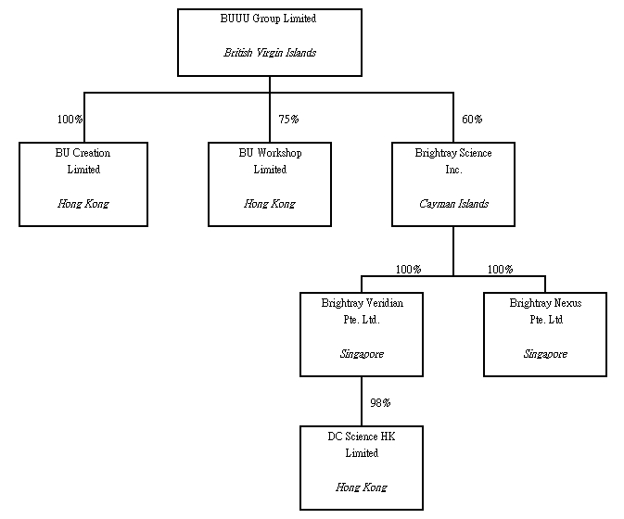
4.D. Property, Plant and Equipment
Facilities
We do not own any real property.
As of the date of this annual report, we have entered into the following lease agreements:
| Location | Tenant | Term of Lease | Usage | |||
| Flat B, 16/F Ford Glory Plaza, No. 37 Wing Hong Street, Kowloon | BU Creation | January 1, 2026 – January 15, 2028 | Office | |||
| The remaining portion of sub-section 3 of section B of Lot No.3723 in D.D. 104 | BU Workshop | April 1, 2026 – March 31, 2029 | Warehouse |
Item 4A. Unresolved Staff Comments
None.
58
Item 5. Operating and Financial Review and Prospects
The following discussion and analysis of our financial condition and results of operations should be read in conjunction with our financial statements and the related notes included elsewhere in this annual report. This discussion contains forward-looking statements reflecting our current expectations that involve risks and uncertainties. See “Forward-Looking Statements” for a discussion of the uncertainties, risks and assumptions associated with these statements. Actual results and the timing of events could differ materially from those discussed in our forward-looking statements as a result of many factors, including those set forth under “Risk Factors” and elsewhere in this annual report.
Overview
Established in 2017, our operating business provides meetings, incentives, conferences and exhibitions, or MICE, solutions in Hong Kong. During the fiscal years presented, our service portfolio comprised two core areas: (i) event management and (ii) stage production.
BUUU Group Limited was incorporated in the British Virgin Islands on April 16, 2024 and is a holding company. Following the reorganization completed on November 18, 2024, we conduct our event management and stage production business principally through BU Creation Limited, our wholly owned subsidiary, and BU Workshop Limited, our 75%-owned subsidiary.
Our Class A ordinary shares commenced trading on the Nasdaq Capital Market under the ticker symbol “BUUU” on August 13, 2025. We closed our initial public offering of 1,500,000 Class A ordinary shares at $4.00 per share on August 15, 2025. Following the underwriter’s partial exercise of its over-allotment option, we issued an additional 175,000 Class A ordinary shares at $4.00 per share, with the closing occurring on September 3, 2025.
In September 2026, after the end of the fiscal year, we acquired a 60% equity interest in Brightray, a provider of fully integrated, prefabricated modular data center solutions. We also entered into private placement subscription agreements in September 2026. These transactions are described under “Item 4. Information on the Company—4.A. History and Development of the Company—Recent Developments” and “—Trend Information” below. Brightray’s operating results are not included in our consolidated results for the years ended June 30, 2026, 2025 and 2024. Accordingly, our historical results may not be indicative of our future financial condition or operating performance following the acquisition.
Key Factors that Affect Operating Results
Market demand and competition
The event management and stage production sector in Hong Kong is highly competitive. Relatively low barriers to entry have resulted in numerous market participants competing for similar customers and projects. This competitive environment may cause service providers to adopt aggressive pricing strategies to secure contracts, which could adversely affect our gross profit margin and results of operations.
In addition, competition may increase the risk of market saturation. As more service providers enter the market, demand for event management and stage production services may become more diluted, making it more difficult for us to differentiate our services, attract new customers and maintain or improve profitability.
59
Geographical Limitations and Customer Concentration
Our event management and stage production operations and customer base during the fiscal years presented were concentrated in Hong Kong. As a result, the performance of these businesses depends significantly on local market conditions and client demand in Hong Kong. A downturn in local economic conditions, reductions in corporate marketing budgets or changes in customer spending priorities could materially affect our revenue and results of operations.
Because our historical client base has been concentrated in Hong Kong, growth in our event management and stage production businesses depends in part on our ability to diversify our client portfolio, expand our service offerings or develop new markets.
We also depend on a limited number of significant customers. Our largest customer accounted for approximately 50.7%, 27.9% and 29.1% of our revenue for the years ended June 30, 2026, 2025 and 2024, respectively. The loss of a significant customer, a reduction in its spending or changes in the timing of its projects could materially affect our revenue, profitability and cash flows.
Our September 2026 acquisition of Brightray expands our business beyond our historical event management and stage production activities. Our ability to realize the benefits of this expansion will depend on the acquired business’s operating performance and our ability to manage and integrate it.
Economic Sensitivity
Our performance is sensitive to economic conditions because demand for event management and stage production services is closely tied to our customers’ marketing and promotional budgets. During periods of economic uncertainty or downturn, customers may reduce spending on exhibitions, promotional events and marketing activities, which may adversely affect our revenue and profitability.
We seek to mitigate this risk by maintaining customer relationships, diversifying our service offerings and improving our operational efficiency. However, there can be no assurance that these measures will be sufficient to offset adverse economic conditions.
Project Mix and Rising Costs
Our results of operations are affected by changes in labor costs, subcontracting costs, purchase costs and other direct project costs. They are also affected by the nature and scale of the projects we undertake. Projects requiring greater purchases of furniture, equipment and supplies, more direct labor or additional outsourced services may generate lower gross margins than consultancy projects performed primarily by our internal staff.
Inflationary pressures and increases in material, equipment, transportation and personnel costs may reduce our gross profit margin if we are unable to pass these increased costs to customers through higher pricing.
During the year ended June 30, 2026, purchase costs increased by approximately 62.3%, while revenue increased by approximately 5.1%. Higher purchase costs, together with increased direct labor costs, contributed to the decline in our gross profit margin from approximately 31.0% to approximately 17.0%.
To manage rising costs, we may seek to improve project planning, negotiate more favorable supplier terms, use cost-effective materials and enhance internal execution capabilities. However, failure to manage rising costs effectively could adversely affect our profitability and competitiveness.
Summary of Results of Operations
The following discussion is based on our Group’s historical results of operations and may not be indicative of our Group’s future operating performance.
60
Comparison of the year ended June 30, 2026 and 2025
The following table sets forth certain income statement data for the fiscal years ended June 30, 2026 and 2025:
| For the year ended June 30, | ||||||||||||||||||||
| 2026 | 2025 | |||||||||||||||||||
| US$ | Percentage of total revenue (in %) | US$ | Percentage of total revenue (in %) | Percentage Change (in %) | ||||||||||||||||
| Revenue | 6,651,132 | 100.0 | 6,328,425 | 100.0 | 5.1 | |||||||||||||||
| Cost of revenue | (5,520,511 | ) | 83.0 | (4,364,911 | ) | 69.0 | 26.5 | |||||||||||||
| Gross profit | 1,130,621 | 17.0 | 1,963,514 | 31.0 | (42.4 | ) | ||||||||||||||
| Operating expenses | ||||||||||||||||||||
| General administrative expenses | (5,981,844 | ) | 89.9 | (935,014 | ) | 14.8 | 539.8 | |||||||||||||
| (Loss) profit from operations | (4,851,223 | ) | (72.9 | ) | 1,028,500 | 16.3 | (571.7 | ) | ||||||||||||
| Other income, net | 79,201 | 1.2 | 2,013 | 0.0 | 3,834.5 | |||||||||||||||
| Finance costs | (26,681 | ) | 0.4 | (18,366 | ) | 0.3 | 45.3 | |||||||||||||
| (Loss) income before income tax | (4,798,703 | ) | (72.1 | ) | 1,012,147 | 16.0 | (574.1 | ) | ||||||||||||
| Provision for income tax expenses | (14,494 | ) | 0.2 | (212,810 | ) | 3.4 | (93.2 | ) | ||||||||||||
| Net (loss) income | (4,813,197 | ) | (72.4 | ) | 799,337 | 12.6 | (702.2 | ) | ||||||||||||
Revenues
We generated all of our revenue during the fiscal years presented in Hong Kong, from third parties, through the provision of event management and stage production services.
The table below sets forth a breakdown of our revenue for the fiscal years ended June 30, 2026 and 2025:
| For the year ended June 30, | ||||||||||||||||
| 2026 | 2025 | |||||||||||||||
| Service Type | US$ | Percentage of total revenue (in %) | US$ | Percentage of total revenue (in %) | ||||||||||||
| Event management services | 5,567,719 | 83.7 | 5,276,924 | 83.4 | ||||||||||||
| Stage production services | 1,083,413 | 16.3 | 1,051,501 | 16.6 | ||||||||||||
| Total | 6,651,132 | 100.0 | 6,328,425 | 100.0 | ||||||||||||
For the year ended June 30, 2026, our revenue was $ 6,651,132, an increase of $ 322,707, or approximately 5.1%, compared to $6,328,425 for the year ended June 30, 2025. The increase was primarily attributable to an increase in revenue from event management services.
Revenue from event management services increased by $290,795, or approximately 5.5%, rising from $5,276,924 for the year ended June 30, 2025 to $5,567,719 for the year ended June 30, 2026. The growth was mainly attributable to an increase in the number of event management projects and the larger scale of those projects.
Revenue from stage production services increased by $31,912, or approximately 3.0%, from $1,051,501 for the year ended June 30, 2025 to $1,083,413 for the year ended June 30, 2026. Stage production services revenue remained relatively stable year over year.
61
Cost of Revenue
For the years ended June 30, 2026 and 2025, cost of revenue consists of the following:
| For the year ended June 30, | ||||||||||||||||
| 2026 | 2025 | |||||||||||||||
| US$ | Percentage of total cost of revenue (in %) | US$ | Percentage of total cost of revenue (in %) | |||||||||||||
| Purchase costs | 2,647,597 | 48.0 | 1,631,723 | 37.4 | ||||||||||||
| Labor costs | 911,134 | 16.5 | 812,366 | 18.6 | ||||||||||||
| Subcontracting costs | 1,961,780 | 35.5 | 1,920,822 | 44.0 | ||||||||||||
| Total | 5,520,511 | 100.0 | 4,364,911 | 100.0 | ||||||||||||
For the year ended June 30, 2026, our cost of revenue was $5,520,511, an increase of $1,155,600, or approximately 26.5%, compared to $4,364,911 for the year ended June 30, 2025. The increase was mainly attributable to the following reasons:
Purchase costs represented 48.0% and 37.4% of total cost of revenue for the year ended June 30, 2026 and 2025, respectively. Purchase costs primarily consist of furniture, equipment and supplies used in the implementation of our event and exhibition projects, including costs charged by stage equipment providers and transportation costs. For the year ended June 30, 2026, our purchase costs were $2,647,597, an increase of $1,015,874, or approximately 62.3%, compared to $1,631,723 for the year ended June 30, 2025. The increase was primarily due to inflation in furniture, equipment, supplies and transportation costs, as well as the increase in stage equipment required for larger-scale projects undertaken during the year ended June 30, 2026.
Labor costs, including labor compensation and related benefits for our full-time and part-time staff, represented 16.5% and 18.6% of total cost of revenue for the year ended June 30, 2026 and 2025, respectively. For the year ended June 30, 2026, our labor costs were $911,134, an increase of $98,768, or approximately 12.2%, compared to $812,366 for the year ended June 30, 2025. The increase was primarily attributable to the greater deployment of direct labor for projects undertaken during the year ended June 30, 2026, as compared to the year ended June 30, 2025.
Subcontracting costs represented 35.5% and 44.0% of total cost of revenue for the year ended June 30, 2026 and 2025, respectively. Subcontracting costs cover services to implement portions of our event and exhibition projects that we outsourced to external providers due to the need for specialized expertise or lack of internal capacity, including entertainers and performers, service personnel, event technology, banners and decoration, rental and other project-related outsourced services. For the year ended June 30, 2026, our subcontracting costs were $1,961,780, an increase of $40,958, or approximately 2.1%, compared to $1,920,822 for the year ended June 30, 2025. The increase was primarily attributable to a slight increase in outsourced services required for event and exhibition projects undertaken during the year ended June 30, 2026.
Gross Profit
For the year ended June 30, 2026, our gross profit was $1,130,621, representing a decrease of $832,893, or approximately 42.4%, compared to $1,963,514 for the year ended June 30, 2025. Our gross profit margin decreased from approximately 31.0% for the year ended June 30, 2025 to approximately 17.0% for the year ended June 30, 2026. The decrease in our gross profit margin was mainly due to the increase in cost of revenue being proportionately larger than the increase in revenue, primarily because we incurred significantly higher purchase costs resulting from inflation in furniture, equipment, supplies and transportation costs, as well as the increased use of stage equipment for larger-scale projects completed during the period, which were not fully passed on to customers. The decrease was also affected, to a lesser extent, by higher labor costs resulting from the greater deployment of direct labor for projects undertaken during the year ended June 30, 2026.
62
Operating Expenses
Our operating expenses consist of general administrative expenses, which primarily include administrative staff costs, share-based compensation, entertainment and travel expenses, depreciation of property, plant and equipment, lease expense, office expenses and legal and professional fees and expected credit loss provisions.
For the year ended June 30, 2026, general administrative expenses were $5,981,844, representing an increase of $5,046,830, or approximately 539.8%, compared to $935,014 for the year ended June 30, 2025. This increase was mainly due to:
| ● | Share-based compensation. Share-based compensation was $3,979,714 for the year ended June 30, 2026, compared to nil for the year ended June 30, 2025. This comprised $1,270,710 relating to RSUs and $2,709,004 relating to share options granted to employees during the year. |
| ● | Administrative staff costs. Administrative staff costs were $823,043 for the year ended June 30, 2026, compared to $78,385 for the year ended June 30, 2025, representing an increase of $744,658, or approximately 950.0%. The increase was primarily attributed to the increase in the bonus paid to our staff and the increase in the number of our administrative staff during the year ended June 30, 2026, as compared to the year ended June 30, 2025. |
We also recognized an expected credit loss provision on trade receivables of $56,385, compared with nil in the prior year. Operating lease expense increased from $73,429 for the year ended June 30, 2025 to $116,754 for the year ended June 30, 2026.
As of June 30, 2026, unrecognized compensation costs relating to outstanding unvested RSUs and share options were $6,083,370 and $2,103,995, respectively. These costs are expected to be recognized over weighted-average periods of approximately 1.3 years and 0.3 years, respectively, subject to the applicable award terms and any forfeitures or modifications.
Other income
Other income is comprised mainly of miscellaneous income and interest income on bank deposits.
For the year ended June 30, 2026, our other income was $79,201, representing an increase of $77,188 or 3,834.5%, as compared to $2,013 for the year ended June 30, 2025. This increase was mainly due to the increase in interest income on bank deposits as we obtained additional funding from our IPO during the year ended June 30, 2026.
Finance Costs
Finance costs comprised finance charges for finance leases and interest expense on interest-bearing bank borrowings.
For the year ended June 30, 2026, finance costs were $26,681, an increase of $8,315 or 45.3%, as compared to $18,366 for the year ended June 30, 2025. Interest expense on finance leases increased from $2,537 to $8,236 following additional motor vehicle hire purchase arrangements, while interest expense on bank borrowings and loan payable increased from $15,829 to $18,445.
Provision for Income Tax Expense
We conduct our historical event management and stage production business through Hong Kong operating subsidiaries, which are subject to Hong Kong profits tax on income derived from Hong Kong, including applicable preferential rates and tax concessions.
For the years ended June 30, 2026 and 2025, provision for income tax expense was $14,494 and $212,810, respectively, which primarily reflected lower assessable profits of our operating subsidiaries. Fiscal 2026 income tax expense comprised current income tax expense of $14,370 and deferred income tax expense of $124.
Although we incurred a consolidated loss before income tax, we recorded income tax expense because the tax treatment of certain expenses differed from their treatment for financial reporting purposes.
63
Net loss
As a result of the foregoing, we recorded net loss of $4,813,197 for the year ended June 30, 2026, compared with net income of $799,337 for the year ended June 30, 2025.
Net loss attributable to equity holders of the Company was $4,831,322, compared with net income attributable to equity holders of $793,420 in the prior year. Net income attributable to non-controlling interests was $18,125 and $5,917, respectively.
Basic and diluted loss per ordinary share was $0.29 for fiscal 2026, compared with basic and diluted earnings per ordinary share of $0.05 for fiscal 2025. Outstanding share options and RSUs were excluded from diluted loss per share for fiscal 2026 because their inclusion would have been anti-dilutive.
Comparison of the years ended June 30, 2025 and 2024
The following table sets forth certain income statement data for the fiscal years ended June 30, 2025 and 2024:
| For the year ended June 30, | ||||||||||||||||||||
| 2025 | 2024 | |||||||||||||||||||
| US$ | Percentage of total revenue (in %) | US$ | Percentage of total revenue (in %) | Percentage Change (in %) | ||||||||||||||||
| Revenue | 6,328,425 | 100.0 | 5,812,204 | 100.0 | 8.9 | |||||||||||||||
| Cost of revenue | (4,364,911 | ) | 69.0 | (4,311,964 | ) | 74.2 | 1.2 | |||||||||||||
| Gross profit | 1,963,514 | 31.0 | 1,500,240 | 25.8 | 30.9 | |||||||||||||||
| Operating expenses | ||||||||||||||||||||
| General administrative expenses | (935,014 | ) | 14.8 | (471,550 | ) | 8.1 | 98.3 | |||||||||||||
| Profit from operations | 1,028,500 | 16.3 | 1,028,690 | 17.7 | 0.0 | |||||||||||||||
| Other income, net | 2,013 | 0.0 | 4,938 | 0.1 | (59.2 | ) | ||||||||||||||
| Finance costs | (18,366 | ) | 0.3 | (24,624 | ) | 0.4 | (25.4 | ) | ||||||||||||
| Income before income tax | 1,012,147 | 16.0 | 1,009,004 | 17.4 | 0.3 | |||||||||||||||
| Provision for income tax expenses | (212,810 | ) | 3.4 | (128,787 | ) | 2.2 | 65.2 | |||||||||||||
| Net Income | 799,337 | 12.6 | 880,217 | 15.2 | (9.2 | ) | ||||||||||||||
Revenues
We generated all of our revenue during the fiscal years presented in Hong Kong, from third parties, through the provision of event management and stage production services.
The table below sets forth a breakdown of our revenue for the fiscal years ended June 30, 2025 and 2024:
| For the year ended June 30, | ||||||||||||||||
| 2025 | 2024 | |||||||||||||||
| Service Type | US$ | Percentage of total revenue (in %) | US$ | Percentage of total revenue (in %) | ||||||||||||
| Event management services | 5,276,924 | 83.4 | 4,681,586 | 80.5 | ||||||||||||
| Stage production services | 1,051,501 | 16.6 | 1,130,618 | 19.5 | ||||||||||||
| Total | 6,328,425 | 100.0 | 5,812,204 | 100.0 | ||||||||||||
64
For the year ended June 30, 2025, our revenue was $6,328,425, an increase of $516,221, or approximately 8.9%, compared to $5,812,204 for the year ended June 30, 2024. We derive a significant portion of our total revenue from the provision of event management services, which comprise $5,276,924 or 83.4% and $4,681,586 or 80.5% of our total revenue for the year ended June 30, 2025 and 2024, respectively. The increase of $595,338 or approximately 12.7% for the year ended June 30, 2025 was primarily due to our successful onboarding of several substantial new clients for the year ended June 30, 2025. The event management consultancy services we provided to these clients, along with the festival events we organized for them, played a significant role in driving our growth, effectively offsetting the negative impacts of the local economic downturn. During the year ended June 30, 2025 and 2024, we recognized the stage production services revenue of $1,051,501 or 16.6% and $1,130,618 or 19.5% of our total revenue, respectively. The decrease of $79,117 or approximately 7.0% for the year ended June 30, 2025 was mainly a result of the local economic downturn, which had a significant effect on our clients’ budgeting choices and resulted in a reduction of stage production services.
Cost of Revenue
For the year ended June 30, 2025 and 2024, cost of revenue consists of the following:
| For the year ended June 30, | ||||||||||||||||
| 2025 | 2024 | |||||||||||||||
| US$ | Percentage of total cost of revenue (in %) | US$ | Percentage of total cost of revenue (in %) | |||||||||||||
| Purchase costs | 1,631,723 | 37.4 | 1,638,294 | 38.0 | ||||||||||||
| Labor costs | 812,366 | 18.6 | 829,051 | 19.2 | ||||||||||||
| Subcontracting costs | 1,920,822 | 44.0 | 1,844,619 | 42.8 | ||||||||||||
| Total | 4,364,911 | 100.0 | 4,311,964 | 100.0 | ||||||||||||
For the year ended June 30, 2025, our cost of revenues was $4,364,911, which remains stable compared to the year ended June 30, 2024.
Purchase costs represent 37.4% and 38.0% of total cost of revenue for the year ended June 30, 2025 and 2024, respectively. Purchase costs cover transportation, equipment and supplies, furniture, materials, and consumables in the implementation of our event and exhibition projects. For the year ended June 30, 2025, our purchase cost was $1,631,723, which remains stable compared to the year ended June 30, 2024.
Labor costs including labor compensation and related benefits for our full-time and part-time staff represent 18.6% and 19.2% of total cost of revenue for the year ended June 30, 2025 and 2024, respectively. For the year ended June 30, 2025, our labor cost was $812,366, which remains stable compared to the year ended June 30, 2024.
Subcontracting costs represent 44.0% and 42.8% of total cost of revenue for the year ended June 30, 2025 and 2024, respectively. Subcontracting costs cover services to implement a part of our event and exhibition projects that we outsourced to external providers due to the need for specialized expertise or lack of internal capacities including (i) event decoration cost such as the backdrop printing, banner and other accessories; (ii) cost of hiring event MC, entertainers and performers such as dance group, DJs, singer, etc to make the event program more unique and attractive; (iii) cost of hiring service personnel such as PRs and event advisers to ensure professionalism for the event; and (iv) event technology set up and media rental cost such as linking and supporting sound and light equipment, projection equipment, LED screens, computers and other IT tools for the best effect. For the year ended June 30, 2025, our subcontracting cost was $1,920,822, which remains stable compared to the year ended June 30, 2024.
Overall, our cost of revenue has remained stable, while our revenue saw an increase of $516,221, or approximately 8.9%. This growth was largely attributed to our successful management of several relatively large-scale event management consultancy projects during the year ended June 30, 2025. By relying exclusively on our internal staff for these projects, we were able to eliminate the costs associated with subcontractors, as well as avoid additional purchase and external labor expenses.
65
Gross Profit
For the year ended June 30, 2025, our gross profit was $1,963,514, representing an increase of $463,274, or 30.9%, compared to $1,500,240 for the year ended June 30, 2024. As a percentage of revenue, our gross profit margin increased to approximately 31.0% for the year ended June 30, 2025 from approximately 25.8% for the year ended June 30, 2024. The increase in our gross margin can be primarily attributed to our successful management of several sizable event management consultancy projects during the year ended June 30, 2025. By utilizing only our internal staff for these initiatives, we were able to eliminate costs associated with subcontractors, as well as avoid additional purchase and external labor expenses. These projects were not undertaken in the year ended June 30, 2024.
Operating Expenses
Our operating expenses include general administrative expenses which comprise of administrative staff costs, entertainment and traveling expense, depreciation of property, plant and equipment, lease expense, office expenses and legal and professional fees.
For the year ended June 30, 2025, our general administrative expenses were $935,014, representing an increase of $463,464, or 98.3%, compared to $471,550 for the year ended June 30, 2024. This increase was mainly due to:
| ● | Administrative staff costs comprised of compensation, related benefits and recruitment expenses for our management and operating personnel constitute $78,385 or 8.4% and $50,193 or 10.6% of our general administrative expenses for the year ended June 30, 2025 and 2024, respectively, representing an increase of $28,192, or 56.2%. The increase was primarily attributed to the salary adjustments made during the fiscal year ending June 30, 2025, as well as the rise in our operational staff count. Our average headcount, including financial consultancy, grew from about 3 staff members in the fiscal year 2024 to approximately 4 staff members in the fiscal year 2025. To support our business growth, we also hired a senior-level accounting staff member in April 2025. |
| ● | Lease expense fees constitute $73,429 or 7.9% and $46,458 or 9.9% of our general administrative expenses for the year ended June 30, 2025 and 2024, respectively, representing an increase of $26,971 or 58.1%. The increase was primarily due to BU Creation entering into a new lease in January 2024, which includes a two-month rent-free period. The expenses associated with this new lease are approximately 73.3% higher than those of the previous lease, and the lease expenses will have a full-year impact in fiscal year 2025. |
| ● | Legal and professional fees constitute $423,447 or 45.3% and $17,463 or 3.7% of our general administrative expenses for the year ended June 30, 2025 and 2024, respectively, representing an increase of $405,984 or 2324.8%, the increase was primarily attributed to the audit fees incurred during the IPO application process, as well as the annual audit fee for fiscal year 2025. The legal and professional fees mainly encompass secretarial fees, statutory audit fees, and tax consultancy fees for filing annual returns, providing audit reports, and submitting tax returns as mandated by relevant Hong Kong laws and regulations for all companies operating in the region. We anticipate that our legal and professional fees will rise over time, reflecting the increased costs associated with operating as a public company following the completion of the IPO. |
Other income
Other income is comprised mainly of miscellaneous income and interest income on bank deposits.
For the year ended June 30, 2025 and 2024, other income was $2,013 and $4,938 respectively. The amount is insignificant for the year ended June 30, 2025 and 2024.
66
Finance Costs
Finance costs comprised finance charges for finance leases and interest expense on interest-bearing bank borrowings.
For the year ended June 30, 2025, finance costs were $18,366, a decrease of $6,258 or 25.4%, as compared to $24,624 for the year ended June 30, 2024. The decrease was mainly due to the change in the effective interest rates on bank borrowings.
Provision for Income Tax Expense
We operate our business in Hong Kong and are subject to the Hong Kong corporate income tax rate of 16.5% on income derived from Hong Kong.
For the year ended June 30, 2025 and 2024, provision for income tax expense was $212,810 and $128,787, respectively.
Net Income
For the year ended June 30, 2025, our net income was $799,337, representing a decrease of $80,880 or 9.2%, compared to a net income of $880,217 for the year ended 30 June, 2024, primarily due to the reasons discussed above.
Liquidity and Capital Resources
Our principal sources of liquidity and capital resources during the periods presented included cash generated from operations, proceeds from our initial public offering and borrowings, including a loan from a shareholder. Our principal uses of cash included operating expenditures, working capital requirements, investment deposits, debt and finance lease repayments, offering costs and, during fiscal 2025, dividends.
Management believes that our existing cash resources, together with expected cash flows from operations and available financing sources, provide adequate financial resources to continue operations for at least twelve months from the date the consolidated financial statements are issued. This assessment is subject to uncertainties, including our operating performance, customer collections, investment and acquisition requirements and access to financing.
As of June 30, 2026 and 2025, we had cash and cash equivalents of $3,755,687 and $101,535, respectively.
As of June 30, 2026, total current assets were $5,406,820 and total current liabilities were $1,798,376, resulting in working capital of $3,608,444. As of June 30, 2025, total current assets were $2,371,763 and total current liabilities were $1,477,330, resulting in working capital of $894,433.
As of June 30, 2026, we also held $1,600,000 of refundable deposits for pending equity investments in a private company incorporated in Delaware. These deposits were classified as non-current assets and were not included in cash and cash equivalents or working capital. The transaction was initially expected to close in July 2026, and the closing date was subsequently extended to December 2026.
Outstanding bank borrowings were $358,021 and $432,101 as of June 30, 2026 and 2025, respectively. The loan agreements contain repayment-on-demand clauses, and the entire outstanding balances were classified as current liabilities. The borrowings are supported by personal guarantees from certain shareholders and other individuals identified.
Our $180,000 shareholder loan was fully repaid on August 20, 2025.
Although we generated positive operating cash flow during fiscal 2026, operating cash inflows were only $15,939. The increase in our year-end cash balance therefore principally reflected financing activities rather than cash generated from operations. Our future liquidity requirements will also be affected by the Acquisition and private placementthe Private Placement described under “Item 4. Information on the Company—4.A. History and Development of the Company—Recent Developments.”” and “—Trend Information” below.
67
Subsequent to June 30, 2026, our liquidity and capital resources have been, and will be, affected by the Acquisition and the Private Placement. The Acquisition did not require any cash consideration, as the consideration consists of the Consideration Shares and the P-Note, which is settled solely in Class A Ordinary Shares. We intend to use the proceeds of the Private Placement, for capacity expansion and working capital requirements of Brightray’s business, and the Purchaser Warrants, if exercised in full for cash, would provide additional gross proceeds of US$5.0 million. In addition, we may be required to refund the subscription proceeds of the Private Placement in the circumstances described in “Item 3. Key Information—3.D. Risk Factors—Risks Relating to the Acquisition and Our Data Center Business.”
The following table summarizes the key cash flow components from our consolidated statements of cash flows for the periods indicated:
| For the year ended June 30, | ||||||||||||
| 2026 | 2025 | 2024 | ||||||||||
| USD | USD | USD | ||||||||||
| Net cash provided by operating activities | $ | 15,939 | 336,061 | 87,272 | ||||||||
| Net cash used in investing activities | (1,612,879 | ) | (5,699 | ) | (27,001 | ) | ||||||
| Net cash provided by (used in) financing activities | 5,240,035 | (677,104 | ) | (129,096 | ) | |||||||
| Net increase (decrease) in cash and cash equivalents before effect of exchange rate changes | 3,643,095 | (346,742 | ) | (68,825 | ) | |||||||
| Effect of exchange rate changes on balance of cash held in foreign currencies | 11,057 | (611 | ) | 1,782 | ||||||||
| Cash and cash equivalents at the beginning of the year | 101,535 | 448,888 | 515,931 | |||||||||
| Cash and cash equivalents at the end of the year | 3,755,687 | 101,535 | 448,888 | |||||||||
Operating Activities
For the year ended June 30, 2026
Net cash inflows from operating activities were $15,939 for the year ended June 30, 2026. The difference between our net loss of $ 4,813,197 and net cash inflows from operating activities was due to the adjustment of non-cash items in an aggregate amount of $4,232,118 and net cash inflows from changes in operating assets and liabilities totaling $597,018.
The adjustment of non-cash items is comprised of (i) depreciation of property, plant and equipment of $52,063; (ii) lease expenses of $116,754 for office premises and warehouse in Hong Kong; (iii) finance costs of $26,681 relating to the finance charges on finance leases and interest expense on bank borrowings; (iv) movement on deferred income tax of $124; (v) gain on disposal of property, plant and equipment of $(896), (vi) share-based compensation of $3,979,714; (vii) provision for expected credit losses on trade receivables of $56,385 and (viii) loss on lease termination of $1,293.
The cash provided by operating assets and liabilities was mainly attributable to (i) decrease in trade receivables of $493,332, mainly due to more settlement from our customers near the year-end June 30, 2026, as compared to the year ended June 30, 2025; (ii) decrease in deposits, prepayments and other receivables of $115,067, mainly resulting from the receipt of the settlement of the other receivables from BU Production; (iii) increase in contract assets of $(245,932), mainly due to more services provided but not yet billed to customers closer to the end of the year ended June 30, 2026, as compared to that of the year ended June 30, 2025; (iv) increase in trade payables of $411,414, mainly due to the increase in the billings from our suppliers on the services they provided to us closer to the year ended June 30, 2026, as compared to the year ended June 30, 2025; and (v) the payment of lease liabilities of $118,797 during the year ended June 30, 2026.
For the year ended June 30, 2025
Net cash inflows from operating activities were $336,061 for the year ended June 30, 2025. The difference between our net income of $799,337 and net cash inflows from operating activities was due to the adjustment of non-cash items in an aggregate amount of $132,543 and the cash generated in operating assets and liabilities in an aggregate amount of $(595,819).
68
The adjustment of non-cash items is comprised of (i) depreciation of property, plant and equipment of $43,071; (ii) lease expenses of $73,429 for office premises and warehouse in Hong Kong; (iii) finance costs of $18,366 relating to the finance charges on finance leases and interest expense on bank borrowings; and (iv) movement on deferred income tax of $696.
The cash provided by operating assets and liabilities was mainly attributable to (i) increase in trade receivables of $(446,192), mainly due to more event projects were completed near the period-end for which the payment is due in the following period; (ii) increase in deposits and prepayments of $(15,909), mainly resulting from the payment of certain prepaid services during the period; (iii) increase in contract assets of $(539,330), mainly due to more services provided but not yet billed to customers closer to the end of the year ended June 30, 2025, as compared to that of the fiscal year ended June 30, 2024; (iv) increase in trade payables, other payables and accruals of $106,273, mainly due to the rise in accrued expenses resulting from the annual audit fee accrual for the fiscal year 2025; (v) increase in income tax payable of $170,650 which represented the provision amount for income tax on our taxable income for the period; and (vi) decrease in amounts due with related parties of $203,901 which represented repayments made by related parties during the period.
For the year ended June 30, 2024
Net cash inflows from operating activities were $87,272 for the year ended June 30, 2024. The difference between our net income of $880,217 and net cash inflows from operating activities was due to the adjustment of non-cash items in an aggregate amount of $111,646 and the cash used in operating assets and liabilities in an aggregate amount of $(904,591).
The adjustment of non-cash items is comprised of (i) depreciation of property, plant and equipment of $46,202; (ii) lease expenses of $46,458 for office premises and warehouse in Hong Kong; (iii) finance costs of $24,624 relating to the finance charges on finance leases and interest expense on bank borrowings; and (iv) movement on deferred income tax of $(667).
The cash used in operating assets and liabilities was mainly attributable to (i) increase in trade receivables of $(655,722), mainly due to more event projects were completed near the period-end for which the payment is due in the following period; (ii) increase in deposits and prepayments of $(130,429), mainly resulting from the payment of certain prepaid services during the period; (iii) increase in contract assets of $(36,959), mainly due to more services provided but not yet billed to customers closer to the end of the year ended June 30, 2024, as compared to that of the fiscal year ended June 30, 2023; (iv) increase in trade payables, other payables and accruals of $158,554, mainly due to the decrease in the amount due to our vendors as more projects were completed near the period-end; (v) decrease in income tax payable of $129,455 which represented the provision amount for income tax on our taxable income for the period and (vi) increase in amounts due with related parties of $(330,553) which represented expense paid on behalf of our related parties.
Investing Activities
Net cash outflows from investing activities were $1,612,879 for the year ended June 30, 2026, which was due to (i) payment of deposits for investments of $(1,600,000); (ii) payment of $(13,775) for the purchase of property, plant and equipment and (iii) the proceeds from disposal of property, plant and equipment of $896.
69
Net cash outflows from investing activities were $5,699 for the year ended June 30, 2025, which was due to payment of $5,699 for the purchase of property, plant and equipment.
Net cash outflows from investing activities were $27,001 for the year ended June 30, 2024, which was due to (i) payment of $25,402 for the purchase of property, plant and equipment; and (ii) cash outflow related to the disposal of BU Production on September 25, 2023 of $1,599.
Financing Activities
Net cash inflows from financing activities were $5,240,035 for the year ended June 30, 2026, which was attributable to the (i) repayment of loan payables of $(180,000); (ii) repayment of bank borrowings of $(86,144) in relation to the term loans with a bank in Hong Kong; (iii) payment of finance lease liabilities of $(68,904) related to the hire purchase financing for our motor vehicles; (iv) receipt of the subscription receivables from our shareholders of $19,801; (v) proceeds from issuance of ordinary shares pursuant to the IPO, net of offering costs of $5,804,648; and (vi) payments of offering costs related to the IPO of $(249,366) during the year ended June 30, 2026.
Net cash outflows from financing activities were $(677,104) for the year ended June 30, 2025, which was attributable to (i) payments of a dividend to shareholders of $(508,072); (ii) proceeds from loans payables of $180,000; (iii) repayment of bank loan payables of $(115,860) to the term loans with a bank in Hong Kong; (iv) payment of finance lease liabilities of $(28,208) related to the hire purchase financing for our motor vehicles; and (v) payments of offering costs related to the initial public offering of $(204,964) during the year ended June 30, 2025.
Net cash outflows from financing activities were $(129,096) for the year ended June 30, 2024, which was attributable to (i) repayment of bank loan payables of $(100,997) to the term loans with a bank in Hong Kong; and (ii) payment of finance lease liabilities of $(28,099) related to the hire purchase financing for our motor vehicles.
Research and Development, Patents and Licenses
We did not incur material research and development expenses during the years ended June 30, 2026, 2025 and 2024. Following the Acquisition, Brightray’s business relies on intellectual property relating to the design and construction of prefabricated modular data centers, including patents and software copyrights to be assigned or licensed to the Brightray group under the Share Purchase Agreement. See “Item 4. Information on the Company—4.B. Business Overview—Intellectual Properties.”
Trend Information
In September 2026, we acquired a 60% equity interest in Brightray, a provider of fully integrated, prefabricated modular data center solutions.
Pursuant to the Share Purchase Agreement, we issued to DeedTech (i) 2,000,000 Class A ordinary shares (20,000,000 after giving effect to the Share Subdivision) at a fixed issue price of $20.00 per share ($2.00 after giving effect to the Share Subdivision) and (ii) a non-negotiable, non-transferable promissory note with an initial face amount of $200,000,000.
The promissory note is settleable solely in our Class A ordinary shares at a fixed issue price of $20.00 per share. Annual installments are determined by reference to Brightray’s Net Profit for the fiscal years ending June 30, 2027, 2028 and 2029, and the shares for each fiscal year are issued in stages in proportion to the cash collected from customers in respect of Brightray’s revenue for that fiscal year. We also hold a call option, exercisable during the three years following completion, to acquire the remaining 40% equity interest in Brightray.
The acquisition occurred after June 30, 2026 and is not reflected in our consolidated balance sheet as of that date or our operating results for the fiscal years presented. It expands our business into a new area and may materially affect our future operating results, capital resources and financial condition. Settlement of the promissory note in shares would increase our outstanding Class A ordinary shares and dilute existing shareholders. Beginning with the fiscal year ending June 30, 2027, our consolidated financial statements will include Brightray’s results of operations, with a 40% non-controlling interest, and, subject to the completion of our accounting assessment, the P-Note may be accounted for as contingent consideration that is remeasured at fair value at each reporting date, with changes recognized in our results of operations. Brightray has not yet generated revenue, and its results for the fiscal year ending June 30, 2027 will depend significantly on securing new contracts, including any definitive agreements arising from the Macao framework agreement and the Indiana letter of intent.
The contractual issue prices and the promissory note’s initial face amount described above are transaction terms and do not constitute a determination of the accounting fair value of the acquisition consideration.
70
Private Placement
In September 2026, we entered into private placement subscription agreements with two non-U.S. investors to issue and sell units at $10.00 per unit ($1.00 after giving effect to the Share Subdivision). One agreement expired without any units being issued, and on September 16, 2026 we issued 1,000,000 units (10,000,000 after giving effect to the Share Subdivision) to the other investor for gross proceeds of $10,000,000. Each unit consists of one Class A ordinary share and one-half of a warrant to purchase one Class A ordinary share.
Each warrant is exercisable from its issuance date through September 2, 2027 at an exercise price of $10.00 per Class A ordinary share, subject to customary adjustments. The warrants may be exercised only for cash and do not provide for cashless exercise.
As of the date of this annual report, we had raised $10,000,000 from the private placement, upon the first closing on September 16, 2026.
Off-Balance Sheet Arrangements
As of June 30, 2026 and 2025, we had no significant off-balance sheet arrangements that have or are reasonably likely to have a current or future effect on our financial condition, changes in our financial condition, revenues or expenses, results of operations, liquidity, capital expenditures or capital resources that are material to our shareholders.
Internal Control over Financial Reporting
On August 13, 2025, our Class A ordinary shares commenced trading on the Nasdaq Capital Market following our initial public offering. In connection with the preparation and audit of our consolidated financial statements for the years ended June 30, 2026, 2025 and 2024, we identified a material weakness in our internal control over financial reporting. As defined by the PCAOB, a “material weakness” is a deficiency, or a combination of deficiencies, in internal control over financial reporting such that there is a reasonable possibility that a material misstatement of our annual or interim financial statements will not be prevented or detected on a timely basis.
The material weakness identified relates to our lack of sufficient personnel with appropriate knowledge of U.S. GAAP and SEC reporting requirements to properly address complex U.S. GAAP accounting issues and related disclosures.
We have begun implementing measures to improve our internal controls and remediate the material weakness. In particular, we have engaged a specialized U.S. GAAP accounting consultant to assist us in preparing our financial statements in accordance with U.S. GAAP. We have also commenced a search for full-time qualified accounting personnel with U.S. GAAP and SEC reporting experience to strengthen our finance and accounting functions. We expect that these measures will improve our internal control over financial reporting. However, the material weakness will not be considered remediated until the enhanced controls operate for a sufficient period of time and management has concluded, through testing, that these controls are operating effectively.
Critical Accounting Policies and Estimates
Our consolidated financial statements are prepared in accordance with U.S. GAAP. Their preparation requires management to make estimates and assumptions affecting reported assets, liabilities, revenue and expenses and related disclosures. Significant estimates include estimated project costs and measures of progress used in revenue recognition, expected credit losses and the valuation of share-based compensation. Actual results could differ from these estimates. We review estimates periodically and recognize adjustments in the periods in which they become known. This discussion should be read together with Note 2 to our consolidated financial statements.
71
Trade receivables
Trade receivables are recorded at the invoiced amount less expected credit losses as needed.
To estimate expected credit losses, we use historical loss experience and receivable aging, adjusted for current conditions and reasonable and supportable forecasts of future economic conditions. We also assess collectability on an individual basis where appropriate. Receivables are written off when collection efforts have been exhausted. The Company recorded provision for expected credit losses of $56,385, nil and nil for the years ended June 30, 2026, 2025, and 2024, respectively.
Related parties
The Company follows ASC 850, “Related Party Disclosures,” for the identification of related parties and disclosure of related party transactions and balances. Parties are considered to be related if one party has the ability, directly or indirectly, to control the other party or exercise significant influence over the other party in making financial and operating decisions. Parties are also considered to be related if they are subject to common control or significant influence, such as a family member or relative, shareholder, or a related corporation.
Revenue from contracts with customers
The Company adopts Accounting Standards Update (“ASU”) 2014-09, Revenue from Contracts with Customers (ASC Topic 606) for all periods presented and determines revenue recognition by applying the following five-step model:
| ● | Identification of the contract, or contracts, with a customer; |
| ● | Identification of the performance obligations in the contract; |
| ● | Determination of the transaction price; |
| ● | Allocation of the transaction price to the performance obligations in the contract; and |
| ● | Recognition of revenue when, or as, the Company satisfies a performance obligation. |
Segment reporting
The Company operated during the fiscal years presented as a single operating and reportable segment. The Company generates revenue primarily from the provision of event management services and stage production services. Due to the integrated structure of the Company’s business, the Company’s chief operating decision maker, its Chief Executive Officer, reviews financial information on an aggregate basis for the purposes of allocating resources and evaluating financial performance.
The Company generates revenue from the provision of event management services and the provision of stage production services. During the years ended June 30, 2026, 2025 and 2024, all revenue was generated from Hong Kong and from third parties.
The chief operating decision maker uses revenue to evaluate segment performance and allocate resources. The historical single-segment presentation relates to the periods before the September 2026 acquisition of Brightray. Future segment presentation will depend on the organization of the combined business and the financial information reviewed by the chief operating decision maker.
Event management services
The Company provides customized event management services upon requests from its customers in exchange for a fixed transaction price. The services generally entail design, logistics, layout of events and coordination and supervision of the actual event set-up and implementation. These services are not distinct within the context of the contracts and are considered as a single performance obligation.
72
The Company recognizes revenue for performance obligations satisfied over time by measuring the progress toward complete satisfaction of the performance obligation using a single method of measuring progress which depicts the performance in transferring control of the associated goods or services to the customers. The Company uses input methods to measure the progress toward the complete satisfaction of performance obligations satisfied over time. Significant management judgment is required in determining the level of effort required under an arrangement and the period over which the Company is expected to complete the performance obligations under an arrangement. At each reporting period, the Company measures the progress based on the budgeting and costing systems and estimates the proportion of service rendered based on the ratio of costs incurred to estimated total costs.
Changes in estimated total project costs or project requirements may affect the measure of progress, the timing of revenue recognition and project profitability.
Stage production services
Apart from the event management services, the Company also provides stage production services, including sales of furniture pieces, essential decor items, stage equipment and the corresponding installation service to its customers. The transaction price is fixed. The Company recognizes revenues from stage production services at a point in time when the goods are delivered to the customer.
Contract balances
Contract assets
The Company recognizes a contract asset when revenue is recognized in advance of invoicing on a customer contract, unless the right to payment for that revenue is unconditional (i.e. requiring no further performance and only the passage of time). If a right to payment is determined to meet the criteria to be considered ‘unconditional’, then the Company will recognize a trade receivable. As of June 30, 2026 and 2025, the balances of contract asset amounted to $818,043 and $571,982, respectively.
Contract liability
The Company presents the consideration that a customer pays before the Company transfers the service to the customer as a contract liability (advance from customers) when the payment is made. An advance from customers is the Company’s obligation to transfer services to a customer for which the Company has received consideration from the customer. As of June 30, 2026, and 2025, the balances of advance from customers amounted to $12,968 and $21,212, respectively.
Contract costs
The Company applies the practical expedient in ASC Topic 606 that permits the recognition of incremental costs of obtaining contracts as an expense when incurred if the amortization period of such costs is one year or less. These costs are included in cost of revenue.
Share-Based Compensation
Share-based awards are measured at grant-date fair value. Compensation expense is recognized immediately for awards requiring no additional service or over the requisite service period for awards subject to service conditions. We account for forfeitures of unvested awards as they occur.
The fair value of RSUs is determined by reference to the underlying share price at the grant date. Share options are valued using a binomial option pricing model. Significant assumptions include the underlying share price, expected volatility, expected life, risk-free interest rate and dividend yield. Changes in these assumptions could materially affect estimated award values and compensation expense.
73
For the option grants made on October 16, 2025 and February 1, 2026, the valuation assumptions included volatility of 48.38% and 48.20%, share prices of $8.40 and $11.49, a ten-year time to maturity, risk-free rates of 3.975% and 4.237%, and a zero dividend yield.
For fiscal 2026, total share-based compensation expense was $3,979,714, comprising $1,270,710 for RSUs and $2,709,004 for share options.
As of June 30, 2026, 600,500 RSUs (6,005,000 after giving effect to the Share Subdivision) were outstanding and unvested, and 720,000 share options (7,200,000 after giving effect to the Share Subdivision) were outstanding, of which 390,000 (3,900,000 after giving effect to the Share Subdivision) were vested and exercisable. Unrecognized compensation costs totaled $6,083,370 for RSUs and $2,103,995 for share options, expected to be recognized over weighted-average periods of approximately 1.3 years and 0.3 years, respectively.
Investment Deposits
Deposits that are capital in nature, including advances for strategic equity investments, business acquisitions or joint venture developments, are classified as non-current assets and carried at cost less recognized impairment charges.
Management evaluates these balances for impairment at each reporting date and when events or changes in arrangements indicate that the carrying amount may not be fully recoverable. As of June 30, 2026, we held $1,600,000 of refundable deposits for pending equity investments in a private Delaware company. Evaluation of recoverability requires consideration of the contractual refund terms, the counterparty’s ability to perform and changes in the proposed transaction.
Risks and uncertainties
Economic and political risk
The Company’s operating subsidiaries conduct business in Hong Kong, a Special Administrative Region of the PRC. Accordingly, the Company’s business, financial condition and results of operations may be influenced by the political, economic and legal environment in the PRC, and by the general state of the PRC economy.
The Company’s operations in Hong Kong are subject to special considerations and significant risks not typically associated with companies in North America and Western Europe. These include risks associated with, among others, the political, economic and legal environment and foreign currency exchange. The Company’s results may be adversely affected by changes in the political and social conditions in the PRC, and by changes in governmental policies with respect to laws and regulations, anti-inflationary measures, currency conversion, remittances abroad, and rates and methods of taxation.
Concentration of Credit Risk
Financial instruments that potentially expose the Company to significant concentration of credit risk consist primarily of trade receivables. The Company conducts credit evaluations of its customers, and generally does not require collateral or other security from them. The Company evaluates its collection experience and long outstanding balances to determine the need for a provision for expected credit losses. The Company conducts periodic reviews of the financial condition and payment practices of its customers to minimize collection risk on trade receivables.
Details of the customers which accounted for 10% or more of revenue in any of the periods presented are as follows:
| For the years ended June 30, | ||||||||||||||||||||||||
| 2026 | % revenue | 2025 | % revenue | 2024 | % revenue | |||||||||||||||||||
| Customer A | $ | 3,375,429 | 50.7 | % | $ | 1,765,297 | 27.9 | % | $ | 1,694,083 | 29.1 | % | ||||||||||||
| Customer B | — | — | % | — | — | % | 866,590 | 14.9 | % | |||||||||||||||
| Customer C | 598,208 | 9.0 | % | 846,411 | 13.4 | % | — | — | % | |||||||||||||||
| Customer D | 405,740 | 6.1 | % | 749,711 | 11.8 | % | — | — | % | |||||||||||||||
| $ | 4,379,377 | 65.8 | % | $ | 3,361,419 | 53.1 | % | $ | 2,560,673 | 44.0 | % | |||||||||||||
74
Details of the customers which accounted for 10% or more of the trade receivables are as follows:
| As of June 30, | ||||||||||||||||
| 2026 | % trade receivables | 2025 | % trade receivables | |||||||||||||
| Customer A | $ | — | — | % | $ | 382,170 | 28.9 | % | ||||||||
| Customer B | — | — | % | 199,748 | 15.1 | % | ||||||||||
| Customer C | — | — | % | 150,002 | 11.4 | % | ||||||||||
| Customer D | 381,127 | 49.2 | % | 3,822 | 0.3 | % | ||||||||||
| Customer E | 107,794 | 13.9 | % | — | — | % | ||||||||||
| Customer F | 96,947 | 12.5 | % | 57,364 | 4.3 | % | ||||||||||
| $ | 585,868 | 75.6 | % | $ | 793,106 | 60.0 | % | |||||||||
Quantitative And Qualitative Disclosures About Market Risk
Inflation Risk
Inflationary factors, such as increases in personnel and overhead costs, could impair our operating results.
During fiscal 2026, higher purchase costs, including inflation-related cost increases and additional equipment requirements for larger-scale projects, contributed to the decline in gross profit margin from approximately 31.0% to approximately 17.0%. Further increases in furniture, equipment, supplies, transportation, personnel and overhead costs may adversely affect our margins if we cannot recover them through customer pricing or operating efficiencies.
Interest Rate Risk
Our bank borrowings bear interest at the Hong Kong Prime Rate less 2.5%. Changes in the applicable rate may affect interest expense and cash flows. As of June 30, 2026, outstanding bank borrowings totaled $358,021. Although the loans have contractual installment schedules, they contain repayment-on-demand provisions and are classified as current liabilities.
Foreign Currency Risk
Our reporting currency is the U.S. dollar, while the functional currency of our Hong Kong operating subsidiaries is the Hong Kong dollar. Their assets and liabilities are translated at year-end exchange rates, and revenue and expenses are translated at average exchange rates.
Exchange rate movements affect the translation of financial results and net assets into U.S. dollars. Currency translation differences were income of $14,963 for fiscal 2026, a loss of $15,014 for fiscal 2025 and income of $3,000 for fiscal 2024.
Credit Risk
Credit risk is controlled by the application of credit approvals, limits and monitoring procedures. We manage credit risk through regularly evaluating the collectability of financial assets, based on a combination of factors such as credit worthiness, past transaction history, current economic industry trends and changes in payment patterns. We identify credit risk collectively based on industry and customer type. In measuring the credit risk of our sales to our customers, we mainly reflect the “probability of default” by the customer on its contractual obligations and consider the current financial position of the customer and the current and likely future exposures to the customer.
Liquidity Risk
We are also exposed to liquidity risk, which is risk that we will be unable to provide sufficient capital resources and liquidity to meet our commitments and business needs. Liquidity risk is controlled by the application of financial position analysis and monitoring procedures. To manage liquidity risk, the Company monitors and maintains a level of cash and cash equivalents deemed adequate by the management to finance the Company’s operations and mitigate the effects of fluctuations in cash flows.
As of June 30, 2026, we had cash and cash equivalents of $3,755,687 and working capital of $3,608,444. Our liquidity remains subject to operating performance, collection of receivables, recovery or use of investment deposits, repayment-on-demand bank borrowings and the requirements of our expanded business following the Acquisition. The private placement and any cash exercise of warrants may provide additional resources, but future warrant exercise proceeds are not assured.
75
Item 6. Directors, Senior Management and Employees
6.A. Directors and Senior Management
The following table provides information regarding our executive officers, directors and other key employee as of the date hereof:
| Directors and Executive officers | Age | Position | ||
| Nana, CHAN | 42 | Director and the Chairperson of the Board | ||
| Wai Kwong, POON | 52 | Director and Chief Executive Officer | ||
| Hoi Yiu TSANG | 27 | Chief Financial Officer | ||
| Chun Kit, TSUI | 49 | Independent Director | ||
| Ho Wa, CHA | 36 | Independent Director | ||
| Pak Lun Patrick, AU | 40 | Independent Director |
Nana, CHAN is a Director and Chairperson of the Board, overseeing the general corporate strategy and business development and risk management of the Company. Ms. Chan has over 9 years of experience in the event management industry in Hong Kong. Prior to joining the Company in 2017, Ms. Chan has been serving Irregular Consulting Limited, a financial public relation consultancy firm in Hong Kong, from December 2015 to August 2017 with her last position as account manager (investor relations). Ms. Chan has also worked as a senior visual merchandising officer of Ulferts of Sweden (Far East) Limited from April 2006 to January 2009 and a senior visual merchandising officer of Fantastic Natural Cosmetics Limited from January 2009 to December 2015. Ms. Chan received a higher diploma of 3D (Spatial) Design interior architecture from Caritas Bianchi College of Careers in 2005.
Wai Kwong, POON is a Director and the Chief Executive Officer of the Company, overseeing the general corporate strategy and business operation of the Company. Mr. Poon has more than 21 years of experience in the event management industry in Hong Kong. Prior to joining the Company in 2021, Mr. Poon has accumulated extensive experiences in different brands and event and exhibition production agencies in Hong Kong. From 2016 to 2021, he served as the art director of To Be Concepts Limited, an event agency in Hong Kong. Before that, he was the art director of To Be Communications Limited, another event agency in Hong Kong from 2013 to 2016. From 2011 to 2013, he held the role of art director of To Be Design Limited, a design firm in Hong Kong. Earlier in his career, Mr. Poon served as a senior graphic designer of Ulferts of Sweden (Far East) Limited from 2006 to 2010. From 1998 to 2005, Mr. Poon served as a graphic designer of Oriental Press Group, a press group in Hong Kong. From 1995 to 1998, Mr. Poon served as a graphic artist of Design X.O., a design firm in Hong Kong. Mr. Poon completed a Communication Design Diploma Course from Hong Kong Designfirst in 1995.
Hoi Yiu, TSANG is the Chief Financial Officer of the Company. Ms. Tsang has been serving as the Finance Manager of BU Creation Limited, the Company’s operating entity, since April, 2025. From October 2021 to November 2024, Ms. Tsang served as the Audit Senior Associate of Grant Thornton Hong Kong, responsible for the audit assurance and accounting consulting services. From November 2024 to April 2025, Ms. Tsang served as the Assistant Officer of the Internal Audit function of Hong Kong Examinations and Assessment Authority. Ms. Tsang graduated from the Hang Seng University of Hong Kong, with a bachelor’s degree in Business Administration in 2021. Ms. Tsang has also been a member of the Hong Kong Institute of Certified Public Accountants.
Chun Kit, TSUI is our independent director and chairman of the audit committee and the member of the nominating committee and the compensation committee. He has over 20 years of experience in audit, accounting and finance. From 2022 to 2025, he served as the Chief Financial Officer of PS International Group Limited (NASDAQ: PSIG). From 2020 to 2022. Mr. Tsui also served as the finance director of Aceso Life Science Group Limited (stock code: 00474.HK). From 2013 to 2020, he served as the general finance manager of Beijing Energy International Holding Co., Ltd. (formerly known as Panda Green Energy Group Limited) (stock code: 00686.HK). From 2006 to 2013, he joined PricewaterhouseCoopers Hong Kong, where he provided audit assurance and accounting consulting services to customers in various industries, and his last position was a manager. From 2005 to 2006, he was a lecturer at Hong Kong Institute of Vocational Education. From 2004 to 2005, he joined BDO McCabe Lo Limited as an audit senior associate. From 2000 to 2004, he commenced his career at Lawrence Cheung C.P.A. Company Limited as an audit senior. Mr. Tsui obtained a Bachelor degree in Accountancy from Hong Kong Polytechnic University in 2000 and a Master degree in Professional Accountancy from University of London in 2018. He has been a fellow member of the Association of Chartered Certified Accountants and the Hong Kong Institute of Certified Public Accountants since 2008 and 2010, respectively.
Ho Wa, CHA is our independent director, the chairman of the compensation committee, and a member of each of the audit committee and the nominating committee. Mr. Cha was admitted as a solicitor of the High Court of Hong Kong in October 2018 and has been a practising solicitor since then. Mr. Cha has over 10 years of experience in the legal field. Since April 2023, Mr. Cha has been a senior consultant of Messrs. Eddie Lee & Co., Solicitors. From June 2016 to March 2023, Mr. Cha worked at Messrs. Peter K.S. Chan & Co., with his last position as a partner. Since July 2025, Mr. Cha has been an independent director of Rich Sparkle Holdings Limited (NASDAQ: ANPA). Since February 2024, Mr. Cha has been an independent non-executive director of WK Group (Holdings) Limited (stock code: 2535.HK). From October 2024 to September 2025, Mr. Cha was an independent director of Skyline Builders Group Holding Limited (NASDAQ: SKBL). From September 2023 to July 2024, Mr. Cha was an independent non-executive director of Ficus Technology Holdings Limited (formerly known as Vision International Holdings Limited) (stock code: 8107.HK). From December 2020 to September 2021, Mr. Cha was an independent non-executive director of Century Energy International Holdings Limited (formerly known as China Oil Gangran Energy Group Holdings Limited) (stock code: 8132.HK). Mr. Cha obtained a Bachelor of Arts degree from The Chinese University of Hong Kong in 2013, and further obtained a Juris Doctor degree and a Postgraduate Certificate in Laws from The Chinese University of Hong Kong in 2015 and 2016, respectively.
76
Pak Lun Patrick, AU is our independent director and also the chairman of the nominating committee and the member of the audit committee and the compensation committee. Mr. Au has served as a director of MANC Family Office Ltd. since 2021 and a director of MMPC World LTD since 2021. Mr. Au was an executive director of QMMM Holdings Limited (NASDAQ: QMMM) from 2023 to 2025, the Chief Financial Officer of ManyMany Creations Limited, a subsidiary of QMMM Holdings Limited, from 2022 to 2025, an executive director of Lapco Holdings Limited (stock code: 8472.HK), a company listed on the Hong Kong Stock Exchange, from 2023 to 2024 and the joint company secretary of Crosstec Group Holdings Ltd. (stock code: 3893.HK), a company listed on the Hong Kong Stock Exchange, from 2022 to 2023. From 2021 to 2022, Mr. Au served as the president, CEO and director of MSB Global Capital Corp (OTC Pink: MSBM). From 2019 to 2021, Mr. Au served as vice president of Greenpro Capital Corp (NASDAQ: GRNQ). From 2017 to 2019, Mr. Au was the assistant accounting manager of Hui Kai Financial Group Limited. From 2016 to 2017, Mr. Au was an associate (financial accounting) of SBI Securities (Hong Kong) Limited. From 2013 to 2015, Mr. Au was an assistant general manager and senior accountant (corp. finance) of Oilco Asia Pacific Limited. From 2012 to 2013, Mr. Au was the audit semi-senior of Kaizen Certified Public Accountants Limited. From 2009 to 2011, Mr. Au was the audit semi-senior level II of Akin CPA Limited. Mr. Au received his master’s degree of Corporate Governance from The Hong Kong Polytechnic University. Mr. Au is a member of Hong Kong Institute of Certified Public Accountants, The Institute of Chartered Accountants in England and Wales, The Hong Kong Chartered Governance Institute and The Chartered Governance Institute of Chartered Governance Professional.
Family Relationships
None of the directors or executive officers have a family relationship as defined in Item 401 of Regulation S-K.
Involvement in Certain Legal Proceedings
To the best of our knowledge, none of our directors, director appointees or executive officers has, during the past ten years, been involved in any legal proceedings described in subparagraph (f) of Item 401 of Regulation S-K.
6.B. Compensation
For the year ended June 30, 2026, the aggregate cash compensation and benefits that we paid to the executive officers and directors were approximately HK$3,201,000 (approximately US$409,772), as compensation to our directors and executive officers, as well as an aggregate of HK$36,000 (approximately US$4,609) as contributions by our Operating Subsidiaries in Hong Kong to the Mandatory Provident Fund (“MPF”), a statutory retirement scheme introduced after the enactment of the Mandatory Provident Fund Schemes Ordinance in Hong Kong.
For the fiscal year ended June 30, 2026, we paid an aggregate of HK$367,500 (approximately US$47,199) in directors’ fees to our independent directors.
Except our contribution to the MPF, we have not set aside or accrued any amount to provide pension, retirement, or other similar benefits to our directors and executive officers. Other than the 2025 Equity Incentive Plan described below, we do not have any equity incentive plan in place as of the date of this annual report.
Compensation Recovery Policy
We have adopted an executive compensation recovery policy in accordance with Rule 10D-1 under the Exchange Act and Nasdaq Listing Rule 5608, a copy of which is incorporated by reference as Exhibit 97.1 to this annual report.
Employment Agreements and Indemnification Agreements
We have entered into employment agreements with our senior executives, officers and/or directors.
On December 12, 2024, BUUU entered into separate standard employment agreements with: (a) Mr. Wai Kwong POON, the Director and Chief Executive Officer; (b) Ms. Nana CHAN, the Director and the Chair of the Board; and (c) Ms. Hoi Yiu TSANG, the Chief Financial Officer, respectively (collectively, the Directors and Officers Employment Agreements) (Ms. Chan, Ms. Tsang and Mr. Poon are collectively referred as the Named Directors and Officers). The initial term of employment under the Directors and Officer Employment Agreements is for a term of one year unless terminated earlier. Upon expiration of the initial-year term, the Directors and Officer Employment Agreements shall be automatically extended for successive one-year terms unless a three-months prior written notice to terminate the Directors and Officer Employment Agreement or unless terminated earlier pursuant to the terms of the Directors and Officer Employment Agreements.
Pursuant to the Directors Employment Agreements, Mr. Poon will receive cash compensation of annual salary of HK$576,000 from BU Creation Limited, BUUU’s operating entity, and nil from BUUU; Ms. Chan will receive cash compensation of annual salary of HK$576,000 from BU Creation Limited, and nil from BUUU; and Ms. Tsang will receive cash compensation of annual salary of HK$420,000 from BU Creation Limited, and nil from BUUU.
77
BUUU is entitled to terminate their agreement for cause at any time without remuneration for certain acts of the Named Directors and Officers, as being convicted of any criminal conduct, any act of gross or willful misconduct, or any severe, willful, grossly negligent, or persistent breach of any employment agreement provision, or engaging in any conduct which may make the continued employment of such officer detrimental to our company. The Named Directors and Officers have agreed to hold, both during and after the terms of his or her agreement, in confidence and not to use for their benefit or the benefit of any third party, any trade secrets, other information of a confidential nature or non-public information of or relating to us in respect of which we owe a duty of confidentiality to a third party. In addition, each Named Directors and Officers has agreed not to, for a period of one year following the termination of his employment, carry on any business in direct competition with the business of the BUUU group of companies, solicit or seek or endeavor to entice away any customers, clients, representative, or agent of the BUUU group of companies or in the habit of dealing with the BUUU group of companies who is or shall at any time within two years prior to such cessation have been a customer, client, representative, or agent of the BUUU group of companies, and use a name including the words used by the BUUU group of companies in its name or in the name of any of its products, services or their derivative terms, or Chinese or English equivalent in such a way as to be capable of or likely to be confused with the name of the BUUU group of companies.
The Named Directors and Officers will continue to receive cash compensation, in the form of salary from BU Creation Limited, one of the Operating Subsidiaries, pursuant to their Letters of Appointment with BU Creation Limited.
Agreements with independent directors
We entered into director offer letters with each of our independent directors which agreements set forth the terms and provisions of their engagement.
Equity Compensation Plan Information
On September 23, 2025, the Company adopted the 2025 equity incentive plan (the “2025 Equity Incentive Plan”), for the purpose of granting share-based compensation awards to employees, directors and consultants to incentivize their performance and align their interests with ours. Under the 2025 Equity Incentive Plan, the Company is authorized to issue an aggregate of 2,000,000 Class A Ordinary Shares (20,000,000 Class A Ordinary Shares after giving effect to the Share Subdivision). On October 16, 2025, February 1, 2026 and April 1, 2026, we granted 360,000, 360,000 and 12,000 restricted share units (3,600,000, 3,600,000 and 120,000 after giving effect to the Share Subdivision), respectively, to three employees, with the awards vesting over three years, three years and two years, respectively. As of the date of this annual report, restricted share units in respect of 732,000 Class A Ordinary Shares (7,320,000 Class A Ordinary Shares after giving effect to the Share Subdivision) have been granted or are subject to outstanding awards under the 2025 Equity Incentive Plan.
The following summarize the terms of the 2025 Equity Incentive Plan.
Types of Awards. The 2025 Equity Incentive Plan permits the awards of options, stock appreciation rights, restricted stock, restricted stock units, stock bonus awards and/or performance compensation awards.
Plan Administration. The 2025 Equity Incentive Plan is administered by the Compensation Committee of the Board or any other committee appointed by the Board to administer this Plan (or if no Committee is appointed, the Board). The plan administrator is entitled to determine the participants who are to receive awards, the number of awards to be granted, and the terms and conditions of each award grant.
Eligibility. Employees, directors and officers and the consultants of our company are eligible to participate pursuant to the terms of the 2025 Equity Incentive Plan.
Conditions of Award. The plan administrator shall determine the participants, types of awards, numbers of shares to be covered by awards, terms and conditions of each award, and provisions with respect to the vesting schedule, settlement, exercise, repurchase, cancellation, forfeiture, restrictions, limitations or suspension of awards.
78
Term of Award. The term of each award shall be fixed by the administrator and is stated in the award agreement between recipient of an award and us. No award shall be granted under the 2025 Equity Incentive Plan after ten years from the date the 2025 Equity Incentive Plan was approved by the board.
Vesting Schedule. In general, the plan administrator determines the vesting schedule, which is set forth in the award agreement.
Transfer Restrictions. Unless otherwise determined by the administrator of the 2025 Equity Incentive Plan, no award and no right under any such award shall be sold, pledged, assigned, hypothecated, transferred, or disposed of in any manner other than by will or by the laws of descent and distribution or pursuant to a qualified domestic relations order, and shall not be subject to execution, attachment, or similar process.
Outstanding Equity Awards at Fiscal Year-End
During the year ended June 30, 2026, we granted 732,000 restricted share units (7,320,000 after giving effect to the Share Subdivision) under the 2025 Equity Incentive Plan. In addition, under employment agreements dated October 16, 2025 and February 1, 2026, we granted options to purchase an aggregate of 720,000 Class A Ordinary Shares (7,200,000 Class A Ordinary Shares after giving effect to the Share Subdivision) at an exercise price of US$4.00 per share (US$0.40 per share after giving effect to the Share Subdivision). These options were granted outside the 2025 Equity Incentive Plan, vest in twelve monthly installments and have a term of ten years; by agreement with the holders, their terms other than the number of options, the exercise price, the vesting schedule and the term are those applicable to options under the 2025 Equity Incentive Plan. We also issued 131,500 Class A Ordinary Shares (1,315,000 after giving effect to the Share Subdivision) upon the vesting of restricted share units. As of June 30, 2026, 600,500 restricted share units (6,005,000 after giving effect to the Share Subdivision) were outstanding, and 1,268,000 Class A Ordinary Shares (12,680,000 after giving effect to the Share Subdivision) remained available for future awards under the 2025 Equity Incentive Plan. As of June 30, 2025 and 2024, we had no outstanding equity awards.
6.C. Board Practices
Board of Directors
Our board of directors consists of five directors, three of whom are independent as such term is defined by the Nasdaq Capital Market.
Our directors are elected by resolution of members or by resolution of directors for such term as the members or directors determine. If no term is fixed, a director serves until his or her death, resignation or removal. Our directors are not subject to retirement by rotation, and our Memorandum and Articles of Association do not require us to hold an annual general meeting unless required by the rules of the Nasdaq Capital Market. A director may be removed from office, with or without cause, by a resolution of members passed at a meeting of members or by a written resolution passed by at least 75% of the members entitled to vote, or by a resolution of directors passed at a meeting of directors.
A director may vote in respect of any contract or transaction in which he is interested, provided, however that the nature of the interest of any director in any such contract or transaction shall be disclosed by him forthwith after becoming aware of the fact that he is interested in such contract or transaction. A general notice or disclosure to the directors or otherwise contained in the minutes of a meeting or a written resolution of the directors or any committee thereof to the effect that a director is a member, director or officer of another named entity or has a fiduciary relationship with respect to the entity or a named individual and is to be regarded as interested in any transaction which may, after the date of the entry or disclosure, be entered into with that entity or individual, shall be sufficient disclosure and after such general notice it shall not be necessary to give special notice relating to any particular transaction. A director may be counted for a quorum upon a motion in respect of any contract or arrangement which he shall make with our company, or in which he is so interested and may vote on such motion.
Committees of the Board of Directors
We have established three committees under the board of directors: an audit committee, a compensation committee and a nominating committee. We have also adopted a charter for each of the three committees. Copies of our committee charters are available on our corporate investor relations website.
Each committee’s members and functions are described below.
Audit Committee. Our audit committee consists of Ho Wa, CHA, Chun Kit, TSUI, Pak Lun Patrick, AU. Chun Kit, TSUI, is the chair of our audit committee. The audit committee oversees our accounting and financial reporting processes and the audits of the financial statements of our company. The audit committee is responsible for, among other things:
| ● | appointing the independent auditors and pre-approving all auditing and non-auditing services permitted to be performed by the independent auditors; |
| ● | reviewing with the independent auditors any audit problems or difficulties and management’s response; |
| ● | discussing the annual audited financial statements with management and the independent auditors; |
| ● | reviewing the adequacy and effectiveness of our accounting and internal control policies and procedures and any steps taken to monitor and control major financial risk exposures; |
| ● | reviewing and approving all proposed related party transactions; |
79
| ● | meeting separately and periodically with management and the independent auditors; and |
| ● | monitoring compliance with our code of business conduct and ethics, including reviewing the adequacy and effectiveness of our procedures to ensure proper compliance. |
Compensation Committee. Our compensation committee consists of Ho Wa, CHA, Chun Kit, TSUI, Pak Lun Patrick, AU. Ho Wa, CHA is the chair of our compensation committee. The compensation committee is responsible for, among other things:
| ● | reviewing and approving, or recommending to the board for its approval, the compensation for our chief executive officer and other executive officers; |
| ● | reviewing and recommending to the board for determination with respect to the compensation of our directors; |
| ● | reviewing periodically and approving any incentive compensation or equity plans, programs or similar arrangements; and |
| ● | selecting compensation consultant, legal counsel or other adviser only after taking into consideration all factors relevant to that person’s independence from management. |
Nominating Committee. Our nominating committee consists of Ho Wa, CHA, Chun Kit, TSUI, Pak Lun Patrick, AU. Pak Lun Patrick, AU is the chair of our nominating committee. We have determined that Ho Wa, CHA, Chun Kit, TSUI, Pak Lun Patrick, AU satisfy the “independence” requirements under Nasdaq Rule 5605. The nominating committee assists the board of directors in selecting individuals qualified to become our directors and in determining the composition of the board and its committees. The nominating committee is responsible for, among other things:
| ● | selecting and recommending to the board nominees for election by the shareholders or appointment by the board; |
| ● | reviewing annually with the board the current composition of the board with regards to characteristics such as independence, knowledge, skills, experience and diversity; |
| ● | making recommendations on the frequency and structure of board meetings and monitoring the functioning of the committees of the board; and |
| ● | advising the board periodically with regards to significant developments in the law and practice of corporate governance as well as our compliance with applicable laws and regulations, and making recommendations to the board on all matters of corporate governance and on any remedial action to be taken. |
Duties of Directors
Under BVI law, our Directors owe fiduciary duties at both common law and under statute, including a statutory duty to act honestly, in good faith and with a view to our best interests. When exercising powers or performing duties as a director, the director is required to exercise the care, diligence and skill that a reasonable director would exercise in the circumstances taking into account, without limitation, the nature of the company, the nature of the decision and the position of the director and the nature of the responsibilities undertaken by him. In exercising the powers of a director, the directors must exercise their powers for a proper purpose and shall not act or agree to the company acting in a manner that contravenes our memorandum and articles of association or the BVI Act.
Remuneration
The directors may receive such remuneration as our board of directors may determine from time to time. The compensation committee will assist the directors in reviewing and approving the compensation structure for the directors.
80
Qualification
There are no membership qualifications for directors. Further, there are no share ownership qualifications for directors. Other than the Share Purchase Agreement, which provides for the appointment of Mr. Wang Bin as an executive director and entitles DeedTech Inc. to nominate one additional executive director to our board, there are no arrangements or understandings pursuant to which our directors are selected or nominated.
Meetings of directors
Our business and affairs are managed by our board of directors, who will make decisions by voting on resolutions of directors. Our directors are free to meet at such times and in such manner and places within or outside the BVI as the directors determine to be necessary or desirable. A director must be given not less than 3 days’ notice of a meeting of directors. At any meeting of directors, a quorum will be present if not less than one half of the total number of directors is present, unless there are only 2 directors in which case the quorum is 2. An action that may be taken by the directors at a meeting may also be taken by a resolution of directors consented to in writing by all of the directors. A person other than an individual which is a shareholder may by a resolution of its directors or other governing body authorize any individual it thinks fit to act as its representative at any meeting of shareholders. The duly authorized representative shall be entitled to exercise the same powers on behalf of the person which he represents as that person could exercise if it were an individual.
6.D. Employees
BUUU employed 21 full-time staff in Hong Kong as of the date of this annual report, 21 full-time staff in Hong Kong as of June 30, 2026, 16 full-time staff in Hong Kong as of June 30, 2025 and 14 full-time staff in Hong Kong as of June 30, 2024. In addition, as of the date of this annual report, BrightRay and its subsidiaries employed 4 full-time staff.
The following table sets forth the number of our full-time employees categorized by function as of June 30, 2026, 2025 and 2024:
| Number of staff as of | ||||||||||||
| June 30, 2026 | June 30, 2025 | June 30, 2024 | ||||||||||
| Function | ||||||||||||
| Management | 2 | 2 | 2 | |||||||||
| Administration, accounting and finance | 3 | 3 | 2 | |||||||||
| Business development | 7 | 3 | 3 | |||||||||
| Design and production | 4 | 4 | 3 | |||||||||
| Event management | 5 | 4 | 4 | |||||||||
| Total | 21 | 16 | 14 | |||||||||
We have not experienced any significant disputes with our employees or any disruption to our operations due to any labor disputes. We have not experienced any difficulties in recruiting suitable employees. Our remuneration package includes salary and discretionary bonuses. In general, we determine employees’ salaries based on their qualifications, position and seniority. In order to attract and retain valuable employees, we review the performance of our employees annually which will be taken into account in annual salary review and promotion appraisal.
Trainings are provided to our newly joined staff for the tasks they perform and we offer continuous trainings to our employees from time to time to improve their skills and to develop their potential. We consider our labor practices and employee relations to be good.
81
6.E. Share Ownership
Except as specifically noted, the following table sets forth information with respect to the beneficial ownership of our Ordinary Shares as of the date of this annual report by:
| ● | Each person who is known by us to beneficially own more than 5% our outstanding Class A Ordinary Shares and Class B Ordinary Shares; |
| ● | Each of our Directors and named executive officers; and |
| ● | All Directors and named executive officers as a group. |
Percentage of beneficial ownership of each listed person is based on 148,780,000 Class A Ordinary Shares, of no par value, and 50,000,000 Class B Ordinary Shares, of no par value, issued and outstanding as of the date of this annual report, after giving effect to the Share Subdivision.
Holders of Class A Ordinary Share will be entitled to one vote per share. Holders of Class B Ordinary Shares will be entitled to twenty (20) votes per share. Information with respect to beneficial ownership has been furnished by each director, officer or beneficial owner of more than 5% of either Class A Ordinary Shares or Class B Ordinary Shares. Beneficial ownership is determined in accordance with the rules of the SEC and generally requires that such person have voting or investment power with respect to securities.
In computing the number of Class A Ordinary Shares and Class B Ordinary Shares beneficially owned by a person listed below and the percentage ownership of such person, Class A Ordinary Shares and Class B Ordinary Shares underlying options, warrants or convertible securities held by each such person that are exercisable or convertible within 60 days of the date of this annual report are deemed outstanding, but are not deemed outstanding for computing the percentage ownership of any other person. Except as otherwise indicated in the footnotes to this table, or as required by applicable community property laws, all persons listed have sole voting and investment power for all Class A Ordinary Shares and Class B Ordinary Shares shown as beneficially owned by them.
| Class A Ordinary Shares Beneficially Owned | Class B Ordinary Shares Beneficially Owned | Voting Power | ||||||||||||||||||
| Name of Beneficial Owner | Number | % | Number | % | % | |||||||||||||||
| Directors, and Named Executive Officers: | ||||||||||||||||||||
| Nana CHAN(1) | 60,400,000 | 40.6 | % | 50,000,000 | 100.0 | % | 92.3 | % | ||||||||||||
| Wai Kwong POON(1) | 60,400,000 | 40.6 | % | 50,000,000 | 100.0 | % | 92.3 | % | ||||||||||||
| Hoi Yiu TSANG | - | - | - | - | - | |||||||||||||||
| Ho Wa CHA | - | - | - | - | - | |||||||||||||||
| Chun Kit TSUI | - | - | - | - | - | |||||||||||||||
| Pak Lun Patrick AU | ||||||||||||||||||||
| Directors, and Named Executive Officers as a group (six persons) | 60,400,000 | 40.6 | % | 50,000,000 | 100.0 | % | 92.3 | % | ||||||||||||
| 5% or Greater Shareholders: | ||||||||||||||||||||
| BUBI Services Limited(1) | 60,400,000 | 40.6 | % | 50,000,000 | 100.0 | % | 92.3 | % | ||||||||||||
| A Max Holding Limited(2) | 25,000,000 | 16.8 | % | - | - | 2.2 | % | |||||||||||||
| DeedTech Inc.(3) | 20,000,000 | 13.4 | % | - | - | 1.7 | % | |||||||||||||
| AO Mio Leong(4) | 15,000,000 | 9.8 | % | - | - | 1.3 | % | |||||||||||||
| (1) | Based solely on a Schedule 13D filed with the SEC on December 22, 2025 by BUBI Services Limited, Ms. Nana CHAN and Mr. Wai Kwong POON. BUBI Services Limited is an investment holding company incorporated in the British Virgin Islands with its registered address at Vistra Corporate Services Centre, Wickhams Cay II, Road Town, Tortola, VG1110, British Virgin Islands. BUBI Services Limited is owned as to 25.5% by Ms. Nana CHAN, our Chair of the Board, 25.5% by Mr. Wai Kwong POON, our Chief Executive Officer and Director, 29% by Mr. Chao MA and 20% by Perfect Wood Limited, a company incorporated in the British Virgin Islands which is owned as to 50% by Mr. Chao YUAN and 50% by Ms. Li PAN. The members of the board of directors of BUBI Services Limited constituted only by Mr. Wai Kwong POON and Ms. Nana CHAN have voting and dispositive power over the Class A and Class B Ordinary Shares held by BUBI Services Limited and approval of a majority of directors, i.e. jointly by Ms. Chan and Mr. Poon, is required to approve an action. Ms. Chan and Mr. Poon, as a group, may be deemed the beneficial owners of the shares held by BUBI Services Limited, and Ms. Chan and Mr. Poon jointly hold the voting and dispositive power over the Class A Ordinary Shares and Class B Ordinary Shares held by BUBI Services Limited. |
82
| (2) | A Max Holding Limited is an investment holding company incorporated in the British Virgin Islands with its registered address at Vistra Corporate Services Centre, Wickhams Cay II, Road Town, Tortola, VG1110, British Virgin Islands. All of its issued shares are held by 3 Diamonds VCC, a Singapore variable capital company, for the account of its sub-fund, 8 Capital Global Equities Fund. 8 Capital Asset Management Pte. Ltd. is the manager of 3 Diamonds VCC and exercises voting and investment discretion over the assets of that sub-fund. Mr. HENG Hwa Liang is the sole director of A Max Holding Limited, a director and the managing director of 3 Diamonds VCC, and a director and the sole shareholder of 8 Capital Asset Management Pte. Ltd. Each of 3 Diamonds VCC, 8 Capital Asset Management Pte. Ltd. and Mr. HENG Hwa Liang may be deemed to share voting and dispositive power over, and to beneficially own, the Class A Ordinary Shares held by A Max Holding Limited. The business address of each of them is 26 Ann Siang Road, Singapore 069706. |
| (3) | DeedTech Inc. is an exempted company incorporated in the Cayman Islands and holds the remaining 40% of the issued share capital of Brightray. On September 15, 2026, we issued 2,000,000 Class A Ordinary Shares (20,000,000 after giving effect to the Share Subdivision) to DeedTech Inc. as the Consideration Shares under the Share Purchase Agreement, which are subject to lock-up until at least October 31, 2027. The number shown excludes Class A Ordinary Shares issuable in settlement of the P-Note, none of which is issuable within 60 days of the date of this annual report. Mr. WANG Bin has voting and dispositive power over the Class A Ordinary Shares held by DeedTech Inc. |
| (4) | Represents 10,000,000 Class A Ordinary Shares and 5,000,000 Class A Ordinary Shares issuable upon exercise of Purchaser Warrants acquired in the Private Placement, in each case after giving effect to the Share Subdivision. The business address of AO Mio Leong is Rua de Viseu No. 235-329, Yoho Twins, Block 2, 24-and-A, Taipa, Macau. The Purchaser Warrants are exercisable at any time through September 2, 2027 and are therefore deemed outstanding for the purpose of this table. AO Mio Leong has sole voting and dispositive power over these shares. |
6.F. Disclosure of a Registrant’s Action to Recover Erroneously Awarded Compensation.
Not applicable.
Item 7. Major Shareholders and Related Party Transactions
7.A. Major Shareholders
Please refer to “Item 6. Directors, Senior Management and Employees - 6.E. Share Ownership.”
Significant Changes in Percentage Ownership
To our knowledge, other than as disclosed in this annual report, there has been no significant change in the percentage ownership held by any major shareholders during the past three years. On September 15, 2026, we issued 2,000,000 Class A Ordinary Shares (20,000,000 after giving effect to the Share Subdivision) to DeedTech as Consideration Shares, and on September 16, 2026, we issued 1,000,000 Class A Ordinary Shares (10,000,000 Class A Ordinary Shares after giving effect to the Share Subdivision) at the first closing of the Private Placement
Our major shareholders do not have voting rights different from those of our other shareholders, except that each Class B Ordinary Share is entitled to twenty votes and each Class A Ordinary Share is entitled to one vote. BUBI Services Limited holds all of our issued and outstanding Class B Ordinary Shares.
As of the date of this annual report, approximately 28.1% of our issued and outstanding Class A Ordinary Shares and 0.0% of our issued and outstanding Class B Ordinary Shares were held in the United States by one record holder (Cede & Co., as nominee for The Depository Trust Company).
7.B. Related Party Transactions
Employment Agreements
See “Item 6. Directors, Senior Management and Employees-6.B. Compensation-Employment Agreements and Indemnification Agreements.”
Other Transactions with Related Parties
(a) Names and relationship of related parties:
| Name of related parties | Relationship with our Company | |
| BUBI Services Limited | Controlling shareholder of our Company | |
| Nana CHAN | Director, Chair of the Board, and beneficial shareholder of BUUU | |
| Wai Kwong Poon (“Mr. Poon”) | Director, Chief Executive Officer and beneficial shareholder of BUUU | |
| WANG Bin (“Mr. Wang”) | Founder and director of Brightray, director of DeedTech and party to the Share Purchase Agreement | |
| Cheung Suk Ling (“Ms. Cheung”) | Spouse of Mr. Poon and director of BU Creation and BU Workshop until August 16, 2023 | |
| Li Sze Ho | Minority shareholder of BU Workshop | |
| Chung Yiu Cho | Minority shareholder of BU Production until September 25, 2023 | |
| Excellent Prospect Investment Holding Limited | Shareholder of BUUU | |
| DeedTech Inc. | Shareholder of BUUU since September 15, 2026 and holder of the remaining 40% of BrightRay |
83
(b) Summary of balances with related parties:
Amounts due from related parties:
| As of June 30, | ||||||||||||||||
| 2026 | 2025 | 2024 | ||||||||||||||
| Nana CHAN | (a) | $ | - | $ | - | $ | 570,697 | |||||||||
| Wai Kwong POON | (b) | - | - | 150,802 | ||||||||||||
| Sze Ho LI | (a) | - | - | 13,446 | ||||||||||||
| BUBI Services Limited | (c) | - | - | 50,222 | ||||||||||||
| $ | - | $ | - | $ | 785,167 | |||||||||||
| (a) | Amounts due from Nana CHAN (“Ms. Chan”) and Sze Ho LI (“Mr. Li”) represent expense paid on behalf of Ms. Chan and Mr. Li, respectively. The amounts were unsecured, non-interest bearing and due on demand. Ms. Chan and Mr. Li had fully repaid the outstanding balance on November 15, 2024 and October 30, 2024 respectively. |
| (b) | Amounts due from Wai Kwong POON (“Mr. Poon”) represent expense paid on behalf of Mr. Poon. The amounts were unsecured, non-interest bearing and due on demand. Mr. Poon had fully repaid the outstanding balance on November 25, 2024. |
| (c) | Amount due from Yiu Cho CHUNG represents expense paid on behalf of Yiu Cho CHUNG. Yiu Cho CHUNG was no longer a related party upon the completion of the disposal of BU Production on September 23, 2023. Yiu Cho CHUNG had fully repaid the outstanding balance during the year ended June 30, 2024. |
On December 20, 2024, the Company and Excellent Prospect Investment Holding Limited, being a shareholder of the Company, entered into a loan agreement, pursuant to which Excellent Prospect Investment Holding Limited agreed to lend $180,000 to the Company for the payment of IPO related expenses. The loan bore interest at 6% per annum and was scheduled to mature on December 19, 2025. The Company fully repaid the outstanding balance on August 20, 2025.
The bank borrowings of our Operating Subsidiaries in Hong Kong are personally guaranteed by Ms. Nana CHAN and Ms. Suk Ling CHEUNG, the spouse of Mr. Poon, and one of such bank borrowings is also personally guaranteed by Mr. Sze Ho LI, a minority shareholder of BU Workshop. As of June 30, 2026, the aggregate outstanding balance of such bank borrowings was $358,021.
In connection with the Acquisition, which closed on September 15, 2026, we issued the Consideration Shares and the P-Note to DeedTech Inc., and the following arrangements with Mr. Wang and DeedTech Inc. or their affiliates are in effect or contemplated under the Share Purchase Agreement: (i) an employment agreement to be entered into between Mr. Wang and Brightray or one of its subsidiaries for a term through June 30, 2029; (ii) the transfer to the Brightray group of the core trade marks and certain patents used in the Brightray business that are registered in the names of affiliates of Mr. Wang, and royalty-bearing licences, on arm’s-length terms and for a term of ten years, from affiliates of Mr. Wang to the Brightray group of the other core intellectual property used in the Brightray business; (iii) reciprocal approval rights of our board of directors and DeedTech Inc., until June 30, 2029, over the annual budget, capital expenditure exceeding US$20 million, external guarantees and related party transactions exceeding US$20 million of the Brightray group; (iv) the P-Note, our call option over the remaining 40% of the issued share capital of Brightray and the right of DeedTech Inc. to nominate one additional executive director to our board of directors; and (v) a guarantee by DeedTech Inc. that the cumulative Net Profit of Brightray for the fiscal years ending June 30, 2027, 2028 and 2029 will be not less than US$150 million, any shortfall in which reduces the consideration for the Acquisition, and indemnities given by DeedTech Inc. and Mr. Wang in respect of, among other things, pre-closing taxes and the pre-closing restructuring of the Brightray group, the core intellectual property and existing non-competition obligations of Mr. Wang. See “Recent Developments” in Item 4.A of this annual report.
84
Brightray Science Sdn. Bhd., which is developing the data center campus at Sedenak Tech Park in Johor, Malaysia, is not a member of the Brightray group, and Mr. Wang has an indirect interest in it.
Transactions entered with related parties:
Other than as described above, there were no transactions entered into with related parties during the years ended June 30, 2026, 2025 and 2024, and the period beginning July 1, 2026 through the date of this annual report.
7.C. Interests of Experts and Counsel
Not applicable.
Item 8. Financial Information
A. Consolidated Statements and Other Financial Information
Please refer to “Item 18. Financial Statements.”
Legal Proceedings
As of the date of this annual report, we and our subsidiaries had not been involved in any legal proceedings, investigations, claims nor had we been aware of any pending or threatened litigation, arbitration or other claims which would have a material adverse impact on the operations, financial position and reputation of us.
85
Dividend Policy
BUUU Group Limited, since its incorporation on April 16, 2024, has not declared or made any dividend or other distribution to its shareholders, including U.S. investors, in the past, nor have any dividends or distributions been made by our subsidiaries to the BVI holding company. Furthermore, no payments of any kind (including transfers, capital contributions and loans) have been made between BUUU and its subsidiaries, or by the Operating Subsidiaries to BUUU. On September 1, 2024, BU Creation Limited and BU Workshop Limited declared a cash dividend of HK$7.1 million (approximately US$904,470) and HK$1.4 million (approximately US$178,346), respectively, to their then shareholders, for the purpose of distribution of retained profits. Save as disclosed above, as of the date of the annual report, and for the fiscal years ended June 30, 2026, 2025 and 2024, our Operating Subsidiaries have not declared any dividends to their then shareholders, before the incorporation of BUUU.
We anticipate that we will retain any earnings to support operations and to finance the growth and development of our business. Therefore, we do not currently have any plans to declare or pay any dividends in the near future on our shares. Any future determination related to our dividend policy will be made at the discretion of our board of directors after considering our financial condition, results of operations, capital requirements, contractual requirements, business prospects and other factors the board of directors deems relevant, and subject to the restrictions contained in any future financing instruments.
The declaration, amount and payment of any future dividends will be at the sole discretion of our board of directors, subject to compliance with applicable BVI laws regarding solvency. Our board of directors will take into account general economic and business conditions, our financial condition and results of operations, our available cash and current and anticipated cash needs, capital requirements, contractual, legal, tax and regulatory restrictions and other implications on the payment of dividends by us to our shareholders or by our Operating Subsidiaries to us, and such other factors as our board of directors may deem relevant.
Subject to the BVI Act and our Amended and Restated Memorandum and Articles of Association, our board of directors may, by resolution of directors, declare and authorize a distribution (which includes a dividend) to our shareholders from time to time and of an amount they think fit if they are satisfied, on reasonable grounds, that immediately after the distribution (a) the company will be able to pay its debts as they fall due; and (b) the value of our assets exceeds its liabilities.
We rely on dividends paid by our Operating Subsidiaries for its cash requirements, including funds to pay any dividends and other cash distributions to its shareholders, service any debt it may incur and pay its operating expenses. Our ability to pay dividends to our shareholders will depend on, among other things, the availability of dividends from our Operating Subsidiaries, and from Brightray, the latter being subject to the restrictions under the Share Purchase Agreement described in “Item 3. Key Information—Transfers of Cash to and from Our Subsidiaries.”
Cash dividends, if any, on our Ordinary Shares will be paid in U.S. dollars.
Under the current practice of the Inland Revenue Department of Hong Kong, no tax is payable in Hong Kong in respect of dividends paid by us.
8.B. Significant Changes
Except as otherwise disclosed in this report, including the Acquisition, the Private Placement and the Share Subdivision described in “Item 4. Information on the Company—4.A. History and Development of the Company—Recent Developments,” We have not experienced any significant changes since the date of our audited consolidated financial statements included herein.
86
Item 9. The Offer and Listing
9.A. Offer and listing details
Our Class A Ordinary Shares are listed on the Nasdaq Capital Market under the symbol “BUUU.”
The Purchaser Warrants issued in the Private Placement are not listed on any securities exchange or quoted on any automated quotation system.
9.B. Plan of distribution
Not applicable for annual reports on Form 20-F.
9.C. Markets
Our Class A Ordinary Shares are listed on the Nasdaq Capital Market under the symbol “BUUU.”
9.D. Selling shareholders
Not applicable for annual reports on Form 20-F.
9.E. Dilution
Not applicable for annual reports on Form 20-F.
9.F. Expenses of the issue
Not applicable for annual reports on Form 20-F.
Item 10. Additional Information
10.A. Share capital
Not applicable for annual reports on Form 20-F.
10.B. Memorandum and articles of association
We incorporate by reference into this annual report the description of our Amended and Restated Memorandum and Articles of Association, incorporated by reference as Exhibit 1.1 to this annual report, and the description of our securities filed as Exhibit 2.1 to this annual report.
On September 28, 2026, our board of directors approved, by resolution of directors, the Share Subdivision and a proportionate increase in the maximum number of shares we are authorized to issue from 500,000,000 no par value shares, divided into 250,000,000 Class A Ordinary Shares and 250,000,000 Class B Ordinary Shares, to 5,000,000,000 no par value shares, divided into 2,500,000,000 Class A Ordinary Shares and 2,500,000,000 Class B Ordinary Shares. The Share Subdivision became effective on October 26, 2026.
10.C. Material contracts
Other than those described in this annual report, we have not entered into any material agreements other than in the ordinary course of business.
10.D. Exchange controls
Hong Kong Exchange Controls
There is currently no restriction or limitation under the laws of Hong Kong on the conversion of Hong Kong dollars into foreign currencies and the transfer of currencies out of Hong Kong. The foreign currency regulations of Mainland China do not currently have any material impact on the transfer of cash between our Company and our Hong Kong subsidiaries. However, the PRC government may impose controls on the conversion of RMB into foreign currencies and the remittance of currencies out of the PRC. Therefore, there is a possibility that certain PRC laws and regulations, including existing laws and regulations and those enacted or promulgated in the future were to become applicable to our Hong Kong subsidiaries in the future, and the PRC government may prevent our cash maintained in Hong Kong from leaving or restrict the deployment of the cash into our business or for the payment of dividends in the future.
87
See “Item 3.D. Risk Factors- Risks relating to our Corporate Structure-We rely on dividends and other distributions of equity paid by our subsidiaries to fund any cash and financing requirements we may have. In the future, funds may not be available to fund operations or for other uses outside of Hong Kong, due to interventions in, or the imposition of restrictions and limitations on, our ability or our subsidiary by the PRC government to transfer cash. Any limitation on the ability of our subsidiaries to make payments to us could have a material adverse effect on our ability to conduct our business and might materially decrease the value of our Class A Ordinary Shares or cause them to be worthless.” for more information. Although the exchange rate between the Hong Kong dollar to the U.S. dollar has been pegged since 1983, we cannot assure you that this policy will not be changed in the future. See “Item 3.D. Risk Factors - Risks Relating to Doing Business in Hong Kong - Because our business is conducted in Hong Kong dollars and the price of our Class A Ordinary Shares is quoted in United States dollars, changes in currency conversion rates may affect the value of your investments.”
British Virgin Islands Exchange Controls
There are no exchange controls restrictions on payment of dividends, interest or other payments to the holders of our Ordinary Shares or on the conduct of our operations in the BVI, where we were incorporated. There are no BVI laws that impose any exchange controls on us or that affect the payment of dividends, interest or other payments to nonresident holders of our ordinary shares. BVI law and our articles of association do not impose any material limitations on the right of non-residents or foreign owners to hold or vote our Ordinary Shares.
Cayman Islands Exchange Controls
There are currently no exchange control regulations in the Cayman Islands applicable to Brightray or its shareholders.
Singapore Exchange Controls
There are currently no exchange control restrictions in Singapore on the payment of dividends or other distributions by our Singapore subsidiaries to their shareholders.
10.E. Taxation
Material United States Federal Income Tax Considerations
The following discussion is a summary of United States federal income tax considerations relating to the ownership and disposition of our Class A Ordinary Shares by a U.S. holder (as defined below) that holds our Class A Ordinary Shares as “capital assets” (generally, property held for investment) under the United States Internal Revenue Code of 1986, as amended (the “Code”). This discussion is based upon existing United States federal income tax law, which is subject to differing interpretations and may be changed, possibly with retroactive effect. No ruling has been sought from the Internal Revenue Service (the “IRS”) with respect to any United States federal income tax consequences described below, and there can be no assurance that the IRS or a court will not take a contrary position. This discussion does not address all aspects of United States federal income taxation that may be important to particular investors in light of their individual circumstances, including investors subject to special tax rules (for example, banks or other financial institutions, insurance companies, broker-dealers, pension plans, cooperatives, traders in securities that have elected the mark-to-market method of accounting for their securities, partnerships and their partners, regulated investment companies, real estate investment trusts, and tax-exempt organizations (including private foundations)), holders who are not U.S. holders, holders who own (directly, indirectly, or constructively) 10% or more of our voting shares, holders who will hold their Class A Ordinary Shares as part of a straddle, hedge, conversion, constructive sale, or other integrated transaction for United States federal income tax purposes, or investors that have a functional currency other than the United States dollar, all of whom may be subject to tax rules that differ significantly from those summarized below. In addition, this discussion does not discuss any non-United States, alternative minimum tax, state, or local tax considerations, or the Medicare tax on net investment income. Each U.S. holder is urged to consult its tax advisors regarding the United States federal, state, local, and non-United States income and other tax considerations with respect to the ownership and disposition of our Class A Ordinary Shares.
General
For purposes of this discussion, a “U.S. holder” is a beneficial owner of our Class A Ordinary Shares that is, for United States federal income tax purposes, (i) an individual who is a citizen or resident of the United States, (ii) a corporation (or other entity treated as a corporation for United States federal income tax purposes) created in, or organized under the laws of, the United States or any state thereof or the District of Columbia, (iii) an estate the income of which is subject to United States federal income taxation regardless of its source, or (iv) a trust (A) the administration of which is subject to the primary supervision of a United States court and which has one or more United States persons who have the authority to control all substantial decisions of the trust or (B) that has otherwise elected to be treated as a United States person under applicable United States Treasury regulations.
88
If a partnership (or other entity treated as a partnership for United States federal income tax purposes) is a beneficial owner of our Class A Ordinary Shares, the tax treatment of a partner in the partnership will generally depend upon the status of the partner and the activities of the partnership. Partnerships holding our Class A Ordinary Shares and partners in such partnerships are urged to consult their tax advisors as to the particular United States federal income tax consequences of an investment in our Class A Ordinary Shares.
Passive Foreign Investment Company Considerations
A non-United States corporation, such as our company, will be a “passive foreign investment company,” or “PFIC,” for United States federal income tax purposes, if, in any particular taxable year, either (i) 75% or more of its gross income for such year consists of certain types of “passive” income or (ii) 50% or more of the average quarterly value of its assets (as determined on the basis of fair market value) during such year produce or are held for the production of passive income. For this purpose, cash is categorized as a passive asset and the company’s unbooked intangibles associated with active business activities may generally be classified as active assets. Passive income generally includes, among other things, dividends, interest, rents, royalties, and gains from the disposition of passive assets. We will be treated as owning a proportionate share of the assets and earning a proportionate share of the income of any other corporation in which we own, directly or indirectly, at least 25% (by value) of the stock.
The discussion below under “Dividends” and “Sale or Other Disposition of Class A Ordinary Shares” is written on the basis that we will not be or become a PFIC for United States federal income tax purposes. The United States federal income tax rules that apply if we are a PFIC for the current taxable year or any subsequent taxable year are generally discussed below under “Passive Foreign Investment Company Rules.”
Dividends
Subject to the PFIC rules discussed below, any cash distributions (including the amount of any tax withheld) paid on our Class A Ordinary Shares out of our current or accumulated earnings and profits, as determined under United States federal income tax principles, will generally be includible in the gross income of a U.S. holder as dividend income on the day actually or constructively received by the U.S. holder. Because we do not intend to determine our earnings and profits on the basis of United States federal income tax principles, any distribution paid will generally be reported as a “dividend” for United States federal income tax purposes. A non-corporate recipient of dividend income will generally be subject to tax on dividend income from a “qualified foreign corporation” at a reduced United States federal tax rate rather than the marginal tax rates generally applicable to ordinary income provided that certain holding period requirements are met.
A non-United States corporation (other than a corporation that is a PFIC for the taxable year in which the dividend is paid or the preceding taxable year) will generally be considered to be a qualified foreign corporation (a) if it is eligible for the benefits of a comprehensive tax treaty with the United States which the Secretary of Treasury of the United States determines is satisfactory for purposes of this provision and which includes an exchange of information program, or (b) with respect to any dividend it pays on stock which is readily tradable on an established securities market in the United States. In the event we are deemed to be a resident enterprise under the PRC Enterprise Income Tax Law, we may be eligible for the benefits of the United States-PRC income tax treaty (which the U.S. Treasury Department has determined is satisfactory for this purpose) and in that case we would be treated as a qualified foreign corporation with respect to dividends paid on our Class A Ordinary Shares. Each non-corporate U.S. holder is advised to consult its tax advisors regarding the availability of the reduced tax rate applicable to qualified dividend income for any dividends we pay with respect to our Class A Ordinary Shares. Dividends received on the Class A Ordinary Shares will not be eligible for the dividends received deduction allowed to corporations.
Dividends will generally be treated as income from foreign sources for United States foreign tax credit purposes and will generally constitute passive category income. In the event that we are deemed to be a PRC “resident enterprise” under the Enterprise Income Tax Law, a U.S. holder may be subject to PRC withholding taxes on dividends paid on our Class A Ordinary Shares. In that case, a U.S. holder may be eligible, subject to a number of complex limitations, to claim a foreign tax credit in respect of any foreign withholding taxes imposed on dividends received on Class A Ordinary Shares. A U.S. holder who does not elect to claim a foreign tax credit for foreign tax withheld may instead claim a deduction, for United States federal income tax purposes, in respect of such withholdings, but only for a year in which such U.S. holder elects to do so for all creditable foreign income taxes. The rules governing the foreign tax credit are complex. U.S. holders are advised to consult their tax advisors regarding the availability of the foreign tax credit under their particular circumstances.
89
Sale or Other Disposition of Class A Ordinary Shares
Subject to the Passive Foreign Investment Company (PFIC) rules discussed below, you will recognize taxable gain or loss on any sale, exchange or other taxable disposition of a share equal to the difference between the amount realized (in U.S. dollars) for the share and your tax basis (in U.S. dollars) in the Class A Ordinary Shares. The gain or loss will be treated as a capital gain or loss. If you are a non-corporate U.S. Holder, including an individual U.S. Holder, who has held the Class A Ordinary Shares for more than one year, you will be eligible for reduced tax rates. The deductibility of capital losses is subject to limitations. Any such gain or loss that you recognize will generally be treated as United States source income or loss for foreign tax credit limitation purposes.
Passive Foreign Investment Company Rules
Based on our current and anticipated operations and the composition of our assets, we were not a PFIC for U.S. federal income tax purposes. Depending on the amount of cash we hold from any future securities offerings or other financing activities, together with any other assets held for the production of passive income, it is possible that, for our future taxable years, more than 50% of our assets may consist of assets that produce passive income. In such event, we could be classified as a passive foreign investment company (“PFIC”) for U.S. federal income tax purposes, which could have adverse U.S. federal income tax consequences for U.S. shareholders. We will make this determination following the end of any particular tax year. PFIC status is a factual determination for each taxable year which cannot be made until the close of the taxable year. A non-U.S. corporation is considered a PFIC, as defined in Section 1297(a) of the US Internal Revenue Code (“IRC”), for any taxable year if either:
| ● | at least 75% of its gross income is passive income; or |
| ● | at least 50% of the value of its assets (based on an average of the quarterly values of the assets during a taxable year) is attributable to assets that produce or are held for the production of passive income (the “asset test”). |
We will be treated as owning our proportionate share of the assets and earning our proportionate share of income of any other corporation in which we own, directly or indirectly, at least 25% (by value) of the stock.
We must make a separate determination each year as to whether we are a PFIC, however, and there can be no assurance with respect to our status as a PFIC for our current taxable year or any future taxable year. Depending on the amount of cash we hold from any future securities offerings or other financing activities, together with any other assets held for the production of passive income, it is possible that, for our future taxable years, more than 50% of our assets may consist of assets that produce passive income. In such event, we could be classified as a passive foreign investment company (“PFIC”) for U.S. federal income tax purposes, which could have adverse U.S. federal income tax consequences for U.S. shareholders. We will make this determination following the end of any particular tax year. In addition, because the value of our assets for purposes of the asset test will generally be determined based on the market price of our Class A Ordinary Shares and because cash is generally considered to be an asset held for the production of passive income, our PFIC status will depend in large part on the market price of our Class A Ordinary Shares. Accordingly, fluctuations in the market price of the Class A Ordinary Shares may cause us to become a PFIC. In addition, the application of the PFIC rules is subject to uncertainty in several respects and the composition of our income and assets will be affected by how, and how quickly, we spend the cash we raised in our initial public offering. We are under no obligation to take steps to reduce the risk of our being classified as a PFIC, and as stated above, the determination of the value of our assets will depend upon material facts (including the market price of our Class A Ordinary Shares from time to time) that may not be within our control. If we are a PFIC for any year during which you hold Class A Ordinary Shares, we will continue to be treated as a PFIC for all succeeding years during which you hold Class A Ordinary Shares. If we cease to be a PFIC and you did not previously make a timely “mark-to-market” election as described below, you will continue to be treated as a PFIC, however, you may avoid some of the adverse effects of the PFIC regime by making a “purging election” (as described below) with respect to the Class A Ordinary Shares.
90
If we are a PFIC for any taxable year during which you hold Class A Ordinary Shares, you will be subject to special tax rules with respect to any “excess distribution” that you receive and any gain you realize from a sale or other disposition (including a pledge) of the Class A Ordinary Shares, unless you make a “mark-to-market” election as discussed below. Distributions you receive in a taxable year that are greater than 125% of the average annual distributions you received during the shorter of the three preceding taxable years or your holding period for the Class A Ordinary Shares will be treated as an excess distribution. Under these special tax rules:
| ● | the excess distribution or gain will be allocated ratably over your holding period for the Class A Ordinary Shares; |
| ● | the amount allocated to the current taxable year, and any taxable year prior to the first taxable year in which we were a PFIC, will be treated as ordinary income, |
| ● | the amount allocated to each other year will be subject to the highest tax rate in effect for that year and the interest charge generally applicable to underpayments of tax will be imposed on the resulting tax attributable to each such year, and |
| ● | an additional tax equal to the interest charge generally applicable to underpayments of tax will be imposed on the tax attributable to each prior taxable year, other than a pre-PFIC year. |
The tax liability for amounts allocated to years prior to the year of disposition or “excess distribution” cannot be offset by any net operating losses for such years, and gains (but not losses) realized on the sale of the Class A Ordinary Shares cannot be treated as capital, even if you hold the Class A Ordinary Shares as capital assets.
A U.S. Holder of “marketable stock” (as defined below) in a PFIC may make a mark-to-market election for such stock to elect out of the tax treatment discussed above. If you make a mark-to-market election for the Class A Ordinary Shares, you will include in income each year an amount equal to the excess, if any, of the fair market value of the Class A Ordinary Shares as of the close of your taxable year over your adjusted basis in such Class A Ordinary Shares. You are allowed a deduction for the excess, if any, of the adjusted basis of the Class A Ordinary Shares over their fair market value as of the close of the taxable year. However, deductions are allowable only to the extent of any net mark-to-market gains on the Class A Ordinary Shares included in your income for prior taxable years. Amounts included in your income under a mark-to-market election, as well as gain on the actual sale or other disposition of the Class A Ordinary Shares, are treated as ordinary income. Ordinary loss treatment also applies to the deductible portion of any mark-to-market loss on the Class A Ordinary Shares, as well as to any loss realized on the actual sale or disposition of the Class A Ordinary Shares, to the extent that the amount of such loss does not exceed the net mark-to-market gains previously included for such Class A Ordinary Shares. Your basis in the Class A Ordinary Shares will be adjusted to reflect any such income or loss amounts. If you make a valid mark-to-market election, the tax rules that apply to distributions by corporations which are not PFICs would apply to distributions by us, except that the lower applicable capital gains rate for qualified dividend income discussed above under “- Taxation of Dividends and Other Distributions on our Class A Ordinary Shares” generally would not apply.
The mark-to-market election is available only for “marketable stock”, which is stock that is traded in other than de minimis quantities on at least 15 days during each calendar quarter (“regularly traded”) on a qualified exchange or other market (as defined in applicable U.S. Treasury regulations), including the Nasdaq Capital Market. If the Class A Ordinary Shares are regularly traded on the Nasdaq Capital Market and if you are a holder of Class A Ordinary Shares, the mark-to-market election would be available to you were we to be or become a PFIC.
Alternatively, a U.S. Holder of stock in a PFIC may make a “qualified electing fund” election with respect to such PFIC to elect out of the tax treatment discussed above. A U.S. Holder who makes a valid qualified electing fund election with respect to a PFIC will generally include in gross income for a taxable year such holder’s pro rata share of the corporation’s earnings and profits for the taxable year. However, the qualified electing fund election is available only if such PFIC provides such U.S. Holder with certain information regarding its earnings and profits as required under applicable U.S. Treasury regulations. We do not currently intend to prepare or provide the information that would enable you to make a qualified electing fund election. If you hold Class A Ordinary Shares in any year in which we are a PFIC, you will be required to file U.S. Internal Revenue Service Form 8621 regarding distributions received on the Class A Ordinary Shares and any gain realized on the disposition of the Class A Ordinary Shares. If you do not make a timely “mark-to-market” election (as described above), and if we were a PFIC at any time during the period you hold our Class A Ordinary Shares, then such Class A Ordinary Shares will continue to be treated as stock of a PFIC with respect to you even if we cease to be a PFIC in a future year, unless you make a “purging election” for the year we cease to be a PFIC. A “purging election” creates a deemed sale of such Class A Ordinary Shares at their fair market value on the last day of the last year in which we are treated as a PFIC. The gain recognized by the purging election will be subject to the special tax and interest charge rules treating the gain as an excess distribution, as described above. As a result of the purging election, you will have a new basis (equal to the fair market value of the Class A Ordinary Shares on the last day of the last year in which we are treated as a PFIC) and holding period (which new holding period will begin the day after such last day) in your Class A Ordinary Shares for tax purposes.
91
IRC Section 1014(a) provides for a step-up in basis to the fair market value for our Class A Ordinary Shares when inherited from a decedent that was previously a holder of our Class A Ordinary Shares. However, if we are determined to be a PFIC and a decedent that was a U.S. Holder did not make either a timely qualified electing fund election for our first taxable year as a PFIC in which the U.S. Holder held (or was deemed to hold) our Class A Ordinary Shares, or a mark-to-market election and ownership of those Class A Ordinary Shares are inherited, a special provision in IRC Section 1291(e) provides that the new U.S. Holder’s basis should be reduced by an amount equal to the IRC Section 1014 basis minus the decedent’s adjusted basis just before death. As such if we are determined to be a PFIC at any time prior to a decedent’s passing, the PFIC rules will cause any new U.S. Holder that inherits our Class A Ordinary Shares from a U.S. Holder to not get a step-up in basis under IRC Section 1014 and instead will receive a carryover basis in those Class A Ordinary Shares.
You are urged to consult your tax advisors regarding the application of the PFIC rules to your investment in our Class A Ordinary Shares and the elections discussed above.
Information Reporting
Dividend payments with respect to our Class A Ordinary Shares and proceeds from the sale, exchange or redemption of our Class A Ordinary Shares may be subject to information reporting to the U.S. Internal Revenue Service and possible U.S. backup withholding at a current rate of 24%. Backup withholding will not apply, however, to a U.S. Holder who furnishes a correct taxpayer identification number and makes any other required certification on U.S. Internal Revenue Service Form W-9 or who is otherwise exempt from backup withholding. U.S. Holders who are required to establish their exempt status generally must provide such certification on U.S. Internal Revenue Service Form W-9. U.S. Holders are urged to consult their tax advisors regarding the application of the U.S. information reporting and backup withholding rules.
Backup withholding is not an additional tax. Amounts withheld as backup withholding may be credited against your U.S. federal income tax liability, and you may obtain a refund of any excess amounts withheld under the backup withholding rules by filing the appropriate claim for refund with the U.S. Internal Revenue Service and furnishing any required information. We do not intend to withhold taxes for individual shareholders. However, transactions effected through certain brokers or other intermediaries may be subject to withholding taxes (including backup withholding), and such brokers or intermediaries may be required by law to withhold such taxes.
Under the Hiring Incentives to Restore Employment Act of 2010, certain U.S. Holders are required to report information relating to our Class A Ordinary Shares, subject to certain exceptions (including an exception for Class A Ordinary Shares held in accounts maintained by certain financial institutions), by attaching a complete Internal Revenue Service Form 8938, Statement of Specified Foreign Financial Assets, with their tax return for each year in which they hold Class A Ordinary Shares. Failure to report the information could result in substantial penalties. You should consult your own tax advisor regarding your obligation to file Form 8938.
Hong Kong Taxation
Profits Tax
No tax is imposed in Hong Kong in respect of capital gains from the sale of property, such as our Class A Ordinary Shares. Generally, gains arising from disposal of the Class A Ordinary Shares which are held more than two years are considered capital in nature. However, trading gains from the sale of property by persons carrying on a trade, profession or business in Hong Kong where such gains are derived from or arise in Hong Kong from such trade, profession or business will be chargeable to Hong Kong profit tax. Liability for Hong Kong profits tax would therefore arise in respect of trading gains from the sale of Class A Ordinary Shares realized by persons in the course of carrying on a business of trading or dealing in securities in Hong Kong where the purchase or sale contracts are effected (being negotiated, concluded and/or executed) in Hong Kong. Effective from April 1, 2018, profits tax is levied on a two-tiered profits tax rate basis, with the first HK$2 million of profits being taxed at 8.25% for corporations and 7.5% for unincorporated businesses, and profits exceeding the first HK$2 million being taxed at 16.5% for corporations and 15% for unincorporated businesses.
92
In addition, Hong Kong does not impose withholding tax on gains derived from the sale of stock in Hong Kong companies and does not impose withholding tax on dividends paid outside of Hong Kong by Hong Kong companies. Accordingly, investors will not be subject to Hong Kong withholding tax with respect to a disposition of their Class A Ordinary Shares or with respect to the receipt of dividends on their Class A Ordinary Shares, if any. No income tax treaty relevant to the acquiring, withholding or dealing in the Class A Ordinary Shares exists between Hong Kong and the United States.
Stamp duty
Hong Kong stamp duty is generally payable on the transfer of “Hong Kong stocks”. The term “stocks” refers to shares in companies incorporated in Hong Kong, as widely defined under the Stamp Duty Ordinance (Cap. 117 of the laws of Hong Kong), or SDO, and includes shares. However, our Class A Ordinary Shares are not considered “Hong Kong stocks” under the SDO since the transfer of the Class A Ordinary Shares are not required to be registered in Hong Kong given that the books for the transfer of Class A Ordinary Shares are located in the United States. The transfer of Class A Ordinary Shares is therefore not subject to stamp duty in Hong Kong. If Hong Kong stamp duty applies, both the purchaser and the seller are liable for the stamp duty charged on each of the sold note and bought note at the ad valorem rate of 0.1% on the higher of the consideration stated on the contract notes or the fair market value of the shares transferred. In addition, a fixed duty, currently of HK$5.00, is payable on an instrument of transfer.
Singapore Taxation
The following summary of certain Singapore tax considerations relevant to our Singapore subsidiaries and to holders of our Class A Ordinary Shares is based on Singapore law and practice in effect as of the date of this annual report, which may change, possibly with retroactive effect. It does not constitute legal or tax advice, and holders should consult their own tax advisers.
Corporate Income Tax
Companies that carry on business in Singapore, including Brightray Veridian Pte. Ltd. and Brightray Nexus Pte. Ltd., are subject to Singapore corporate income tax at a flat rate of 17% of their chargeable income, subject to applicable exemptions and incentives. A company is tax resident in Singapore if the control and management of its business is exercised in Singapore. BUUU is not currently tax resident in Singapore. Following the planned relocation of our corporate headquarters to Singapore, BUUU may become tax resident in Singapore, in which case income that it derives in, or receives in, Singapore may become subject to Singapore tax.
Dividend Distributions
Under the one-tier corporate tax system that applies to Singapore tax resident companies, tax paid on corporate profits is final, and dividends paid by a Singapore tax resident company are exempt from Singapore income tax in the hands of its shareholders, whether or not the shareholder is tax resident in Singapore. Singapore does not impose withholding tax on dividends. Accordingly, dividends paid by our Singapore subsidiaries to their shareholders, and any dividends paid by BUUU if it becomes tax resident in Singapore, would not be subject to Singapore tax in the hands of the recipients.
Capital Gains
Singapore does not impose tax on capital gains. Gains from the disposal of shares may, however, be treated as income and subject to Singapore income tax if they arise from activities that the Inland Revenue Authority of Singapore regards as the carrying on of a trade or business in Singapore.
93
Stamp Duty
Singapore stamp duty is payable on instruments of transfer of shares in companies incorporated in Singapore and of shares in foreign companies that maintain a branch register in Singapore. As BUUU is incorporated in the BVI and does not maintain a branch register in Singapore, no Singapore stamp duty is payable on transfers of our Class A Ordinary Shares.
Goods and Services Tax
Goods and services tax is charged at 9% on supplies of goods and services made in Singapore by a taxable person in the course or furtherance of its business and on the importation of goods into Singapore.
BVI Taxation
The Company and all distributions, interest and other amounts paid by the company in respect of the Class A Ordinary Shares of the Company to persons who are not resident in the BVI are exempt from all provisions of the Income Tax Ordinance in the BVI.
No estate, inheritance, succession or gift tax is payable with respect to any shares, debt obligations or other securities of a BVI company.
All instruments relating to transactions in respect of the shares, debt obligations or other securities of the Company and all instruments relating to other transactions relating to the business of the Company are exempt from payment of stamp duty in the BVI provided that they do not relate to real estate in the BVI.
There are currently no withholding taxes or exchange control regulations in the BVI applicable to our Company.
10.F. Dividends and paying agents
Not applicable for annual reports on Form 20-F.
10.G. Statement by experts
Not applicable for annual reports on Form 20-F.
10.H. Documents on display
We have previously filed with the SEC our registration statement on Form F-1 (File No. 333-286203), as amended, and our annual report on Form 20-F for the fiscal year ended June 30, 2025.
We are subject to the information requirements of the Exchange Act. In accordance with these requirements, the Company files reports and other information with the SEC. You may read and copy any materials filed with the SEC at the Public Reference Room at 100 F Street, N.E., Washington, D.C. 20549. You may obtain information on the operation of the Public Reference Room by calling the SEC at 1-800-SEC-0330. The SEC also maintains a web site at http://www.sec.gov that contains reports and other information regarding registrants that file electronically with the SEC.
10.I. Subsidiary Information
Not applicable.
94
Item 11. Quantitative and Qualitative Disclosures About Market Risk
Economic and political risk
The Company’s operating subsidiaries conduct business in Hong Kong, a Special Administrative Region of the PRC. Accordingly, the Company’s business, financial condition and results of operations may be influenced by the political, economic and legal environment in the PRC, and by the general state of the PRC economy.
The Company’s operations in Hong Kong are subject to special considerations and significant risks not typically associated with companies in North America and Western Europe. These include risks associated with, among others, the political, economic and legal environment and foreign currency exchange. The Company’s results may be adversely affected by changes in the political and social conditions in the PRC, and by changes in governmental policies with respect to laws and regulations, anti-inflationary measures, currency conversion, remittances abroad, and rates and methods of taxation.
Concentration of credit risk
Financial instruments that potentially expose the Company to significant concentration of credit risk consist primarily of trade receivables. The Company conducts credit evaluations of its customers, and generally does not require collateral or other security from them. The Company evaluates its collection experience and long outstanding balances to determine the need for a provision for expected credit losses. The Company conducts periodic reviews of the financial condition and payment practices of its customers to minimize collection risk on trade receivables.
Details of the customers which accounted for 10% or more of the revenue are as follows:
| For the years ended June 30, | ||||||||||||||||||||||||
| 2026 | % revenue | 2025 | % revenue | 2024 | % revenue | |||||||||||||||||||
| Customer A | $ | 3,375,429 | 50.7 | % | $ | 1,765,297 | 27.9 | % | $ | 1,694,083 | 29.1 | % | ||||||||||||
| Customer B | - | - | % | - | - | % | 866,590 | 14.9 | % | |||||||||||||||
| Customer C | 598,208 | 9.0 | % | 846,411 | 13.4 | % | - | - | % | |||||||||||||||
| Customer D | 405,740 | 6.1 | % | 749,711 | 11.8 | % | - | - | % | |||||||||||||||
| $ | 4,379,377 | 65.8 | % | $ | 3,361,419 | 53.1 | % | $ | 2,560,673 | 44.0 | % | |||||||||||||
Details of the customers which accounted for 10% or more of the trade receivables are as follows:
| As of June 30, | ||||||||||||||||
| 2026 | % trade receivables | 2025 | % trade receivables | |||||||||||||
| Customer A | $ | - | - | % | $ | 382,170 | 28.9 | % | ||||||||
| Customer B | - | - | % | 199,748 | 15.1 | % | ||||||||||
| Customer C | - | - | % | 150,002 | 11.4 | % | ||||||||||
| Customer D | 381,127 | 49.2 | % | 3,822 | 0.3 | % | ||||||||||
| Customer E | 107,794 | 13.9 | % | - | - | % | ||||||||||
| Customer F | 96,947 | 12.5 | % | 57,364 | 4.3 | % | ||||||||||
| $ | 585,868 | 75.6 | % | $ | 793,106 | 60.0 | % | |||||||||
95
Item 12. Description of Securities Other than Equity Securities
12.A. Debt Securities
Not applicable.
12.B. Warrants and Rights
Not applicable.
12.C. Other Securities
Not applicable.
12.D. American Depositary Shares
Not applicable.
96
PART II
Item 13. Defaults, Dividend Arrearages and Delinquencies
We do not have any material defaults in the payment of principal, interest, or any installments under a sinking or purchase fund.
Item 14. Material Modifications to the Rights of Securities Holders and Use of Proceeds
14.A. - 14.D. Material Modifications to the Rights of Security Holders
See “Item 10. Additional Information” for a description of the rights of shareholders, which remain unchanged.
14.E. Use of Proceeds
The following “Use of Proceeds” information relates to the registration statement on Form F-1, as amended (File Number: 333-286203) (the “F-1 Registration Statement”), in relation to our initial public offering of 1,675,000 Class A Ordinary Shares at an offering price of US$4.00 per share, including the partial exercise of the underwriters’ over-allotment option. Our initial public offering closed on August 15, 2025. Dominari Securities LLC acted as the representative of the underwriters (the “Representative”) for our initial public offering. On August 27, 2025, the Representative exercised the Over-Allotment Option partially to purchase an additional 175,000 Class A Ordinary Shares, at a price of US$4.00 per share.
The total expenses incurred for our company’s account in connection with our initial public offering were approximately US$1.35 million, including underwriting discounts of US$469,000, underwriters’ non-accountable expense of US$67,000, and other expenses of approximately US$0.81 million. None of the fees and expenses were directly or indirectly paid to the directors, officers of our company or their associates, persons owning 10% or more of our equity securities or our affiliates or others.
After deducting the total expenses, we received net proceeds of approximately US$5.80 million from our initial public offering.
As of the date of this annual report, we have used approximately US$2.84 million of the net proceeds as follows: (i) approximately US$0.10 million to enhance brand recognition and strengthen marketing initiatives; (ii) approximately US$0.30 million to expand our service offerings and broaden our market reach; (iii) approximately US$0.30 million to integrate advanced technologies into our events; (iv) approximately US$1.60 million to expand into the United States and Southeast Asia; and (v) approximately US$0.54 million for general corporate purposes. We intend to use the remaining net proceeds as described in the F-1 Registration Statement.
None of the net proceeds from our initial public offering were directly or indirectly paid to the directors, officers of our company or their associates, persons owning 10% or more of our equity securities or our affiliates or others.
97
Item 15. Controls and Procedures
(a) Disclosure Controls and Procedures
Our management, with the participation of our Chief Executive Officer and Chief Financial Officer, has evaluated the effectiveness of our disclosure controls and procedures (as defined in Rules 13a-15(e) and 15d-15(e) under the Exchange Act) as of June 30, 2026. Based on that evaluation, our Chief Executive Officer and Chief Financial Officer concluded that, as of June 30, 2026, our disclosure controls and procedures were not effective due to the material weakness described below.
In connection with the preparation and audit of our consolidated financial statements for the fiscal years ended June 30, 2026, 2025 and 2024, we identified a material weakness in our internal control over financial reporting. As defined by the PCAOB, a “material weakness” is a deficiency, or a combination of deficiencies, in internal controls, such that there is a reasonable possibility that a material misstatement of our annual or interim financial statements will not be prevented or detected on a timely basis. The material weakness identified is related to the lack of sufficient personnel adequately trained in and have appropriate knowledge of U.S. GAAP and SEC reporting requirements to properly address complex U.S. GAAP accounting issues and related disclosures to fulfil U.S. GAAP and SEC financial reporting requirements. As of June 30, 2026, this material weakness had not been remediated.
We have started and intend to implement measures to improve our internal controls to address the underlying causes of the material weakness. In particular, we have hired a specialized U.S. GAAP accounting consultant to assist us in the preparation of our financial statements in U.S. GAAP. We have also commenced searching for full time qualified accounting personnel with experience in U.S. GAAP to fill up the key roles in the finance operations. The material weakness will not be considered remediated until the enhanced controls have operated for a sufficient period of time and management has concluded, through testing, that these controls are operating effectively.
(b) Management’s Annual Report on Internal Control over Financial Reporting
Our management is responsible for establishing and maintaining adequate internal control over financial reporting, as defined in Rules 13a-15(f) and 15d-15(f) under the Exchange Act. Our internal control over financial reporting is a process designed to provide reasonable assurance regarding the reliability of financial reporting and the preparation of financial statements for external purposes in accordance with U.S. GAAP. Because of its inherent limitations, internal control over financial reporting may not prevent or detect misstatements. Also, projections of any evaluation of effectiveness to future periods are subject to the risk that controls may become inadequate because of changes in conditions, or that the degree of compliance with the policies or procedures may deteriorate. Our management, with the participation of our Chief Executive Officer and Chief Financial Officer, assessed the effectiveness of our internal control over financial reporting as of June 30, 2026 based on the criteria established in Internal Control—Integrated Framework (2013) issued by the Committee of Sponsoring Organizations of the Treadway Commission. Based on this assessment, our management concluded that, as of June 30, 2026, our internal control over financial reporting was not effective due to the material weakness described above.
(c) Attestation report of the registered public accounting firm
Since we are an “emerging growth company” as defined under the JOBS Act, we are exempt from the requirement to comply with the auditor attestation requirements that our independent registered public accounting firm attest to and report on the effectiveness of our internal control structure and procedures for financial reporting.
(d) Changes in Internal Control over Financial Reporting
Other than the remediation measures described above, there were no changes in our internal control over financial reporting that occurred during the period covered by this Annual Report on Form 20-F that have materially affected, or are reasonably likely to materially affect, our internal control over financial reporting.
Item 16. [Reserved]
Item 16A. Audit Committee Financial Expert
Our audit committee consists of Ho Wa CHA, Chun Kit TSUI, and Pak Lun Patrick AU. Chun Kit TSUI is the chair of our audit committee.
Ho Wa CHA, Chun Kit TSUI and Pak Lun Patrick AU, each satisfies the “independence” requirements of Rule 5605 of the Corporate Governance Rules of Nasdaq Stock Market and meets the independence standards under Rule 10A-3 under the Exchange Act. We have determined that Chun Kit TSUI qualifies as an “audit committee financial expert.”
Item 16B. Code of Ethics
The Company has adopted a Code of Business Conduct and Ethics that applies to the Company’s directors, officers, employees and advisors.
98
Item 16C. Principal Accountant Fees and Services
The following table sets forth the aggregate fees by categories specified below in connection with certain professional services rendered by Onestop Assurance PAC, our independent registered public accounting firm, for the periods indicated.
| Year Ended June 30, | ||||||||||||
| Services | 2026 | 2025 | 2024 | |||||||||
| US$ | US$ | US$ | ||||||||||
| Audit Fees - Onestop Assurance PAC (1) | $ | 130,000 | 390,000 | - | ||||||||
| Audit-related fees(2) | 25,000 | 46,738 | - | |||||||||
| All other fees(3) | - | - | - | |||||||||
| Total | $ | 155,000 | 436,738 | - | ||||||||
Note
| (1) | Audit fees include the aggregate fees billed in each of the fiscal years for professional services rendered by our independent registered public accounting firm for the audit of our annual financial statements, review of the interim financial statements and for the audits of our financial statements in connection with our initial public offering, and comfort letter in connection with the underwritten public offering. |
| (2) | Audit-related fees include the aggregate fees billed for assurance and related services by our principal auditors that are reasonably related to the performance of the audit or review of our financial statements and are not reported as audit fees. |
| (3) | All other fees refer to the fees not covered in (1) and (2) above. |
The policy of our audit committee is to pre-approve all audit and non-audit services provided by our independent registered public accounting firm, including audit services and audit-related services as described above, other than those for the minimum services which are approved by the audit committee prior to the completion of the audit.
Item 16D. Exemptions from the Listing Standards for Audit Committees
Not applicable.
Item 16E. Purchases of Equity Securities by the Issuer and Affiliated Purchasers
Not applicable.
Item 16F. Change in Registrant’s Certifying Accountant
Not applicable.
Item 16G. Corporate Governance
As a company listed on the Nasdaq Capital Market, we are subject to the Nasdaq corporate governance listing standards. Our Company is considered a “foreign private issuer” under U.S. securities laws and Nasdaq listing rules. Nasdaq listing rules include certain accommodations in the corporate governance requirements that allow foreign private issuers, such as our Company, to follow “home country” corporate governance practices in lieu of the otherwise applicable corporate governance standards of Nasdaq. Certain corporate governance practices in the British Virgin Islands, which is our home country, may differ significantly from the Nasdaq corporate governance listing standards.
We comply with the following Nasdaq corporate governance requirements: (i) we have an audit committee of three independent directors that satisfies the requirements of Nasdaq Rule 5605(c) and Rule 10A-3 under the Exchange Act; (ii) we have a compensation committee composed entirely of independent directors, as required by Nasdaq Rule 5605(d); (iii) our director nominees are selected, or recommended for selection by our board of directors, by a nominating committee composed entirely of independent directors, as required by Nasdaq Rule 5605(e); (iv) our Memorandum and Articles of Association provide that a meeting of shareholders is duly constituted if there are present in person or by proxy not less than 50% of the votes of the shares entitled to vote (or one-third at an adjourned meeting), which is not less than the minimum quorum of 33 1/3% of the outstanding voting shares required by Nasdaq Rule 5620(c); and (v) our audit committee conducts an appropriate review and oversight of all related party transactions for potential conflict of interest situations on an ongoing basis, as required by Nasdaq Rule 5630(a).
99
Nasdaq Listing Rule 5615(a)(3)(A) permits foreign private issuers to follow their home country practice in lieu of certain Nasdaq corporate governance requirements. We currently rely on home country practice in lieu of the following Nasdaq requirements:
Equity compensation plans and arrangements (Nasdaq Rule 5635(c)). In September 2025, the board of directors of the Company adopted the 2025 Equity Incentive Plan to motivate, attract and retain directors, consultants, or key employees to exert their best efforts on behalf of the Company and link their personal interests to those of the Company’s shareholders. As a company incorporated in the British Virgin Islands, the Company has elected to rely on the home country exemption pursuant to Nasdaq Rule 5615(a)(3)(A), which provides that (with certain exceptions) a Foreign Private Issuer may follow its home country practice in lieu of the requirements of the Nasdaq Rule 5600 Series. The Company has elected to be exempt from the Nasdaq Rule 5635(c) which provides that shareholder approval is required prior to the issuance of securities when a stock option or purchase plan is to be established or materially amended or other equity compensation arrangement made or materially amended, pursuant to which stock may be acquired by officers, directors, employees, or consultants, subject to certain exceptions. We follow British Virgin Islands practice, which does not require shareholder approval for the adoption or amendment of equity compensation plans, and the 2025 Equity Incentive Plan was adopted by our board of directors without shareholder approval. In addition, the options to purchase an aggregate of 720,000 Class A Ordinary Shares (7,200,000 Class A Ordinary Shares after giving effect to the Share Subdivision) granted to two employees under employment agreements dated October 16, 2025 and February 1, 2026 were granted outside the 2025 Equity Incentive Plan without shareholder approval, in reliance on the same home country practice.
Share issuances in connection with the Acquisition and the Private Placement (Nasdaq Rules 5635(a) and 5635(d)). Nasdaq Rule 5635(a) requires shareholder approval prior to an issuance of securities in connection with the acquisition of the stock or assets of another company where the securities issued will have voting power, or will be in number, equal to or in excess of 20% of the voting power or shares outstanding before the issuance, and Nasdaq Rule 5635(d) requires shareholder approval prior to an issuance of 20% or more of the shares or voting power outstanding before the issuance, other than in a public offering, at a price less than the Minimum Price (as defined in Nasdaq Rule 5635(d)). We followed British Virgin Islands practice, which does not require shareholder approval for the issuance of shares, and under our Memorandum and Articles of Association unissued shares are at the disposal of our directors and may be issued by resolution of directors. Accordingly, we did not seek shareholder approval for (i) the issuance of the 2,000,000 Consideration Shares (20,000,000 after giving effect to the Share Subdivision) to DeedTech on September 15, 2026; (ii) the issuance of the P-Note and of Class A Ordinary Shares in settlement of the P-Note, which together with the Consideration Shares are subject to the Share Cap of 24,000,000 Class A Ordinary Shares (240,000,000 after giving effect to the Share Subdivision); or (iii) the issuance in the Private Placement of 1,000,000 Purchaser Units (10,000,000 after giving effect to the Share Subdivision) at the first closing, of any further Purchaser Units under the addendum and of the Class A Ordinary Shares issuable upon exercise of the Purchaser Warrants, to the extent Nasdaq Rule 5635(d) applies.
Annual meetings of shareholders (Nasdaq Rule 5620(a)). Nasdaq Rule 5620(a) requires each listed company to hold an annual meeting of shareholders no later than one year after the end of its fiscal year. We follow British Virgin Islands practice, which does not require a company to hold an annual meeting of shareholders, and our Memorandum and Articles of Association provide that we may, but are not obligated to, hold an annual general meeting in each year. We have not held an annual meeting of shareholders since our initial public offering.
Proxy solicitation (Nasdaq Rule 5620(b)). Nasdaq Rule 5620(b) requires each listed company to solicit proxies and provide proxy statements for all meetings of shareholders. We follow British Virgin Islands practice, which does not require a company to solicit proxies or provide proxy statements for meetings of shareholders.
Distribution of annual reports (Nasdaq Rule 5250(d)). Nasdaq Rule 5250(d) requires each listed company to make available to its shareholders an annual report containing audited financial statements. We follow British Virgin Islands practice, which does not require a company to distribute annual reports to its shareholders. This annual report is filed with the SEC and is available on the SEC’s website.
100
Executive sessions of independent directors (Nasdaq Rule 5605(b)(2)). Nasdaq Rule 5605(b)(2) requires independent directors to have regularly scheduled meetings at which only independent directors are present. We follow British Virgin Islands practice, which does not require independent directors to meet in executive session.
Other than as described above, we currently follow the Nasdaq corporate governance requirements applicable to U.S. domestic issuers. We may in the future elect to follow home country practice in lieu of other Nasdaq corporate governance requirements, as permitted by Nasdaq Rule 5615(a)(3). To the extent we choose to follow home country practice in lieu of Nasdaq listing rules, our shareholders may be afforded less protection than they otherwise would under the Nasdaq corporate governance listing standards applicable to U.S. domestic issuers.
The “controlled company” exception to Nasdaq’s rules provides that a company of which more than 50% of the voting power is held by an individual, group or another company, a “controlled company” need not comply with certain requirements of Nasdaq’s corporate governance rules. As of the date of this annual report, Ms. Nana Chan and Mr. Wai Kwong Poon (together, our ultimate controlling shareholders and majority shareholders of BUBI Services Limited, our Controlling Shareholder) beneficially own the majority of the voting power of our outstanding Ordinary Shares, representing approximately 92.3% of the total voting power. Accordingly, we are a “controlled company” within the meaning of the corporate governance standards of Nasdaq. Under Nasdaq rules, a “controlled company” may elect not to comply with certain Nasdaq corporate governance requirements.
As a “controlled company,” we may elect not to comply with certain corporate governance standards, including that a majority of our board of directors consist of independent directors. For so long as we qualify as a controlled company, we may take advantage of these exemptions. Accordingly, our shareholders may not have the same protections afforded to shareholders of companies that are subject to all of these corporate governance requirements.
In the event that we cease to be a “foreign private issuer” under the rules of Nasdaq and cease to be a “controlled company” and our Class A Ordinary Shares continue to be listed on Nasdaq, the Company’s Board of Directors will take all action necessary to comply with the corporate governance rules of Nasdaq, including but not limited to, establishing certain committees composed entirely of independent directors, subject to a permitted “phase-in” period.
Notwithstanding the Company’s status as a foreign private issuer or a controlled company, the Company will remain subject to the corporate governance standard of Nasdaq that requires the Company to have an audit committee with at least three independent directors as well as composed entirely of independent directors. Our audit committee consists of three independent directors, at least one of whom qualifies as an audit committee financial expert under SEC rules and as a financially sophisticated audit committee member under the Nasdaq rule.
Item 16H. Mine Safety Disclosure
Not applicable.
Item 16I. Disclosure Regarding Foreign Jurisdictions that Prevent Inspections.
Not applicable.
Item 16J. Insider Trading Policies
We have adopted an insider trading policy to promote compliance with applicable securities laws and regulations, including those that prohibit insider trading. This policy applies to all officers, directors, employees and consultants of our Company (each, an “Affiliate”) and extends to all activities within and outside an individual’s duties at our Company.
A copy of the insider trading policies is attached as an exhibit to this annual report.
Item 16K. Cybersecurity
The Company currently has an informal cybersecurity policy. As of the date of this annual report, our board of directors has oversight responsibility for the Company’s overall risk management, including cybersecurity risk. The Company’s executive officers oversee the strategic processes to safeguard data and comply with relevant regulations and report material cybersecurity incidents to the board of directors. The Company relies on certain third parties for the provision of its cloud infrastructure but does not currently engage any assessors, consultants, auditors, or other third parties in connection with any processes for assessing, identifying, and managing material risks from cybersecurity threats, given the size and scale of the Company, the resources available to it, the anticipated expenditures, and the risks it faces in terms of cybersecurity. As of the date of this annual report, there have been no cybersecurity threats that have materially affected or are reasonably likely to materially affect the Company.
101
PART III
Item 17. Financial Statements
See “Item 18. Financial Statements.”
Item 18. Financial Statements
Our consolidated financial statements are included at the end of this annual report, beginning with page F-1.
Item 19. Exhibits
| * | Filed herewith. |
| ** | Furnished herewith. |
102
SIGNATURES
The registrant hereby certifies that it meets all of the requirements for filing on Form 20-F and that it has duly caused and authorized the undersigned to sign this annual report on its behalf.
| BUUU Group Limited | |||
| By: | /s/ Wai Kwong, POON | ||
| Name: | Wai Kwong, POON | ||
| Title: | Chief Executive Officer | ||
Date: October 30, 2026
103
BUUU GROUP LIMITED AND SUBSIDIARIES
INDEX TO CONSOLIDATED FINANCIAL STATEMENTS
F-1
REPORT OF INDEPENDENT REGISTERED PUBLIC ACCOUNTING FIRM
| To: | The Board of Directors and Shareholders of BUUU Group Limited |
Opinion on the consolidated financial statements
We have audited the accompanying consolidated balance sheets of BUUU Group Limited and its Subsidiaries (collectively referred to as the “Company”) as of June 30, 2026 and 2025, and the related consolidated statements of operations, consolidated statements of comprehensive income, changes in equity and cash flows for each of the years in the three-year period ended June 30, 2026, and the related notes (collectively referred to as the “financial statements”). In our opinion, the financial statements present fairly, in all material respects, the financial position of the Company as of June 30, 2026 and 2025, and the results of its operations and its cash flows for each of the years in the three-year period ended June 30, 2026, in conformity with accounting principles generally accepted in the United States of America.
Basis for Opinion
These consolidated financial statements are the responsibility of the Company’s management. Our responsibility is to express an opinion on the Company’s consolidated financial statements based on our audits. We are a public accounting firm registered with the Public Company Accounting Oversight Board (United States) (“PCAOB”) and are required to be independent with respect to the Company in accordance with the U.S. federal securities laws and the applicable rules and regulations of the Securities and Exchange Commission and the PCAOB.
We conducted our audits in accordance with the standards of the PCAOB. Those standards require that we plan and perform the audits to obtain reasonable assurance about whether the financial statements are free of material misstatement, whether due to error or fraud. The Company is not required to have, nor were we engaged to perform, an audit of its internal control over financial reporting. As part of our audits, we are required to obtain an understanding of internal control over financial reporting, but not for the purpose of expressing an opinion on the effectiveness of the Company’s internal control over financial reporting. Accordingly, we express no such opinion.
Our audits included performing procedures to assess the risks of material misstatement of the financial statements, whether due to error or fraud, and performing procedures that respond to those risks. Such procedures included examining, on a test basis, evidence regarding the amounts and disclosures in the financial statements. Our audits also included evaluating the accounting principles used and significant estimates made by management, as well as evaluating the overall presentation of the financial statements. We believe that our audits provide a reasonable basis for our opinion.
/s/ Onestop Assurance PAC
We have served as the Company’s auditor since 2024.
Singapore
October 30, 2026
F-2
BUUU GROUP LIMITED AND SUBSIDIARIES
CONSOLIDATED BALANCE SHEETS
JUNE 30, 2026 AND 2025
(Amounts expressed in US dollars (“$”) except for numbers of shares and par value)
| As of June 30, | ||||||||
| 2026 | 2025 | |||||||
| Assets | ||||||||
| Current Assets: | ||||||||
| Cash and cash equivalents | $ | 3,755,687 | $ | 101,535 | ||||
| Trade receivables, net | 775,203 | 1,320,983 | ||||||
| Deposits, prepayments and other receivables | 57,887 | 172,299 | ||||||
| Contract assets | 818,043 | 571,982 | ||||||
| Deferred initial public offering (“IPO”) costs | 204,964 | |||||||
| Total Current Assets | 5,406,820 | 2,371,763 | ||||||
| Non-Current Assets: | ||||||||
| Property, plant and equipment, net | 138,559 | 69,684 | ||||||
| Right of use assets – operating lease | 572,172 | 42,084 | ||||||
| Cash surrender value of life insurance policies | 55,677 | 55,587 | ||||||
| Deposits for investments | 1,600,000 | |||||||
| Deferred tax assets, net | 123 | |||||||
| Total Non-Current assets | 2,366,408 | 167,478 | ||||||
| Total Assets | $ | 7,773,228 | $ | 2,539,241 | ||||
| Liabilities and Equity | ||||||||
| Current Liabilities: | ||||||||
| Trade payables | $ | 728,942 | $ | 318,350 | ||||
| Other payables and accruals | 182,485 | 139,528 | ||||||
| Advance from customers | 12,968 | 21,212 | ||||||
| Bank borrowings | 358,021 | 432,101 | ||||||
| Current portion of operating lease liabilities | 234,490 | 42,830 | ||||||
| Loan payables | 180,000 | |||||||
| Current portion of finance lease liabilities | 49,454 | 26,585 | ||||||
| Income tax payable | 232,016 | 316,724 | ||||||
| Total Current Liabilities | 1,798,376 | 1,477,330 | ||||||
| Non-Current Liabilities: | ||||||||
| Operating lease liabilities | 337,682 | |||||||
| Finance lease liabilities | 42,024 | 18,364 | ||||||
| Total Non-Current Liabilities | 379,706 | 18,364 | ||||||
| Total Liabilities | $ | 2,178,082 | $ | 1,495,694 | ||||
| Commitments and contingencies | ||||||||
| Equity | ||||||||
| Share capital* (5,000,000,000 shares authorized, -par value, 118,065,000 and 100,000,000 Class A shares issued and outstanding as of June 30, 2026 and 2025, respectively and 50,000,000 and 50,000,000 Class B shares issued and outstanding as of June 30, 2026 and 2025, respectively) | $ | 6,640,851 | $ | 19,823 | ||||
| Subscription receivable | (19,801 | ) | ||||||
| Additional paid-in capital | 2,709,004 | |||||||
| (Accumulated losses) retained earnings | (3,809,987 | ) | 1,021,335 | |||||
| Accumulated other comprehensive income (loss) | 2,324 | (12,642 | ) | |||||
| Capital and reserves attributable to equity holders of the Company | 5,542,192 | 1,008,715 | ||||||
| Non-controlling interests | 52,954 | 34,832 | ||||||
| Total Equity | 5,595,146 | 1,043,547 | ||||||
| Total Liabilities and Equity | $ | 7,773,228 | $ | 2,539,241 | ||||
| * | Retrospectively presented for the effect of 15,000,000 shares issued on various dates between April 16, 2024 and November 18, 2024 in preparation of the Company’s initial public offering (Note 1) and the share subdivision effective from October 26, 2026 (Notes 1, 2.17 and 16). |
The accompanying notes are an integral part of these consolidated financial statements.
F-3
BUUU GROUP LIMITED AND SUBSIDIARIES
CONSOLIDATED STATEMENTS OF OPERATIONS
JUNE 30, 2026, 2025 AND 2024
(Amounts expressed in US dollars (“$”) except for numbers of shares)
| Years Ended June 30, |
||||||||||||
| 2026 | 2025 | 2024 | ||||||||||
| Revenue | $ | 6,651,132 | $ | 6,328,425 | $ | 5,812,204 | ||||||
| Cost of revenue | (5,520,511 | ) | (4,364,911 | ) | (4,311,964 | ) | ||||||
| Gross profit | 1,130,621 | 1,963,514 | 1,500,240 | |||||||||
| Operating expenses | ||||||||||||
| General administrative expenses | (5,981,844 | ) | (935,014 | ) | (471,550 | ) | ||||||
| (Loss) profit from operations | (4,851,223 | ) | 1,028,500 | 1,028,690 | ||||||||
| Other income, net | 79,201 | 2,013 | 4,938 | |||||||||
| Finance costs | (26,681 | ) | (18,366 | ) | (24,624 | ) | ||||||
| (Loss) income before income tax | (4,798,703 | ) | 1,012,147 | 1,009,004 | ||||||||
| Provision for income tax expense | (14,494 | ) | (212,810 | ) | (128,787 | ) | ||||||
| Net (loss) income for the year | (4,813,197 | ) | 799,337 | 880,217 | ||||||||
| Less: Net income attributable to non-controlling interests | (18,125 | ) | (5,917 | ) | (46,066 | ) | ||||||
| Net (loss) income attributable to equity holders of the Company | $ | (4,831,322 | ) | $ | 793,420 | $ | 834,151 | |||||
| Basic and diluted (losses) earnings per ordinary share | $ | (0.03 | ) | $ | 0.01 | $ | 0.01 | |||||
| Weighted average number of ordinary shares outstanding | 164,913,300 | * | 150,000,000 | * | 150,000,000 | * | ||||||
| * | Retrospectively presented for the effect of 15,000,000 shares issued on various dates between April 16, 2024 and November 18, 2024 in preparation of the Company’s initial public offering (Note 1) and the share subdivision effective from October 26, 2026 (Notes 1, 2.17 and 16). |
The accompanying notes are an integral part of these consolidated financial statements.
F-4
BUUU GROUP LIMITED AND SUBSIDIARIES
CONSOLIDATED STATEMENTS OF COMPREHENSIVE (LOSS) INCOME
JUNE 30, 2026, 2025 AND 2024
(Amounts expressed in US dollars (“$”) except for numbers of shares)
| Years Ended June 30, | ||||||||||||
| 2026 | 2025 | 2024 | ||||||||||
| Net (loss) income for the year | $ | (4,813,197 | ) | $ | 799,337 | $ | 880,217 | |||||
| Currency translation differences | 14,963 | (15,014 | ) | 3,000 | ||||||||
| Total comprehensive (loss) income for the year | $ | (4,798,234 | ) | $ | 784,323 | $ | 883,217 | |||||
| Attributable to: | ||||||||||||
| Equity holders of the Company | (4,816,356 | ) | $ | 778,102 | $ | 837,282 | ||||||
| Non-controlling interests | 18,122 | 6,221 | 45,935 | |||||||||
| Total comprehensive (loss) income for the year | $ | (4,798,234 | ) | $ | 784,323 | $ | 883,217 | |||||
The accompanying notes are an integral part of these consolidated financial statements.
F-5
BUUU GROUP LIMITED AND SUBSIDIARIES
CONSOLIDATED STATEMENTS OF CHANGES IN EQUITY
JUNE 30, 2026, 2025 AND 2024
(Amounts expressed in US dollars (“$”) except for numbers of shares)
| Ordinary shares | Accumulated | Retained | ||||||||||||||||||||||||||||||
| Number of Shares* |
Amount (no-par value)* |
Subscription receivable |
Additional Paid-In Capital |
Other Comprehensive (Loss) Income |
Earnings (Accumulated losses) | Non- Controlling Interests |
Total Equity |
|||||||||||||||||||||||||
| Balance as of June 30, 2023 | 150,000,000 | $ | 19,823 | $ | (19,801 | ) | $ | $ | (455 | ) | $ | 431,994 | $ | 53,809 | $ | 485,370 | ||||||||||||||||
| Disposal of BU Production (Note 11) | — | (26,546 | ) | (26,546 | ) | |||||||||||||||||||||||||||
| Net income for the year | — | 834,151 | 46,066 | 880,217 | ||||||||||||||||||||||||||||
| Foreign currency translation | — | 3,131 | (131 | ) | 3,000 | |||||||||||||||||||||||||||
| Balance as of June 30, 2024 | 150,000,000 | $ | 19,823 | $ | (19,801 | ) | $ | $ | 2,676 | $ | 1,266,145 | $ | 73,198 | $ | 1,342,041 | |||||||||||||||||
| Net income for the year | — | 793,420 | 5,917 | 799,337 | ||||||||||||||||||||||||||||
| Foreign currency translation | — | (15,318 | ) | 304 | (15,014 | ) | ||||||||||||||||||||||||||
| Dividend declared during the year | — | (1,038,230 | ) | (44,587 | ) | (1,082,817 | ) | |||||||||||||||||||||||||
| Balance as of June 30, 2025 | 150,000,000 | $ | 19,823 | $ | (19,801 | ) | $ | $ | (12,642 | ) | $ | 1,021,335 | $ | 34,832 | $ | 1,043,547 | ||||||||||||||||
| Net (loss) income for the year | — | (4,831,322 | ) | 18,125 | (4,813,197 | ) | ||||||||||||||||||||||||||
| Foreign currency translation | — | 14,966 | (3 | ) | 14,963 | |||||||||||||||||||||||||||
| Issuance of ordinary shares pursuant to the IPO, net of offering cost | 16,750,000 | 5,350,318 | 5,350,318 | |||||||||||||||||||||||||||||
| Issuance of ordinary shares under 2025 equity incentive plan | 1,315,000 | 1,270,710 | 1,270,710 | |||||||||||||||||||||||||||||
| Collection of subscription receivable | — | 19,801 | 19,801 | |||||||||||||||||||||||||||||
| Share-based compensation | — | 2,709,004 | 2,709,004 | |||||||||||||||||||||||||||||
| Balance as of June 30, 2026 | 168,065,000 | $ | 6,640,851 | $ | $ | 2,709,004 | $ | 2,324 | $ | (3,809,987 | ) | $ | 52,954 | $ | 5,595,146 | |||||||||||||||||
| * | Retrospectively presented for the effect of 15,000,000 shares issued on various dates between April 16, 2024 and November 18, 2024 in preparation of the Company’s initial public offering (Note 1) and the share subdivision effective from October 26, 2026 (Notes 1, 2.17 and 16). |
The accompanying notes are an integral part of these consolidated financial statements.
F-6
BUUU GROUP LIMITED AND SUBSIDIARIES
CONSOLIDATED STATEMENTS OF CASH FLOWS
JUNE 30, 2026, 2025 AND 2024
(Amounts expressed in US dollars (“$”))
| Years Ended June 30, | ||||||||||||
| 2026 | 2025 | 2024 | ||||||||||
| Cash Flows From Operating Activities: | ||||||||||||
| Net (loss) income for the year | $ | (4,813,197 | ) | $ | 799,337 | $ | 880,217 | |||||
| Adjustments to reconcile net income to net cash used in operating activities: | ||||||||||||
| Depreciation of property, plant and equipment | 52,063 | 43,071 | 46,202 | |||||||||
| Lease expenses | 116,754 | 70,410 | 43,195 | |||||||||
| Finance costs | 26,681 | 18,366 | 24,624 | |||||||||
| Deferred income tax | 124 | 696 | (667 | ) | ||||||||
| Gain on disposal of property, plant and equipment | (896 | ) | ||||||||||
| Change in cash value of life insurance policies | (1,708 | ) | ||||||||||
| Share-based compensation | 3,979,714 | |||||||||||
| Provision for expected credit losses on trade receivables | 56,385 | |||||||||||
| Loss on lease termination | 1,293 | |||||||||||
| Changes in operating assets and liabilities: | ||||||||||||
| Trade receivables, net | 493,332 | (446,192 | ) | (655,722 | ) | |||||||
| Deposits, prepayments and other receivables | 115,067 | (15,909 | ) | (130,429 | ) | |||||||
| Contract asset | (245,932 | ) | (539,330 | ) | (36,959 | ) | ||||||
| Trade payables | 411,414 | (20,965 | ) | 78,886 | ||||||||
| Other payables and accruals | 35,740 | 127,238 | 79,668 | |||||||||
| Advance from customers | (8,305 | ) | (586 | ) | (1,225 | ) | ||||||
| Operating lease liabilities | (118,797 | ) | (74,626 | ) | (37,712 | ) | ||||||
| Income tax payable | (85,501 | ) | 170,650 | 129,455 | ||||||||
| Amounts due with related parties | 203,901 | (330,553 | ) | |||||||||
| Net Cash Provided By Operating Activities | 15,939 | 336,061 | 87,272 | |||||||||
| Cash Flows From Investing Activities: | ||||||||||||
| Acquisition of property, plant and equipment | (13,775 | ) | (5,699 | ) | (25,402 | ) | ||||||
| Proceeds from disposal of property, plant and equipment | 896 | |||||||||||
| Deposits for investments | (1,600,000 | ) | ||||||||||
| Disposal of a subsidiary, net of cash disposed | (1,599 | ) | ||||||||||
| Net Cash Used In Investing Activities | (1,612,879 | ) | (5,699 | ) | (27,001 | ) | ||||||
| Cash Flows From Financing Activities: | ||||||||||||
| Payment of dividend to shareholders* | (508,072 | ) | ||||||||||
| Proceeds from loan payables | 180,000 | |||||||||||
| Repayment of loan payables | (180,000 | ) | ||||||||||
| Repayment of bank borrowings | (86,144 | ) | (115,860 | ) | (100,997 | ) | ||||||
| Payment of finance lease liabilities | (68,904 | ) | (28,208 | ) | (28,099 | ) | ||||||
| Subscription receivables | 19,801 | |||||||||||
| Proceeds from issuance of ordinary shares pursuant to IPO, net of offering cost | 5,804,648 | |||||||||||
| Payments of offering costs related to initial public offering | (249,366 | ) | (204,964 | ) | ||||||||
| Net Cash Provided By (Used In) Financing Activities | 5,240,035 | (677,104 | ) | (129,096 | ) | |||||||
| Effect of movements in exchange rates on cash held | 11,057 | (611 | ) | 1,782 | ||||||||
| Net changes in cash | 3,654,152 | (347,353 | ) | (67,043 | ) | |||||||
| Cash at beginning of the year | 101,535 | 448,888 | 515,931 | |||||||||
| Cash at end of the year | $ | 3,755,687 | $ | 101,535 | $ | 448,888 | ||||||
| Supplemental Disclosure of Cash Flow Information: | ||||||||||||
| Cash paid for interest | $ | 26,681 | $ | 18,366 | $ | 23,922 | ||||||
| Cash paid for taxes | $ | 99,871 | $ | 41,465 | $ | |||||||
| Supplemental non-cash in investing and financing activities: | ||||||||||||
| Right-of-use assets obtained in exchange for operating lease liabilities | $ | 657,331 | $ | $ | 115,838 | |||||||
| * | A special dividend of $1,082,817 was declared on September 1, 2024 and of which $574,745 was offset with the amount due from related parties. |
The accompanying notes are an integral part of these consolidated financial statements.
F-7
BUUU GROUP LIMITED AND SUBSIDIARIES
NOTES TO THE CONSOLIDATED FINANCIAL STATEMENTS
(Amounts expressed in US dollars (“$”) except for numbers of shares)
Note 1. Organization and nature of operations
BUUU Group Limited (“BUUU” or the “Company”) is a business company established under the laws of the British Virgin Islands on April 16, 2024. It is a holding company with no business operation. It is authorised to issue a maximum of 5,000,000,000 par value shares divided into (i) 2,500,000,000 Class A Ordinary Shares with par value each and (ii) 2,500,000,000 Class B Ordinary Shares with par value each. On August 14, 2025, the Company was listed on the Nasdaq Capital Market and began trading under the ticker symbol “BUUU”.
The Company, through its subsidiaries incorporated and domiciled in Hong Kong (collectively referred to as the “Company”), specializes in all aspects of the design, planning and production of face-to-face events, immersive environments and brand-based experiences for clients and venues, including event organizers, consumer brand marketers and retail shopping centers.
BU Creation Limited (“BU Creation”) was incorporated in Hong Kong under the Hong Kong Companies Ordinance (Chapter 622) on May 11, 2017. BU Creation is a 100% owned subsidiary of BUUU. BU Creation engages principally in providing fully integrated event design, event planning, event production, and on-site event management services.
BU Workshop Limited (“BU Workshop”) was incorporated in Hong Kong under the Hong Kong Companies Ordinance (Chapter 622) on September 13, 2019. BU Workshop is a 75% owned subsidiary of BUUU. BU Workshop engages principally in stage production services, including merchandizing and selling event set furniture and decor.
BUUU Enterprise Limited (“BUUU Enterprise”) was incorporated in Hong Kong under the Hong Kong Companies Ordinance (Chapter 622) on March 24, 2026. BUUU Enterprise was a wholly owned subsidiary of BUUU. From its incorporation until its disposal, BUUU Enterprise was dormant and did not carry on any business. On October 6, 2026, BUUU disposed of its entire equity interest in BUUU Enterprise. After the disposal, BUUU Enterprise was no longer a subsidiary of the Company.
Cirruslink Pte. Ltd. (“Cirruslink”) was incorporated in Singapore under the Companies Act 1967 of Singapore on August 13, 2025, as a private company limited by shares. Cirruslink was a wholly owned subsidiary of BUUU. From its incorporation until its disposal, Cirruslink was dormant and did not carry on any business. On September 9, 2026, BUUU disposed of its entire equity interest in Cirruslink. After the disposal, Cirruslink was no longer a subsidiary of the Company.
Reorganization
On October 17, 2024, BUUU resolved and approved to increase the maximum number of shares it is authorized to issue from 500,000 with no par value to 5,000,000,000 with no par value. On the same day, BUUU resolved and approved to re-designate (a) 2,499,999,990 authorized but unissued ordinary shares of no par value into 2,499,999,990 Class A ordinary shares (“Class A Ordinary Shares”) of no par value; and (b) 2,500,000,000 authorized but unissued ordinary shares of no par value into 2,500,000,000 Class B ordinary shares (“Class B Ordinary Shares”) of par value, and re-designate a total of 1 issued ordinary shares of par value owned by BUBI Services Limited (“BUBI Services”) into 1 Class A Ordinary Shares of par value.
On October 22, 2024, 60,399,990 Class A Ordinary Shares were issued and allotted to BUBI Services at a total consideration of US$1. On November 7, 2024, A Max Holding Limited, Glitter Win International Limited, Tight Core Limited, Storm Citadel Global Limited and Virtuous Accolade Limited, subscribed for and were allotted 39,600,000 Class A Ordinary shares representing approximately 25.0%, 4.8%, 4.8%, 1.0% and 4.0% of the issued share capital of BUUU. On November 18, 2024, under a share swap arrangement (the “Share Swap”), Ms. Nana CHAN, Mr. Wai Kwong POON and Perfect Wood Limited transferred their entire shareholding interest in BU Creation and BU Workshop to BUUU, in consideration of the allotment and issue an aggregate of 50,000,000 Class B ordinary shares to BUBI Services, credited as fully paid. Following the Share Swap, BU Creation and BU Workshop became a subsidiary of BUUU.
On December 13, 2024, pursuant to a sale and purchase agreement entered into between Glitter Win International Limited and Excellent Prospect Investment Holding Limited, Excellent Prospect Investment Holding Limited has acquired 4,800,000 Class A Ordinary Shares from Glitter Win International Limited, representing 4.8% of the Class A Ordinary Shares in issue of BUUU.
F-8
BUUU GROUP LIMITED AND SUBSIDIARIES
NOTES TO THE CONSOLIDATED FINANCIAL STATEMENTS
(Amounts expressed in US dollars (“$”) except for numbers of shares)
Note 1. Organization and nature of operations (cont.)
As of June 30, 2026, the accompanying consolidated financial statements reflect the activities of the Company and the following entities:
| Subsidiaries | Date of Incorporation | Jurisdiction of Formation | Percentage of direct/indirect Economic Ownership | Principal Activities | ||||
| BU Creation Limited | May 11, 2017 | Hong Kong | 100% | Provision of fully integrated event design, event planning, event production, and on-site event management services | ||||
| BU Workshop Limited | September 13, 2019 | Hong Kong | 75% | Provision of stage production services, including merchandizing and selling event set furniture and decor | ||||
| BUUU Enterprise Limited | March 24, 2026 | Hong Kong | 100% | Dormant | ||||
| CIRRUSLINK PTE. LTD. | August 13, 2025 | Singapore | 100% | Dormant |
Share subdivision
On September 28, 2026, the Board of Directors approved a ten-for-one forward subdivision of the Company’s Class A and Class B Ordinary Shares and an increase in the Company’s authorized share capital from 500,000,000 to 5,000,000,000 no par value shares, which became effective on October 26, 2026. All share, per-share, stock option, and share awards information presented in these consolidated financial statements and accompanying notes have been retroactively adjusted for all periods presented to reflect the impact of this ten-for-one share subdivision.
Note 2. Significant Accounting Policies
The following is a summary of significant accounting policies used in the preparation of these consolidated financial statements.
2.1 Basis of presentation and going concern
The consolidated financial statements are prepared on the basis as if the reorganization became effective as of the beginning of the first period presented in the accompanying consolidated financial statements in accordance with accounting principles generally accepted in the United States of America (“U.S. GAAP”).
The consolidated financial statements include the financial statements of the Company and all its majority-owned subsidiaries from the dates they were incorporated. All intercompany balances and transactions have been eliminated on consolidation.
These consolidated financial statements have been prepared on a going concern basis, which assumes that the Company will be able to continue in operation for the foreseeable future and will be able to realize its assets and discharge its liabilities and commitments in the normal course of business. Management believes that the Company’s existing cash resources, together with expected cash flows from operations and available financing sources, provide adequate financial resources to continue as a going concern for at least twelve months from the date these consolidated financial statements are issued.
2.2 Basis of consolidation
The Company and its subsidiaries resulting from the Reorganization have always been under the common control of the same controlling shareholders before and after the Reorganization. Accordingly, the combination of these entities has been accounted for as a reorganization of entities under common control in accordance with ASC 805 guidelines, whereby the resulting controlling entity, namely, BUUU recognized the assets and liabilities of the Subsidiaries transferred at their carrying amounts with a carry-over basis. The reorganization of entities under common control was retrospectively applied to the financial statements of all prior periods when the financial statements are issued for a period that includes the date the share exchange transaction occurred.
Equity interests in BU Workshop held by parties other than BUUU are presented as non-controlling interests in equity.
F-9
BUUU GROUP LIMITED AND SUBSIDIARIES
NOTES TO THE CONSOLIDATED FINANCIAL STATEMENTS
(Amounts expressed in US dollars (“$”) except for numbers of shares)
Note 2. Significant Accounting Policies (cont.)
2.3 Use of estimates
The preparation of the consolidated financial statements in conformity with U.S. GAAP requires the management of the Company to make estimates and assumptions relating to the reported amounts of assets and liabilities and the disclosures of contingent assets and liabilities at the balance sheet dates and the reported amounts of revenue and expenses during the reporting periods. Areas involving significant estimates and assumptions include the estimated cost and the input measure method used in revenue recognition, expected credit loss assessment and valuation for share-based compensation. Actual results could differ from those estimates. These estimates are reviewed periodically, and as adjustments become necessary, they are reported in earnings in the period in which they become known.
2.4 Foreign currency translation
The reporting currency of the Company is United States Dollar (“USD”) and the accompanying consolidated financial statements have been expressed in “$”. The Company’s operating subsidiaries are based in Hong Kong, with its books and records maintained in its local currency, the Hong Kong Dollar (“HKD”), which is the functional currency as being the primary currency of the economic environment in which their operations are conducted. In general, for consolidation purposes, assets and liabilities of its subsidiaries whose functional currency is not USD are translated into USD, in accordance with ASC 830-30, “Translation of Financial Statement”, using the exchange rate on the balance sheet date. Shareholders’ equity is translated using the historical rates and adjustments resulting from the translation, if any, are included in accumulated other comprehensive income or loss. Revenue and expenses are translated at average rates prevailing during the years. The gains and losses resulting from the translation of financial statements of foreign subsidiaries are recorded as a separate component of accumulated other comprehensive income within the statements of changes in shareholders’ equity.
The currency exchange rates were utilized as follows:
| 2026 | 2025 | 2024 | ||||||||||
| Year-end HKD exchange rate | 0.1276 | 0.1274 | 0.1281 | |||||||||
| Annual average HKD exchange rate | 0.1280 | 0.1284 | 0.1279 | |||||||||
2.5 Cash and cash equivalents
The Company considers all highly liquid investments purchased with original maturities of three months or less to be cash equivalents. As of June 30, 2026 and 2025, substantially all the Company’s cash and cash equivalents were deposited with financial institutions with high credit ratings and quality.
2.6 Deposits, prepayments and other receivables
Deposits, prepayments and other receivables primarily consists of advances to suppliers for purchasing furniture and decor, rental deposits made to the landlord, prepaid expenses and other receivables. Deposits, prepayments and other receivables are classified as either current or non-current based on the terms of the respective agreements. These advances are unsecured and are reviewed periodically to determine whether their carrying value has become impaired.
Deposits for investments paid to third parties that are capital in nature, including, but not limited to, advances for strategic equity investments, business acquisitions, or joint venture developments, are classified as non-current assets on the consolidated balance sheets in accordance with ASC 210-10-45-4, as these funds are designated for the acquisition of long-lived or noncurrent assets and are not available to clear current operational obligations. Deposits for investments are carried at cost, less any recognized impairment charges. Management evaluates these balances for impairment at each reporting date, or whenever events or subsequent modifications to arrangements indicate that the carrying value may not be fully recoverable.
2.7 Trade receivables, net
Trade receivables, net, are recorded at the invoiced amount less expected credit losses as needed.
To estimate expected credit losses, the Company has adopted the loss rate methodology to estimate historical losses on trade receivables and the Company uses the aging schedule method in the current expected credit losses model to estimate the expected credit losses. The Company’s estimation of allowance for expected credit losses considers factors such as historical credit loss experience, age of receivable balances, current market conditions, reasonable and supportable forecasts of future economic conditions, in combination with assessing receivable collectability on an individual basis, and applying current situation adjustment. Trade receivables balances are written off after all collection efforts have been exhausted.. The Company recorded provision for expected credit losses of $56,385, and for the years ended June 30, 2026, 2025, and 2024, respectively.
F-10
BUUU GROUP LIMITED AND SUBSIDIARIES
NOTES TO THE CONSOLIDATED FINANCIAL STATEMENTS
(Amounts expressed in US dollars (“$”) except for numbers of shares)
Note 2. Significant Accounting Policies (cont.)
2.8 Property, plant and equipment, net
Property, plant and equipment are stated at cost less accumulated depreciation and accumulated impairment losses. Cost represents the purchase price of the asset and other costs incurred to bring the asset into its existing use. Maintenance and repairs are charged to general administrative expenses; major additions to improve service potential or extend economic life are capitalized.
Depreciation of property, plant and equipment is computed using the straight-line method over the estimated useful lives of the assets with no residual value. The estimated useful lives are as follows:
| Useful life | ||
| Motor vehicles | 5 years | |
| Furniture and fixtures | 4 years | |
| Computer equipments | 4 years | |
| Leasehold improvements |
2.9 Impairment of Long-Lived Assets
The Company tests its long-lived assets for impairment at least annually and whenever events or circumstances change that indicate impairment may have occurred. A significant amount of judgment is involved in determining if an indicator of impairment has occurred. Such indicators may include, among others and without limitation: a significant decline in the Company’s expected future cash flows; a significant adverse change in legal factors or in the business climate of the Company’s operations; unanticipated competition; and slower growth rates. If any such indication exists, the recoverable amount of the asset is estimated in order to determine the extent of the impairment loss (if any). Where it is not possible to estimate the recoverable amount of an individual asset, the Company estimates the recoverable amount of the cash-generating unit to which the asset belongs.
2.10 Life insurance policies
In September 2022 and February 2023, the Company purchased two life insurance policies (the “policies”) on a director that the Company is the policyholder and are recorded at the amount that can be realized under the insurance contracts at the balance sheet date, which is the cash surrender value adjusted for other charges or other amounts due that are probable at settlement. The Company may terminate the policies at any time and receive the cash surrender value at the date of withdrawal calculated by the insurance company. The gain or loss related to the change in cash value of these life insurance policies at the balance sheet date is recorded as other income under the Company’s consolidated statements of operations.
As of June 30, 2026 and 2025, the cash surrender values of the life insurance policies of $55,677 and $55,587 were measured at fair value (Note 2.13) and classified as non-current assets.
2.11 Leases
The Company leases all the office space, warehouse and motor vehicles to conduct the business. Leases are classified as either finance leases or operating leases. A lease is classified as a finance lease if any one of the following criteria is met: the lease transfers ownership of the asset by the end of the lease term, the lease contains an option to purchase the asset that is reasonably certain to be exercised, the lease term is for a major part of the remaining useful life of the asset or the present value of the lease payments equals or exceeds substantially all of the fair value of the asset. A lease is classified as an operating lease if it does not meet any one of these criteria. The Company’s operating leases are comprised of office space and warehouse leases, and finance leases are comprised of motor vehicles.
The Company recognizes a lease liability and a right-of-use (“ROU”) asset at the commencement date of a lease. A lease liability is initially measured as the Company’s obligation for the future fixed lease payments that will be made over the lease term, measured on a discounted basis. An ROU asset is an asset that represents the Company’s right to use or control the use of specified assets for the lease term. The lease term includes periods for which it’s reasonably certain that the renewal options will be exercised and periods for which it’s reasonably certain that the termination options will not be exercised. The future fixed lease payments are discounted using the rate implicit in the lease. If the rate implicit in the leases is not readily determinable, the lessee should use the incremental borrowing rate as the discount rate, which approximates the interest rate at which the lessee could borrow on a collateralized basis with similar terms and payments and in similar economic environments. The Company elected not to recognize any leases with lease terms of 12 months or less at the commencement date in the consolidated balance sheets.
F-11
BUUU GROUP LIMITED AND SUBSIDIARIES
NOTES TO THE CONSOLIDATED FINANCIAL STATEMENTS
(Amounts expressed in US dollars (“$”) except for numbers of shares)
Note 2. Significant Accounting Policies (cont.)
The ROU asset is subsequently measured at the amount of the lease liability with adjustments, if applicable. The Company will evaluate the carrying value of ROU assets if there are indicators of impairment and review the recoverability of the related asset group. If the carrying value of the asset group is determined to not be recoverable and is in excess of the estimated fair value, the Company will record an impairment loss in other expenses in the consolidated statements of operations.
Operating leases are included in operating lease ROU assets and operating lease liabilities in the consolidated balance sheets. Operating lease liabilities that become due within one year of the balance sheet date are classified as current portion of operating lease liabilities. Finance leases are included in motor vehicles and finance lease liabilities in the consolidated balance sheets. Finance lease liabilities that become due within one year of the balance sheet date are classified as current portion of finance lease liabilities.
Lease expense for operating leases consists of the fixed lease payments recognized on a straight-line basis over the lease term. Lease expense for finance leases consists of the amortization of the right-of-use asset over the shorter of the lease term or useful life of the underlying asset. Interest accretion on the finance lease liabilities is recorded as finance costs. For both operating and finance leases, lease expense related to variable payments is recognized as incurred based on performance or usage in accordance with the contractual agreements.
2.12 Trade payables, other payables and accruals
Trade payables, other payables and accruals are liabilities for unpaid goods and services provided to the Company prior to the end of each reporting period. They are recognized initially at their fair value and subsequently measured at amortized cost using the effective interest method. They are classified as current liabilities if payment is due within one year or less. If not, they are presented as non-current liabilities.
2.13 Fair value measurements
The Company uses a three-tier fair value hierarchy to classify and disclose all assets and liabilities measured at fair value on a recurring basis, as well as assets and liabilities measured at fair value on a non-recurring basis, in periods subsequent to their initial measurement. The hierarchy requires the Company to use observable inputs when available and to minimize the use of unobservable inputs when determining fair value. The three tiers are defined as follows:
| ● | Level 1 — Observable inputs that reflect quoted market prices (unadjusted) for identical assets or liabilities in active markets; |
| ● | Level 2 — Observable inputs other than quoted prices in active markets that are observable either directly or indirectly in the marketplace for identical or similar assets and liabilities; and |
| ● | Level 3 — Unobservable inputs that are supported by little or no market data, which require the Company to develop its own assumptions. |
The cash surrender value of life insurance policies is classified as Level 2. The value was determined by inputs that are readily available in a public market or can be derived from information available in publicly quoted markets. These inputs include the underwriting insurance company’s valuation models, which take into account the passage of time, mortality tables, interest rates, cash values for paid-up additions and dividend accumulations. The cash surrender value represents the guaranteed value the Company would receive upon surrender of these policies held on a director as of June 30, 2026 and 2025. The fair value of the life insurance policies is marked to market at each reporting period and any changes in fair value is reflected in the consolidated statements of operations for that period.
The carrying values of the Company’s financial instruments, including cash, trade receivables, net, deposits, prepayments and other assets, trade payables, other payables and accruals, amounts due from/to related parties, approximate their fair values as of June 30, 2026 and 2025 due to the short-term nature of these instruments.
2.14 Revenue from contracts with customers
The Company adopts Accounting Standards Update (“ASU”) 2014-09, Revenue from Contracts with Customers (ASC Topic 606) for all periods presented and determines revenue recognition by applying the following five-step model:
| ● | Identification of the contract, or contracts, with a customer; |
| ● | Identification of the performance obligations in the contract; |
F-12
BUUU GROUP LIMITED AND SUBSIDIARIES
NOTES TO THE CONSOLIDATED FINANCIAL STATEMENTS
(Amounts expressed in US dollars (“$”) except for numbers of shares)
Note 2. Significant Accounting Policies (cont.)
| ● | Determination of the transaction price; |
| ● | Allocation of the transaction price to the performance obligations in the contract; and |
| ● | Recognition of revenue when, or as, the Company satisfies a performance obligation. |
Segment reporting
In accordance with ASC 280, Segment Reporting, the Company is required to report financial and descriptive information about its reportable segments. Reportable segments are operating segments or aggregations of operating segments that meet specific quantitative thresholds. The identification of operating segments is based on the internal reporting used by the Chief Operating Decision Maker (“CODM”) to assess performance and allocate resources.
The Company has determined that it operates as a single operating and reportable segment. This conclusion is based on the following considerations:
| ● | The Company is managed as a single business, with a single set of operating metrics used to assess performance and allocate resources; |
| ● | The CODM, who is the Company’s Chief Executive Officer, reviews consolidated financial information to make operational and strategic decisions; |
| ● | The nature of the products and services, customer base, and methods of distribution are consistent across the business. |
The CODM uses revenue to evaluate segment performance and allocate resources.
The following table identifies the disaggregation of the Company’s revenue for the years ended June 30, 2026, 2025 and 2024, respectively:
| For the years ended June 30, | ||||||||||||||||||||||||
| Service Type | 2026 | Percentage of Total revenue (in %) | 2025 | Percentage of Total revenue (in %) | 2024 | Percentage of Total revenue (in %) | ||||||||||||||||||
| Event management services | $ | 5,567,719 | 83.7 | $ | 5,276,924 | 83.4 | $ | 4,681,586 | 80.5 | |||||||||||||||
| Stage production services | 1,083,413 | 16.3 | 1,051,501 | 16.6 | 1,130,618 | 19.5 | ||||||||||||||||||
| Total | $ | 6,651,132 | 100.0 | $ | 6,328,425 | 100.0 | $ | 5,812,204 | 100.0 | |||||||||||||||
During the years ended June 30, 2026, 2025 and 2024, all revenue was generated from Hong Kong and from third parties.
Event management services
The Company provides customized event management services upon requests from its customers in exchange for a fixed transaction price. The services generally entail design, logistics, layout of events and coordination and supervision of the actual event set-up and implementation. These services are not distinct within the context of the contracts and are considered as a single performance obligation.
The Company recognizes revenue that are satisfied over time by measuring the progress toward complete satisfaction of the performance obligation using a single method of measuring progress which depicts the performance in transferring control of the associated goods or services to the customers. The Company uses input methods to measure the progress toward the complete satisfaction of performance obligations satisfied over time. Significant management judgment is required in determining the level of effort required under an arrangement and the period over which the Company is expected to complete the performance obligations under an arrangement. At each reporting period, the Company measures the progress based on the budgeting and costing systems and estimates the proportion of service rendered based on the ratio of costs incurred to estimated total costs.
Stage production services
Apart from the event management services, the Company also provides stage production services, including sales of furniture pieces, essential decor items, stage equipment and the corresponding installation service to its customers. The transaction price is fixed. The Company recognizes revenues from stage production services at a point in time when the goods are delivered to the customer.
F-13
BUUU GROUP LIMITED AND SUBSIDIARIES
NOTES TO THE CONSOLIDATED FINANCIAL STATEMENTS
(Amounts expressed in US dollars (“$”) except for numbers of shares)
Note 2. Significant Accounting Policies (cont.)
Principal versus Agent Considerations
The Company evaluates the arrangements with its customers to determine whether it acts as a principal or an agent in fulfilling the promised goods or services, which determines whether revenue is recognized on a gross or net basis.
The Company is considered a principal if it controls the specified goods or services before they are transferred to the customer. To determine control, the Company assesses indicators including, but not limited to, whether the Company: (i) is primarily responsible for fulfilling the promise to provide the specified good or service; (ii) has inventory risk before the specified good or service has been transferred to a customer or after transfer of control to the customer; and (iii) has discretion in establishing the price for the specified good or service.
For event management services, the Company acts as a principal because it controls the integrated service delivery, maintains primary responsibility for design, logistics, layout, and coordination, and bears ultimate implementation risk. Accordingly, revenue from these services is presented on a gross basis.
For stage production services, the Company acts as a principal for the sourcing, delivery, and installation of furniture pieces, decor items, and stage equipment. The Company is primarily responsible for the fulfillment and suitability of the production setup, bears inventory risk during transit and installation, and maintains absolute pricing discretion. Accordingly, all revenues and related vendor costs are presented on a gross basis in the consolidated statements of comprehensive income.
Contract balances
Contract assets
The Company recognizes a contract asset when revenue is recognized in advance of invoicing on a customer contract, unless the right to payment for that revenue is unconditional (i.e. requiring no further performance and only the passage of time). If a right to payment is determined to meet the criteria to be considered ‘unconditional’, then the Company will recognize a trade receivable. As of June 30, 2026 and 2025 the balances of contract asset amounted to $818,043 and $571,982, respectively.
Contract liability
The Company presents the consideration that a customer pays before the Company transfers the service to the customer as a contract liability (advance from customers) when the payment is made. An advance from customers is the Company’s obligation to transfer services to a customer for which the Company has received consideration from the customer. As of June 30, 2026, and 2025, the balances of advance from customers amounted to $12,968 and $21,212, respectively. For the years ended June 30, 2026 and 2025, $21,212 and $21,910 of revenue recognized was included in the Company’s advance from customers’ balance as of June 30, 2025 and 2024, respectively. The Company expects to recognize June 30, 2026 advance from customers’ balance of $12,968 in revenue over the next twelve months.
Contract costs
The Company applies the practical expedient in ASC Topic 606 that permits the recognition of incremental costs of obtaining contracts as an expense when incurred if the amortization period of such costs is one year or less. These costs are included in cost of revenue.
2.15 Cost of revenue
Cost of revenue is recognized when incurred. Cost of revenue consists primarily of subcontracting costs associated with the tasks outsourced to a subcontractor to fulfill the Company’s revenue contracts and staff costs incurred that are directly attributable to the revenue-generating services to clients.
2.16 Income Taxes
The Company accounts for income taxes in accordance with ASC 740 “Income Taxes”.
Current taxes represent the expected tax payable or receivable on the taxable income or loss for the current period, using tax rates enacted or substantively enacted at the reporting date, and any adjustment to tax receivable or payable in respect of previous years. Deferred taxes are recognized in respect of temporary differences between the carrying amounts of assets and liabilities for financial reporting purposes and the amounts used for taxation purposes. The Company conducts business activities and is subject to taxes in Hong Kong. The Company files tax returns in Hong Kong and is subject to examination by the Hong Kong tax authority.
F-14
BUUU GROUP LIMITED AND SUBSIDIARIES
NOTES TO THE CONSOLIDATED FINANCIAL STATEMENTS
(Amounts expressed in US dollars (“$”) except for numbers of shares)
Note 2. Significant Accounting Policies (cont.)
Deferred tax assets and liabilities are recognized for the future tax consequences of transactions that have been recognized in the Company’s financial statements or tax returns. A valuation allowance is provided when it is more likely than not that some portion, or all, of the deferred tax asset will not be realized.
Deferred tax asset is recognized for unused tax losses, tax credits and deductible temporary differences, to the extent that it is probable that future taxable profits will be available against which they can be utilized. Deferred tax assets are reviewed at each reporting date and are reduced to the extent that it is no longer probable that the related tax benefit will be realized. The Company considers positive and negative evidence to determine whether some portion or all of the deferred tax assets will more likely than not be realized. This assessment considers, among other matters, the nature, frequency and severity of recent losses, forecasts of future profitability, the duration of statutory carry forward periods, the Company’s experience with tax attributes expiring unused and tax planning alternatives. Valuation allowances have been established for deferred tax assets based on a more-likely-than-not threshold. The Company’s ability to realize deferred tax assets depends on its ability to generate sufficient taxable income within the carry forward periods provided for in the tax law.
Deferred taxes are not recognized for the following temporary differences: the initial recognition of assets or liabilities in a transaction that is not a business combination and that affects neither accounting nor taxable profit or loss, and differences relating to investments in subsidiaries and jointly controlled entities to the extent that it is probable that they will not reverse in the foreseeable future.
2.17 Earnings per share (“EPS”)
Basic EPS is calculated by dividing the net income attributable to ordinary equity holders by the weighted average number of ordinary shares outstanding during the year. Diluted EPS is calculated by using the weighted average number of ordinary shares outstanding adjusted to include the potentially dilutive effect of ordinary shares outstanding during the year using the treasury stock method and as if converted method, unless their inclusion in the calculation is anti-dilutive. As of June 30, 2026, potentially dilutive securities (including share options and restricted share units) were excluded from the computation of diluted EPS because their inclusion would be anti-dilutive due to the net loss for the period. As a result, basic and diluted EPS are the same for the year ended June 30, 2026. As of June 30, 2025 and 2024, there were potentially dilutive securities outstanding.
On September 28, 2026, the Board of Directors approved a ten-for-one forward subdivision of the Company’s Class A and Class B Ordinary Shares and an increase in the Company’s authorized share capital from 500,000,000 to 5,000,000,000 no par value shares, which became effective on October 26, 2026. In accordance with ASC 260, the calculation of basic and diluted earnings per share for the years ended June 30, 2026 and 2025 has been adjusted retroactively to reflect the impact of the share split as if the event had occurred at the beginning of the earliest period presented.
The weighted average number of ordinary shares outstanding utilized in the denominator has been adjusted from 16,491,330 to 164,913,300 for the year ended June 30, 2026, and from 15,000,000 to 150,000,000 for the years ended June 30, 2025 and 2024.
2.18 Non-controlling interests
A non-controlling interest in a subsidiary of the Company represents the portion of the equity (net assets) in the subsidiary not directly or indirectly attributable to the Company. Non-controlling interests are presented as a separate component of equity on the consolidated balance sheets and net income and other comprehensive income attributable to non-controlling shareholders are presented as a separate component on the consolidated statements of operations.
2.19 Related Parties
The Company follows ASC 850, “Related Party Disclosures,” for the identification of related parties and disclosure of related party transactions and balances. Parties are considered to be related if one party has the ability, directly or indirectly, to control the other party or exercise significant influence over the other party in making financial and operating decisions. Parties are also considered to be related if they are subject to common control or significant influence, such as a family member or relative, shareholder, or a related corporation.
2.20 Commitments and Contingencies
In the normal course of business, the Company is subject to loss contingencies, such as legal proceedings and claims arising out of its business, that cover a wide range of matters, including, among others, government investigations and tax matters. In accordance with ASC No. 450-20, “Loss Contingencies”, the Company will record accruals for such loss contingencies when it is probable that a liability has been incurred and the amount of loss can be reasonably estimated.
In the opinion of the management of the Company, there were no pending or threatened claims and litigation as of June 30, 2026, and through the date of this report.
F-15
BUUU GROUP LIMITED AND SUBSIDIARIES
NOTES TO THE CONSOLIDATED FINANCIAL STATEMENTS
(Amounts expressed in US dollars (“$”) except for numbers of shares)
Note 2. Significant Accounting Policies (cont.)
2.21 Deferred IPO costs
Deferred IPO costs consist primarily of direct expenses paid to attorneys, consultants, underwriters, and other parties related to the Company’s IPO. Pursuant to ASC 340-10-S99-1, IPO costs directly attributable to an offering of equity securities are deferred and would be charged against the gross proceeds of the initial public offering as a reduction of capital. During the year ended June 30, 2026, 2025 and 2024, deferred IPO costs of $454,330, and , respectively, were charged against the gross proceeds of the initial public offering as a reduction of share capital.
2.22 Share-based compensation
Share-based awards granted are measured at fair value on grant date and share-based compensation expense is recognized (i) immediately at the grant date if no vesting conditions are required, or (ii) using the straight-line attribution method, over the requisite service period. The fair values of restricted stock units (“RSUs”) and restricted shares are determined with reference to the fair value of the underlying shares and the fair value of share options is generally determined using the binomial option pricing model. The Company accounts for forfeitures of unvested awards as they occur. Accordingly, when an employee terminates service prior to the vesting date, any previously recognized share-based compensation expense associated with the unvested portion of the award is fully reversed in the period of termination. Share-based compensation expense, when recognized, is charged to the consolidated statements of operations with the corresponding credit to additional paid-in capital for the share options and share capital for the RSUs to the extent that such awards are to be settled only in stock.
On each measurement date, the Company reviews internal and external sources of information to assist in the estimation of various attributes to determine the fair value of the share-based awards granted by the Company, including the fair value of the underlying shares, expected life and expected volatility.
2.23 Recent Accounting Pronouncements
In December 2023, the FASB issued ASU 2023-09, Income Taxes (Topic 740): Improvements to Income Tax Disclosures (ASU 2023-09), which requires disclosure of incremental income tax information within the rate reconciliation and expanded disclosures of income taxes paid, among other disclosure requirements. ASU 2023-09 is effective for fiscal years beginning after December 15, 2024. Early adoption is permitted. The Company adopted the ASU on July 1, 2025. The additional required disclosures did not have a material impact on our consolidated financial statements.
In November 2024, the FASB issued ASU no. 2024-03, Income Statement — Reporting Comprehensive Income — Expense Disaggregation Disclosure (Subtopic 220-40). The amendments in this update enhance disclosures about a public business entity’s expense and provide more detailed information about the types of expenses included in certain notes in the consolidated financial statements. ASU no. 2024-03 is effective for annual periods beginning after December 15, 2026, and interim reporting periods beginning after December 15, 2027. Early adoption permitted. The amendments may be applied prospectively to reporting periods after the effective date or retrospectively to all periods presented in the consolidated financial statements. The Company’s management is currently evaluating any new disclosures that may be required upon adoption of ASU 2024-03.
In May 2025, the FASB issued ASU No. 2025-03, Business Combinations (Topic 805) and Consolidation (Topic 810): Accounting Acquirer in a Business Combination Involving a Variable Interest Entity. This ASU clarifies that when a business that is a VIE is acquired primarily with equity interests, the determination of the accounting acquirer should follow ASC 805 rather than defaulting to the primary beneficiary under ASC 810. The standard is effective for fiscal years beginning after December 15, 2026, including interim periods within those fiscal years. Early adoption is permitted. The Company’s management is currently evaluating the impact of adopting this ASU 2025-03 on its consolidated financial statements.
In May 2025, the FASB issued ASU No. 2025-04, Compensation—Stock Compensation (Topic 718) and Revenue from Contracts with Customers (Topic 606): Clarifications to Share-Based Consideration Payable to a Customer. This ASU clarifies how entities account for share-based consideration payable to a customer. The ASU requires customer awards with vesting conditions tied to purchases to be treated as performance conditions, eliminates the forfeiture policy election, and states that the variable consideration constraint under ASC 606 does not apply to these awards. The standard is effective for annual periods beginning after December 15, 2026, with early adoption permitted. The Company’s management is currently evaluating the impact of adopting this ASU 2025-04 on its consolidated financial statements.
In July 2025, the FASB issued ASU No. 2025-05, Financial Instruments—Credit Losses (Topic 326): Measurement of Credit Losses for Accounts Receivable and Contract Assets. This ASU provides a practical expedient for all entities related to the estimation of expected credit losses for current accounts receivable and current contract assets that arise from transactions accounted for under Topic 606. The standard is effective for annual periods beginning after December 15, 2025. Early adoption of ASU 2025-05 is permitted and should be applied prospectively. The Company’s management is currently evaluating the impact of adopting this ASU 2025-05 on its consolidated financial statements.
Except for the above-mentioned pronouncements, there are no new recent issued accounting standards that will have a material impact on the consolidated financial position, statements of operations and cash flows.
F-16
BUUU GROUP LIMITED AND SUBSIDIARIES
NOTES TO THE CONSOLIDATED FINANCIAL STATEMENTS
(Amounts expressed in US dollars (“$”) except for numbers of shares)
Note 3. Risks and uncertainties
Economic and political risk
The Company’s operating subsidiaries conduct business in Hong Kong, a Special Administrative Region of the PRC. Accordingly, the Company’s business, financial condition and results of operations may be influenced by the political, economic and legal environment in the PRC, and by the general state of the PRC economy.
The Company’s operations in Hong Kong are subject to special considerations and significant risks not typically associated with companies in North America and Western Europe. These include risks associated with, among others, the political, economic and legal environment and foreign currency exchange. The Company’s results may be adversely affected by changes in the political and social conditions in the PRC, and by changes in governmental policies with respect to laws and regulations, anti-inflationary measures, currency conversion, remittances abroad, and rates and methods of taxation.
Concentration of credit risk
Financial instruments that potentially expose the Company to significant concentration of credit risk consist primarily of trade receivables. The Company conducts credit evaluations of its customers, and generally does not require collateral or other security from them. The Company evaluates its collection experience and long outstanding balances to determine the need for a provision for expected credit losses. The Company conducts periodic reviews of the financial condition and payment practices of its customers to minimize collection risk on trade receivables. The Company recorded provision for expected credit losses of $56,385, and for the years ended June 30, 2026, 2025, and 2024, respectively.
Details of the customers which accounted for 10% or more of the revenue in any of the periods presented are as follows:
| For the years ended June 30, | ||||||||||||||||||||||||
| 2026 | % revenue | 2025 | % revenue | 2024 | % revenue | |||||||||||||||||||
| Customer A | $ | 3,375,429 | 50.7 | % | $ | 1,765,297 | 27.9 | % | $ | 1,694,083 | 29.1 | % | ||||||||||||
| Customer B | % | % | 866,590 | 14.9 | % | |||||||||||||||||||
| Customer C | 598,208 | 9.0 | % | 846,411 | 13.4 | % | % | |||||||||||||||||
| Customer D | 405,740 | 6.1 | % | 749,711 | 11.8 | % | % | |||||||||||||||||
| $ | 4,379,377 | 65.8 | % | $ | 3,361,419 | 53.1 | % | $ | 2,560,673 | 44.0 | % | |||||||||||||
Details of the customers which accounted for 10% or more of the trade receivables in any of the periods presented are as follows:
| As of June 30, | ||||||||||||||||
| 2026 | % trade receivables | 2025 | % trade receivables | |||||||||||||
| Customer A | $ | % | $ | 382,170 | 28.9 | % | ||||||||||
| Customer B | % | 199,748 | 15.1 | % | ||||||||||||
| Customer C | % | 150,002 | 11.4 | % | ||||||||||||
| Customer D | 381,127 | 49.2 | % | 3,822 | 0.3 | % | ||||||||||
| Customer E | 107,794 | 13.9 | % | % | ||||||||||||
| Customer F | 96,947 | 12.5 | % | 57,364 | 4.3 | % | ||||||||||
| $ | 585,868 | 75.6 | % | $ | 793,106 | 60.0 | % | |||||||||
F-17
BUUU GROUP LIMITED AND SUBSIDIARIES
NOTES TO THE CONSOLIDATED FINANCIAL STATEMENTS
(Amounts expressed in US dollars (“$”) except for numbers of shares)
Note 4. Trade receivables, net
At June 30, 2026 and 2025, trade receivables, net consisted of the following:
| As of June 30, | ||||||||
| 2026 | 2025 | |||||||
| Trade receivables | 831,404 | 1,320,983 | ||||||
| Less: allowance for expected credit losses | (56,201 | ) | ||||||
| Trade receivables, net | $ | 775,203 | $ | 1,320,983 | ||||
The movement of allowance for expected credit losses is as follows:
| As of June 30, | ||||||||
| 2026 | 2025 | |||||||
| Balance at the beginning of the year | $ | $ | ||||||
| Addition | 56,385 | |||||||
| Exchange difference | (184 | ) | ||||||
| Balance at end of the year | $ | 56,201 | $ | |||||
Note 5. Deposits, prepayments and other receivables
At June 30, 2026 and 2025, deposits and prepayments consisted of the following:
| As of June 30, | ||||||||
| 2026 | 2025 | |||||||
| Refundable deposits | 46,879 | 18,548 | ||||||
| Advance to suppliers | 8 | 90 | ||||||
| Deposits for investments# | 1,600,000 | |||||||
| Other receivables* | 11,000 | 153,661 | ||||||
| Total prepayments, deposits and other receivables | 1,657,887 | 172,299 | ||||||
| Less: amount classified as non-current assets | (1,600,000 | ) | ||||||
| Amount classified as current assets | $ | 57,887 | $ | 172,299 | ||||
| * | As of June 30, 2025, other receivables mainly represent the non-trade receivables due from BU Production. BU Production ceased to be a subsidiary of the Company upon the completion of the disposal on September 25, 2023 and the balance with BU Production ceased to be eliminated on consolidation. |
| # | As of June 30, 2026, deposits for investments represent refundable deposits held directly by counterparties for pending equity investments in a private company incorporated in the State of Delaware, United States of America. The transaction was initially expected to close by July 2026, and subsequently, the closing date was extended to December 2026. Management remains in ongoing communication with the counterparty regarding the status of the transaction. Based on the contractual terms and the current status of these discussions, management expects the transaction to close or the deposit to be recovered within the extended timeline. Accordingly, no impairment has been recorded as of June 30, 2026. |
F-18
BUUU GROUP LIMITED AND SUBSIDIARIES
NOTES TO THE CONSOLIDATED FINANCIAL STATEMENTS
(Amounts expressed in US dollars (“$”) except for numbers of shares)
Note 6. Property, plant and equipment, net
At June 30, 2026 and 2025, property, plant and equipment consisted of the following:
| As of June 30, | ||||||||
| 2026 | 2025 | |||||||
| Motor vehicles | 231,218 | 204,587 | ||||||
| Furniture and fixtures | 31,103 | 17,345 | ||||||
| Computer equipment | 22,702 | 22,665 | ||||||
| Leasehold improvements | 42,779 | 42,710 | ||||||
| 327,802 | 287,307 | |||||||
| Accumulated depreciation | (189,243 | ) | (217,623 | ) | ||||
| Property, plant and equipment, net of accumulated depreciation | $ | 138,559 | $ | 69,684 | ||||
| * | A motor vehicle with a net carrying amount of $118,072 and $53,365 were held under a finance lease arrangement as of June 30, 2026 and 2025, respectively (Note 9). |
During the years ended June 30, 2026, 2025 and 2024, the Company recorded additions to different categories of property, plant and equipment in aggregate costs of $13,775, $5,699 and $25,402, respectively. Apart from the additions, during the years ended June 30, 2026, 2025 and 2024, the Company disposed of different categories of property, plant and equipment in aggregate costs of $80,891, $ and $9,420, respectively.
For the years ended June 30, 2026, 2025 and 2024, depreciation expense, including the depreciation expense of fixed assets under finance leases, was $52,063, $43,071 and $46,202, respectively.
Note 7. Right-of-use assets and operating lease liabilities
The Company has leases for the office premise and warehouse in Hong Kong expiring on various dates through March 2029, which are classified as operating leases. All cash payments of operating lease cost are classified within operating activities in the consolidated statements of cash flows. For the years ended June 30, 2026, 2025 and 2024, lease expense included in the Company’s general administrative expenses was $116,754, $70,410 and $43,195, respectively.
The carrying amounts of right-of-use assets are as below:
| As of June 30, | ||||||||
| 2026 | 2025 | |||||||
| Office premise and warehouse | $ | 657,331 | $ | 139,732 | ||||
| Less: Accumulated lease expense | (85,159 | ) | (97,648 | ) | ||||
| ROU assets, net | $ | 572,172 | $ | 42,084 | ||||
F-19
BUUU GROUP LIMITED AND SUBSIDIARIES
NOTES TO THE CONSOLIDATED FINANCIAL STATEMENTS
(Amounts expressed in US dollars (“$”) except for numbers of shares)
Note 7. Right-of-use assets and operating lease liabilities (cont.)
The Company’s future minimum payments under long-term non-cancellable operating leases are as follows:
| As of June 30, 2026 | ||||
| Within 1 year | $ | 247,284 | ||
| 1 year – 2 year | 213,572 | |||
| 2 year – 3 year | 132,063 | |||
| Total operating lease payments | $ | 592,919 | ||
| Less: imputed interest | (20,747 | ) | ||
| Total operating lease obligation | $ | 572,172 | ||
| Less: current portion of operating lease liabilities | (234,490 | ) | ||
| Long-term operating lease liabilities | $ | 337,682 | ||
Other information:
| For the years ended June 30, | ||||||||||||
| 2026 | 2025 | 2024 | ||||||||||
| Cash paid for amounts included in the measurement of lease liabilities: | ||||||||||||
| Cash outflows from operating lease | $ | 118,797 | $ | 77,394 | $ | 40,975 | ||||||
| Right-of-use assets obtained in exchange for operating lease liabilities | $ | 657,331 | $ | $ | 115,838 | |||||||
| Remaining lease term for operating leases (years) | 2.52 | 0.83 | 1.83 | |||||||||
| Weighted average discount rate for operating leases | 2.75 | % | 3.61 | % | 3.43 | % | ||||||
Note 8. Other payables and accruals
| As of June 30, | ||||||||
| 2026 | 2025 | |||||||
| Payroll payable | $ | 32,905 | $ | 5,442 | ||||
| Other payables | 149,580 | 134,086 | ||||||
| $ | 182,485 | $ | 139,528 | |||||
F-20
BUUU GROUP LIMITED AND SUBSIDIARIES
NOTES TO THE CONSOLIDATED FINANCIAL STATEMENTS
(Amounts expressed in US dollars (“$”) except for numbers of shares)
Note 9. Finance lease liabilities
In August 2022, July 2025 and December 2025, the Company acquired motor vehicles pursuant to hire purchase financing arrangements. Future minimum lease payments under finance lease that have initial non-cancelable lease terms as of June 30, 2026 were as follows:
| As of June 30, 2026 | ||||
| Within 1 year | $ | 54,694 | ||
| 1-2 year | 30,369 | |||
| 2-3 year | 13,464 | |||
| Over 3 years | 1,122 | |||
| Total finance lease payments | $ | 99,649 | ||
| Less: imputed interest | (8,171 | ) | ||
| Total finance lease obligation | $ | 91,478 | ||
| Less: current portion of finance lease liabilities | (49,454 | ) | ||
| Long-term finance lease liabilities | $ | 42,024 | ||
For the years ended June 30, 2026, 2025 and 2024, interest expense of $8,236, $2,537 and $3,596 were recorded as finance costs, respectively.
Note 10. Bank borrowings
| As of June 30, | |||||||||||
| 2026 | 2025 | ||||||||||
| Loan I | (a) | $ | $ | 27,995 | |||||||
| Loan II | (b) | 175,288 | 200,640 | ||||||||
| Loan III | (c) | 182,733 | 203,466 | ||||||||
| Total bank borrowings | $ | 358,021 | $ | 432,101 | |||||||
| (a) | On December 15, 2021, the Company borrowed a term loan from a financial institution in the amount of HKD2,050,000 (approximately $264,000) (“Loan I”), which is repayable by 60 monthly installments in average amount of HKD36,888 (approximately $4,800) with the first installment to be paid on January 15, 2022. The loan bears an annual interest rate at the Hong Kong Prime Rate minus 2.5%. For the years ended June 30, 2025 and 2024, effective interest rates for this loan were 2.31% and 2.98% per annum, respectively. The loan was secured by joint personal guarantee provided by Ms. Nana CHAN, shareholder of BUUU and Suk Ling CHEUNG, spouse of Wai Kwong POON who is the shareholder of BUUU. Such term loan was fully settled in December 2025. |
| (b) | On August 30, 2022, the Company borrowed a term loan from a financial institution in the amount of HKD2,100,000 (approximately $268,000) (“Loan II”), which is repayable by 120 monthly installments in average amount of HKD20,831 (approximately $2,700) with the first installment to be paid on September 30, 2022. The loan bears an annual interest rate at the Hong Kong Prime Rate minus 2.5%. For the years ended June 30, 2026, 2025 and 2024, effective interest rates for this loan were 2.66%, 3.06% and 3.47% per annum, respectively. The loan was secured by joint personal guarantee provided by Ms. Nana CHAN, shareholder of BUUU and Suk Ling CHEUNG, spouse of Wai Kwong POON who is the shareholder of BUUU. |
| (c) | On February 27, 2023, the Company borrowed a term loan from a financial institution in the amount of HKD1,805,000 (approximately $230,000) (“Loan III”), which is repayable by 132 monthly installments in average amount of HKD16,808 (approximately $2,100) with the first installment to be paid on March 27, 2023. The loan bears an annual interest rate at the Hong Kong Prime Rate minus 2.5%. For the years ended June 30, 2026, 2025 and 2024, effective interest rates for this loan were 2.69%, 3.09% and 3.61% per annum, respectively. The loan was secured by joint personal guarantee provided by Ms. Nana CHAN, shareholder of BUUU, Suk Ling CHEUNG, spouse of Wai Kwong POON who is the shareholder of BUUU and Sze Ho LI, minority shareholder of BU Workshop. |
All of these term loan agreements contain a repayable on demand clause that these loans shall be immediately due and payable by the Company on demand by the bank at any time. Therefore, as of June 30, 2026 and 2025, the outstanding balance of bank borrowings was classified as current liability on the Company’s consolidated balance sheets. For the years ended June 30, 2026, 2025 and 2024, interest expense related to these term loans of $11,117, $15,829 and $21,028 were recorded as finance costs, respectively.
F-21
BUUU GROUP LIMITED AND SUBSIDIARIES
NOTES TO THE CONSOLIDATED FINANCIAL STATEMENTS
(Amounts expressed in US dollars (“$”) except for numbers of shares)
Note 11. Disposal of subsidiary
On September 25, 2023, the Company completed the disposal of its entire 50% equity interest in BU Production. gain or loss on disposal was recorded during the year ended June 30, 2024. This disposal was not classified as a discontinued operation as BU Production was operating within the Company’s same core business as other subsidiaries, and the operating results contributed by BU Production were immaterial to the Company’s consolidated financial statements.
Note 12. Income tax
British Virgin Islands
The Company was incorporated in the British Virgin Islands. Under the current laws of the British Virgin Islands, the Company is not subject to income or capital gains taxes. In addition, dividend payments are not subject to withholding tax in the British Virgin Islands.
Hong Kong
BU Creation and BU Workshop were incorporated in Hong Kong and subject to the Hong Kong corporate income tax rate of 16.5% on income derived from Hong Kong.
The components of the income tax provision were as follows:
| For the years ended June 30, | ||||||||||||
| 2026 | 2025 | 2024 | ||||||||||
| Current income tax expense | 14,370 | 212,115 | 129,456 | |||||||||
| Deferred income tax expense (benefit) | 124 | 695 | (669 | ) | ||||||||
| Total income tax expenses | $ | 14,494 | $ | 212,810 | $ | 128,787 | ||||||
A reconciliation between the statutory tax rate to income before income taxes and the actual provision for income taxes prior to the adoption of ASU 2023-09 was as follows:
| For the years ended June 30, | ||||||||
| 2025 | 2024 | |||||||
| Income before income tax | $ | 1,012,147 | $ | 1,009,004 | ||||
| Hong Kong income tax statutory rate | 16.5 | % | 16.5 | % | ||||
| Income tax at statutory rate | 167,004 | 166,486 | ||||||
| Preferential tax rate* | (23,842 | ) | (37,139 | ) | ||||
| Non-deductible expense | 67,197 | |||||||
| Permanent differences | 2,451 | (560 | ) | |||||
| Income tax expenses | $ | 212,810 | $ | 128,787 | ||||
F-22
BUUU GROUP LIMITED AND SUBSIDIARIES
NOTES TO THE CONSOLIDATED FINANCIAL STATEMENTS
(Amounts expressed in US dollars (“$”) except for numbers of shares)
Note 12. Income tax (cont.)
A reconciliation between the statutory tax rate to loss before income taxes and the actual provision for income taxes for the year ended June 30, 2026 after the adoption of ASU 2023-09 was as follows:
| For the year ended June 30, | ||||||||
| 2026 | ||||||||
| Loss before income tax | $ | (4,798,703 | ) | |||||
| Hong Kong income tax statutory rate | 16.5 | % | ||||||
| Income tax at statutory rate | (791,786 | ) | 16.5 | % | ||||
| Foreign tax effects: | ||||||||
| British Virgin Islands | ||||||||
| - Different tax rates in other jurisdictions | 814,262 | (17.0 | )% | |||||
| Other foreign jurisdictions | ||||||||
| - Non-deductible expenses | 75 | (0.0 | )% | |||||
| Preferential tax rate* | (4,318 | ) | 0.1 | % | ||||
| Non-deductible expenses | 37,322 | (0.8 | )% | |||||
| Non-taxable income | (41,061 | ) | 0.9 | % | ||||
| Income tax expenses | $ | 14,494 | (0.3 | )% | ||||
| * | With effective from April 1, 2018, the provision for Hong Kong current tax is based on a preferential rate of 8.25% on the first approximately $255,000 (HKD2,000,000) of the assessable income as determined in accordance with the relevant income tax rules and regulations of Hong Kong. In addition, each entity was entitled to a 100% waiver of the profit tax subject to a ceiling of HKD3,000 (approximately $380), HKD1,500 (approximately $190) and HKD3,000 (approximately $380) for the taxable years of 2026, 2025 and 2024, respectively. |
The composition of cash paid for income tax, net of refunds received for the year ended June 30, 2026 is as follows:
| 2026 | ||||
| Hong Kong | $ | 99,871 | ||
| Total | $ | 99,871 | ||
Deferred tax assets net of deferred tax liabilities at June 30, 2026 and 2025 were and $123, respectively. These deferred tax assets reflect the tax effect of temporary differences between the book and taxable income related to the lease expense and capital allowance claimed in Hong Kong, where the Company operates.
F-23
BUUU GROUP LIMITED AND SUBSIDIARIES
NOTES TO THE CONSOLIDATED FINANCIAL STATEMENTS
(Amounts expressed in US dollars (“$”) except for numbers of shares)
Note 12. Income tax (cont.)
Deferred tax assets and liabilities are comprised of the following:
| As of June 30, | ||||||||
| 2026 | 2025 | |||||||
| Deferred tax assets: | ||||||||
| Operating lease liabilities | $ | 94,408 | $ | 7,067 | ||||
| Total deferred tax assets | $ | 94,408 | $ | 7,067 | ||||
| Deferred tax liabilities: | ||||||||
| Right of use assets – operating lease | $ | (94,408 | ) | $ | (6,944 | ) | ||
| Total deferred tax liabilities | $ | (94,408 | ) | $ | (6,944 | ) | ||
| Deferred tax assets, net | $ | $ | 123 | |||||
Note 13. Related party transactions
The table below sets forth the major related parties and their relationships with the Company as of June 30, 2026 and 2025:
| Name of related parties | Relationship with the Company | |
| Poon Wai Kwong (“Mr. Poon”) | Shareholder of BUUU | |
| Excellent Prospect Investment Holding Limited | Shareholder of BUUU |
On December 20, 2024, the Company and Excellent Prospect Investment Holding Limited, being a shareholder of the Company, entered into a loan agreement, pursuant to which Excellent Prospect Investment Holding Limited agreed to lend $180,000 to the Company for the payment of IPO related expenses. The loan bears 6% interest per annum and will be matured on December 19, 2025. The Company had fully repaid the outstanding balance on August 20, 2025.
F-24
BUUU GROUP LIMITED AND SUBSIDIARIES
NOTES TO THE CONSOLIDATED FINANCIAL STATEMENTS
(Amounts expressed in US dollars (“$”) except for numbers of shares)
Note 14. Equity
The shareholders’ equity structure as of June 30, 2026 and 2025 are presented after giving retroactive effect to the reorganization of the Company that was completed on November 18, 2024 and the share subdivision that was effective on October 26, 2026. Immediately before and after reorganization, the Company, together with its subsidiary, were effectively controlled by the same shareholder; therefore, for accounting purposes, the reorganization was accounted for as a recapitalization.
Authorized Shares
The Company has 5,000,000,000 authorized ordinary shares, -par value per share.
Ordinary Shares
As of June 30, 2025, the Company has 100,000,000 Class A Ordinary shares and 50,000,000 Class B outstanding and issued to the participating shareholders in connection with the reorganization of the Company. Each Class A Ordinary Share has one (1) vote and each Class B Ordinary Share has twenty (20) votes. Except for voting and conversion rights, Class A and Class B Ordinary Shares rank pari passu and share equally in all aspects, including dividend distribution rights and liquidation preferences.
On August 13, 2025, the Company completed its initial public offering and its Class A Ordinary shares commenced trading on the Nasdaq Capital Market under the ticker symbol “BUUU”. Under this offering, 15,000,000 Class A Ordinary shares were issued at a price of $0.40 per share. On August 15, 2025, the Company closed its IPO of 15,000,000 Class A Ordinary shares. Subsequently, on August 27, 2025, the underwriter partially exercised its over-allotment option to purchase an additional 1,750,000 Class A Ordinary shares of the Company at the public offering price of US$0.40 per share. The closing for the sale of the over-allotment shares took place on September 3, 2025. The IPO and the exercise of the over-allotment option with net proceeds totaling $5,804,648 from the offering after deducting underwriting discounts and offering expenses of $895,352 from the gross proceeds totaling $6,700,000.
Upon the completion of IPO of the Company, IPO costs capitalized as of June 30, 2025 amounted to $204,964, together with other IPO costs incurred during the year ended June 30, 2026 of $249,366, were charged to shareholders’ equity under share capital.
During the year ended June 30, 2026, the Company issued 1,315,000 Class A Ordinary shares to the employees under 2025 equity incentive plan.
As of June 30, 2026, 118,065,000 Class A Ordinary shares and 50,000,000 Class B ordinary shares were issued and outstanding.
Subscription receivable and share allotment
On November 7, 2024, BUUU, via a subscription agreement for aggregate proceeds of $19,800, issued 39,600,000 ordinary shares of BUUU to the pre-IPO investors. As of June 30, 2025, proceeds to be received from this subscription were reflected in share capital and subscription receivable in the amount of $19,801. All of these subscription receivables were settled during the year ended June 30, 2026.
Cash dividend
On September 1, 2024, BU Creation Limited, the subsidiary of the Company, declared a special dividend of approximately HK$71,000 per share (equivalent to approximately $9,140 per share) with respect to the 100 issued shares of BU Creation Limited or HK$7,100,000 (equivalent to $904,470) to the shareholders of BU Creation Limited, of which $495,663 was offset with the current account with shareholders. The dividend declared by BU Creation Limited has been fully paid.
On September 1, 2024, BU Workshop Limited, the subsidiary of the Company, declared a special dividend of approximately HK$14,000 per share (equivalent to approximately $1,802 per share) with respect to the 100 issued shares of BU Workshop Limited or HK$1,400,000 (equivalent to $178,346) to the shareholders of BU Workshop Limited, of which $79,082 was offset with the current account with shareholders. The dividend declared by BU Workshop Limited has been fully paid.
F-25
BUUU GROUP LIMITED AND SUBSIDIARIES
NOTES TO THE CONSOLIDATED FINANCIAL STATEMENTS
(Amounts expressed in US dollars (“$”) except for numbers of shares)
Note 15. Share-based compensation
2025 Equity Incentive Plan
On September 23, 2025, the Board of Directors and compensation committee of the Company approved and adopted an equity incentive plan (“2025 Equity Incentive Plan”), which became effective on September 23, 2025. The 2025 Equity Incentive Plan provides up to 20,000,000 Class A Ordinary shares that may be issued pursuant to awards granted under the 2025 Equity Incentive Plan.
As of June 30, 2026, the cumulative grants totaled 7,320,000 Class A Ordinary Shares, comprising 7,320,000 RSUs, of which cumulative 1,315,000 Class A Ordinary Shares were exercised and issued, leaving 6,005,000 Class A Ordinary Shares reserved for issuance and 12,680,000 Class A Ordinary Shares available for future grants.
Share-based compensation such as individually or collectively, any incentive stock option, nonqualified stock option, stock appreciation right, restricted stock, restricted stock unit (“RSUs”), stock bonus award and performance compensation award may be granted to any directors, officers, managers, employees, consultants and advisors (and prospective directors, officers, managers, employees, consultants and advisors) of the Company and its affiliates under 2025 Equity Incentive Plan.
Restricted Stock Units
Pursuant to the employment agreement dated October 16, 2025, the Company granted a RSU award of 3,600,000 Class A Ordinary shares to the employee, which vests over the service term of three years so long as the employee remains employed by the Company starting from October 16, 2025.
Pursuant to the employment agreement dated February 1, 2026, the Company granted a RSU award of 3,600,000 Class A Ordinary shares to the employee, which vests over the service term of three years so long as the employee remains employed by the Company starting from February 1, 2026.
Pursuant to the employment agreement dated April 1, 2026, the Company granted a RSU award of 120,000 Class A Ordinary shares to the employee, which vests over the service term of two years so long as the employee remains employed by the Company starting from April 1, 2026.
During the year ended June 30, 2026, the Company issued in aggregate of 1,315,000 RSUs to the employees. These RSUs were vested immediately upon issuance.
A summary of the changes in the RSUs relating to Class A Ordinary shares granted by the Company during the year ended June 30, 2026 is as follows:
| Number of RSUs | Weighted average grant date fair value | |||||||
| Awarded and unvested as of July 1, 2025 | $ | |||||||
| Granted | 7,320,000 | 1.0 | ||||||
| Vested | (1,315,000 | ) | 1.0 | |||||
| Awarded and unvested as of June 30, 2026 | 6,005,000 | $ | 1.0 | |||||
The fair values of the RSUs at the grant date are determined with reference to the fair value of the underlying shares (i.e. closing price of the Company’s share as at grant date).
As of June 30, 2026 and 2025, there were unrecognized compensation costs of $6,083,370 and , respectively, related to all outstanding unvested RSUs expected to be recognized over a weighted-average period of approximately 1.3 years and , respectively.
The Company recognized the share-based compensation related to these RSUs on a straight-line basis over the vesting periods. For the years ended June 30, 2026, 2025 and 2024, the Company recognized share-based compensation expense of $1,270,710, and , respectively, in connection with the above RSU awards included in general administrative expenses in the consolidated statements of operations.
F-26
BUUU GROUP LIMITED AND SUBSIDIARIES
NOTES TO THE CONSOLIDATED FINANCIAL STATEMENTS
(Amounts expressed in US dollars (“$”) except for numbers of shares)
Note 15. Share-based compensation (cont.)
Share options
On October 16, 2025, the Company granted 3,600,000 share options to an employee, at an exercise price of $0.40. The vesting schedule of these share options is 300,000 share options per month being vested from November 1, 2025, to October 1, 2026.
On February 1, 2026, the Company granted 3,600,000 share options to an employee, at an exercise price of $0.40. The vesting schedule of these share options is 300,000 share options per month being vested from February 1, 2026, to January 1, 2027.
The Company recognizes share-based compensation expenses related to these options on a straight-line basis over the vesting periods. For the years ended June 30, 2026, 2025 and 2024, the Company recognized share-based compensation expenses of $2,709,004, and , respectively, included in general administrative expenses in the consolidated statements of operations. As of June 30, 2026 and 2025, there were unrecognized share-based compensation costs of $2,103,995 and , respectively, related to all outstanding share options expected to be recognized over a weighted-average period of approximately 0.3 years and , respectively.
The following table summarized the share option activities for the year ended June 30, 2026:
| Number of share options | Weighted average grant date fair value | Weighted average remaining contract life (in years) | ||||||||||
| Share options outstanding as of July 1, 2025 | $ | |||||||||||
| Granted | 7,200,000 | 0.67 | 10.00 | |||||||||
| Exercised | — | |||||||||||
| Share options outstanding as of June 30, 2026 | 7,200,000 | $ | 0.67 | 9.45 | ||||||||
| Vested and exercisable as of June 30, 2026 | 3,900,000 | $ | 0.63 | 9.41 | ||||||||
The fair value of the share options at the grant date was estimated at $4,812,999 using the binomial option pricing model. Inherent in these valuations are assumptions related to expected stock-price volatility, expected life, risk-free interest rate and dividend yield. The Company estimates the volatility of its Ordinary Shares based on historical and implied volatilities of selected peer companies as well as its own that match the expected remaining life of the share options. The risk-free interest rate is based on the yield of the US Treasury Active Curve with maturity life similar to the period between respective grant dates and respective maturity dates of the share options. The expected life of the share options is assumed to be equivalent to their remaining contractual term. The dividend rate is based on the historical rate, which the Company anticipates it to remain at zero.
The following table provides quantitative information regarding Level 3 fair value measurements inputs for the Company’s share options at their measurement date:
| As of October 16, 2025 | As of February 1, 2026 | |||||||
| Volatility | 48.38 | % | 48.20 | % | ||||
| Stock price ($) | 0.84 | 1.149 | ||||||
| Time to maturity (in year) | 10 | 10 | ||||||
| Risk free rate | 3.975 | % | 4.237 | % | ||||
| Dividend yield | 0.00 | % | 0.00 | % | ||||
F-27
BUUU GROUP LIMITED AND SUBSIDIARIES
NOTES TO THE CONSOLIDATED FINANCIAL STATEMENTS
(Amounts expressed in US dollars (“$”) except for numbers of shares)
Note 16. Subsequent events
In September 2026, the Company acquired 60% equity interest in Brightray Science Inc. (“Brightray”), a provider of fully integrated, prefabricated modular data center solutions. Pursuant to the share purchase agreement, the Company issued to the seller (i) 20,000,000 Class A Ordinary shares of the Company (the “Consideration Shares”) at a fixed issue price of US$2.00 per share, and (ii) a non-negotiable, non-transferable promissory note in an initial face amount of US$200,000,000 (the “P-Note”), which is settleable solely in Class A Ordinary shares of the Company at a fixed issue price of US$2.00 per share in annual installments determined by reference to the net profit of Brightray for the fiscal years ending June 30, 2027, 2028 and 2029. The Company holds a call option, exercisable during the three years following the completion, to acquire the remaining 40% equity interest in Brightray. The transaction will be accounted for as a business combination under US GAAP. Because the transaction occurred subsequent to the balance sheet date and close to the date of financial statement issuance, management’s detailed technical assessment of the accounting treatment, including the determination of the acquisition-date fair value of the consideration transferred, the valuation of the assets acquired and liabilities assumed, and the evaluation of potential derivative accounting implications for the P-Note and call option is currently incomplete. Accordingly, an estimate of the initial financial statement effect of the business combination cannot be made at this time.
In September 2026, the Company entered into private placement subscription agreements (the “Subscription Agreements”) with certain investors (the “Purchasers”), pursuant to which the Company agreed to issue and sell to the Purchasers, in a private placement (the “Private Placement”), units (the “Purchaser Units”), with each Purchaser Unit consisting of (i) one Class A Ordinary share of the Company, and (ii) one-half of a warrant to purchase one Class A Ordinary share (the “Purchaser Warrants”), at a purchase price of $1.00 per Purchaser Unit. Each Purchaser Warrant is exercisable from the date of issuance through September 2, 2027 at an exercise price of $1.00 per Class A Share, subject to customary adjustments. The Purchaser Warrants may only be exercised for cash and do not provide for cashless exercise. As of the date of these consolidated financial statements, the Company raised $10,000,000 from the Private Placement.
On September 28, 2026, the Board of Directors approved a ten-for-one forward subdivision of the Company’s Class A and Class B Ordinary Shares and an increase in the Company’s authorized share capital from 500,000,000 to 5,000,000,000 no par value shares, which became effective on October 26, 2026.
On September 9, 2026, BUUU disposed of its entire equity interest in Cirruslink. After the disposal, Cirruslink was no longer a subsidiary of the Company.
On October 6, 2026, BUUU disposed of its entire equity interest in BUUU Enterprise. After the disposal, BUUU Enterprise was no longer a subsidiary of the Company.
Save as disclosed above, the Company’s management has evaluated subsequent events up to the date of these consolidated financial statements were available to be issued, pursuant to the requirements of ASC 855 and has determined there are no material subsequent events to disclose.
F-28