UNITED STATES
SECURITIES AND EXCHANGE COMMISSION
WASHINGTON, D.C. 20549
FORM 20-F
(Mark One)
☐ REGISTRATION STATEMENT PURSUANT TO SECTION 12(b) OR 12(g) OF THE SECURITIES EXCHANGE ACT OF 1934
OR
☒ ANNUAL REPORT PURSUANT TO SECTION 13 OR 15(d) OF THE SECURITIES EXCHANGE ACT OF 1934
For the fiscal year ended July 31, 2026
OR
☐ TRANSITION REPORT PURSUANT TO SECTION 13 OR 15(d) OF THE SECURITIES EXCHANGE ACT OF 1934
OR
☐ SHELL COMPANY REPORT PURSUANT TO SECTION 13 OR 15(d) OF THE SECURITIES EXCHANGE ACT OF 1934
Date of event requiring this shell company report:
Commission File Number: 001-43416
TACTICAL RESOURCES CORP.
(Exact name of Registrant as specified in its charter)
| Not applicable | ||
| (Translation of Registrant’s name into English) | (Jurisdiction of incorporation of organization) |
1055 West Georgia Street, 1500 Royal Centre, Vancouver, British Columbia, Canada V6E 4N7
(Address of principal executive offices)
Ranjeet Sundher, 778-588-5483, rsundher@tacticalresources.com
1055 West Georgia Street, 1500 Royal Centre, Vancouver, British Columbia, Canada V6E 4N7
(Name, Telephone, Email, and/or Facsimile number and Address of Company Contact Person)
Securities registered or to be registered pursuant to Section 12(b) of the Act:
| Title of each class | Trading Symbol(s) | Name of exchange on which registered | ||
| Common shares, no par value | TREO | The Nasdaq Stock Market LLC |
Securities registered or to be registered pursuant to Section 12(g) of the Act:
None
(Title of Class)
Securities for which there is a reporting obligation pursuant to Section 15(d) of the Act:
None
(Title of Class)
Indicate the number of outstanding shares of each of the issuer’s classes of capital or common stock as of the close of the period covered by the shell company report: 13,524,682 Common Shares
Indicate by check mark if the registrant is a well-known seasoned issuer, as defined in Rule 405 of the Securities Act. Yes ☐ No ☒
If this report is an annual or transition report, indicate by check mark if the registrant is not required to file reports pursuant to Section 13 or 15(d) of the Securities Exchange Act of 1934. Yes ☐ No ☒
Indicate by check mark whether the registrant (1) has filed all reports required to be filed by Section 13 or 15(d) of the Securities Exchange Act of 1934 during the preceding 12 months (or for such shorter period that the registrant was required to file such reports), and (2) has been subject to such filing requirements for the past 90 days. Yes ☐ No ☒
Indicate by check mark whether the registrant has submitted electronically every Interactive Data File required to be submitted pursuant to Rule 405 of Regulation S-T (§232.405 of this chapter) during the preceding 12 months (or for such shorter period that the registrant was required to submit and post such files). Yes ☒ No ☐
Indicate by check mark whether the registrant is a large accelerated filer, an accelerated filer, a non-accelerated filer, or an emerging growth company. See definition of “large accelerated filer,” “accelerated filer,” and “emerging growth company” in Rule 12b-2 of the Exchange Act.
| Large accelerated filer ☐ | Accelerated filer ☐ | Non-accelerated filer ☒ | Emerging growth company ☒ |
If an emerging growth company that prepares its financial statements in accordance with U.S. GAAP, indicate by check mark if the registrant has elected to use the extended transition period for complying with any new or revised financial accounting standards† provided pursuant to Section 13(a) of the Exchange Act. ☐
| † | The term “new or revised financial accounting standard” refers to any update issued by the Financial Accounting Standards Board to its Accounting Standards Codification after April 5, 2012. |
Indicate by check mark whether the registrant has filed a report on and attestation to its management’s assessment of the effectiveness of its internal control over financial reporting over Section 404(b) of the Sarbanes-Oxley Act (15 U.S.C. 7262(b)) by the registered public accounting firm that prepared or issued its audit report. ☐
If securities are registered pursuant to Section 12(b) of Act, indicate by check mark whether the financial statements of the registrant included in the filing reflect the correction of an error to previously issued financial statements. ☐
Indicate by check mark whether any of those error corrections are restatements that required a recovery analysis of incentive-based compensation received by any of the registrant’s executive officers during the relevant recovery period pursuant to §240.10D-1(b). ☐
Indicate by check mark which basis of accounting the registrant has used to prepare the financial statements included in this filing:
| U.S. GAAP ☒ | International Financial Reporting Standards as issued by the International Accounting Standards Board ☐ | Other ☐ |
If “Other” has been checked in response to the previous question indicate by check mark which financial statement item the registrant has elected to follow. Item 17 ☐ Item 18 ☐
If this is an annual report, indicate by check mark whether the registrant is a shell company (as defined in Rule 12b-2 of the Exchange Act). Yes ☐ No ☒
Table of Contents
i
EXPLANATORY NOTE
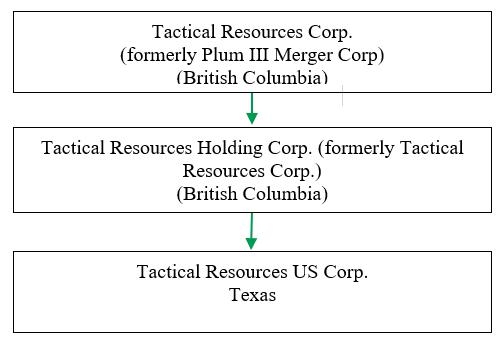
On August 13, 2026 (the “Closing Date”), Tactical Resources Corp. (f.k.a. Plum III Merger Corp., “PubCo”) consummated the business combination contemplated by the Business Combination Agreement dated as of August 22, 2024 (as amended to date, the “Business Combination Agreement”), by and among PubCo, Plum Acquisition Corp. III (“Plum”), Plum III Amalco Corp. (“Amalco”), and Tactical Resources Holdings Corp. (“TRC”), pursuant to which (i) Plum transferred by way of continuation from the Cayman Islands to the Province of British Columbia in accordance with the Cayman Islands Companies Act (As Revised) (the “Companies Act”) and continued as a corporation under the Laws of the Province of British Columbia in accordance with the applicable provisions of the Business Corporations Act (British Columbia) (the “BCBCA”) (the “Domestication”), (ii) following the Domestication, Plum amalgamated with PubCo (the “Plum Amalgamation”) to form one corporate entity, and (iii) immediately following the Plum Amalgamation, TRC and Amalco amalgamated (the “TRC Amalgamation” and, together with the Plum Amalgamation, the “Amalgamations”) to form one corporate entity (with such consummation, the “Closing”).
Pursuant to the Plum Amalgamation, on the Closing Date:
| ● | each Plum Unit was automatically divided, and the holder thereof then held one Plum Class A Share, par value $0.0001 per share (a “Plum Class A Share”) and one-third of one Plum Warrant in accordance with the terms of the applicable Plum Unit; |
| ● | each Plum Class A Share and Plum Class B ordinary share, par value $0.0001 per share (a “Plum Class B Share” and together with the Plum Class A Shares, the “Plum Common Shares”), was exchanged on a one-for-one basis, for a Common Share in the authorized share capital of PubCo (a “Common Share”); and |
| ● | each Plum Warrant was converted into a warrant (each, a “PubCo Plum Warrant”) to purchase a number of Common Shares determined in accordance with the terms of such Plum Warrant. |
On the Closing Date, pursuant to the TRC Amalgamation:
| ● | each TRC Common Share (other than any Cancelled TRC Shares or Dissenting Shares) was exchanged for the right to receive a number of Common Shares equal to the TRC Exchange Ratio (the aggregate of all such Common Shares, the “Arrangement Consideration Shares”). Any Arrangement Consideration Shares exchanged for TRC Common Shares which were subject to any vesting or forfeiture terms shall continue to be governed by such terms from and after the TRC Amalgamation Effective Time. 63% of the Arrangement Consideration Shares will be freely tradable upon the Closing and 37% of the Arrangement Consideration Shares is subject to restrictions on transfer for a period of six months following the Closing |
| ● | each of the Dissenting Shares was cancelled and now represents only the right to receive the applicable payments set forth in the Plan of Arrangement; |
| ● | each TRC Option was assumed by PubCo and converted into an option to purchase Common Shares (each, a “Converted TRC Option”), subject to the same terms and conditions as were previously applicable, except that (A) the number of TRC Common Shares subject to such Converted TRC Option was increased by multiplying the number of shares previously issuable thereunder by the TRC Exchange Ratio, rounded down to the nearest whole Common Share, and (B) the per share exercise price was reduced by dividing the previous exercise price thereof by the TRC Exchange Ratio (rounded up to the nearest cent); |
ii
| ● | each TRC RSU was assumed by PubCo and converted into a restricted stock unit in respect of Common Shares (each, a “Converted TRC RSU”), subject to the same terms and conditions as were previously applicable thereto, except that such Converted TRC RSU was in respect of a number of Common Shares equal to the product of (A) the number of shares previously subject to such TRC RSU and (B) the TRC Exchange Ratio; |
| ● | each TRC Warrant shall automatically be converted into a warrant to purchase Common Shares (each, a “PubCo TRC Warrant”), and such PubCo TRC Warrant shall continue to be governed by the same terms and conditions as were previously applicable, except that (A) the number of TRC Common Shares subject to such PubCo TRC Warrant was increased by multiplying the number of shares previously issuable thereunder by the TRC Exchange Ratio, rounded down to the nearest whole Common Share, and (B) the per share exercise price was reduced by dividing the previous exercise price thereof by the TRC Exchange Ratio (rounded up to the nearest cent); |
| ● | the TRC Convertible Debenture shall survive the TRC Amalgamation in accordance with the terms thereof (subject to the conversion rights of the holder set forth therein); and |
| ● | each Amalco Share shall automatically be exchanged for one validly-issued, fully paid and nonassessable common share of TRC. |
As a result of the Business Combination, the shareholders of Plum became shareholders of PubCo. Following the Plum Amalgamation, PubCo changed its name to “Tactical Resources Corp.” The final TRC Exchange Ratio was determined to be 4.45396657. On August 13, 2026, the PubCo board of directors approved a one-for-four reverse stock split (the “PubCo Stock Split”), which effected on August 17, 2026. All of the share numbers set forth herein are provided on a post-PubCo Stock Split basis. As a result of the application of the TRC Exchange Ratio and the PubCo Stock Split, each TRC Common Share was converted into 1.11349164 PubCo Common Shares. Fractional shares will be rounded down to the nearest whole share. On August 20, 2026, PubCo the PubCo Common Shares began trading on the Nasdaq Capital Market, or “NASDAQ”, under the symbol “TREO”.
At the closing of the Business Combination, a subsidiary of PubCo purchased 1.5 million tons of tailings from Sierra Blanca Quarry, LLC (“SBQ”) for a purchase price consisting of 750,000 PubCo Common Shares. Also at the closing of the Business Combination, Yorkville loaned PubCo $7,500,000 in exchange for the initial Yorkville Note in the amount of $7,500,000.
Certain amounts that appear in this Report may not sum due to rounding.
Unless otherwise indicated or required by context, references in this Report on Form 20-F (including information incorporated by reference herein, the “Report”) to “we,” “us,” “our,” or “PubCo” are to Plum III Merger Corp. (to be renamed Tactical Resources Corp. at closing) and its consolidated subsidiaries. Capitalized terms used herein but not otherwise defined are as defined in the Business Combination Agreement. The PubCo Plum Warrants issued in exchange for Plum Warrants that were publicly traded prior to the Business Combination will not be listed on Nasdaq. PubCo intends to apply to have the PubCo Plum Warrants issued in exchange for publicly traded Plum Warrants qualified for trading on the OTC market.
iii
SELECTED DEFINITIONS
Terms defined in the body of this document shall have the meanings attributed to them therein.
“Allowable Capital Loss” means one-half of any capital loss incurred by a Canadian Holder.
“BCBCA” means the Business Corporations Act (British Columbia).
“Business Combination” means the transactions contemplated by the Business Combination Agreement.
“Business Combination Agreement” means the Business Combination Agreement entered into on August 22, 2024, by and among Plum, Amalco, PubCo and TRC, as amended, supplemented or otherwise modified from time to time.
“Canada U.S. Tax Treaty” means the Canada-United States Tax Convention (1980), as amended.
“Canadian Holder” means a Holder who, for the purposes of the Canadian Tax Act and any applicable tax convention, is a resident or deemed to be a resident in Canada at all relevant times.
“Canadian Tax Act” means the Income Tax Act (Canada) and the regulations thereunder.
“Code” means the U.S. Internal Revenue Code of 1986.
“CRA” means the Canada Revenue Agency.
“Exchange Act” means the U.S. Securities Exchange Act of 1934.
“GAAP” means generally accepted accounting principles in the U.S. as in effect from time to time.
“Holder” means a purchaser who acquires PubCo Common Shares as a beneficial owner and who, at all relevant times, for purposes of the Canadian Tax Act, deals at arm’s length with PubCo, is not affiliated with PubCo, and will acquire and hold such PubCo Common Shares as capital property.
“Investor” means Yorkville.
“Investor Plum Shares” refer to 1,000,000 Plum Class A Shares transferred to the Investor by Sponsor upon entry into the SEPA as a commitment fee upon entry into the SEPA, on October 31, 2025, and which Plum Class A Shares at the Closing were exchanged for 250,000 PubCo Common Shares.
“Key Company Securityholders Lock-up Agreement” means the Key Company Securityholders Lock-Up Agreement, dated as of July 30, 2025, among PubCo, Plum and the Key TRC Securityholders pursuant to which certain PubCo Common Shares to be held by the Key TRC Securityholders Parties immediately following the Closing will be subject to certain limitations on disposition as set forth therein.
“Key TRC Securityholders” means Ranjeet Sundher, Kuljit Basi, Alnesh Mohan, J. Garry Clark, Justus Parmar, Manavdeep Mukhija, SVK Metrix Inc., Matthew Chatterton, 1129925 BC Ltd., Number Eight Management Ltd. and Blue Bird Capital Enterprises LLC.
“Law” means any statute, law, ordinance, rule, regulation, directive or Governmental Order, in each case, of any Governmental Authority, including general principles of common and civil law.
“MLI” means the Multilateral Convention to Implement Tax Treaty Related Measures to Prevent Base Erosion and Profit Shifting.
“Non-Canadian Holder” means a Holder who, for purposes of the Canadian Tax Act and any applicable tax convention and at all relevant times, is not resident or deemed to be resident in Canada and does not use or hold, and is not deemed to use or hold, PubCo Common Shares in connection with a business (including an adventure or concern in the nature of trade) carried on in Canada.
iv
“PCAOB” means the U.S. Public Company Accounting Oversight Board and any division or subdivision thereof.
“Peak REE Project” means the project undertaken by TRC to explore and potentially develop rare earth elements from materials extracted from the Sierra Blanca Quarry operated by Sierra Blanca Quarry LLC in Hudspeth County, Texas.
“Person” means any individual, firm, corporation, partnership, limited liability company, incorporated or unincorporated association, trust, estate, joint venture, joint stock company, union, association, Governmental Authority or other entity, enterprise, authority or business organization of any kind.
“Plum” means Plum Acquisition Corp. III, a Cayman Islands exempt company.
“Proposed Amendments” means specific proposals to amend the Canadian Tax Act which have been publicly announced by or on behalf of the Minister of Finance (Canada) prior to the date hereof.
“PubCo” means Tactical Resources Corp. (formerly Plum III Merger Corp.), a corporation formed under the Laws of the Province of British Columbia.
“PubCo Articles” means the articles adopted and filed with the Registrar by PubCo in connection with the Business Combination.
“PubCo Assumed Plum Warrant” means each Plum Warrant that was converted into a warrant to purchase a number of PubCo Common Shares.
“PubCo Assumed TRC Warrant” means each TRC Warrant that converted into a warrant to purchase a number of PubCo Common Shares.
“PubCo Certificate” means the Certificate of Incorporation of PubCo filed with the Registrar on August 8, 2024, as amended, restated or amended and restated from time to time.
“PubCo Common Shares” means the common shares of PubCo, par value $0.0001 per share.
“PubCo Governing Documents” means, collectively, the PubCo Articles and the PubCo Certificate.
“PubCo Warrants” means, collectively, the PubCo Assumed TRC Warrants and the PubCo Assumed Plum Warrants.
“Public Warrants” are to the warrants sold as part of the units in the IPO.
“REE” means the group of 17 rare earth elements on the periodic table of elements including the 15 elements of the lanthanide series together with the transition metals scandium and yttrium.
“Registration Rights Agreement” the Registration Rights Agreement among PubCo and the Sponsor Parties pursuant to which PubCo shall provide the Sponsor Parties with certain demand and piggyback registration rights with respect to the PubCo Common Shares (and any securities convertible into or exercisable for PubCo Common Shares) to be held by such Persons immediately following the Closing.
“SBQ” means Sierra Blanca Quarry LLC, the owner of the mine at the Peak REE Project.
“SEC” means the U.S. Securities and Exchange Commission.
v
“Securities Act” means the U.S. Securities Act of 1933.
“SEPA” means the standby equity purchase agreement with Yorkville, pursuant to which Yorkville opened a standby equity line for PubCo in the aggregate principal amount of up to $100,000,000, of which $7,500,000 was made available to PubCo in the form of a pre-paid advance evidenced by a convertible promissory note upon the Closing of the Business Combination, $2,500,000 will be available to PubCo in the form of a second pre-paid advance with an equivalent note on the date the post-business combination registration statement is declared effective, and $30,000,000 will be available to PubCo in the form of a third pre-paid advance with an equivalent note at such time as agreed to by the Investor and PubCo. Each of the pre-paid advances is subject to a discount in the amount equal to 5% of the principal amount of that pre-paid advance netted from the purchase price and structured as an original issue discount, and such advances and further advances under the standby equity line are subject to conditions specified in the SEPA. The availability period of the equity line of credit is for 36 months after the date of the SEPA.
“Sponsor” means Mercury Capital, LLC, the sponsor of Plum.
“Sponsor Parties Lock-up Agreement” means the Sponsor Parties Lock-Up Agreement, dated as of August 22, 2024, among PubCo, Plum and the Sponsor Parties pursuant to which certain PubCo Common Shares held by the Sponsor Parties immediately following the Closing are subject to certain limitations on disposition.
“Taxable Capital Gain” means one-half of any capital gain.
“Transactions” means the transactions contemplated by the Business Combination Agreement.
“Transfer Agent” means Continental Stock & Trust Company.
“TRC” means Tactical Resources Holdings Corp., a corporation formed under the Laws of the Province of British Columbia, which is, following the closing of the Business Combination, is a wholly owned subsidiary of PubCo.
“U.S.” means the United States of America.
“Yorkville” means Yorkville II PN, LTD., an investment fund managed by Yorkville Advisors Global, LP, and its affiliates;
“Yorkville Financing” means the sale of the PubCo Common Shares pursuant to the SEPA which provides for a standby equity line for PubCo in the aggregate principal amount of up to $100,000,000, as specified in the SEPA and the Yorkville Notes, of which up to $40,000,000 will be available to PubCo in the form of a pre-paid advances as specified in the SEPA, with $7,500,000 of such pre-paid advances available upon the Closing of the Business Combination and with delivery of a Yorkville Note; and
“Yorkville Note” means those certain unsecured convertible promissory notes to be issued by PubCo to Yorkville in the amount of $7,500,000 at the Closing of the Business Combination, $2,500,000 will be available to PubCo in the form of a second pre-paid advance with an equivalent note on the date the post business combination registration statement becomes effective, and $30,000,000 will be available to PubCo in the form of a third pre-paid advance with an equivalent note at such time as agreed to by the Investor and PubCo, in each case with an effective original issue discount of 5% and that are convertible into PubCo Common Shares.
vi
CAUTIONARY NOTE REGARDING FORWARD-LOOKING STATEMENTS
This Report on Form 20-F (including information incorporated by reference herein, this “Report”) may contain “forward-looking statements” within the meaning of the federal securities laws. Forward-looking statements relate to expectations, beliefs, projections, future plans and strategies, anticipated events or trends and similar expressions concerning matters that are not historical facts. Forward-looking statements reflect PubCo’s current views with respect to, among other things, its capital resources, performance and results of operations. Likewise, all of PubCo’s statements regarding anticipated growth in operations, anticipated market conditions, demographics and results of operations are forward-looking statements. In some cases, you can identify these forward-looking statements by the use of terminology such as “outlook,” “believes,” “expects,” “potential,” “continues,” “may,” “will,” “should,” “could,” “seeks,” “approximately,” “predicts,” “intends,” “plans,” “estimates,” “anticipates” or the negative version of these words or other comparable words or phrases, but the absence of these words does not mean that a statement is not forward-looking.
The forward-looking statements contained in this Report reflect PubCo’s current views about future events and are subject to numerous known and unknown risks, uncertainties, assumptions and changes in circumstances that may cause actual results to differ significantly from those expressed in any forward-looking statement. PubCo does not guarantee that the transactions and events described will happen as described (or that they will happen at all). The following factors, among others, could cause actual results and future events to differ materially from those set forth or contemplated in the forward-looking statements:
| ● | PubCo’s estimates of the funding it needs to meet operational needs and to more fully evaluate the tailings at the Peak REE Project; |
| ● | the ability of PubCo to finance its projected operating deficits; |
| ● | the ability of PubCo to profitably extract REEs from the tailings at the Peak REE Project; |
| ● | the continued existence of the Project Lease and the extension of the termination date thereof; |
| ● | general economic uncertainty; |
| ● | PubCo’s ability to obtain and maintain financing arrangements on attractive terms; |
| ● | PubCo’s ability to obtain or maintain the listing of PubCo’s Common Shares on the NASDAQ or any other national exchange following the Business Combination; |
| ● | the impact of and changes in governmental regulations or the enforcement thereof, tax laws and rates, accounting guidance and similar matters in regions in which PubCo operates or will operate in the future; |
| ● | potential litigation, governmental or regulatory proceedings, investigations or inquiries involving PubCo, including in relation to the Business Combination; |
| ● | international, national or local economic, social or political conditions that could adversely affect the companies and their business; |
| ● | the effectiveness of PubCo’s internal controls and its corporate policies and procedures; |
| ● | changes in personnel and availability of qualified personnel; |
| ● | environmental uncertainties and risks related to adverse weather conditions and natural disasters; |
| ● | potential write-downs, write-offs, restructuring and impairment or other charges required to be taken by PubCo subsequent to the Business Combination; |
| ● | the limited experience of certain members of PubCo’s management team in operating a public company in the United States; |
| ● | the volatility of the market price and liquidity of Common Shares; and |
| ● | The other matters described in the section entitled “Risk Factors” included in this Report. |
Forward-looking statements representing post-closing expectations are inherently uncertain. Estimates such as expected revenue, production, operating expenses, EBITDA, general and administrative expenses, capital expenditures, free cash flow, net debt, reserves and other measures are preliminary in nature. There can be no assurance that the forward-looking statements will prove to be accurate and reliance should not be placed on these estimates.
The forward-looking statements contained herein are subject to risks, uncertainties and other factors, which could cause actual results to differ materially from future results expressed, projected or implied by the forward-looking statements. There may be additional risks that PubCo does not presently know or that PubCo currently believes are immaterial, that could also cause actual results to differ from those contained in the forward-looking statements. Should one or more of these risks or uncertainties materialize, or should any of the assumptions made in making these forward-looking statements prove incorrect, actual results may vary in material respects from those projected in these forward-looking statements. While such forward-looking statements reflect PubCo’s good faith beliefs, they are not guarantees of future performance. PubCo disclaims any obligation to publicly update or revise any forward-looking statement to reflect changes in underlying assumptions or factors, new information, data or methods, future events or other changes after the date of this Report, except as required by applicable law. You should not place undue reliance on any forward-looking statements, which are based only on information currently available to PubCo.
vii
PART I
ITEM 1 - IDENTITY OF DIRECTORS, SENIOR MANAGEMENT AND ADVISERS
Not applicable.
ITEM 2 - OFFER STATISTICS AND EXPECTED TIMETABLE
Not applicable.
ITEM 3 - KEY INFORMATION
A. Reserved
B. Capitalization and Indebtedness
Not applicable.
C. Reasons for the Offer and Use of Proceeds
Not applicable.
D. Risk Factors
Risk Factors
You should consider carefully the risks and uncertainties described in this report before investing in our securities. These risks are discussed more fully in the section titled “Risk Factors” following this summary. If any of these risks actually occur, our business, financial condition or results of operations would likely be materially adversely affected. These risks include, but are not limited to, the following:
| ● | PubCo’s financial statements have been prepared assuming that PubCo will continue as a going concern. |
| ● | We have a history of losses in every year since inception and will require additional financing to fund operations. |
| ● | We will need to raise additional capital or financing to continue to execute and expand our business. |
| ● | Our future performance is difficult to evaluate because we have had a limited operating history on which to base an evaluation of our business and properties. |
| ● | The Peak REE Project is in the exploration stage. |
| ● | There is no history of producing metals from the Peak REE Project and determining if mineral reserves in commercially exploitable quantities exist and any future development of such resources will be capital intensive. |
| ● | Our exploration activities may not be commercially successful. |
| ● | The Sierra Blanca Quarry has been leased pursuant to the Project Lease which expires by its terms in February 2028. |
| ● | Mining and mineral exploration is inherently dangerous and subject to conditions or events beyond our control, which could have a material adverse effect on our business and plans. |
1
| ● | Mineral operations are subject to market forces outside of our control which could negatively impact us. |
| ● | We may be adversely affected by fluctuations in demand for, and prices of, rare earth minerals and products. |
| ● | PubCo competes with larger, better capitalized competitors in the mining industry. |
| ● | Our business and our continued growth depends on our ability to complete the Phase 1 Technical Work Program at the Peak REE Project, which is our only rare earth mining project. |
| ● | An increase in the global supply of REE products, dumping, predatory pricing and other tactics designed to inhibit our further expansion by our competitors could have a material adverse effect on our prospective profitability. |
| ● | Increasing costs or limited access to raw materials, including chemical reagents, may adversely affect our profitability. |
| ● | Fluctuations in transportation costs or disruptions in transportation services or damage or loss during transport could |
| ● | Permitting, licensing and approval processes are required for the operations at the Peak REE Project and obtaining and maintaining required permits and licenses is subject to conditions which may be unable to be achieved. |
| ● | We are subject to significant governmental regulations, which affect operations and costs of conducting business. |
| ● | Regulations and pending legislation governing issues involving climate change could result in increased operating costs, which could have a material adverse effect on PubCo as well as any other business in which we engage. |
| ● | Our exploration and development activities are subject to environmental risks, which could expose us to significant liability and result in the delay, suspension or termination of our operations. |
| ● | PubCo and Plum have no history operating as a combined company. The unaudited pro forma condensed combined financial information may not be an indication of PubCo’s financial condition or results of operations following the Business Combination, and accordingly, you have limited financial information on which to evaluate PubCo and your investment decision. |
| ● | PubCo’s management has limited experience in operating a public company. |
| ● | PubCo’s disclosure controls and procedures may not prevent or detect all errors or acts of fraud. |
| ● | Following the consummation of the Business Combination, PubCo may incur significant increased expenses and administrative burdens as a listed public company, which could have an adverse effect on its business, financial condition and results of operations. |
| ● | PubCo’s internal controls over financial reporting currently do not meet all of the standards contemplated by Section 404 of the Sarbanes-Oxley Act, and the failure of PubCo to achieve and maintain effective internal controls over financial reporting in accordance with Section 404 of the Sarbanes-Oxley Act of 2002 could have a material adverse effect on its business and the market price of PubCo Common Shares. |
| ● | There has been no prior market for PubCo’s Common Shares and an active trading market for such securities may never develop or be sustained, which may cause its shares to trade at a discount and make it difficult to sell the shares. |
2
RISK FACTORS
You should consider carefully the following risks, together with the financial and other information contained in this report, including “Operating and Financial Review and Prospects,” before you decide to purchase PubCo securities. If any of the following risks actually occur, our business, financial condition and operating results could be materially and adversely affected. In that case, the market price of the PubCo securities could decline and you may lose all or a part of your investment. The risks discussed below are not the only risks we face. Additional risks or uncertainties not currently known to us, or that we currently deem immaterial, may also have a material adverse effect on our business, financial condition and operating results. See “Cautionary Note Regarding Forward-Looking Statements.”
Risks Related to this Offering
It is not possible to predict the actual number of shares we will sell to Yorkville under the Yorkville Financing, or the actual gross proceeds resulting from those sales. We may not have access to the full amount available under the Yorkville Financing.
On November 5, 2025, we entered into the Yorkville Financing with Yorkville, pursuant to which Yorkville committed to purchase up to $100 million Common Shares, subject to certain limitations and conditions set forth in the Yorkville Financing. The Common Shares that may be issued under the Yorkville Financing may be sold by us to Yorkville at our discretion, from time to time, over a 36-month period commencing on the date of the Yorkville Financing. We generally have the right to control the timing and amount of any sales of our Common Shares to Yorkville under the Yorkville Financing. Sales of our Common Shares to Yorkville under the Yorkville Financing will depend upon market conditions as well as other factors to be determined by us. We may ultimately decide to sell to Yorkville all or a portion of the shares of our Common Shares that may be available pursuant to the Yorkville Financing, or decide to terminate the Yorkville Financing or not sell to Yorkville any Common Shares that may be available for us to sell to Yorkville thereunder.
Because the purchase price per share to be paid by Yorkville for the Common Shares that we may elect to sell to Yorkville under the Yorkville Financing will fluctuate based on the market prices of our Common Shares during the applicable pricing period for each purchase, it is not possible for us to predict, as of the date of this report, the number of Common Shares that we will sell to Yorkville under the Yorkville Financing, the purchase price per share that Yorkville will pay for shares purchased from us under the Yorkville Financing, or the aggregate gross proceeds that we will receive from those purchases by Yorkville under the Yorkville Financing.
If we elect to sell to Yorkville all of the Common Shares being registered for resale by Yorkville, depending on the market prices of our Common Shares during the applicable pricing period for each purchase made pursuant to the Yorkville Financing, the actual gross proceeds from the sale of all such shares may be substantially less than the $100 million total commitment originally available to us under the Yorkville Financing.
If it becomes necessary for us to issue and sell to Yorkville under the Yorkville Financing more than the shares being registered for resale under the registration statement in order to receive aggregate gross proceeds equal to the total commitment of $100 million under the Yorkville Financing, we must file with the SEC one or more additional registration statements to register under the Securities Act the resale by Yorkville of any such additional Common Shares we wish to sell from time to time under the Yorkville Financing, which the SEC must declare effective. We will need to obtain shareholder approval to issue Common Shares in excess of the Exchange Cap under the Yorkville Financing in accordance with the Nasdaq listing rules, unless the average per share purchase price paid by Yorkville for all Common Shares sold under the Yorkville Financing equals or exceeds equal or exceed the average Nasdaq official closing price for the five (5) trading days immediately prior to the Effective Date of the Yorkville Financing, in which case, under the Nasdaq listing rules, the Exchange Cap limitation will not apply to issuances and sales of our Common Shares under the Yorkville Financing. In addition, Yorkville will not be required to purchase any Common Shares if such sale would result in Yorkville’s beneficial ownership exceeding 4.99% of the then-outstanding voting power or number of Common Shares.
Any issuance and sale by us under the Yorkville Financing of a substantial amount of shares of our Common Shares could cause additional substantial dilution to our stockholders. The number of Common Shares ultimately offered for resale by Yorkville is dependent upon the number of Common Shares we ultimately sell to Yorkville under the Yorkville Financing. Our inability to access a portion or the full amount available under the Yorkville Financing, in the absence of any other financing sources, could have a material adverse effect on our business.
Investors who buy shares at different times will likely pay different prices.
Pursuant to the Yorkville Financing, we will have discretion, subject to market demand, to vary the timing, prices, and numbers of shares sold to Yorkville. If and when we do elect to sell Common Shares to Yorkville under the Yorkville Financing, after Yorkville has acquired such shares, Yorkville may resell all or a portion of such shares at any time or from time to time in its discretion and at different prices. As a result, investors who purchase shares from Yorkville at different times will likely pay different prices for those shares, and so may experience different levels of dilution and in some cases substantial dilution and different outcomes in their investment results. Investors may experience a decline in the value of the shares they purchase from Yorkville as a result of future sales made by us to Yorkville at prices lower than the prices such investors paid for their shares.
3
Risks Relating to PubCo’s Business and Industry
PubCo’s financial statements have been prepared assuming that PubCo will continue as a going concern.
Our financial statements have been prepared assuming that PubCo will continue as a going concern. PubCo has an accumulated deficit from inception through July 31, 2026, of approximately $16.2 million, has yet to achieve profitable operations, and projects further losses in the development of its business. PubCo’s ability to continue as a going concern is dependent upon its ability to obtain the necessary financing to meet its obligations and pay its liabilities arising from normal business operations when they come due.
There can be no assurance that PubCo will be able to raise the necessary capital to fund its expected operating expenses. We have no firm commitments for equity or debt financing and any financing that may be obtained will be on a best efforts basis. Based on these factors, there is substantial doubt as to PubCo’s ability to continue as a going concern for a period of twelve months from the issuance date of its most recent audited financial statements. The failure to obtain sufficient financing may cause us to curtail or discontinue operations.
We have a history of losses in every year since inception and will require additional financing to fund operations. Failure to obtain additional financing could have a material adverse effect on our financial condition and results of operation and could cast uncertainty on our ability to continue as a going concern in future periods.
During the fiscal year ended July 31, 2026, we had no revenues. For the fiscal year ended July 31, 2026, our net loss was approximately $2.9 million and our accumulated deficit as of July 31, 2026 was approximately $16.2 million. At July 31, 2026, our cash position was approximately $282,146 and our working capital deficit was approximately $6.9 million. There can be no assurance that the Peak REE Project will ever commence commercial production.
We will need to raise additional capital or financing to continue to execute and expand our business.
We will need to raise additional capital to support operations and execute on our business plan, which may include the issuance of equity or convertible debt securities. There is no guarantee that we will be able to raise additional capital on a timely basis or on acceptable terms. To the extent that we raise additional funds by issuing equity or convertible debt securities, PubCo Shareholders may experience additional dilution. Newly issued securities may include preferences, superior voting rights, and the issuance of warrants or other convertible securities that will have additional dilutive effects. Further, we may incur substantial costs in pursuing such capital and/or financing. We may also be required to recognize non-cash expenses in connection with certain securities we may issue, such as convertible notes and warrants, which will adversely impact our financial condition and results of operations. Our ability to obtain needed financing may be impaired by such factors as the weakness of capital markets, and the fact that we have not been profitable, which could impact the availability and cost of future financings.
Our future performance is difficult to evaluate because we have had a limited operating history on which to base an evaluation of our business and properties.
We have not realized any revenues to date from the sale of rare earth minerals and our operating cash flow needs have been financed through the issuances of debt and equity raises and not through cash flows derived from our operations. As a result, we have little historical financial and operating information available to help you evaluate our performance. Any investment in PubCo should be considered a high-risk investment because investors will be placing funds at risk in an early stage, under-capitalized business with unforeseen costs, expenses, competition, a history of operating losses and other problems to which start-up ventures are often subject. Investors should not invest in PubCo unless they can afford to lose their entire investment. Your investment must be considered in light of the risks, expenses, and difficulties encountered in establishing a new business in a highly competitive industry. Our operating history has been limited to the acquisition and sampling of the tailings from the Peak REE Project which does not yet provide a meaningful basis for an evaluation of the Peak REE Project. Other than through conventional and typical exploration methods and procedures, we have no additional way to evaluate the likelihood of whether the Peak REE Project contains commercial quantities of mineral reserves or, if it does, that it will be operated successfully. We anticipate that we will continue to incur significant operating costs without realizing any revenues for the foreseeable future.
4
The Peak REE Project is in the exploration stage. There is no assurance that PubCo can establish the existence of any mineral reserve from the Peak REE Project in commercially exploitable quantities. Until then, we cannot earn any revenues from the Peak REE Project, and our business could fail.
We have not established that the Peak REE Project contains any commercially exploitable quantities of mineral reserve, nor can there be any assurance that we will be able to do so. The probability of the Peak REE Project ever having a commercially exploitable mineral reserve that meets the requirements of the SEC may be remote. Even if we do eventually discover commercially exploitable quantities of mineral reserve on the Peak REE Project, there can be no assurance that it can be developed into a producing mine and extract those minerals. Both mineral exploration and development involve a high degree of risk and few properties, which are explored, are ultimately developed into producing mines.
The commercial viability of an established mineral deposit will depend on a number of factors including, by way of example, the size, grade and other attributes of the mineral deposit, the proximity of the deposit to infrastructure such as a smelter, roads and a point for shipping, government regulation and market prices. Most of these factors will be beyond our control, and any of them could increase costs and make extraction of any identified mineral deposit unprofitable.
Even if commercial viability of a mineral deposit is established, it may take several years until production is possible, during which time the economic feasibility of production may change. Substantial expenditures are required to establish proven and probable reserves through sampling, to determine the optimal metallurgical process to extract the metals from the tailings and, in the case of new properties, to construct processing facilities. Because of these uncertainties, no assurance can be given that our exploration programs will result in the establishment or expansion of a mineral deposit or reserves.
The Peak REE Project is a high-risk project and investors should not make an investment in PubCo unless you have the ability to lose your entire investment.
There is no history of producing metals from the Peak REE Project and determining if mineral reserves in commercially exploitable quantities exist and any future development of such resources will be capital intensive.
There is no history of producing metals from the Peak REE Project. The Peak REE Project is an exploration stage property in the early stage of exploration and evaluation. Advancing properties from exploration into the development stage requires significant capital and time, and successful commercial production from the Peak REE Project will be subject to permitting and construction of processing plants, roads, and other related works and infrastructure. As a result, we are subject to all of the risks associated with developing and establishing new mining operations and business enterprises including:
| ● | verifying reserves and commercial viability, including the ability to find sufficient REE reserves to support a commercial mining operation; |
| ● | the timing and cost, which can be considerable, of further exploration, permitting and construction of infrastructure and processing facilities; |
| ● | the availability and costs of exploration personnel, skilled labor and processing equipment, if required; |
| ● | the availability and cost of appropriate smelting and/or refining arrangements, if required, and securing a commercially viable sales outlet for our products; |
| ● | compliance with environmental and other governmental approval and permit requirements; |
| ● | the availability of funds to finance exploration, development and construction activities, as warranted; |
| ● | potential opposition from non-governmental organizations, environmental groups, local groups or local inhabitants which may delay or prevent development activities; |
| ● | potential increases in exploration, construction and operating costs due to changes in the cost of fuel, power, materials and supplies; and |
| ● | potential shortages of mineral processing, construction and other facilities related supplies. |
5
The costs, timing and complexities of exploration, development and construction activities may be increased by the location of the Peak REE Project and demand by other mineral exploration and mining companies. It is common in exploration programs to experience unexpected problems and delays during development, construction and mine start-up activities. Accordingly, PubCo’s activities may not result in profitable processing operations and PubCo may not succeed in establishing processing operations or profitably producing metals with respect to the Peak REE Project.
If we establish the existence of a mineral reserve in the Peak REE Project in a commercially exploitable quantity, we will require additional capital in order to fund our costs to develop the property into a producing mine.
PubCo will be required to expend significant funds to determine if mineral reserves in commercially exploitable quantities exist in the Peak REE Project, and then PubCo will be required to expend substantial additional sums of money to establish the extent of the reserve, develop processes to extract it and develop extraction and processing facilities and infrastructure. There is no assurance that any project level financing can ever be obtained. As such, there is no assurance that the necessary financing can be obtained to develop necessary facilities and infrastructure to accomplish our goals. Although PubCo may derive substantial benefits from the discovery of a major mineral deposit, there can be no assurance that such a deposit will be large enough to justify commercial operations, nor can there be any assurance that PubCo will be able to raise the funds at the level required for development on a timely basis.
Our exploration activities may not be commercially successful.
Our long-term success depends on our ability to identify mineral deposits in the Peak REE Project or other properties we may acquire that we can then develop into commercially viable processing operations. Our belief that the Peak REE Project contains commercially exploitable minerals has been based solely on preliminary tests that PubCo has conducted and data provided by our third-party expert. There can be no assurance that the tests and data upon which we have relied is correct or accurate and, accordingly, there is no assurance that the Peak REE Project contains commercially exploitable minerals. Moreover, mineral exploration is highly speculative in nature, involves many risks and is frequently non-productive. The inability to obtain suitable or adequate machinery, equipment or labor are risks involved in the conduct of exploration programs. The success of mineral exploration and development is determined in part by the following factors:
| ● | the identification of potential mineralization based on analysis; |
| ● | the availability of exploration permits; |
| ● | the quality of our management and our geological and technical expertise; and |
| ● | the capital available for exploration. |
Substantial expenditures and time are required to establish existing proven and probable reserves through analysis, to develop metallurgical processes to extract metal, and to develop the processing facilities and infrastructure at any site chosen for processing. Whether a mineral deposit will be commercially viable depends on a number of factors, which include, without limitation, the particular attributes of the deposit, such as size, grade and proximity to infrastructure; metal prices, which fluctuate widely; and government regulations, including, without limitation, regulations relating to prices, taxes, royalties, land tenure, land use, allowable production, importing and exporting of minerals and environmental protection. Any one or a combination of these factors may result in us not receiving an adequate return on our investment in the Peak REE Project or any other mineral project we may pursue. The decision to abandon a project will have an adverse effect on the market value of our securities and our ability to raise future financing.
The Sierra Blanca Quarry has been leased to Sierra Blanca Quarry, LLC (“SBQ”) pursuant to Mining Lease M-11469 (the “Project Lease”), which expires by its terms in February 2028.
The Project Lease is between SBQ and the State of Texas. All of PubCo’s rights under the SBQ Offtake Agreement are subject to the continued existence of the Project Lease. PubCo has no right to cause SBQ to extend the Project Lease after the expiration of its term. PubCo also has no right to cause SBQ to continue to mine the Project Lease and provide PubCo with a continuous stream of tailings. If SBQ decides to let the Project Lease expire, PubCo would lose all access to the Project Lease and the tailings located thereon. This would effectively prevent PubCo from conducting any extraction of REEs from the mine tailings. PubCo does have an option to acquire all of the membership interests in PubCo. However, if PubCo were to acquire SBQ, PubCo would then be in the business of running SBQ’s mining operations. PubCo’s management has no history of operating such a mining operation.
6
Mining and mineral exploration is inherently dangerous and subject to conditions or events beyond our control, which could have a material adverse effect on our business and plans.
Mining and mineral exploration involves various types of risks and hazards, including:
| ● | environmental hazards; |
| ● | power outages; |
| ● | metallurgical and other processing problems; |
| ● | personal injury, flooding, fire, explosions, cave-ins, landslides and rock-bursts; |
| ● | inability to obtain suitable or adequate machinery, equipment, or labor; |
| ● | metals losses; |
| ● | fluctuations in exploration, development and production costs; |
| ● | labor disputes; |
| ● | unanticipated variations in grade; |
| ● | mechanical equipment failure; and |
| ● | periodic interruptions due to inclement or hazardous weather conditions. |
These risks could result in damage to, or destruction of, the Peak REE Project, production facilities or other properties, personal injury, environmental damage, delays in mining, increased production costs, monetary losses and possible legal liability. PubCo may not be able to obtain insurance to cover these risks at economically feasible premiums. Insurance against certain environmental risks, including potential liability for pollution or other hazards as a result of the disposal of waste products occurring from production, may be prohibitively expensive. PubCo may suffer a material adverse effect on its business if not covered by insurance policies. PubCo operations may contain significant uninsured risks which could negatively impact future profitability.
Any exploration of the Peak REE Project contains and will contain certain risks, including unexpected or unusual operating conditions. It is not always possible to insure against these risks. Should events such as these arise, they could reduce or eliminate your investment in PubCo as well as result in increased costs and a decline in the value of your investment.
Mineral operations are subject to market forces outside of our control which could negatively impact us.
The marketability of minerals is affected by numerous factors beyond our control including market fluctuations, government regulations relating to prices, taxes, royalties, allowable production, imports, exports and supply and demand. One or more of these risk elements could have an impact on the costs of PubCo’s operations and, if significant enough, could impact your investment.
We may be adversely affected by fluctuations in demand for, and prices of, rare earth minerals and products.
Our goal is for PubCo to derive revenues from the sale of rare earth and related minerals. Changes in demand for, and the market price of, these minerals could significantly affect us. The value and price of our securities and our financial results may be significantly adversely affected by declines in the prices of rare earth minerals and products. Rare earth minerals and product prices may fluctuate and are affected by numerous factors beyond our control such as interest rates, exchange rates, inflation or deflation, fluctuation in the relative value of the U.S. dollar against foreign currencies on the world market, global and regional supply and demand for rare earth minerals and products, and the political and economic conditions of countries (including specifically China and the U.S.’s relationship with China at any given time) that produce rare earth minerals and products.
A prolonged or significant economic contraction in the United States or worldwide could put further downward pressure on market prices of rare earth minerals and products. Protracted periods of low prices for rare earth minerals and products could significantly reduce revenues and the availability of required development funds in the future. This could cause substantial reductions to, or a suspension of, REE production operations, impair asset values and if reserves are established on our prospects, reduce our proven and probable rare earth reserves.
7
In contrast, extended periods of high commodity prices may create economic dislocations that may be destabilizing to rare earth minerals supply and demand and ultimately to the broader markets. Periods of high rare earth mineral market prices generally would be beneficial to us. However, strong rare earth mineral prices also create economic pressure to identify or create alternate technologies that ultimately could depress future long-term demand for rare earth minerals and products, and at the same time may incentivize development of otherwise marginal mining properties.
Increased competition could adversely affect our ability to attract necessary capital funding or acquire suitable producing properties or prospects for mineral exploration in the future.
The mining industry is intensely competitive. Significant competition exists for the acquisition of properties producing or capable of producing REE or other metals. We likely are at a competitive disadvantage in acquiring additional mining properties because we must compete with other individuals and companies, most of which have greater financial resources, operational experience and technical capabilities than us. We may also encounter increasing competition from other mining companies in our efforts to hire experienced mining professionals. Competition for exploration resources at all levels is currently very intense, particularly affecting the availability of manpower, mining equipment and production equipment. Increased competition could adversely affect our ability to attract necessary capital funding or acquire suitable producing properties or prospects for mineral exploration in the future.
PubCo competes with larger, better capitalized competitors in the mining industry.
The mining industry is competitive in all of its phases, including financing, technical resources, personnel and property acquisition. PubCo will require significant capital, technical resources, personnel and operational experience to effectively compete in the mining industry. Because of the high costs associated with exploration, the expertise required to analyze a project’s potential and the capital required to develop a mine, larger companies with significant resources may have a competitive advantage over PubCo. PubCo faces strong competition from other mining companies, some with greater financial resources, operational experience and technical capabilities than us. As a result of this competition, PubCo may not be able to acquire financing, personnel, technical resources or attractive mining properties on acceptable terms, if at all.
The actual amount of capital required for the Phase 1 Technical Work Program at the Peak REE Project may vary materially from our current estimates, in which case we may need to raise additional funds, which could delay completion and have a material adverse effect on our business, financial condition and results of operations.
The anticipated funding required to complete the Phase 1 Technical Work Program at the Peak REE Project is based on certain estimates and assumptions we have made about the additional equipment, labor, permits and other factors required to complete the project. If any of these estimates or assumptions change, the actual timing and amount of capital required to complete the Phase 1 Technical Work Program may vary materially from what we anticipate. Additional funds may be required in the event of significant departures from our current plans, unforeseen delays, cost overruns, engineering design changes or other unanticipated events or expenses. There can be no assurance that additional financing will be available to us, or, if available, that it can be obtained on a timely basis and on commercially acceptable terms.
Our business and our continued growth depends on our ability to complete the Phase 1 Technical Work Program at the Peak REE Project, which is our only rare earth mining project.
Our only rare earth mining project at this time is at the Peak REE Project. Our business and our continued growth will be based on successfully completing the Phase 1 Technical Work Program and reaching anticipated production rates for the production of REEs in accordance with our expected timeframe. The deterioration or destruction of any part of the Peak REE Project, or a delay in the procurement of any necessary equipment, may significantly hinder our ability to reach or maintain anticipated production rates within the expected time frame or at all. If we are unsuccessful in reaching and maintaining expected production rates for REEs at the Peak REE Project, within expected time frames or at all, we may not be able to build a sustainable or profitable business as currently expected or at all.
The success of our business will depend, in part, on the growth of existing and emerging uses for REE products.
The success of our business will depend, in part, on the growth of existing and emerging uses for rare earth products. Our strategy is to develop rare earth products which are used in critical existing and emerging technologies, such as hybrid and electric vehicles, wind turbines, robotics, medical equipment, military equipment and other high-growth, advanced motion technologies. The success of our business depends on the continued growth of these end markets and successfully commercializing rare earth products in such markets. If the market for these critical existing and emerging technologies does not grow as we expect, grows more slowly than we expect, or if the demand for our products in these markets decreases, then our business, prospects, financial condition and operating results could be harmed. In addition, the market for these technologies, particularly in the automotive industry, tends to be cyclical, which exposes us to increased volatility, and it is uncertain as to how such macroeconomic factors will impact our business. Any unexpected costs or delays in the commercialization of our expected products, or less than expected demand for the critical existing and emerging technologies that use rare earth products, could have a material adverse effect on our financial condition or results of operations.
8
Our ability to generate revenue will be diminished if we are unable to compete with substitutions for the rare earth minerals that we intend to mine.
Technology changes rapidly in the industries and end markets that we expect to utilize our materials. If these industries introduce new technologies or products that no longer require the rare earth materials we intend to mine to function or suitable substitutes become available, it could result in a decline in demand for our rare earth minerals. If the demand for our rare earth minerals decreases, it will have a material adverse effect on our business and the results of our operations and financial condition.
An increase in the global supply of REE products, dumping, predatory pricing and other tactics designed to inhibit our further expansion by our competitors could have a material adverse effect on our prospective profitability.
The pricing and demand for REEs is affected by a number of factors beyond our control, including growth of economic development and the global supply and demand for REE products. According to a study from the Brooking’s Institution, China presently produces some 60% of the world’s rare earth elements and processes 85% of them China also dominates the manufacture of metals and NdFeB magnets from rare earths, capabilities that are not currently present in the United States, and the Chinese Central Government regulates production via quotas and environmental standards. Over the past few years, there has been significant restructuring of the Chinese markets in line with China Central Government policy. Assuming that we reach anticipated production rates for REEs, the increased competition may lead our competitors to engage in predatory pricing or other behaviors designed to inhibit our further expansion. Any increase in the amount of REEs and rare earth products exported from other nations and increased competition may result in price reductions, reduced margins or loss of potential market share, any of which could materially adversely affect our profitability. As a result of these factors, we may not be able to compete effectively against current and future competitors.
A power shortage at the Peak REE Project could temporarily delay processing operations and increase costs, which could have a material adverse effect on our business, financial condition and results of operations.
Operations relating to our Peak REE Project currently rely on electricity provided by a single utility company. Instability in electrical supply could cause sporadic outages and brownouts and result in temporary interruptions of processing operations. If power to the Peak REE Project is disrupted during certain phases of our REE extraction process, we may incur significant delays and expenses that may adversely impact our ability to generate future revenues.
Increasing costs or limited access to raw materials, including chemical reagents, may adversely affect our profitability.
We intend to use significant amounts of chemical reagents to process REEs. On-site production of these reagents could be delayed and any production could be hampered by any disruptions in the process used to produce these chemicals. A significant increase in the price, or decrease in the availability of these chemicals before we restart our ability to produce them on-site, or restrictions imposed by environmental regulations or law on chemical use, could materially increase our operating costs and adversely affect our profit margins and production volumes.
Fluctuations in transportation costs or disruptions in transportation services or damage or loss during transport could decrease our competitiveness or impair our ability to supply REE products to future customers, which could adversely affect our results of operations.
We expect to transport our products to future customers wherever they are located. Finding affordable and dependable transportation will be important because it will allow us to supply customers around the world. Labor disputes, embargos, government restrictions, work stoppages, pandemics, derailments, damage or loss events, adverse weather conditions, other environmental events, changes to rail or ocean freight systems or other events and activities beyond our control could interrupt or limit available transport services, which could result in customer dissatisfaction and loss of sales potential and could materially adversely affect our results of operations.
We will need to process REEs to exacting specifications in order to provide future customers with a consistently high-quality product. An inability to perfect the mineral extraction processes to meet individual customer specifications could have a material adverse effect on our business, financial condition and results of operations.
Upon the completion of our Phase 1 Technical Work Program, we will need to be able to process REEs to meet customer needs and specifications and to provide customers with a consistently high-quality product and to meet ever-stricter purity requirements. An inability to perfect the mineral extraction processes to meet individual customer specifications may have a material adverse effect on our financial condition or results of operations. In addition, customer needs and specifications may change with time. Any delay or failure in developing processes to meet changing customer needs and specifications may have a material adverse effect on our financial condition or results of operations.
9
A shortage of skilled personnel may further increase operating costs, which could have a material adverse effect on our results of operations.
Efficient production of REEs using modern techniques and equipment will require skilled management, scientific, technical, marketing and support personnel. In addition, optimization and eventual downstream efforts will significantly increase the number of skilled operators, maintenance technicians, engineers and other personnel required to successfully operate our business. In the event that we are unable to hire, train and retain the necessary number of skilled management, scientific, technical, marketing and support personnel, there could be an adverse impact on our labor costs and our ability to reach production in a timely manner, which could have a material adverse effect on our results of operations.
We are dependent upon information technology systems, which are subject to cyber threats, disruption, damage and failure.
We depend upon information technology systems in the conduct of our operations. Our information technology systems are subject to disruption, damage or failure from a variety of sources, including, without limitation, computer viruses, security breaches, cyber-attacks, natural disasters and defects in design. Cybersecurity incidents, in particular, are evolving and include, but are not limited to, malicious software, attempts to gain unauthorized access to data and other electronic security breaches that could lead to disruptions in systems, unauthorized release of confidential or otherwise protected information or the corruption of data. Various measures have been implemented to manage our risks related to information technology systems and network disruptions. However, given the unpredictability of the timing, nature and scope of information technology disruptions, we could potentially be subject to downtimes, operational delays, the compromising of confidential or otherwise protected information, destruction or corruption of data, security breaches, other manipulation or improper use of our systems and networks or financial losses from remedial actions, any of which could have a material adverse effect on our business, operating results and financial condition.
Risks Related to Legal, Compliance and Regulations
Permitting, licensing and approval processes are required for the operations at the Peak REE Project and obtaining and maintaining required permits and licenses is subject to conditions which may be unable to be achieved.
Both mineral exploration and extraction at the Peak REE Project requires permits from various federal, state, provincial and local governmental authorities and are governed by laws and regulations, including those with respect to prospecting, mine development, mineral production, transport, export, taxation, labor standards, occupational health, waste disposal, toxic substances, land use, environmental protection, mine safety and other matters. Permits currently required include (i) an operating plan for the conduct of exploration and development approved by the Texas General Land Office (“GLO”), (ii) an operating plan for production approved by the GLO, and (iii) reporting to and compliance with regulations of the Texas Commission of Environmental Quality. If PubCo recovers uranium at the Peak REE Project, it will be required to obtain a source material license from the United States Nuclear Regulatory Commission. PubCo may also be subject to the reporting requirements and regulations of the Texas Department of Health. Such licenses and permits are subject to changes in regulations and changes in various operating circumstances. Companies that engage in exploration activities often experience increased costs and delays in production and other schedules as a result of the need to comply with applicable laws, regulations and permits. Issuance of permits for PubCo’s activities is subject to the discretion of government authorities, and PubCo may be unable to obtain or maintain such permits. Permits required for future exploration or development may not be obtainable on reasonable terms or on a timely basis. There can be no assurance that PubCo will be able to obtain or maintain any of the permits required for the continued exploration or development of the Peak REE Project (or any other of our mineral properties that we may subsequently acquire) or for the construction and operation of a mine on our properties that we may subsequently acquire at economically viable costs. If we cannot accomplish these objectives, our business could face difficulty and/or fail.
We are subject to significant governmental regulations, which affect operations and costs of conducting business.
Our current and future operations are and will be governed by laws and regulations, including:
| ● | laws and regulations governing mineral concession acquisition, prospecting, development, mining and production; |
| ● | laws and regulations related to exports, taxes and fees; |
| ● | labor standards and regulations related to occupational health and mine safety; |
| ● | environmental standards and regulations related to waste disposal, toxic substances, land use and environmental protection; and |
| ● | other matters. |
10
Corporations engaged in exploration activities often experience increased costs and delays in production and other schedules as a result of the need to comply with applicable laws, regulations and permits. Failure to comply with applicable laws, regulations and permits may result in enforcement actions, including the forfeiture of claims, orders issued by regulatory or judicial authorities requiring operations to cease or be curtailed, and may include corrective measures requiring capital expenditures, installation of additional equipment or costly remedial actions. PubCo may be required to compensate those suffering loss or damage by reason of its mineral exploration activities and may have civil or criminal fines or penalties imposed for violations of such laws, regulations and permits.
Existing and possible future laws, regulations and permits governing operations and activities of exploration companies, or more stringent implementation, could have a material adverse impact on PubCo’s business and cause increases in capital expenditures or require abandonment or delays in exploration.
Regulations and pending legislation governing issues involving climate change could result in increased operating costs, which could have a material adverse effect on PubCo as well as any other business in which we engage.
A number of governments or governmental bodies have introduced or are contemplating regulatory changes in response to various climate change interest groups and the potential impact of climate change. Legislation and increased regulation regarding climate change could impose significant costs on PubCo and our suppliers, including costs related to increased energy requirements, capital equipment, environmental monitoring and reporting and other costs to comply with such regulations. Any adopted future climate change regulations could also negatively impact the ability to compete with companies situated in areas not subject to such limitations. Given the emotion, political significance and uncertainty around the impact of climate change and how it should be dealt with, we cannot predict how legislation and regulation will affect our financial condition, operating performance and ability to compete. Furthermore, even without such regulation, increased awareness and any adverse publicity in the global marketplace about potential impacts on climate change by us or other companies in our industry could harm our reputation. The potential physical impacts of climate change on our operations are highly uncertain and would be particular to the geographic circumstances in areas in which we operate. These may include changes in rainfall and storm patterns and intensities, water shortages, changing sea levels and changing temperatures. These impacts may adversely impact the cost, production and financial performance of PubCo’s operations or any other mineral projects we may pursue.
Our exploration and development activities are subject to environmental risks, which could expose us to significant liability and result in the delay, suspension or termination of our operations.
The exploration, future development and production phases of our business will be subject to federal, state and local environmental regulation. These regulations mandate, among other things, the maintenance of air and water quality standards and land reclamation. They also set out limitations on the generation, transportation, storage and disposal of solid and hazardous waste. Environmental legislation is evolving in a manner which will require stricter standards and enforcement, increased fines and penalties for non-compliance, more stringent environmental assessments, and a heightened degree of responsibility for companies and their officers, directors and employees. Future changes in environmental regulations may adversely affect our operations. If we fail to comply with any of the applicable environmental laws, regulations or permit requirements, we could face regulatory or judicial sanctions. Penalties imposed by either the courts or administrative bodies could delay or stop operations or require a considerable capital expenditure. Although we intend to comply with all environmental laws and permitting obligations in conducting our business, there is a possibility that those opposed to exploration and mining will attempt to interfere with our operations, whether by legal process, regulatory process or otherwise.
Environmental hazards unknown to PubCo, which have been caused by previous or existing owners or operators of the properties, may exist on the properties comprising the Peak REE Project. It is possible that these properties could be located on or near the site of a Federal Superfund cleanup project; as such, it is possible that environmental cleanup or other environmental restoration procedures could remain to be completed or mandated by law, causing unpredictable and unexpected liabilities to arise.
The Comprehensive Environmental, Response, Compensation, and Liability Act (“CERCLA”), and comparable state statutes, impose strict, joint and several liability on current and former owners and operators of sites and on persons who disposed of or arranged for the disposal of hazardous substances found at such sites. It is not uncommon for the government to file claims requiring cleanup actions, demands for reimbursement for government-incurred cleanup costs, or natural resource damages, or for neighboring landowners and other third parties to file claims for personal injury and property damage allegedly caused by hazardous substances released into the environment. The Federal Resource Conservation and Recovery Act (“RCRA”), and comparable state statutes, govern the disposal of solid waste and hazardous waste and authorize the imposition of substantial fines and penalties for noncompliance, as well as requirements for corrective actions. CERCLA, RCRA and comparable state statutes can impose liability for clean-up of sites and disposal of substances found on exploration, mining and processing sites long after activities on such sites have been completed.
11
The Clean Air Act restricts the emission of air pollutants from many sources, including mining and processing activities. Our processing operations may produce air emissions, including fugitive dust and other air pollutants from stationary equipment, storage facilities and the use of mobile sources such as trucks and heavy construction equipment, which are subject to review, monitoring and/or control requirements under the Clean Air Act and state air quality laws. New facilities may be required to obtain permits before work can begin, and existing facilities may be required to incur capital costs in order to remain in compliance. In addition, permitting rules may impose limitations on our production levels or result in additional capital expenditures in order to comply with the rules.
The National Environmental Policy Act (“NEPA”) requires federal agencies to integrate environmental considerations into their decision-making processes by evaluating the environmental impacts of their proposed actions, including issuance of permits to mining facilities, and assessing alternatives to those actions. If a proposed action could significantly affect the environment, the agency must prepare a detailed statement known as an Environmental Impact Statement (“EIS”). The U.S. Environmental Protection Agency (“EPA”), other federal agencies, and any interested third parties will review and comment on the scoping of the EIS and the adequacy of and findings set forth in the draft and final EIS. This process can cause delays in issuance of required permits or result in changes to a project to mitigate its potential environmental impacts, which can in turn impact the economic feasibility of a proposed project.
The Clean Water Act (“CWA”), and comparable state statutes, imposes restrictions and controls on the discharge of pollutants into waters of the United States. The discharge of pollutants into regulated waters is prohibited, except in accordance with the terms of a permit issued by the EPA or an analogous state agency. The CWA regulates storm water mining facilities and requires a storm water discharge permit for certain activities. Such a permit requires the regulated facility to monitor and sample storm water run-off from its operations. The CWA and regulations implemented thereunder also prohibit discharges of dredged and fill material in wetlands and other waters of the United States unless authorized by an appropriately issued permit. The CWA and comparable state statutes provide for civil, criminal and administrative penalties for unauthorized discharges of pollutants and impose liability on parties responsible for those discharges for the costs of cleaning up any environmental damage caused by the release and for natural resource damages resulting from the release.
The Safe Drinking Water Act (“SDWA”) and the Underground Injection Control (“UIC”) program promulgated thereunder, regulate the drilling and operation of subsurface injection wells. EPA directly administers the UIC program in some states and in others the responsibility for the program has been delegated to the state. The program requires that a permit be obtained before drilling a disposal or injection well. Violation of these regulations and/or contamination of groundwater by mining related activities may result in fines, penalties, and remediation costs, among other sanctions and liabilities under the SDWA and state laws. In addition, third party claims may be filed by landowners and other parties claiming damages for alternative water supplies, property damages, and bodily injury.
We could be subject to environmental lawsuits.
Neighboring landowners and other third parties could file claims based on environmental statutes and common law for personal injury and property damage allegedly caused by the release of hazardous substances or other waste material into the environment on or around the Peak REE Project. While currently SBQ is the legal and beneficiary holder of the Project Lease and the agreement between SBQ and PubCo for the Peak REE Project is solely related to the sale and purchase of tailings such that PubCo is not bound by any environmental liabilities related to the Quarry mining activity at this time, PubCo’s future operations, including the exercise of its option to acquire SBQ, could expose PubCo to potential environmental claims. There can be no assurance that any defense of such claims will be successful. A successful claim against PubCo could have an adverse effect on not only PubCo, but us and our business prospects, financial condition and results of operation.
Land reclamation requirements for the Peak REE Project may be burdensome and expensive.
Although variability exists by location and the governing authority, land reclamation requirements are generally imposed on mineral exploration companies (as well as companies with mining operations) in order to minimize long term effects of land disturbance.
Reclamation may include requirements to:
| ● | control dispersion of potentially deleterious effluents; |
| ● | treat ground and surface water to drinking water standards; and |
| ● | reasonably re-establish pre-disturbance land forms and vegetation. |
12
In accordance with GLO lease/prospecting permits, all the areas impacted by the surface operations shall be reclaimed upon completion of the activity, including (a) removal of all trash, debris, plastic and contaminated soil by off-site disposal, and (b) upon completion of surface grading, the soil surface shall be left in a roughened condition to negate wind and enhance water infiltration.
In order to carry out reclamation obligations imposed on PubCo in connection with potential development activities, PubCo must allocate financial resources that might otherwise be spent on further exploration and development programs. PubCo plans to set up a provision for reclamation obligations on its properties, as appropriate, but this provision may not be adequate. If PubCo is required to carry out unanticipated reclamation work, its financial position could be adversely affected.
Mining presents potential health risks; payment of any liabilities that arise from these health risks may adversely impact PubCo.
Complying with health and safety standards will require additional expenditure on testing and the installation of safety equipment. Moreover, inhalation of certain minerals can result in specific potential health risks. Symptoms of these associated diseases may take years to manifest. Failure to comply with health and safety standards could result in statutory penalties and civil liability. PubCo does not currently maintain any insurance coverage against these health risks. The payment of any liabilities that arise from any such occurrences could have a material, adverse impact on PubCo.
There may be challenges to the title of the Peak REE Project or any other mineral properties that we may acquire.
We expect that any additional properties to be acquired by PubCo (with respect to any other opportunities) will be by unpatented claims or by lease from those owning the property. The lease of the Peak REE Project property was issued by the State of Texas. In addition, we are not parties to the lease and do not have the right to cause its extension. Also, if SBQ’s contract to supply ballast to Union Pacific Railroad were to terminate, SBQ would no longer have any reason to continue mining operations at the quarry. The validity of title to many types of natural resource property depends upon numerous circumstances and factual matters (many of which are not discoverable of record or by other readily available means) and is subject to many uncertainties of existing law and its application. We cannot assure you that the validity of PubCo’s titles to its properties or our title to properties we may purchase in the future will be upheld or that third parties will not otherwise invalidate those rights. In the event the validity of PubCo’s or our titles with respect to any future properties are not upheld, such an event would have a material adverse effect on PubCo.
The issuance of PubCo Common Shares in the Yorkville Financing could result in substantial dilution, which could materially affect the trading price of the PubCo Common Shares.
The SEPA grants PubCo the right, but not the obligation, to require Yorkville to purchase, from time to time, up to $100,000,000 of newly issued PubCo Common Shares. The Pre-Paid Advances may result in issuance upon conversion of a substantial number of such shares, of which currently 375,000 are estimated, and PubCo is registering 10,000,000 shares in connection with such Pre-Paid Advances. In addition, to the extent PubCo is eligible to, and exercises its right to, sell shares as further Advances under the SEPA, PubCo will need to issue new PubCo Common Shares to Yorkville. Although PubCo cannot predict the number of shares of PubCo Common Shares that would actually be issued in connection with any such sale, such issuances could result in substantial dilution and decreases to PubCo’s stock price. In addition, under the terms of the SEPA, Yorkville received a commitment fee from Plum a number of shares of Plum that were exchanged for 250,000 PubCo Common Shares. Yorkville will have the right to sell such shares, upon their registration, which it may choose to do at prevailing prices from time to time. Any sale of the above described PubCo Common Shares could result in a decrease in the price of PubCo Common Shares.
The Yorkville Financing may be terminated by either party under the terms of the SEPA.
The term of the SEPA in the Yorkville Financing is for thirty-six months from the date of closing of the Business Combination, which is its Effective Date (or until such date, if later, that the Yorkville Note that was outstanding has been repaid), unless terminated earlier under the terms of the SEPA. PubCo may terminate the SEPA effective upon five trading days’ prior written notice to the Investor; provided that (i) there are no outstanding Advance Notices (as defined below) under which PubCo Common Shares have yet to be issued, (ii) there is not an outstanding Yorkville Note, and (iii) PubCo has paid all amounts owed to the Investor pursuant to the SEPA. The Investor may terminate the SEPA upon written notice to PubCo. The SEPA also may be terminated at any time by the mutual written consent of its parties, effective as of the date of such mutual written consent unless otherwise provided in such written consent. As of the date of this report, neither PubCo nor Investor has provided notice of any termination or notice of an intention to provide notice of termination.
13
If either PubCo or Investor terminated the SEPA, PubCo would expect to seek alternative financing. Such alternative financing may be on different terms from the SEPA. In the event the SEPA is terminated PubCo may find alternative financing at terms which may or may not be more favorable to PubCo and its shareholders, or be available. PubCo cannot assure as to the terms or availability of alternative financing, as of the date of this report, if the SEPA was terminated, and such alternative financing may not be available on more favorable terms or at all. In such a circumstance, the termination of the SEPA would result in an adverse effect on PubCo.
Outstanding warrants, which, if exercised, would increase the number of shares eligible for future resale in the public market and result in dilution to PubCo Shareholders.
Outstanding warrants to purchase an aggregate of 3,014,791 PubCo Common Shares have become exercisable in accordance with the terms of the Warrant Agreement governing those securities. These warrants will become exercisable 30 days after the completion of the Business Combination. The exercise price of these warrants will be $46.00 per share. To the extent such warrants are exercised, additional shares of PubCo Common Shares will be issued, which will result in dilution to the existing holders of PubCo Common Shares and increase the number of shares eligible for resale in the public market. Sales of substantial numbers of such shares in the public market or the fact that such warrants may be exercised could adversely affect the market price of PubCo Common Shares. However, there is no guarantee that the PubCo Warrants will ever be in the money prior to their expiration, and as such, the PubCo Warrants may expire worthless.
There are also outstanding (i) TRC Warrants to purchase up to a total of 1,010,029 PubCo Common Shares, (ii) 189,293 PubCo Common Shares issuable pursuant to TRC RSUs, (iii) TRC Convertible Debt convertible into up to a total of 532,823 PubCo Common Shares, and (iv) 67,187 PubCo Common Shares issuable to financial advisors.
The value of PubCo’s securities may decline.
Fluctuations in the trading price of PubCo Shares could contribute to the loss of all or part of your investment. Prior to the Business Combination, there has not been a public market for PubCo’s securities. If an active market for PubCo’s securities develops and continues, the trading price of PubCo Shares could be volatile and subject to wide fluctuations in response to various factors, some of which are beyond PubCo’s control. Any of the factors listed below could have a material adverse effect on your investment in shares PubCo Shares and PubCo Shares may trade at prices significantly below the price you paid for them. In such circumstances, the trading price of PubCo Shares may not recover and may experience a further decline.
Factors affecting the trading price of PubCo Shares may include:
| ● | actual or anticipated fluctuations in PubCo’s quarterly and annual financial results or the quarterly or annual financial results of companies perceived to be similar to PubCo; |
| ● | changes in the market’s expectations about PubCo’s operating results; |
| ● | success of competitors; |
| ● | PubCo’s operating results failing to meet the expectation of securities analysts or investors in a particular period; |
| ● | changes in financial estimates and recommendations by securities analysts concerning PubCo or the industries in which PubCo operates in general; |
| ● | operating and share price performance of other companies that investors deem comparable to PubCo; |
| ● | changes in laws and regulations affecting PubCo’s business; |
| ● | commencement of, or involvement in, litigation involving PubCo; |
14
| ● | changes in PubCo’s capital structure, such as future issuances of securities or the incurrence of additional debt; |
| ● | the volume of PubCo Shares available for public sale; |
| ● | any major change in PubCo’s board of directors or management; |
| ● | sales of substantial amounts of PubCo Shares by PubCo’s directors, executive officers or significant shareholders or the perception that such sales could occur; |
| ● | general economic and political conditions such as recessions, interest rates, international currency fluctuations and acts of war or terrorism; and |
| ● | occurrence of natural disasters, pandemics or other unanticipated catastrophes. |
Broad market and industry factors may materially harm the trading price of PubCo Shares irrespective of PubCo’s operating performance. The stock market in general has experienced price and volume fluctuations that have often been unrelated or disproportionate to the operating performance of the particular companies affected. The trading prices and valuations of these stocks, and of PubCo Common Shares, may not be predictable. A loss of investor confidence in the market for the stocks of other companies that investors perceive to be similar to PubCo could depress its share price regardless of its business, prospects, financial conditions, or results of operations. A decline in the trading price of PubCo Shares also could adversely affect PubCo’s ability to issue additional securities and its ability to obtain additional financing in the future.
Risks Related to Ownership of PubCo Securities
PubCo’s ability to be successful will depend upon the efforts of the PubCo’s board of directors and key personnel and the loss of such persons could negatively impact the operations and profitability of PubCo’s business.
PubCo’s ability to be successful will be dependent upon the efforts of the PubCo’s board of directors and key personnel. We cannot assure you that PubCo’s board of directors and key personnel will be effective or successful or remain with PubCo. In addition to the other challenges they will face, such individuals may be unfamiliar with the requirements of operating a public company, which could cause PubCo’s management to have to expend time and resources helping them become familiar with such requirements.
PubCo’s management has limited experience in operating a public company.
PubCo’s executive officers have no experience in the management of a company that is publicly traded in the United States and subject to the rules of the U.S. Securities and Exchange Commission. PubCo’s management team may not successfully or effectively manage its transition to a public company that will be subject to significant regulatory oversight and reporting obligations under federal securities laws. Their limited experience in dealing with the increasingly complex laws pertaining to public companies could be a significant disadvantage in that it is likely that an increasing amount of their time may be devoted to these activities which will result in less time being devoted to the management and growth of PubCo. PubCo may not have adequate personnel with the appropriate level of knowledge, experience, and training in the accounting policies, practices or internal control over financial reporting required of public companies in the United States. The development and implementation of the standards and controls necessary for PubCo to achieve the level of accounting standards required of a public company in the United States may require costs greater than expected. It is possible that PubCo will be required to expand its employee base and hire additional employees to support its operations as a public company, which will increase its operating costs in future periods.
PubCo’s disclosure controls and procedures may not prevent or detect all errors or acts of fraud.
PubCo is subject to certain reporting requirements of the Exchange Act. PubCo’s disclosure controls and procedures are designed to reasonably assure that information required to be disclosed in reports to file or submit under the Exchange Act is accumulated and communicated to management, recorded, processed, summarized and reported within the time periods specified in the rules and forms of the SEC. PubCo believes that any disclosure controls and procedures or internal controls and procedures, no matter how well conceived and operated, can provide only reasonable, not absolute, assurance that the objectives of the control system are met. These inherent limitations include the realities that judgments in decision-making can be faulty, and that breakdowns can occur because of simple error or mistake. Additionally, controls can be circumvented by the individual acts of some persons, by collusion of two or more people or by an unauthorized override of the controls. Accordingly, because of the inherent limitations in the control system, misstatements, or insufficient disclosures due to error or fraud may occur and not be detected.
15
PubCo may incur significant increased expenses and administrative burdens as a listed public company, which could have an adverse effect on its business, financial condition and results of operations.
PubCo will face increased legal, accounting, administrative and other costs and expenses as a U.S.-listed public company. The Sarbanes-Oxley Act, including the requirements of Section 404, as well as rules and regulations subsequently implemented by the SEC, the Dodd-Frank Wall Street Reform and Consumer Protection Act of 2010 and the rules and regulations promulgated, and to be promulgated, thereunder by the Public Company Accounting Oversight Board (the “PCAOB”) and the securities exchanges, impose additional reporting and other obligations on public companies. Compliance with public company requirements will increase costs and make certain activities more time-consuming. A number of those requirements will require PubCo to carry out activities PubCo has not done previously. For example, PubCo will create new board committees and adopt new internal controls and disclosure controls and procedures. In addition, expenses associated with SEC reporting requirements will be incurred. Furthermore, if any issues in complying with those requirements are identified, PubCo could incur additional costs rectifying those issues, and the existence of those issues could adversely affect PubCo’s reputation or investor perceptions of it. It may also be more expensive to obtain director and officer liability insurance. Risks associated with PubCo’s status as a U.S.-listed public company may make it more difficult to attract and retain qualified persons to serve on PubCo’s board of directors or as executive officers. The additional reporting and other obligations imposed by these rules and regulations will increase legal and financial compliance costs and the costs of related legal, accounting and administrative activities. These increased costs will require PubCo to divert a significant amount of money that could otherwise be used to expand the business and achieve strategic objectives. Advocacy efforts by shareholders and third parties may also prompt additional changes in governance and reporting requirements, which could further increase costs.
PubCo’s internal controls over financial reporting currently do not meet all of the standards contemplated by Section 404 of the Sarbanes-Oxley Act, and the failure of PubCo to achieve and maintain effective internal controls over financial reporting in accordance with Section 404 of the Sarbanes-Oxley Act of 2002 could have a material adverse effect on its business and the market price of PubCo Common Shares.
As a public company, PubCo will have significant requirements for enhanced financial reporting and internal controls. If PubCo is unable to establish or maintain appropriate internal financial reporting controls and procedures, it could cause PubCo to fail to meet its reporting obligations on a timely basis, result in material misstatements in PubCo’s consolidated financial statements and harm PubCo’s operating results. PubCo’s internal controls over financial reporting currently do not meet all of the standards contemplated by Section 404 of the Sarbanes-Oxley Act that eventually PubCo will be required to meet. Because currently PubCo does not have comprehensive documentation of its internal controls and has not yet tested its internal controls in accordance with Section 404, PubCo cannot conclude in accordance with Section 404 that it does not have a material weakness in its internal controls or a combination of significant deficiencies that could result in the conclusion that it has a material weakness in our internal controls.
Matters impacting our internal controls may cause PubCo to be unable to report financial information on a timely basis and thereby subject PubCo to adverse regulatory consequences, including sanctions by the SEC or violations of applicable stock exchange listing rules, which may result in a breach of the covenants under existing or future financing arrangements. There also could be a negative reaction in the financial markets due to a loss of investor confidence in us and the reliability of our financial statements. Confidence in the reliability of our financial statements also could suffer if we or our independent registered public accounting firm were to report a material weakness in our internal controls over financial reporting. In addition, we may be required to incur costs in improving our internal control system and the hiring of additional personnel. Any such action could materially adversely affect us and lead to a decline in the market price of our Ordinary Shares.
As an “emerging growth company,” we cannot be certain if the reduced disclosure requirements applicable to “emerging growth companies” will make the PubCo Shares less attractive to investors.
As an “emerging growth company,” PubCo will be entitled to take advantage of certain exemptions from various reporting requirements that are applicable to other public companies that are not “emerging growth companies,” including not being required to obtain an assessment of the effectiveness of its internal control over financial reporting from its independent registered public accounting firm pursuant to Section 404 of the Sarbanes-Oxley Act, reduced disclosure obligations regarding executive compensation in its periodic reports and proxy statements, and exemptions from the requirements of holding a non-binding advisory vote on executive compensation and shareholder approval of any golden parachute payments not previously approved. In addition, the JOBS Act provides that an emerging growth company can take advantage of an extended transition period for complying with new or revised accounting standards, which we have elected to do.
We cannot predict if investors will find the PubCo Common Shares less attractive because it will rely on these exemptions. If some investors find the PubCo Common Shares less attractive as a result, there may be a less active market for the PubCo Common Shares, the share price of PubCo Common Shares may be more volatile and the price at which our securities trade could be less than if we did not use these exemptions.
16
As a foreign private issuer, PubCo will be exempt from a number of rules under the U.S. securities laws and will be permitted to file less information with the SEC than U.S. public companies.
Because PubCo qualifies as a foreign private issuer under the Exchange Act, it will be exempt from certain provisions of the securities rules and regulations in the United States that are applicable to U.S. domestic issuers, including:
| ● | the rules under the Exchange Act requiring the filing with the SEC of quarterly reports on Form 10-Q or current reports on Form 8-K; |
| ● | the sections of the Exchange Act regulating the solicitation of proxies, consents, or authorizations in respect of a security registered under the Exchange Act; |
| ● | the sections of the Exchange Act requiring insiders to file public reports of their stock ownership and trading activities and liability for insiders who profit from trades made in a short period of time; and |
| ● | the selective disclosure rules by issuers of material nonpublic information under Regulation FD. |
PubCo will be required to file an annual report on Form 20-F within four months of the end of each fiscal year. Press releases relating to financial results and material events will also be furnished to the SEC on Form 6-K. However, the information PubCo is required to file with or furnish to the SEC will be less extensive and less timely compared to that required to be filed with the SEC by U.S. domestic issuers. As a result, you may not be afforded the same protections or information that would be made available to you were you investing in a U.S. domestic issuer.
While it is a foreign private issuer, PubCo may opt out of certain Nasdaq corporate governance rules applicable to public companies organized in the U.S.
We are entitled to rely on a provision in Nasdaq corporate governance rules that allows PubCo to follow Canadian corporate law with regard to certain aspects of corporate governance. This allows PubCo to follow certain corporate governance practices that differ in significant respects from the corporate governance requirements applicable to domestic issuers listed on Nasdaq, which may provide less protection to PubCo’s shareholders than what is accorded to investors under the Nasdaq rules applicable to domestic issuers.
Rather than being required to follow all of the corporate governance requirements that apply to domestic companies, a foreign private issuer may follow the corporate governance practice in its home country, except that it must:
| ● | Disclose publicly each requirement that it does not follow and describe the home country practice that it does follow. |
| ● | Refrain from a disparate reduction or restriction of voting rights of common shareholders, subject to certain exceptions if not prohibited by home country law. |
| ● | Provide a prompt notification if an executive officer of the company becomes aware of any noncompliance by the company of Nasdaq rules. |
| ● | Have an audit committee that meets certain requirements, as discussed below. |
PubCo may lose its foreign private issuer status, which would then require it to comply with the Exchange Act’s domestic reporting regime and cause it to incur significant legal, accounting and other expenses.
PubCo will be required to test its foreign private issuer status at the end of its second fiscal quarter in each fiscal year after the consummation of the Business Combination. If PubCo were no longer a foreign private issuer, it would be required to comply with all of the periodic disclosure and current reporting requirements of the Exchange Act applicable to U.S. domestic issuers beginning on the first day of its next fiscal year. In order to maintain PubCo’s status as a foreign private issuer, either (a) a majority of its securities must be either directly or indirectly owned of record by nonresidents of the U.S. or (b)(i) a majority of its executive officers or directors cannot be U.S. citizens or residents, (ii) more than 50% of its assets must be located outside the U.S. and (iii) its business must be administered principally outside the U.S. If PubCo loses its status as a foreign private issuer, it would be required to comply with the Exchange Act reporting and other requirements applicable to U.S. domestic issuers, which are more detailed and extensive than the requirements for foreign private issuers. PubCo may also be required to make changes in its corporate governance practices in accordance with various SEC and Nasdaq rules. The regulatory and compliance costs to PubCo under U.S. securities laws if it is required to comply with the reporting requirements applicable to a U.S. domestic issuer may be significantly higher than the cost it would incur as a foreign private issuer. As a result, we expect that a loss of foreign private issuer status for PubCo would increase its legal and financial compliance costs and is likely to make some activities highly time-consuming and costly. We also expect that if PubCo were required to comply with the rules and regulations applicable to U.S. domestic issuers, it would make it more difficult and expensive for it to obtain director and officer liability insurance, and PubCo may be required to accept reduced coverage or incur substantially higher costs to obtain coverage. These rules and regulations could also make it more difficult for PubCo to attract and retain qualified members of its board of directors.
17
The future exercise of registration rights may adversely affect the market price of PubCo Common Shares.
In connection with the Business Combination, PubCo entered into a registration rights agreement that obligates PubCo to register PubCo Common Shares held by the Sponsor and certain other holders of PubCo Common Shares. Specifically, within 15 days after the Closing, PubCo is required to file a registration statement to register the resale of (i) 1,765,625 PubCo Common Shares that will be issued to the Sponsor Parties in exchange for their Plum Shares and (ii) 2,642,500 PubCo Common Shares issuable upon the exercise of TRC Warrants to the extent such securities are “restricted securities” (as defined in Rule 144) or are otherwise held by an affiliate (as defined in Rule 144) of PubCo. Subject to certain requirements and limitations, the holders may demand that PubCo consummate an underwritten offering of the demanding holder’s or holders’ PubCo Common Shares. In addition, the holders will have certain “piggy-back” registration rights with respect to subsequent registration statements filed and rights to require PubCo to register for resale such securities pursuant to Rule 415 under the Securities Act. Sales of a substantial amount of ordinary shares pursuant to a resale registration statement in the public market could occur at any time the registration statement remains effective. These sales, or the perception in the market that the holders of a large number of ordinary shares intend to sell such shares, could reduce the market price of the PubCo Common Shares.
There may be sales of a substantial amount of PubCo Common Shares by Shareholders, and these sales could cause the price of PubCo Common Shares to fall.
There are approximately 13,524,682 outstanding PubCo Common Shares. Of PubCo Common Shares issued in exchange for Plum’s shares that were issued prior to the Business Combination, all will be freely transferable, except for any shares held by Plum’s “affiliates,” as that term is defined in Rule 144 under the Securities Act. Following completion of the Business Combination, approximately 14.6% of the PubCo Common Shares will be held by the Sponsor Parties. This percentage does not take into account (i) the issuance of up to 2,867,978 shares (or options to acquire shares) under the Equity Incentive Plan, (ii) the issuance of any shares upon the exercise of Plum Warrants to purchase up to a total of 3,014,791 PubCo Common Shares, (iii) the issuance of any shares upon the exercise of TRC Warrants to purchase up to a total of 1,010,029 PubCo Common Shares, or (iv) the issuance of up to a total of 189,293 PubCo Common Shares pursuant to TRC RSUs, (v) the issuance of any shares upon the conversion of TRC Convertible Debt acquire up to a total of 532,823 PubCo Common Shares. Future sales of PubCo Common Shares may cause the market price of PubCo’s securities to drop significantly, even if its business is performing well. Additionally, sales of substantial amounts of PubCo Common Shares in the public market, or the perception that such sales will occur, could adversely affect the market price of PubCo Common Shares and make it difficult for it to raise funds through securities offerings in the future.
PubCo may not pay dividends and, as a result, your ability to achieve a return on your investment will depend on appreciation in the price of PubCo Common Shares.
PubCo may retain any future earnings to finance the growth and development of the business and, therefore, may not pay any cash dividends on PubCo Common Shares in the medium term. Any determination to pay dividends in the future will be at the discretion of PubCo’s board of directors and will be dependent upon its future financial condition, results of operations and capital requirements, general business conditions and other relevant factors. Accordingly, investors must rely on sales of their PubCo Common Shares after price appreciation, which may never occur, as the only way to realize any future gains on their investments.
There has been no prior market for PubCo’s Common Shares and an active trading market for such securities may never develop or be sustained, which may cause its shares to trade at a discount and make it difficult to sell the shares.
There has not been a public trading market for PubCo Common Shares. We cannot predict the extent to which investor interest in PubCo will lead to the development of an active trading market or how liquid that market might become. An active public market for PubCo Common Shares may not develop or be sustained, which would make it difficult for you to sell your PubCo Common Shares at a price that is attractive to you, or at all. The market price of PubCo Common Shares may decline below the current price.
You will not be permitted to exercise your warrants unless we register and qualify the underlying Common Shares or certain exemptions are available.
Under the terms of the warrant agreement, we have agreed that, as soon as practicable, but in no event later than 15 business days, after the closing of our initial business combination, we will use our commercially reasonable efforts to file with the SEC a post-effective amendment to the registration statement for this offering or a new registration statement covering the registration under the Securities Act of the Common Shares issuable upon exercise of the warrants and thereafter will use our commercially reasonable efforts to cause the same to become effective within 60 business days following our initial business combination and to maintain a current prospectus relating to the Common Shares issuable upon exercise of the warrants until the expiration or redemption of the warrants in accordance with the provisions of the warrant agreement. We cannot assure you that we will be able to do so if, for example, any facts or events arise which represent a fundamental change in the information set forth in the registration statement or prospectus, the financial statements contained or incorporated by reference therein are not current or correct, complete or the SEC issues a stop order.
18
If the Common Shares issuable upon exercise of the warrants are not registered under the Securities Act, under the terms of the warrant agreement, holders of warrants who seek to exercise their warrants will not be permitted to do so for cash and, instead, will be required to do so on a cashless basis in accordance with Section 3(a)(9) of the Securities Act or another exemption. In the event holders exercise their warrants on a cashless basis, the number of Common Shares that you will receive upon cashless exercise will be based on a formula subject to a maximum amount of shares equal to 0.361 Common Shares per warrant (subject to adjustment).
In no event will warrants be exercisable for cash or on a cashless basis, and we will not be obligated to issue any shares to holders seeking to exercise their warrants, unless the issuance of the shares upon such exercise is registered or qualified under the securities laws of the state of the exercising holder, or an exemption from registration or qualification is available.
If our Common Shares are at the time of any exercise of a warrant not listed on a national securities exchange such that they satisfy the definition of “covered securities” under Section 18(b)(1) of the Securities Act, we may, at our option, not permit holders of warrants who seek to exercise their warrants to do so for cash and, instead, require them to do so on a cashless basis in accordance with Section 3(a)(9) of the Securities Act; in the event we so elect, we will not be required to file or maintain in effect a registration statement or register or qualify the shares underlying the warrants under applicable state securities laws, and in the event we do not so elect, we will use our commercially reasonable efforts to register or qualify the shares underlying the warrants under applicable state securities laws to the extent an exemption is not available.
Our ability to require holders of our warrants to exercise such warrants on a cashless basis after we call the warrants for redemption or if there is no effective registration statement covering the public resale of the Common Shares issuable upon exercise of these warrants will cause holders to receive fewer Common Shares upon their exercise of the warrants than they would have received had they been able to pay the exercise price of their warrants in cash.
If we call the warrants for redemption for cash, we will have the option, in our sole discretion, to require all holders that wish to exercise warrants to do so on a cashless basis. If we choose to require holders to exercise their warrants on a cashless basis or if holders elect to do so when there is no effective registration statement, the number of Common Shares received by a holder upon exercise will be fewer than it would have been had such holder exercised his or her warrant for cash.
For example, if the holder is exercising 875 public warrants at $46.00 per share through a cashless exercise when the Common Shares have a fair market value of $70.00 per share, then upon the cashless exercise, the holder will receive 300 Common Shares. The holder would have received 875 Common Shares if the exercise price was paid in cash. This will have the effect of reducing the potential “upside” of the holder’s investment in our company because the warrant holder will hold a smaller number of Common Shares upon a cashless exercise of the warrants they hold.
We may redeem your unexpired warrants prior to their exercise at a time that is disadvantageous to you, thereby making your warrants worthless.
We have the ability to redeem the outstanding warrants at any time after they become exercisable and prior to their expiration, at a price of $0.04 per warrant, if, among other things, the Reference Value equals or exceeds $72.00 per share (as adjusted for share sub-divisions, share capitalizations, reorganizations, recapitalizations and the like). If and when the warrants become redeemable by us, we may exercise our redemption right even if we are unable to register or qualify the underlying securities for sale under all applicable state securities laws. Redemption of the outstanding warrants as described above could force you to (i) exercise your warrants and pay the exercise price therefor at a time when it may be disadvantageous for you to do so, (ii) sell your warrants at the then-current market price when you might otherwise wish to hold your warrants or (iii) accept the nominal redemption price which, at the time the outstanding warrants are called for redemption, we expect would be substantially less than the Market Value of your warrants. None of the private placement warrants will be redeemable by us so long as they are held by our sponsor or its permitted transferees.
In addition, we have the ability to redeem the outstanding warrants at any time after they become exercisable and prior to their expiration, at a price of $0.40 per warrant if, among other things, the Reference Value equals or exceeds $40.00 per share (as adjusted for share sub-divisions, share capitalizations, reorganizations, recapitalizations and the like). In such a case, the holders will be able to exercise their warrants prior to redemption for a number of shares of our Common Shares determined based on the redemption date and the fair market value of our Common Shares. The value received upon exercise of the warrants (1) may be less than the value the holders would have received if they had exercised their warrants at a later time where the underlying share price is higher and (2) may not compensate the holders for the value of the warrants, including because the number of ordinary shares received is capped at 0.361 shares of our Common Shares per warrant (subject to adjustment) irrespective of the remaining life of the warrants.
19
We may amend the terms of the warrants in a manner that may be adverse to holders of public warrants with the approval by the holders of at least 50% of the then outstanding public warrants, or for amendments necessary for the warrants to be classified as equity. As a result, the exercise price of your warrants could be increased, the exercise period could be shortened and the number of our Common Shares purchasable upon exercise of a warrant could be decreased, all without your approval.
Our warrants were issued in registered form under a warrant agreement between Continental Stock Transfer & Trust Company, as warrant agent, and us. The warrant agreement provides that the terms of the warrants may be amended without the consent of any shareholder or warrant holder to cure any ambiguity or correct any defective provision or correct any mistake, including to conform the provisions of the warrant agreement to the description of the terms of the warrants and the warrant agreement set forth in this report, or to make any amendments that are necessary in the good faith determination of our board of directors (taking into account then existing market precedents) to allow for the warrants to be classified as equity in our financial statements, (provided that our board of directors may not amend pursuant to the proceeding clause (iii), the warrant agreement to increase the exercise price, shorten the exercise period, reduce the $72.00 price trigger as or reduce the $40.00 or $72.00 price trigger, but otherwise requires the approval by the holders of at least 50% of the then outstanding public warrants to make any change that adversely affects the interests of the registered holders. Accordingly, we may amend the terms of the public warrants (i) in a manner adverse to a holder if holders of at least 50% of the then-outstanding public warrants approve of such amendment and, solely with respect to any amendment to the terms of the private placement warrants or any provision of the warrant agreement with respect to the private placement warrants, 50% of the number of the then outstanding private placement warrants or (ii) to the extent necessary for the warrants in the good faith determination of our board of directors (taking into account then existing market precedents) to allow for the warrants to be classified as equity in our financial statements without the consent of any shareholder or warrant holder. Although our ability to amend the terms of the public warrants with the consent of at least 50% of the then-outstanding public warrants is unlimited, examples of such amendments could be amendments to, among other things, increase the exercise price of the warrants, convert the warrants into cash, shorten the exercise period or decrease the number of Common Shares purchasable upon exercise of a warrant. We may redeem your unexpired warrants prior to their exercise at a time that is disadvantageous to you, thereby making your warrants worthless.
Our warrant agreement designates the courts of the State of New York or the United States District Court for the Southern District of New York as the sole and exclusive forum for certain types of actions and proceedings that may be initiated by holders of our warrants, which could limit the ability of warrant holders to obtain a favorable judicial forum for disputes with our company.
Our warrant agreement will provide that, subject to applicable law, (i) any action, proceeding or claim against us arising out of or relating in any way to the warrant agreement, including under the Securities Act, will be brought and enforced in the courts of the State of New York or the United States District Court for the Southern District of New York, and (ii) that we irrevocably submit to such jurisdiction, which jurisdiction shall be the exclusive forum for any such action, proceeding or claim. We will waive any objection to such exclusive jurisdiction and that such courts represent an inconvenient forum.
Notwithstanding the foregoing, these provisions of the warrant agreement will not apply to suits brought to enforce any liability or duty created by the Exchange Act or any other claim for which the federal district courts of the United States of America are the sole and exclusive forum. Any person or entity purchasing or otherwise acquiring any interest in any of our warrants shall be deemed to have notice of and to have consented to the forum provisions in our warrant agreement. If any action, the subject matter of which is within the scope of the forum provisions of the warrant agreement, is filed in a court other than a court of the State of New York or the United States District Court for the Southern District of New York (a “foreign action”) in the name of any holder of our warrants, such holder shall be deemed to have consented to: (x) the personal jurisdiction of the state and federal courts located in the State of New York in connection with any action brought in any such court to enforce the forum provisions (an “enforcement action”), and (y) having service of process made upon such warrant holder in any such enforcement action by service upon such warrant holder’s counsel in the foreign action as agent for such warrant holder.
This choice-of-forum provision may limit a warrant holder’s ability to bring a claim in a judicial forum that it finds favorable for disputes with our company, which may discourage such lawsuits. Alternatively, if a court were to find this provision of our warrant agreement inapplicable or unenforceable with respect to one or more of the specified types of actions or proceedings, we may incur additional costs associated with resolving such matters in other jurisdictions, which could materially and adversely affect our business, financial condition and results of operations and result in a diversion of the time and resources of our team and board of directors.
20
Item 4. INFORMATION ON PUBCO
A. History and Development of the Company
PubCo is a British Columbia corporation incorporated on August 8, 2024. PubCo survived the Plum Amalgamation and became the parent company of the amalgamated company resulting from the TRC Amalgamation upon the Closing. Following the Plum Amalgamation, PubCo changed its name to “Tactical Resources Corp.”
PubCo’s registered office 2600 – 1066 West Hastings Street, Vancouver, British Columbia V6E 3X1., and PubCo’s principal executive office is 1055 West Georgia Street, 1500 Royal Centre, Vancouver, British Columbia, Canada V6E 4N7. PubCo’s principal website address is www.tacticalresources.com. We do not incorporate the information contained on, or accessible through, PubCo’s website into this Report, and you should not consider it a part of this Report. The SEC maintains an Internet site that contains reports, proxy and information statements, and other information regarding issuers that file electronically with the SEC. The SEC’s website is www.sec.gov.
B. Business Overview
Shareholders should read this section in conjunction with the more detailed information about PubCo contained in this report, including the Financial Statements and the other information appearing in the section entitled “Operating and Financial Review and Prospects.” TRC is considered our accounting predecessor, and, accordingly, the following description of the business of PubCo reflects the business of TRC prior to the Closing.
Description of Business
PubCo is a mineral exploration company engaged in the acquisition, exploration, and development of rare earth mineral properties. TRC, PubCo’s operating subsidiary, was incorporated under the BCBCA on June 25, 2018. The principal business of TRC is the exploration and development of rare earth elements (“REE”) through the Peak REE Project. PubCo is a reporting issuer in British Columbia, Alberta and Ontario. Our principal executive office is located at 1055 West Georgia St., 1500 Royal Centre, Vancouver, British Columbia, V6E 4N7, Canada.
Rare earth elements are a group of chemically similar elements that usually are found together in nature — they are referred to as the “lanthanide series,” as well as the elements scandium and yttrium, which tend to occur in the same deposits as lanthanides and exhibit similar chemical properties. These individual elements have a variety of characteristics that are critical in a wide range of technologies, products, and applications and are critical inputs in existing and emerging applications. Without these elements, multiple high-tech technologies would not be possible. These technologies include:
| ● | semiconductors, |
| ● | cell phones, |
| ● | computer and television screens, |
| ● | permanent magnets for electric vehicles, |
| ● | clean energy technologies, such as hybrid and electric vehicles, solar panels and wind power turbines, |
| ● | optoelectronic sensors for artificial intelligence and self-driving cars, |
| ● | numerous national defense and military applications, such as guidance and control systems and global positioning systems, and |
| ● | advanced water treatment technology for use in industrial and military. |
21
Because of these applications, global demand for REE is projected to steadily increase due to continuing growth in existing applications and increased innovation and development of new end uses. Interest in developing resources domestically has become a strategic necessity as there is limited production of these elements outside of China.
Sierra Blanca Quarry, LLC (“SBQ LLC”) entered into a mining lease with the State of Texas on February 1, 2013 (the “Project Lease”) which, unless extended, will expire in February 2028. Peak 6891 LLC (“Peak”) is party to an agreement dated June 1, 2021 with Sierra Blanca Quarry, LLC (“SBQ”), Dennis Walker and Becky Dean Walker (the “Original Offtake Agreement”), pursuant to which Peak was granted the rights to acquire certain crushed ore and tailings materials extracted by SBQ from the Sierra Blanca Quarry, located in Hudspeth County in the State of Texas. On July 14, 2021, TRC entered into an assignment and assumption agreement (the “SBQ Assignment Agreement”) with Peak. Pursuant to the SBQ Assignment Agreement, on August 11, 2021, (the “SBQ Closing Date”), Peak assigned all of its rights and obligations under the Original Offtake Agreement to TRC.
Agreements with SBQ
Pursuant to the SBQ Assignment Agreement, TRC and SBQ executed a purchase and sale agreement dated July 30, 2021, as amended May 13, 2022 (the “Second Offtake Agreement”), with respect to the crushed ore and tailings materials extracted by SBQ from the Sierra Blanca Quarry (“Tailings”) and agreed to terminate the Original Offtake Agreement. On March 9, 2026, TRC, SBQ, Dennis Walker and Becky Dean Walker entered into a Purchase and Sale Agreement (the “PSA”), which terminates, supersedes and replaces the Second Offtake Agreement. The PSA has an initial term expiring July 31, 2036, with successive one-year extensions available upon written request by TRC, subject to SBQ’s right to deny any such extension.
Pursuant to the PSA, TRC has secured from Dennis Walker and Becky Dean Walker (the “Walkers”) an option, exercisable in TRC’s sole discretion, to acquire all of the membership interests of SBQ, subject to certain conditions. The option remains exercisable until five business days after the date that is 36 months following the fifth business day after PubCo is first listed on the Nasdaq Stock Market. The purchase price for the membership interests will be $29,000,000, subject to certain adjustments (the “SBQ Purchase Price”). The SBQ Purchase Price is expected to be comprised of 50% cash and 50% equity in TRC or its parent company.
Under the PSA, TRC will also acquire approximately four million tons of tailings generated by the operation of a ballast crushing plant located in Sierra Blanca, Texas (the “2026 Tailings Amount”) and certain additional tailings produced thereafter (the “Additional Tailings”). TRC may acquire the 2026 Tailings Amount in whole or in part with the balance to be acquired under the Purchase and Sale Agreement described below.
On April 7, 2026, TRC, PubCo and SBQ entered into an Asset Purchase Agreement (the “Purchase Agreement”), pursuant to which TRC agreed to purchase 1.5 million tons of Tailings from SBQ upon the closing of the closing of the Business Combination for a purchase price consisting of 750,000 PubCo Common Shares.
Peak REE Project
The Sierra Blanca Quarry is approximately five miles northwest of the Town of Sierra Blanca, Hudspeth County, Texas, and 68 miles southeast of the City of El Paso, Texas. Sierra Blanca Quarry, LLC operates a railway ballast mine and crushing plant at the Sierra Blanca Quarry for the recovery of rhyolite, granite, and other similar igneous rocks. As part of the railway ballast production, SBQ generates waste tailings that are stockpiled on site. TRC is developing a materials project using these tailings known as the Peak REE Project that, if and when developed, initial tests indicate could produce rare earth materials.
The Sierra Blanca Quarry is defined by three mining leases with a combined contiguous area of 2,680 acres, which are easily accessed year-round via Interstate 10 between El Paso and Sierra Blanca. The leases are owned 100% by SBQ. Mining Lease M-114769, which is the focus of the Peak REE Project and the Original Offtake Agreement, comprises 1,803 acres (or 67% of the overall property). The Peak REE Project focuses on the tailings material produced within Mining Lease M-114769. TRC acquired its interest in the Peak REE Project from Peak through the “SBQ Assignment Agreement, pursuant to which Peak assigned all of its rights and obligations under the Original Offtake Agreement to TRC. The Original Offtake Agreement was then terminated and replaced with the SBQ Offtake Agreement.
22
The Peak REE Project is not dependent upon the exercise of this option, and there can be no assurance that this option will be exercised. SBQ is obligated to transport the selected tailings from the quarry to any proposed future TRC processing facility. TRC has not yet completed a work program on the tailings to be acquired pursuant to the SBQ Agreement, and there is no guarantee that such tailings will have economically recoverable REEs.
SBQ currently mines rhyolite and rhyolite porphyry that form the Sierra Blanca laccolith to produce railway ballast. The overall footprint of the mine is approximately 1.7 miles east-west by 0.75 miles north-south and is composed of two sub-areas that include (a) the active mine excavation and crushing area, and (b) a wash plant and railcar loading area. The tailings material at the quarry consists of discarded ballast rhyolite crush fragments of less than three-quarters of an inch in size. The tailings stockpile dumps are situated in organized stockpiles throughout the mine site and form either as topographic highs or infill in previously excavated areas.
TRC has been investigating the rare earth element potential of the tailings material derived from the ballast mining activity. Historical and current tests conducted by TRC show that the tailings material has elevated rare earth elements.
In 2021, TRC commissioned Tigren Inc. of Sparks, NV, to conduct a sampling program at the Sierra Blanca Quarry. A total of 40 samples were collected at various tailings locations within the Sierra Blanca Quarry. The samples were subjected to two analytical batch tests at American Assay Laboratories Inc. in Elko, NV, the first by Tigren Inc. and the second by TRC. The analytical work included testing for lithium + rare earth elements, multi-elements, whole rock, and specific gravity measurements.
Based on the geochemical analytical results, the chondrite normalized rare earth element profiles show the tailings material has elevated rare earth elements and distinct, anomalous, negative Eu anomalies. The tailings material is also enriched in high field strength and large-ion lithophile elements that include, for example, Li, Be, Nb, Rb, Y, and Zr.
TRC initiated mineralogical investigations at the University of Texas to obtain a better understanding of the mineralogy and chemistry that constitutes the Peak REE Project tailings material. Backscattered electron gigapan images and energy-dispersive X-ray spectra experiments were conducted on four samples that yielded common accessory minerals including cassiterite (SnO2), columbite (Fe2+Nb2O6), yttrofluorite (Ca0.7Y0.3F2.3), yttrocerite (CaF2+ (Y,Ce)F3), thorite ((Th,U)SiO4), and zircon (ZrSiO4).
During June to August 2022, a metallurgical test program was completed on behalf of TRC by Kemetco Research in Richmond, BC Canada to assess direct leach amenability, and maximum extraction potential of the rare earth elements and lithium. The 40 TRC field samples collected in 2021 were composited into 3 ‘Tails’ samples for metallurgical testing, with the following weights and head assay values:
| ● | Tails 1: 56.7 kg composite; 366.4 mg/kg TREO (including Y), 94.1 mg/kg LREEs, 196.4 mg/kg HREEs + Y, 189 mg/kg Li; |
| ● | Tails 2: 30.6 kg composite; 358.0 mg/kg TREO (including Y), 93.3 mg/kg LREEs, 190.4 mg/kg HREEs + Y, 188 mg/kg Li; and |
| ● | Tails 3: 45.0 kg composite; 362.1 mg/kg TREO (including Y), 98.9 mg/kg LREEs, 188.6 mg/kg HREEs + Y, 193 mg/kg Li. |
The head assay values of the composite tail samples correlate well with the field sample assay test work, which shows the metallurgical test samples were representative of the field sample Sierra Blanca tailings material. Scoping bottle roll, agitated tank, acid-bake and water leach tests were conducted.
23
Recent Corporate Events
Business Operations
We are currently working on our Phase 1 Technical Work Program to evaluate the Peak REE Project to assess the potential of processing the tailings into rare earth metals. This program consists of:
| ● | Sample Characterization: Establishing a foundational GeoMetallurgical database for ongoing and subsequent studies of the tailings materials. Testing is complete, with data analysis and reporting ongoing. |
| ● | Bench-scale Leach Testing: Evaluating leach processes and optimizing extraction efficacy at fine particle sizes. Testing is complete, with data analysis and reporting ongoing. |
| ● | Bulk-scale Leach Testing: Examining leaching methods and extraction efficacy at coarser particle sizes. Vat-Leach and Column Leach Testing is complete, with data-analysis ongoing. |
| ● | Permeability Testing: Investigating hydraulic conductivity characteristics of potential feed blends. Testing is complete, with data-analysis and reporting ongoing. |
| ● | Desktop Benchmarking and Scoping Study: Assessing key value drivers and potential economic viability of the project. This study is ongoing. |
Our primary business strategy is to advance our Peak REE Project to commercial production should we determine that the tailings are convertible into REEs. We are focused on obtaining additional funds to carry out our Phase 1 Technical Work Program. We will need to secure significant project financing necessary to complete studies, detailed design, development, and construction of processing facilities for the Peak REE Project. TRC is also actively involved in the development of innovative metallurgical processing techniques to further unlock REE project development. The total costs that TRC has incurred in connection with the Peak REE Project as of July 31, 2025 is approximately $1.0 million. TRC is not aware of any encumbrances against the property other than the contractual obligations described herein.
For the sample characterization, bench-scale testing, bulk-scale testing, permeability testing, and benchmarking study test programs, PubCo estimates a final reporting target of December 2025 for the collective workflows.
Additional Phase 1 technical work may include: (1) a sonic drill program, (2) geophysical orientation surveys and follow-up surveying, and (3) core sampling program with whole rock and trace element geochemical analyses (rare earth element add-on) and mineralogical QEMSCAN analysis. Implementation of this additional technical work is contingent on the results of the current on-going Phase 1 work program (sample characterization, bench-scale testing, bulk-scale testing, permeability testing, and benchmarking study) and subject to additional funding. Once exploration funds are secured, PubCo estimates a reasonable program duration and completion target of 6 to 12 months for the additional Phase 1 work.
Implementation of a Phase 2 work program is contingent on positive results of the Phase 1 work, and subject to positive results of the Phase 1 technical work and additional funding. If warranted, Phase 2 could include: (1) advanced metallurgical work to improve and expand the extraction technology and workflow, (2) work planning toward the development of a demonstration plant, (3) consideration of modifying factors including permitting, environmental studies, and community consultation, and (4) technical reporting, including a potential mineral resource estimation, in accordance with Canadian Institute of Mining, Metallurgy and Petroleum definition standards and best practice guidelines (2014, 2019), the disclosure rule National Instrument 43-101, and in accordance with the requirements of S-K 1300. PubCo estimates a reasonable program duration and completion target of 12 to 24 months for the potential Phase 2 work program.
Competitive Business Conditions
There is significant competition within the minerals industry to discover and acquire mineral properties considered to have commercial potential. We compete for the opportunity to participate in promising exploration projects with other entities. In addition, we compete with others in efforts to obtain financing to acquire and explore mineral properties, acquire and utilize mineral exploration equipment, and hire qualified mineral exploration personnel. We may compete with other mining companies for mining claims in regions adjacent to our existing claims, or in other parts of the world should we dedicate resources to doing so in the future. These companies may be better capitalized than us and we may have difficulty in expanding our holdings through the staking or acquisition of additional mining claims or other mineral tenures.
24
In competing for qualified mineral exploration personnel, we may be required to pay compensation or benefits relatively higher than those paid in the past, and the availability of qualified personnel may be limited in high-demand mining periods, such as was the case in past years when the price of gold and other metals was higher than it is now.
Cycles
The mining business is subject to mineral price cycles. The marketability of minerals and mineral concentrates is also affected by worldwide economic cycles. At the present time, strong demand for some minerals in many countries is lifting commodity prices, although it is difficult to assess how long such trends may continue. Fluctuations in supply and demand in various regions throughout the world are common.
As TRC is a development stage issuer and has not yet generated any revenue from the operation of the Peak REE Project, it is not currently significantly affected by changes in commodity demand and prices, except to the extent that same impact the availability of capital for mineral exploration and development projects. As it does not carry on production activities, TRC’s ability to fund ongoing exploration is affected by the availability of financing, which is, in turn, affected by the strength of the economy and other general economic factors.
Economic Dependence
TRC’s business is dependent on the SBQ Offtake Agreement as well as SBQ holding Mining Lease M-114796. Otherwise, TRC’s business is not substantially dependent on any contract such as a contract to sell the major part of its product or services or to purchase the major part of its requirements for goods, services or its raw materials, or any franchise or license or other agreement to use a patent, formula, trade secret, process or trade name upon which its business depends.
Government Regulation
The exploration and development of a mining prospect is subject to regulation by a number of federal and state government authorities. These include the United States Environmental Protection Agency (the “EPA”) and the United States Army Corps of Engineers (the “USACE”) as well as the various state and local environmental protection agencies. The regulations address many environmental issues relating to air, soil, and water contamination, and apply to many mining related activities including exploration, mine construction, mineral extraction, materials milling, water use, waste disposal, and use of toxic substances. In addition, we may be to regulations relating to labor standards, occupational health and safety, mine safety, general land use, export of minerals, taxation, data protection, and data security. Many of the regulations require permits or licenses to be obtained, the absence of which and/or inability to obtain such permits or licenses would adversely affect our ability to conduct our exploration, development, and operation activities. The failure to comply with the regulations and terms of permits and licenses may result in fines or other penalties or in revocation of a permit or license or loss of a prospect.
General
While none of the lands on which the Peak REE Project is proposed to be built are owned by the U.S. Government, mining rights on public lands are governed by the General Mining Law of 1872, as amended, which allows for the location of mining claims on certain federal lands upon the discovery of a valuable mineral deposit and compliance with location requirements. The exploration of mining properties and development and operation of mines is governed by both federal and state laws. Federal laws that govern mining claim location and maintenance and mining operations on federal lands are generally administered by the Bureau of Land Management. Additional federal laws, governing mine safety and health, also apply. State laws also require various permits and approvals before exploration, development or production operations can begin. Among other things, a reclamation plan must typically be prepared and approved, with financial assurance provided in the amount of projected reclamation costs. The financial assurance is used to ensure that proper reclamation takes place and will not be released until that time. Local jurisdictions may also impose permitting requirements, such as conditional use permits or zoning approvals.
25
Environmental Regulation
Mineral projects are subject to various federal, state and local laws and regulations governing protection of the environment. These laws are continually changing and, in general, are becoming more restrictive. The development, operation, closure, and reclamation of mining projects in the U.S. requires numerous notifications, permits, authorizations, and public agency decisions. Compliance with environmental and related laws and regulations will require us to obtain permits issued by regulatory agencies and to file various reports and keep records of our operations. Certain of these permits will require periodic renewal or review of their conditions and may be subject to a public review process during which opposition to our proposed operations may be encountered. We are currently operating under various permits for activities connected to mineral exploration, reclamation, and environmental considerations. Our policy is to conduct business in a way that safeguards public health and the environment. We believe that our operations are conducted in material compliance with applicable laws and regulations. While currently SBQ is the legal and beneficiary holder of the Project Lease and the agreement between SBQ and TRC for the Peak REE Project is solely related to the sale and purchase of tailings such that TRC is not bound by any environmental liabilities related to the Quarry mining activity at this time, TRC’s future operations, including the exercise of its option to acquire SBQ, could expose TRC to potential environmental claims.
Changes to current local, state, or federal laws and regulations in the jurisdictions where we may operate could require additional capital expenditures and increased operating and/or reclamation costs. Although we are unable to predict what additional legislation, if any, might be proposed or enacted, additional regulatory requirements could impact the economics of our projects.
Environmental Regulation — U.S. Federal Laws
The Comprehensive Environmental, Response, Compensation, and Liability Act (“CERCLA”), and comparable state statutes, impose strict, joint, and several liability on current and former owners and operators of sites and on persons who disposed of or arranged for the disposal of hazardous substances found at such sites. It is not uncommon for the government to file claims requiring clean-up actions and/or demands for reimbursement for government-incurred clean-up costs or natural resource damages. It is also not uncommon for neighboring landowners and other third parties to file claims for personal injury and property damage allegedly caused by hazardous substances released into the environment. The Resource Conservation and Recovery Act (“RCRA”), and comparable state statutes, govern the disposal of solid waste and hazardous waste and authorize the imposition of substantial fines and penalties for noncompliance, as well as requirements for corrective actions. CERCLA, RCRA, and comparable state statutes can impose liability for clean-up of sites and disposal of substances found on exploration, mining and processing sites long after activities on such sites have been completed.
The Clean Air Act, as amended (“CAA”), restricts the emission of air pollutants from many sources, including mining and processing activities. Any future processing operations by TRC may produce air emissions, including fugitive dust and other air pollutants from stationary equipment, storage facilities, and the use of mobile sources such as trucks and heavy construction equipment, which are subject to review, monitoring and/or control requirements under the CAA and state air quality laws. New facilities may be required to obtain permits before work can begin, and existing facilities may be required to incur capital costs in order to remain in compliance. In addition, permitting rules may impose limitations on our production levels or result in additional capital expenditures in order to comply with the rules.
The National Environmental Policy Act (“NEPA”) requires federal agencies to integrate environmental considerations into their decision-making processes by evaluating the environmental impacts of their proposed actions, including issuance of permits to mining facilities and assessing alternatives to those actions. If a proposed action could significantly affect the environment, the agency must prepare either a detailed statement known as an Environmental Impact Statement (“EIS”), or a less detailed statement known as an Environmental Assessment (“EA”). The EPA, other federal agencies, and any interested third parties can review and comment on the scope of the EIS or EA and the adequacy of any findings set forth in the draft and final EIS or EA. This process can cause delays in issuance of required permits or result in changes to a project to mitigate its potential environmental impacts, which can in turn impact the economic feasibility of a proposed project.
The Clean Water Act (“CWA”), and comparable state statutes, impose restrictions and controls on the discharge of pollutants into waters of the U.S. The discharge of pollutants into regulated waters is prohibited, except in accordance with the terms of a permit issued by the EPA or an analogous state agency. The CWA regulates storm water from mining facilities and requires a storm water discharge permit or Stormwater Pollution Prevention Plan for certain activities. Such a permit requires the regulated facility to monitor and sample storm water run-off from its operations. The CWA and regulations implemented thereunder also prohibit discharges of dredged and fill material in wetlands and other waters of the U.S. unless authorized by an appropriately issued permit. The CWA and comparable state statutes provide for civil, criminal, and administrative penalties for unauthorized discharges of pollutants, and impose liability on parties responsible for those discharges for the costs of cleaning up any environmental damage caused by the release and for natural resource damages resulting from the release.
26
The Safe Drinking Water Act (“SDWA”) and the Underground Injection Control (“UIC”) program promulgated thereunder, regulate the drilling and operation of subsurface injection wells. The EPA directly administers the UIC program in some states and in others the responsibility for the program has been delegated to the state. The program requires that a permit be obtained before drilling a disposal or injection well. Violation of these regulations and/or contamination of groundwater by mining-related activities may result in fines, penalties, and remediation costs, among other sanctions and liabilities under the SDWA and state laws. In addition, third-party claims may be filed by landowners and other parties claiming damages for alternative water supplies, property damages, and bodily injury.
Human Capital
TRC’s ability to continue to progress the Peak REE Project will depend on its ability to attract and retain individuals with (among other skills) financial, administrative, engineering, geological and mining skills, and knowledge of our industry and targeted markets. Much of the necessary specialized skills and knowledge required by TRC as a mineral exploration company are available from TRC’s current management team and Board of Directors. Substantially all of TRC’s current management, including its executive officers, is provided by consultants rather than pursuant to typical employment arrangements.
As of July 31, 2025, we had no employees. We use consultants with specific skills to assist with various aspects of our corporate affairs, project evaluation, due diligence, corporate governance and property management.
Our compensation programs are designed to align compensation of our service providers with TRC’s performance and to provide the proper incentives to attract, retain and motivate these individuals to achieve superior results. The structure of our compensation programs balances competitive wages and benefits and incentive earnings for both short-term and long-term performance.
Oversight is provided by TRC’s Board of Directors and, for specific areas of performance, by committees of the Board of Directors.
Available Information
We maintain a website at http://www.tacticalresources.com. Our Common Shares are currently listed on the TSX-V and we file required reports on SEDAR+, which are available on our website, free of charge.
We are not including the information contained on or accessible through our website or the SEC’s website as a part of, or incorporating it by reference into, this report.
C. Organizational Structure
PubCo is not part of a group and following the closing will have two subsidiaries. The first is TRC, which is formed in British Columbia, Canada and is wholly owned by PubCo. The second is Tactical Resources US Corp. which is formed in the state of Texas and is 100% owned by TRC. The following diagram depicts the organizational structure of PubCo as of the closing date.
27
D. Property, Plants and Equipment
The information set forth below is supported by the Technical Report, Geological Introduction to Tactical Resources Corp.’s Peak Rare Earth Element Project, Texas, United States, prepared by: D. Roy Eccles, M.Sc., P. Geol. of APEX Geoscience Ltd. and Norman Chow M.A.Sc. P. Eng, of Kemetco Research Inc. and, effectively dated September 15, 2022 (the “Qualified Person’s Report”). The authors are defined as Qualified Persons within NI 43-101 and S-K 1300. The geological introduction technical report that was prepared for TRC in accordance with Canadian Institute of Mining and Metallurgy (CIM) Mineral Exploration Best Practice Guidelines (2018). The CIM-compliant NI 43-101 technical report (the “NI 43-101 Peak REE Project Technical Report”) for PubCo’s rare earth element project (the “Peak REE Project”) and S-K 1300 Peak REE Project Technical Report Summary, filed as Exhibit 99.2 to the Company’s registration statement on Form F-4 (File No. 333-282863). The objective of the Peak REE Project is to assess the tailings material produced by SBQ within the Project Lease, and more specifically, the Quarry, for its Rare Earth Element potential. A copy of the Qualified Person’s Report is included as Annex O, to the prospectus included in the Company’s registration statement on Form F-4 (File No. 333-282863).
Property Description
The Sierra Blanca Quarry (the “Quarry”) property is defined by three Mining Leases (M-114769, M-120354, and M-120355) with a combined contiguous area of 2,680 acres. The leases are owned 100% by Sierra Blanca Quarry LLC (“SBQ”). Mining Lease M-114769 (the “Project Lease”), which is the focus of Peak REE Project, comprises 1,803 acres (or 67% of the overall property). SBQ operates a railway ballast mine and crushing plant at the Quarry for the recovery of rhyolite, granite, and other similar igneous rocks. As part of the railway ballast production, SBQ generates waste tailings that are stockpiled within the Project Lease.
The Quarry is on the northeast corner of the Sierra Blanca laccolith. The Peak REE Project is within Universal Transverse Mercator (UTM) Zone 13N and North American Datum 83 (NAD83). The approximate center of the Peak REE Project is in UTM coordinate system at 459774 m Easting, 3458162 m Northing and in the geodetic coordinate system at Latitude 31.2570° N, Longitude 105.4225° W. Set forth below are two maps showing the general and specific location of the Quarry. (See Section 4.1 of the Qualified Person’s Report).
The Sierra Blanca range in west Texas consists of a series of five separate igneous intrusions that form as peaks, or domes, or laccoliths, that pop up intermittently over an area of approximately 35 square miles. The laccoliths were emplaced in the western calc-alkalic side of the Trans-Pecos Magmatic Province and are composed of leucocratic, aphanitic to porphyritic rhyolite or rhyolite porphyry. Consequently, the laccoliths form as topographic highs due to the resistive nature of the rhyolite.
The Peak REE Project is located on the northwest side of the Sierra Blanca laccolith. The laccolith dome is composed primarily of a Tertiary rhyolite porphyry, along with less common dykes and sills, that collectively intruded a sequence of Cretaceous sedimentary rocks. The rhyolite can be described as an “evolved rhyolite”, or a late-stage magmatic rock with a long process/history of fractional crystallization.
Infrastructure
The Peak REE Project is located within the Quarry, approximately five miles northwest of the Town of Sierra Blanca, TX, and 68 miles southeast of the City of El Paso, TX. The Project is approximately 4.5 miles north of U.S. Interstate 10 (I-10), between El Paso and Sierra Blanca. I-10 is the fourth-longest Interstate in the U.S. running from the Pacific coast in California to the Atlantic coast in Florida. Turning north off I-10, the Quarry mine site it is accessible via a rhyolite crush material service road due north for about six miles. (See Section 5 of the Qualified Person’s Report).
The nearest major airport is the El Paso International Airport in El Paso, TX. A major rail line operated by the Union Pacific Railroad Company has a spur line that runs through the Project Lease. Rail cars for ballast loading are owned by the Union Pacific Railroad Company. Union Pacific Railroad Company is a freight-hauling railroad that operates 8,300 locomotives over 32,000 mile routes in 23 U.S. states west of Chicago and New Orleans. Consequently, the access infrastructure related to the Peak REE Project is good and would allow for rail and/or truck transportation of the Quarry tailings — and/or potential products derived from the tailings — to any future defined points of the delivery as designated by TRC.
As of 2020, the population in Hudspeth and El Paso counties was 3,202 and 867,657 individuals, respectively, including 832 persons in the Town of Sierra Blanca, TX. Skilled workers for the Peak REE Project processing facility could be obtained in Hudspeth County, El Paso County, or other surrounding cities if any future processing facility is opened at the Quarry or nearby. At present, and depending on contracts, SBQ operates a quarry work schedule of 10 hours/day and the Quarry is operational from September to June (reduced work shifts and/or mine shutdown during the heat of summer).
28
Powerlines extend directly to the Quarry mine site with a voltage of 120/480 volts. It is likely that the power would need to be upgraded to operate any future REE processing facility at the Quarry mine site. Water to supply the Quarry mining activity and wash plant is pumped from a subsurface aquifer located at a depth of approximately 1,200 feet.
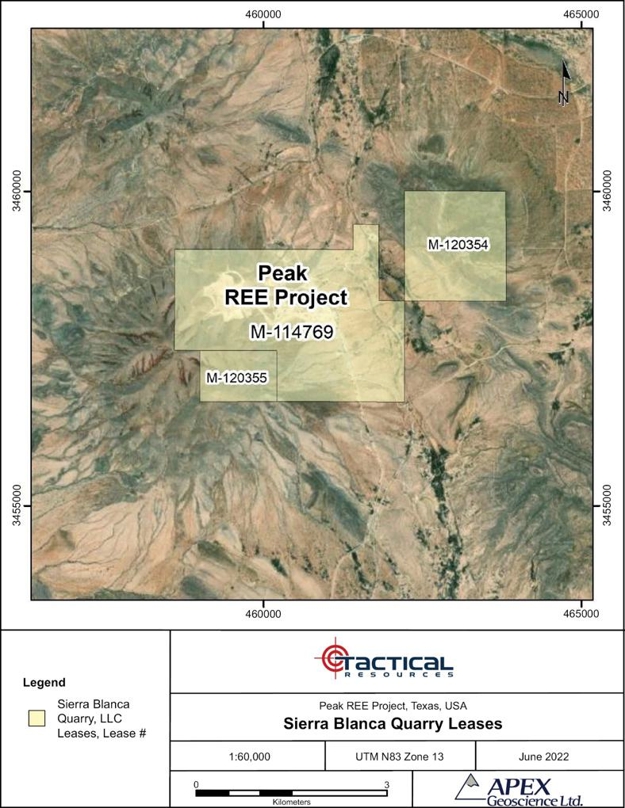
29
Property Ownership Summary
The property covering the Sierra Blanca laccolith was first obtained by Cabot Corporation (“Cabot”) in 1984 for beryllium exploration. Cabot subsequently entered a joint venture agreement with Cyprus Metals Company (“Cyprus”) in 1987 to continue beryllium exploration. Throughout the 1990s, the property fell back under control of the GLO after Cyprus terminated its beryllium exploration programs. In 2007, SBQ acquired the Sierra Blanca laccolith Property with the intent of excavating the rhyolite porphyry that constitutes most of the Sierra Blanca laccolith. (See Sections 4.2 through 4.5 of the Qualified Person’s Report).
SBQ first entered into a 15-year agreement with the State of Texas on February 1, 2013, in accordance with Chapter 53, Subchapter B, of the Texas Natural Resources Code for the grant of the Project Lease (1,803 acres). Subject to an extension, the Project Lease expires in February 2028. SBQ now operates a rhyolite-sourced railway ballast quarry and crushing plant. SBQ subsequently entered into 5-year agreements with the State of Texas on August 14, 2020, for Mining Leases M-120354 (640 acres) and M-120355 (240 acres), which are contiguous to the Project Lease. Mining Leases M-120354 and M-120355, which are not material to the operation of TRC, expired and were not renewed in August 2025. Mining Lease M-114769 (the “Project Lease”), which is the focus of Peak REE Project and material to the operation of TRC, comprises 1,803 acres, and is active through February 2028.
The Project Lease was granted for the purpose of prospecting for, exploring for, producing, developing, mining, extracting, milling, removing, and marketing the following: Rhyolite, granite, and other similar igneous rocks and the rocks, minerals and mineral substances that are contained in or are necessarily and actually produced in conjunction with or incidental to the named material.
The Project Lease provides SBQ with all rights with respect to the surface and subsurface thereof for any, and all, purposes, together with the rights of ingress and egress and use of the property and its mineral lessees, for purposes of exploring for and producing the minerals which are not covered by the terms of the lease, but which may be located within the surface boundaries of the leased area.
With respect to maintenance, $10,000 was paid by SBQ to GLO for the Project Lease, which corresponds to $5.56 per acre on the 1800 acres covered by the Lease. Payments from SBQ to GLO of $100,000 under the Project Lease are due annually.
On June 1, 2021, Peak 6891 LLC (the “Peak LLC”) and SBQ entered into an agreement with respect to the purchase and sale of existing tailings covered under the Project Lease (the “Original Offtake Agreement”). On July 14, 2021, TRC and the Peak LLC executed and delivered an assignment and agreement pursuant to which the Peak LLC agreed to sell to TRC and TRC agreed to purchase the right, title, and interest of the Peak LLC in and to the Original Offtake Agreement. The Original Offtake Agreement provided that SBQ shall subscribe for 10% of the issued shares of the Peak LLC in consideration of the sum of $100.00, and TRC understands that SBQ has made its own arrangements with the Peak LLC with respect to the satisfaction of such condition.
On July 30, 2021, TRC and SBQ executed a purchase and sale agreement (the “SBQ Offtake Agreement”) with respect to mine tailings covered under the Project Lease and agreed to terminate the Original SBQ Offtake Agreement upon the execution and delivery of this SBQ Offtake Agreement. The term of the SBQ Offtake Agreement is 15 years, renewable for so long as SBQ is directly or indirectly the holder of the Project Lease as well as all renewals, extensions and new leases of like kind and tenor in the same geographical location as the Project Lease.
On May 13, 2022, TRC and SBQ executed an Amending Agreement that stipulates (1) historical stockpiles of not less than four million tons of tailings material on, about, or under the leased premises, (2) a delivery schedule in which SBQ estimates the annual tailings production, and TRC and SBQ execute purchase agreements on a calendar year basis, and (3) an exclusive one-time option to purchase all membership interest in SBQ.
SBQ operates a ballast mine and crushing plant at the Quarry for the recovery of rhyolite, granite, and other similar igneous rocks. During such operations, SBQ generates waste tailings that are stockpiled within the Project Lease. SBQ estimates that the plant currently generates approximately 2,000 tons of tailings daily when the plant is operational.
SBQ has agreed to sell to TRC, and TRC has agreed to purchase from SBQ, the tailings, in amounts selected by TRC, in its sole discretion, all on and subject to the terms and conditions of the SBQ Offtake Agreement and Amending Agreement. It is understood and agreed by both parties that most of the tailings from the leased premises shall be available for sale to TRC, should TRC so choose to purchase such tailings. To date, TRC has not purchased any of the tailings.
30
Mining Lease agreements in the State of Texas are subject to production royalty payments corresponding to a minimum of 6.25% of the value of the leased minerals produced from the leased premises. The Project Lease is subject to a production royalty of:
| ● | 11% of the market value of the first 350,000 tons of leased minerals produced from the leased premises each year, and, |
| ● | 10% of the market value for all production more than the first 350,000 tons of leased minerals produced from the leased premises each year. |
The market value is defined as the higher of, at the option of the GLO Commissioner: (1) gross proceeds received by SBQ from the sale of the leased minerals and including any reimbursements for severance taxes and production related costs, or (2) highest price for materials or minerals produced from the leased premises or from other mines and that are comparable in quality to the produced leased minerals. For purposes of computing and paying royalties under the Project Lease, the market value is be presumed to be the gross proceeds received by SBQ pursuant to a bona fide transaction entered at arm’s length with a non-affiliated party of adverse economic interests.
The royalty due may be adjusted at the discretion of the GLO Commissioner if SBQ incurs additional costs outside the performance of its duty to put the leased minerals into a make marketable condition. These additional costs may include post-mining costs such as the cost of upgrading, loading, handling, and transporting the leased minerals to a buyer away from the leased premises, if SBQ incurs these costs pursuant to a bona fide transaction entered at arm’s length with a non-affiliated of adverse economic interests.
An initial minimum advance royalty of $10,000 is to be paid to the GLO immediately upon commencement of production of the leased minerals from the premises leased under the Project Lease. The same minimum advance royalty ($10,000) is to be paid to the GLO in advance for each lease year (as determined by the anniversary date of the lease) in which the leased minerals are produced from the leased premises, regardless of the amount of actual production.
Potential royalty payments associated with any future REE production facility by TRC would include tonnage fees for the tailings material, and mineral worth of the tailings (i.e., REE/ton). The mineral worth royalty payment would be negotiated between TRC and the GLO.
Historical Exploration
The first documented minerals related exploration in the Sierra Blanca range area occurred in 1968 after the discovery of widespread fluoritization at the Sierra Blanca, Round Top, Little Blanca, and Little Round Top volcanic peaks. The fluorite occurrences were explored between 1971 and 1980 before being deemed unprofitable. However, the historical exploration revealed the potential for beryllium, uranium, tin, and zinc. (See Section 6.2 of the Qualified Person’s Report).
In January 1987, Cyprus Metals Company and Cabot Corporation formed a joint venture agreement in which the Sierra Blanca laccolith was subject to shallow drill holes that targeted vein and fault-controlled beryllium mineralization. Cyprus Metals Company reportedly excavated a pit to a depth of 200 feet on the Sierra Blanca laccolith, which was then filled with tailings from the current Quarry mining activity. Cyprus terminated its beryllium exploration and mining programs at Sierra Blanca in 1993.
In 2007, SBQ acquired the Sierra Blanca laccolith Property and has since excavated the rhyolite porphyry as a source of railway ballast for the Union Pacific Railroad Company.
In 2020, the Sortros Group of Companies conducted two small sampling programs — as permitted by SBQ — that resulted in the collection of tailings material and rock samples at the Quarry. Six samples were analyzed for whole rock and trace element, including rare earth metals. The Sortros Group of Companies also commissioned a preliminary metallurgical study in which CVMR (a privately held, metal refining technology provider) proposed the conversion of rare earth oxides to chlorides and then applying vapor phase production techniques to isolate the rare earth chlorides by temperature.
With respect to historical mineral processing, more work is required by TRC to assess rare earth element extraction technologies that are applicable to the Sierra Blanca rhyolite laccolith tailings material.
31
Current Operations
The Peak REE Project is an early-stage exploration property. Currently, there has been insufficient exploration to allow for an estimate of a mineral resource, nor have any such REE minerals been extracted on a commercial basis. TRC has no equipment or facilities located on the Peak REE Project at this time.
SBQ presently mines rhyolite and rhyolite porphyry that form the Sierra Blanca laccolith to produce railway ballast. The overall footprint of the mine is approximately 1.7 miles east-west by 0.75 miles north-south and is composed of 2 sub-areas that include (1) the active mine excavation and crushing area, and (2) a wash plant and railcar loading area, which also includes part of an historical quarry area that was focused on beryllium, which mostly occurs in contact metasomatic veins and replacements in limestone directly underlying the rhyolite laccolith. (See Section 6.2 and 7.2 of the Qualified Person’s Report).
The tailings material at the Quarry is defined as discarded ballast rhyolite crush fragments of less than three-quarters of an inch in size. The tailings stockpile dumps are situated in organized stockpiles throughout the mine site and form either as topographic highs or infill in previously excavated areas.
TRC is interested in the rare earth element potential of the tailings material derived from the Quarry ballast mining activity. Historical and current exploration conducted by TRC show that the tailings material has elevated rare earth elements, which may be of commercial interest because the elements have become vital to manufacturing numerous high-tech products.
The present-day Quarry mine plan and primary tailings stockpiles are presented in the picture below. The location of mine tailings prior to 2007 (i.e., the Cyprus mine discards), filled the open pit that is presently located in the eastern part of the mine plan and is labelled as “historical quarry” in the picture below.
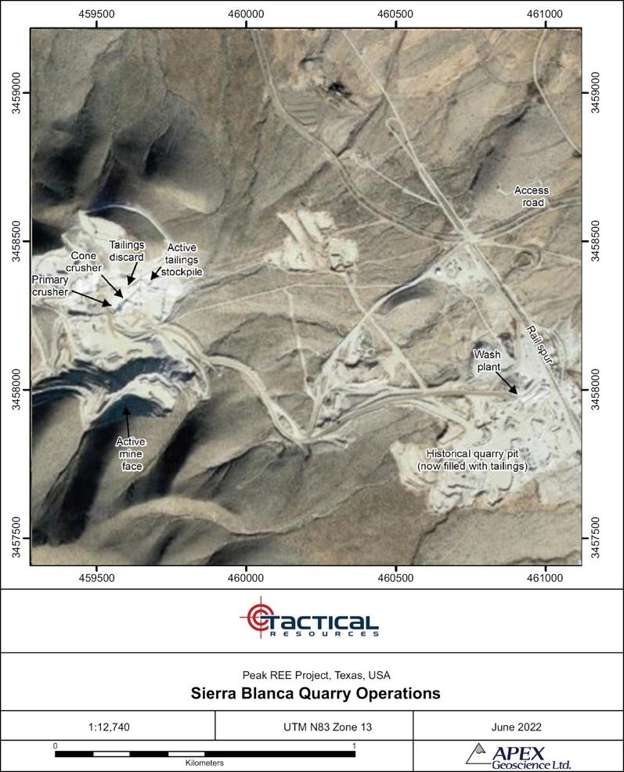
32
Permitting.
SBQ is the legal and beneficiary holder of the Project Lease and the agreement between SBQ and TRC for the Peak REE Project is solely related to the sale and purchase of tailings. Therefore, TRC is not bound by any environmental liabilities related to the Quarry mining activity at this time. (See Section 4.6 of the Qualified Person’s Report). That is,
| ● | The mine permits for the current Quarry operation, which include storm water runoff, air quality, and mine reclamation plans are granted to, and managed by, SBQ. |
| ● | TRC Peak REE Project is an early-stage exploration project, and TRC has yet to consider modifying factors and advanced scoping studies toward development of a REE processing facility, which could be developed on-site at the Quarry, or off-site. |
If the Peak REE Project progresses to the developmental stages of an “on-site” REE-from-tailings extraction plant PubCo would be obligated to acquire the required federal and state permits and licenses, and the following permits — if required — would require consideration by TRC.
| ● | Air permitting regulations and fees in accordance with the State Texas Commission on Environmental Quality (TCEQ), and federally, by the U.S. Environmental Protection Agency |
| ● | Storm Water — General Construction Permit and Industrial Storm Water Multi-Sector General Permit as regulated by the TCEQ. |
| ● | Public Water System Authorization including Potable Water Usage prior to use of non-municipal water as drinking water source, and Water Right Permit prior to using surface water or runoff as regulated by the State TCEQ. |
| ● | Storge of petroleum products on site as regulated by the TCEQ and an Explosives Permit as regulated by the US Bureau of Alcohol, Tobacco, Firearms, and Explosives. |
| ● | Hazardous Waste Management Activity and Hazardous Waste Permit (RCRA), and Radioactive Material License as regulated by the TCEQ. |
If the Peak REE Project progresses to the developmental stages of an “on-site” REE-from-tailings extraction plant, a Phase 1 Environmental Site Assessment Report would be conducted for the site and processing facility.
Results of Exploration
In 2021, TRC commissioned Tigren Inc. of Sparks, NV, to conduct a sampling program at the Quarry. A total of 40 samples were collected at various tailings locations within the Quarry. The samples were subjected to two analytical batch tests at American Assay Laboratories Inc. in Elko, NV, the first by Tigren Inc. and the second by TRC. The analytical work included lithium + rare earth elements (lab code ICP-5AREE), multi-elements (ICP-5AM48), whole rock (WD-XRF), and specific gravity measurements. The Qualified Person advocates that the digestion method used by TRC should be changed to a lithium borate fusion. The sampling program included blind Blank Samples and Sample Standards, the results of which, demonstrated good reproducibility of results and data quality. (See Section 11.4 of the Qualified Person’s Report).
Based on the geochemical analytical results derived from TRC 2021 exploration program, the Sierra Blanca laccolith tailings material is rhyolite that is metaluminous-peraluminous, silica-rich, and alkali-calcic. Trace element distributions are representative of a within plate granite setting associated with ferroan, A-Type granites. The chondrite normalized rare earth element profiles show the tailings material has elevated rare earth elements and distinct, anomalous, negative Eu anomalies. The tailings material is also enriched in high field strength and large-ion lithophile elements that include, for example, Li, Be, Nb, Rb, Y, and Zr.
Specific gravity measurements on 40 samples yield between 2.19 and 3.26 g/cm3 with an average of 2.67 g/cm3.
33
The quality assurances and quality control (“QA-QC”) protocol from TRC’s Peak REE Project 2021 exploration campaign included:
| ● | For the set of geochemical analyses commissioned by Tigren Inc. on behalf of TRC |
| ● | Original samples: 40 samples (PK-01 through PK-40). |
| ● | Duplicate samples: 5 samples (PK-09-X, PK-14-X, PK-19-X, PK-29-X, and PK-40-X). |
| ● | Lab blank samples: 2 samples. |
| ● | Lab standard samples: 2 samples (OREAS 905 and OREAS 600b). |
| ● | For the set of geochemical analyses commissioned by TRC |
| ● | Original samples: 40 samples (PK-01 through PK-40). |
| ● | Duplicate samples: 7 samples (PK-05-X, PK-13-X, PK-15 dup, PK-19-X, PK-27-X, PK-34-X, and PK-38-X). |
| ● | Blind blank samples: 2 samples (PK-41 and PK-43, corresponding to OREAS Silica Blanks). |
| ● | Blind standard samples: 1 sample (PK-42, corresponding to OREAS 461) |
| ● | Lab blank samples: 2 samples. |
| ● | Lab standard samples: 3 samples (OREAS 905, OREAS 600b, and OREAS 602b). |
| ● | For the set of whole-rock WD-XRF analyses commissioned by TRC |
| ● | Original samples: 20 samples. |
| ● | Duplicate samples: 4 samples (PK-03-X, PK-08 dup, PK-26-X, and PK-30-X). |
| ● | Blind blank samples: 2 samples (PK-44 and PK-46, corresponding to OREAS Silica Blanks). |
| ● | Blind standard samples: 1 sample (PK-45, corresponding to OREAS 463) |
| ● | Lab blank samples: 1 sample. |
| ● | Lab standard samples: 4 samples (OREAS 906, OREAS 907, OREAS 62, and NBM-1). |
| ● | For the specific gravity analyses commissioned by TRC |
| ● | Original samples: 40 samples (PK-01 through PK-40). |
| ● | Duplicate samples: 1 sample (PK-15 dup). |
| ● | Blind blank samples: 2 samples (PK-41 and PK-43, corresponding to OREAS Silica Blanks). |
| ● | Blind standard samples: 1 sample (PK-42, corresponding to OREAS 461). |
| ● | Blind blanks and blind standards were inserted alternating every 10th original sample. Lab blanks and standards were randomly inserted in the sample stream. |
34
| ● | Results of Duplicate Samples: |
| ● | A total of 17 duplicate samples were analyzed at American Assay Laboratories Inc.: 5 samples for the due diligence geochemical analyses, 7 samples for the second set of geochemical analyses, 4 samples for whole-rock WD-XRF analyses, and 1 sample for the specific gravity analysis. There is good data quality as depicted by the low relative standard deviation (“RSD”) percentage values that mostly range between 0 and 4%, 0 and 2.5%, 0 and 1%, and 9.9% respectively. |
| ● | Results of Blind Blank Samples: |
| ● | 4 blind blank samples were analyzed at American Assay Laboratories Inc. for QA-QC protocol related to trace/major element geochemical analyses. These blank samples, composed of nearly pure silica sand (OREAS Coarse Silica Blank Material), were inserted as blind samples into the sample stream, and yielded 98.1 and 98.4 weight% SiO2 for PK-44 and PK-46 respectively which is an accurate result, and trace elements concentrations for PK-41 and PK-43 in accordance with the certified values. |
| ● | Results of Blind Standard Samples: |
| ● | Two blind standard samples were analyzed at American Assay Laboratories Inc. for QA-QC protocol related to trace/major element geochemical analyses. These standard samples consisted of sample PK-42 corresponding to the certified reference material OREAS 461, and sample PK-45 corresponding to the certified reference material OREAS 463. The RSD of the standard sample analysis and the certified OREAS result is between 0.1 and 7.4% and between 0.3 and 8.9% respectively. The analytical results of samples PK-42 and PK-45 mostly plot within 2 standard deviations of the OREAS certified results, indicative of good data quality. |
| ● | With respect to the Tactical Resources 2021 exploration program, the qualified person has reviewed the adequacy of the sample preparation, security, and analytical procedures and found no significant issues or inconsistencies that would cause one to question the validity of the data. The work conducted was completed using an independent, accredited laboratory and reasonable REE standard sampling practices, QA-QC protocols, and analytical methods. The QA-QC results of the subsequent are of good quality. The qualified person is therefore satisfied with the adequacy of the sample preparation, security, and analytical procedures as implemented by TRC and American Assay Laboratories Inc. |
TRC initiated mineralogical investigations at the University of Texas to obtain a better understanding of the mineralogy and chemistry that constitutes the Peak REE Project tailings material. Backscattered electron gigapan images and energy-dispersive X-ray spectra experiments were conducted on 4 samples that yielded common accessory minerals including cassiterite (SnO2), columbite (Fe2+Nb2O6), yttrofluorite (Ca0.7Y0.3F2.3), yttrocerite (CaF2+ (Y,Ce)F3), thorite ((Th,U)SiO4), and zircon (ZrSiO4).
In 2022, TRC commissioned Frank X. Spencer and Associates to conduct two unmanned aerial vehicles, or drone, surveys on the active tailings pile area at the Quarry. The first drone survey was intended to assess the volume of tailings in the active tailings pile of the Quarry. The second drone survey was intended to assess the monthly volume of tailings material being added to the active tailings pile. The surveys were prepared by State of Texas Registered Land Surveyors and yield valid information related to the position and lateral scale of the tailings material stockpiles at the Quarry.
During June to August 2022, a metallurgical test program was completed on behalf of TRC by Kemetco Research in Richmond, BC Canada to assess direct leach amenability, and maximum extraction potential of the rare earth elements and lithium. The 40 TRC field samples collected in 2021 were composited into 3 “Tails” samples for metallurgical testing, with the following weights and head assay values:
| ● | Tails 1: 56.7 kg composite; 366.4 mg/kg TREO (including Y), 94.1 mg/kg LREEs, 196.4 mg/kg HREEs + Y, 189 mg/kg Li; |
| ● | Tails 2: 30.6 kg composite; 358.0 mg/kg TREO (including Y), 93.3 mg/kg LREEs, 190.4 mg/kg HREEs + Y, 188 mg/kg Li; and |
| ● | Tails 3: 45.0 kg composite; 362.1 mg/kg TREO (including Y), 98.9 mg/kg LREEs, 188.6 mg/kg HREEs + Y, 193 mg/kg Li. |
35
The head assay values of the composite Tail samples correlate well with the assay test work, which shows the metallurgical test samples were representative of the Sierra Blanca tailings material. Scoping bottle roll, agitated tank, acid tank and water leach tests, and extraction results, include:
| 1. | 48-hour bottle roll extractions with 200 g/L sulfuric acid (ambient temperature) that extracted 93-97% yttrium (Y), 75-84% lanthanum (La), 79-88% neodymium (Nd), 75-85% cerium (Ce), 92-95% dysprosium (Dy), 88-93% ∑REE+Y, 79-87% LREE, 92-96% HREE+Y, and 27-28% lithium (Li). |
| 2. | 48-hour bottle roll extractions with 200 g/L hydrochloric acid (ambient temperature) that resulted in low ∑REE extractions, below 25.3% at 32 μm and 21.5% at 61 μm. Lithium extractions were below 28.8% at 32 μm and 26.7% at 61 μm. |
| 3. | 48-hour agitated tank extractions with 50 g/L sulfuric acid (90o C) that extracted 93-94% Y, 77-79% La, 76-80% Nd, 75-85% Ce, 89-90% Dy, 89-90% ∑REE+Y, 79-81% LREE, 92-93% HREE+Y, and 33-42% Li. |
| 4. | 48-hour agitated tank extractions with 50 g/L hydrochloric acid (90o C) that extracted 94-96% Y, 94-95% Nd, 93% Ce, 93-95% Dy, 95.6-96.1% ∑REE+Y, and 66.2% Li, 87.6% Li, and 86.3% Li for Tails 1, Tails 2, and Tails 3, respectively. |
| 5. | Acid bake (with sulfuric acid) followed by water extraction that extracted 54-77% Y, 68-74% Nd, 73-87% Ce, 41-70% Dy, and 90-96% Li. Reducing the acid bake temperature to from 325o C to 250o C resulted in 62% Y, 69% Nd, 76% Ce, 51% Dy, and similar lithium extractions (95%). |
Conclusions of Technical Expert
TRC Peak REE Project is a co-product opportunity of merit. (See Section 4.1 of the Qualified Person’s Report). Points to support this contention include:
| ● | The Sierra Blanca laccolith rhyolite, or rhyolite porphyry — and its associated tailings waste material — can be defined as highly evolved magmatic rocks in which a silica-rich magmatic system has undergone a high-degree of late-stage magmatic fractional crystallization. |
| ● | The rhyolite contains mineral assemblages that represent precipitates of the evolved magmatic silicate melts, and as such, are uniquely elevated in rare earth elements, lithium, beryllium, fluorine, niobium, rubidium, thorium, tin, uranium, yttrium, and zircon. |
| ● | Based on TRC 2021 geochemical analytical results, the Quarry tailings material is chemically homogenous, which may suggest that the crystallization process was relatively rapid and occurred within an isolated magmatic system. |
| ● | The tailings material is process-testing-ready in that the rhyolite material has already been mined from its original quarry benches, moved within the quarry site, crushed, conveyed, and finessed to individual tailing stockpiles. |
| ● | TRC has executed the SBQ Offtake Agreement with SBQ in which TRC has acquired the tailings material and is therefore free and clear of all encumbrances with respect to testing, and the potential commercialization, of rare earth element production associated with the tailings. |
| ● | TRC has access to potential rare earth element processing areas located within the quarry site, or to a rail line in which the TRC can transport the tailings material to another processing site. |
| ● | The Quarry is easily accessible, has an associated rail spur and rail line network, there is a lot of space within the Project Lease to build demonstration and/or processing plants, has power directly to the Quarry (although an upgrade would likely be required if any future processing plant was developed within the Project Lease). |
| ● | Rare earth elements are critical minerals that represent an opportunity for the U.S. to enter an emerging and globally strategic market. Rare earth elements are required to manufacture high technology products, including high-powered magnets fuel cells, superconductors, clean energy, aerospace, automotive, defense, and many other industrial products. While rare earths are abundant geologically, they are economically recoverable in only a few mineral deposits. |
36
The Qualified Person’s report summarizes TRC 2021-2022 exploration work, which includes geochemical sampling program and analyses, mineralogical investigations, and unmanned aerial vehicle surveys to better delineate the two-dimensional spatial extent of the tailings stockpiles. The Qualified Person has reviewed all exploration work conducted by TRC and concludes that:
| ● | The exploration work is relevant to the initial assessment of the early exploration stage Peak REE Project. While the exploration results are material to TRC, there has been insufficient exploration to allow for an estimate of a mineral resource. It is uncertain if further exploration will result in the estimation of a mineral resource. |
| ● | The work was conducted in a reasonable manner that is compliant with the Canadian Institute of Mining, Metallurgy and Petroleum “Mineral Exploration Best Practice Guidelines” (2018), Canadian Securities Administration’s National Instrument 43-101 Standards of Disclosure for Mineral Projects, and guidelines for technical reporting and in accordance with the requirements of S-K 1300. |
| ● | The Qualified Person has reviewed the adequacy of the sample preparation, security, and analytical procedures and found no significant issues or inconsistencies that would cause one to question the validity of the data associated with TRC 2021 exploration program. The work conducted was completed using accepted standard sampling practices, QA-QC protocols, and analytical methods. |
The analytical data were prepared by an independent laboratory, American Assay Laboratories Inc., and the analytical methods carried out by the laboratory are standard and routine in the field geochemical analytical work for the rock type and commodity type being evaluated by TRC.
Uncertainty and Risk
TRC will attempt to reduce risk/uncertainty through effective project management, engaging technical experts and developing contingency plans. With respect to property-related potential risks and uncertainties, the qualified person notes that:
| 1. | Any forfeiture of the Project Lease by SBQ would imply an inability for SBQ to supply continued tailings material to TRC under the SBQ Offtake Agreement. |
| 2. | The ability of SBQ to provide TRC with ongoing tailings material depends upon continued performance under the ballast sales agreement between SBQ and Union Pacific Railroad Company. |
| 3. | There is no guarantee that TRC will obtain all the necessary permits, environmental assessment approvals, and mine closure and rehabilitation plan approvals required to operate a REE processing facility from the Texas GLO. |
| 4. | Finally, there is no guarantee that TRC can successfully extract REE from the Sierra Blanca Quarry mine tailings in a commercial capacity. Additional metallurgical testing, process development and scale-up work remain to be completed. Ultimately, there is a risk that the scalability of any future initial bench-scale or pilot-scale mineral processing/metallurgical test work may not translate to a full-scale commercial operation. |
ITEM 4A. UNRESOLVED STAFF COMMENTS
None.
37
Item 5. OPERATING AND FINANCIAL REVIEW AND PROSPECTS
You should read the following discussion and analysis in conjunction with our audited financial statements and notes thereto for the year ended July 31, 2026 included herein.
This Report contains forward-looking statements. These statements relate to future events or our future financial performance. In some cases, you can identify forward-looking statements by terminology such as “believe,” “expect,” “intend,” “anticipate,” “estimate,” “may,” “will,” “can,” “plan,” “predict,” “could,” “future,” “continue,” variations of such words, and similar expressions. These statements are only predictions. Actual events or results may differ materially. In evaluating these statements, you should specifically consider various factors, including the risks outlined at the beginning of this Report under “Cautionary Notice Regarding Forward-Looking Statements” and in our other reports we file with the SEC. These factors may cause our actual results to differ materially from any forward-looking statements. Except as required by law, we undertake no obligation to publicly release any revisions to these forward-looking statements that may be made to reflect events or circumstances after the date hereof or to reflect the occurrence of unanticipated events.
Overview
Tactical was incorporated under the Business Corporations Act of British Columbia on June 25, 2018. The principal business of the Company is exploration and development of Rare Earth Elements (“REE”).
The Company’s head office, principal address, registered address and records office is 1055 West Georgia Street, 1500 Royal Centre, Vancouver, British Columbia, Canada V6E 4N7.
The Company’s common shares were listed on August 20, 2026 on the NASDAQ Capital Market under the ticker symbol “TREO”. Previously, the Company’s common shares were listed on the TSX Venture Exchange (under the symbol “RARE.V”) and were quoted in the United States on the OTC Markets under the symbol “USREF”.
Qualified Person (QP)
Norman Chow, P.Eng., is the designated Qualified Person (QP) under National Instrument 43-101 (“NI 43-101”), with respect to the disclosure of metallurgical scientific and technical reporting regarding the Peak project.
Roy Eccles, P.Geo., is the designated Qualified Person (QP) under National Instrument 43-101 (“NI 43-101”), with respect to the disclosure of geological scientific and technical reporting regarding the Peak project.
Results of Operations
Three Months Ended July 31, 2026 compared with the Three Months Ended July 31, 2025
The Company is in the exploration stage and has not generated revenue from operations. During the three months ended July 31, 2026, the Company recorded a net loss of $1,155,280, compared to a net loss of $758,242 for the three months ended July 31, 2025. The increase in net loss was primarily attributable to higher property investigation costs and travel expenses, partially offset by lower transaction costs, consulting fees and stock-based compensation expense.
During the three months ended July 31, 2026, the Company incurred the following significant expenditures:
| ● | Transaction costs were $315,819 for the three months ended July 31, 2026, compared to $393,287 for the three months ended July 31, 2025. The decrease was primarily attributable to lower legal and corporate advisory fees incurred in connection with the proposed transaction compared to the prior period. |
| ● | Consulting fees were $55,561 for the three months ended July 31, 2026, compared to $78,242 for the three months ended July 31, 2025. The decrease was primarily attributable to lower government relations consulting fees incurred during the period. |
| ● | Stock-based compensation was $nil for the three months ended July 31, 2026, compared to $35,963 for the three months ended July 31, 2025. The prior-period expense related to stock-based compensation recognized in connection with the Company’s equity incentive awards. |
| ● | Travel expenses were $79,896 for the three months ended July 31, 2026, compared to $nil for the three months ended July 31, 2025. The increase was primarily attributable to additional travel undertaken by management and Company personnel during the period. |
| ● | Investor relations expenses were $16,292 for the three months ended July 31, 2026, compared to $452 for the three months ended July 31, 2025. The increase was primarily attributable to higher media and website costs, as well as costs associated with news releases issued during the period. |
38
Year Ended July 31, 2026 compared with the Year Ended July 31, 2025
The Company is in the exploration stage and has not generated revenue from operations. During the year ended July 31, 2026, the Company recorded a net loss of $2,932,330, compared to a net loss of $4,717,108 for the year ended July 31, 2025. The decrease in net loss was primarily attributable to lower transaction costs, stock-based compensation expense, consulting fees and property investigation costs, as well as a gain on extension of accounts payable and recovery of property investigation costs recognized during the year. These decreases were partially offset by higher professional fees, travel expenses, foreign exchange losses and the impairment of deferred acquisition costs.
During the year ended July 31, 2026, the Company incurred the following significant expenditures:
| ● | Transaction costs were $1,331,383 for the year ended July 31, 2026, compared to $2,630,219 for the year ended July 31, 2025. The decrease was primarily attributable to lower legal and corporate advisory fees incurred in connection with the proposed transaction compared to the prior year. |
| ● | Stock-based compensation was $nil for the year ended July 31, 2026, compared to $1,151,838 for the year ended July 31, 2025. The Company recognized stock-based compensation expense arising from bonus share agreements and the vesting of restricted share units during the prior year, with no corresponding expense recognized in the current year. |
| ● | Consulting fees were $291,902 for the year ended July 31, 2026, compared to $448,272 for the year ended July 31, 2025. The decrease was primarily attributable to transaction-related consulting costs and bonus payments recognized in the prior year that did not recur in the current year. |
| ● | Property investigation costs were $71,754 for the year ended July 31, 2026, compared to $118,239 for the year ended July 31, 2025. The decrease was primarily attributable to lower costs associated with technical studies conducted in connection with the evaluation and proposed acquisition of the Sierra Blanca Quarry Tailings project. |
| ● | Professional fees were $675,212 for the year ended July 31, 2026, compared to $173,257 for the year ended July 31, 2025. The increase was primarily attributable to higher legal and due diligence costs incurred in connection with the evaluation and proposed acquisition of the Sierra Blanca Quarry Tailings project. |
| ● | Travel expenses were $165,140 for the year ended July 31, 2026, compared to $nil for the year ended July 31, 2025. The increase reflects additional travel undertaken by management and Company personnel during the current year. |
| ● | Foreign exchange loss was $67,007 for the year ended July 31, 2026, compared to a foreign exchange loss of $13,518 for the year ended July 31, 2025. The increase primarily reflects fluctuations in foreign exchange rates during the respective years. |
| ● | Investor relations expenses were $42,431 for the year ended July 31, 2026, compared to $17,674 for the year ended July 31, 2025. The increase was primarily attributable to higher media and website costs, as well as costs associated with news releases issued during the year. |
| ● | Transfer agent and regulatory costs were $33,878 for the year ended July 31, 2026, compared to $11,159 for the year ended July 31, 2025. The increase primarily reflects higher regulatory filing fees related to the plan of arrangement and annual general meeting mailing costs. |
| ● | Gain on extension of accounts payable was $47,982 for the year ended July 31, 2026, compared to $nil for the year ended July 31, 2025. The gain relates to the extension of payment terms for certain accounts payable and the resulting remeasurement of the liabilities at fair value. |
| ● | Recovery of property investigation costs was $20,865 for the year ended July 31, 2026, compared to $nil for the year ended July 31, 2025. The recovery relates to a cost-sharing agreement entered into during the year. |
| ● | Impairment of deferred acquisition costs was $154,242 for the year ended July 31, 2026, compared to $nil for the year ended July 31, 2025. The impairment reflects the write-off of previously capitalized deferred acquisition costs following the Company's entry into the March 2026 Purchase and Sale Agreement with Sierra Blanca Quarry, LLC, which replaced the prior 2021 agreement and rendered the previously capitalized costs no longer recoverable. |
39
Liquidity and Capital Resources
Working capital and cash flow
The Company has no revenue-producing operations and has historically funded its activities through equity financings. As at July 31, 2026, the Company had accumulated losses of $16,259,562 (July 31, 2025 – $13,327,232), a working capital deficiency of $6,880,302 (July 31, 2025 – $4,702,025), and cash of $282,146 (July 31, 2025 – $46,469).
The Company’s available funds are primarily being used to evaluate the Sierra Blanca Quarry Project, including assessing existing tailings and advancing its option to acquire all or part of the Peak project.
The Company is dependent on external financing, including equity and debt financing, to fund its operations and meet its obligations as they come due. There can be no assurance that such financing will be available on acceptable terms, or at all. Management monitors its level of expenditures and may adjust planned activities as necessary to preserve working capital.
The Company has incurred losses since inception and has a working capital deficiency as of July 31, 2026. These conditions indicate the existence of a material uncertainty that may cast significant doubt on the Company’s ability to continue as a going concern.
Operating activities
Cash outflows of $849,849 were recorded from operating activities during the year ended July 31, 2026. This was primarily attributable to expenditures relating to consulting fees, corporate communications, general and administrative expenses, professional fees, property investigation costs, transfer agent and regulatory fees, and evaluation activities related to the Sierra Blanca Quarry Project.
Financing activities
Cash provided by financing activities was $1,090,726 for the year ended July 31, 2026, compared to $329,599 for the year ended July 31, 2025. During the period, the Company completed a non-brokered private placement consisting of 207,625 common shares for gross proceeds of $946,092. After payment of finder’s fees and share issuance costs, net proceeds totaled $846,067. The Company also received proceeds of $173,772 from the exercise of stock options and $70,887 from loans payable.
As of July 31, 2026, the Company had loans payable of $71,329, which are 8% interest bearing and repayable on demand.
Management intends to fund its operations through a combination of existing cash resources and future financings, including equity and debt financing. However, there can be no assurance that additional financing will be available on acceptable terms, or at all.
Critical Accounting Estimates
The preparation of financial statements in conformity with accounting principles generally accepted in the United States of America (“U.S. GAAP”) requires management to make certain estimates and assumptions. Such estimates and assumptions affect the reported amounts of assets and liabilities and disclosure of contingent assets and liabilities at the date of the financial statements and the reported amounts of revenues and expenses during the reporting period. Actual results could differ from those estimates. The most significant estimates included in the preparation of the financial statements are related to stock-based compensation and the discount rate used to determine the fair value of long-term accounts payable and convertible notes.
New Accounting Pronouncements
For a discussion of recently issued accounting pronouncements, see Note 2 of the annual financial statements.
Off-balance Sheet Arrangements
The Company does not utilize off-balance sheet arrangements.
40
Item 6. DIRECTORS, SENIOR MANAGEMENT AND EMPLOYEES
A. Directors and Senior Management
Executive Officers and Directors
The executive officers and directors of PubCo following the TRC Amalgamation will be as follows:
| Name | Age | Position | Class of Director | |||
| Ranjeet Sundher | 60 | Chief Executive Officer & Director | Class II | |||
| Kuljit Basi | 43 | Executive Chairman & Director | Class III | |||
| Jenny Kuan (Man Ching Shen) | 39 | Chief Financial Officer | N/A | |||
| Matthew Chatterton | 46 | Director | Class III | |||
| Manavdeep Mukhija | 40 | Director | Class II | |||
| J. Garry Clark | 66 | Director | Class I |
Director Biographies
Ranjeet Sundher, Chief Executive Officer and Director
Mr. Sundher specializes in early-stage project finance and structure. He has lived in Asia and North America for the last 20 years and has 25 years of capital markets experience. Mr. Sundher has over 25 years of experience in the mining sector and has acted as the President and CEO of public companies in the exploration space, where he has taken mining projects from grassroots exploration to feasibility study. Mr. Sundher’s roles have included serving as the CEO and as a director of Bolt Metals Corp. (“Bolt Metals”) (October 2017 to September 2024), the CEO (June 2019 to April 2021) and as a director (June 2019 to April 2024) of Pace Metals Ltd., and the CEO of DeepMarkit Corp. (November 2021 to February 2024) and as a director (March 2008 to March 2025). Mr. Sundher has developed and sold several successful private and public companies in the technology, resource and software space. He has also served as a director of several public companies in the mining and technology sectors.
Kuljit Basi, Executive Chairman and Director
Mr. Kuljit (Jeet) Basi is an established mining industry professional with over 19 years of technical leadership experience in global public mining companies including Newmont Corporation (“Newmont”), Goldcorp Inc. (“Goldcorp”) and Teck Resources Ltd. (“Teck”). Mr. Basi has a passion for growing a collaborative culture of technical excellence focused on maximizing net asset values. Since July 2020 to present, Mr. Basi has been the principal consultant for SVK Metrix Inc. (“SVK”), which company provides consulting advice to numerous natural resource companies including Modern Mining Technology Corp. (“Modern Mining”) and Ausenco Engineering. Mr. Basi has also served as the CEO of Modern Mining since March 2022. Prior thereto, from July 2019 to February 2020, Mr. Basi held the position of Senior Advisor, Newmont North America, where he was responsible for implementing industry leading best practices in the areas of technical services, project development and strategic planning across all of Newmont’s Canadian, U.S. and Mexican assets. Prior thereto, from February 2011 to June 2019, Mr. Basi held various positions with Goldcorp including the position of Corporate Manager of Processing & Metallurgy. During his eight-year tenure with Goldcorp, Mr. Basi established a track record of delivering bottom-line growth across major assets within Goldcorp’s global portfolio. Prior to Goldcorp, Mr. Basi worked, from September 2006 to January 2011, at Teck’s Highland Valley Copper operation where he most notably was involved in the mill optimization and expansion projects. Mr. Basi is an industry professional and has co-authored multiple publications within the technical community. Mr. Basi obtained his Bachelor of Applied Science in Mining and Mineral Process Engineering degree from the University of British Columbia with a Minor in Commerce in 2006.
Jenny Kuan (Man Ching Shen), Chief Financial Officer
Ms. Kuan is a Chartered Professional Accountant with more than a decade of experience in financial reporting, regulatory compliance, and capital markets for publicly traded and private companies. She has extensive experience preparing and reviewing financial statements and management reporting under both U.S. GAAP and IFRS, gained across roles in the United States and Canada. Since 2023, Ms. Kuan has served as Accounting Manager and Controller at Quantum Advisory Partners LLP (“Quantum”), a professional services firm providing Chief Financial Officer and full-cycle accounting services to private and public companies, where she leads financial reporting and regulatory compliance functions for multiple public companies and coordinates with auditors, legal counsel, transfer agents, and regulators on continuous disclosure obligations, financings, and corporate transactions. Prior to joining Quantum, she served as Senior Accountant and Commissions Manager at Kapitus LLC in New York from January 2018 to September 2020, where she managed month-end and year-end close processes, revenue recognition, commission accounting, and financial reporting under U.S. GAAP, and prepared management reporting packages and supporting schedules for external audits. She holds a Bachelor of Business Administration in Finance and Accounting (2011) from Simon Fraser University.
41
Matthew Chatterton, Director
Mr. Chatterton has over 20 years of experience in the design, development, and execution across a variety of projects and manufacturing operations and 12 years’ experience in the mining sector, primarily in equipment supply and process development for precious metal mines. His expertise includes project management, facility management, logistics, supply side processes and procedures at a number of international manufacturing operations in Canada, United States, China, Bulgaria, the Philippines and Israel. He has managed operational teams as large as eight direct or 120 indirect reports and has managed capital projects in excess of $35 million for production facilities and laboratories for mining and manufacturing businesses. He is currently the Chief Executive Officer at POWR Lithium Corp, where he has been serving in that role since December, 2023. Prior to POWR, Mr. Chatterton worked in various roles with Isracann Bioscience Inc (May 2019 to January 2023). He is also currently a director of UniDoc Health Corp., a role in which he has served since December 2021. Mr. Chatterton is a Professional Engineer and graduate of Canada’s Queens University with a Master of Applied Science degree in Chemical Engineering (2003) and an undergraduate degree in Applied Science in Engineering Chemistry (2002), a dual accredited Chemistry/Engineering program.
J. Garry Clark, Director
J. Garry Clark graduated with an HBSc (Geology) from Lakehead University, Thunder Bay, Ontario. Garry is a Professional Geologist registered with the Association of Professional Geoscientists of Ontario. After University he held various exploration Geological positions with Major and Junior explorers. In the late 1980’s Garry began his consulting career. Garry presently is a director or advisor for listed junior companies operating in Canada and internationally exploring for gold, base metals and critical metals including DeepMarkit Corp. (since November 2009), Ophir Gold Corp. (since May 2014), Bolt Metals Corp. (since October 2017), Canadian Palladium Resources Inc. (since August 2018), Wedgemount Resources Corp. (since January 2021), Pace Metals Ltd. (since August 2020) and General Copper Gold Corp. (since June 2021), and was formerly a director of Silver Dollar Resources Inc. (from November 2018 to February 2021). He is a member of various audit and compensation committees as well as well as being a director of the Ontario Prospectors Association.
Manavdeep (Mark) Mukhija, Director
Mr. Mukhija brings over 19 years of experience in the mining industry including roles with global mining companies such as Teck Resources (2006), Barrick (2007), BHP (2008-2013), and TransAlta (2014-2015). Since January 2024, Mr. Mukhija has served as the Chief Executive Officer of Eagle Nuclear Energy Corp., a company focused on uranium mining exploration and the development of nuclear energy technologies. Prior to that, from June 2023 to January 2024, Mr. Mukhija served as the Global Head of Business Development for Plotlogic, a mining technology company which utilizes artificial intelligence technology aimed at sustainably increasing mineral production and reducing waste. Mr. Mukhija was the General Manager Australia (January 2020 to May 2023) and Regional Manager (September 2018 to January 2020) for Motion Metrics Pty Australia Ltd., an industrial artificial intelligence and machine learning company catering to the mining industry with a specific focus on safety and productivity. Mr. Mukhija was responsible for the P&L, business development, project management, and logistics of the Motion Metrics (Australia) operations. With BHP, Mr. Mukhija was responsible for life of mine planning and asset value optimization. At TransAlta, Mr. Mukhija began as the Engineering Team Leader at the Sunhills Mine with 14 direct reports and then moved into a capital planning supervisory role where he was responsible for a $60 million annual sustaining capital budget for the operation. Mr. Mukhija is a Professional Engineer and graduate from the University of British Columbia with a Bachelor of Applied Science in Mining Engineering (2003) and has passed Level I of the CFA Program.
Cease Trade Orders and Bankruptcy
Except as disclosed below, within the last 10 years before the date of this report no proposed nominee for election as a director of TRC was a director or executive officer of any company (including TRC in respect of which this report is prepared) acted in that capacity for a company that was:
| (a) | subject to a cease trade or similar order or an order denying the relevant company access to any exemptions under securities legislation, for more than 30 consecutive days; |
| (b) | subject to an event that resulted, after the director or executive officer ceased to be a director or executive officer, in TRC being the subject of a cease trade or similar order or an order that denied the relevant company access to any exemption under the securities legislation, for a period of more than 30 consecutive days; |
| (c) | within a year of that person ceasing to act in that capacity, became bankrupt, made a proposal under any legislation relating to bankruptcy or insolvency or was subject to or instituted any proceedings, arrangement or compromise with creditors or had a receiver, receiver manager or trustee appointed to hold its assets; or has become bankrupt, made a proposal under any legislation relating to bankruptcy or insolvency, or become subject to or instituted any proceedings, arrangement or compromise with creditors, or had a receiver, receiver manager or trustee appointed to hold the assets of the proposed director; |
42
| (d) | subject to any penalties or sanctions imposed by a court relating to securities legislation or by a securities regulatory authority or has entered into a settlement agreement with a securities regulatory authority; or |
| (e) | subject to any other penalties or sanctions imposed by a court or a regulatory body that would likely be considered important to a reasonable securityholder in deciding whether to vote for a proposed director. |
Exceptions
Ranjeet Sundher is the former President, Chief Executive Officer and a director of Bolt Metals. On May 1, 2019, at the request of Bolt Metal’s management, Bolt Metals was granted a temporary management cease trade order (the “Bolt MCTO”) from the BCSC in connection with Bolt Metals’ filing of its audited annual financial statements and management’s discussion and analysis for the financial year ended December 31, 2018 (the “Annual Report”) and its unaudited interim financial statements and management’s discussion and analysis for the financial year ended March 31, 2019 (the “Q1 Report”). On June 27, 2019, Bolt Metals announced that the Annual Report and the Q1 Report had been filed, and the Bolt MCTO was subsequently lifted on July 2, 2019.
Kuljit (Jeet) Basi is a former director of Norra Metals Corp. (“Norra Metals”). On April 5, 2023, the BCSC ordered that all trading in the securities of Norra Metals cease (the “Norra Metals CTO”) until it files annual audited financial statements, MD&A, and the certification of annual filings for the year ended November 30, 2022, as required under National Instrument 51-102 — Continuous Disclosure Obligations. As of the date of this report, the Norra Metals CTO has not been revoked or rescinded.
Mathew Chatterton is a former officer of Isracann Biosciences Inc. (“Isracann”). On April 5, 2023, the BCSC ordered that all trading in the securities of Isracann cease (the “Isracann CTO”) until it files interim financial statements, MD&A, and the certification of interim filings for the period ended November 30, 2022, as required under National Instrument 51-102 — Continuous Disclosure Obligations. On April 6, 2023, the Canadian Securities Exchange (the “CSE”) announced that Isracann was in default of CSE requirements and is therefore suspended pursuant to CSE Policy 3 effectively immediately (the “Isracann Suspension”). The Isracann Suspension is considered a regulatory halt as defined in National Instrument 23-101 — Trading Rules. As of the date of this report, neither the Isracann CTO nor the Isracann Suspension have been revoked or rescinded.
Matthew Chatterton was a former director of The Vurger Co Ltd (“Vurger”) since April 4, 2022. Vurger is a private limited company incorporated under the Companies Act 2006 (United Kingdom) on July 11, 2016, and formerly operated a chain of a vegan fast food restaurants in England. On April 28, 2023, Vurger entered administration under the Insolvency Act 1986 (United Kingdom), leading to a “pre-packaged” administration sale of its assets which was announced and completed on May 5, 2023. Vurger was formally dissolved on June 18, 2025.
Manavdeep (Mark) Mukhija is a former director of Three Sixty Solar Ltd. (“Three Sixty”). On January 6, 2025, the BCSC ordered that all trading in the securities of Three Sixty cease (the “Three Sixty CTO”) until it files annual audited financial statements, MD&A, annual information form, and the certification of annual filings for the year ended September 30, 2024, as required under National Instrument 51-102 — Continuous Disclosure Obligations. As of the date of this report, the Three Sixty CTO has not been revoked or rescinded.
Penalties or Sanctions
No director, executive officer or promoter of TRC, and no shareholder holding a sufficient number of securities of TRC to affect materially the control of TRC, has been subject to:
| (a) | any penalties or sanctions imposed by a court relating to securities legislation or by a securities regulatory authority or has entered into a settlement agreement with a securities regulatory authority; or |
| (b) | any other penalties or sanctions imposed by a court or regulatory body that would likely be considered important to a reasonable investor in making an investment decision. |
43
Conflicts of Interest
TRC’s directors are required by law to act honestly and in good faith with a view to the best interests of TRC and to disclose any interests they may have in any project or opportunity of TRC. To the best of our knowledge, and other than as disclosed in the following paragraph, there are no known existing or potential conflicts of interest among TRC, our directors, officers or other members of management or of any proposed director, officer or other member of management as a result of their outside business interests.
There are potential conflicts of interest to which the directors and officers of TRC will be subject in connection with the operations of TRC. In particular, certain of the directors and officers of TRC are involved in managerial and/or director positions with other companies whose operations may, from time to time, be in direct competition with those of TRC. Conflicts, if any, will be subject to the procedures and remedies available under the Business Corporations Act (British Columbia) (the “BCBCA”). The BCBCA provides that in the event that a director has an interest in a contract or proposed contract or agreement, the director shall disclose his interest in such contract or agreement and shall refrain from voting on any matter in respect of such contract or agreement unless otherwise provided by the BCBCA.
B. Compensation
Historical Executive Compensation
“compensation securities” includes stock options, convertible securities, exchangeable securities and similar instruments including stock appreciation rights, deferred share units and restricted stock units granted or issued by PubCo or one of its subsidiaries for services provided or to be provided, directly or indirectly, to PubCo or any of its subsidiaries;
“external management company” includes a subsidiary, affiliate or associate of the external management company;
“NEO” or “named executive officer” means each of the following individuals:
| (a) | each individual who, in respect of PubCo, during any part of the most recently completed financial year, served as chief executive officer (“CEO”), including an individual performing functions similar to a CEO; |
| (b) | each individual who, in respect of PubCo, during any part of the most recently completed financial year, served as chief financial officer (“CFO”), including an individual performing functions similar to a CFO; |
| (c) | in respect of PubCo and its subsidiaries, the most highly compensated executive officer other than the individuals identified in paragraphs (a) and (b) at the end of the most recently completed financial year whose total compensation was more than $150,000, as determined in accordance with Form 51-102F6V Statement of Executive Compensation — Venture Issuers, for that financial year; |
| (d) | each individual who would be a named executive officer under paragraph (c) but for the fact that the individual was not an executive officer of PubCo, and was not acting in a similar capacity, at the end of that financial year. |
44
DIRECTOR AND NAMED EXECUTIVE COMPENSATION
During financial year ended July 31, 2026, based on the definition above, the NEOs of TRC were: Ranjeet Sundher, Chief Executive Officer and a director, Kuljit Basi, Executive Chairman and a director, and Alnesh Mohan, Chief Financial Officer. The directors who were not NEOs during the financial year ended July 31, 2026 were Matthew Chatterton, J. Garry Clark and Manavdeep (Mark) Mukhija.
During financial year ended July 31, 2025, based on the definition above, the NEOs of TRC were: Ranjeet Sundher, Chief Executive Officer and a director, Kuljit Basi, Executive Chairman and a director, and Alnesh Mohan, Chief Financial Officer. The directors who were not NEOs during the financial year ended July 31, 2025 were Matthew Chatterton, J. Garry Clark and Manavdeep (Mark) Mukhija.
During financial year ended July 31, 2024, based on the definition above, the NEOs of TRC were: Ranjeet Sundher, Chief Executive Officer and a director, and Alnesh Mohan, Chief Financial Officer. The directors who were not NEOs during the financial year ended July 31, 2024 were Kuljit Basi, Matthew Chatterton, J. Garry Clark and Manavdeep (Mark) Mukhija.
Abhishek Tamot ceased to be a director of TRC on September 7, 2022. J. Garry Clark was elected a director on September 7, 2022. Manavdeep (Mark) Mukhija was appointed a director on September 29, 2022.
Director and NEO Compensation, Excluding Options and Compensation Securities
Table of Compensation, Excluding Compensation Securities in Financial Years ended July 31, 2026 and July 31, 2025
The following table of compensation, excluding options and compensation securities, provides a summary of the compensation paid by TRC to NEOs and directors of TRC for the financial years ended July 31, 2026 and July 31, 2025. Options and other compensation securities are disclosed under the heading “Stock Options and Other Compensation Securities” of this report.
| Table of compensation excluding compensation securities | ||||||||||||||||||||||||||
| Name and position | Year | Salary, consulting fee, retainer or commission (C$) | Bonus
(C$) | Committee
or meeting fees (C$) | Value
of perquisites (C$) | Value
of all other compensation (C$) | Total compensation (C$) | |||||||||||||||||||
| Ranjeet Sundher | 2026 | 120,000 | Nil | Nil | Nil | Nil | 120,000 | |||||||||||||||||||
| Chief Executive Officer and Director | 2025 | 120,000 | Nil | Nil | Nil | Nil | 120,000 | |||||||||||||||||||
| Alnesh Mohan | 2026 | 151,840 | Nil | Nil | Nil | 147,420 | (1) | 299,260 | ||||||||||||||||||
| Chief Financial Officer | 2025 | 276,640 | Nil | Nil | Nil | Nil | 276,640 | |||||||||||||||||||
| Kuljit Basi | 2026 | 120,000 | Nil | Nil | Nil | Nil | 120,000 | |||||||||||||||||||
| Executive Chairman and Director | 2025 | 120,000 | Nil | Nil | Nil | Nil | 120,000 | |||||||||||||||||||
| Matthew Chatterton | 2026 | Nil | Nil | Nil | Nil | Nil | Nil | |||||||||||||||||||
| Director | 2025 | Nil | Nil | Nil | Nil | Nil | Nil | |||||||||||||||||||
| J. Garry Clark | 2026 | Nil | Nil | Nil | Nil | Nil | Nil | |||||||||||||||||||
| Director | 2025 | Nil | Nil | Nil | Nil | Nil | Nil | |||||||||||||||||||
| Manavdeep (Mark) Mukhija | 2026 | Nil | Nil | Nil | Nil | Nil | Nil | |||||||||||||||||||
| Director | 2025 | Nil | Nil | Nil | Nil | Nil | Nil | |||||||||||||||||||
| (1) | Represents transaction fees of C$147,420 paid to Quantum Advisory Partners LLP in connection with bookkeeping and other accounting services rendered in connection with the Business Combination. |
45
Outstanding Compensation Securities
Stock Options and Other Compensation Securities
New Form of Omnibus Incentive Plan under TSX Venture Exchange Policy
TRC’s Common Shares were delisted from the Canadian Securities Exchange and TRC’s Common Shares became listed on the TSX Venture Exchange effective on August 31, 2023. As part of the listing of TRC’s Common Shares on the TSX Venture Exchange (the “Exchange”), TRC’s board of directors (the “Board”) adopted a new form Omnibus Incentive Plan to comply with Exchange Policy 4.4 — Share Based Compensation (the “Omnibus Incentive Plan” or “Plan”). The Omnibus Incentive Plan replaces and supersedes TRC’s Omnibus Incentive Plan adopted by the Board of Directors on July 14, 2022. Shareholders ratified, confirmed and approved the Omnibus Incentive Plan dated for reference August 28, 2023, for continuation in accordance with the policies of the Exchange, at TRC’s annual general meeting held on December 7, 2023.
Material Terms
The following is a description of the key terms of the Omnibus Incentive Plan, which is qualified in its entirety by reference to the full text of the Incentive Plan.
The purpose of the Omnibus Incentive Plan is to promote greater alignment of interests between employees and shareholders, and to support the achievement of TRC’s longer-term performance objectives, while providing a long-term retention element.
The Omnibus Incentive Plan allows for a variety of equity-based awards that provide different types of incentives to be granted to TRC’s directors, officers, and other employees of TRC or a subsidiary, Management Company employees, eligible charitable organizations, consultants and Service Providers providing ongoing services to TRC and its Affiliates, who the Board may determine from time to time, in its sole discretion, to hold contributory positions in TRC or a subsidiary are eligible to participate in the Omnibus Incentive Plan, and will facilitate the grant of stock options (“Options”) and restricted share units (“RSUs”) (collectively, the “Awards”) representing the right to purchase one Common Share; and, in the case of RSUs, the right to receive one Common Share, the cash equivalent of one Common Share, or a combination thereof, in accordance with the terms of the Omnibus Incentive Plan. The following discussion is qualified in its entirety by the text of the Omnibus Incentive Plan.
Under the terms of the Omnibus Incentive Plan, the Board, or if authorized by the Board, a Committee of the Board, may grant Awards to eligible Participants, who are defined in the Omnibus Incentive Plan as directors, officers, and other employees of TRC. Awards may be granted at any time and from time to time in order to: (a) increase Participants’ interest in TRC’s welfare; (b) provide incentives for Participants to continue their services; (c) reward Participants for their performance of services; and (d) to provide a means through which TRC or a subsidiary may attract and retain able persons to enter its employment or into contractual arrangements. Participation in the Omnibus Incentive Plan is voluntary and, if an Eligible Participant agrees to participate, the grant of Awards will be evidenced by a grant agreement with each such Participant. The interest of any Participant in any Award is non-assignable and non-transferable, whether voluntary, involuntary, by operation of law or otherwise, except upon the death of the Participant.
For greater certainty, a Person whose employment with TRC or a subsidiary has ceased for any reason, or who has given notice or been given notice of such cessation, whether such cessation was initiated by such Employee, Service Provider, TRC or such Subsidiary, as the case may be, shall cease to be eligible to receive Awards under the Plan as of the date on which such Person provides notice to TRC or the Subsidiary, as the case may be, in writing or verbally, of such cessation, or on the Termination Date as defined under the Plan, for any cessation of a Participant’s employment initiated by TRC.
The Omnibus Incentive Plan provides that appropriate adjustments, if any, are made by the Board in connection with a reclassification, reorganization, consolidation, distribution, merger, amalgamation, plan of arrangement, spin-off, dividend payment or other change of the Common Shares issuable or amounts payable to preclude a dilution or enlargement of the benefits under the Omnibus Incentive Plan. In the event that a Participant receives Common Shares in satisfaction of an Award during a black-out period, such Participant shall not be entitled to sell or otherwise dispose of such Common Shares until such black-out period has expired.
The maximum number of Common Shares reserved for issuance, in aggregate, under the Omnibus Incentive Plan, together with all share-based compensation arrangements of TRC, is the sum of: (i) with respect to Options, 10% of the issued and outstanding Common Shares, calculated as at the date such Option is granted to any Eligible Participants, and (ii) with respect to RSUs, 3,567,448 Common Shares. The aggregate number of Common Shares (i) issued to Insiders (as a group) under the Omnibus Incentive Plan or any other proposed or established share-based compensation arrangement within any one-year period and (ii) issuable to Insiders (as a group) at any time under the Omnibus Incentive Plan or any other proposed or established share-based compensation arrangement, shall in each case not exceed 10% of the aggregate number of issued and outstanding Common Shares (on a non-diluted basis), or such other number as may be approved by the Exchange and the shareholders of TRC from time to time. The aggregate maximum number of Common Shares issued to any one Person under the Omnibus Incentive Plan within any one-year period shall not exceed 5% of the issued and outstanding Common Shares.
46
The total number of Common Shares, in aggregate, reserved and available for the grant and issuance of RSUs shall not exceed 3,567,448 Common Shares. The aggregate number of Common Shares (i) issued to any one consultant under the Omnibus Incentive Plan within any twelve-month period and (ii) issuable to all Persons retained to provide investor relations activities under the Omnibus Incentive Plan within any twelve-month period, shall in each case not exceed 2% of the issued and outstanding Common Shares, calculated at the date an Option is granted to such Investor Relations Service Providers. Investor Relations Service Providers are eligible to receive only Options pursuant to the Omnibus Incentive Plan and are not eligible to receive RSUs.
The aggregate number of Common Shares to all Eligible Charitable Organizations under the Plan and any other proposed or established Share Compensation Arrangements, shall not exceed one percent (1%) of the Outstanding Issue from time to time, calculated at the date a Charitable Stock Option is granted to such Eligible Charitable Organizations.
Pursuant to the Omnibus Incentive Plan, Options must be granted by the Board, or its appointed Board Committee, pursuant to terms specified in the Option Grant Agreement, including designated Eligible Participants, setting the term of the Options, the number of Options granted, the Option Price which shall not be less than the closing price of the Common Shares on the Exchange on the day prior to the date of grant (the “Market Value”), and the relevant vesting provisions. An Option shall be exercisable during a period established by the Board, which shall commence on the date of the grant and shall terminate no later than ten (10) years after the date of grant of the Award or such shorter period as the Board may determine. The Omnibus Incentive Plan provides that the exercise period shall automatically be extended if the date on which it is scheduled to terminate shall fall during a blackout period. In such cases, the extended exercise period shall terminate 10 business days after the last day of the blackout period.
With respect to Options granted to Investor Relations Service Providers the Board will specify the particular terms of such Options and will determine, at its sole discretion, the Investor Relations Service Providers who will receive Options, the number of Options to be granted and the date of grant of such Options, the Term and Option Price and the relevant vesting provisions, including Performance Criteria, if applicable. Vesting of Options granted to Investor Relations Service Providers will occur in stages over a period of not less than twelve months with a maximum of 25% of the Options vesting in any three-month period, and there can be no acceleration of the vesting requirements applicable to Options granted to Investor Relations Service Providers. All terms of Options awarded to Investor Relations Service Providers are subject to the Option Grant Agreement by which such Options are awarded, as well as to any applicable rules of the Exchange.
TRC has added the availability of a cashless exercise or net exercise provision to the Omnibus Incentive Plan, which cashless or net exercise provisions are not available to Investor Relations Service Providers. Cashless Exercise or Net Exercise allows for the exercise of Options based on selling a sufficient number of the Common Shares available for issue upon exercise of the Options to realize the payment of the Option Price and all applicable withholding obligations.
The Omnibus Incentive Plan also provides that the Board, or its appointed Committee, determines and the RSU Grant Agreement shall specify, the relevant conditions and vesting provisions, including the Performance Period and Performance Criteria required to achieve vesting. The Board shall also determine the RSU Restriction Period, provided that such RSU Restriction Period shall begin a minimum of one year following the date of the Award of the RSU as specified in the RSU Grant Agreement and such Restriction Period shall have an end date not exceeding three years after the calendar year in which the RSU Award was granted, subject to the RSU Vesting Determination Date. The RSU Vesting Determination Date must fall after the end of the Performance Period and must be no later than the last day of the RSU Restriction Period. Unless specified otherwise in the RSU Grant Agreement, one-third (1/3) of RSUs awarded pursuant to the RSU Grant Agreement shall vest on each of the first three anniversaries of the date of grant specified in the RSU Grant Agreement. No RSUs will vest prior to one year from the date of award of such RSU. Acceleration of vesting of RSUs is permitted in connection with the death of the relevant Participant; or in connection with a change of control, take-over bid, reverse-take-over or other similar transaction. The Omnibus Incentive Plan has been amended to add that, if upon receipt by TRC of a RSU Redemption Notice, TRC does not have a sufficient number of Common Shares reserved for issuance under the Incentive Plan, in lieu of issuing Common Shares to settle the RSUs, TRC will make payment of a cash amount to the applicable Participant for a value equal to the number of RSUs multiplied by the Market Value, subject to any applicable deductions and withholdings.
47
The following table describes the impact of certain events upon the rights of holders of Awards under the Omnibus Incentive Plan, including termination for cause, resignation, termination other than for cause, retirement, death and change in control, subject to the terms of a participant’s employment agreement:
| Event | Provision | |
| Termination for cause | Immediate forfeiture of all unexercised vested and unvested Awards | |
| Resignation | Forfeiture of all unvested Awards and the earlier of the original expiry date and 90 days after resignation to exercise vested Awards or such longer period as the Board may determine in its sole discretion. | |
| Acceleration of Vesting | Acceleration of vesting is permitted if: (i) a Participant ceases to be an eligible Participant in connection with a change of control, take-over bid or other similar transaction; or (ii) after the death of a Participant, the relevant Exercise Notice or Redemption Notice must be submitted by the administrator or liquidator of the deceased Participant’s estate; and the required vesting period minimum of one year prior to the date of redemption is waived, but such must be stated in the Exercise Notice or Redemption Notice. | |
| Termination other than for cause | Subject to the terms of the grant or as determined by the Board, upon a Participant’s termination without cause the number of Awards that may vest is subject to pro-ration over the applicable performance or vesting period. | |
| Retirement | Upon the retirement of a Participant’s employment with TRC, any unvested Awards held by the Participant as at the termination date will continue to vest in accordance with the applicable vesting schedule, and all vested Awards held by the Participant at the termination date may be exercised until the earlier of the expiry date of the Awards or six (6) months following the termination date, provided that if the Participant breaches any post-employment restrictive covenants in favor of TRC (including non-competition or non-solicitation covenants), then any Awards held by such Participant, whether vested or unvested, will immediately expire and the Participant shall pay to TRC any “in-the-money” amounts realized upon exercise of Awards following the termination date. | |
| Death | All unvested Awards will vest and may be exercised within 180 days after death. | |
| Change of Control | If a Participant is terminated without “cause” or resigns for good reason during the twelve (12) month period following a change in control, or after TRC has signed a written agreement to effect a change in control but before the change in control is completed, then any unvested Awards will immediately vest and may be exercised within thirty (30) calendar days of such date. |
In connection with a change of control of TRC, the Board will take such steps as are reasonably necessary or desirable to cause the conversion or exchange or replacement of outstanding Awards into, or for, rights or other securities of substantially equivalent (or greater) value in the continuing entity, provided that the Board may accelerate the vesting of Awards if: (i) the required steps to cause the conversion or exchange or replacement of Awards are impossible or impracticable to take or are not being taken by the parties required to take such steps (other than TRC); or (ii) TRC has entered into an agreement which, if completed, would result in a change of control and the counterparty or counterparties to such agreement require that all outstanding Awards be exercised immediately before the effective time of such transaction or terminated on or after the effective time of such transaction.
The Board may, in its sole discretion, suspend or terminate the Omnibus Incentive Plan at any time, or from time to time, amend, revise or discontinue the terms and conditions of the Omnibus Incentive Plan or of any Award granted under the Omnibus Incentive Plan and any grant agreement relating thereto, subject to any required regulatory, shareholder and Exchange approval, provided that such suspension, termination, amendment, or revision will not adversely alter or impair any Award previously granted except as permitted by the terms of the Omnibus Incentive Plan or as required by applicable laws.
48
Outstanding Compensation Securities
amendment, or revision will not adversely alter or impair any Award previously granted except as permitted by the terms of the Omnibus Incentive Plan or as required by applicable laws.
Outstanding Compensation Securities
| Compensation Securities | ||||||||||||||||||||
| Name and position | Type of compensation security | Number of compensation securities, number of underlying securities, and percentage of class(1) | Date of Issue or grant | Issue, conversion or exercise price (C$) | Closing price of security or underlying security on date of grant (C$) | Closing price of security or Underlying security at year end (C$)(2) | Expiry date | |||||||||||||
| Ranjeet Sundher | RSUs | 225,000 | March 20, 2024 | N/A | 0.10 | 0.69 | March 20, 2027 | |||||||||||||
| Chief Executive Officer and Director | (6.3 | )% | ||||||||||||||||||
| Alnesh Mohan | RSUs | 50,000 | March 20, 2024 | N/A | 0.10 | 0.69 | March 20, 2027 | |||||||||||||
| Chief Financial Officer | (1.4 | )% | ||||||||||||||||||
| Kuljit Basi | RSUs | 200,000 | March 20, 2024 | N/A | 0.10 | 0.69 | March 20, 2027 | |||||||||||||
| Executive Chairman and Director | (5.6 | )% | ||||||||||||||||||
| Matthew Chatterton | RSUs | 75,000 | March 5, 2024 | N/A | 0.055 | 0.69 | March 5, 2027 | |||||||||||||
| Director | (2.1 | )% | ||||||||||||||||||
| 25,000 | March 20, 2024 | 0.10 | March 20, 2027 | |||||||||||||||||
| (0.7 | )% | |||||||||||||||||||
| Manavdeep (Mark) Mukhija | RSUs | 75,000 | March 5, 2024 | N/A | 0.055 | 0.69 | March 5, 2027 | |||||||||||||
| Director | (2.1 | )% | ||||||||||||||||||
Notes:
| (1) | Percentage of class based on 2,395,000 Options and 3,565,000 RSUs outstanding as of July 31, 2024 (each calculated without taking into account the estimated 8.14 to 1 reverse stock split). |
| (2) | Closing price of the Company’s common shares as at July 31, 2025 |
Exercise of Compensation Securities by NEOs and Directors
There were no exercises by NEOs or directors of TRC of compensation securities during financial years ended July 31, 2026 and July 31, 2025.
Employment, Consulting and Management Agreements
Ranjeet Sundher, Chief Executive Officer
TRC entered into a consulting agreement with Ranjeet Sundher effective June 1, 2021, pursuant to which Mr. Sundher was retained as the CEO of TRC. Mr. Sundher’s compensation in respect of such services includes a base fee of C$10,000 per month and bonuses payable at the sole discretion of the Board. In addition, Mr. Sundher may invoice TRC for pre-approved expenses incurred in connection with his role as CEO of TRC.
TRC entered into a consulting agreement with Mr. Sundher dated January 22, 2024 superseding the June 1, 2021 agreement, and pursuant to which he was appointed as Chief Executive Officer pursuant to which he will be paid an annual fee of $324,000, paid monthly (the “Consulting Fee”) effective following closing of a transaction that results in TRC being listed on the New York Stock Exchange or the Nasdaq Composite (a “Transaction”). The consulting agreement was amended and restated on January 1, 2025. The consulting agreement originally provided for the payment of bonuses based upon certain milestones, including the closing of a Transaction. The consulting agreement now provides for a bonus payment in the amount of C$342,879, which was settled by the issuance of 149,078 TRC common shares immediately prior to Closing at a deemed price per share of C$2.30.
49
Jenny Kuan (Man Ching Shen), Chief Financial Officer
TRC entered in an employment agreement with Jenny Kuan dated August 5, 2026 and effective as of the closing of the Business Combination, pursuant to which Ms. Kuan was retained as the CFO of PubCo. Ms. Kuan’s compensation in respect of such services includes a base salary of $90,000 per year, annual bonuses paid at the sole discretion of the Board, and participation in PubCo’s equity incentive plan. In addition, Ms. Kuan may invoice TRC for pre-approved expenses incurred in connection with her role as CFO of TRC. In the event that Ms. Kuan is terminated without cause, resigns for good reason or is terminated in connection with a change of control, she is entitled to severance pay equal to 12 months of base salary.
Kuljit Basi, Executive Chairman and Director
TRC has retained SVK Metrix Inc. (“SVK”), a company controlled by Kuljit Basi, to perform metallurgical support, research, and operations support consulting services. SVK receives compensation of CAD$10,000 per month for such services. TRC does not have a written agreement with SVK for the provision of such services.
TRC entered into a consulting agreement with Mr. Basi dated January 22, 2024 pursuant to which he was appointed as Executive Chairman pursuant to which he will be paid an annual fee of USD$360,000, paid monthly (the “Consulting Fee”) effective following closing of a Transaction. The consulting agreement was amended and restated on January 1, 2025. The consulting agreement originally provided for the payment of bonuses based upon certain milestones, including the closing of a Transaction. The consulting agreement now provides for a bonus payment in the amount of C$436,671, which was settled by the issuance of 189,857 TRC common shares immediately prior to Closing at a deemed price per share of C$2.30.
Benefits and Perquisites
TRC does not, as of the date of this report, offer any benefits or perquisites to its directors and NEOs other than potential grants of Options and RSUs as otherwise disclosed and discussed herein.
External Management Companies
TRC entered into an agreement with Quantum Advisory Partners LLP dated April 26, 2021 for the provision of CFO services provided by Alnesh Mohan, as well as certain other accounting services. Pursuant to the agreement, fees for services were initially billed on an hourly basis, and moved to a monthly fee once the required level of assistance was established. Current rates for accounting and CFO services range from $100 to $300 per hour. Mr. Mohan is paid a salary for his role at Quantum Advisory Partners LLP, and his salary is not directly attributable to his work with TRC. Quantum Advisory Partners LLP invoices TRC $300 per hour for Mr. Mohan’s CFO services provided to TRC. This arrangement was terminated upon the closing of the Business Combination.
Pension Plan Benefits
TRC has no pension plan arrangements or benefits with respect to any of its NEOs, directors or employees.
50
TRC, its officers, directors and shareholders, have a number of intertwining relationships with other entities that is more extensive than those of most management groups. Most of these relationships with other companies flow out of a group of individuals who collaborate with each other from time to time in investment opportunities. Set forth below is a matrix of relationships between TRC, these individuals and other companies. While these individuals may collaborate on any investment opportunity, they specifically disclaim the formation of a “group” (as defined by Section 13(d)(3) the Securities Exchange Act of 1934) who have agreed to work in concert towards any particular investment goal with regard to TRC or any other entity. None of these individuals or entities has any contractual relationship with TRC, written or unwritten, except as specifically described in this report. In addition, each of the following individuals specifically disclaims beneficial ownership in any of the securities of TRC owned by any other individual or entity listed below. This information is provided to allow investors to understand the extent of the interrelationships that the management team at TRC has with these individuals and entities.
| Entity | Individual or Firm | Relationship | ||
| Tactical Resources Corp. | Ranjeet Sundher | CEO & Director | ||
| Kuljit Basi | President, Executive Chairman & Director | |||
| Mathew Chatterton | Director | |||
| Manavdeep Mukhija | Director | |||
| Garry Clark | Director | |||
| Justus Parmar/Fortuna Investments | See “Related Party Transactions” below | |||
| Sean Bromley | See “Related Party Transactions” below | |||
| POWR Lithium Corp. (listed on CSE) | Matthew Chatterton | CEO & Director | ||
| Manavdeep Mukhija | Director | |||
| Pace Metals Ltd. (listed on TSX-V) | Ranjeet Sundher | Former CEO & Former Director | ||
| Garry Clark | Director | |||
| Bolt Metals Corp. (listed on CSE) | Ranjeet Sundher | Former CEO & Former Director | ||
| Garry Clark | Director | |||
| DeepMarkit Corp. (listed on TSX-V) | Ranjeet Sundher | Former CEO & Former Director | ||
| Garry Clark | Director | |||
| Isracann Biosciences Inc. (delisted from CSE, remains a reporting issuer) | Matthew Chatterton | Former Chief Science Officer | ||
| Sean Bromley | Former Director | |||
| Modern Mining Technology Corp. (Filed a Form 1-A to list on NYSE American) | Kuljit Basi | CEO and Director | ||
| Matthew Chatterton | Director | |||
| Sean Bromley | Director | |||
| Justus Parmar/Fortuna Investments | Significant Securityholder | |||
| Starfighters Space Inc. (listed on NYSE American) | Sean Bromley | Director | ||
| Three Sixty Solar Ltd. (delisted from CBOE Canada, remains a reporting issuer) (“360”) | Manavdeep Mukhija | Director, shares office space at 360 | ||
| Kuljit Basi | shares office space at 360 | |||
| Matthew Chatterton | shares office space at 360 | |||
| Sean Bromley | shares office space at 360 | |||
| Tactical Resources Corp. | Monthly fee paid to 360 for office space | |||
| Starfighters Space Inc. | Monthly fee paid to 360 for office space | |||
| Eagle Nuclear Energy Corp. (listed on Nasdaq) | Manavdeep Mukhija | CEO and Director | ||
| Kuljit Basi | Director |
C. Board Practices
General
Corporate governance refers to the policies and structure of the board of directors of a company, whose members are elected by and are accountable to the shareholders of PubCo. Corporate governance encourages establishing a reasonable degree of independence of the board of directors from executive management and the adoption of policies to ensure the board of directors recognizes the principles of good management. PubCo’s board of directors (the “Board”) is committed to sound corporate governance practices, as such practices are both in the interests of shareholders and help to contribute to effective and efficient decision-making.
51
Board of Directors
The directors shall be divided into three classes:
| 1. | Class I. Class I directors shall initially serve for a term expiring the first annual general meeting following the effectiveness of the PubCo Articles |
| 2. | Class II. Class II directors shall initially serve for a term expiring at the second annual general meeting following the effectiveness of the PubCo Articles |
| 3. | Class III. Class III directors shall initially serve for a term expiring at the third annual general meeting following the effectiveness of the PubCo Articles |
TRC’s Board currently consists of five (5) directors, Ranjeet Sundher, Kuljit Basi, Matthew Chatterton, J. Garry Clark and Manavdeep Mukhija, of which three (3) are independent based upon the tests for independence set forth in the Nasdaq Rules. Ranjeet Sundher is not independent by virtue of his position as CEO of TRC and Kuljit Basi is not independent by virtue of his position as President and Executive Chairman TRC. The Board believes that good corporate governance improves corporate performance and benefits all shareholders.
Directorships
The below named Directors of PubCo also serve as directors of other Reporting Issuers
| Name of Director | Other Reporting Issuer | Name of Exchange or Market | ||
| Matthew Chatterton | UniDoc Health Corp. | CSE | ||
| POWR Lithium Corp. | CSE | |||
| Modern Mining Technology Corp | NYSE | |||
| J. Garry Clark | Bolt Metals Corp. | CSE | ||
| Bullet Exploration Inc. | TSX-V | |||
| Canadian Palladium Resources Inc. | CSE | |||
| DeepMarkit Corp. | TSX-V | |||
| Ophir Gold Corp. | TSX-V | |||
| Superior Canadian Resources Inc. | TSX-V | |||
| Wedgemount Resources Corp. | CSE | |||
| General Copper Gold Corp. | CSE | |||
| Brigadier Gold Limited | TSX-V | |||
| Manavdeep Mukhija | POWR Lithium Corp. | CSE | ||
| Eagle Nuclear Energy Corp. | NASDAQ | |||
| Kuljit Basi | Modern Mining Technology Corp. | NYSE |
Orientation and Continuing Education
The Board briefs all new directors with the policies of the Board, and other relevant corporate and business information. In particular, the Board oversees an orientation program to familiarize new directors with PubCo’s business and operations, including PubCo’s reporting structure, strategic plans, significant financial, accounting and risk issues and compliance programs and policies, management and the external auditors. The Board oversees ongoing education for all directors.
Ethical Business Conduct
The Board has found that the fiduciary duties placed on individual directors by PubCo’s governing corporate legislation and the common law and the restrictions placed by applicable corporate legislation on an individual director’s participation in decisions of the Board in which the director has an interest have been sufficient to ensure that the Board operates independently of management and in the best interests of PubCo.
52
Under the corporate legislation, a director is required to act honestly and in good faith with a view to the best interests of PubCo and exercise the care, diligence and skill that a reasonably prudent person would exercise in comparable circumstances, and disclose to the board the nature and extent of any interest of the director in any material contract or material transaction, whether made or proposed, if the director is a party to the contract or transaction, is a director or officer (or an individual acting in a similar capacity) of a party to the contract or transaction or has a material interest in a party to the contract or transaction. The director must then abstain from voting on the contract or transaction unless the contract or transaction (i) relates primarily to their remuneration as a director, officer, employee or agent of PubCo or an affiliate of PubCo, (ii) is for indemnity or insurance for the benefit of the director in connection with PubCo, or (iii) is with an affiliate of PubCo. If the director abstains from voting after disclosure of their interest, the directors approve the contract or transaction and the contract or transaction was reasonable and fair to PubCo at the time it was entered into, the contract or transaction is not invalid and the director is not accountable to PubCo for any profit realized from the contract or transaction. Otherwise, the director must have acted honestly and in good faith, the contract or transaction must have been reasonable and fair to PubCo and the contract or transaction be approved by the shareholders by a special resolution after receiving full disclosure of its terms in order for the director to avoid such liability or the contract or transaction being invalid.
Committees of the Board of Directors
Audit Committee
Matthew Chatterton, Manavdeep Mukhija and J. Garry Clark serve as members of our audit committee. Our board of directors has determined that each of them are independent under the NASDAQ listing standards and applicable SEC rules. Mr. Chatterton serves as the chair of the audit committee. Under applicable SEC rules, all the directors on the audit committee must be independent. Each member of the audit committee is financially literate and our board of directors has determined that Mr. Chatterton qualifies as an “audit committee financial expert” as defined in applicable SEC rules.
The audit committee is responsible for:
| ● | meeting with our independent registered public accounting firm regarding, among other issues, audits, and adequacy of our accounting and control systems; |
| ● | monitoring the independence of the independent registered public accounting firm; |
| ● | verifying the rotation of the lead (or coordinating) audit partner having primary responsibility for the audit and the audit partner responsible for reviewing the audit as required by law; |
| ● | inquiring and discussing with management our compliance with applicable laws and regulations; |
| ● | pre-approving all audit services and permitted non-audit services to be performed by our independent registered public accounting firm, including the fees and terms of the services to be performed; |
| ● | appointing or replacing the independent registered public accounting firm; |
| ● | determining the compensation and oversight of the work of the independent registered public accounting firm (including resolution of disagreements between management and the independent registered public accounting firm regarding financial reporting) for the purpose of preparing or issuing an audit report or related work; |
| ● | establishing procedures for the receipt, retention and treatment of complaints received by us regarding accounting, internal accounting controls or reports which raise material issues regarding our financial statements or accounting policies; |
| ● | monitoring compliance on a quarterly basis with the terms of the public offering and, if any noncompliance is identified, immediately taking all action necessary to rectify such noncompliance or otherwise causing compliance with the terms of the public offering; and |
| ● | reviewing and approving all payments made to our existing shareholders, executive officers or directors and their respective affiliates. Any payments made to members of our audit committee will be reviewed and approved by our board of directors, with the interested director or directors abstaining from such review and approval. |
53
Nominating and Corporate Governance Committee
The members of our nominating and corporate governance committee are Matthew Chatterton, Manavdeep Mukhija and J. Garry Clark. Manavdeep Mukhija serves as chairman of the nominating and corporate governance committee. Our nominating and corporate governance committee is composed entirely of independent directors. Our board of directors has determined that each of them are independent.
The nominating and corporate governance committee is responsible for overseeing the selection of persons to be nominated to serve on our board of directors. The nominating and corporate governance committee considers persons identified by its members, management, shareholders, investment bankers and others.
Guidelines for Selecting Director Nominees
The guidelines for selecting nominees, which is specified in our nominating and corporate governance committee charter, generally provides that persons to be nominated:
| ● | should have demonstrated notable or significant achievements in business, education, or public service; |
| ● | should possess the requisite intelligence, education and experience to make a significant contribution to the board of directors and bring a range of skills, diverse perspectives and backgrounds to its deliberations; and |
| ● | should have the highest ethical standards, a strong sense of professionalism and intense dedication to serving the interests of the shareholders. |
The nominating and corporate governance committee will consider a number of qualifications relating to management and leadership experience, background and integrity and professionalism in evaluating a person’s candidacy for membership on the board of directors. The nominating and corporate governance committee may require certain skills or attributes, such as financial or accounting experience, to meet specific board needs that arise from time to time and will also consider the overall experience and makeup of its members to obtain a broad and diverse mix of board members. The nominating and corporate governance committee does not distinguish among nominees recommended by shareholders and other persons.
Compensation Committee
The members of our compensation committee are Matthew Chatterton, Manavdeep Mukhija and J. Garry Clark. Mr. Chatterton serves as chairman of the compensation committee.
Our compensation committee is composed entirely of independent directors. Our board of directors has determined that each of them are independent. We adopted a compensation committee charter, which will detail the principal functions of the compensation committee, including:
| ● | reviewing and approving on an annual basis the corporate goals and objectives relevant to our Chief Executive Officer’s compensation, evaluating our Chief Executive Officer’s performance in light of such goals and objectives and determining and approving the remuneration (if any) of our Chief Executive Officer based on such evaluation; |
| ● | reviewing and approving the compensation of all of our other Section 16 executive officers; |
| ● | reviewing our executive compensation policies and plans; |
| ● | implementing and administering our incentive compensation equity-based remuneration plans; |
| ● | assisting management in complying with our proxy statement and annual report disclosure requirements; |
| ● | approving all special perquisites, special cash payments and other special compensation and benefit arrangements for our executive officers and employees; |
| ● | producing a report on executive compensation to be included in our annual proxy statement; and |
| ● | reviewing, evaluating and recommending changes, if appropriate, to the remuneration for directors. |
The charter also provides that the compensation committee may, in its sole discretion, retain or obtain the advice of a compensation consultant, legal counsel or other adviser and will be directly responsible for the appointment, compensation and oversight of the work of any such adviser. However, before engaging or receiving advice from a compensation consultant, external legal counsel or any other adviser, the compensation committee will consider the independence of each such adviser, including the factors required by the SEC.
54
Compensation Committee Interlocks and Insider Participation
None of our executive officers currently serves, and in the past year has not served, as a member of the compensation committee of any entity that has one or more executive officers serving on our board of directors.
Code of Business Conduct and Ethics and Committee Charters
We have adopted a Code of Ethics applicable to our directors, officers and employees. A copy of the Code of Ethics will be provided without charge upon request from us. We intend to disclose any amendments to or waivers of certain provisions of our Code of Ethics in a Form 6-K.
D. Employees
Information pertaining to the employees of PubCo and its subsidiaries is set forth in Item 4.B, in the section titled “Business of TRC and Certain Information about TRC — Human Capital,” which is incorporated herein by reference.
E. Share Ownership
Ownership of PubCo’s shares by its directors and executive officers upon consummation of the Business Combination is set forth in Item 7.A of this Report.
F. Disclosure of a registrant’s action to recover erroneously awarded compensation
None.
Item 7. MAJOR SHAREHOLDERS AND RELATED PARTY TRANSACTIONS
A. Major Shareholders
The following table sets forth information regarding the beneficial ownership of Common Shares as of the date hereof by:
| ● | each person known by us to be the beneficial owner of more than 5% of Common Shares; |
| ● | each of our directors and executive officers; and |
| ● | all our directors and executive officers as a group. |
Beneficial ownership is determined according to the rules of the SEC, which generally provide that a person has beneficial ownership of a security if that person possesses sole or shared voting or investment power over that security. In computing the number of shares beneficially owned by a person and the percentage ownership of that person, shares that the person has the right to acquire within 60 days are included, including through the exercise of any option, warrant or other right or the conversion of any other security. These shares, however, are not included in the computation of the percentage ownership of any other person.
As of the date hereof, there are 13,612,034 Common Shares issued and outstanding. This amount does not include 4,215,147 Common Shares issuable upon the exercise of the PubCo Plum public warrants, Plum founder warrants and private placement warrants, Plum sponsor working capital note warrants, RSUs, warrants and convertible debt of PubCo that remain outstanding following the Business Combination.
55
Unless otherwise indicated, we believe that all persons named in the table below have sole voting and investment power with respect to all shares of voting shares beneficially owned by them.
| Name and Address of Beneficial Owners | Number of Common Shares | % of Class | ||||||
| Directors and officers:(1) | ||||||||
| Ranjeet Sundher | 314,091 | 2.3 | % | |||||
| Kuljit Basi | 455,228 | 3.3 | % | |||||
| Alnesh Mohan | 117,416 | * | ||||||
| Matthew Chatterton | 82,143 | * | ||||||
| Manavdeep Mukhija | 57,902 | * | ||||||
| J. Garry Clark | 7,794 | * | ||||||
| Jenny Kuan (Man Ching Shen) | — | — | ||||||
| All Officers and Directors as a Group | 1,034,574 | 7.6 | % | |||||
| Five percent holders: | ||||||||
| Blue Bird Capital Enterprises, LLC(2) | 1,598,232 | 11.7 | % | |||||
| Sierra Blanca Quarry, LLC | 750,000 | 5.5 | % | |||||
| * | Represents beneficial ownership of less than 1% of the outstanding Common Shares. |
| (1) | Unless otherwise noted, the business address of each of the directors and executive officers of the Surviving Company is c/o Tactical Resources Corp. 1055 West Georgia Street, 1500 Royal Centre, Vancouver, British Columbia, Canada V6E 4N7. |
| (2) | Justus Parmar exercises voting and investment power over the shares beneficially owned by Blue Bird Capital Enterprises, LLC. |
B. Related Party Transactions
TRC has entered into a number of consulting agreements with its related parties, which are described below.
Justus Parmar
Justus Parmar, both individually and through entities he controls, including Fortuna Investments Corp. (“Fortuna”), Blue Bird Capital Enterprises LLC (“Blue Bird”), and F2 Florida, LLC (“F2”), is a promoter of TRC and is party to a number of agreements with TRC, including the following.
TRC entered into a Restricted Share Unit Grant Agreement with Blue Bird on March 20, 2024, pursuant to which TRC granted Blue Bird 825,000 Restricted Stock Units under TRC’s omnibus incentive plan (the “Plan”). On March 20, 2024, TRC granted Blue Bird an option under the Plan to acquire up to 450,000 TRC Common Shares at a purchase price of CAD$0.10 per share, which option has since been exercised.
Blue Bird holds CAD$133,300 in principal amount of TRC’s 10% Unsecured Convertible Debentures maturing on January 21, 2027, which are convertible into units of TRC at CAD$0.20 per unit. Each unit consists of one TRC Common Share and one warrant to purchase one TRC Common Share exercisable at CAD$0.20 per Common Share.
TRC entered into a consulting agreement with F2 dated January 22, 2024 pursuant to which F2 was appointed as Principal Advisor-Capital Markets (USA) pursuant to which F2 will be paid an annual fee of USD$172,800, paid monthly (the “Consulting Fee”) effective following closing of a transaction that results in TRC being listed on the New York Stock Exchange or the Nasdaq Composite (a “Transaction”). The consulting agreement was amended and restated on January 1, 2025. The consulting agreement originally provided for the payment of bonuses based upon certain milestones, including the closing of a Transaction. The consulting agreement now provides for a bonus payment in the amount of C$131,791, which became payable upon the initial filing of the registration statement filed in connection with the Business Combination. TRC may, in its sole discretion, pay the bonus in cash, common shares or a combination thereof, provided that any payment in common shares is subject to prior regulatory approval.
TRC entered into a consulting agreement with Fortuna dated January 22, 2024 pursuant to which Fortuna was appointed as Principal Advisor-Capital Markets (Canada) pursuant to which Fortuna will be paid an annual fee of USD$115,200, paid monthly (the “Consulting Fee”) effective following closing of a Transaction. This agreement provides that Fortuna is eligible to participate in TRC’s then current equity incentive plan. The consulting agreement was amended and restated on January 1, 2025. The consulting agreement originally provided for the payment of bonuses based upon certain milestones, including the closing of a Transaction. The consulting agreement now provides for a bonus payment in the amount of C$127,727, which became payable upon the initial filing of the registration statement filed in connection with the Business Combination. TRC may, in its sole discretion, pay the bonus in cash, common shares or a combination thereof, provided that any payment in common shares is subject to prior regulatory approval.
56
On July 22, 2024, TRC and Fortuna entered into a Debt Extension Agreement whereby Fortuna agreed to extend the due date of CAD$85,619 of indebtedness owed to it for services previously rendered until September 30, 2025. On September 30, 2025, the parties agreed to further extend the indebtedness to September 30, 2026.
On July 22, 2024, TRC and F2 entered into a Debt Extension Agreement whereby F2 agreed to extend the due date of USD$36,000 of indebtedness owed to it for services previously rendered until September 30, 2025. On September 30, 2025, the parties agreed to further extend the indebtedness to September 30, 2026.
On October 1, 2022, TRC and Fortuna entered into a consulting agreement pursuant to which Fortuna was paid consulting fees of CAD$7,000, per month. This consulting agreement was terminated on June 30, 2023.
On October 1, 2021, TRC and F2 entered into a consulting agreement pursuant to which F2 was paid consulting fees of USD$6,000, per month. This consulting agreement was terminated on June 30, 2023.
Ranjeet Sundher
Ranjeet Sundher conducts certain of his business through 1323552 BC Ltd. (“1323552”). TRC entered into a Restricted Share Unit Grant Agreement with Mr. Sundher on March 20, 2024, pursuant to which TRC granted 225,000 Restricted Stock Units under the Plan, which have since been exercised. On March 20, 2024, TRC granted Mr. Sundher an option under the Plan to acquire up to 200,000 TRC Common Shares at a purchase price of CAD$0.10 per share, which have since been exercised.
On July 22, 2024, TRC and 1323552 entered into a Debt Extension Agreement whereby 1323552 agreed to extend the due date of CAD$92,250 of indebtedness owed to it for services previously rendered until September 30, 2025. On September 30, 2025, the parties agreed to further extend the indebtedness to September 30, 2026.
TRC entered into a consulting agreement with Ranjeet Sundher effective June 1, 2021, pursuant to which Mr. Sundher was retained as the CEO of TRC. Mr. Sundher’s compensation in respect of such services included a base fee of CAD$10,000 per month and bonuses payable at the sole discretion of the Board. In addition, Mr. Sundher may invoice TRC for pre-approved expenses incurred in connection with his role as CEO of TRC.
TRC entered into a consulting agreement with Mr. Sundher dated January 22, 2024 superseding his June 1, 2021 agreement, pursuant to which he was appointed as Chief Executive Officer pursuant to which he will be paid an annual fee of USD$324,000, paid monthly (the “Consulting Fee”) effective following closing of a Transaction. This agreement provides that Mr. Sundher is eligible to participate in TRC’s then current equity incentive plan. The consulting agreement was amended and restated on January 1, 2025. The consulting agreement originally provided for the payment of bonuses based upon certain milestones, including the closing of a Transaction. The consulting agreement now provides for a bonus payment in the amount of C$342,879, which was settled by the issuance of 149,078 TRC common shares immediately prior to Closing at a deemed price per share of C$2.30.
Jenny Kuan (Man Ching Shen)
TRC entered into an employment agreement with Jenny Kuan dated August 5, 2026 and effective as of the closing of the Business Combination, pursuant to which Ms. Kuan was retained as the CFO of PubCo. Ms. Kuan’s compensation in respect of such services includes a base salary of $90,000 per year, annual bonuses paid at the sole discretion of the Board, and participation in PubCo’s equity incentive plan. In addition, Ms. Kuan may invoice TRC for pre-approved expenses incurred in connection with her role as CFO of TRC. In the event that Ms. Kuan is terminated without cause, resigns for good reason or is terminated in connection with a change of control, she is entitled to severance pay equal to 12 months of base salary.
57
Sean Bromley
Sean Bromley is a consultant with Fortuna, although he has no ownership therein or compensation payable through that company, and does business through 1129925 BC Ltd (“1129925”). TRC entered into a Restricted Share Unit Grant Agreement with 1129925 on March 20, 2024, pursuant to which TRC granted 200,000 Restricted Stock Units under the Plan, which have since been exercised. On March 20, 2024, TRC granted 1129925 an option under the Plan to acquire up to 250,000 TRC Common Shares at a purchase price of CAD$0.10 per share, which have since been exercised.
TRC entered into a consulting agreement with 1129925 dated January 22, 2024 pursuant to which 1129925 was appointed as Senior Manager-Corporate Strategy pursuant to which 1129925 will be paid an annual fee of USD$216,000, paid monthly (the “Consulting Fee”) effective following closing of a Transaction. This agreement provides that Mr. Bromley is eligible to participate in TRC’s then current equity incentive plan. The consulting agreement was amended and restated on January 1, 2025. The consulting agreement originally provided for the payment of bonuses based upon certain milestones, including the closing of a Transaction. The consulting agreement now provides for a bonus payment in the amount of C$293,031, which was settled by the issuance of 127,405 TRC common shares immediately prior to Closing at a deemed price per share of C$2.30.
Matt Chatterton.
Matt Chatterton conducts certain of his business through Number Eight Management Lt. (“No. 8”). TRC entered into a Restricted Share Unit Grant Agreement with No. 8 on March 5, 2024, pursuant to which TRC granted 75,000 Restricted Stock Units under the Plan. TRC entered into a Restricted Share Unit Grant Agreement with No. 8 on March 20, 2024, pursuant to which TRC granted 25,000 Restricted Stock Units under the Plan. On March 20, 2024, TRC granted No. 8 an option under the Plan to acquire up to 150,000 TRC Common Shares at a purchase price of CAD$0.10 per share. All of these grants have since been exercised.
Manavdeep “Mark” Mukhija
TRC entered into a Restricted Share Unit Grant Agreement with Manavdeep Mukhija on March 20, 2024, pursuant to which TRC granted 75,000 Restricted Stock Units under the Plan. On March 20, 2024, TRC granted Mr. Mukhija an option under the Plan to acquire up to 85,000 TRC Common Shares at a purchase price of CAD$0.10 per share. All of these grants have since been exercised.
Manavdeep Mukhija holds CAD$10,000 in principal amount of TRC’s 10% Unsecured Convertible Debentures maturing on January 21, 2027, which are convertible into units of TRC at CAD$0.20 per unit. Each unit consists of one TRC Common Share and one warrant to purchase one TRC Common Share exercisable at CAD$0.20 per Common Share.
Kuljit Basi
Kuljit Basi conducts certain of his business through SVK Metrix Inc. (“SVK”). TRC entered into a Restricted Share Unit Grant Agreement with SVK on March 20, 2024, pursuant to which TRC granted 200,000 Restricted Stock Units under the Plan. On March 20, 2024, TRC granted SVK an option under the Plan to acquire up to 250,000 TRC Common Shares at a purchase price of CAD$0.10 per share. All of these grants have since been exercised.
SVK holds CAD$5,000 in principal amount of TRC’s 10% Unsecured Convertible Debentures maturing on January 21, 2027, which are convertible into units of TRC at CAD$0.20 per unit. Each unit consists of one TRC Common Share and one warrant to purchase one TRC Common Share exercisable at CAD$0.20 per Common Share.
On July 22, 2024, TRC and SVK entered into a Debt Extension Agreement whereby SVK agreed to extend the due date of CAD$101,000 of indebtedness owed to it for services previously rendered until September 30, 2025. On September 30, 2025, the parties agreed to further extend the indebtedness to September 30, 2026.
TRC entered into a consulting agreement with Mr. Basi dated January 22, 2024 pursuant to which he was appointed as Executive Chairman pursuant to which he will be paid an annual fee of USD$360,000, paid monthly (the “Consulting Fee”) effective following closing of a Transaction. This agreement provides that Mr. Basi is eligible to participate in TRC’s then current equity incentive plan. The consulting agreement was amended and restated on January 1, 2025. The consulting agreement originally provided for the payment of bonuses based upon certain milestones, including the closing of a Transaction. The consulting agreement now provides for a bonus payment in the amount of C$436,671, which was settled by the issuance of 189,857 TRC common shares immediately prior to Closing at a deemed price per share of C$2.30.
58
Garry Clark
On March 20, 2024, TRC granted Mr. Clark an option under the Plan to acquire up to 250,000 TRC Common Shares at a purchase price of CAD$0.10 per share, which have since been exercised.
Key Company Securityholder Lock-up Agreement
The Key TRC Securityholders have entered into a lock-up agreement (the “Key Company Securityholder Lock-up Agreement”) pursuant to which, among other things, each Key TRC Securityholder agreed that he shall not transfer any of the PubCo Common Shares to be issued to him at the Closing (or other equity securities of PubCo to be issued to him at Closing that are convertible or exercisable into PubCo Common Shares) (“Lock-Up Shares”) until the date that is the day immediately following the six-month anniversary of the completion of the Business Combination (the “Lock-Up Restriction”); provided, however, that following the consummation of the Business Combination, (i) if a Stock Price Level equal to or greater than $60.00 is achieved, the Lock-Up Restriction shall expire with respect to one-third of the Lock-Up Shares held by each such person, (ii) if a Stock Price Level equal to or greater than $80.00 is achieved, the Lock-Up Restriction shall expire with respect to an additional one-third of the Lock-Up Shares held by each such person, and (iii) if a Stock Price Level equal to or greater than $100.00 is achieved, the Lock-Up Restriction shall expire with respect to the last one-third of the Lock-Up Shares held by each such person. For purposes hereof: (x) “Stock Price Level” means the daily volume weighted average closing sale price per share of the PubCo Common Shares as quoted on NASDAQ for any 20 Trading Days within any 30 consecutive Trading Day period and (y) “Trading Day” means any day on which the PubCo Common Shares are actually traded on the principal securities exchange or securities market on which the PubCo Common Shares are then traded.
Sponsor Support Agreement
PubCo, Plum, TRC and the Sponsor Parties have entered into a support agreement on August 22, 2024 (the “Sponsor Support Agreement”). On September 5, 2025, PubCo, Plum, TRC and the Sponsor Parties entered the Sponsor Support Agreement Amendment pursuant to which the parties agreed that, to the extent they are not allocated to investors, any retained Sponsor Incentive Units will be subject to vesting based on the achievement of certain trading prices of the PubCo Common Shares after the Closing as described in more detail in the Sponsor Support Agreement Amendment.
In connection with the Sponsor Support Agreement Amendment, the Sponsor and Blue Bird, an affiliate of Fortuna, an investor in TRC, entered into the Blue Bird Securities Purchase Agreement whereby, immediately prior to Closing, Sponsor will transfer to Blue Bird 50% of all Sponsor Incentive Units (as defined in the Sponsor Support Agreement) which have not otherwise been allocated to PIPE Investors by such time pursuant to the terms of the Sponsor Support Agreement. The PubCo Common Shares and PubCo Warrants issued upon conversion of each Sponsor Incentive Unit held by Blue Bird will be subject to vesting based on the achievement of certain trading prices of the PubCo Common Shares after the Closing as described in more detail in the Blue Bird Securities Transfer Agreement. Additionally, the Blue Bird Securities Transfer Agreement provides that any voting rights represented by the Sponsor Incentive Units (including their underlying securities) held by Blue Bird will not be exercisable if, as a result, Blue Bird would, together with its affiliates, beneficially own or exercise control or direction over more than 10% in aggregate of PubCo’s total issued and outstanding voting securities. Additionally, the Securities Transfer Agreement imposes certain transfer restrictions on the Sponsor Incentive Units held by Blue Bird, and Blue Bird has entered a joinder agreement to the Sponsor Support Agreement and is bound by the restrictions on transfer of the Sponsor Incentive Units contained therein.
C. Interests of Experts and Counsel
Not applicable.
59
Item 8. FINANCIAL INFORMATION
A. Consolidated Statements and Other Financial Information
This Annual Report contains the audited Consolidated Financial Statements which comprise the consolidated statements of financial position as at July 31, 2026 and 2025 and the related consolidated statements of loss and comprehensive loss, consolidated statements of cash flows and consolidated statements of changes in equity for the years ended July 31, 2026 and 2025. The audit reports of Manning Elliott LLP are included therein.
Reference is made to the Consolidated Financial Statements that are filed as part of this Annual Report on pages F-1 – F-25.
Legal Proceedings and Regulatory Actions
To our knowledge, there are no legal proceedings material to us to which we are or were a party to or of which any of our properties are or were the subject of during the financial year ended July 31, 2026, nor are there any such proceedings known to us to be contemplated which would materially impact our financial position or ability to continue as a going concern.
During the year ended July 31, 2026, there were no (i) penalties or sanctions imposed against us by a court relating to securities legislation or by a securities regulatory authority; (ii) penalties or sanctions imposed by a court or regulatory body against us that would likely be considered important to a reasonable investor in making an investment decision, or (iii) settlement agreements we entered into before a court relating to securities legislation or with a securities regulatory authority.
Dividend policy
We have paid no dividends on the Common Shares to date and we do not expect to pay dividends on our Common Shares in the foreseeable future. Investors in PubCo’s securities cannot expect to receive a dividend in the foreseeable future, if at all.
B. Significant Changes
We have not experienced any significant changes since the date of the Consolidated Financial Statements included with this Annual Report except as disclosed in this Annual Report.
Item 9. THE OFFER AND LISTING
A. Offer and Listing Details
The Common Shares are listed on NASDAQ under the symbols “TREO”.
B. Plan of Distribution
Not applicable.
C. Markets
See Item 9.A. – Offer and Listing Details.
D. Selling Shareholders
Not applicable.
E. Dilution
Not applicable.
F. Expenses of the Issue
Not applicable.
60
Item 10. ADDITIONAL INFORMATION
A. Share Capital
On January 21, 2025, TRC completed an unregistered private placement of C$500,000 principal amount of 10% unsecured convertible debentures, with each such debenture convertible into units of TRC at a price of C$1.00 per unit (C$0.20 per unit before the effect of the 5-to-1 share consolidation of TRC in December 2025), and with each unit consisting of one common share of TRC and one warrant to purchase an additional common share at a price of C$1.00 (C$0.20 before the effect of the 5-to-1 share consolidation of TRC in December 2025) for a three-year period.
B. Memorandum and Articles of Association
Description of PubCo Securities
This section of the report includes a description of the material terms of the PubCo Articles and of applicable Canadian law. The following description is intended as a summary only and does not constitute legal advice regarding those matters and should not be regarded as such. Unless stated otherwise, this description does not address any (proposed) provisions of Canadian law that have not become effective as per the date of this report. The description is qualified in its entirety by reference to the complete text of the PubCo Articles, which are included as an exhibit to the registration statement of which this report is a part. We urge you to read the full text of the PubCo Articles.
Authorized Share Capital
PubCo’s authorized share capital consist of an unlimited number of PubCo Common Shares.
As of October 30, 2026, 4,215,147 PubCo Common Shares will be either outstanding or subject to issuance upon exercise of outstanding options, warrants convertible debentures or RSUs.
PubCo Common Shares
Holders of PubCo Common Shares are entitled to one vote per share on all matters upon which holders of shares are entitled to vote. The holders of PubCo Common Shares are entitled to receive dividends as, if and when declared by the PubCo Board. In the event of PubCo’s liquidation, dissolution or winding-up or other distribution of its assets among its shareholders, the holders of PubCo Common Shares will be entitled to share pro rata in the distribution of the balance of PubCo’s assets. Holders of PubCo Common Shares will have no pre-emptive or conversion or exchange rights or other subscription rights. There are no redemption, retraction, purchase for cancellation or surrender provisions or sinking or purchase fund provisions applicable to PubCo Common Shares. There is no provision in the PubCo Articles requiring holders of PubCo Common Shares to contribute additional capital, or permitting or restricting the issuance of additional securities or any other material restrictions.
Warrants
Public Shareholders’ Warrants
Each whole warrant entitles the registered holder to purchase one PubCo Common Share at a price of $46.00 per share, subject to adjustment as discussed below, at any time commencing September 12, 2026, provided that we have an effective registration statement under the Securities Act covering the PubCo Common Shares issuable upon exercise of the warrants and a current prospectus relating to them is available (or we permit holders to exercise their warrants on a cashless basis under the circumstances specified in the warrant agreement) and such shares are registered, qualified or exempt from registration under the securities, or blue sky, laws of the state of residence of the holder. Pursuant to the warrant agreement, a warrant holder may exercise its warrants only for a whole number of PubCo Common Shares. This means only a whole warrant may be exercised at a given time by a warrant holder. No fractional warrants will be issued upon separation of the units and only whole warrants will trade. The warrants will expire August 13, 2031, at 5:00 p.m., New York City time, or earlier upon redemption or liquidation.
61
We will not be obligated to deliver any PubCo Common Shares pursuant to the exercise of a warrant and will have no obligation to settle such warrant exercise unless a registration statement under the Securities Act with respect to the PubCo Common Shares underlying the warrants is then effective and a prospectus relating thereto is current, subject to our satisfying our obligations described below with respect to registration, or a valid exemption from registration is available. No warrant will be exercisable and we will not be obligated to issue a PubCo Common Share upon exercise of a warrant unless the PubCo Common Share issuable upon such warrant exercise has been registered, qualified or deemed to be exempt under the securities laws of the state of residence of the registered holder of the warrants. In the event that the conditions in the two immediately preceding sentences are not satisfied with respect to a warrant, the holder of such warrant will not be entitled to exercise such warrant and such warrant may have no value and expire worthless. In no event will we be required to net cash settle any warrant. In the event that a registration statement is not effective for the exercised warrants, the purchaser of a unit containing such warrant will have paid the full purchase price for the unit solely for the PubCo Common Share underlying such unit.
We have agreed that as soon as practicable, but in no event later than 20 business days after the closing of our initial business combination, we will use our commercially reasonable efforts to file with the SEC a new registration statement covering the public resale of the PubCo Common Shares issuable upon exercise of the warrants, and we will use our commercially reasonable efforts to cause the same to become effective within 60 business days after the closing of our initial business combination, and to maintain the effectiveness of such registration statement and a current prospectus relating to those PubCo Common Shares until the warrants expire or are redeemed, as specified in the warrant agreement; provided that if our PubCo Common Shares are at the time of any exercise of a warrant not listed on a national securities exchange such that they satisfy the definition of a “covered security” under Section 18(b)(1) of the Securities Act, we may, at our option, require holders of public warrants who exercise their warrants to do so on a “cashless basis” in accordance with Section 3(a)(9) of the Securities Act and, in the event we so appoint, we will not be required to file or maintain in effect a registration statement. If a registration statement covering the public resale of the PubCo Common Shares issuable upon exercise of the warrants is not effective by the 60th day after the closing of the initial business combination, warrant holders may, until such time as there is an effective registration statement and during any period when we will have failed to maintain an effective registration statement, exercise warrants on a “cashless basis” in accordance with Section 3(a)(9) of the Securities Act or another exemption, but we will use our best efforts to register or qualify the shares under applicable blue sky laws to the extent an exemption is not available. In such event, each holder would pay the exercise price by surrendering the warrants for that number of PubCo Common Shares equal to the quotient obtained by dividing (x) the product of the number of PubCo Common Shares underlying the warrants, multiplied by the excess of the “fair market value” (defined below) less the exercise price of the warrants by (y) the fair market value.
Redemptions of warrants when the price per PubCo Common Share equals or exceeds $72.00.
Once the warrants become exercisable, we may call the warrants for redemption (except as described herein with respect to the private placement warrants):
| ● | in whole and not in part; |
| ● | at a price of $0.04 per warrant; |
| ● | upon not less than 30 days’ prior written notice of redemption to each warrant holder; and |
| ● | if, and only if, the last reported closing price of the PubCo Common Shares for any 20 trading days within a 30-trading day period ending on the third trading day prior to the date on which notice of the redemption is given to the warrant holders (the “Reference Value”) equals or exceeds $72.00 per share (as adjusted for share sub-divisions, share capitalizations, reorganizations, recapitalizations and the like and certain issuances of PubCo Common Shares and equity linked securities). |
We will not redeem the warrants as described above unless a registration statement under the Securities Act covering the issuance of the PubCo Common Shares issuable upon exercise of the warrants is then effective and a current prospectus relating to those shares is available throughout the 30-day redemption period. If and when the warrants become redeemable by us, we may exercise our redemption right even if we are unable to register or qualify the underlying securities for sale under all applicable state securities laws. As a result, we may redeem the warrants as set forth above even if the holders are otherwise unable to exercise the warrants.
We have established the last of the redemption criterion discussed above to prevent a redemption call unless there is at the time of the call a significant premium to the warrant exercise price. If the foregoing conditions are satisfied and we issue a notice of redemption of the warrants, each warrant holder will be entitled to exercise his, her or its warrant prior to the scheduled redemption date. However, the price of the PubCo Common Shares may fall below the $72.00 redemption trigger price (as adjusted for share sub-divisions, share capitalizations, reorganizations, recapitalizations and the like) as well as the $46.00 (for whole shares) warrant exercise price after the redemption notice is issued.
62
Redemption of warrants when the price per PubCo Common Share equals or exceeds $40.00. Once the warrants become exercisable, we may redeem the outstanding warrants:
| ● | in whole and not in part; |
| ● | at $0.40 per warrant upon a minimum of 30 days’ prior written notice of redemption; provided that during such 30 day period holders will be able to exercise their warrants on a cashless basis prior to redemption and receive that number of shares determined by reference to the table below, based on the redemption date and the “fair market value” of our PubCo Common Shares (as defined below) except as otherwise described below; provided, further, that if the warrants are not exercised on a cashless basis or otherwise during such 30 day period, we shall redeem such warrants for $0.40 per warrant; and |
| ● | if, and only if, the Reference Value (as defined above under “Redemption of warrants when the price per PubCo Common Share equals or exceeds $72.00”) equals or exceeds $40.00 per share (as adjusted for share subdivisions, share dividends, reorganizations, recapitalizations and the like and certain issuances of PubCo Common Shares and equity linked securities) on the trading day before we send the notice of redemption to the warrant holders. |
The numbers in the table below represent the number of PubCo Common Shares that a warrant holder will receive upon exercise in connection with a redemption by us pursuant to this redemption feature, based on the “fair market value” of our PubCo Common Shares on the corresponding redemption date (assuming holders elect to exercise their warrants and such warrants are not redeemed for $0.40 per warrant), determined based on volume-weighted average price of our PubCo Common Shares as reported during the 10 trading days immediately following the date on which the notice of redemption is sent to the holders of warrants, and the number of months that the corresponding redemption date precedes the expiration date of the warrants, each as set forth in the table below. We will provide our warrant holders with the final fair market value no later than one business day after the 10-trading day period described above ends.
Pursuant to the warrant agreement, references above to PubCo Common Shares shall include a security other than PubCo Common Shares into which the PubCo Common Shares have been converted or exchanged for in the event we are not the surviving company in our initial business combination. The numbers in the table below will not be adjusted when determining the number of PubCo Common Shares to be issued upon exercise of the warrants if we are not the surviving entity following our initial business combination.
The share prices set forth in the column headings of the table below will be adjusted as of any date on which the number of shares issuable upon exercise of a warrant or the exercise price of the warrant is adjusted as set forth under the heading “— Anti-dilution Adjustments” below. If the number of shares issuable upon exercise of a warrant is adjusted, the adjusted share prices in the column headings will equal the share prices immediately prior to such adjustment, multiplied by a fraction, the numerator of which is the exercise price of the warrant after such adjustment and the denominator of which is the price of the warrant immediately prior to such adjustment. In such an event, the number of shares in the table below shall be adjusted by multiplying such share amounts by a fraction, the numerator of which is the number of shares deliverable upon exercise of a warrant immediately prior to such adjustment and the denominator of which is the number of shares deliverable upon exercise of a warrant as so adjusted. If the exercise price of a warrant is adjusted, (a) in the case of an adjustment pursuant to the fifth paragraph under the heading “— Anti-dilution Adjustments” below, the adjusted share prices in the column headings will equal the unadjusted share price multiplied by a fraction, the numerator of which is the higher of the Market Value and the Newly Issued Price as set forth under the heading “— Anti-dilution Adjustments” and the denominator of which is $40.00 and (b) in the case of an adjustment pursuant to the second paragraph under the heading “— Anti-dilution Adjustments” below, the adjusted share prices in the column headings will equal the unadjusted share price less the decrease in the exercise price of a warrant pursuant to such exercise price adjustment.
| Redemption Date | Fair Market Value of PubCo Common Shares | |||||||||||||||||||||||||||||||||||
| (period to expiration of warrants) | ≤$40.00 | $44.00 | $48.00 | $52.00 | $56.00 | $60.00 | $64.00 | $68.00 | ≥72.00 | |||||||||||||||||||||||||||
| 60 months | 0.261 | 0.281 | 0.297 | 0.311 | 0.324 | 0.337 | 0.348 | 0.358 | 0.361 | |||||||||||||||||||||||||||
| 57 months | 0.257 | 0.277 | 0.294 | 0.310 | 0.324 | 0.337 | 0.348 | 0.358 | 0.361 | |||||||||||||||||||||||||||
| 54 months | 0.252 | 0.272 | 0.291 | 0.307 | 0.322 | 0.335 | 0.347 | 0.357 | 0.361 | |||||||||||||||||||||||||||
| 51 months | 0.246 | 0.268 | 0.287 | 0.304 | 0.320 | 0.333 | 0.346 | 0.357 | 0.361 | |||||||||||||||||||||||||||
| 48 months | 0.241 | 0.263 | 0.283 | 0.301 | 0.317 | 0.332 | 0.344 | 0.356 | 0.361 | |||||||||||||||||||||||||||
| 45 months | 0.235 | 0.258 | 0.279 | 0.298 | 0.315 | 0.330 | 0.343 | 0.356 | 0.361 | |||||||||||||||||||||||||||
| 42 months | 0.228 | 0.252 | 0.274 | 0.294 | 0.312 | 0.328 | 0.342 | 0.355 | 0.361 | |||||||||||||||||||||||||||
| 39 months | 0.221 | 0.246 | 0.269 | 0.290 | 0.309 | 0.325 | 0.340 | 0.354 | 0.361 | |||||||||||||||||||||||||||
| 36 months | 0.213 | 0.239 | 0.263 | 0.285 | 0.305 | 0.323 | 0.339 | 0.353 | 0.361 | |||||||||||||||||||||||||||
| 33 months | 0.205 | 0.232 | 0.257 | 0.280 | 0.301 | 0.320 | 0.337 | 0.352 | 0.361 | |||||||||||||||||||||||||||
| 30 months | 0.196 | 0.224 | 0.250 | 0.274 | 0.297 | 0.316 | 0.335 | 0.351 | 0.361 | |||||||||||||||||||||||||||
| 27 months | 0.185 | 0.214 | 0.242 | 0.268 | 0.291 | 0.313 | 0.332 | 0.350 | 0.361 | |||||||||||||||||||||||||||
| 24 months | 0.173 | 0.204 | 0.233 | 0.260 | 0.285 | 0.308 | 0.329 | 0.348 | 0.361 | |||||||||||||||||||||||||||
| 21 months | 0.161 | 0.193 | 0.223 | 0.252 | 0.279 | 0.304 | 0.326 | 0.347 | 0.361 | |||||||||||||||||||||||||||
| 18 months | 0.146 | 0.179 | 0.211 | 0.242 | 0.271 | 0.298 | 0.322 | 0.345 | 0.361 | |||||||||||||||||||||||||||
| 15 months | 0.130 | 0.164 | 0.197 | 0.230 | 0.262 | 0.291 | 0.317 | 0.342 | 0.361 | |||||||||||||||||||||||||||
| 12 months | 0.111 | 0.146 | 0.181 | 0.216 | 0.250 | 0.282 | 0.312 | 0.339 | 0.361 | |||||||||||||||||||||||||||
| 9 months | 0.090 | 0.125 | 0.162 | 0.199 | 0.237 | 0.272 | 0.305 | 0.336 | 0.361 | |||||||||||||||||||||||||||
| 6 months | 0.065 | 0.099 | 0.137 | 0.178 | 0.219 | 0.259 | 0.296 | 0.331 | 0.361 | |||||||||||||||||||||||||||
| 3 months | 0.034 | 0.065 | 0.104 | 0.150 | 0.197 | 0.243 | 0.286 | 0.326 | 0.361 | |||||||||||||||||||||||||||
| 0 months | — | — | 0.042 | 0.115 | 0.179 | 0.233 | 0.281 | 0.323 | 0.361 | |||||||||||||||||||||||||||
63
The exact fair market value and redemption date may not be set forth in the table above, in which case, if the fair market value is between two values in the table or the redemption date is between two redemption dates in the table, the number of PubCo Common Shares to be issued for each warrant exercised will be determined by a straight-line interpolation between the number of shares set forth for the higher and lower fair market values and the earlier and later redemption dates, as applicable, based on a 365 or 366-day year, as applicable. For example, if the volume-weighted average price of our PubCo Common Shares as reported during the 10 trading days immediately following the date on which the notice of redemption is sent to the holders of the warrants is $44.00 per share, and at such time there are 57 months until the expiration of the warrants, holders may choose to, in connection with this redemption feature, exercise their warrants for 0.277 PubCo Common Shares for each whole warrant. For an example where the exact fair market value and redemption date are not as set forth in the table above, if the volume-weighted average price of our PubCo Common Shares as reported during the 10 trading days immediately following the date on which the notice of redemption is sent to the holders of the warrants is $54.00 per share, and at such time there are 38 months until the expiration of the warrants, holders may choose to, in connection with this redemption feature, exercise their warrants for 0.298 PubCo Common Shares for each whole warrant. In no event will the warrants be exercisable in connection with this redemption feature for more than 0.361 PubCo Common Shares per warrant (subject to adjustment).
This redemption feature is structured to allow for all of the outstanding warrants to be redeemed when the PubCo Common Shares are trading at or above $40.00 per share, which may be at a time when the trading price of our PubCo Common Shares is below the exercise price of the warrants. We have established this redemption feature to provide us with the flexibility to redeem the warrants without the warrants having to reach the $72.00 per share threshold set forth above under “— Redemption of warrants when the price per PubCo Common Share equals or exceeds $72.00.” Holders choosing to exercise their warrants in connection with a redemption pursuant to this feature will, in effect, receive a number of shares for their warrants based on an option pricing model with a fixed volatility input as of the date of this report. This redemption right provides us with an additional mechanism by which to redeem all of the outstanding warrants, and therefore have certainty as to our capital structure as the warrants would no longer be outstanding and would have been exercised or redeemed. We will be required to pay the applicable redemption price to warrant holders if we choose to exercise this redemption right and it will allow us to quickly proceed with a redemption of the warrants if we determine it is in our best interest to do so. As such, we would redeem the warrants in this manner when we believe it is in our best interest to update our capital structure to remove the warrants and pay the redemption price to the warrant holders.
As stated above, we can redeem the warrants when the PubCo Common Shares are trading at a price starting at $40.00, which is below the exercise price of $46.00, because it will provide certainty with respect to our capital structure and cash position while providing warrant holders with the opportunity to exercise their warrants on a cashless basis for the applicable number of shares. If we choose to redeem the warrants when the PubCo Common Shares are trading at a price below the exercise price of the warrants, this could result in the warrant holders receiving fewer PubCo Common Shares than they would have received if they had chosen to wait to exercise their warrants for PubCo Common Shares if and when such PubCo Common Shares were trading at a price higher than the exercise price of $46.00.
No fractional PubCo Common Shares will be issued upon exercise. If, upon exercise, a holder would be entitled to receive a fractional interest in a share, we will round down to the nearest whole number of the number of PubCo Common Shares to be issued to the holder. If, at the time of redemption, the warrants are exercisable for a security other than the PubCo Common Shares pursuant to the warrant agreement (for instance, if we are not the surviving company in our initial business combination), the warrants may be exercised for such security. At such time as the warrants become exercisable for a security other than the PubCo Common Shares, PubCo (or surviving company) will use its commercially reasonable efforts to register under the Securities Act the security issuable upon the exercise of the warrants.
A holder of a warrant may notify us in writing in the event it elects to be subject to a requirement that such holder will not have the right to exercise such warrant, to the extent that after giving effect to such exercise, such person (together with such person’s affiliates), to the warrant agent’s actual knowledge, would beneficially own in excess of 4.9% or 9.8% (as specified by the holder) of the PubCo Common Shares issued and outstanding immediately after giving effect to such exercise.
Anti-dilution Adjustments. If the number of outstanding PubCo Common Shares is increased by a capitalization or share dividend payable in PubCo Common Shares, or by a sub-divisions of ordinary shares or other similar event, then, on the effective date of such capitalization or share dividend, sub-divisions or similar event, the number of PubCo Common Shares issuable on exercise of each warrant will be increased in proportion to such increase in the outstanding ordinary shares. A rights offering made to all or substantially all holders of ordinary shares entitling holders to purchase PubCo Common Shares at a price less than the “historical fair market value” (as defined below) will be deemed a share dividend of a number of PubCo Common Shares equal to the product of (i) the number of PubCo Common Shares actually sold in such rights offering (or issuable under any other equity securities sold in such rights offering that are convertible into or exercisable for PubCo Common Shares) and (ii) one minus the quotient of (x) the price per PubCo Common Share paid in such rights offering and (y) the historical fair market value. For these purposes, (i) if the rights offering is for securities convertible into or exercisable for PubCo Common Shares, in determining the price payable for PubCo Common Shares, there will be taken into account any consideration received for such rights, as well as any additional amount payable upon exercise or conversion and (ii) “historical fair market value” means the volume-weighted average price of PubCo Common Shares as reported during the 10 trading day period ending on the trading day prior to the first date on which the PubCo Common Shares trade on the applicable exchange or in the applicable market, regular way, without the right to receive such rights.
64
In addition, if we, at any time while the warrants are outstanding and unexpired, pay a dividend or make a distribution in cash, securities or other assets to all or substantially all the holders of PubCo Common Shares on account of such PubCo Common Shares (or other securities into which the warrants are convertible), other than (a) as described above, or (b) any cash dividends or cash distributions which, when combined on a per share basis with all other cash dividends and cash distributions paid on the PubCo Common Shares during the 365-day period ending on the date of declaration of such dividend or distribution does not exceed $0.50 (as adjusted to appropriately reflect any other adjustments and excluding cash dividends or cash distributions that resulted in an adjustment to the exercise price or to the number of PubCo Common Shares issuable on exercise of each warrant) but only with respect to the amount of the aggregate cash dividends or cash distributions equal to or less than $0.50 per share, then the warrant exercise price will be decreased, effective immediately after the effective date of such event, by the amount of cash and/or the fair market value of any securities or other assets paid on each PubCo Common Share in respect of such event.
If the number of outstanding PubCo Common Shares is decreased by a consolidation, combination, reverse share sub-division or reclassification of PubCo Common Shares or other similar event, then, on the effective date of such consolidation, combination, reverse share sub-division, reclassification or similar event, the number of PubCo Common Shares issuable on exercise of each warrant will be decreased in proportion to such decrease in outstanding PubCo Common Shares.
Whenever the number of PubCo Common Shares purchasable upon the exercise of the warrants is adjusted, as described above, the warrant exercise price will be adjusted by multiplying the warrant exercise price immediately prior to such adjustment by a fraction (x) the numerator of which will be the number of PubCo Common Shares purchasable upon the exercise of the warrants immediately prior to such adjustment and (y) the denominator of which will be the number of PubCo Common Shares so purchasable immediately thereafter.
In addition, if (x) we issue additional PubCo Common Shares or equity linked securities for capital raising purposes in connection with the closing of our initial business combination at an issue price or effective issue price of less than $36.80 per PubCo Common Share (with such issue price or effective issue price to be determined in good faith by our board of directors and, in the case of any such issuance to our initial shareholders or their affiliates, without taking into account any founder shares held by our initial shareholders or such affiliates, as applicable, prior to such issuance including any transfer or reissuance of such shares (the “Newly Issued Price”)), (y) the aggregate gross proceeds from such issuances represent more than 60% of the total equity proceeds, and interest thereon, available for the funding of our initial business combination, and (z) the volume-weighted average trading price of our PubCo Common Shares during the 10 trading day period starting on the trading day prior to the day on which we consummate our initial business combination is below $36.80 per share, the exercise price of the warrants will be adjusted (to the nearest cent) to be equal to 115% of the higher of the Market Value and the Newly Issued Price, and the $40.00 and $72.00 per share redemption trigger prices adjacent to “Redemption of warrants when the price per PubCo Common Share equals or exceeds $40.00.” and “Redemption of warrants when the price per PubCo Common Share equals or exceeds $72.00.” will be adjusted (to the nearest cent) to be equal to 100% and 180% of the higher of the Market Value and the Newly Issued Price, respectively.
In case of any reclassification or reorganization of the outstanding PubCo Common Shares (other than those described above or that solely affects the par value of such PubCo Common Shares), or in the case of any merger or consolidation of us with or into another corporation (other than a consolidation or merger in which we are the continuing corporation and that does not result in any reclassification or reorganization of our issued and outstanding PubCo Common Shares), or in the case of any sale or conveyance to another corporation or entity of the assets or other property of us as an entirety or substantially as an entirety in connection with which we are dissolved, the holders of the warrants will thereafter have the right to purchase and receive, upon the basis and upon the terms and conditions specified in the warrants and in lieu of the PubCo Common Shares immediately theretofore purchasable and receivable upon the exercise of the rights represented thereby, the kind and amount of PubCo Common Shares or other securities or property (including cash) receivable upon such reclassification, reorganization, merger or consolidation, or upon a dissolution following any such sale or transfer, that the holder of the warrants would have received if such holder had exercised their warrants immediately prior to such event. If less than 70% of the consideration receivable by the holders of PubCo Common Shares in such a transaction is payable in the form of PubCo Common Shares in the successor entity that is listed for trading on a national securities exchange or is quoted in an established over-the-counter market, or is to be so listed for trading or quoted immediately following such event, and if the registered holder of the warrant properly exercises the warrant within thirty days following public disclosure of such transaction, the warrant exercise price will be reduced as specified in the warrant agreement based on the Black-Scholes Warrant Value (as defined in the warrant agreement) of the warrant. The purpose of such exercise price reduction is to provide additional value to holders of the warrants when an extraordinary transaction occurs during the exercise period of the warrants pursuant to which the holders of the warrants otherwise do not receive the full potential value of the warrants.
The warrants will be issued in registered form under a warrant agreement between Continental Stock Transfer & Trust Company, as warrant agent, and us. The warrant agreement provides that the terms of the warrants may be amended without the consent of any shareholder or warrant holder to cure any ambiguity or correct any defective provision or correct any mistake, including to conform the provisions of the warrant agreement to the description of the terms of the warrants and the warrant agreement set forth in this report, or to make any amendments that are necessary in the good faith determination of our board of directors (taking into account then existing market precedents) to allow for the warrants to be classified as equity in our financial statements (provided that our board of directors may not amend pursuant to the proceeding clause (iii), the warrant agreement to increase the exercise price, shorten the exercise period, reduce the $72.00 price trigger as described in “Description of PubCo Securities — Warrants — Public Shareholders’ Warrants — Redemption of warrants when the price per PubCo Common Share equals or exceeds $72.00” or reduce the $40.00 or $72.00 price trigger or amounts set forth in the table described in “Description of PubCo Securities — Warrants — Public Shareholders’ Warrants — Redemption of warrants when the price per PubCo Common Share equals or exceeds $40.00”), but otherwise requires the approval by the holders of at least 50% of the then outstanding public warrants to make any change that adversely affects the interests of the registered holders. You should review a copy of the warrant agreement, which will be filed as an exhibit to this report, for a complete description of the terms and conditions applicable to the warrants.
65
The warrant holders do not have the rights or privileges of holders of ordinary shares and any voting rights until they exercise their warrants and receive PubCo Common Shares. After the issuance of PubCo Common Shares upon exercise of the warrants, each holder will be entitled to one vote for each share held of record on all matters to be voted on by shareholders.
No fractional warrants will be issued upon separation of the units and only whole warrants will trade. If, upon exercise of the warrants, a holder would be entitled to receive a fractional interest in a share, we will, upon exercise, round down to the nearest whole number the number of PubCo Common Shares to be issued to the warrant holder.
We have agreed that, subject to applicable law, any action, proceeding or claim against us arising out of or relating in any way to the warrant agreement will be brought and enforced in the courts of the State of New York or the United States District Court for the Southern District of New York, and we irrevocably submit to such jurisdiction, which jurisdiction will be the exclusive forum for any such action, proceeding or claim. See “Risk Factors — Our warrant agreement will designate the courts of the State of New York or the United States District Court for the Southern District of New York as the sole and exclusive forum for certain types of actions and proceedings that may be initiated by holders of our warrants, which could limit the ability of warrant holders to obtain a favorable judicial forum for disputes with our company.” This provision applies to claims under the Securities Act but does not apply to claims under the Exchange Act or any claim for which the federal district courts of the United States of America are the sole and exclusive forum.
Private Placement Warrants
Except as described below, the private placement warrants have terms and provisions that are identical to the public shareholder warrants. The private placement warrants (including the PubCo Common Shares issuable upon exercise of the private placement warrants) will not be transferable, assignable or salable until 30 days after the completion of our initial business combination and they will not be redeemable by us so long as they are held by affiliates of our sponsor or their permitted transferees. Our sponsor, or its permitted transferees, have the option to exercise the private placement warrants on a cashless basis. If the private placement warrants are held by holders other than affiliates of our sponsor or their permitted transferees, the private placement warrants will be redeemable by us in all redemption scenarios and exercisable by the holders on the same basis as the warrants included in the units being sold in this offering. Any amendment to the terms of the private placement warrants or any provision of the warrant agreement with respect to the private placement warrants will require a vote of holders of at least 50% of the number of the then outstanding private placement warrants.
If holders of the private placement warrants elect to exercise them on a cashless basis, they would pay the exercise price by surrendering his, her or its warrants for that number of PubCo Common Shares equal to the quotient obtained by dividing (x) the product of the number of PubCo Common Shares underlying the warrants, multiplied by the excess of the “historical fair market value” (defined below) over the exercise price of the warrants by (y) the historical fair market value. The “historical fair market value” will mean the average reported closing price of the PubCo Common Shares for the 10 trading days ending on the third trading day prior to the date on which the notice of warrant exercise is sent to the holders of warrants. The reason that we have agreed that these warrants will be exercisable on a cashless basis so long as they are held by our sponsor or its permitted transferees is because it is not known at this time whether they will be affiliated with us following a business combination. If they remain affiliated with us, their ability to sell our securities in the open market will be significantly limited. We have policies in place that restrict insiders from selling our securities except during specific periods of time. Even during such periods of time when insiders will be permitted to sell our securities, an insider cannot trade in our securities if he or she is in possession of material non-public information. Accordingly, unlike public shareholders who could exercise their warrants and sell the PubCo Common Shares received upon such exercise freely in the open market in order to recoup the cost of such exercise, the insiders could be significantly restricted from selling such securities. As a result, we believe that allowing the holders to exercise such warrants on a cashless basis is appropriate.
In order to fund working capital deficiencies or finance transaction costs in connection with an intended initial business combination, our sponsor or an affiliate of our sponsor or certain of our officers and directors may, but are not obligated to, loan us funds as may be required.
Certain Important Provisions of the PubCo Articles and the BCBCA
The following is a summary of certain important provisions of our articles and certain related sections of the BCBCA. Please note that this is only a summary and is not intended to be exhaustive. This summary is subject to, and is qualified in its entirety by reference to, the provisions of our articles and the BCBCA.
Stated Objects or Purposes
The PubCo Articles do contain stated objects or purposes and will not place any limitations on the business that PubCo may carry on.
66
Directors
Power to vote on matters in which a director is materially interested. Under the BCBCA, a director or senior officer of a company is liable to account to the company for any profit that accrues to the director or senior officer under or as a result of a contract or transaction in which the director or officer holds a disclosable interest if the contract or transaction is material to the company, the company has entered, or proposes to enter, into the contract or transaction, and either the director or senior officer has a material interest in the contract or transaction or is a director or senior officer of, or has a material interest in, a person who has a material interest in the contract or transaction, unless otherwise provided for in the BCBCA. A director does not hold a disclosable interest in a contract or transaction if the contract or transaction: (i) is an arrangement by way of security granted by the company for money loaned to, or obligations undertaken by, the director, or a person in whom the director has a material interest, for the benefit the company or for one of our affiliates’ benefit; (ii) relates to an indemnity or insurance permitted under the BCBCA; (iii) relates to the remuneration of the director in his or her capacity as director, officer, employee or agent of the company or of one of its affiliates; (iv) relates to a loan to the company and the director, or a person in whom the director has a material interest, is the guarantor of some or all of the loan; or (v) is with a company that is affiliated to the company and the director is also a director or senior officer of that company or an affiliate of that company.
A director who holds a disclosable interest may not be liable to account to the company for any profit that accrues to the director under or as a result of a contract or transaction in which the director holds a disclosable interest, if the contract or transaction is: (i) approved by the other non-interested directors (unless all directors have a disclosable interest) or by a special resolution of the shareholders, after the nature and extent of the disclosable interest has been disclosed to the directors or shareholders, as applicable, or (ii) the contract or transaction was entered into before the individual became a director, the disclosable interest was disclosed to the other directors or shareholders and the director who holds the disclosable interest does not vote on any decision or resolution touching on the contract or transaction. Directors will also be required to comply with certain other relevant provisions of the BCBCA regarding conflicts of interest. A director who holds such disclosable interest in respect of any material contract or transaction into which the company has entered or propose to enter may be required to absent himself or herself from the meeting while discussions and voting with respect to the matter are taking place.
Directors’ power to determine the remuneration of directors. The remuneration of PubCo’s directors, if any, may be determined by PubCo’s directors subject to PubCo’s articles. The remuneration may be in addition to any salary or other remuneration paid to any of PubCo’s employees (including executive officers) who are also directors.
Number of shares required to be owned by a director. PubCo’s articles will not and the BCBCA does not provide that a director is required to hold any of PubCo’s shares as a qualification for holding his or her office. The PubCo Board has discretion to prescribe minimum share ownership requirements for directors.
Shareholder Meetings
Subject to applicable exchange requirements, and the BCBCA, PubCo will have to hold a general meeting of its shareholders at least once every year at a time and place determined by its board of directors, provided that the meeting must not be held later than 15 months after the preceding annual general meeting, unless an extension is obtained. A meeting of PubCo’s shareholders may be held anywhere in or outside British Columbia. The board may also determine that shareholders may attend a meeting of shareholders by means of telephone, electronic or other communications facilities that permit all participants to communicate with each other during the meeting.
A notice to convene a meeting, specifying the date, time and location of the meeting, and, where a meeting is to consider special business, the general nature of the special business, among other things, must be sent to each shareholder entitled to attend the meeting and to each director, so long that the company is a public company, not less than 21 days and no more than two months prior to the meeting, although, as a result of applicable securities laws, the minimum time for notice is effectively longer in most circumstances. Under the BCBCA, shareholders entitled to notice of a meeting may waive or reduce the period of notice for that meeting, provided applicable securities laws are met. The accidental omission to send notice of any meeting of shareholders to, or the non-receipt of any notice by, any person entitled to notice does not invalidate any proceedings at that meeting.
67
A quorum for meetings of shareholders is present if at least one shareholder who holds at least five (5%) of the issued shares entitled to vote at the meeting, are present in person or represented by proxy at the meeting. If a quorum is not present within one half hour from the time set for the opening of any meeting of shareholders, the meeting stands adjourned to the same day in the next week at the same time and place, unless the meeting was requisitioned by shareholders, in which case the meeting is dissolved.
Holders of PubCo Common Shares are entitled to attend and vote at meetings of PubCo’s shareholders except meetings at which only holders of another class of shares are entitled to vote. Except as otherwise provided with respect to any particular series of preference share, and except as otherwise required by law, the holders of PubCo’s preference shares are not entitled to receive notice of, or to attend or vote at any meetings of PubCo’s shareholders. PubCo’s directors and officers, PubCo’s auditor and any other persons invited by PubCo’s directors or the chair of the meeting are entitled to attend any meeting of PubCo’s shareholders but will not be counted in the quorum or be entitled to vote at the meeting unless he or she is a shareholder or proxyholder entitled to vote at the meeting.
Shareholder Proposals and Advance Notice Procedures
Under the BCBCA, qualified shareholders holding at least (i) 1% of the PubCo Common Shares or (ii) PubCo Common Shares with a fair market value in excess of C$2,000 may make proposals for matters to be considered at the annual general meeting of shareholders. Such proposals must be sent to PubCo in advance of any proposed meeting by delivering a timely written notice in proper form to PubCo’s registered office in accordance with the requirements of the BCBCA. The notice must include information on the business the shareholder intends to bring before the meeting. To be a qualified shareholder, a shareholder must currently be and have been a registered or beneficial owner of at least one share of PubCo for at least two years before the date of signing the proposal.
Certain advance notice provisions with respect to the election of PubCo’s directors will be included in the PubCo Articles (the “Advance Notice Provisions”). The Advance Notice Provisions are intended to: (i) facilitate orderly and efficient annual general meetings or, where the need arises, special meetings; (ii) ensure that all shareholders receive adequate notice of board nominations and sufficient information with respect to all nominees; and (iii) allow shareholders to register an informed vote. Only persons who are nominated in accordance with the Advance Notice Provisions will be eligible for election as directors at any annual meeting of shareholders, or at any special meeting of shareholders if one of the purposes for which the special meeting was called was the election of directors.
Under the Advance Notice Provisions, a shareholder wishing to nominate a director would be required to provide PubCo notice, in the prescribed form, within the prescribed time periods. These time periods include, (i) in the case of an annual meeting of shareholders (including annual and special meetings), not less than 30 days nor more than 65 days prior to the date of the annual meeting of shareholders; provided, that if the first public announcement of the date of the annual meeting of shareholders (the “Notice Date”) is less than 40 days after the date on which the first public announcement of the date of the annual meeting was made, notice by the nominating shareholder may be made not later than 5:00 p.m. in the time zone of the principal executive offices of PubCo on the 10th day following the Notice Date; and (ii) in the case of a special meeting (which is not also an annual meeting) of shareholders called for any purpose which includes electing directors, not later than 5:00 p.m. in the time zone of the principal executive offices on the 15th day following the Notice Date.
These provisions could have the effect of delaying until the next shareholder meeting the nomination of certain persons for director that are favored by the holders of a majority of PubCo’s outstanding voting securities.
Limitation of Liability and Indemnification
Under the BCBCA, a company may indemnify: (i) a current or former director or officer of that company; (ii) a current or former director or officer of another company if, at the time such individual held such office, such company was an affiliate of the company, or if such individual held such office at the company’s request; or (iii) an individual who, at the request of the company, held, or holds, an equivalent position in another entity (an “indemnifiable person”) against all judgments, penalties or fines, or amounts paid to settle a proceeding or an action, in respect of any civil, criminal, administrative or other legal proceeding or investigative action (whether current, threatened, pending or completed) in which he or she is involved because of that person’s position as an indemnifiable person (an “eligible proceeding”), unless: (i) the individual did not act honestly and in good faith with a view to the best interests of such company or the other entity, as the case may be; or (ii) in the case of a proceeding other than a civil proceeding, the individual did not have reasonable grounds for believing that the individual’s conduct in respect of which proceeding was brought was lawful. A company cannot indemnify an indemnifiable person if it is prohibited from doing so under its articles or by applicable law. A company may pay, as they are incurred in advance of the final disposition of an eligible proceeding, the expenses actually and reasonably incurred.
Insofar as indemnification for liabilities arising under the Securities Act may be permitted to directors, officers or persons controlling PubCo pursuant to the foregoing provisions, PubCo has been informed that in the opinion of the SEC such indemnification is against public policy as expressed in the Securities Act and is therefore unenforceable.
68
Ownership and Exchange Controls
There is no limitation imposed by Canadian law or by the PubCo Articles on the right of a non-resident to hold or vote PubCo Common Shares, other than discussed below.
Competition Act
Limitations on the ability to acquire and hold PubCo Common Shares may be imposed by the Competition Act (Canada). This legislation permits the Commissioner, to review any acquisition or establishment, directly or indirectly, including through the acquisition of shares, of control over or of a significant interest in us. This legislation grants the Commissioner jurisdiction, for up to one year after the acquisition has been substantially completed, to challenge this type of acquisition by seeking a remedial order, including an order to prohibit the acquisition or require divestitures, from the Canadian Competition Tribunal, which may be granted where the Competition Tribunal finds that the acquisition substantially prevents or lessens, or is likely to substantially prevent or lessen, competition.
This legislation also requires any person or persons who intend to acquire more than 20% of our voting shares or, if such person or persons already own more than 20% of our voting shares prior to the acquisition, more than 50% of our voting shares, to file a notification with the Canadian Competition Bureau if certain financial thresholds are exceeded. Where a notification is required, unless an exemption is available, the legislation prohibits completion of the acquisition until the expiration of the applicable statutory waiting period, unless the Commissioner either waives or terminates such waiting period or issues an advance ruling certificate. The Commissioner’s review of a notifiable transaction for substantive competition law considerations may take longer than the statutory waiting period.
Investment Canada Act
The Investment Canada Act requires each “non Canadian” (as defined in the Investment Canada Act) who acquires, directly or indirectly, “control” of an existing “Canadian business,” to file a notification in prescribed form with the responsible federal government department or departments not later than 30 days after closing, provided the acquisition of control is not a reviewable transaction under the Investment Canada Act. Subject to certain exemptions, a transaction that is reviewable under the Investment Canada Act may not be implemented until an application for review has been filed and the responsible Minister of the federal cabinet has determined that the investment is likely to be of “net benefit to Canada” taking into account certain factors set out in the Investment Canada Act. Under the Investment Canada Act, an investment in PubCo Common Shares by a non-Canadian who is a private sector investor originating from a country with which Canada has a free trade agreement, including a United States investor, would be reviewable only if it were an investment to acquire control of us pursuant to the Investment Canada Act and our enterprise value (as determined pursuant to the Investment Canada Act and its regulations) was equal to or greater than the amount specified, which is currently C$1.989 billion. For most other investors who are not state-owned enterprises the threshold is currently C$1.326 billion for 2024.
The Investment Canada Act contains various rules to determine if there has been an acquisition of control. Generally, for purposes of determining whether an investor has acquired control of a corporation by acquiring shares, the following general rules apply, subject to certain exceptions: the acquisition of a majority of the undivided ownership interests in the voting shares of the corporation is deemed to be acquisition of control of that corporation; the acquisition of less than a majority, but one-third or more, of the voting shares of a corporation or of an equivalent undivided ownership interest in the voting shares of the corporation is presumed to be acquisition of control of that corporation unless it can be established that, on the acquisition, the corporation is not controlled in fact by the acquirer through the ownership of voting shares; and the acquisition of less than one-third (1/3) of the voting shares of a corporation or of an equivalent undivided ownership interest in the voting shares of the corporation is deemed not to be acquisition of control of that corporation.
Under the national-security-review regime in the Investment Canada Act, review on a discretionary basis may also be undertaken by the federal government in respect to a much broader range of investments by a non-Canadian to “acquire, in whole or part, or to establish an entity carrying on all or any part of its operations in Canada.” No financial threshold applies to a national-security review. The relevant test is whether such investment by a non-Canadian could be “injurious to national security.” The responsible ministers have broad discretion to determine whether an investor is a non-Canadian and therefore subject to national-security review. Review on national-security grounds is at the discretion of the responsible ministers, and may occur on a pre- or post-closing basis.
69
The above-noted considerations with respect to the national-security-review regime in the Investment Canada Act are underscored in view of the fact that the principal business of TRC is exploration and development of Rare Earth Elements (“REE”). Under the Guidelines on the National Security Review of Investments made under the Investment Canada Act, for the purposes of making determinations under the national security regime in the Act, the Minister who exercises authority under the Investment Canada Act may take into account factors including but not limited to the following as they relate to national security, “the potential impact of the investment on critical minerals and critical mineral supply chains”. The current list of critical minerals listed by the Canadian Government expressly include REE.
Certain transactions relating to PubCo Common Shares will generally be exempt from the Investment Canada Act, subject to the federal government’s prerogative to conduct a national-security review, including:
| ● | the acquisition of PubCo Common Shares by a person in the ordinary course of that person’s business as a trader or dealer in securities; |
| ● | the acquisition of control of us in connection with the realization of security granted for a loan or other financial assistance and not for any purpose related to the provisions of the Investment Canada Act; and |
| ● | the acquisition of control of us by reason of an amalgamation, merger, consolidation or corporate reorganization following which the ultimate direct or indirect control in fact of us, through ownership of PubCo Common Shares, remains unchanged. |
Other
There is no law, governmental decree or regulation in Canada that restricts the export or import of capital, or that would affect the remittance of dividends (if any) or other payments by PubCo to non-resident holders of PubCo Common Shares, other than withholding tax requirements.
Transfer Agent and Warrant Agent
The transfer agent for PubCo Common Shares and warrant agent for the PubCo public warrants and private placement warrants will be Continental Stock Transfer & Trust Company.
Periodic Reporting under U.S. Securities Law
PubCo will be a “foreign private issuer” under the securities laws of the United States and the exchange listing rules of the NASDAQ (the “Listing Rules”). Under the securities laws of the United States, “foreign private issuers” are subject to different disclosure requirements than U.S. registrants. PubCo intends to take all actions necessary to maintain compliance as a foreign private issuer under the applicable corporate governance requirements of the Sarbanes-Oxley Act, the rules adopted by the SEC and NASDAQ listing standards. Subject to certain exceptions, the Listing Rules permit a “foreign private issuer” to comply with its home country rules in lieu of the listing requirements of the NASDAQ.
Additionally, because PubCo qualifies as a “foreign private issuer” under the Exchange Act, it is exempt from certain provisions of the securities rules and regulations in the U.S. that are applicable to U.S. domestic issuers, including, among others: (i) the rules under the Exchange Act requiring the filing with the SEC of quarterly reports on Form 10-Q or current reports on Form 8-K; (ii) the sections of the Exchange Act regulating the solicitation of proxies, consents, or authorizations in respect of a security registered under the Exchange Act; (iii) the sections of the Exchange Act requiring insiders to file public reports of their share ownership and trading activities and liability for insiders who profit from trades made in a short period of time; and (iv) the selective disclosure rules by issuers of material nonpublic information under Regulation FD.
PubCo will be required to file an annual report on Form 20-F within four months of the end of each fiscal year. Press releases relating to financial results and material events will also be furnished to the SEC on Form 6-K.
70
Listing of PubCo Securities
PubCo Common Shares and PubCo Warrants currently are not traded on a stock exchange. PubCo has applied to have the PubCo Common Shares and PubCo Public Warrants listed on the NASDAQ. Listing is subject to the approval of NASDAQ in accordance with its original listing requirements. There is no assurance that NASDAQ will approve PubCo’s listing application. Any such listing of the PubCo Common Shares and PubCo Warrants will be conditional upon PubCo fulfilling all of the listing requirements and conditions of NASDAQ. It is anticipated that upon the Closing the PubCo Common Shares and PubCo Warrants will be listed on the NASDAQ under the ticker symbols “TREO” and “TREOW,” respectively. Following the Closing, it is anticipated that the TRC Common Shares will be delisted from the TSX-V, and TRC will apply to have TRC cease to be a reporting issuer in the jurisdictions in which it is currently a reporting issuer.
Certain Insider Trading and Market Manipulation Laws
Canadian and U.S. law each contain rules intended to prevent insider trading and market manipulation. The following is a general description of those laws as such laws exist as of the date of this report and should not be viewed as legal advice for specific circumstances.
In connection with its listing on the NASDAQ, PubCo will adopt an insider trading policy. This policy will provide for, among other things, rules on transactions by members of the PubCo Board and PubCo employees in PubCo Common Shares or in financial instruments the value of which is determined by the value of the shares.
United States
United States securities laws generally prohibit any person from trading in a security while in possession of material, non-public information or assisting someone who is engaged in doing the same. The insider trading laws cover not only those who trade based on material, non-public information, but also those who disclose material nonpublic information to others who might trade on the basis of that information (known as “tipping”). A “security” includes not just equity securities, but any security (e.g., derivatives). Thus, members of the PubCo Board, officers and other employees of PubCo may not purchase or sell shares or other securities of PubCo when he or she is in possession of material, non-public information about PubCo (including PubCo’s business, prospects or financial condition), nor may they tip any other person by disclosing material, non-public information about PubCo.
Canada
Canadian securities laws prohibit any person or company in a special relationship with an issuer from purchasing or selling a security with the knowledge of a material fact or material change that has not been generally disclosed (known as “material, non-public information”). Further, Canadian securities laws also prohibit: (i) an issuer and any person or company in a special relationship with the issuer, other than when it is necessary in the course of business, from informing another person or company of a material fact or material change with respect to the issuer before the material fact or material change has been generally disclosed (known as “tipping”); and (ii) an issuer and any person or company in a special relationship with an issuer, with knowledge of a material fact or material change with respect to the issuer that has not been generally disclosed, from recommending or encouraging another person or company: (A) to purchase or sell a security of the issuer; or (B) to enter into a transaction involving a security the value of which is derived from or varies materially with the market price or value of a security of the issuer. A “security” includes not just equity securities, but any security (e.g., derivatives).
A person or company is in a special relationship with an issuer if the person (a) is an insider, affiliate or associate of (i) the issuer, (ii) a person or company that is considering or evaluating whether to make a take-over bid, or a person or company that is proposing to make a take-over bid, for the securities of the issuer, or (iii) a person that is considering or proposing (A) to become a party to a reorganization, amalgamation, merger or arrangement or a similar business combination with the issuer, or (B) to acquire a substantial portion of the property of the issuer; (b) has engaged, is engaging in, or is considering or proposing to engage in in any business or professional activity with or on behalf of (i) the issuer, or (ii) a person described in clause (a)(ii) or (iii); (c) is a director, officer or employee of (i) the issuer, or (ii) a person or company described in clause (a)(ii) or (iii) or (b); (d) knows of a material fact or of a material change with respect to the company, having acquired the knowledge while in a relationship described in paragraph (a), (b) or (c) with the company; (e) knows of a material fact or of a material change with respect to the company, having acquired the knowledge from another person at a time when (i) that other person was in a special relationship with the company, whether under this paragraph or any of paragraphs (a) to (d), and (ii) the person that acquired knowledge of the material fact or material change from that other person knew or reasonably ought to have known of the special relationship referred to in subparagraph (i); or (f) is within a class of persons prescribed by the BCBCA. Thus, members of the PubCo Board, officers and other employees of PubCo may not purchase or sell PubCo Common Shares or other securities of PubCo when they are in possession of material, non-public information about PubCo (including PubCo’s business, prospects or financial condition), nor may they inform (or “tip”) anyone else of such material, non-public information about PubCo.
71
Rule 144
All PubCo Common Shares and PubCo Warrants received by Plum Shareholders in the Business Combination are expected to be freely tradable, except that PubCo Common Shares and PubCo Warrants received in the Business Combination by persons who become affiliates of PubCo for purposes of Rule 144 under the Securities Act may be resold by them only in transactions permitted by Rule 144, or as otherwise permitted under the Securities Act. Persons who may be deemed affiliates of PubCo generally include individuals or entities that control, are controlled by or are under common control with, PubCo and may include the directors and executive officers of PubCo as well as its principal shareholders.
Resale under Canadian Securities Laws
The PubCo Common Shares to be issued in connection with the Business Combination, will not be legended and may be resold in each of the provinces and territories of Canada, provided that: (i) PubCo is and has been a reporting issuer in a jurisdiction of Canada for the four months immediately preceding the trade (subject to the abridgment of such four month period upon PubCo becoming a reporting issuer by filing a non-offering prospectus in the Province of British Columbia); (ii) the trade is not a “control distribution” (as defined in NI 45-102); (iii) no unusual effort is made to prepare the market or create a demand for the PubCo Common Shares; (iv) no extraordinary commission or consideration is paid to a person or company in respect of the trade; and (v) if the selling securityholder is an insider or officer (as defined under applicable Canadian securities legislation) of PubCo, the insider or officer has no reasonable grounds to believe that PubCo is in default of applicable Canadian securities legislation. Each holder of PubCo Common Shares is urged to consult the holder’s professional advisors with respect to applicable restrictions.
Registration Rights
Pursuant to the Registration Rights Agreement, PubCo agreed that, within 15 business days after the Closing, PubCo will file with the SEC (at PubCo’s sole cost and expense) the Resale Registration Statement, and PubCo will use its commercially reasonable efforts to cause the Resale Registration Statement to become effective by the SEC as soon as reasonably practicable after the initial filing thereof. In certain circumstances, the holders can demand PubCo’s assistance with underwritten offerings and block trades. The holders will be entitled to customary piggyback registration rights.
Transfer Agent and Warrant Agent
The transfer agent for PubCo Common Shares in the United States is Continental Stock Transfer & Trust Company and in Canada is Odyssey Trust Company. Each person investing in PubCo Common Shares held through DTC must rely on the procedures thereof and on institutions that have accounts therewith to exercise any rights of a PubCo Shareholder.
For as long as any PubCo Common Shares are listed on the NASDAQ or on any other stock exchange operating in the United States, the laws of the State of New York will apply to the property law aspects of the PubCo Common Shares reflected in the register administered by PubCo’s transfer agent.
PubCo will list the PubCo Common Shares in registered form and such PubCo Common Shares, through the transfer agent, will not be certificated. PubCo has appointed Continental Stock Transfer & Trust Company as its agent in New York to maintain the shareholders’ register of PubCo on behalf of the PubCo Board and to act as transfer agent and registrar for the PubCo Common Shares. The PubCo Common Shares will be traded on the NASDAQ in book-entry form.
The warrant agent for the PubCo Warrants is Continental Stock Transfer & Trust Company.
72
PubCo Articles
This section describes the material provisions of the PubCo Articles which govern the rights of the PubCo Shareholders. The following summary is qualified in its entirety by reference to the complete text of the form of the PubCo Articles, which is included as an exhibit to this report, and interested parties are urged to read the PubCo Articles in their entirety.
Shares and Share Certificates
The authorized share structure of PubCo consists of shares of the classes described in the Notice of Articles of PubCo. The directors may resolve for specific shares, or any or all classes shares in the capital of PubCo to be uncertificated shares. For the certificated shares registered in a shareholder’s name, such shareholder is entitled to one share certificate for each class or series of such shares or a non-transferable written acknowledgement of such shareholder’s right to obtain such a share certificate. Shareholders are entitled to obtain a replacement for a share certificate or acknowledgement if the share certificate or acknowledgement is worn out, defaced, lost, stolen or destroyed.
Issue of Shares
PubCo may allot, issue, sell or otherwise dispose of unissued shares, and issued shares held by PubCo. The issue price for a share with par value must be equal to or greater than the par value of the share. PubCo may pay a reasonable commission or allow a reasonable discount to any person in consideration of that person’s purchase or agreement to purchase the shares. No share may be issued until it is fully paid. PubCo may issue share purchase warrants, options and rights upon such terms and conditions as the directors determine.
Share Transfers
A transfer of a share must not be registered unless PubCo, the transfer agent or the registrar has received a written instrument of transfer in respect of the share, the share certificate if such share certificate has been issued by PubCo, the non-transferable written acknowledgment of the shareholder’s right to obtain a share certificate if such acknowledgement has been issued by PubCo and, such other evidence if any as PubCo, the transfer agent or the registrar may require to prove the transfer of the share.
Purchase, Redeem or Otherwise Acquire Shares
If authorized by the directors, PubCo may purchase, redeem or otherwise acquire any of its shares at the price and upon the terms determined by the directors.
PubCo must not make a payment or provide any other consideration to purchase, redeem or otherwise acquire any of its shares if there are reasonable grounds for believing that PubCo is insolvent.
Alterations
PubCo may, by ordinary resolution or a resolution of the directors, create or eliminate one more classes or series of shares, increase or reduce the maximum number of shares authorized to be issued in any class or series of shares, subdivide or consolidate all or any of its unissued or fully paid issued shares, decrease or the par value of shares, increase the par value of shares if none of the shares of that class of shares are allotted or issued, change all or any of its unissued or fully paid issued shares with par value into shares without par value or vice versa, alter the identifying name of any of its shares, or otherwise alter its shares.
PubCo may create, vary or delete special rights or restrictions attached to any class or series of shares.
PubCo may change its name or adopt or change any translation of its name by resolution of the directors.
PubCo may alter the PubCo Articles by ordinary resolution or by resolution of the directors.
73
Meetings of Shareholders
PubCo must hold its first annual general meeting within 18 months after the date on which it was incorporated, and after that must hold an annual general meeting at least once in each calendar year and not more than 15 months after the last annual reference date. If all the shareholders who are entitled to vote at an annual general meeting consent in writing by a unanimous resolution to all of the business that is required to be transacted at that annual general meeting, the annual general meeting is deemed to have been held on the date of the unanimous resolution.
The board of directors may call a meeting of shareholders at any time. PubCo must provide notice of the date, time and location of any meeting of shareholders to each shareholder entitled to attend the meeting at least 10 days before the meeting or, if PubCo is a public company, 21 days before the meeting. If the meeting of shareholders includes special business, the notice of the meeting must state the general nature of the special business; and, if the special business includes considering, approving, ratifying, adopting or authorizing any document or the signing of or giving of effect to any document, have attached to it a copy of the document or state that a copy of the document will be available for inspection by shareholders at the Company’s records office, or at such other reasonably accessible location in British Columbia as is specified in the notice during statutory business hours on any one or more specified days before the day set for the holding of the meeting. The directors may set a record date for notice and a record date for voting.
Any general meeting may be held in any location in or outside of British Columbia. The directors may determine that a meeting of shareholders be held by telephonic, electronic, hybrid or other communication facilities. Any vote at a meeting of shareholders may be held entirely or partially by means of telephonic, electronic, hybrid or other communication medium.
Proceedings at Meetings of Shareholders
The following business is considered “special business” at a meeting of shareholders:
| (a) | at a meeting of shareholders that is not an annual general meeting, all business is special business except business relating to the conduct of or voting at the meeting; |
| (b) | at an annual general meeting, all business is special business except for: |
| i. | business relating to the conduct of or voting at the meeting; |
| ii. | consideration of any financial statements of the Company presented to the meeting; |
| iii. | consideration of any reports of the directors or auditor; |
| iv. | the setting or changing of the number of directors; |
| v. | the election or appointment of directors; |
| vi. | the appointment of an auditor; |
| vii. | the setting of the remuneration of an auditor; |
| viii. | business arising out of a report of the directors not requiring the passing of a special resolution or an exceptional resolution; |
| ix. | any other business which may be transacted at a meeting of shareholders without prior notice of the business being given to the shareholders. |
The majority of votes required for the Company to pass a special resolution at a general meeting of shareholders is two-thirds of the votes cast on the resolution.
Quorum for the transaction of business at a meeting of shareholders is at least one person who is, or who represents by proxy, one or more shareholders who, in the aggregate, hold at least five percent of the issued shares entitled to be voted at the meeting. If there is only one shareholder entitled to vote at a meeting of shareholders, the quorum is that shareholder. If a quorum is present at the opening of any meeting of shareholders, the shareholders present or represented may proceed with the business of the meeting notwithstanding that a quorum is not present throughout the meeting. If a quorum is not present within one-half hour from the time set for holding of the meeting of shareholders, in the case of a general meeting requisitioned by shareholders, the meeting is dissolved, and in the case of any other meeting of shareholders, the meeting stands adjourned to the same day in the next week at the same time and place.
74
At a meeting of shareholders, in addition to the shareholders and proxyholders, the directors, the president, the secretary, the assistant secretary, any lawyer of PubCo, the auditor of PubCo, any persons invited by the directors or the chair and any persons required to be present under legislation are entitled to be present.
At a meeting of shareholders, the chair shall be the chair of the board or, if the chair of the board is absent or unwilling to act as chair, the president.
If a poll is demanded at a meeting of shareholders, the poll must be taking at the meeting or within seven days after the date of the meeting, and the result of the poll is deemed to be the decision of the meeting. The demand for the poll may be withdrawn by the person who demanded it. A shareholder entitled to more than one vote need not cast all the votes in the same way on a poll.
Votes of Shareholders
On a vote by a show of hands, every shareholder or proxyholder present entitled to vote on the matter has one vote. On a poll, every shareholder entitled to vote has one vote in respect of each share entitled to be voted on the matter and held by such shareholder. Every shareholder of PubCo entitled to vote at a meeting of shareholders may, by proxy, appoint one or more (but not more than two) proxy holders to attend the meeting and act with the powers conferred by the proxy. A proxy may be revoked by a signed instrument in writing received at the registered office of PubCo up to the last business day before the meeting date or at the meeting by the chair of the meeting.
Directors
The first directors are the persons designated as directors of the Company in the Notice of Articles. The number of directors is set at the number of directors that is equal to the number of PubCo’s first directors — if PubCo is a public company, the number of directors is set at the greater of three and the most recently set of the number of directors set by a resolutions of the directors, and if PubCo is not a public company, the number of directors is set by a resolution of the directors.
The shareholders may elect or appoint the directors needed to fill any vacancies up to the set number of directors. If the shareholders do not elect or appoint the directors to fill any vacancies, then the directors may appoint directors to fill such vacancies.
A director is not required to hold shares as qualification for his or her office.
The directors are entitled to the remuneration for acting as directors, if any, as the directors may from time to time determine. PubCo must reimburse each director for the reasonable expenses that he or she may incur in and about the business of PubCo.
The directors shall be divided into three classes:
| 1. | Class I. Class I directors shall initially serve for a term expiring the first annual general meeting following the effectiveness of the PubCo Articles |
| 2. | Class II. Class II directors shall initially serve for a term expiring at the second annual general meeting following the effectiveness of the PubCo Articles |
| 3. | Class III. Class III directors shall initially serve for a term expiring at the third annual general meeting following the effectiveness of the PubCo Articles |
Election and Removal of Directors
At every annual general meeting, the shareholders entitled to vote at the annual general meeting must elect the number of directors.
If PubCo fails to hold an annual general meeting or the shareholder fails to elect or appoint any directors, then each director then in office continues to hold office until the earlier of when his or her successor is elected or appointed and when he or she otherwise ceases to hold office.
Any casual vacancy in the board of directors may be filled by the directors.
Between annual general meetings, the directors may appoint one or more additional directors, but the number of additional directors appointed must not at any time exceed one-third of the number of first directors, if, at the time of the appointments, one or more of the first directors have not yet completed their first term of office; or in any other case, one-third of the number of the current directors who were elected or appointed as directors. Any director so appointed ceases to hold office immediately before the next election or appointment of directors, but is eligible for re-election or re-appointment.
75
PubCo may remove any director before the expiration of his or her term of office by special resolution. In that event, the shareholders may elect, or appoint by ordinary resolution, a director to fill the resulting vacancy. If the shareholders do not elect or appoint a director to fill the resulting vacancy contemporaneously with the removal, then the directors may appoint or the shareholders may elect, or appoint by ordinary resolution, a director to fill that vacancy.
The directors may remove any director before the expiration of his or her term of office if the director is convicted of an indictable offence, or if the director ceases to be qualified to act as a director of a company and does not promptly resign, and the directors may appoint a director to fill the resulting vacancy.
Powers and Duties of Directors
The directors must manage or supervise the management of the business and affairs of PubCo. The directors may by power of attorney appoint any person to be the attorney of PubCo.
Interests of Directors and Officers
A director who holds a disclosable interest in a contract or transaction into which the Company has entered or proposes to enter is not entitled to vote on any directors’ resolution to approve that contract or transaction, unless all the directors have a disclosable interest in that contract or transaction, in which case any or all of those directors may vote on such resolution.
A director who holds a disclosable interest in a contract or transaction into which the Company has entered or proposes to enter and who is present at the meeting of directors at which the contract or transaction is considered for approval may be counted in the quorum at the meeting.
A director or senior officer must disclose the nature and extent of any conflicts of interest it has or could have with its duty or interest as a director or senior officer.
A director or officer may act in any professional capacity for PubCo, except as auditor of PubCo.
Proceedings of Directors
The directors may meet together as they think fit, and meetings of the directors held at regular intervals may be held at the place, time and on the notice, if any, as the directors may from time to time determine. A director may participate in a meeting of directors in person or by telephone or electronic means.
Questions arising at any meeting of directors are to be decided by a majority of votes and, in the case of an equality of votes, the chair of the meeting has a second or casting vote.
The chair at a meeting of directors can be the chair of the board, if any; in the absence of the chair of the board, the president, if any, if the president is a director; or any other director chosen by the directors if the chair of the board and the president (i) are not present at the meeting within 15 minutes after the time set for holding the meeting, (ii) are not willing to chair the meeting, or (iii) have advised any other director that they will not be present at the meeting.
The quorum necessary for the transaction of the business of the directors may be set by the directors to a number not less than a majority of the directors in office, and, if not so set, is deemed to be a majority of the directors in office, or, if the number of directors is set at one, is deemed to be set at one director, and that director may constitute a meeting.
A resolution of the directors may be passed without a meeting if each director entitled to vote on the resolutions consents to it in writing. In the case of a resolution to approve a contract or transaction in respect of which a director has disclosed that he or she has or may have a disclosable interest, such resolution may be passed if each of the other directors who have not made such a disclosure consents in writing to the resolution.
76
Executive and Other Committees
The directors may, by resolution, appoint an executive committee consisting of director(s), such member(s) of the committee having all of the directors’ powers, except the power to fill vacancies on the board of directors, the power to remove a director, the power to change the membership of any committee of the directors and such other powers as may be set out in the resolution or any subsequent directors’ resolution.
The directors may, by resolution appoint any other committee(s) consisting of director(s) and delegate to such committee any of the directors’ powers, except the power to fill vacancies on the board of directors, the power to remove a director, the power to change the membership of any committee of the directors and such other powers as may be set out in the resolution or any subsequent directors’ resolution.
Officers
The directors may from time to time appoint and terminate the appointment of any officers. For each officer, the directors may determine the duties of the officer, confer on the officer any powers exercisable by the directors and revoke, withdraw, alter or vary any of the duties or powers of the officer. One person may hold more than one position as an officer of the Company. Any person appointed as the chair of the board or as a managing director must be a director. Any other officer need not be a director.
Indemnification
PubCo must indemnify each eligible party and legal personal representatives of each eligible party against all eligible penalties to which such person is or may be liable. An “eligible party” means an individual who is or was a director or officer of PubCo; is or was a director or officer of another corporation at a time when the corporation is or was an affiliate of PubCo or at the request of PubCo; or at the request of PubCo, is or was, or holds or held a position equivalent to that of, a director or officer of a partnership, trust, joint venture or other unincorporated entity. PubCo may agree to indemnify any person against eligible penalties in connection with the performance of services by that person for PubCo.
Dividends
Directors of PubCo may declare dividends and authorize payment of such dividends as they deem advisable. Dividends may be paid wholly or partly in money or by the distribution of specific assets or of fully paid shares or of bonds, debentures or other securities of PubCo or any other corporation. All dividends must be declared and paid according to the number of shares held. Fractional dividends may be disregarded in making payment of a dividend.
Accounting Records and Auditor
No shareholder of PubCo is entitled to inspect or obtain a copy of any accounting records of the Company.
Notices
Any notice to be sent by the PubCo to a person may be sent by mail, by fax, by email, by physical delivery to the intended recipient, or as otherwise permitted by any securities legislation in Canada or the United States. A notice that is mailed by ordinary mail is deemed to be received on the day (Saturdays, Sundays and holidays excepted) following the date of mailing. A notice that is faxed or emailed to a person is deemed to be received on the day it was faxed or emailed, respectively. A certificate signed by the secretary or other officer of PubCo, or any other corporation acting in such capacity stating that a notice was sent is conclusive evidence of that fact. If on two consecutive occasions, PubCo receives a returned notice, statement or report because the shareholder cannot be located, PubCo will not be required to send any further records to the shareholder until the shareholder informs PubCo in writing of their new address.
77
Seal
PubCo’s seal must be attested by the signatures of any two directors, any officer together with any director, any sole director, or any one or more directors or officers or persons as may be determined by the directors. Notwithstanding the foregoing, for the purpose of certifying under seal a certificate of incumbency of the directors or officers of PubCo, the seal may be attested by the signature of any director or officer or the signature of any other person as may be determined by the directors.
Prohibitions
No share or designated security may be sold, transferred or otherwise disposed of without the consent of the directors, such consent which may be withheld without any reason.
C. Material Contracts
Sierra Blanca Quarry, LLC (“SBQ LLC”) entered into a mining lease with the State of Texas on February 1, 2013 (the “Project Lease”) which, unless extended, will expire in February 2028. Peak 6891 LLC (“Peak”) is party to an agreement dated June 1, 2021 with Sierra Blanca Quarry, LLC (“SBQ”), Dennis Walker and Becky Dean Walker (the “Original Offtake Agreement”), pursuant to which Peak was granted the rights to acquire certain crushed ore and tailings materials extracted by SBQ from the Sierra Blanca Quarry, located in Hudspeth County in the State of Texas. On July 14, 2021, TRC entered into an assignment and assumption agreement (the “SBQ Assignment Agreement”) with Peak. Pursuant to the SBQ Assignment Agreement, on August 11, 2021, (the “SBQ Closing Date”), Peak assigned all of its rights and obligations under the Original Offtake Agreement to TRC.
Pursuant to the SBQ Assignment Agreement, TRC and SBQ executed a purchase and sale agreement dated July 30, 2021, as amended May 13, 2022 (the “Second Offtake Agreement”), with respect to the crushed ore and tailings materials extracted by SBQ from the Sierra Blanca Quarry (“Tailings”) and agreed to terminate the Original Offtake Agreement. On March 9, 2026, TRC, SBQ, Dennis Walker and Becky Dean Walker entered into a Purchase and Sale Agreement (the “PSA”), which terminates, supersedes and replaces the Second Offtake Agreement. The PSA has an initial term expiring July 31, 2036, with successive one-year extensions available upon written request by the Company, subject to SBQ’s right to deny any such extension.
Pursuant to the PSA, TRC has secured from Dennis Walker and Becky Dean Walker (the “Walkers”) an option, exercisable in TRC’s sole discretion, to acquire all of the membership interests of SBQ, subject to certain conditions. The option remains exercisable until five business days after the date that is 36 months following the fifth business day after PubCo is first listed on the Nasdaq Stock Market. The purchase price for the membership interests will be $29,000,000, subject to certain adjustments (the “SBQ Purchase Price”). The SBQ Purchase Price is expected to be comprised of 50% cash and 50% equity in TRC or its parent company.
Under the PSA, TRC will also acquire approximately four million tons of tailings generated by the operation of a ballast crushing plant located in Sierra Blanca, Texas (the “2026 Tailings Amount”) and certain additional tailings produced thereafter (the “Additional Tailings”). TRC may acquire the 2026 Tailings Amount in whole or in part with the balance to be acquired under the Purchase and Sale Agreement described below.
On April 7, 2026, TRC, PubCo and SBQ entered into an Asset Purchase Agreement (the “Purchase Agreement”), pursuant to which TRC agreed to purchase 1.5 million tons of Tailings from SBQ upon the closing of the closing of the Business Combination for a purchase price consisting of 750,000 PubCo Common Shares.
78
“Registration Rights Agreement” the Registration Rights Agreement among PubCo and the Sponsor Parties. Pursuant to the Registration Rights Agreement, PubCo agreed that, within 15 business days after the Closing, PubCo will file with the SEC (at PubCo’s sole cost and expense) the Resale Registration Statement, and PubCo will use its commercially reasonable efforts to cause the Resale Registration Statement to become effective by the SEC as soon as reasonably practicable after the initial filing thereof. In certain circumstances, the holders can demand PubCo’s assistance with underwritten offerings and block trades. The holders will be entitled to customary piggyback registration rights.
PubCo has entered into a standby equity purchase agreement with Yorkville, pursuant to which Yorkville opened a standby equity line for PubCo in the aggregate principal amount of up to $100,000,000, of which $7,500,000 was made available to PubCo in the form of a pre-paid advance evidenced by a convertible promissory note upon the Closing of the Business Combination, $2,500,000 will be available to PubCo in the form of a second pre-paid advance with an equivalent note on the date the registration statement filed after the business combination is consummated is declared effective, and $30,000,000 will be available to PubCo in the form of a third pre-paid advance with an equivalent note at such time as agreed to by the Investor and PubCo. Each of the pre-paid advances is subject to a discount in the amount equal to 5% of the principal amount of that pre-paid advance netted from the purchase price and structured as an original issue discount, and such advances and further advances under the standby equity line are subject to conditions specified in the SEPA. The availability period of the equity line of credit is for 36 months after the date of the SEPA.
The Sponsor Parties Lock-Up Agreement, dated as of August 22, 2024, among PubCo, Plum and the Sponsor Parties provides that certain PubCo Common Shares held by the Sponsor Parties immediately following the Closing are subject to certain limitations on disposition.
The Key TRC Securityholders have entered into a lock-up agreement (the “Key Company Securityholder Lock-up Agreement”) pursuant to which, among other things, each Key TRC Securityholder agreed that he shall not transfer any of the PubCo Common Shares to be issued to him at the Closing (or other equity securities of PubCo to be issued to him at Closing that are convertible or exercisable into PubCo Common Shares) (“Lock-Up Shares”) until the date that is the day immediately following the six-month anniversary of the completion of the Business Combination (the “Lock-Up Restriction”); provided, however, that following the consummation of the Business Combination, (i) if a Stock Price Level equal to or greater than $60.00 is achieved, the Lock-Up Restriction shall expire with respect to one-third of the Lock-Up Shares held by each such person, (ii) if a Stock Price Level equal to or greater than $80.00 is achieved, the Lock-Up Restriction shall expire with respect to an additional one-third of the Lock-Up Shares held by each such person, and (iii) if a Stock Price Level equal to or greater than $100.00 is achieved, the Lock-Up Restriction shall expire with respect to the last one-third of the Lock-Up Shares held by each such person. For purposes hereof: (x) “Stock Price Level” means the daily volume weighted average closing sale price per share of the PubCo Common Shares as quoted on NASDAQ for any 20 Trading Days within any 30 consecutive Trading Day period and (y) “Trading Day” means any day on which the PubCo Common Shares are actually traded on the principal securities exchange or securities market on which the PubCo Common Shares are then traded.
D. Exchange Controls
There are no governmental laws, decrees, regulations or other legislation in Canada that may affect the import or export of capital, including the availability of cash and cash equivalents for use by PubCo, or that may affect the remittance of dividends, interest, or other payments by PubCo to non-resident holders of its ordinary shares. There is no limitation imposed by laws of Canada or in PubCo’s articles of association on the right of non-residents to hold or vote shares, except as provided in “Description of PubCo Securities – Ownership and Exchange Controls” in the Form F-4 which is incorporated herein by reference.
E. Taxation
79
MATERIAL U.S. FEDERAL INCOME TAX CONSIDERATIONS
The following discussion is a summary of certain U.S. federal income tax considerations for U.S. Holders and Non-U.S. Holders (each as defined below, and together, “Holders”) of owning and disposing of PubCo Common Shares and PubCo Warrants (each, a “PubCo Security”) after the closing of the Business Combination. This section applies only to Holders that hold their PubCo Securities as “capital assets” for U.S. federal income tax purposes (generally, property held for investment).
This discussion is based on provisions of the Code, its legislative history, final, temporary and proposed U.S. treasury regulations promulgated thereunder (“Treasury Regulations”), published rulings and court decisions, all as currently in effect. These authorities are subject to change or differing interpretations, possibly on a retroactive basis, which may affect the U.S. federal income tax consequences described herein.
This discussion is general in nature and does not address all aspects of U.S. federal income taxation that may be relevant to any particular holder based on such holder’s individual circumstances or status. In particular, this discussion considers only Holders that hold PubCo Securities as capital assets within the meaning of Section 1221 of the Code (generally, property held for investment). In addition, this discussion does not address the alternative minimum tax, the Medicare tax on net investment income, or the U.S. federal income tax consequences to Holders that are subject to special treatment under U.S. federal income tax law, such as:
| ● | financial institutions or financial services entities; |
| ● | broker-dealers; |
| ● | persons that are subject to the mark-to-market accounting rules under Section 475 of the Code; |
| ● | tax-exempt entities; |
| ● | governments or agencies or instrumentalities thereof; |
| ● | insurance companies; |
| ● | regulated investment companies; |
| ● | real estate investment trusts; |
| ● | certain expatriates or former long-term residents of the United States; |
| ● | persons that acquired PubCo Warrants pursuant to an exercise of employee options, in connection with employee incentive plans or otherwise as compensation; |
| ● | persons that hold PubCo Warrants as part of a straddle, constructive sale, hedging, redemption or other integrated transaction; |
| ● | persons whose functional currency is not the U.S. dollar; |
| ● | controlled foreign corporations; |
| ● | passive foreign investment companies (a “PFIC”); |
| ● | persons required to accelerate the recognition of any item of gross income with respect to PubCo Warrants as a result of such income being recognized on an applicable financial statement; |
80
| ● | persons who actually or constructively own 5% or more of the shares of PubCo by vote or value (except as specifically provided below); or |
| ● | foreign corporations with respect to which there are one or more United States shareholders within the meaning of Treasury Regulations Section 1.367(b)-3(b)(1)(ii). |
This discussion does not address any tax laws other than the U.S. federal income tax law, such as gift or estate tax laws, state, local or non-U.S. tax laws or, except as discussed herein, any tax reporting obligations of a holder of PubCo Securities. Additionally, this discussion does not address the tax treatment of partnerships or other pass-through entities or persons who hold PubCo Securities through such entities. If a partnership (or other entity classified as a partnership for U.S. federal income tax purposes) is the beneficial owner of PubCo Securities, the U.S. federal income tax treatment of a partner in the partnership will generally depend on the status of the partner and the activities of the partner and such partnership. Holders of PubCo Securities are urged to consult with their tax advisors regarding the specific tax consequences to such Holders. This discussion also assumes that any distribution made (or deemed made) on PubCo Securities and any consideration received (or deemed received) by a holder in consideration for the sale or other disposition of PubCo Securities will be in U.S. dollars. We have not sought, and do not intend to seek, a ruling from the Internal Revenue Service (“IRS”) as to any U.S. federal income tax consequences described herein. There can be no assurance that the IRS will agree with the discussion herein, or that a court would not sustain any challenge by the IRS in the event of litigation. Moreover, there can be no assurance that future legislation, regulations, administrative rulings or court decisions will not adversely affect the accuracy of the statements in this discussion.
THIS DISCUSSION IS FOR GENERAL INFORMATION PURPOSES ONLY, AND IS NOT INTENDED TO BE, AND SHOULD NOT BE CONSTRUED AS, LEGAL OR TAX ADVICE TO ANY PARTICULAR HOLDER. THE U.S. FEDERAL INCOME TAX TREATMENT OF THE BENEFICIAL OWNERS OF PUBCO SECURITIES MAY BE AFFECTED BY MATTERS NOT DISCUSSED HEREIN AND DEPENDS IN SOME INSTANCES ON DETERMINATIONS OF FACT AND INTERPRETATIONS OF COMPLEX PROVISIONS OF U.S. FEDERAL INCOME TAX LAW FOR WHICH NO CLEAR PRECEDENT OR AUTHORITY MAY BE AVAILABLE. WE URGE BENEFICIAL OWNERS OF PUBCO SECURITIES TO CONSULT THEIR TAX ADVISORS REGARDING THE SPECIFIC TAX CONSEQUENCES TO SUCH HOLDER OF OWNING AND DISPOSING OF PUBCO SECURITIES AS A RESULT OF ITS PARTICULAR CIRCUMSTANCES, INCLUDING THE U.S. FEDERAL, STATE, LOCAL AND FOREIGN INCOME AND OTHER TAX CONSEQUENCES THEREOF.
For purposes of this discussion, a “U.S. Holder” means a beneficial owner of PubCo Securities that is for U.S. federal income tax purposes:
| ● | an individual citizen or resident of the United States; |
| ● | a corporation (or other entity treated as a corporation) that is created or organized (or treated as created or organized) in or under the laws of the United States, any state thereof or the District of Columbia; |
| ● | an estate whose income is subject to U.S. federal income taxation regardless of its source; or |
| ● | a trust if (i) a U.S. court can exercise primary supervision over the trust’s administration and one or more U.S. persons are authorized to control all substantial decisions of the trust or (ii) it has a valid election in effect under applicable Treasury Regulations to be treated as a U.S. person. |
A “Non-U.S. Holder” means a beneficial owner of PubCo Securities that, for U.S. federal income tax purposes, is an individual, corporation, estate or trust that is not a U.S. Holder.
U.S. Holders
PFIC Considerations
Because PubCo is an REE exploration and development company that has not begun (and is not expected to) generate operating income in the 2026 taxable year, based upon the composition of PubCo’s income and assets, and upon a review of its financial statements, PubCo believes that it is (and will be in the 2026 taxable year) a PFIC.
81
Definition and General Taxation of a PFIC. A non-U.S. corporation will be a PFIC if either (a) at least 75% of its gross income in a taxable year, including its pro rata share of the gross income of any corporation in which it owns or is considered to own at least 25% of the shares by value, is passive income or (b) at least 50% of its assets in a taxable year, ordinarily determined based on fair market value and averaged quarterly over the year, including its pro rata share of the assets of any corporation in which it owns or is considered to own at least 25% of the shares by value, are held for the production of, or produce, passive income. Passive income generally includes dividends, interest, rents and royalties (other than certain rents or royalties derived from the active conduct of a trade or business) and gains from the disposition of passive assets. The determination of whether a foreign corporation is a PFIC is made annually. As discussed above, PubCo believes that it is a PFIC and expects that it will be a PFIC in the 2026 taxable year.
If PubCo is determined to be a PFIC for any taxable year (or portion thereof) that is included in the holding period of a U.S. Holder of PubCo Common Shares or PubCo Warrants and, solely with respect to the PubCo Common Shares, the U.S. Holder did not make either (a) a timely qualified electing fund (“QEF”) election for PubCo’s first taxable year as a PFIC in which the U.S. Holder held (or was deemed to hold) PubCo Common Shares, (b) a QEF election along with a “purging election,” or (c) a mark-to-market (“MTM”) election, all of which are discussed further below, such U.S. Holder generally will be subject to special rules with respect to any gain recognized by the U.S. Holder on the sale or other disposition of its PubCo Common Shares or PubCo Warrants and any “excess distribution” made to the U.S. Holder. Excess distributions are generally any distributions to such U.S. Holder during a taxable year of the U.S. Holder that are greater than 125% of the average annual distributions received by such U.S. Holder in respect of the PubCo Common Shares during the three preceding taxable years of such U.S. Holder or, if shorter, such U.S. Holder’s holding period for the PubCo Common Shares.
Under these rules, the U.S. Holder’s gain or excess distribution will be allocated ratably over the U.S. Holder’s holding period for the PubCo Common Shares or PubCo Warrants. The amount of gain allocated to the U.S. Holder’s taxable year in which the U.S. Holder recognized the gain or received the excess distribution, or to the period in the U.S. Holder’s holding period before the first day of PubCo’s first taxable year in which it qualified as a PFIC, will be taxed as ordinary income. The amount of gain or excess distribution allocated to other taxable years (or portions thereof) of the U.S. Holder and included in its holding period will be taxed at the highest tax rate in effect for that year and applicable to the U.S. Holder. The interest charge generally applicable to underpayments of tax will be imposed on the U.S. Holder in respect of the tax attributable to each such other taxable year of the U.S. Holder.
In general, if PubCo is determined to be a PFIC, a U.S. Holder may mitigate the tax consequences described above with respect to its PubCo Common Shares (but not PubCo Warrants) by making a timely QEF election (or a QEF election along with a purging election), or an MTM election, all as described below.
Impact of PFIC Rules on Certain U.S. Holders. The impact of the PFIC rules on a U.S. Holder of PubCo Common Shares will depend on whether the U.S. Holder has made a timely and effective election to treat PubCo as a QEF under Section 1295 of the Code, for PubCo’s first taxable year as a PFIC in which the U.S. Holder held (or was deemed to hold) PubCo Common Shares, the U.S. Holder made a QEF election along with a “purging election,” or if the U.S. Holder made an MTM election, all as discussed below. A U.S. Holder of a PFIC that made either a timely and effective QEF election, a QEF election along with a purging election, or an MTM election is hereinafter referred to as an “Electing Shareholder.” A U.S. Holder of a PFIC that is not an Electing Shareholder is hereinafter referred to as a “Non-Electing Shareholder.”
The QEF election is made on a shareholder-by-shareholder basis and, once made, can be revoked only with the consent of the IRS. A U.S. Holder generally makes a QEF election by attaching a completed IRS Form 8621 (Return by a Shareholder of a Passive Foreign Investment Company or Qualified Electing Fund), including the information provided in a “PFIC Annual Information Statement,” to a timely filed U.S. federal income tax return for the tax year to which the election relates. Retroactive QEF elections generally may be made only by filing a protective statement with such return and if certain other conditions are met or with the consent of the IRS. U.S. Holders are urged to consult their tax advisors regarding the availability and tax consequences of a retroactive QEF election under their particular circumstances.
A U.S. Holder’s ability to make a QEF election with respect to its PubCo Common Shares is contingent upon, among other things, the provision by PubCo of certain information that would enable the U.S. Holder to make and maintain a QEF election. Upon written request, PubCo will endeavor to provide to a U.S. Holder such information as the IRS may require, including a PFIC Annual Information Statement, in order to enable the U.S. Holder to make and maintain a QEF election, but there can be no assurance that PubCo will timely provide such information that is required to make and maintain the QEF election. A U.S. Holder is not able to make a QEF election with respect to PubCo Warrants. An Electing Shareholder making a valid and timely QEF election generally would not be subject to the adverse PFIC rules discussed above with respect to their PubCo Common Shares. As a result, such a U.S. Holder would instead include annually in gross income its pro rata share of the ordinary earnings and net capital gain of PubCo, whether or not such amounts are actually distributed.
82
As indicated above, if a U.S. Holder of PubCo Common Shares has not made a timely and effective QEF election with respect to PubCo’s first taxable year as a PFIC in which the U.S. Holder held (or was deemed to hold) PubCo Common Shares, such U.S. Holder generally may nonetheless qualify as an Electing Shareholder by filing on a timely filed U.S. income tax return (including extensions) a QEF election and a purging election to recognize under the rules of Section 1291 of the Code any gain that it would otherwise recognize if the U.S. Holder sold its PubCo Common Shares for their fair market value on the “qualification date.” The qualification date is the first day of PubCo’s tax year in which PubCo qualifies as a QEF with respect to such U.S. Holder. The purging election can only be made if such U.S. Holder held PubCo Common Shares on the qualification date. The gain recognized by the purging election will be subject to the special tax and interest charge rules treating the gain as an excess distribution, as described above. As a result of the purging election, the U.S. Holder will increase the adjusted tax basis in its PubCo Common Shares by the amount of the gain recognized and will also have a new holding period in the PubCo Common Shares for purposes of the PFIC rules.
Alternatively, if a U.S. Holder, at the close of its taxable year, owns shares in a PFIC that are treated as marketable shares, the U.S. Holder may make an MTM election with respect to such shares for such taxable year. If the U.S. Holder makes a valid MTM election for the first taxable year of the U.S. Holder in which the U.S. Holder holds (or is deemed to hold) PubCo Common Shares and for which PubCo is determined to be a PFIC, such holder will not be subject to the PFIC rules described above with respect to its PubCo Common Shares. Instead, the U.S. Holder will include as ordinary income each year the excess, if any, of the fair market value of its PubCo Common Shares at the end of its taxable year over the adjusted basis in its PubCo Common Shares. The U.S. Holder also will be allowed to take an ordinary loss in respect of the excess, if any, of the adjusted basis of its PubCo Common Shares over the fair market value of its PubCo Common Shares at the end of its taxable year (but only to the extent of the net amount of previously included income as a result of the MTM election). The U.S. Holder’s basis in its PubCo Common Shares will be adjusted to reflect any such income or loss amounts and any further gain recognized on a sale or other taxable disposition of the PubCo Common Shares will be treated as ordinary income. Shareholders who hold different blocks of PubCo Common Shares (generally, shares of PubCo purchased or acquired on different dates or at different prices) are urged to consult their tax advisors to determine how the above rules apply to them. The MTM election is available only for shares that are regularly traded on a national securities exchange that is registered with the SEC, including Nasdaq, or on a foreign exchange or market that the IRS determines has rules sufficient to ensure that the market price represents a legitimate and sound fair market value. No assurance can be given that the PubCo Common Shares are considered to be regularly traded for purposes of the MTM election or whether the other requirements of this election are satisfied. If such an election is available and has been made, such U.S. Holders will generally not be subject to the special taxation rules of Section 1291 of the Code discussed herein with respect to their PubCo Common Shares. However, if the MTM election is made by a Non-Electing Shareholder after the beginning of the holding period for the PFIC stock, then the Section 1291 rules will apply to certain dispositions of, distributions on and other amounts taxable with respect to PubCo Common Shares. An MTM election is not available with respect to PubCo Warrants. U.S. Holders are urged to consult their tax advisors regarding the availability and tax consequences of an MTM election with respect to PubCo Common Shares under their particular circumstances. In addition, although a U.S. Holder may be eligible to make an MTM election with respect to the PubCo Common Shares, no such election may be made with respect to the stock of any subsidiary PFIC of PubCo that a U.S. Holder is treated as owning because such stock is not marketable. Hence, the MTM election will not be effective to eliminate the interest charge and other income inclusion rules described above with respect to deemed dispositions of such subsidiary PFIC stock or distributions from such a subsidiary PFIC to its shareholder.
The rules dealing with PFICs and with the timely QEF election, the QEF election with a purging election, and the MTM election are very complex and are affected by various factors in addition to those described above. Accordingly, a U.S. Holder of PubCo Common Shares is urged to consult its tax advisor concerning the application of the PFIC rules to such securities under such holder’s particular circumstances.
Tax Consequences for U.S. Holders of Owning and Disposing of PubCo Common Shares and PubCo Warrants
Distributions on PubCo Common Shares. Subject to the PFIC rules described above, a U.S. Holder will generally be required to include in gross income as dividend income the amount of any distribution of cash or other property paid on PubCo Common Shares to the extent the distribution is paid out of PubCo’s current or accumulated earnings and profits (as determined under U.S. federal income tax principles). The source of such dividend income will generally be domestic unless less than 25% of the gross income from all sources of PubCo for the 3-year period ending with the close of its taxable year preceding the declaration of such dividends (or for such part of such period as the corporation has been in existence) was effectively connected (or treated as effectively connected other than income described in Section 884(d)(2) of the Code) with the conduct of a trade or business within the United States; but only in an amount which bears the same ratio to such dividends as the gross income of the corporation for such period which was effectively connected (or treated as effectively connected other than income described in Section 884(d)(2) of the Code). Distributions in excess of PubCo’s current and accumulated earnings and profits will constitute a return of capital that will be applied against and reduce (but not below zero) the U.S. Holder’s adjusted tax basis in its PubCo Common Shares on a per-share basis. Any remaining excess will be treated as gain realized on the sale of PubCo Common Shares and will be treated as described below under the section entitled “Sale, Taxable Exchange or Other Taxable Disposition of PubCo Common Shares.”
83
With certain exceptions, and provided certain holding period requirements are met, dividends received on stock of a “qualified foreign corporation” by a non-corporate U.S. Holder will generally constitute “qualified dividends” that will be subject to U.S. federal income tax at preferential long-term capital gains rates. For this purpose, a “qualified foreign corporation” means any foreign corporation provided that: (i) the corporation was not, in the year prior to the year in which the dividend was paid, and is not, in the year in which the dividend is paid, a passive foreign investment company and (ii) either (A) the corporation is eligible for the benefits of a comprehensive income tax treaty with the United States that the IRS has approved for the purposes of the qualified dividend rules or (B) the stock with respect to which such dividend was paid is readily tradable on an established securities market in the United States. There can be no assurances that PubCo will qualify as a “qualified foreign corporation” under the Code (because, among other reasons, there can be no assurance that the PubCo Common Shares will be treated as regularly traded on an established securities market or that PubCo will not be a PFIC in a given taxable year) or that an applicable tax treaty will apply.
A U.S. Holder may be entitled, subject to a number of complex limitations and conditions (including a minimum holding period requirement), to claim a U.S. foreign tax credit in respect of Canadian income taxes, if any, withheld on the foreign source portion (as determined under U.S. federal income tax principles) of dividends received in respect of the PubCo Common Shares. A U.S. Holder who does not elect to claim a credit for any foreign income taxes paid during the taxable year may instead claim a deduction in respect of such income taxes provided the U.S. Holder elects to deduct (rather than credit) all foreign income taxes for that year. Further, Treasury Regulations finalized in January 2022 have imposed additional requirements that must be met for a Canadian or other foreign tax to be creditable (including requirements that a “covered withholding tax” be imposed on nonresidents in lieu of a generally applicable tax that satisfies the regulatory definition of an “income tax,” which may be unclear or difficult to determine), and these requirements may further restrict a U.S. Holder’s ability to benefit from the foreign tax credit for Canadian withholding taxes. Recent IRS guidance provides temporary relief from some of these Treasury Regulations, subject to certain requirements being met, until further notice is provided by the IRS. The rules relating to computing foreign tax credits or deducting foreign taxes are extremely complex, and U.S. Holders are encouraged to consult their own tax advisors regarding the availability of foreign tax credits under their particular circumstances.
Dividends paid in Canadian dollars (including the amount of any Canadian taxes withheld therefrom, if any) will be includible in a U.S. Holder’s gross income in a U.S. dollar amount calculated by reference to the spot rate of exchange in effect on the day the Canadian dollars are actually or constructively received by the U.S. Holder, regardless of whether the dividends are converted into U.S. dollars. If the Canadian dollars are converted to U.S. dollars on the date of such receipt, a U.S. Holder generally will not recognize any foreign currency gain or loss. However, if the U.S. Holder converts the Canadian dollars into U.S. dollars on a later date, the U.S. Holder must include in gross income any gain or loss resulting from any exchange rate fluctuations. The gain or loss will be equal to the difference between (i) the U.S. dollar value of the amount included in income when the dividend was received and (ii) the amount received on the conversion of the Canadian dollars into U.S. dollars. Generally, any gain or loss resulting from currency exchange fluctuations during the period from the date the dividend is includible in a U.S. Holder’s gross income to the date such payment is converted into U.S. dollars will be foreign currency gain or loss and will be treated as ordinary income or loss. Such gain or loss generally will be treated as income from sources within the United States. U.S. Holders are encouraged to consult their own independent tax advisors regarding the treatment of foreign currency gain or loss, if any, on any Canadian dollars received that are converted into U.S. dollars on a date subsequent to actual or constructive receipt by the U.S. Holder.
Sale, Taxable Exchange or Other Taxable Disposition of PubCo Common Shares. Subject to the PFIC rules described above, a U.S. Holder generally will recognize capital gain or loss in an amount equal to the difference between the amount of cash received in the disposition and the U.S. Holder’s adjusted tax basis in the PubCo Common Shares disposed of. Any such capital gain or loss generally will be long-term capital gain or loss if the U.S. holder’s holding period for the PubCo Common Shares so disposed of exceeds one year. Long-term capital gains recognized by non-corporate U.S. Holders generally will be eligible to be taxed at reduced rates. The deductibility of capital losses is subject to limitations.
U.S. Holders who hold different blocks of PubCo Common Shares should consult their tax advisors to determine how the above rules apply to them.
Additional Reporting Requirements. Certain U.S. Holders may be required to file an IRS Form 926 (Return by a U.S. Transferor of Property to a Foreign Corporation) to report a transfer of property (including cash) to PubCo. Substantial penalties may be imposed on a U.S. Holder that fails to comply with this reporting requirement, and the period of limitations on assessment and collection of U.S. federal income taxes will be extended in the event of a failure to comply. Furthermore, certain U.S. Holders who are individuals and certain entities will be required to report information with respect to such U.S. Holder’s investment in “specified foreign financial assets” on IRS Form 8938 (Statement of Specified Foreign Financial Assets), subject to certain exceptions. Specified foreign financial assets generally include any financial account maintained with a non-U.S. financial institution and should also include PubCo Common Shares if they are not held in an account maintained with a financial institution. U.S. Holders are urged to consult their tax advisors regarding the foreign financial asset and other reporting obligations and their application to an investment in PubCo Common Shares.
84
Treasury Regulations meant to require the reporting of certain tax shelter transactions could be interpreted to cover transactions generally not regarded as tax shelters, including certain foreign currency transactions. Under the applicable Treasury Regulations, certain transactions are required to be reported to the IRS including, in certain circumstances, a sale, exchange, retirement or other taxable disposition of foreign currency, to the extent that such sale, exchange, retirement or other taxable disposition results in a tax loss in excess of a threshold amount. You should consult your tax advisor to determine the tax return obligations, if any, with respect to PubCo Common Shares and the receipt of Canadian dollars in respect thereof, including any requirement to file IRS Form 8886 (Reportable Transaction Disclosure Statement).
Non-U.S. Holders
Tax Consequences for Non-U.S. Holders of Owning and Disposing of PubCo Common Shares
Distributions on PubCo Common Shares. Distributions of cash or property to a Non-U.S. Holder in respect of PubCo Common Shares will generally constitute dividends for U.S. federal income tax purposes to the extent paid from PubCo’s current or accumulated earnings and profits, as determined under U.S. federal income tax principles. While a portion of such dividends may be treated as derived from U.S. sources, as discussed above under “Tax Consequences for U.S. Holders of Owning and Disposing of PubCo Common Shares and PubCo Warrants — Distributions on PubCo Common Shares,” such U.S. source dividends should be exempt from U.S. federal withholding tax under Section 871(i)(2)(D) and Section 881(d) of the Code.
Dividends that are effectively connected with the conduct of a trade or business by the Non-U.S. Holder within the United States (and, if required by an applicable income tax treaty, are attributable to a U.S. permanent establishment or fixed base of the Non-U.S. Holder) are not subject to such withholding tax, provided certain certification and disclosure requirements are satisfied (generally by providing an IRS Form W-8ECI). Instead, such dividends are subject to United States federal income tax on a net income basis in the same manner as if the Non-U.S. Holder were a United States person as defined under the Code. Any such effectively connected dividends received by a foreign corporation may be subject to an additional “branch profits tax” at a 30% rate or such lower rate as may be specified by an applicable income tax treaty.
Gain on Disposition of PubCo Securities. Subject to the below discussion of backup withholding and the Foreign Account Tax Compliance Act (as defined below), any gain realized by a Non-U.S. Holder on the taxable disposition of PubCo Securities generally will not be subject to U.S. federal income tax unless:
| ● | the gain is effectively connected with a trade or business of the Non-U.S. Holder in the United States (and, if required by an applicable income tax treaty, is attributable to a United States permanent establishment or fixed base of the Non-U.S. Holder); or |
| ● | the Non-U.S. Holder is an individual who is present in the United States for a period or periods aggregating 183 days or more in the taxable year of the disposition, and certain other conditions are met. |
A non-corporate Non-U.S. Holder described in the first bullet point immediately above will be subject to tax on the net gain derived from the sale of PubCo Securities under regular U.S. federal income tax rates. An individual Non-U.S. Holder described in the second bullet point immediately above will be subject to a flat 30% tax on the gain derived from the sale of PubCo Securities, which may be offset by certain United States source capital losses, even though the individual is not considered a resident of the United States, provided that the individual has timely filed U.S. federal income tax returns with respect to such losses. If a Non-U.S. Holder that is a foreign corporation falls under the first bullet point immediately above, it will be subject to tax on its net gain in the same manner as if it were a United States person as defined under the Code and, in addition, may be subject to the “branch profits tax” equal to 30% (or such lower rate as may be specified by an applicable income tax treaty) of its effectively connected earnings and profits, subject to adjustments.
85
Information Reporting and Backup Withholding
PubCo generally must report annually to the IRS and to each Non-U.S. Holder the amount of dividends paid to such holder and the tax withheld with respect to such dividends, regardless of whether withholding was required. Copies of the information returns reporting such dividends and withholding may also be made available to the tax authorities in the country in which the Non-U.S. Holder resides under the provisions of an applicable income tax treaty.
A Non-U.S. Holder generally will be subject to backup withholding for dividends paid to such holder unless such holder certifies under penalty of perjury that it is a Non-U.S. Holder (and the payor does not have actual knowledge or reason to know that such holder is a United States person as defined under the Code), or such holder otherwise establishes an exemption. Information reporting and, depending on the circumstances, backup withholding generally will apply to the proceeds of a sale of PubCo Common Shares within the United States or conducted through certain United States-related financial intermediaries, unless the beneficial owner certifies under penalty of perjury that it is a Non-U.S. Holder (and the payor does not have actual knowledge or reason to know that the beneficial owner is a United States person as defined under the Code), or such owner otherwise establishes an exemption.
Any amounts withheld under the backup withholding rules may be allowed as a refund or a credit against a Non-U.S. Holder’s U.S. federal income tax liability provided the required information is timely furnished to the IRS.
Foreign Account Tax Compliance Act
Sections 1471 through 1474 of the Code and the Treasury Regulations and administrative guidance promulgated thereunder (commonly referred to as the “Foreign Account Tax Compliance Act” or “FATCA”) generally impose withholding at a rate of 30% in certain circumstances on dividends in respect of, and (subject to the proposed Treasury Regulations discussed below) gross proceeds from the sale or other disposition of, securities (including PubCo Securities) which are held by or through certain foreign financial institutions (including investment funds), unless any such institution (i) enters into, and complies with, an agreement with the IRS to report, on an annual basis, information with respect to interests in, and accounts maintained by, the institution that are owned by certain U.S. persons and by certain non-U.S. entities that are wholly or partially owned by U.S. persons and to withhold on certain payments or (ii) if required under an intergovernmental agreement between the United States and an applicable foreign country, reports such information to its local tax authority, which will exchange such information with the U.S. authorities. An intergovernmental agreement between the United States and an applicable foreign country may modify these requirements. Accordingly, the entity through which PubCo Securities are held will affect the determination of whether such withholding is required. Similarly, dividends in respect of, and (subject to the proposed Treasury Regulations discussed below) gross proceeds from the sale or other disposition of, PubCo Securities held by an investor that is a non-financial non-U.S. entity that does not qualify under certain exceptions will generally be subject to withholding at a rate of 30%, unless such entity either (i) certifies to the applicable withholding agent that such entity does not have any “substantial United States owners” or (ii) provides certain information regarding the entity’s “substantial United States owners,” which will in turn be provided to the U.S. Department of Treasury.
Under the applicable Treasury Regulations and administrative guidance, withholding under FATCA generally applies to payments of dividends in respect of PubCo Common Shares. While withholding under FATCA generally would also apply to payments of gross proceeds from the sale or other disposition of securities (including PubCo Securities), proposed Treasury Regulations eliminate FATCA withholding on payments of gross proceeds entirely. Taxpayers generally may rely on these proposed Treasury Regulations until final Treasury Regulations are issued. All Holders should consult their tax advisors regarding the possible implications of FATCA on their investment in PubCo Securities.
86
MATERIAL CANADIAN TAX CONSIDERATIONS
The following is, as of the date hereof, a summary of certain of the principal Canadian federal income tax considerations under the Income Tax Act (Canada) and the regulations thereunder (collectively, the “Canadian Tax Act”) that are generally applicable to a beneficial owner of PubCo Common Shares who at all relevant times and for purposes of the Canadian Tax Act: (a) deals at arm’s length with PubCo and each of its direct and indirect subsidiaries; (b) is not and will not be affiliated with PubCo or any of its direct and indirect subsidiaries; and (c) holds PubCo Common Shares as capital property (each such beneficial owner in this section, a “Holder”). PubCo Common Shares will generally be considered to be capital property to a Holder provided the Holder does not use or hold, is not deemed to use or hold and will not use or hold the PubCo Common Shares in the course of carrying on a business of trading or dealing in securities and such Holder has not acquired or been deemed to have acquired the PubCo Common Shares in one or more transactions considered to be an adventure or concern in the nature of trade.
This summary is based on the provisions of the Canadian Tax Act in force as of the date hereof, any specific proposals to amend the Canadian Tax Act which have been publicly announced by or on behalf of the Minister of Finance (Canada) prior to the date hereof (the “Proposed Amendments”), the current provisions of the Canada-United States Tax Convention (1980), as amended (the “Canada U.S. Tax Treaty”), and counsel’s understanding of the current administrative policies and assessing practices of the CRA published in writing by the CRA and publicly available prior to the date hereof. This summary assumes that all Proposed Amendments will be enacted in the form proposed. However, no assurances can be given that the Proposed Amendments will be enacted as proposed, or at all. This summary does not otherwise take into account or anticipate any changes in law, whether by way of judicial, legislative, regulatory, administrative or governmental decision or action, or in the administrative policies or assessing practices of the CRA, nor does it take into account provincial, territorial or foreign income tax legislation or considerations, which may differ significantly from the Canadian federal income tax considerations discussed herein. No assurances can be given that legislative, judicial or administrative changes will not modify or change the statements expressed herein.
This summary is not applicable to a Holder: (a) that is a “financial institution” (as defined in the Canadian Tax Act for the purposes of the “mark-to-market rules” in the Canadian Tax Act); (b) that is a “specified financial institution” (as defined in the Canadian Tax Act); (c) an interest in which is, or whose PubCo Common Shares are, a “tax shelter” or a “tax shelter investment” (as defined in the Canadian Tax Act); (d) whose functional currency for purposes of the Canadian Tax Act is the currency of a country other than Canada; (e) that is a “foreign affiliate” (as defined in the Canadian Tax Act) of a taxpayer resident in Canada; (f) that has entered into or will enter into a “synthetic disposition arrangement,” “synthetic equity arrangement,” or a “derivative forward agreement” (as such terms are defined in the Canadian Tax Act) with respect to PubCo Common Shares; (g) that receives dividends on its PubCo Common Shares under or as part of a “dividend rental arrangement” (as defined in the Canadian Tax Act); or (h) that is exempt from tax under Part I of the Canadian Tax Act. All such Holders should consult with their own tax advisors to determine the tax consequences to them of an investment in PubCo Common Shares.
This summary is not exhaustive of all possible Canadian federal income tax considerations applicable to Holders in respect of an investment in PubCo Common Shares. This summary is of a general nature only and is not intended to be, nor should it be construed to be, legal or tax advice to any particular Holder, and no representations with respect to the income tax consequences to any Holder are made. Consequently, Holders should consult their own tax advisors for advice with respect to the tax consequences to them of acquiring PubCo Common Shares, having regard to their particular circumstances.
This summary is not applicable to any holder of conversion or exchange rights to acquire PubCo Common Shares, and the tax considerations relevant to such holders are not discussed herein. Any such Persons should consult their own tax advisor with respect to the tax consequences of the Plan of Arrangement having regard to their particular circumstances.
This summary does not address any tax considerations applicable to persons other than Holders and such persons should consult their own tax advisors regarding the consequences of acquiring, holding and disposing of PubCo Common Shares under the Canadian Tax Act and any jurisdiction in which they may be subject to tax. Such persons should consult their own income tax advisors with respect to the tax consequences applicable to them based on their own particular circumstances.
Currency Conversion
Subject to certain exceptions that are not discussed herein, for the purposes of the Canadian Tax Act, all amounts relating to the acquisition, holding or disposition of securities (including dividends, adjusted cost base and proceeds of disposition) must be expressed in Canadian dollars. Amounts denominated in another currency must be converted into Canadian dollars as determined in accordance with the Canadian Tax Act, generally based on the Bank of Canada spot exchange rate on the date such amounts arise or such other rate of exchange as is acceptable to the Minister of National Revenue (Canada). The amount of dividends to be included in the income of, and the amount of capital gains or capital losses realized by, a Holder may be affected by fluctuation in the relevant Canadian dollar exchange rate.
87
Holders Not Resident in Canada
The following portion of this summary is generally applicable to a Holder who, for purposes of the Canadian Tax Act and any applicable tax convention, at all relevant times, is neither resident nor deemed to be resident in Canada and does not use or hold, and will not be deemed to use or hold, PubCo Common Shares in connection with a business (including an adventure or concern in the nature of trade) carried on in Canada (each, a “Non-Canadian Holder”). The term “U.S. Holder,” for the purposes of this summary, means a Non-Canadian Holder who, for purposes of the Canada U.S. Tax Treaty, is at all relevant times a resident of the United States and is a “qualifying person” (within the meaning of the Canada U.S. Tax Treaty) eligible for the full benefits of the Canada U.S. Tax Treaty. In some circumstances, persons deriving amounts through fiscally transparent entities (including limited liability companies) may be entitled to benefits under the Canada U.S. Tax Treaty. U.S. Holders are urged to consult their own tax advisors to determine their entitlement to benefits under the Canada U.S. Tax Treaty and related compliance requirements based on their particular circumstances.
Special considerations, which are not discussed in this summary, may apply to a Non-Canadian Holder that is (a) an insurer that carries on an insurance business in Canada and elsewhere; (b) an “authorized foreign bank” as defined in the Canadian Tax Act; or (c) a “foreign affiliate,” as defined in the Canadian Tax Act, of a person resident in Canada. Such Non-Canadian Holders should consult their own advisors.
Taxation of Dividends
Dividends paid or credited, or deemed to be paid or credited, to a Non-Canadian Holder on PubCo Common Shares will be subject to Canadian withholding tax under the Canadian Tax Act at the rate of 25% of the gross amount of the dividend unless reduced by the terms of an applicable tax convention between Canada and the country in which the Non-Canadian Holder is resident. Such rate is generally reduced under the Canada U.S. Tax Treaty to 15% if the beneficial owner of such dividend is a U.S. Holder. The rate of withholding tax is generally further reduced to 5% if the beneficial owner of such dividend is a U.S. Holder that is a company that owns, directly or indirectly, at least 10% of the voting stock of PubCo. The Multilateral Convention to Implement Tax Treaty Related Measures to Prevent Base Erosion and Profit Shifting (the “MLI”) of which Canada is a signatory, affects many of Canada’s tax treaties (but not the Canada U.S. Tax Treaty), including the ability to claim benefits thereunder. Non-Canadian Holders should consult their own tax advisors to determine their entitlement to benefits under any applicable income tax convention based on their particular circumstances.
Disposition of PubCo Common Shares
A Non-Canadian Holder generally will not be subject to tax under the Canadian Tax Act in respect of any capital gain realized by such Non-Canadian Holder on a disposition or deemed disposition of a PubCo Common Share, nor will capital losses arising therefrom be recognized under the Canadian Tax Act, unless the PubCo Common Share constitutes “taxable Canadian property” (as defined in the Canadian Tax Act) of the Non-Canadian Holder at the time of the disposition and the Non-Canadian Holder is not entitled to relief under an applicable income tax convention between Canada and the country in which the Non-Canadian Holder is resident at the time of the disposition (including as a result of the application of the MLI).
Generally, PubCo Common Shares will not constitute “taxable Canadian property” of a Non-Canadian Holder at a particular time provided that PubCo Common Shares are, at that time, listed on a “designated stock exchange” as defined in the Canadian Tax Act (which currently includes the Nasdaq), unless at any time during the 60-month period immediately preceding the particular time the following two conditions are met concurrently: (i) one or any combination of (a) the Non-Canadian Holder, (b) persons with whom the Non-Canadian Holder does not deal at arm’s length, and (c) partnerships in which the Non-Canadian Holder or a person described in (b) holds a membership interest, either directly or indirectly through one or more partnerships, owned 25% or more of the issued shares of any class or series of shares of the capital stock of PubCo; and (ii) more than 50% of the fair market value of PubCo Common Shares was derived, directly or indirectly, from one or any combination of real or immovable property situated in Canada, “Canadian resource properties,” “timber resource properties” (each as defined in the Canadian Tax Act), and options in respect of, or interests in, or, for civil law, rights in, any such property (whether or not such property exists). Notwithstanding the foregoing, a PubCo Common Share may also be deemed to be “taxable Canadian property” to a Non-Canadian Holder in certain other circumstances under the Canadian Tax Act.
If PubCo Common Shares are, or are deemed to be, “taxable Canadian property” of a Non-Canadian Holder and any capital gain that would be realized on the disposition thereof is not exempt from tax under the Canadian Tax Act or pursuant to an applicable income tax convention (including as a result of the application of the MLI), the income tax consequences described below under “Holders Resident in Canada — Disposition of PubCo Common Shares” and “Holders Resident in Canada — Taxation of Capital Gains and Losses” will generally apply to the Non-Canadian Holder.
Non-Canadian Holders whose PubCo Common Shares may constitute “taxable Canadian property” should consult their own tax advisors regarding the tax and compliance considerations that may be relevant to them.
88
Holders Resident in Canada
This portion of the summary is generally applicable to a Holder who, at all relevant times, for purposes of the Canadian Tax Act and any applicable income tax convention is, or is deemed to be, resident in Canada (a “Canadian Holder”).
Certain Canadian Holders whose PubCo Common Shares might not otherwise qualify as capital property may, in certain circumstances, be eligible to make an irrevocable election in accordance with subsection 39(4) of the Canadian Tax Act to have their PubCo Common Shares and every other “Canadian security” (as defined in the Canadian Tax Act) owned by such Canadian Holder in the taxation year in which the election is made or in any subsequent taxation year, be deemed to be capital property. Canadian Holders should consult their own tax advisors as to whether they hold PubCo Common Shares or will hold their PubCo Common Shares as capital property and whether such election can or should be made.
Dividends on PubCo Common Shares
In the case of a Canadian Holder who is an individual (including certain trusts), dividends (including deemed dividends) received on PubCo Common Shares will be included in the Canadian Holder’s income and be subject to the gross-up and dividend tax credit rules generally applicable to “taxable dividends” received by an individual from “taxable Canadian corporations,” including the enhanced gross-up and dividend tax credit for “eligible dividends” (each as defined in the Canadian Tax Act) properly designated as such by PubCo. There may be limitations on the ability of PubCo to designate dividends as “eligible dividends,” and PubCo has made no commitments in this regard.
In the case of a Canadian Holder that is a corporation, such dividends (including deemed dividends) received on PubCo Common Shares will be included in the Canadian Holder’s income and may be deductible in computing such Canadian Holder’s taxable income, subject to certain restrictions and special rules under the Canadian Tax Act. In certain circumstances, subsection 55(2) of the Canadian Tax Act will treat a taxable dividend received or deemed to be received by a Canadian Holder that is a corporation as proceeds of disposition or a capital gain. Canadian Holders that are corporations should consult their own tax advisors with respect to the application of subsection 55(2) of the Canadian Tax Act having regard to their own circumstances.
A Canadian Holder that is a “private corporation” or “subject corporation,” as such terms are defined in the Canadian Tax Act, may be liable to pay a tax (refundable in certain circumstances) under Part IV of the Canadian Tax Act on dividends received or deemed to be received on PubCo Common Shares to the extent that such dividends are deductible in computing the Canadian Holder’s taxable income for the year.
Disposition of PubCo Common Shares
A Canadian Holder who disposes of, or is deemed to have disposed of, a PubCo Common Share (other than to PubCo, unless purchased by PubCo in the open market in the manner in which shares are normally purchased by any member of the public in the open market) will realize a capital gain (or incur a capital loss) equal to the amount by which the proceeds of disposition in respect of the PubCo Common Share exceed (or are exceeded by) the aggregate of the adjusted cost base to the Canadian Holder of such PubCo Common Share immediately before the disposition or deemed disposition and any reasonable expenses incurred for the purpose of making the disposition. The adjusted cost base to a Canadian Holder of a PubCo Common Share will be determined by averaging the cost of that PubCo Common Share with the adjusted cost base (determined immediately before the acquisition of the PubCo Common Share) of all other PubCo Common Shares held as capital property at that time by the Canadian Holder. The tax treatment of capital gains and capital losses is discussed in greater detail below under the subheading “Taxation of Capital Gains and Losses.”
89
Taxation of Capital Gains and Losses
Generally, one-half of the amount of any capital gain (a “Taxable Capital Gain”)realized by a Canadian Holder in a taxation year must be included in computing such Canadian Holder’s income for that year, and one-half of any capital loss (an “Allowable Capital Loss”)realized by a Canadian Holder in a taxation year must be deducted from any Taxable Capital Gains realized by the Canadian Holder in the year, subject to and in accordance with the provisions of the Canadian Tax Act. Allowable Capital Losses in excess of Taxable Capital Gains for the taxation year generally may be carried back and deducted in any of the three preceding taxation years or carried forward and deducted in any subsequent year against net Taxable Capital Gains (but not against other income) realized in such years, in the circumstances and to the extent provided in the Canadian Tax Act.
The amount of any capital loss realized on the disposition or deemed disposition of PubCo Common Shares by a Canadian Holder that is a corporation may be reduced by the amount of dividends received or deemed to have been received by it on such shares or shares substituted for such shares to the extent and in the circumstances specified by the Canadian Tax Act. Similar rules may apply where a Canadian Holder that is a corporation is a member of a partnership or a beneficiary of a trust that owns PubCo Common Shares, directly or indirectly, through a partnership or trust. Canadian Holders to whom these rules may be relevant should consult their own tax advisors.
Minimum Tax
Capital gains realized (or deemed to be realized) and dividends received (or deemed to be received) by a Canadian Holder that is an individual or a trust, other than certain specified trusts, may give rise to minimum tax under the Canadian Tax Act. Such Canadian Holders should consult their own advisors with respect to the application of the minimum tax.
Additional Refundable Tax
A Canadian Holder that is throughout the relevant taxation year a “Canadian-controlled private corporation” (as defined in the Canadian Tax Act) or at any time of the year is a “substantive CCPC” (as defined in the Canadian Tax Act) also may be liable to pay a special additional tax (refundable in certain circumstances) on its “aggregate investment income” (as defined in the Canadian Tax Act) for the year which will generally include Taxable Capital Gains and dividends or deemed dividends that are not deductible in computing the Canadian Holder’s taxable income. Canadian Holders to whom these rules may be relevant should consult their own tax advisors.
F. Dividends and Paying Agents
The payment of any cash dividends will be dependent upon the revenue, earnings and financial condition of PubCo from time to time. The payment of any dividends will be within the discretion of the board of directors of PubCo. PubCo has not identified a paying agent.
G. Statement by Experts
The financial statements of TRC as of July 31, 2026 and 2025 and for the two years ending July 31, 2025 appearing in this Report have been audited by Manning Elliott LLP, an independent registered public accounting firm, as set forth in their report appearing elsewhere herein, and are included in reliance upon such report given on the authority of said firm as experts in accounting and auditing.
The Technical Report of APEX Geoscience Ltd and Kemetco Research Inc. concerning Tactical Resources Corp. Peak Rare Earth Element Project and the information derived from that report and included in this Report has been included in reliance upon the authority of said firms as qualified persons with respect to the matters covered by their report and the giving of their report.
90
H. Documents on Display
We are subject to certain of the informational filing requirements of the Exchange Act. Since we are a “foreign private issuer,” we are exempt from the rules and regulations under the Exchange Act prescribing the furnishing and content of proxy statements, and our officers, directors and principal shareholders are exempt from the “short-swing” profit recovery provisions contained in Section 16 of the Exchange Act, with respect to their purchase and sale of our shares. In addition, we are not required to file reports and financial statements with the SEC as frequently or as promptly as U.S. companies whose securities are registered under the Exchange Act. However, we are required to file with the SEC an Annual Report on Form 20-F containing financial statements audited by an independent accounting firm. We may, but are not required, to furnish to the SEC, on Form 6-K, unaudited financial information after each of our first three fiscal quarters. The SEC also maintains a website at http://www.sec.gov that contains reports and other information that we file with or furnish electronically with the SEC. You may read and copy any report or document we file, including the exhibits, at the SEC’s public reference room located at 100 F Street, N.E., Washington, D.C. 20549. Please call the SEC at 1-800-SEC-0330 for further information on the public reference room.
Information about PubCo is also available on our website at www.tacticalresources.com. Our website and the information contained therein or connected thereto will not be deemed to be incorporated into this Report and you should not rely on any such information in making your decision whether to purchase our ordinary shares.
I. Subsidiary Information
Not applicable.
J. Annual Report to Security Holders
Not applicable.
Item 11. QUANTITATIVE AND QUALITATIVE DISCLOSURES ABOUT MARKET RISK
The information set forth in the Market Risk section of Footnote 10 of TRC’s financial statements included herein in Item 17 entitled Fair Value of Financial Instruments is incorporated herein by reference.
Item 12. DESCRIPTION OF SECURITIES OTHER THAN EQUITY SECURITIES
Warrants
Information regarding PubCo Warrants is set forth under Item 10B. under the section titled “Description of PubCo Securities — Warrants” and is incorporated herein by reference.
There are 3,014,791 PubCo Plum Warrants outstanding. The PubCo Plum Warrants, which entitle the holder to purchase one Common Share at an exercise price of $46.00 per share, subject to adjustment The PubCo Plum Warrants will expire on or about August 13, 2031, (i.e., five years after the completion of the Business Combination) or earlier upon redemption or liquidation in accordance with their terms.
91
PART II
ITEM 13 - DEFAULTS, DIVIDEND ARREARS AND DELINQUENCIES
There has not been a material default in the payment of principal, interest, a sinking or purchase fund installment, or any other material default not cured within thirty days, relating to indebtedness of the Company or any of its significant subsidiaries. There are no payments of dividends by the Company in arrears, nor has there been any other material delinquency relating to any class of preference shares of the Company.
ITEM 14 - MATERIAL MODIFICATIONS TO THE RIGHTS OF SECURITY HOLDERS AND USE OF PROCEEDS
A. Material Modification to the Rights of Security Holders.
Effective August 18, 2026, PubCo effected a one-for-four reverse stock split of its Common Shares. All instruments granting any party the right to acquire Common Shares have been affected by reducing the number of Common Shares that may be acquired by four and by multiplying the strike price by four.
C. to D.
None.
E. Use of Proceeds
Not applicable.
ITEM 15 - CONTROLS AND PROCEDURES
A. Disclosure Controls and Procedures
PubCo’s CEO and CFO have evaluated the effectiveness of the design and operation of PubCo’s disclosure controls and procedures and assessed the design of PubCo’s internal control over financial reporting as of July 31, 2026. As required by Rule 13(a)-15(e) under the Exchange Act, in connection with this Annual Report on Form 20-F, under the direction of our CEO and CFO, we have evaluated our disclosure controls and procedures as of July 31, 2026, and we have concluded our disclosure controls and procedures were effective as at July 31, 2026.
Disclosure controls and procedures refer to controls and other procedures designed to ensure that information required to be disclosed in the reports we file or submit under the Exchange Act is (i) recorded, processed, summarized and reported within the time periods specified in the rules and forms of the SEC and (ii) that such information is accumulated and communicated to our management, including our CEO and CFO, or persons performing similar functions, as appropriate, to allow timely decisions regarding required disclosure.
B. Management’s Annual Report on internal control over financial reporting
Management is responsible for establishing and maintaining adequate internal control over financial reporting as defined in Rules 13a-15(f) and 15d-15(f) under the Exchange Act. Internal control over financial reporting has been designed to provide reasonable assurance with respect to the reliability of financial reporting and the presentation of financial statements for external purposes in accordance with IFRS Accounting Standards. A control system, no matter how well designed and operated, can provide only reasonable, not absolute, assurance that the control system’s objectives will be met. Further, the design of a control system must reflect the fact that there are resource constraints. Because of the inherent limitations in all control systems, no evaluation of controls can provide absolute assurance that all control issues and instances of fraud, if any, within our Company have been detected.
As of the date of this Annual Report, we have in place controls and procedures to maintain appropriate segregation of duties in our manual and computer-based business processes that we believe are appropriate for a company of our size and extent of business transactions. Under the supervision and with the participation of the CEO and CFO, management assessed the effectiveness of PubCo’s internal control over financial reporting as of July 31, 2026. In making their assessment, management used the control objectives established in the 2013 Committee of Sponsoring Organizations of the Treadway Commission (“COSO”) framework. Based upon that assessment and those criteria, management concluded that PubCo’s internal control over financial reporting was effective as of July 31, 2026.
C. Attestation report of registered public accounting firm
This Annual Report does not include an attestation report of our registered public accounting firm regarding internal control over financial reporting. Management’s report was not subject to attestation by our registered public accounting firm as we qualify as an “emerging growth company” under section 3(a) of the Exchange Act (as amended by the JOBS Act, enacted on April 5, 2012), and are therefore exempt from the attestation requirement.
92
D. Changes in internal controls over financial reporting
There were no changes in PubCo’s internal controls over financial reporting identified in connection with the evaluation required by paragraph (d) of 17 CFR 240.13a-15 or 240.15d-15 that occurred during the period covered by this Annual Report that has materially affected, or is reasonably likely to materially affect, the issuer’s internal control over financial reporting.
ITEM 16 - [RESERVED]
ITEM 16A - AUDIT COMMITTEE FINANCIAL EXPERT
Matthew Chatterton, Manavdeep Mukhija and J. Garry Clark serve as members of our audit committee. Our board of directors has determined that each of them are independent under the NASDAQ listing standards and applicable SEC rules. Mr. Chatterton serves as the chair of the audit committee. Under applicable SEC rules, all the directors on the audit committee must be independent. Each member of the audit committee is financially literate and our board of directors has determined that Mr. Chatterton qualifies as an “audit committee financial expert” as defined in applicable SEC rules.
The SEC has indicated that the designation of an audit committee financial expert does not make that person an “expert” for any purpose, impose any duties, obligations, or liability on that person that are greater than those imposed on members of the Audit Committee and Board who do not carry this designation, or affect the duties, obligations, or liabilities of any other member of the Audit Committee.
ITEM 16B - CODE OF ETHICS
We have adopted a Code of Ethics applicable to our directors, officers and employees. A copy of the Code of Ethics will be provided without charge upon request from us. We intend to disclose any amendments to or waivers of certain provisions of our Code of Ethics in a Form 6-K.
The text of this code is available on PubCo’s website https://tacticalresources.com.
PubCo has not granted any waiver from the Code of Ethics to the CEO, CFO, principal accounting officer or controller, or persons performing similar functions during the fiscal year ended July 31, 2026.
ITEM 16C - PRINCIPAL ACCOUNTANT FEES AND SERVICES
The following table sets forth the aggregate fees billed by our external auditors, Manning Elliott LLP (PCAOB ID 1524), unless stated otherwise, for the years indicated:
| 2026(1)(2) | 2025(1)(2) | |||||||
| Audit fees(3) | C$ | 135,000 | C$ | 85,000 | ||||
| Audit-related fees(4) | C$ | 63,000 | C$ | 48,250 | ||||
| Tax fees(5) | C$ | 3,500 | C$ | 128,500 | ||||
| Other fees(6) | C$ | 121,125 | C$ | 7,000 | ||||
| Total | C$ | 323,125 | C$ | 268,750 |
| (1) | Prior to the start of the audit process, the Company’s Audit Committee receives an estimate of the costs from its auditors and reviews such costs for their reasonableness. After their review and pre-approval of the fees, the Audit Committee recommends to the Board whether to accept the estimated audit fees given by the auditors. |
| (2) | Represents fees billed by Manning Elliott LLP. |
| (3) | “Audit fees” include the aggregate professional fees paid to the external auditors for the audit of the financial statements, management’s discussion and analysis (“MD&A”) and other annual regulatory audits and filings. |
| (4) | “Audit-related fees” includes the aggregate fees paid to the external auditors for services related to the audit services, including reviewing quarterly financial statements and MD&A thereon and conferring with the Board and Audit Committee regarding financial reporting and accounting standards. |
| (5) | “Tax fees” include the aggregate fees paid to external auditors for tax compliance, tax advice, tax planning and advisory services, including timely preparation of tax returns. |
| (6) | “Other fees” include fees other than “Audit fees”, “Audit-related fees”, and “Tax fees” above, which include consent procedures on our Form 20-F, Form F-1 and Canadian Public Accountability Board fees. |
93
ITEM 16D - EXEMPTIONS FROM THE LISTING STANDARDS FOR AUDIT COMMITTEES
Not applicable.
ITEM 16E - PURCHASES OF EQUITY SECURITIES BY THE ISSUER AND AFFILIATED PURCHASERS
Not applicable.
ITEM 16F - CHANGE IN REGISTRANT’S CERTIFYING ACCOUNTANT
None.
ITEM 16G - CORPORATE GOVERNANCE
Because our securities are listed on Nasdaq, being a national securities exchange in the U.S., we are subject to the corporate governance requirements set out in the Nasdaq Rules. The Nasdaq Rules permit Nasdaq to consider the laws, customs and practices of foreign issuers, and to grant exemptions from Nasdaq listing criteria based on these considerations. A company seeking relief under these provisions is required to provide a written certification from independent local counsel that the non-complying practice is not prohibited by home country law. While PubCo may from time-to-time seek relief from Nasdaq corporate governance requirements on specific transactions under Nasdaq Rules by providing written certification from independent local counsel that the non-complying practice is not prohibited by our home country law, PubCo must make the disclosure of such transactions available on its website.
ITEM 16H - MINE SAFETY DISCLOSURE
Pursuant to Section 1503(a) of the Dodd-Frank Wall Street Reform and Consumer Protection Act of 2010, issuers that are operators, or that have a subsidiary that is an operator, of a coal or other mine in the U.S. are required to disclose in their periodic reports filed with the SEC information regarding specified health and safety violations, orders and citations, related assessments and legal actions, and mining-related fatalities with respect to mining operations and properties in the U.S. that are subject to regulation by the Federal Mine Safety and Health Administration (“MSHA”) under the Federal Mine Safety and Health Act of 1977 (the “Mine Act”). During the year ended July 31, 2026, PubCo had no mines in the U.S. that were subject to regulation by the MSHA under the Mine Act.
ITEM 16I - DISCLOSURE REGARDING FOREIGN JURISDICTIONS THAT PREVENT INSPECTIONS
Not applicable.
ITEM 16J – INSIDER TRADING POLICIES
PubCo has adopted an insider trading policy effective August 13, 2026, which was reviewed and approved by the Board on February 26, 2026 (referred to as the “Insider Trading Policy”) governing the purchase, sale and other dispositions of PubCo’s securities by its directors, officers, employees, all family members of the foregoing who share the same address or are financially dependent on the foregoing, and all entities in which any of the foregoing have a substantial beneficial interest or is otherwise owned or controlled by any of the foregoing. The Insider Trading Policy is filed as Exhibit 19.1 to this Form 20-F.
94
ITEM 16K – CYBERSECURITY
We have established policies and processes for assessing, identifying, and managing material risks from cybersecurity threats, and have integrated these processes into our overall risk management systems and processes. We routinely assess material risks from cybersecurity threats, including any potential unauthorized occurrence on or conducted through our information systems that may result in adverse effects on the confidentiality, integrity, or availability of our information systems or any information residing therein.
We conduct annual risk assessments to identify cybersecurity threats, as well as assessments in the event of a material change in our business practices that may affect information systems and our broader enterprise IT environment. These risk assessments include identification of reasonably foreseeable internal and external risks, the likelihood and potential damage that could result from such risks, and the sufficiency of existing policies, procedures, systems, and safeguards in place to manage such risks.
Following these risk assessments, we design, implement, and maintain reasonable safeguards to minimize identified risks; reasonably address any identified gaps in existing safeguards; and regularly monitor the effectiveness of our safeguards.
Our overall risk management system includes:
| ● | policies, standards and processes based upon National Institute of Standards and Technology (“NIST”), the International Organization for Standardization and other applicable industry standards; | |
| ● | regular assessments and deployment technical safeguards to improve the protection of our information systems; | |
| ● | the use of external service providers, where appropriate, to assess, test or otherwise assist with aspects of our security controls; | |
| ● | cybersecurity awareness training of our employees, incident response personnel, and senior management; and | |
| ● | a cybersecurity incident response plan that includes procedures for responding to cybersecurity incidents. |
We continue to make investments to enhance the protection of our information technology systems and our business from cybersecurity incidents. As of the date of this Annual Report, there have been no cybersecurity incidents that have impacted PubCo.
95
PART III
ITEM 17. FINANCIAL STATEMENTS
See Item 18.
ITEM 18. FINANCIAL STATEMENTS
The financial statements of TRC as of July 31, 2026 and 2025 and for the two years ending July 31, 2026, are included on pages F-1 through F-25 and are incorporated herein by reference.
ITEM 19. EXHIBITS
EXHIBIT INDEX
96
97
| * | Filed herewith. |
98
SIGNATURE
The registrant hereby certifies that it meets all of the requirements for filing on Form 20-F and that it has duly caused and authorized the undersigned to sign this report on its behalf.
| TACTICAL RESOURCES CORP. | ||
| Name: | Ranjeet Sundher | |
| Title: | Chief Executive Officer | |
| October 30, 2026 | ||
99
INDEX TO CONSOLIDATED FINANCIAL STATEMENTS
Tactical Resources Corp.
F-1

REPORT OF INDEPENDENT REGISTERED PUBLIC ACCOUNTING FIRM
To the Shareholders and the Board of Directors of Tactical Resources Corp.
Opinion on the Financial Statements
We have audited the accompanying balance sheets of Tactical Resources Corp. (the “Company”) as of July 31, 2026 and 2025, and the related statements of operations, comprehensive loss, equity and cash flows for the years then ended, and the related notes (collectively referred to as the “financial statements”).
In our opinion, the financial statements present fairly, in all material respects, the financial position of the Company as of July 31, 2026 and 2025, and the results of its operations and its cash flows for the years then ended in conformity with accounting principles generally accepted in the United States of America.
Explanatory Paragraph – Going Concern Uncertainty
The accompanying financial statements have been prepared assuming that the Company will continue as a going concern. As discussed in Note 1 to the financial statements, the Company has not generated revenue since inception and as of July 31, 2026, has a working capital deficit of $6,880,302 and an accumulated deficit of $16,259,562 and has relied on financing by equity and debt to fund operations. These factors raise substantial doubt about the Company’s ability to continue as a going concern. Management’s plans in regard to these matters are also described in Note 1. The financial statements do not include any adjustments that might result from the outcome of this uncertainty.
Basis for Opinion
These financial statements are the responsibility of the Company's management. Our responsibility is to express an opinion on the Company's financial statements based on our audits. We are a public accounting firm registered with the Public Company Accounting Oversight Board (United States) ("PCAOB") and are required to be independent with respect to the Company in accordance with the U.S. federal securities laws and the applicable rules and regulations of the Securities and Exchange Commission and the PCAOB.
We conducted our audits in accordance with the standards of the PCAOB. Those standards require that we plan and perform the audits to obtain reasonable assurance about whether the financial statements are free of material misstatement, whether due to error or fraud. The Company is not required to have, nor were we engaged to perform, an audit of its internal control over financial reporting. As part of our audits we are required to obtain an understanding of internal control over financial reporting but not for the purpose of expressing an opinion on the effectiveness of the Company's internal control over financial reporting. Accordingly, we express no such opinion.
Our audits included performing procedures to assess the risks of material misstatement of the financial statements, whether due to error or fraud, and performing procedures that respond to those risks. Such procedures included examining, on a test basis, evidence regarding the amounts and disclosures in the financial statements. Our audits also included evaluating the accounting principles used and significant estimates made by management, as well as evaluating the overall presentation of the financial statements. We believe that our audits provide a reasonable basis for our opinion.
/s/ Manning Elliott LLP
CHARTERED PROFESSIONAL ACCOUNTANTS
Vancouver, Canada
October 30, 2026
We have served as the Company’s auditor since 2020.
F-2
Tactical Resources Corp.
balance sheets
(Expressed in United States dollars)
| July 31, | July 31, | |||||||
| As at | 2026 | 2025 | ||||||
| ASSETS | ||||||||
| Current assets: | ||||||||
| Cash | $ | 282,146 | $ | 46,469 | ||||
| Amounts receivable | 133,951 | 74,325 | ||||||
| Prepaid expenses and other receivables | 89,241 | 42,636 | ||||||
| Deposits (Note 3) | 44,000 | |||||||
| Total current assets | 549,338 | 163,430 | ||||||
| Deferred acquisition costs (Note 3) | 151,751 | |||||||
| $ | 549,338 | $ | 315,181 | |||||
| LIABILITIES | ||||||||
| Current liabilities: | ||||||||
| Accounts payable and accrued liabilities (Note 4) | 6,971,443 | 4,707,940 | ||||||
| Loans payable (Note 5) | 71,329 | |||||||
| Current portion of convertible notes (Note 6) | 386,868 | 157,515 | ||||||
| Total current liabilities | 7,429,640 | 4,865,455 | ||||||
| Non-current accounts payable (Note 4) | 332,779 | |||||||
| Convertible notes (Note 6) | 365,303 | |||||||
| Total liabilities | 7,429,640 | 5,563,537 | ||||||
| EQUITY: | ||||||||
| 7,577,500 | 5,991,568 | |||||||
| Obligation to issue shares (Note 7) | 828,132 | 828,132 | ||||||
| Reserves | 1,225,441 | 1,597,600 | ||||||
| Accumulated deficit | (16,259,562 | ) | (13,327,232 | ) | ||||
| Accumulated other comprehensive loss | (251,813 | ) | (338,424 | ) | ||||
| Total equity | (6,880,302 | ) | (5,248,356 | ) | ||||
| $ | 549,338 | $ | 315,181 | |||||
| Nature of operations | Note 1 | |
| Going concern | Note 1 | |
| Commitments and contingencies | Note 9 | |
| Subsequent events | Notes 1, 12 |
See accompanying notes to the financial statements.
F-3
Tactical Resources Corp.
statements of operations
(Expressed in United States dollars)
| Years Ended | ||||||||
| July 31, | ||||||||
| 2026 | 2025 | |||||||
| Operating expenses: | ||||||||
| Accretion of interest (Note) | $ | 48,139 | $ | 46,625 | ||||
| Accretion of interest of convertible notes (Note 6) | 62,957 | 41,594 | ||||||
| Consulting fees (Note 4) | 291,902 | 448,272 | ||||||
| Depreciation | 352 | |||||||
| Foreign exchange loss | 67,007 | 13,518 | ||||||
| General and administrative expenses | 57,132 | 64,361 | ||||||
| Professional fees | 675,212 | 173,257 | ||||||
| Project investigation costs (Note 3) | 71,754 | 118,239 | ||||||
| Stock-based compensation (Note 7) | 1,151,838 | |||||||
| Investor relations | 42,431 | 17,674 | ||||||
| Transfer agent and regulatory | 33,878 | 11,159 | ||||||
| Travel | 165,140 | |||||||
| Total operating expenses | (1,515,552 | ) | (2,086,889 | ) | ||||
| Loss before other items | ||||||||
| Gain on extension of accounts payable (Note 4) | 47,982 | |||||||
| Impairment of deferred acquisition costs (Note 3) | (154,242 | ) | ||||||
| Transaction costs (Note 1) | (1,331,383 | ) | (2,630,219 | ) | ||||
| Recovery of property investigation costs | 20,865 | |||||||
| Other items, net | (1,416,778 | ) | (2,630,219 | ) | ||||
| Loss before income taxes | (2,932,330 | ) | (4,717,108 | ) | ||||
| Income tax | ||||||||
| Net loss | $ | (2,932,330 | ) | $ | (4,717,108 | ) | ||
| Net loss per share - basic and diluted | $ | (0.36 | ) | $ | (0.66 | ) | ||
| Weighted average common shares outstanding - basic and diluted | 8,052,959 | 7,134,896 | ||||||
See accompanying notes to the financial statements.
F-4
Tactical Resources Corp.
statements of comprehensive loss
(Expressed in United States dollars)
| Years Ended | ||||||||
| July 31, | ||||||||
| 2026 | 2025 | |||||||
| Net loss | $ | (2,932,330 | ) | $ | (4,717,108 | ) | ||
| Other comprehensive (loss) income | ||||||||
| Foreign currency translation adjustment | 86,611 | (43,663 | ) | |||||
| Total comprehensive loss | $ | (2,845,719 | ) | $ | (4,760,771 | ) | ||
See accompanying notes to the financial statements.
F-5
Tactical Resources Corp.
statements of equity
(Expressed in United States dollars)
| Year ended | Year ended | |||||||||||||||
| July 31, 2026 | July, 2025 | |||||||||||||||
| Number of shares issued |
Amount | Number of shares issued |
Amount | |||||||||||||
| Common shares | ||||||||||||||||
| Balance, beginning of period | 7,134,895 | $ | 5,991,568 | 7,134,895 | $ | 5,991,568 | ||||||||||
| Shares issued for cash - private placement | 207,625 | 946,092 | ||||||||||||||
| Share issue costs | (100,025 | ) | ||||||||||||||
| Shares issued for cash - exercise of stock options | 479,000 | 173,772 | ||||||||||||||
| Shares issued for conversion of convertible notes | 433,032 | 101,581 | ||||||||||||||
| Reclassification of grant-date fair value on exercise of stock options | 121,498 | |||||||||||||||
| Reclassification of grant-date fair value on issue of shares for the restricted shares units | 538,000 | 343,014 | ||||||||||||||
| Balance, end of period | 8,792,553 | $ | 7,577,500 | 7,134,895 | $ | 5,991,568 | ||||||||||
| Obligation to issue shares | ||||||||||||||||
| Balance, beginning of period | $ | 828,132 | $ | |||||||||||||
| Stock-based compensation | 828,132 | |||||||||||||||
| Balance, end of period | $ | 828,132 | $ | 828,132 | ||||||||||||
| Equity portion of convertible notes | ||||||||||||||||
| Balance, beginning of period | $ | $ | 10,814 | |||||||||||||
| Effect of accounting change on convertible debt | (10,814 | ) | ||||||||||||||
| Balance, end of period | $ | $ | ||||||||||||||
| Reserves | ||||||||||||||||
| Balance, beginning of period | $ | 1,597,600 | $ | 1,273,894 | ||||||||||||
| Stock-based compensation | 323,706 | |||||||||||||||
| Shares issued for conversion of convertible notes | 92,353 | |||||||||||||||
| Reclassification of grant-date fair value on exercise of stock options | (121,498 | ) | ||||||||||||||
| Reclassification of grant-date fair value on issue of shares for the restricted shares units | (343,014 | ) | ||||||||||||||
| Balance, end of period | $ | 1,225,441 | $ | 1,597,600 | ||||||||||||
| Deficit | ||||||||||||||||
| Balance, beginning of period | $ | (13,327,232 | ) | $ | (8,615,197 | ) | ||||||||||
| Effect of accounting change on convertible debt | 5,073 | |||||||||||||||
| Net loss | (2,932,330 | ) | (4,717,108 | ) | ||||||||||||
| Balance, end of period | $ | (16,259,562 | ) | $ | (13,327,232 | ) | ||||||||||
| Accumulated other comprehensive loss | ||||||||||||||||
| Balance, beginning of period | $ | (338,424 | ) | $ | (294,761 | ) | ||||||||||
| Foreign currency translation | 86,611 | (43,663 | ) | |||||||||||||
| Balance, end of period | $ | (251,813 | ) | $ | (338,424 | ) | ||||||||||
| Total Equity | ||||||||||||||||
| Balance, beginning of period | $ | (5,248,356 | ) | $ | (1,633,682 | ) | ||||||||||
| Balance, end of period | $ | (6,880,302 | ) | $ | (5,248,356 | ) | ||||||||||
See accompanying notes to the financial statements.
F-6
Tactical Resources Corp.
statements of cash flow
(Expressed in United States dollars)
| Year Ended | ||||||||
| July 31, | ||||||||
| 2026 | 2025 | |||||||
| OPERATING ACTIVITIES: | ||||||||
| Net loss | $ | (2,932,330 | ) | $ | (4,717,108 | ) | ||
| Adjustments to reconcile net loss to net cash flows used in operating activities | ||||||||
| Accretion of interest | 48,139 | 46,625 | ||||||
| Accretion of interest of convertible notes | 62,957 | 41,594 | ||||||
| Depreciation | 352 | |||||||
| Impairment of deferred acquisition costs | 154,242 | |||||||
| Gain on extension of accounts payable | (47,982 | ) | ||||||
| Stock-based compensation | 1,151,838 | |||||||
| Effect of accounting change on convertible debt | 13,394 | |||||||
| Effects of currency exchange rate changes on non-current accounts payable | 477 | |||||||
| Changes in operating assets and liabilities: | ||||||||
| Amounts receivable | (61,278 | ) | (30,479 | ) | ||||
| Prepaid expenses and other receivables | (47,694 | ) | (5,299 | ) | ||||
| Deposits | (44,502 | ) | ||||||
| Accounts payable and accrued liabilities | 2,018,123 | 3,193,440 | ||||||
| Net cash used in continuing operations | (849,848 | ) | (305,643 | ) | ||||
| FINANCING ACTIVITIES: | ||||||||
| Proceeds on exercise of options | 173,772 | |||||||
| Proceeds on issuance of common shares, net of cash share issue costs | 846,067 | |||||||
| Proceeds on issuance of convertible notes | 329,599 | |||||||
| Proceeds on loans payable, net of transaction costs | 70,887 | |||||||
| Net cash provided by financing activities | 1,090,726 | 329,599 | ||||||
| Net change in cash | 240,878 | 23,956 | ||||||
| Effect of exchange rate changes on cash | (5,201 | ) | (10,120 | ) | ||||
| Cash, beginning of year | 46,469 | 32,633 | ||||||
| Cash, end of year | $ | 282,146 | $ | 46,469 | ||||
| Supplemental disclosure: | ||||||||
| Reclassification of grant-date fair value on exercise of stock options | $ | 121,498 | $ | |||||
| Reclassification of grant-date fair value on issue of shares for the restricted shares units | 343,014 | |||||||
| Cash paid during the year for: | ||||||||
| Income taxes | $ | $ | ||||||
| Interest | ||||||||
| Non-cash transactions | ||||||||
| Shares issued upon conversion of convertible notes | $ | 162,239 | $ | |||||
| Shares issued in settlement of accrued interest on convertible notes | 31,695 | |||||||
See accompanying notes to the financial statements.
F-7
Tactical Resources Corp.
Notes to financial statements
(Expressed in United States dollars)
FOR THE years ended july 31, 2026 AND 2025
| 1. | Nature of operations |
Tactical Resources Corp. (the “Company”) was incorporated under the Business Corporations Act of British Columbia on June 25, 2018 as DJ1 Capital Corp. On March 25, 2021, the Company changed its name to Tactical Resources Corp. The principal business of the Company is exploration and development of Rare Earth Elements (“REE”). The Company’s registered and records office address is located at 1055 West Georgia Street, 1500 Royal Centre, Vancouver, British Columbia, Canada V6E 4N7.
On August 20, 2026 the Company’s shares began trading on the Nasdaq Stock Market under the symbol “TREO”.
Going concern
As of July 31, 2026, the Company had not generated revenue from operations, has a working capital deficit of $6,880,302 (July 31, 2025 - $4,702,025) and an accumulated deficit of $16,259,562 (July 31, 2025 - $13,327,232), and expects to incur further losses in assessing the Sierra Blanca Quarry Project. These conditions cast substantial doubt about the Company’s ability to continue as a going concern. These financial statements have been prepared on a going concern basis which assumes that the Company will be able to realize its assets and discharge its liabilities in the normal course of business for the foreseeable future even though events and conditions exist that, when considered in the aggregate raise substantial doubt about the Company’s ability to continue as a going concern. The Company plans on raising financing through the issuance of shares or debt instruments to fund its operations. The junior mining industry is considered speculative in nature which could make the Company more difficult to fund.
The financial statements do not include any adjustments relating to the recoverability and classification of recorded asset amounts and classification of liabilities that might be necessary should the Company be unable to continue as a going concern.
These financial statements were authorized for issue by the Board of Directors on October 30, 2026.
Business Combination
On August 22, 2024, the Company entered into a definitive business combination agreement (the “Business Combination Agreement”) with Plum Acquisition Corp. III (NASDAQ: PLMJF) (“Plum”), a NASDAQ-listed special purpose acquisition company.
Pursuant to the terms of the Business Combination Agreement:
| i. | Plum will re-domicile in the Province of British Columbia and amalgamate with a newly formed company incorporated under the laws of the Province of British Columbia (“Pubco”), and |
| ii. | immediately thereafter, a newly formed, wholly owned subsidiary of Plum incorporated under the laws of the Province of British Columbia will amalgamate with the Company, such that, following the closing of the transactions contemplated by the Business Combination Agreement (the “Closing”), the Company will continue as a wholly owned subsidiary of Pubco, which will be renamed “Tactical Resources Corp.” or such other name as may be agreed to between the parties. |
In the Proposed Business Combination, shares of the Company (the “Company Shares”) will be exchanged for newly issued shares of Pubco (“Pubco Shares”) pursuant to an exchange ratio to be determined at the Closing.
F-8
The exchange ratio is to be based on a pre-transaction contractually deemed equity value of the Company of $500 million. Specifically, the exchange ratio will be calculated by dividing:
| a) | the quotient obtained by dividing: |
| (i) | the sum of $500 million, the amount of any new equity financings and the aggregate exercise price of any in-the-money equity awards, by | |
| (ii) | the number of issued and outstanding Company Shares on a fully diluted basis, and |
| b) | $10 per share. |
On December 10, 2024, the Company amended its Business Combination Agreement (the “BCA”), which was further amended on January 28, 2025, with Plum Acquisition Corp. III, extending the transaction deadline to July 30, 2025, and removing the $5,000,001 net tangible asset requirement, subject to shareholder approval. Plum’s securities moved to OTC Markets after delisting from Nasdaq on January 27, 2025.
On July 30, 2025, the Company executed Amendment No. 3 to the BCA, which introduced the following terms:
| ● | Lock-Up Restrictions: 80–85% of shares issued to Company shareholders at closing will be subject to a six-month lock-up, with early release possible in three tranches based on Pubco’s stock price performance. |
| ● | Reverse Stock Split^: Requires shareholders’ approval to effect a reverse stock split prior to closing, with a maximum exchange ratio of 1-for-25. |
| ● | Termination Extension: The outside date for closing was reaffirmed as July 30, 2026 in Amendment No. 3. |
| ● | Ancillary Agreements: The Key Company Securityholder Lock-Up Agreement was executed, formalizing lock-up obligations for certain shareholders. |
| ^ | This was completed on December 5, 2025 with an exchange ratio of 1-for-5. |
As of July 31, 2026, the Company has incurred $5,160,411 (July 31, 2025 – $3,829,028) in accumulated costs including $1,331,383 during the year ended July 31, 2026 (July 31, 2025 – $2,630,219), that were expensed which related to the proposed transaction, and accumulated costs of $4,762,976 remained unpaid and is included in accounts payable and accrued liabilities (July 31, 2025 – $3,699,481).
In addition, on January 1, 2025, the Company entered into agreements with its directors, officers, and consultants to grant 920,148 common shares of the Company as bonus shares (the “Bonus Shares”) with a fair value of $0.90 (CA$1.275) per share, totaling $828,132 (CA$1,173,187) which was included in stock-based compensation expense during the year ended July 31, 2025. Of these, 414,383 common shares are to be issued to the Company’s directors and officers. On January 1, 2025 the Company also agreed to pay certain consultants $232,161 (CA$333,887) in cash (the “Cash Bonus”) for filing the initial filing statement of the proposed transaction on October 29, 2024. The Bonus Shares and Cash Bonus are to be issued and paid upon the closing of the proposed transaction.
On April 23, 2025, the Company entered into a consulting agreement with a consultant to provide capital market advisory services for a 12-month period. Pursuant to the agreement, the consultant is entitled to receive 10,000 PubCo Shares upon the Closing.
On May 26, 2025, the Company amended the advisory agreement originally entered into on February 13, 2024 (the “Amended Advisory Agreement”) with its financial advisor (the “Advisor”). Under the terms of the Amended Advisory Agreement, the Advisor is entitled to an advisory fee of $1 million (the “Advisory Fee”), which is earned and payable upon the closing of the proposed transaction and subject to the size of the concurrent financing (the “Proposed Financings”) associated with the transaction.
The Advisory Fee payment structure is as follows:
| ● | If the gross proceeds from the Proposed Financings are less than $20 million, 100% of the Advisory Fee will be deferred or settled in PubCo Shares at the sole discretion of the Advisor. |
F-9
| ● | If the gross proceeds from the Proposed Financings exceed $20 million but are less than $35 million, 50% of the Advisory Fee will be paid in cash, while the remaining 50% will be deferred or settled in PubCo Shares at the sole discretion of the Advisor. |
| ● | If the gross proceeds from the Proposed Financings exceed $50 million, 100% of the Advisory Fee will be paid in cash. |
Additionally, in the event that the Company and/or Plum completes an equity or equity-linked offering, including a private investment in public equity (PIPE), or any financing related to the proposed transaction that may dilute the Company’s capitalization, the Advisor will be entitled to a fee equal to 5% of the gross proceeds raised in the PIPE (the “PIPE Fee”), payable as follows:
| ● | 50% in cash |
| ● | 50% in PubCo Shares upon closing |
Furthermore, if the Company and/or Plum completes a debt offering in connection with the proposed transaction (the “Debt Offering”), the Advisor will be entitled to a fee equal to 2.5% of the gross proceeds raised in the Debt Offering (the “Debt Fee”), payable as follows:
| ● | 50% in cash |
| ● | 50% in PubCo Shares upon closing |
In addition, accounts receivable as of July 31, 2026, include $89,861 (CA$125,981) (July 31, 2025 – $26,936 (CA$37,275)) receivable from PLUM Acquisition Corp III for transaction costs paid by the Company on its behalf.
On November 7, 2025, the Company, Tactical, and YA II PN, Ltd (“Yorkville”) entered into a financing agreement (the “SEPA”) and a registration rights agreement (the “Registration Rights Agreement”). Pursuant to the SEPA, Yorkville will open a standby equity line for the Company in an aggregate principal amount of up to $100,000,000. Yorkville is to advance $7,500,000 to the Company in the form of a first pre-paid advance evidenced by a convertible promissory note on the closing of the Business Combination, and another $2,500,000 to the Company in the form of a second pre-paid advance with an equivalent note that is not convertible on the date the initial registration statement on form F-1, filed pursuant to the Registration Rights Agreement in connection with the SEPA, becomes effective.
Pursuant to the SEPA, Yorkville has a right of first refusal for 24-months from the date of entering into the SEPA for any at-the-market offering program pursuant to Rule 415(a)(4) under the Securities Act of 1933, as amended.
Pursuant to the Registration Right Agreement, the Company will file within 30 calendar days of closing of the Business Combination a registration statement on Form F-1 registering the SEPA. The Company shall use its best efforts to have the registration statement on form F-1 declared effective as soon as practicable, but in no event later than 60 calendar days after the filing of the registration statement.
Since signing the SEPA, $7,500,000 has been received subsequent to July 31, 2026 as of October 30, 2026.
On December 16, 2025, the Company announced that its shareholders approved the Business Combination Agreement.
On April 7, 2026, the Company entered into an Asset Purchase Agreement with Sierra Blanca Quarry, LLC (“SBQ LLC”) and the PubCo. Under the agreement, the Company agreed to acquire certain processed crushed aggregate stockpiles located at the Sierra Blanca, Texas site. The consideration for the transaction consists of 3,000,000 common shares of PubCo to be issued to SBQ LLC at closing. No cash consideration is payable. As of October 30, 2026 closing has not occurred and no crushed aggregate stockpiles have been purchased.
The business combination was completed on August 13, 2026. See Note 12 for further details. In connection with the business combination, the Company was determined to be the accounting acquirer in a reverse capitalization and changed its name to Tactical Resources Holdings Corp. and the parent company registrant was then named Tactical Resources Corp.
F-10
| 2. | basis of preparation |
Basis of preparation
The financial statements as of and for the years ending July 31, 2026 and July 31, 2025, have been prepared in accordance with generally accepted accounting principles in the United States of America (“U.S. GAAP”).
Use of Estimates and Assumptions
The preparation of financial statements in conformity with generally accepted accounting principles in U.S. GAAP requires management to make certain estimates and assumptions. Such estimates and assumptions affect the reported amounts of assets and liabilities and disclosure of contingent assets and liabilities at the date of the financial statements and the reported amounts of revenues and expenses during the reporting period. Actual results could differ from those estimates. The most significant estimates included in the preparation of the financial statements are related to stock-based compensation and the discount rate used to determine the fair value of long-term accounts payable and convertible notes.
Share consolidation
On December 5, 2025, the Company completed a consolidation of its issued and outstanding common shares on the basis of one post-consolidation common share for five pre-consolidation common shares (the “Share Consolidation”). The exercise price and number of common shares issuable pursuant to the exercise of any outstanding convertible securities, including incentive stock options and warrants, were also adjusted in accordance with the Share Consolidation. The numbers of outstanding securities and other relevant information including but not limited to price per share, and exercise prices of convertible securities presented in these financial statements have been retroactively adjusted accordingly, unless otherwise specified.
Significant accounting policies
Foreign currency
The Company’s functional currency is the Canadian dollar (“CA$”). Transaction gains and losses related to foreign currency denominated monetary assets and liabilities other than the CA$ are remeasured at the current exchange rates and the resulting adjustments are recorded as foreign exchange gain (loss) in the statements of operations.
These financial statements are presented in US dollars; as a result, all assets and liabilities are translated into the US dollar using exchange rates in effect at the balance sheet date, while revenues and expenses are translated at the average exchange rates for the period, and the resulting adjustments charged or credited directly to accumulated other comprehensive income (loss) in total equity.
The gains or losses on foreign currency rates on cash holdings in foreign currencies are included in the effect of exchange rate changes on cash in the Company’s statements of cash flows.
Cash and cash equivalents
Cash and cash equivalents include cash on hand and held at banks and short-term investments with an original maturity of three months or less, which are readily convertible into a known amount of cash. As of July 31, 2026 and 2025, the Company did not have any cash equivalents.
F-11
Financial instruments
ASC 825, Financial Instruments, requires an entity to maximize the use of observable inputs and minimize the use of unobservable inputs when measuring fair value. ASC 825 establishes a fair value hierarchy based on the level of independent, objective evidence surrounding the inputs used to measure fair value. A financial instrument’s categorization within the fair value hierarchy is based upon the lowest level of input that is significant to the fair value measurement. ASC 825 prioritizes the inputs into three levels that may be used to measure fair value:
| ● | Level 1applies to assets or liabilities for which there are quoted prices in active markets for identical assets or liabilities. |
| ● | Level 2 applies to assets or liabilities for which there are inputs other than quoted prices that are observable for the asset or liability such as quoted prices for similar assets or liabilities in active markets; quoted prices for identical assets or liabilities in markets with insufficient volume or infrequent transactions (less active markets); or model-derived valuations in which significant inputs are observable or can be derived principally from, or corroborated by, observable market data. |
| ● | Level 3 applies to assets or liabilities for which there are unobservable inputs to the valuation methodology that are significant to the measurement of the fair value of the assets or liabilities. |
The financial instruments consist principally of cash, accounts payable and convertible notes. The fair value of cash when applicable is determined based on “Level 1” inputs, which consist of quoted prices in active markets for identical assets. The Company believes that the recorded values of all other financial instruments which are categorized as loans and receivables approximate their current fair values because of their nature and respective relatively short maturity dates or current market rates of interest for similar instruments.
The Company does not have any assets or liabilities measured at fair value on a recurring basis presented on the Company’s balance sheet as of July 31, 2026 and 2025, other than cash.
Financial instruments that potentially subject the Company to a concentration of credit risk consist primarily of cash. The Company limits its exposure to credit loss by placing its cash with high credit quality financial institutions.
Mineral Properties
Mineral rights acquisition costs are capitalized when incurred, and exploration costs are expensed as incurred. When management determines that a mineral right can be economically developed in accordance with U.S. GAAP, the costs then incurred to develop such property will be capitalized. During the periods that the Company’s facilities are not in production, depletion of its mineral interests, permits, licenses and development properties is suspended as the assets are not in service. If mineral properties are subsequently abandoned or impaired, any non-depleted costs will be charged to loss in that period.
Impairment of non-financial assets
The Company reviews and evaluates its long-lived assets for impairment when events or changes in circumstances indicate that the related carrying amounts may not be recoverable. The Company considers events or changes in circumstances such as, but not limited to, significant negative impacts in the market price of graphite and or potential graphite products, a significant adverse change in the extent or manner to which we will use our long-lived asset (or asset group), adverse social or political developments, accumulation of costs over projected budget or accumulation of costs in excess of potential future cash flows of a long-lived asset (or asset group).
Impairment is considered to exist if the total estimated future cash flows on an undiscounted basis are less than the carrying amount of the assets. An impairment loss is measured and recorded based on discounted estimated future cash flows or upon an estimate of fair value that may be received in an exchange transaction. Future cash flows are estimated based on quantities of recoverable minerals, expected commodity prices, production levels and operating costs of production and capital, based upon the projected remaining future mineral production from each project. Existing proven and probable reserves and value beyond proven and probable reserves, including mineralization that is not part of the measured, indicated or inferred resource base, are included when determining the fair value of mine site reporting units at acquisition and, subsequently, in determining whether the assets are impaired. The term “recoverable minerals” refers to the estimated amount of mineral that will be obtained after taking into account losses during processing and treatment. In estimating future cash flows, assets are grouped at the lowest level for which there are identifiable cash flows that are largely independent of future cash flows from other asset groups. The Company’s estimates of future cash flows are based on numerous assumptions and it is likely that actual future cash flows will be significantly different than the estimates, as actual future quantities of recoverable minerals, mineral prices, production levels and operating costs of production and availability and cost of capital are each subject to significant risks and uncertainties.
F-12
Loss per share
Basic loss per share is computed by dividing the net loss applicable to the common shares by the weighted average number of common shares outstanding for the period.
Diluted loss per share is computed by dividing the net loss applicable to the common shares by the sum of the weighted average number of common shares issued and outstanding and all additional common shares that would have been outstanding, if potentially dilutive instruments were converted. When losses are incurred, basic and diluted loss per share are the same as the exercise of stock options and share purchase warrants is considered to be anti-dilutive. As of July 31, 2026 and July 31, 2025, the Company had 603,032 and 1,758,300, respectively, in potentially dilutive securities.
Equity
Financial instruments issued by the Company are classified as equity only to the extent that they do not meet the definition of a financial liability or financial asset. The Company’s common shares, special warrants, options and restricted share units (“RSUs”) are classified as equity instruments.
Costs directly attributable to the issue of new shares are recognized in equity as a deduction from the proceeds. Costs attributable to the listing of existing shares are expensed as incurred.
Upon the issuance of a unit of shares and warrants, the Company uses the relative fair value method in attributing value to each of the shares and warrants issued in a unit.
Stock-based compensation
The Company determines the fair value on the grant date for stock-based compensation awards and expenses the awards in the statements of operations over the vesting period on a straight-line basis. Based on the terms of the award, and the Company’s intent and past practice for settlement in cash or shares, the awards are classified as liabilities or equity. The Company recognizes forfeitures as they occur.
For equity-settled stock options, the fair value at the grant date is estimated using the Black-Scholes option pricing model. For RSUs and RSU Replacement Units, the fair value at the grant date is estimated based on the quoted market price of the Company’s common stock.
The Company’s estimates may be impacted by certain variables including, but not limited to, stock price volatility, the Company’s performance and related tax impacts.
Income taxes
The Company accounts for income taxes pursuant to the provision of ASC 740-10, “Accounting for Income Taxes” (“ASC 740-10”), which requires, among other things, an asset and liability approach to calculating deferred income taxes. The asset and liability approach requires the recognition of deferred tax assets and liabilities for the expected future tax consequences of temporary differences between the carrying amounts and the tax bases of assets and liabilities. A valuation allowance is provided to offset any net deferred tax assets for which management believes it is more likely than not that the net deferred asset will not be realized.
The Company follows the provision of ASC 740-10 related to Accounting for Uncertain Income Tax Positions. When tax returns are filed, there may be uncertainty about the merits of positions taken or the amount of the position that would be ultimately sustained. In accordance with the guidance of ASC 740-10, the benefit of a tax position is recognized in the financial statements in the period during which, based on all available evidence, management believes it is more likely than not that the position will be sustained upon examination, including the resolution of appeals or litigation processes, if any. Tax positions taken are not offset or aggregated with other positions.
F-13
Tax positions that meet the more likely than not recognition threshold are measured at the largest amount of tax benefit that is more than 50 percent likely of being realized upon settlement with the applicable taxing authority. The portion of the benefit associated with tax positions taken that exceed the amount measured as described above should be reflected as a liability for uncertain tax benefits in the accompanying balance sheet along with any associated interest and penalties that would be payable to the taxing authorities upon examination. The Company believes its tax positions are all more likely than not to be upheld upon examination. As such, the Company has not recorded a liability for uncertain tax benefits.
The Company follows ASC 740-10-25, “Definition of Settlement”, which provides guidance on how an entity should determine whether a tax position is effectively settled for the purpose of recognizing previously unrecognized tax benefits and provides that a tax position can be effectively settled upon the completion and examination by a taxing authority without being legally extinguished. For tax positions considered effectively settled, an entity would recognize the full amount of tax benefit, even if the tax position is not considered more likely than not to be sustained based solely on the basis of its technical merits and the statute of limitations remains open. The federal and state income tax returns of the Company are subject to examination by tax authorities, generally for three years after they are filed.
Equipment
Expenditures for new facilities or equipment and expenditures that extend the useful lives of existing facilities or equipment are capitalized and recorded at cost. Facilities and equipment acquired as a part of a finance lease, build-to-suit or other financing arrangement are capitalized and recorded based on the contractual lease terms. The carrying amounts of plant and equipment are depreciated to their estimated residual value over the estimated useful lives of the specific assets. Depreciation starts on the date when the asset is available for its intended use. The major categories of plant and equipment are depreciated on a straight-line basis using the estimated lives indicated below:
Computer equipment – 30%
New Accounting Pronouncements Adopted
| ● | ASU 2024-01: Compensation—Stock Compensation (Topic 718): Scope Application of Profits Interest and Similar Awards |
ASU 2024-01 clarifies the scope of the accounting for profits interest and similar awards under Topic 718, Stock Compensation. It provides guidance on how to determine whether such awards should be accounted for as equity or as liabilities.
The adoption of this guidance did not have a material impact on the Company’s financial statements and related disclosures.
| ● | ASU 2024-02: Codification Improvements—Amendments to Remove References to the Concepts Statements |
ASU 2024-02 amends the FASB Codification to remove references to the Concepts Statements, which are no longer considered authoritative guidance.
The adoption of this guidance did not have a material impact on the Company’s financial statements and related disclosures.
F-14
Recent Accounting Guidance Not Yet Adopted
| ● | ASU 2024-03: Income Statement—Reporting Comprehensive Income—Expense Disaggregation Disclosures (Subtopic 220-40): Disaggregation of Income Statement Expenses |
ASU 2024-03 requires entities to disaggregate income statement expenses into more detailed categories to enhance the transparency and usefulness of financial information.
| ● | ASU 2024-04: Debt—Debt with Conversion and Other Options (Subtopic 470-20): Induced Conversions of Convertible Debt Instruments |
ASU 2024-04 provides guidance on the accounting for induced conversions of convertible debt instruments. It clarifies the circumstances under which a conversion feature can be considered to be induced and how to account for such conversions.
| 3. | Deferred acquisition costs |
On July 14, 2021, the Company entered into an assignment and assumption agreement (the “SBQ 2021 Agreement”) with Peak 6891 LLC (“Peak”). Peak is party to an agreement dated June 1, 2021 with Sierra Blanca Quarry, LLC (“SBQ LLC”), Dennis Walker and Becky Dean Walker (the “SBQ Offtake Agreement”), pursuant to which Peak was granted the rights to acquire certain processed crushed aggregate stockpiles extracted by SBQ LLC from the Sierra Blanca Quarry, located in Hudspeth County in the State of Texas. Pursuant to the Assignment Agreement, on August 11, 2021, (the “SBQ Closing Date”), Peak assigned all of its rights and obligations under the Offtake Agreement to the Company.
During the year ended July 31, 2026, the Company incurred property investigation costs related to the Sierra Blanca Quarry Project of $71,754 (July 31, 2025 – $118,329). These costs were incurred to evaluate the Sierra Blanca Quarry Project.
On March 9, 2026, the Company entered into a Purchase and Sale Agreement (the “SBQ 2026 Agreement”) with SBQ LLC for the purchase of tailings that are comprised of processed crushed aggregate stockpiles containing rare earth elements. The SBQ 2026 Agreement supersedes the SBQ 2021 Agreement and grants the Company the right to acquire approximately 4 million tons of existing tailings as of the March 9, 2026, along with all additional tailings produced during the term.
On April 7, 2026, the Company entered into an Asset Purchase Agreement with Sierra Blanca Quarry, LLC (“SBQ LLC”) and the PubCo. Under the agreement, the Company agreed to acquire certain processed crushed aggregate stockpiles located at the Sierra Blanca, Texas site. The consideration for the transaction consists of 3,000,000 common shares of PubCo to be issued to SBQ LLC at Closing. No cash consideration is payable.
The initial 2026 stockpiles are to be purchased for $44,000, which was deposited into escrow, while additional tailings will be purchased annually at a fixed per-ton price. Title transfers only upon delivery to the Company’s designated delivery point, and SBQ LLC remains responsible for storage and safeguarding until delivery. Transportation costs are subject to a capped fee, and the Company may engage third-party transporters if SBQ LLC’s proposed fee exceeds the cap.
The Company is restricted from selling the stockpiles as aggregate prior to any potential acquisition of SBQ LLC but may use the stockpiles as collateral for financing. The SBQ 2026 Agreement also provides the Company with an exclusive option to purchase 100% of SBQ LLC’s membership interests during a defined option period, subject to non-refundable option payments. If exercised, the purchase price is $29 million, payable in a combination of cash and equity, net of prior payments.
F-15
The arrangement does not transfer ownership of the mine or underlying mineral rights and does not constitute a lease. Payments for delivered stockpiles are recorded as inventory costs when title transfers, while option payments are expensed as incurred because they are non-refundable and do not convey a present ownership interest.
As a result of the SBQ 2026 Agreement superseding the SBQ 2021 Agreement, the Company wrote off the previously capitalized deferred acquisition costs related to the SBQ 2021 Agreement in the amount of $154,242 (CA$210,000) as of July 31, 2026.
On June 11, 2026, the Company entered into an escrow agreement with Sierra Blanca Quarry, LLC and Odyssey Transfer and Trust Company in connection with the Purchase and Sale Agreement for the acquisition of certain tailings assets. Under the agreement, the Company is required to deposit an initial payment of $44,000 and any future contingent payments specified in the Purchase and Sale Agreement into an escrow account administered by the escrow agent. The escrow funds are held in a segregated account and may only be released pursuant to joint written instructions from the parties. The escrow arrangement remains in effect until July 31, 2036, unless terminated earlier in accordance with the agreement.
Following is the breakdown of the project investigation costs incurred during the years ended July 31, 2026, and 2025:
| Years Ended | ||||||||
| July 31, | ||||||||
| 2026 | 2025 | |||||||
| Field | $ | $ | 606 | |||||
| Geological | 527 | 4,494 | ||||||
| Project management | 59,897 | 60,152 | ||||||
| Sample analysis | 3,381 | 3,316 | ||||||
| Technical studies | 7,214 | 49,138 | ||||||
| Travel | 735 | 533 | ||||||
| $ | 71,754 | $ | 118,239 | |||||
| 4. | Accounts payable and accrued liabilities |
The balance of accounts payable and accrued liabilities as of July 31, 2026 is $6,971,443 (CA$9,773,615) (July 31, 2025 – $4,707,940 (CA$6,515,083)), and includes $328,935 (CA$461,151) (July 31, 2025 – $332,779 (CA$$460,516)) representing amounts due to service providers (the “Extended Payables”). The service providers initially agreed to extend the due date for the Extended Payables to September 30, 2025. On September 30, 2025, the due date was further extended to September 30, 2026; no further extensions were made and the balance remains in accounts payable.
As a result of these extensions, the Company calculated the fair value of the accounts payable at the date of extension using a risk-adjusted discount rate of 16.5%. The extension of the accounts payable has been considered as an extinguishment of debt pursuant to ASC 310-20-35-9. Consequently, a gain on extinguishment of $47,982 has been recognized in the statements of operations for the year ended July 31, 2026, and a decrease in the carrying value of the accounts payable. The discount is being amortized over the extended period of the accounts payable.
The changes of the Extended Payables for the years ended July 31, 2026 and 2025 are summarized below:
| Years Ended | ||||||||
| July 31, | ||||||||
| 2026 | 2025 | |||||||
| Balance, beginning of year | $ | 332,779 | $ | 286,019 | ||||
| Initial recognition | 291,660 | |||||||
| Derecognition | (339,642 | ) | ||||||
| Interest | 48,139 | 46,625 | ||||||
| Effect of movements on exchange rates | (4,001 | ) | 135 | |||||
| Balance, end of year | $ | 328,935 | $ | 332,779 | ||||
During the year ended July 31, 2026, accretion expense of $48,139 was recorded as finance costs with a corresponding increase in the carrying value of the accounts payable (July 31, 2025 – $46,625).
F-16
As described in Note 2, on January 1, 2025, the Company entered into agreements with certain consultants to provide a cash bonus of $232,161 (CA$333,887) upon the successful submission of the initial filing statement in connection with the proposed transaction dated October 29, 2024. Payment of this bonus remains contingent upon completion of the proposed transaction. This amount was recorded and included in consulting fees expensed in the statements of operations for the year ended July 31, 2025. As of July 31, 2026, accounts payable and accrued liabilities included $238,159 (CA$333,887) related to this cash bonus (July 31, 2025 – $241,274 (CA$333,887)).
| 5. | Loans payable |
On November 6, 2025, the Company received cash advances totaling $70,887 (C$100,000) from several prospective investors. The advances bear interest at 8% per annum, are repayable on demand, and are not subject to any binding financing or subscription agreements.
As of July 31, 2026, the carrying amount of the loans payable was $71,329 (CA$100,000) (July 31, 2025 – $ (CA$)).
| 6. | Convertible notes |
| Years Ended | ||||||||
| July 31, | ||||||||
| 2026 | 2025 | |||||||
| Balance, beginning of period | $ | 522,818 | $ | 124,699 | ||||
| Initial recognition of 2025 convertible notes | 329,599 | |||||||
| Effect of accounting change on convertible debt | 13,532 | |||||||
| Interest | 62,957 | 41,594 | ||||||
| Conversion | (193,934 | ) | ||||||
| Effect of movements on exchange rates | (4,973 | ) | 13,394 | |||||
| Balance, end of period | $ | 386,868 | $ | 522,818 | ||||
| Current | $ | 386,868 | $ | 157,515 | ||||
| Non-current | 365,303 | |||||||
| $ | 386,868 | $ | 522,818 | |||||
During the year ended July 31, 2026:
| ● | On May 17, 2024, the Company completed a non-brokered private placement of a 2-year, 10% unsecured convertible note in the principal amount of $146,837 (CA$200,000) with an arm’s length lender (the “2024 Convertible Notes”). Any accrued and unpaid interest may, at the Company’s sole discretion, be paid in cash or in units at a conversion price equal to the last closing market price of the Company’s common shares on the TSXV immediately prior to the conversion date, subject to TSXV policies. The convertible notes have a maturity date of May 17, 2026 (the “2024 Maturity Date”). |
The 2024 Convertible Notes may be converted into units of the Company (“Units”) at any time from the date of issuance until the Maturity Date, with a conversion price of CA$0.10 per Unit. Each Unit consists of one common share of the Company and one share purchase warrant. Warrants are exercisable into additional common shares of the Company at an exercise price of CA$0.15 for a period of 3 years.
Effective August 1, 2024, the Company adopted ASU 2024-04, Debt—Debt with Conversion and Other Options (Subtopic 470-20): Induced Conversions of Convertible Debt Instruments, using the modified retrospective approach. As a result of adopting this standard, as of July 31, 2024, the Company reversed the equity component previously recognized for the 2024 Convertible Notes, as well as the related deferred income tax effects, and recorded a cumulative adjustment to opening accumulated deficit of $5,073.
In connection with the issuance of the 2024 Convertible Notes, the Company incurred issuance costs of $10,276 (CA$13,996). These costs are recorded as a reduction of the carrying value 2024 Convertible Notes.
F-17
During the year ended July 31, 2025:
| ● | On January 21, 2025, the Company completed a non-brokered private placement of a 2-year, 10% unsecured convertible notes in the principal amount of $347,422 (CA$500,000) (the “2025 Convertible Notes”); of this amount $336,999 (CA$485,000) was with arm’s length lenders and $10,423 (CA$15,000) was with two of the directors of the Company. Any accrued and unpaid interest may, at the Company’s sole discretion, be paid in cash or in units at a conversion price equal to the last closing market price of the Company’s common shares on the TSXV immediately prior to the conversion date, subject to TSXV policies. The convertible notes have a maturity date of January 21, 2027 (the “2025 Maturity Date”). |
The 2025 Convertible Notes may be converted into units of the Company (the “2025 Units”) at any time from the date of issuance until the Maturity Date, with a conversion price of CA$0.20 per 2025 Unit. Each 2025 Unit consists of one common share of the Company and one share purchase warrant. Warrants are exercisable into additional common shares of the Company at an exercise price of CA$0.20 for a period of 3 years.
In connection with the issuance of the 2025 Convertible Notes, the Company incurred issuance costs amounting to $17,823 (CA$25,651). These costs have been allocated as a reduction to the carrying value of the 2025 Convertible Notes.
The 2024 Convertible Notes, the 2025 Convertible Notes and warrants issued upon conversion are subject to the following blocker provisions:
| ● | 10% blocker: Prevents conversion if it would result in the security holder holding 10% or more of the issued and outstanding shares. |
| ● | 20% blocker: Restricts exercise of warrants if it exceeds 20% ownership. |
During the year ended July 31, 2026, 2025 Convertible Notes with a principal value of $17,939 (CA$25,000), including interest of $1,529 (CA$2,126), were converted into 27,125 units. As a result of the conversion, the Company reclassified the carrying value of the converted 2025 Convertible Notes of $18,893 (CA$26,322) to share capital ($9,777 (CA$13,723)) and warrants ($9,116 (CA$12,599)).
During the year ended July 31, 2026, 2024 Convertible Notes with a principal value of $145,482 (CA$200,000), including interest of $30,551 (CA42,000), were converted into 405,907 units. As a result of the conversion, the Company reclassified the carrying value of the converted 2024 Convertible Notes of $175,041 (CA$242,000) to share capital ($91,804 (CA$134,531)) and warrants ($83,237 (CA$107,469)).
As of July 31, 2026, the carrying value of the convertible notes was $386,868 (CA$542,369) (July 31, 2025 – $522,818 (CA$723,501)), of which $ (CA$) was classified as non-current (July 31, 2025 – $365,303 (CA$505,524)).
| 7. | equity |
Authorized share capital
number of common shares without par value.
Issued share capital
As of July 31, 2026, the Company had 8,792,553 (July 31, 2025 – 7,134,895) common shares issued and outstanding.
During the year ended July 31, 2026:
| ● | The Company completed a non-brokered private placement consisting of 207,625 common shares at a price of $4.56 (CA$6.30) per share, for gross proceeds of $946,092 (CA$1,308,038). |
| ● | In connection with the private placement, the Company paid a cash finder’s fee of $94,609 (CA$130,804) and incurred additional share issuance costs of $5,416 (CA$7,540). |
| ● | 479,000 stock options were exercised for proceeds of $173,772 (CA$239,500). In addition, the Company reclassified the grant date fair value of the exercised stock options of $121,498 (CA$164,723) from stock options reserve to share capital. |
| ● | The Company issued 538,000 common shares with a grant date fair value of $343,014 (CA$468,450) pursuant to restricted share units. |
F-18
| ● | As discussed in Note 6, the Company issued 27,125 units in connection with the conversion of the 2025 Convertible Notes with a principal value of $17,939 (CA$25,000), including interest of $1,529 (CA$2,126). Each unit consists of one common share of the Company and one share purchase warrant. Each unit consists of: |
| - | One common share of the Company; and | |
| - | One share purchase warrant, exercisable into an additional common share of the Company at an exercise price of CA$1.00 for a period of three years. |
For accounting purposes, the Company estimated the grant-date fair value of warrants issued upon conversion of the 2025 Convertible Notes using the Black-Scholes option pricing model, with the following assumptions:
| - | Risk-free interest rate: 2.71% | |
| - | Expected life: 3 years | |
| - | Expected volatility: 135% | |
| - | Expected dividend yield: 0% |
The total fair value of the warrants was $9,116 (CA$12,710), which was recorded in warrants reserve. The value attributed to the warrants was determined on a relative fair value basis compared to the fair value of the common shares. The remaining balance of $9,777 ($13,612) was recorded as common shares.
| ● | As discussed in Note 6, the Company issued 405,907 units in connection with the conversion of the 2024 Convertible Notes with a principal value of $145,482 (CA$200,000), including interest of $30,551 (CA42,000). |
Each unit consists of one common share of the Company and one share purchase warrant.
For the units issued for the conversion of the principal, each unit consists of:
| - | One common share of the Company; and | |
| - | One share purchase warrant, exercisable into an additional common share of the Company at an exercise price of CA$0.75 for a period of three years. |
For the units issued for the conversion of the interest, each unit consists of:
| - | One common share of the Company; and | |
| - | One share purchase warrant, exercisable into an additional common share of the Company at an exercise price of CA$7.29 for a period of three years. |
For accounting purposes, the Company estimated the grant-date fair value of warrants issued upon conversion of the 2025 Convertible Notes using the Black-Scholes option pricing model, with the following assumptions:
| - | Risk-free interest rate: 2.91% | |
| - | Expected life: 3 years | |
| - | Expected volatility: 128% | |
| - | Expected dividend yield: 0% |
The total fair value of the warrants was $83,237 (CA$115,062), which was recorded in warrants reserve. The value attributed to the warrants was determined on a relative fair value basis compared to the fair value of the common shares. The remaining balance of $91,804 ($126,938) was recorded as common shares.
During the year ended July 31, 2025, share capital transactions occurred.
F-19
Obligation to issue shares
As discussed in Note 2, on January 1, 2025, the Company entered into agreements with its directors, officers, and consultants for the issuance of 920,147 common shares of the Company (“Bonus Shares”), of which 414,383 Bonus Shares were allocated to the Company’s directors and officers. The Bonus Shares were earned upon the successful filing of the initial filing statement related to the proposed transaction on October 29, 2024, and are to be issued upon a future closing of the proposed transaction. The fair value of the Bonus Shares, totaling $828,132 (CA$1,173,187), was recorded as stock-based compensation in the statements of operations for the year ended July 31, 2025.
Warrants
The following table summarizes the changes in warrants outstanding during the years ended July 31, 2026 and 2025:
| Year ended | Year ended | |||||||||||||||
| July 31, 2026 | July 31, 2025 | |||||||||||||||
| Number outstanding | Weighted average exercise price | Number outstanding | Weighted average exercise price | |||||||||||||
| Balance, beginning of period | 571,300 | CA$ | 12.50 | 571,300 | CA$ | 12.50 | ||||||||||
| Issued | 433,032 | 0.85 | ||||||||||||||
| Expired | (571,300 | ) | 12.50 | |||||||||||||
| Balance, end of period | 433,032 | CA$ | 0.85 | 571,300 | CA$ | 12.50 | ||||||||||
Apart from the discussion above, during the years ended July 31, 2026 and 2025, warrants were issued, exercised, or cancelled.
The following table presents a summary of the Company’s outstanding warrants as of July 31, 2026:
| Expiry Date | Number Outstanding and Exercisable | Remaining Contractual Life (Years) | Exercise Price Per Share (in dollar) | |||||||||
| October 22, 2028 | 21,483 | 2.23 | 1.00 | |||||||||
| April 29, 2029 | 5,642 | 2.75 | 1.00 | |||||||||
| May 17, 2029 | 400,000 | 2.80 | 0.75 | |||||||||
| May 17, 2029 | 5,907 | 2.80 | 7.29 | |||||||||
| 433,032 | ||||||||||||
Incentive Plan
On July 14, 2022, the Board of Directors adopted an omnibus incentive plan as a 20% rolling plan (the “Plan”), pursuant to which the Company may grant stock options and restricted share units (“RSUs”) to the Company’s directors, officers, employees, and consultants.
Under the Plan, the number of stock options that may be issued is limited to no more than 10% of the Company’s issued and outstanding shares immediately prior to the grant. The exercise price of each stock option shall equal the market price of the Company’s shares, less any applicable discount, as calculated on the date of grant. Stock options can be granted for a maximum term of 10 years and vest at the discretion of the Board of Directors.
Under the Plan, the number of RSUs that may be issued is limited to no more than 10% of the Company’s issued and outstanding shares immediately prior to the grant. The RSUs will be subject to any restriction imposed by the Board of Directors.
F-20
Stock Options
The changes in stock options during the years ended July 31, 2026 and 2025, are as follows:
| Year ended | Year ended | |||||||||||||||
| July 31, 2026 | July 31, 2025 | |||||||||||||||
| Number outstanding | Weighted average exercise price | Number outstanding | Weighted average exercise price | |||||||||||||
| Balance, beginning of period | 479,000 | CA$ | 0.50 | 479,000 | CA$ | 0.50 | ||||||||||
| Exercised | (479,000 | ) | 0.50 | |||||||||||||
| Balance, end of period | CA$ | 479,000 | CA$ | 0.50 | ||||||||||||
During the year ended July 31, 2026, the Company issued 479,000 common shares upon the exercise of stock options.
Apart from the discussion above, during the year ended July 31, 2026 and 2025, options were issued, exercised, or cancelled.
stock-based compensation expense arising from stock options was recognized during the years ended July 31, 2026 and 2025.
RSUs
The Company determined the fair value of the RSUs issued by using the market price of the Company’s common shares on the issuance date.
During the year ended July 31, 2026, the Company recognized stock-based compensation expense arising from RSUs of $ (July 31, 2025 – US$323,706 (CA$ 441,951)).
As of July 31, 2026, a total of 170,000 RSUs were issued and outstanding (July 31, 2025 – 708,000) of which 170,000 were fully vested as of July 31, 2026 (July 31, 2025 – 543,000).
| 8. | Segmented information |
ASC Topic 280, “Segment Reporting,” establishes standards for companies to report in their financial statement information about operating segments, products, services, geographic areas, and major customers. Operating segments are defined as components of an enterprise for which separate financial information is available that is regularly evaluated by the Company’s chief operating decision maker, or group, in deciding how to allocate resources and assess performance.
The Company’s chief operating decision maker has been identified as the (“CODM”), who reviews the operating results for the Company as a whole to make decisions about allocating resources and assessing financial performance. Accordingly, management has determined that the Company only has one operating segment.
When evaluating the Company’s performance and making key decisions regarding resource allocation the CODM reviews several key metrics, which include the following:
| Years Ended | ||||||||
| July 31, | ||||||||
| 2026 | 2025 | |||||||
| Operating costs | $ | 1,515,552 | $ | 2,086,889 | ||||
The key measures of segment profit or loss reviewed by our CODM are related to formation and operational costs. Formation and operational costs are reviewed and monitored by the CODM to manage and forecast cash to ensure enough capital is available to complete a business combination within the business combination period. The CODM also reviews formation and operational costs to manage, maintain and enforce all contractual agreements to ensure costs are aligned with all agreements and budget.
F-21
| 9. | Commitments and contingencies |
Commitments
The Company is committed to certain cash payments and share issuances under the Sierra Blanca Quarry Project described in Note 3, and for the Bonus Shares and cash bonus described in the Business Combination (Note 1).
Contingencies
From time to time, the Company may be involved in litigation relating to claims arising out of operations in the normal course of business. As of July 31, 2026 and 2025, there were no pending or threatened lawsuits that could reasonably be expected to have a material effect on the results of the Company’s operations. There are also no proceedings in which any of the Company’s directors and officers is an adverse party or has a material interest adverse to the Company’s interest.
| 10. | FAIR VALUE OF FINANCIAL INSTRUMENTS |
Fair value
The carrying values of cash, accounts payable, and accrued liabilities approximate their fair values due to the relatively short period to maturity of these financial instruments. The carrying value of the Company’s non-current accounts payable, loan payable and convertible notes approximates their fair value, as they have been discounted using an interest rate comparable to current market rates.
Financial instruments recorded at fair value on the balance sheets are classified using a fair value hierarchy that reflects the significance of the inputs used in making the measurements. The hierarchy gives the highest priority to unadjusted quoted prices in active markets for identical assets or liabilities and the lowest priority to unobservable inputs. The three levels of the fair value hierarchy are as follows:
Level 1: Unadjusted quoted prices in active markets for identical assets or liabilities;
Level 2: Inputs other than quoted prices included in Level 1 that are observable for the asset or liability either directly (i.e., as prices) or indirectly (i.e., derived from prices); and
Level 3: Inputs that are not based on observable market data.
As of July 31, 2026, and 2025, there were no financial assets or liabilities measured and recognized in the statement of financial position at fair value that would be categorized as Level 1, 2 and 3 in the fair value hierarchy above.
Set out below are the Company’s financial assets and financial liabilities which are measured at fair value on a recurring basis by level:
| July 31, 2026 | Level 1 | Level 2 | Level 3 | |||||||||||||
| $ | $ | $ | $ | |||||||||||||
| FINANCIAL ASSETS | ||||||||||||||||
| ASSETS | ||||||||||||||||
| Cash | 282,146 | 282,146 | ||||||||||||||
| July 31, 2025 | Level 1 | Level 2 | Level 3 | |||||||||||||
| $ | $ | $ | $ | |||||||||||||
| FINANCIAL ASSETS | ||||||||||||||||
| ASSETS | ||||||||||||||||
| Cash | 46,469 | 46,469 | ||||||||||||||
Credit risk
The Company’s financial assets are cash and accounts receivable. The Company’s maximum exposure to credit risk, as at period end, is the carrying value of its financial assets, being $416,097. The Company holds its cash with major financial institutions and with a publicly traded payment processing company therefore minimizing the Company’s credit risk.
F-22
Liquidity risk
Liquidity risk is the risk that the Company will not be able to meet its financial obligations as they fall due. The Company manages liquidity by maintaining adequate cash balances and by raising equity financings. The Company has no assurance that such financings will be available on favorable terms. In general, the Company attempts to avoid exposure to liquidity risk by obtaining corporate financing through the issuance of shares.
As of July 31, 2026, the Company had cash of $282,146 and current liabilities of $7,429,640.
The following are the remaining contractual maturities of the financial instruments at the reporting date. The amounts are gross and undiscounted and include contractual interest payments.
| July 31, 2026 | Less than 1 year | 1 to 2 years | 3 to 5 years | More than 5 years | ||||||||||||||||
| $ | $ | $ | $ | $ | ||||||||||||||||
| Accounts payable | 6,971,443 | 6,971,443 | ||||||||||||||||||
| Loans payable | 71,329 | 71,329 | ||||||||||||||||||
| Convertible notes | 386,868 | 386,868 | ||||||||||||||||||
| 7,429,640 | 7,429,640 | |||||||||||||||||||
Market risk
The significant market risks to which the Company is exposed are interest rate risk, currency risk, other price risk, and commodity price risk.
| ● | Interest rate risk |
Interest rate risk is the risk that the fair value or future cash flows of a financial instrument will fluctuate because of changes in market interest rates. As of July 31, 2026, the Company’s cash is placed in an interest-free account at a Canadian chartered bank and does not hold any variance interest-bearing debt; as a result, the Company is not subject to any risks due to the fluctuation of the interest rate.
| ● | Currency risk |
The Company is exposed to currency risk to the extent that monetary assets and liabilities held by the Company are not denominated in Canadian dollars (“CA$”). The Company has not entered into any foreign currency contracts to mitigate the risk.
The Company’s accounts payable is held in CA$ and United States dollars (“US”); therefore, US accounts are subject to fluctuation against the CA$.
The Company’s financial instruments were denominated as follows as of July 31, 2026.
| CA$ | US$ | |||||||
| Cash | 395,555 | |||||||
| Accounts receivable (exclude GST receivable) | 76,913 | 35,000 | ||||||
| Deposits | 44,000 | |||||||
| Accounts payable and accrued liabilities | (3,108,449 | ) | (4,754,212 | ) | ||||
| Note payable | (100,000 | ) | ||||||
| Current portion of convertible notes | (527,728 | ) | ||||||
| (3,263,709 | ) | (4,675,212 | ) | |||||
| Rate to convert to $1.00 CA$ | 1.00 | 1.40 | ||||||
| Equivalent to CA$ | (3,263,709 | ) | (6,554,413 | ) |
Based on the above net exposures as of July 31, 2026, and assuming that all other variables remain constant, a 10% change of the CA$ against the US would change profit or loss by approximately $468,000.
F-23
Other price risk
The Company is exposed to price risk with respect to commodity prices. The Company’s ability to raise capital to fund exploration and development activities may be subject to risks associated with fluctuations in the market price of commodities. The Company is not exposed to significant other price risk.
| 11. | Income taxes |
The following table reconciles the amount of income tax recoverable on application of the statutory Canadian federal and provincial income tax rates:
| 2026 | 2025 | |||||||
| $ | $ | |||||||
| Canadian statutory income tax rate | 27 | % | 27 | % | ||||
| Income tax recovery at statutory rate | (791,729 | ) | (1,273,619 | ) | ||||
| Effect of income taxes of: | ||||||||
| Permanent differences | 1,077 | 340,582 | ||||||
| Change in valuation allowance | 790,652 | 933,037, | ||||||
| Deferred tax recovery | ||||||||
The temporary differences that give rise to significant portions of the deferred tax assets not recognized are presented below:
| 2026 | 2025 | |||||||
| $ | $ | |||||||
| Non-capital tax loss carry-forwards | 3,588,620 | 2,804,311 | ||||||
| Mineral properties | 155,310 | 155,996 | ||||||
| Share issuance costs | 8,182 | 1,153 | ||||||
| Total deferred tax assets | 3,752,112 | 2,961,460 | ||||||
| Valuation allowance | (3,752,112 | ) | (2,961,460 | ) | ||||
| Net deferred tax assets | ||||||||
The Company recognizes deferred tax assets and liabilities based on the differences of amounts in financial reporting and tax basis reporting using the enacted rates expected to be effect when the taxes are paid or recovered. A valuation allowance is provided against net future tax assets because management considers the realization of such assets to not be more likely than not under the standard. The Company has non-capital tax losses carried forward of approximately $13,291,185 available to reduce income taxes in future years which expire starting in 2038.
Tax attributes are subject to review and potential adjustment by tax authorities.
| 12. | SubsEquent events |
Business Combination
On August 13, 2026, the Company completed its previously announced business combination (the “Business Combination”) with Plum Acquisition Corp. III (“Plum”), a special purpose acquisition company, pursuant to the Business Combination Agreement dated August 22, 2024, as amended (see Note 1). Pursuant to the Business Combination Agreement, following a series of amalgamation transactions, the Company became a wholly owned subsidiary of a newly formed public parent entity (“New PubCo”), which was renamed Tactical Resources Corp.
In connection with the Business Combination, each issued and outstanding common share of the Company was exchanged for approximately 4.45396657 common shares of New PubCo. Following completion of the Business Combination and prior to the subsequent share consolidation, New PubCo had approximately 54.4 million common shares outstanding.
F-24
As a result of the Business Combination, the Company received approximately $7.05 million of gross cash proceeds, net of shareholder redemptions, including proceeds received under a Pre-Paid Advance financing arrangement. The Pre-Paid Advance bears interest at 5% per annum and may be settled through the issuance of the Company’s common shares pursuant to purchase notices delivered by the investor, with the number of shares determined based on the applicable market-based purchase price in accordance with the terms of the agreement. Any outstanding balance under the Pre-Paid Advance that has not been settled through the issuance of common shares is due and payable in cash at maturity, 12 months following the initial closing. Following the payment of transaction costs, other closing-related amounts and the settlement of outstanding payables of approximately $3.5 million, the Company realized approximately $3.3 million of net cash proceeds from the Business Combination and related financing transactions.
At the closing of the Business Combination, the Company recognized approximately $28,000 of assets and $9.3 million of liabilities of Plum, including approximately $500 of cash and cash equivalents and $9.2 million of other net assets or liabilities. As the Business Combination was accounted for as a reverse recapitalization, goodwill or other intangible assets is recognized.
Sierra Blanca Quarry Inventory Acquisition
In connection with the closing of the Business Combination, the Company completed the acquisition of approximately 1.5 million tons of processed crushed aggregate stockpiles located at the Sierra Blanca Quarry in Texas pursuant to the Asset Purchase Agreement dated April 7, 2026 with Sierra Blanca Quarry, LLC (“SBQ”). The acquired material consists of processed crushed aggregate containing rare earth elements and is classified as raw materials inventory based on the Company’s intended use of the material as feedstock for future rare earth processing activities. The material may also have alternative commercial uses as aggregate products.
The consideration for the acquired inventory consisted of 3,000,000 pre-consolidation common shares of the New Pubco public parent issued to SBQ, equivalent to 750,000 common shares following the four-for-one share consolidation. Management intends to measure acquired inventory based on the fair value of the equity consideration issued. Based on the quoted market price of $7.17 per post-consolidation common share on August 20, 2026, the issuance date, the fair value of the consideration transferred and the acquired inventory was approximately $5.4 million. No cash consideration was paid in connection with the acquisition.
Bonus Shares
In connection with the closing of the Business Combination on August 13, 2026, the Company issued the Bonus Shares of 920,147 common shares of the Company discussed in Note 7. The Bonus Shares were subsequently exchanged for New PubCo common shares in accordance with the exchange ratio under the Business Combination Agreement.
Share Consolidation and Nasdaq Listing
Immediately following the Business Combination, the board of directors of New PubCo approved a four-for-one consolidation of New PubCo’s common shares in connection with its Nasdaq listing. As this share consolidation occurred after the completion of business combination it impacted New PubCo and accordingly has no impact on share amounts presented for the Company in these Financial Statements. The consolidation became effective on August 17, 2026 and reduced the approximately 54.4 million New PubCo common shares outstanding following the Business Combination to approximately 13.6 million common shares. The consolidation did not change the proportionate ownership interests of shareholders, subject to the treatment of fractional shares.
Plum’s outstanding warrants were exchanged for warrants of New PubCo in connection with the Business Combination and were adjusted for the four-for-one share consolidation. Following the consolidation, the warrants entitle the holders to purchase approximately 3,014,791 common shares at an adjusted exercise price of $46.00 per share.
The Company’s common shares subsequently commenced trading on the Nasdaq Capital Market under the ticker symbol “TREO.”
Debt Settlements
Subsequent to July 31, 2026, in connection with the closing of the Business Combination, the Company entered into settlement agreements with certain vendors with respect to amounts outstanding for professional and other services. Pursuant to these agreements, certain vendors agreed to permanently waive approximately $1.3 million of outstanding amounts and to accept shares of the Company in settlement of approximately $1.59 million of additional outstanding amounts in lieu of cash payments. As the settlement agreements were entered into subsequent to July 31, 2026 and represented new arrangements that became effective in connection with the closing of the Business Combination, and accordingly effects of these settlements have not been recognized in the Company’s financial statements as of July 31, 2026.
F-25