UNITED STATES
SECURITIES AND EXCHANGE COMMISSION
WASHINGTON, D.C. 20549
FORM 20-F
(Mark One)
☐ REGISTRATION STATEMENT PURSUANT TO SECTION 12(b) OR (g) OF THE SECURITIES EXCHANGE ACT OF 1934
OR
☒ ANNUAL REPORT PURSUANT TO SECTION 13 OR 15(d) OF THE SECURITIES EXCHANGE ACT OF 1934
For the fiscal year ended June 30, 2026
OR
☐ TRANSITION REPORT PURSUANT TO SECTION 13 OR 15(d) OF THE SECURITIES EXCHANGE ACT OF 1934
OR
☐ SHELL COMPANY REPORT PURSUANT TO SECTION 13 OR 15(d) OF THE SECURITIES EXCHANGE ACT OF 1934
Date of event requiring this shell company report
For the transition period from ________ to _________
Commission file number: 001-43394
Resolution Minerals Ltd
(Exact name of Registrant as specified in its charter and translation of Registrant’s name into English)
Australia
(Jurisdiction of incorporation or organization)
Level 21, 91 King William Street
Adelaide, South Australia 5000
Australia
(Address of principal executive offices)
Aharon Zaetz, Chief Executive Officer
Level 21, 91 King William Street
Adelaide, South Australia 5000
Australia
Phone: +61 8 6118 7110
E-mail: [email protected]
(Name, Telephone, E-mail and/or Facsimile number and Address of Company Contact Person)
Securities registered or to be registered pursuant to Section 12(b) of the Act.
| Title of each class | Trading Symbol(s) | Name of each exchange on which registered | ||
| Ordinary Shares, as represented by American Depositary Shares | RML | The Nasdaq Stock Market, LLC |
Securities registered or to be registered pursuant to Section 12(g) of the Act. None
Securities for which there is a reporting obligation pursuant to Section 15(d) of the Act. None
The number of ordinary shares outstanding as of June 30, 2026, was 2,239,650,858.
Indicate by check mark if the registrant is a well-known seasoned issuer, as defined in Rule 405 of the Securities Act. ☐ Yes ☒ No
If this report is an annual or transition report, indicate by check mark if the registrant is not required to file reports pursuant to Section 13 or 15(d) of the Securities Exchange Act of 1934. ☐ Yes ☒ No
Indicate by check mark whether the registrant (1) has filed all reports required to be filed by Section 13 or 15(d) of the Securities Exchange Act of 1934 during the preceding 12 months (or for such shorter period that the registrant was required to file such reports), and (2) has been subject to such filing requirements for the past 90 days. ☒ Yes ☐ No
Indicate by check mark whether the registrant has submitted electronically every Interactive Data File required to be submitted pursuant to Rule 405 of Regulation S-T (§232.405 of this chapter) during the preceding 12 months (or for such shorter period that the registrant was required to submit such files). ☒ Yes ☐ No
Indicate by check mark whether the registrant is a large accelerated filer, an accelerated filer, a non-accelerated filer, or an emerging growth company. See definition of “large accelerated filer,” “accelerated filer,” and “emerging growth company” in Rule 12b-2 of the Exchange Act.
| Large accelerated filer | ☐ | Accelerated filer | ☐ |
| Non-accelerated filer | ☒ | Emerging growth company | ☒ |
If an emerging growth company that prepares its financial statements in accordance with U.S. GAAP, indicate by check mark if the registrant has elected not to use the extended transition period for complying with any new or revised financial accounting standards provided pursuant to Section 13(a) of the Exchange Act. ☐
Indicate by check mark whether the registrant has filed a report on and attestation to its management’s assessment of the effectiveness of its internal control over financial reporting under Section 404(b) of the Sarbanes-Oxley Act (15 U.S.C. 7262(b) by the registered public accounting firm that prepared or issued its audit report. ☐
If securities are registered pursuant to Section 12(b) of the Act, indicate by check mark whether the financial statements of the registrant included in the filing reflect the correction of an error to previously issued financial statements. ☐
Indicate by check mark whether any of those error corrections are restatements that required a recovery analysis of incentive-based compensation received by any of the registrant’s executive officers during the relevant recovery period pursuant to §240.10D-1(b). ☐
Indicate by check mark which basis of accounting the registrant has used to prepare the financial statements included in this filing:
| U.S. GAAP ☐ | International Financial Reporting Standards as issued by the International Accounting Standards Board ☒ | Other ☐ |
If “Other” has been checked in response to the previous question, indicate by check mark which financial statement item the registrant has elected to follow. ☐ Item 17 ☐ Item 18
If this is an annual report, indicate by check mark whether the registrant is a shell company (as defined in Rule 12b-2 of the Exchange Act). ☐ Yes ☒ No
TABLE OF CONTENTS
i
INTRODUCTION
Resolution Minerals Ltd was incorporated in Australia in March 2017. In November 2019, the company’s name was changed from Northern Cobalt Ltd to Resolution Minerals Ltd to reflect its change of focus.
The primary listing of our ordinary shares is the Australian Securities Exchange (“ASX”) and this Annual Report relates to a secondary listing of our ordinary shares, represented by American Depositary Shares (“ADSs”), on the Nasdaq Capital Market. As used in this Annual Report on Form 20-F, the terms “we,” “us,” “our”, “Resolution Minerals” and the “Company” mean Resolution Minerals Ltd and its subsidiaries, unless otherwise indicated.
FINANCIAL AND OTHER INFORMATION
Our consolidated financial statements appearing in this Annual Report on Form 20-F are prepared in Australian dollars and in accordance with the International Financial Reporting Standards (“IFRS”), as issued by the International Accounting Standards Board. Our consolidated financial statements appearing in this Annual Report on Form 20-F comply with both the IFRS and Australian Accounting Standards.
In this Annual Report:
| ● | all references to “U.S. dollars” or “US$” are to the currency of the United States and all references to “Australian dollars” or “$” or “A$” are to the currency of Australia; and |
| ● | “fiscal” year refers to the period between July 1 and June 30 of the following calendar year. |
Statements made in this Annual Report on Form 20-F concerning the contents of any contract, agreement or other document are summaries of such contracts, agreements or documents and are not complete descriptions of all of their terms. If we filed any of these documents as an exhibit to this Annual Report or to any registration statement that we previously filed, you may read the document itself for a complete description of its terms.
SPECIAL NOTE REGARDING FORWARD-LOOKING STATEMENTS
Except for the historical information contained in this Annual Report on Form 20-F, the statements contained in this Annual Report on Form 20-F are “forward-looking statements” that reflect our current view with respect to future events and financial results. We urge you to consider that statements which use the terms “anticipate,” “believe,” “do not believe,” “expect,” “plan,” “intend,” “estimate,” and similar expressions are intended to identify forward-looking statements and these forward-looking statements, include, without limitation, any statements relating to:
| ● | our exploration and development activities and our business operations in general; |
| ● | sufficiency of our cash resources; |
| ● | our ability to profitably extract minerals; |
| ● | our ability to raise additional funding when needed; |
| ● | estimates of our expenses, future revenues, capital requirements and our needs for additional financing; |
| ● | our financial performance; |
| ● | developments relating to our competitors and our industry; |
| ● | other risks and uncertainties, including those listed under the caption “Risk Factors”; and |
| ● | any statement of assumptions underlying any of the foregoing. |
We remind investors that forward-looking statements are merely predictions and therefore inherently subject to uncertainties and other factors and involve known and unknown risks that could cause the actual results, performance, levels of activity, our achievements or industry results, to be materially different from any future results, performance, levels of activity, or our achievements expressed or implied by such forward-looking statements. Investors are cautioned not to place undue reliance on these forward-looking statements, which speak only as of the date hereof. Except as required by applicable law, we undertake no obligation to publicly release any update or revision to any forward-looking statements to reflect new information, future events or circumstances. Please see the Risk Factors section that appears in “Item 3. Key Information – D. Risk Factors.”
ii
TECHNICAL MINING INFORMATION AND TERMS
Cautionary Note Regarding Presentation of Mineral Reserve and Mineral Resource Estimates
The Securities and Exchange Commission (the “SEC”) adopted new mineral property disclosure requirements in subpart 1300 of Regulation S-K (the “SEC Mining Disclosure Rules”) effective January 2021 that are applicable to all companies filing registration statements with the SEC. These rules better align disclosure with international regulatory practices, including the Joint Ore Reserves Committee of the Australasian Institute of Mining and Metallurgy, Australian Institute of Geoscientists and Minerals Council of Australia (“JORC”). However, while the definitions in the SEC Mining Disclosure Rules are more similar to those in JORC compared to the previous SEC disclosure rules, there are differences in the definitions and standards under the SEC Mining Disclosure Rules and JORC. Investors are therefore cautioned that public disclosure by us of mineral resources in Australia in accordance with JORC (as required by ASX Listing Rules) does not form a part of this Annual Report.
We are still in the exploration stage and our planned commercial operations have not commenced. There is currently no commercial production at our projects. We have not completed a technical report in compliance with the SEC Mining Disclosure Rules. We have not produced a scoping study on our projects. We have not yet completed a preliminary economic assessment or started a preliminary feasibility study of our projects. As such, our projects’ estimated proven or probable mineral reserves cannot be determined at this time.
You are cautioned that, except for that portion of mineral resources classified as mineral reserves, mineral resources do not have demonstrated economic value. Inferred mineral resources have a high degree of uncertainty as to their existence and as to whether they can be economically or legally mined. Estimates of inferred mineral resources may not form the basis of an economic analysis. It cannot be assumed that all or any part of an inferred mineral resource will ever be upgraded to a higher category. A significant amount of exploration must be completed in order to determine whether an inferred mineral resource may be upgraded to a higher category. Therefore, you are cautioned not to assume that all or any part of an inferred mineral resource exists, that it can be economically or legally mined, or that it will ever be upgraded to a higher category. Likewise, you are cautioned not to assume that all or any part of measured or indicated mineral resources will ever be upgraded to mineral reserves.
Glossary of Terms
Ag means silver
Au means gold
Assay means, in economic geology, to analyze the proportions of metal in a rock or overburden sample; to test an ore or mineral for composition, purity, weight or other properties of commercial interest.
Deposit means a mineralized body which has been physically delineated by sufficient drilling, trenching, and/or underground work, and found to contain a sufficient average grade of metal or metals to warrant further exploration and/or development expenditures; such a deposit does not qualify as a commercially mineable ore body or as containing ore reserves, until final legal, technical, and economic factors have been resolved.
g/t Au means grams of gold per metric tonne of material.
Grade or grade means the amount of valuable metal in each tonne of ore, expressed as grams per tonne (g/t) for precious metals and as percent (%) for antimony.
km means kilometre(s).
m means metre(s) (equivalent to 3.281 feet).
M means million.
iii
Mineralization or mineralization means the concentration of metals and their chemical compounds within a body of rock.
Mineral Reserve or mineral reserve means an estimate of tonnage and grade or quality of indicated and measured mineral resources that, in the opinion of the qualified person, can be the basis of an economically viable project. More specifically, it is the economically mineable part of a measured or indicated mineral resource, which includes diluting materials and allowances for losses that may occur when the material is mined or extracted.
Mineral Resource or mineral resource means a concentration or occurrence of material of economic interest in or on the earth’s crust in such form, grade or quality, and quantity that there are reasonable prospects for economic extraction. A mineral resource is a reasonable estimate of mineralization, taking into account relevant factors such as cut-off grade, likely mining dimensions, location or continuity, that, with the assumed and justifiable technical and economic conditions, is likely to, in whole or in part, become economically extractable. It is not merely an inventory of all mineralization drilled or sampled.
Ore means a mineral reserve of sufficient value as to quality and quantity to enable it to be mined at a profit.
Sb means antimony
W means tungsten
Conversion of measurement units
| In converting from: | To: | Multiply by | ||
| Feet | Metres (m) | 0.305 | ||
| Metres | Feet (ft) | 3.281 | ||
| Miles | Kilometres (km) | 1.609 | ||
| Hectares | Acres | 2.471 | ||
| Kilometres | Miles | 0.6214 | ||
| Grams | Ounces (Troy) (oz) | 0.03215 |
iv
PART I
| Item 1. | Identity of Directors, Senior Management and Advisers |
Not applicable.
| Item 2. | Offer Statistics and Expected Timetable |
Not applicable.
| Item 3. | Key Information |
| A. | [Reserved] |
| B. | Capitalization and Indebtedness |
Not applicable.
| C. | Reasons for the Offer and Use of Proceeds |
Not applicable.
1
| D. | Risk Factors |
The following risks relate specifically to our business and should be considered carefully. Our business, financial condition and results of operations could be harmed by any of the following risks. As a result, the trading price of our ordinary shares and the American Depositary Shares, or ADSs, representing our ordinary shares, could decline and the holders could lose part or all of their investment.
Risks Related to Our Business
We have a history of operating losses and may not achieve or maintain profitability in the future.
We are an exploration stage company and our planned principal operations have not commenced. We currently do not have any commercial production at our projects. We have experienced significant recurring operating losses and negative cash flows from operating activities since inception. For example, for fiscal years 2026 and 2025, we had total comprehensive losses of A$53,340,554 and A$6,157,595, respectively, and we had negative cash flows from operating activities of A$17,947,997 and A$1,896,750, respectively. As of June 30, 2026, we had accumulated losses of A$88,692,536.
We expect to continue to incur losses from operations for the foreseeable future as we continue our exploration activities and develop our projects. Because of the numerous risks and uncertainties associated with our business activities, we may experience larger than expected future losses and may never become profitable.
There is no assurance that we can establish the existence of any mineral reserve on our property in commercially exploitable quantities. Until we can do so, we cannot earn any revenues from this property and if we do not do so we will lose all of the funds that we expend on exploration. If we do not discover any mineral reserve in a commercially exploitable quantity, the exploration component of our business could fail.
We have not established that any of our mineral properties contains any mineral reserve according to SEC Mining Disclosure Rules, nor can there be any assurance that we will be able to do so. A mineral reserve is defined by the SEC Mining Disclosure Rules as that part of a mineral deposit, which could be economically and legally extracted or produced at the time of the reserve determination. There is a probability that our mineral property does not contain any “reserves” and any funds that we spend on exploration could be lost. Even if we do eventually discover mineral reserves on our property, there can be no assurance that it can be developed into producing mines and extract those minerals. Both mineral exploration and development involve a high degree of risk and few mineral properties which are explored are ultimately developed into producing mines.
The commercial viability of an established mineral deposit will depend on a number of factors including, by way of example, the size, grade and other attributes of the mineral deposit, the proximity of the mineral deposit to infrastructure such as a smelter, roads and a point for shipping, government regulation and market prices. Most of these factors will be beyond our control, and any of them could increase costs and make extraction of any identified mineral deposit unprofitable.
Our ability to continue the exploration, permitting, development, and construction of our projects will depend in part on our ability to obtain suitable financing.
We have limited financial resources and will need external financing to develop and construct our projects. We continue to explore various funding opportunities, which may include the issuance of additional equity, new debt, or project specific debt; government funding; and/or other financing or strategic opportunities. Any such financing or strategic transaction would be subject to due diligence, the negotiation of funding terms and other conditions, and there can be no assurance of the amount, timing or nature of any such financing or strategic transaction and any such financing or strategic transaction may not be consummated at all.
2
We have no history of producing metals from our mineral properties and there can be no assurance that we will successfully establish mining operations or profitably produce antimony, gold, silver or tungsten.
We have no history of producing any minerals from our properties. While we seek to move our projects into production, such efforts will be subject to all the risks associated with establishing new mining operations and business enterprises, including:
| ● | the timing and cost, which are considerable, of the construction of mining and processing facilities; |
| ● | the ability to find sufficient reserves to support a profitable mining operation; |
| ● | the availability and costs of skilled labor and mining equipment; |
| ● | compliance with environmental and other governmental approval and permit requirements; |
| ● | the availability of funds to finance construction and development activities; |
| ● | potential opposition from non-governmental organizations, environmental groups, local groups or local inhabitants that may delay or prevent development activities; and |
| ● | potential increases in construction and operating costs due to changes in the cost of labor, fuel, power, materials and supplies. |
The costs, timing and complexities of mine construction and development may be increased by the remote location of our property. It is common in new mining operations to experience unexpected problems and delays during construction, development and mine start-up. In addition, our management team will need to be expanded. This could result in delays in the commencement of mineral production and increased costs of production. Accordingly, we cannot assure you that our activities will result in profitable mining operations or that we will successfully establish mining operations.
Any material changes in mineral resource/reserve estimates and grades of mineralization will affect the economic viability of placing a property into production and a property’s return on capital.
As we have not completed a feasibility study on any of our properties and have not commenced actual production, mineralization resource estimates may require adjustments or downward revisions. In addition, the grade of minerals ultimately mined, if any, may differ from that indicated by our feasibility studies and drill results. Minerals recovered in small scale tests may not be duplicated in large scale tests under on-site conditions or in production scale.
The resource estimates that we may calculate in the future will be determined based on assumed future prices, cut-off grades and operating costs that could prove to be inaccurate. Any extended declines in market prices for critical metals could render portions of our mineralization and resource estimates uneconomic and result in reduced reported mineralization or adversely affect any commercial viability determinations that we may reach. Any material reductions in estimates of mineralization, or of our ability to extract this mineralization, could have a material adverse effect on our share price and the value of our property.
3
The profitability of our operations, and the cash flows generated by our operations, are affected by changes in the market price for critical metals.
We expect that substantially all our revenue and cash flows will come from the sale of critical metals if we enter into production stage. Historically, the market price for critical metals has fluctuated widely and has been affected by numerous factors over which we have no control, including:
| ● | the demand for critical metals antimony and tungsten; |
| ● | international or regional political and economic trends; |
| ● | financial market expectations regarding the rate of inflation; |
| ● | interest rates; |
| ● | the production and cost levels for antimony and tungsten at competing projects; and |
| ● | speculative activities. |
If critical metals prices were to fall below and remain below our cost of production for any sustained period, then we could experience losses and may be forced to curtail or suspend some or all of mining operations. In addition, we would also have to assess the economic impact of low prices on our ability to recover any losses we may incur during that period and on our ability to maintain adequate reserves.
We face cybersecurity risks that could result in damage to our reputation and/or subject us to fines, payment of damages, lawsuits and restrictions on our use of data.
Our information systems and data, including those we maintain with our third-party service providers, may be subject to cybersecurity breaches in the future. Computer programmers and hackers may be able to penetrate our network security and misappropriate, copy or pirate our confidential information or that of third parties, create system disruptions or cause interruptions or shutdowns of our internal systems and services. Our technology may become subject to denial-of-service attacks, where a website is bombarded with information requests eventually causing the website to overload, resulting in a delay or disruption of service. Computer programmers and hackers also may be able to develop and deploy viruses, worms and other malicious software programs that attack our products or otherwise exploit any security vulnerabilities of our products. Certain of our employees have access to sensitive information about our clients’ employees. While we conduct background checks of our employees and limit access to systems and data, it is possible that one or more of these individuals may circumvent these controls, resulting in a security breach.
There is also a growing trend of advanced persistent threats being launched by organized and coordinated groups against corporate networks to breach security for malicious purposes.
There is substantial doubt about our ability to continue as a going concern.
We have incurred substantial operating losses and have used cash in our operating activities for the past few years. As of and for the year ended June 30, 2026, we had a net loss of A$53,316,618 and net cash used in operating activities of A$17,947,997. Our consolidated financial statements do not include any adjustments to the amounts and classification of assets and liabilities that may be necessary should we be unable to continue as a going concern. We also cannot be certain that additional financing, if needed, will be available on acceptable terms, or at all, and our failure to raise capital when needed could limit our ability to continue our operations. There remains substantial doubt about our ability to continue as a going concern for the next twelve months from the date the consolidated financial statements were issued.
4
To date, we have experienced negative cash flow from exploration activities. Our ability to develop the Company’s assets is dependent on successfully continuing the development of its exploration assets and raising additional funds which may be from a variety of means inclusive of, but not limited to issuances of new equity, debt, asset sales or entering into joint venture arrangements on mineral properties.
Because of the numerous risks and uncertainties associated with further project development, we are unable to predict the extent of any future losses or the exact timing of when we will become profitable, if ever. We may never become profitable, and you may never receive a return on an investment in our securities. An investor in our securities must carefully consider the substantial challenges, risks and uncertainties inherent in the development in our industry. We may never develop our assets and our business may fail.
The profitability of our operations, and the cash flows generated by our operations, are affected by changes in the market price for gold which in the past has fluctuated widely.
We could also earn significant revenue from the sale of gold if we enter into the production stage at a gold project. Historically, the market price for gold has fluctuated widely and has been affected by numerous factors over which we have no control, including:
| ● | the demand for gold; |
| ● | international or regional political and economic trends; |
| ● | the strength of the U.S. dollar, the currency in which gold prices generally are quoted, and of other currencies; |
| ● | financial market expectations regarding the rate of inflation; |
| ● | interest rates; |
| ● | speculative activities; |
| ● | actual or expected purchases and sales of gold bullion holdings by central banks or other large gold bullion holders or dealers; |
| ● | hedging activities by gold producers; and |
| ● | the production and cost levels for gold in major gold-producing nations. |
5
In addition, the current demand for, and supply of, gold affects the price of gold, but not necessarily in the same manner as current demand and supply affect the prices of other commodities. Historically, gold has tended to retain its value in relative terms against basic goods in times of inflation and monetary crisis. As a result, central banks, financial institutions, and individuals hold large amounts of gold as a store of value, and production in any given year constitutes a very small portion of the total potential supply of gold. Since the potential supply of gold is large relative to mine production in any given year, normal variations in current production will not necessarily have a significant effect on the supply of gold or its price.
If gold prices were to fall below and remain below our cost of production for any sustained period, we may experience losses and may be forced to curtail or suspend some or all of our gold mining operations. In addition, we would also have to assess the economic impact of low gold prices on our ability to recover any losses we may incur during that period and on our ability to maintain adequate reserves.
We may not meet cost estimates.
The level of capital and operating cost estimates that are used for determining and obtaining financing and other purposes are based on certain assumptions and are fundamentally subject to considerable uncertainties. It is very likely that actual results for our property will differ from our projections, estimates and assumptions, and these differences may be significant. Moreover, experience from actual mining may identify new or unexpected conditions that could decrease operational activities and/or increase capital or operating costs above the current estimates. If actual results are less favorable than we currently estimate, our business, results from operations, financial condition and liquidity could be materially adversely affected.
We may experience an inability to attract or retain qualified personnel.
Our success depends to a large degree upon our ability to attract, retain and train key management personnel, as well as other technical personnel. If we are not successful in retaining or attracting such personnel, our business may be adversely affected. Furthermore, the loss of our key management personnel could materially and adversely affect our business and operations.
As our business becomes more established, we will also be required to recruit additional qualified key financial, administrative, operations and marketing personnel. There will be no guarantee that we will be able to attract and keep such qualified personnel and if we are not successful, it could have a material and adverse effect on our business and results from operations.
Our ability to obtain desirable mineral exploration projects in the future will be adversely affected by competition from other exploration companies.
In conducting our exploration activities, we compete with other mining companies in the search for and acquisition of properties producing or possessing the potential to produce critical metals. Many of these companies have significantly greater resources than us. Existing or future competition in the mining industry could materially and adversely affect our prospects for mineral exploration and success in the future.
6
Joint ventures and other partnerships may expose us to risks.
We may enter into joint ventures or partnership arrangements with other parties in relation to the exploration, development and production of the properties in which we have an interest. Joint ventures can often require unanimous approval of the parties to the joint venture or their representatives for certain fundamental decisions such as an increase or reduction of registered capital, merger, division, dissolution, amendments of constating documents, and the pledge of joint venture assets, which means that each joint venture party may have a veto right with respect to such decisions which could lead to a deadlock in the operations of the joint venture. Further, we may be unable to exert control over strategic decisions made in respect of such properties. Any failure of such other companies to meet their obligations to us or to third parties, or any disputes with respect to the parties’ respective rights and obligations, could have a material adverse effect on the joint ventures or the property and therefore could have a material adverse effect on our results of operations, financial performance, cash flows and the price of the ADSs.
Any failure to comply with federal, state and local laws could adversely affect our business.
Our mining operations are subject to various laws and regulations governing exploration, development, production, taxes, labor standards and occupational health, mine safety, protection of endangered and protected species, toxic substances and explosives use, reclamation, exports, price controls, waste disposal and use, water use, forestry, land claims of local people and other matters. This includes periodic review and inspection of our property that may be conducted by applicable regulatory authorities.
Although the exploration activities on our properties have been, and we expect will continue to be, carried out in accordance with all applicable laws, there is no guarantee that new laws will not be enacted or that existing laws will not be applied in a way which could limit or curtail exploration or, in the future, production. New laws, amendments to current laws or more stringent implementation of existing laws could have a material adverse effect on us and cause an increase in capital expenditures costs or reduction in levels of exploration, development and/or production.
Any failure to comply with applicable laws, even if inadvertent, could result in enforcement actions, including orders issued by regulatory or judicial authorities causing operations to cease or be curtailed. Such enforcement actions could also include corrective measures requiring capital expenditures, installation of additional equipment or remedial actions. We could also be required to reimburse any parties affected by loss or damage caused by our mining activities and could become subject to civil or criminal fines and/or penalties imposed against us for any infringement of applicable laws.
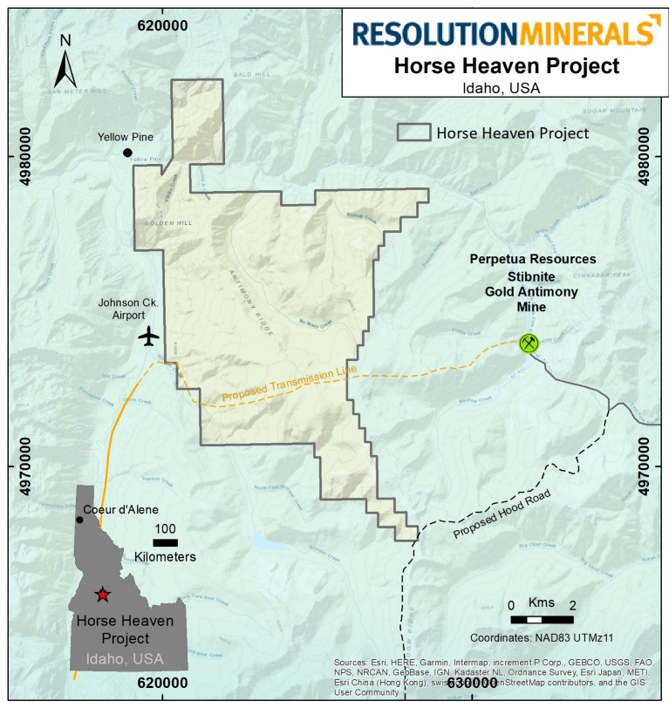
For example, Perpetua Resources Corp.’s Stibnite Gold Project, which is adjacent to our Horse Heaven Project in Idaho, is subject to ongoing historical legacy impacts and environmental reclamation liabilities and could face further historical legacy challenges in the future.
We may pursue opportunities to acquire complementary businesses, which could dilute our shareholders’ ownership interests, incur expenditure and have uncertain returns.
We may seek to expand through future acquisitions of either companies or properties, however, there can be no assurance that we will locate attractive acquisition candidates, or that we will be able to acquire such candidates on economically acceptable terms, if at all, or that we will not be restricted from completing acquisitions pursuant to contractual arrangements. Future acquisitions may require us to expend significant amounts of cash, resulting in our inability to use these funds for other business or may involve significant issuances of equity. Future acquisitions may also require substantial management time commitments, and the negotiation of potential acquisitions and the integration of acquired operations could disrupt our business by diverting management’s attention away from day-to-day operations. The difficulties of integration may be increased by the necessity of coordinating geographically diverse organizations, integrating personnel with disparate backgrounds and combining different corporate cultures.
7
Any future acquisition involves potential risks, including, among other things: (i) mistaken assumptions and incorrect expectations about mineral properties, mineral resources and costs; (ii) an inability to successfully integrate any operation our company acquires; (iii) an inability to recruit, hire, train or retain qualified personnel to manage and operate the operations acquired; (iv) the assumption of unknown liabilities; (v) limitations on rights to indemnity from the seller; (vi) mistaken assumptions about the overall cost of equity or debt; (vii) unforeseen difficulties operating acquired projects, which may be in geographic areas new to us; and (viii) the loss of key personnel and/or key relationships at the acquired project.
At times, future acquisition candidates may have liabilities or adverse operating issues that we may fail to discover through due diligence prior to the acquisition. If we consummate any future acquisitions with unanticipated liabilities or that fails to meet expectations, our business, results of operations, cash flows or financial condition may be materially adversely affected. The potential impairment or complete write-off of goodwill and other intangible assets related to any such acquisition may reduce our overall earnings and could negatively affect our balance sheet.
In the event that key personnel leave our company, we would be harmed since we are heavily dependent upon them for key aspects of our activities.
We have entered into employment, consulting or service agreements with our executive officers and contractors. We are heavily dependent on our executive officers and contractors, the loss of whom could have, in the short-term, a negative impact on our ability to conduct our activities and could cause a decline in profitability of our property or additional costs from a delay in development or exploration of the property.
Our assets and operations are subject to economic, geopolitical and other uncertainties.
Economic, geopolitical and other uncertainties may negatively affect our business. Economic conditions globally are beyond our control. In addition, the outbreak of hostilities and armed conflicts between countries can create geopolitical uncertainties that may affect both local and global economies. Downturns in the economy or geopolitical uncertainties may cause future customers to delay or cancel projects, reduce their overall capital or operating budgets or reduce or cancel orders which could have a material adverse effect on our business, results of operations and financial condition.
Our operations may be affected in varying degrees by government regulations with respect to restrictions on production, price controls, export controls, currency remittance, income taxes, foreign investment, maintenance of claims, environmental legislation, land use, land claims of local people, water use and mine safety. Any failure to comply strictly with applicable laws and local practices relating to mineral rights could result in loss, reduction or expropriation of entitlements.
In addition, the financial markets can experience significant price and value fluctuations that can affect the market prices of equity securities and other companies in ways that are unrelated to the operating performance of these companies. Broad market fluctuations, as well as economic conditions generally, can adversely affect the market price of our ordinary shares and ADSs.
Legal proceedings could arise from time to time in the course of our business.
Legal proceedings may arise from time to time in the course of our business. Such litigation could be brought from time to time in the future against us. Defense and settlement costs of legal claims can be substantial, even with respect to claims that have no merit. We are not currently subject to material litigation nor have we received an indication that any material claims are forthcoming. However, due to the inherent uncertainty of the litigation process, we could become involved in material legal claims or other proceedings with other parties in the future. The results of litigation or any other proceedings cannot be predicted with certainty. The cost of defending such claims may take away from management’s time and effort and if we are incapable of resolving such disputes favorably, the resultant litigation could have a material adverse impact on our financial condition, cash flow and results from operation.
8
Risks Related to Our Exploration and Mining Operations
Mineral exploration and development are subject to extraordinary operating risks. In the event of a cave-in or similar occurrence, our liability may exceed our resources, which could have an adverse impact on us.
Exploration and mining operations generally involve a degree of risk. Our operations are subject to all the hazards and risks normally encountered in the exploration, development and production of critical metals, including unusual and unexpected geologic formations, seismic activity, rock bursts, cave-ins, flooding and other conditions involved in the drilling and removal of material, any of which could result in damage to, or destruction of, mines and other producing facilities, personal injury or loss of life and damage to property and environmental damage, all of which may result in possible legal liability. Although we expect that adequate precautions to minimize risk will be taken, mining operations are subject to hazards such as fire, rock falls, geo-mechanical issues, equipment failure or failure of retaining dams around tailings disposal areas which may result in environmental pollution and consequent liability. The occurrence of any of these events could result in a prolonged interruption of our operations that would have a material adverse effect on our business, financial condition, results of operations and prospects.
The exploration and development of our projects may not be profitable.
The exploration for and development of mineral deposits involves significant risks, which even a combination of careful evaluation, experience and knowledge may not eliminate. While the discovery of a mineral deposit may result in substantial rewards, few properties that are explored are ultimately developed into producing mines. Major expenses may be required to locate and establish mineral resources and reserves, to develop metallurgical processes and to construct mining and processing facilities and infrastructure at a particular site. It is impossible to ensure that the exploration or development programs planned by us will result in a profitable commercial mining operation. Whether a mineral deposit will be commercially viable depends on a number of factors, some of which are: the particular attributes of the deposit, such as size, grade and proximity to infrastructure, critical metals prices and government regulations, including regulations relating to prices, taxes, royalties, land tenure, land use, exporting of minerals and environmental protection. The exact effect of these factors cannot be accurately predicted, but the combination of these factors may result in our company not receiving an adequate return on invested capital. There is no certainty that the expenditures made towards the search and evaluation of mineral deposits will result in the discovery of mineral resources or the development of commercial quantities of mineral reserves.
Our exploration projects have no operating history upon which to base estimates of future capital and operating costs. Mineral resource and reserve estimates and estimates of operating costs are or will be, to a large extent, based upon the interpretation of geologic data obtained from drill holes and other sampling techniques, and technical reports and feasibility studies, which derive estimates of capital and operating costs based upon anticipated tonnage and grades to be mined and processed, ground conditions, the configuration of the deposit, expected recovery rates of minerals from ore, estimated operating costs, and other factors. As a result, actual production, cash operating costs and economic returns could differ significantly from those estimated.
9
Our business operations are exposed to a high degree of risk associated with the mining industry.
Our business operations are exposed to a high degree of risk inherent in the mining sector. Risks which may occur during the exploration and development of mineral resources include environmental hazards, industrial accidents, equipment failure, import/customs delays, shortage or delays in installing and commissioning plant and equipment, metallurgical and other processing problems, seismic activity, unusual or unexpected formations, formation pressures, rock bursts, wall failure, cave ins or slides, burst dam banks, flooding, fires, explosions, power outages, opposition with respect to mining activities from individuals, communities, governmental agencies and non-governmental organizations, interruption to or the increase in costs of services, cave-ins and interruption due to inclement or hazardous weather conditions.
Such occurrences could cause damage to, or destruction of properties, personal injury or death, environmental damage, pollution, delays, increased production costs, monetary losses and potential legal liabilities. Moreover, these factors could result in a mineral deposit, which has been mined profitably in the past to become unprofitable. Any liabilities that we incur for these risks and hazards could be significant and the costs of rectifying the hazard may exceed our asset value.
As we face intense competition in the mineral exploration and exploitation industry, there can be no assurance that we will be able to compete effectively with other companies.
The mining industry is very competitive. Our competition is from larger, established mining companies with greater liquidity, greater access to credit and other financial resources, newer or more efficient equipment, lower cost structures, more effective risk management policies and procedures and/or a greater ability than us to withstand losses. Our competitors may be able to respond more quickly to new laws or regulations or emerging technologies, or devote greater resources to the expansion or efficiency of their operations than we can. In addition, current and potential competitors may make strategic acquisitions or establish cooperative relationships among themselves or with third parties. Accordingly, it is possible that new competitors or alliances among current and new competitors could emerge and gain significant market share to our detriment.
As a result of this competition, we may have to compete for financing and be unable to acquire financing on terms we consider acceptable. We may also have to compete with the other mining companies for the recruitment and retention of qualified managerial and technical personnel. If we are unable to successfully compete for financing or for qualified personnel or we may not be able to compete successfully against current and future competitors, and any failure to do so could have a material adverse effect on our business, financial condition, results of operations and future prospects as well as our exploration programs may be slowed down or suspended, which may cause us to cease operations as a company.
Our exploration activities on our property may not be commercially successful, which could lead us to abandon our plans to develop our property and our investments in exploration.
Our long-term success depends on our ability to identify mineral deposits on our existing property and other properties we may acquire, if any, that we can then develop into commercially viable mining operations. Mineral exploration is highly speculative in nature, involves many risks and is frequently non-productive. These risks include unusual or unexpected geologic formations, and the inability to obtain suitable or adequate machinery, equipment or labor.
10
The success of exploration is determined in part by the following factors:
| ● | the identification of potential mineralization based on surficial analysis; |
| ● | availability of government-granted exploration permits; |
| ● | the quality of our management and our geological and technical expertise; and |
| ● | the capital available for exploration and development work. |
Substantial expenditures are required to establish proven and probable reserves through drilling and analysis, to develop metallurgical processes to extract metal, and to develop the mining and processing facilities and infrastructure at any site chosen for mining. We may invest significant capital and resources in exploration activities and abandon such investments if we are unable to identify commercially exploitable mineral reserves. Any such decision to abandon a project could have an adverse effect on the market value of our securities and the ability to raise future financing.
Our business is subject to operational risks that are generally outside of our control and could adversely affect our business.
Mineral mining sites by their nature are subject to many operational risks and factors that are generally outside of our control and could adversely affect our business, operating results and cash flows.
These operational risks and factors include the following:
| ● | unanticipated ground and water conditions; |
| ● | adverse claims to water rights and shortages of water to which we have rights; |
| ● | adjacent land ownership that results in constraints on current or future operations; |
| ● | geological problems, including earthquakes and other natural disasters; |
| ● | metallurgical and other processing problems; |
| ● | the occurrence of unusual weather or operating conditions and other force majeure events; |
| ● | lower than expected ore grades or recovery rates; |
| ● | accidents; |
| ● | delays in the receipt of or failure to receive necessary government permits; |
| ● | the results of litigation, including appeals of agency decisions; |
| ● | uncertainty of exploration and development; |
11
| ● | delays in transportation; |
| ● | interruption of energy supply; |
| ● | labor disputes; |
| ● | inability to obtain satisfactory insurance coverage; and |
| ● | the failure of equipment or processes to operate in accordance with specifications or expectations. |
Any one or more of these factors or other risks could cause us not to realize the anticipated benefits of an acquisition of properties or companies and could have a material adverse effect on our financial condition.
There are numerous risks associated with the development of our property.
Our future success will largely depend upon our ability to successfully explore, develop and manage our property. In particular, our success is dependent upon management’s ability to implement our strategy, to develop the projects and to maintain ongoing production from the mines that we expect to develop.
Development of our property could be delayed, experience interruptions, incur increased costs or be unable to complete due to a number of factors, including but not limited to:
| ● | changes in the regulatory environmental compliance requirements; |
| ● | non-performance by third party consultants and contractors; |
| ● | inability to attract and retain a sufficient number of qualified workers; |
| ● | unforeseen escalation in anticipated costs of exploration and development, or delays in construction, or adverse currency movements resulting in insufficient funds being available to complete planned exploration and development; |
| ● | increases in extraction costs including energy, material and labor costs; |
| ● | lack of availability of mining equipment and other exploration services; |
| ● | shortages or delays in obtaining critical mining and processing equipment; |
| ● | catastrophic events such as fires, storms or explosions; |
| ● | the breakdown or failure of equipment or processes; |
| ● | construction, procurement and/or performance of the processing plant and ancillary operations falling below expected levels of output or efficiency; |
| ● | civil unrest in and/or around our exploration and mining sites and supply routes, which would adversely affect the community support of our operations; |
| ● | changes to anticipated levels of taxes and imposed royalties; and/or |
| ● | a material and prolonged deterioration in market conditions, resulting in material price erosion. |
It is not uncommon for new mining developments to experience these factors during their exploration or development stages or during construction, commissioning and production start-up, or indeed for such projects to fail as a result of one or more of these factors occurring to a material extent. There can be no assurance that we will complete the various stages of exploration and development necessary in order to achieve our strategy in the timeframe pre-determined by us or at all. Any of these factors could have a material adverse effect on our business, results of operations and activities, financial condition and prospects.
12
Infrastructure required to carry on our business may be affected by unusual or infrequent weather phenomena, sabotage, government or other interference in the maintenance or provision of such infrastructure.
Exploitation of our property will depend to a significant degree on adequate infrastructure. In the course of developing our expected operations, assuming our exploration efforts will be successful, we may need to construct and support the construction of infrastructure, which includes water supplies, power, transport and logistics services. Unusual or infrequent weather phenomena, sabotage, government or other interference in the maintenance or provision of such infrastructure or any failure or unavailability in such infrastructure could materially adversely affect our operations, financial condition and results of operations.
We may not be able to obtain or renew licenses or permits that are necessary to our operations.
In the ordinary course of business, we will be required to obtain and renew governmental licenses or permits for exploration, development, construction and commencement of mining at our property. Obtaining or renewing the necessary governmental licenses or permits is a complex and time-consuming process involving public hearings and costly undertakings on the part of our company. The duration and success of our efforts to obtain and renew licenses or permits are contingent upon many variables not within our control, including the interpretation of applicable requirements implemented by the licensing or permitting authorities. We may not be able to obtain or renew licenses or permits that are necessary to our operations, including an exploitation license, or the cost to obtain or renew licenses or permits could exceed what we believe we can recover from our property. Any unexpected delays or costs associated with the licensing or permitting process could delay the development or impede the operation of a mine, which could adversely impact our operations and profitability.
Our property may face indigenous land claims.
Our property may now or in the future be the subject of indigenous land claims. The legal nature of land claims is a matter of considerable complexity. The impact of any such claim on our ownership interest in our properties cannot be predicted with any degree of certainty and no assurance can be given that a broad recognition of indigenous rights in the area in which our properties are located, by way of a negotiated settlement or judicial pronouncement, would not have an adverse effect on our operations. Even in the absence of such recognition, we could at some point be required to negotiate with and seek the approval of holders of such interests in order to facilitate exploration and development work on our property. There is no assurance that we would be able to establish a practical working relationship with an indigenous group in the area that would allow us to ultimately develop our properties.
Non-governmental organizations could seek to delay development of our projects.
Our relationship with the communities in which we operate is important to ensure the future success of our operations. While we believe our relationships with the communities in which we operate are strong, there is an increasing level of public concern relating to the perceived effect of mining activities on the environment and on communities impacted by such activities. Certain non-governmental organizations (“NGOs”), some of which oppose resource development, are often vocal critics of the mining industry and its practices. Adverse publicity generated by such NGOs or others related to extractive industries generally, or its operations specifically, could have an adverse effect on our reputation or financial condition and may impact our relationship with the communities in which we operate. While we believe that we operate in a socially responsible manner, there is no guarantee that our efforts in this respect will mitigate this potential risk. There is a risk that NGOs could cause a delay in the development of our projects.
For example, Perpetua Resources Corp.’s Stibnite Gold Project, which is adjacent to our Horse Heaven Project in Idaho, is subject to ongoing litigation and could face further litigious challenges in the future resulting from actions by NGOs. In February 2025, claims were filed in the U.S. District Court for the District of Idaho against the U.S. Forest Service and other federal agencies by several claimants, including the Idaho Conservation League, alleging violations of the National Environmental Policy Act and other federal laws in the regulatory review process for the Stibnite Gold Project. Among other remedies, the claimants seek to vacate the Final Record of Decision, Final Environmental Impact Statement, the Final Biological Opinions and other approvals and to enjoin any further implementation of the Stibnite Gold Project.
There can be no guarantee that our interests in our property are free from any title defects.
We have taken all reasonable steps to ensure that we have proper title to our property. However, there can be no guarantee that our interests in our property are free from any title defects, as title to mineral rights involves certain intrinsic risks due to the potential problems arising from the unclear conveyance history characteristic of many mining projects. There can be no assurance that our rights and title interests will not be challenged or impugned by third parties.
13
Our activities are subject to environmental laws that could increase our costs of doing business and restrict our operations.
All phases of our operations are subject to environmental regulation in the jurisdictions in which we operate. Environmental legislation is evolving in a manner that will require stricter standards and enforcement, increased fines and penalties for non-compliance, more stringent environmental assessments of proposed projects and a heightened degree of responsibility for companies and their officers and directors. These laws address emissions into the air, discharges into water, management of waste, management of hazardous substances, protection of natural resources, antiquities and endangered species and reclamation of lands disturbed by mining operations. Compliance with environmental laws and future changes in these laws could require significant capital outlays and cause material changes or delays in our operations and future activities. It is possible that future changes in these laws or regulations could have a significant adverse impact on our property or some portion of our business, causing us to re-evaluate those activities at that time. from our business operations, which could adversely affect our financial condition.
Land reclamation requirements may be burdensome.
Land reclamation requirements are generally imposed on companies with mining operations or mineral exploration companies in order to minimize long term effects of land disturbance. Reclamation may include requirements to control dispersion of potentially deleterious effluents or reasonably re-establish pre-disturbance land forms and vegetation. In order to carry out reclamation obligations imposed on us in connection with exploration, potential development and production activities, we must allocate financial resources that might otherwise be spent on exploration and development programs. If we are required to carry out unanticipated reclamation work, our financial position could be adversely affected.
Our mining operations are dependent on the adequate and timely supply of water, electricity or other power supply, chemicals and other critical supplies.
Our exploration programs are dependent on the adequate and timely supply of water, electricity or other power supply, chemicals and other critical supplies. If we are unable to obtain the requisite critical supplies in time and at commercially acceptable prices or if there are significant disruptions in the supply of electricity, water or other inputs to our mining sites, our business performance and results of operations may experience material adverse effects.
A shortage of equipment and supplies could adversely affect our ability to operate our business.
We are dependent on various supplies and equipment to carry out our mining exploration and development operations. The shortage of such supplies, equipment and parts could have a material adverse effect on our ability to carry out our operations and therefore limit, or increase the cost of, production.
Risks Related to Regulatory and Industry Matters
We will be subject to significant governmental regulations, including the U.S. Federal Mine Safety and Health Act.
Minerals extraction activities in the United States are subject to extensive federal, state and local laws governing environmental protection, natural resources, prospecting, development, production, post-closure reclamation, taxes, labor standards and occupational health and safety laws, including mine safety, toxic substances and other matters. The costs associated with compliance with such laws are substantial. In addition, changes in such laws, or more restrictive interpretations of current laws by governmental authorities, could result in unanticipated capital expenditures, expenses or restrictions on or suspensions of our operations and delays in the development of our properties.
14
We will be required to obtain governmental permits in order to conduct development and minerals extraction operations, a process which is often costly and time-consuming.
We are required to obtain and renew governmental permits for our exploration activities and, prior to developing or extracting any mineralization that we discover, we will be required to obtain new governmental permits. Obtaining and renewing governmental permits is a complex and time-consuming process. The timeliness and success of permitting efforts are contingent upon many variables not within our control, including the interpretation of permit approval requirements administered by the applicable permitting authority. We may not be able to obtain or renew permits that are necessary to our planned operations or the cost and time required to obtain or renew such permits may exceed our expectations, which in turn could materially adversely affect our future revenues and profitability. In addition, private parties, such as environmental activists, frequently attempt to intervene in the permitting process and to persuade regulators to deny necessary permits or seek to overturn permits that have been issued. These third-party actions can materially increase the costs and cause delays in the permitting process and could cause us to not proceed with the development or operation of a property.
Compliance with environmental regulations and litigation based on environmental regulations could require significant expenditures.
Environmental regulations mandate the maintenance of air and water quality standards, land development and land reclamation, and set forth limitations on the generation, transportation, storage and disposal of solid and hazardous waste. In connection with our current exploration activities or in connection with our prior extraction operations, we could incur environmental costs that could have a material adverse effect on financial condition and results of operations.
Any failure to remedy an environmental problem could require us to suspend operations or enter into interim compliance measures pending completion of the required remedy. Moreover, governmental authorities and private parties could bring lawsuits based upon damage to property and injury to persons resulting from the environmental, health and safety impacts of prior and current operations, including operations conducted by other extraction companies many years ago at sites located on properties that we currently own or formerly owned. We cannot assure you that any such law, regulation, enforcement or private claim would not have a material adverse effect on our financial condition, results of operations or cash flows. If we violate or fail to comply with applicable environmental laws and regulations, we could be subject to penalties, restrictions on operations or other sanctions. Such liability could materially adversely affect our reputation, business, results of operations and financial condition.
The requirements of being a public company may strain our resources and divert management’s attention.
We are subject to the reporting requirements of the U.S. Securities Exchange Act of 1934 (the “Exchange Act”), the Sarbanes-Oxley Act, the listing requirements of the Nasdaq Capital Market and other applicable securities rules and regulations. Compliance with these rules and regulations will increase our legal and financial compliance costs, make some activities more difficult, time-consuming or costly and increase demand on our systems and resources. The Exchange Act requires that we file an annual report on Form 20-F. The Sarbanes-Oxley Act requires that we maintain effective disclosure controls and procedures and internal control over financial reporting. In order to maintain and, if required, improve our disclosure controls and procedures and internal control over financial reporting to meet this standard, significant resources and management oversight are required. As a result, management’s attention may be diverted from other business concerns, which could adversely affect our business and results of operations.
The Sarbanes-Oxley Act requires that we assess the effectiveness of our internal control over financial reporting annually and disclosure controls and procedures quarterly. If we identify material weaknesses in future periods or we are not able to comply with the requirements of Section 404 in a timely manner, our reported financial results could be restated, we could be subject to investigations or sanctions by regulatory authorities, which would require additional financial and management resources, and the market price of our ordinary shares and ADSs could decline.
15
If we fail to maintain an effective system of internal control over financial reporting, we may not be able to accurately report our financial results or prevent fraud. As a result, shareholders could lose confidence in our financial and other public reporting, which would harm our business and the trading price of our ordinary shares.
Effective internal controls over financial reporting are necessary for us to provide reliable financial reports and, together with adequate disclosure controls and procedures, are designed to prevent fraud. Any failure to implement required new or improved controls, or difficulties encountered in their implementation could cause us to fail to meet our reporting obligations. In addition, any testing by us conducted in connection with Section 404 or any subsequent testing by our independent registered public accounting firm, may reveal deficiencies in our internal controls over financial reporting that are deemed to be material weaknesses or that may require prospective or retroactive changes to our consolidated financial statements or identify other areas for further attention or improvement. Inferior internal controls could also cause investors to lose confidence in our reported financial information, which could have a negative effect on the trading price of our ordinary shares.
We are a small exploration company with limited accounting personnel and other resources with which to address our internal controls and procedures. Our independent registered public accounting firm has not conducted an audit of our internal control over financial reporting. However, in preparing our consolidated financial statements as of and for the years ended June 30, 2026, 2025 and 2024, we identified material weaknesses in our internal control over financial reporting. As a result of lacking an effective accounting review process, material adjustments were made to the consolidated financial statements for the fiscal years ended June 30, 2025, and 2024, in order to be in conformity with IFRS Accounting Standards. In connection with these material adjustments, we also identified a significant deficiency relating to insufficient review of non-routine and judgmental transactions and inadequate controls.
These material weaknesses resulted in identified material misstatements to the consolidated financial statements. As a result of these material weaknesses that persisted through fiscal 2026, our management, under the supervision of the Audit Committee and with participation of our Chief Executive Officer and Chief Financial Officer, concluded that our internal control over financial reporting was not effective as of June 30, 2026.
To remediate our material weaknesses, we expect to incur substantially more additional costs for addressing our material weaknesses and deficiencies. Our remedial measures will include: (a) hiring qualified internal control personnel, including financial and IT personnel, to manage the implementation of internal control policies, procedures and improvement of the internal audit function, system user access, security management and data protection, as applicable; (b) developing and implementing written policies and procedures for accounting and financial reporting that meet the standards applied to public companies listed in the United States; and (c) conducting internal control training to management, key operations personnel and the accounting department, so that management and relevant personnel understand the requirements and elements of internal control over financial reporting mandated by the U.S. securities laws. We have commenced the implementation of several aforementioned remedial measures, including recruitment of additional senior finance personnel focusing on improvements to financial controls and procedures. Our ongoing remedial measures include the formal documentation of key Company controls, processes and accounting transactions. The implementation of any or all of these measures, however, still may not fully address the material weaknesses in our internal control over financial reporting. Additionally, as most of our documentation will be prepared internally, we do not expect there to be significant material costs to implement our remedial measures. Our failure to correct the material weaknesses or our failure to discover and address any other material weaknesses or control deficiencies could result in inaccuracies in our consolidated financial statements and could also impair our ability to comply with applicable financial reporting requirements and related regulatory filings on a timely basis. Moreover, ineffective internal control over financial reporting significantly hinders our ability to prevent fraud.
We could become subject to the auditor attestation requirement under the Sarbanes-Oxley Act even if we have little or no revenue, thus imposing significant cost and administrative burden on us.
We currently qualify as an “emerging growth company” and, as a result, are exempt from the auditor attestation requirement under Section 404 of the Sarbanes-Oxley Act of 2002 in the assessment of internal controls over financial reporting. We expect to remain an emerging growth company until the earlier of the last day of our fiscal year following the fifth anniversary of the completion of our first public offering in the United States or, as of the last business day of our most recently completed second fiscal quarter, our aggregate worldwide market value of the voting and non-voting common equity held by our non-affiliates is US$700 million or more. Once we cease to be an emerging growth company and the aggregate worldwide market value of our voting equity held by non-affiliates exceeds US$75 million as of our most recently completed second fiscal quarter, then we will be subject to the auditor attestation requirement in the assessment of the internal controls over financial reporting.
16
While the U.S. Securities and Exchange Commission (“SEC”) has acknowledged the significant cost of the auditor attestation requirement for small companies and provided an exemption for U.S. “smaller reporting companies” with less than US$100 million in revenue, the SEC has decided not to similarly exempt foreign private issuers (such as the Company) unless they comply with the reporting requirements for U.S. companies, including presenting financial statements in accordance with U.S. generally accepted accounting principles. Given the significant cost and administrative burden resulting from inconsistent reporting obligations under the rules of the SEC and ASX, it may not be feasible for us to comply with the SEC’s reporting requirements for U.S. companies in the event we were to cease being an “emerging growth company” and have aggregate worldwide market value of our voting equity held by non-affiliates exceeding US$75 million.
In such event, we could be obligated to incur significant compliance costs (which the SEC estimated to be US$210,000 per year in 2019) and administrative burden given our limited number of personnel. If such costs were to become too significant, we could reconsider our listing on Nasdaq because, as the SEC has acknowledged, the savings for a small company could be put to more productive use such as developing the company.
Risks Relating to Ownership of the ADSs
The trading price of the ADSs may be volatile, and purchasers of the ADSs could incur substantial losses.
The market price of our ordinary shares historically has been, and we expect our ordinary shares and ADSs will continue to be, subject to significant fluctuations over short periods of time. These fluctuations may be due to factors specific to us, to changes in analysts’ recommendations and earnings estimates, to arbitrage between our Australian-listed ordinary shares and our Nasdaq-listed ADSs, to changes in exchange rates, or to factors affecting the securities markets in general. Market fluctuations, as well as general political and economic conditions, such as a recession, interest rate or currency fluctuations, could adversely affect the market price of our securities.
We may experience a material decline in the market price of our shares, regardless of our operating performance. Therefore, a holder of the ADSs may not be able to sell those ADSs at or above the price paid by such holder for such ADSs. Price declines in the ADSs could result from a variety of factors, including many outside our control. These factors include:
| ● | actual or anticipated variations in our operating results; |
| ● | changes in earnings estimates; |
| ● | market conditions; |
| ● | actions or announcements by our competitors; |
| ● | increases in our costs or decreases in our revenues due to unfavorable movements in foreign currency exchange rates; |
| ● | changes in recommendations or earnings estimates by securities analysts; |
| ● | actual and anticipated fluctuations in our quarterly operating results; |
| ● | rumors relating to us or our competitors; |
| ● | additions or departures of key personnel; and |
| ● | developments concerning current or future strategic alliances or acquisitions. |
In addition, volatility and low market price of the ADSs may adversely impact investors’ interest in our securities. A decline in investors’ interest may prompt further volatility and decrease in market price.
If we are or become a passive foreign investment company (“PFIC”), then that would subject our U.S. shareholders to adverse tax rules.
Holders of the ADSs who are U.S. taxpayers will be subject to particular income tax rules if we are a passive foreign investment company, or PFIC. These rules could result in a reduction in the after-tax return to a “U.S. Holder” of the ADSs and reduce the value of the ADSs. For U.S. federal income tax purposes, we will be classified as a PFIC for any taxable year in which (i) 75% or more of our gross income is passive income, or (ii) at least 50% of the average value of all of our assets for the taxable year produce or are held for the production of passive income. For this purpose, cash is considered to be an asset that produces passive income.
17
We believe Resolution Minerals was a PFIC in fiscal 2026 and could be a PFIC in fiscal 2027. If we are classified as a PFIC in any year that a U.S. Holder owns ADSs, the U.S. Holder will generally continue to be treated as holding ADSs of a PFIC in all subsequent years, notwithstanding that we are not classified as a PFIC in a subsequent year. Dividends received by the U.S. Holder and gains realized from the sale of the ADSs would be taxed as ordinary income and subject to an interest charge. We urge U.S. investors to consult their own tax advisors about the application of the PFIC rules and certain elections that may help to minimize adverse U.S. federal income tax consequences in their particular circumstances.
Our issuance of additional ordinary shares in connection with financings, acquisitions, investments, or otherwise will dilute all other ADS holders.
We expect to issue additional ordinary shares in the future that will result in dilution to all other ADS holders. Any such issuances of additional ordinary shares may cause ADS holders to experience significant dilution of their ownership interests and the per ADS value of the ADSs to decline.
We are subject to risks associated with currency fluctuations, and changes in foreign currency exchange rates could impact our results of operations.
Our ordinary shares are quoted in Australian dollars on the ASX and the ADSs will be quoted in U.S. dollars. Any significant change in the value of the Australian dollar may have a negative effect on the value of the ADSs in U.S. dollars. In addition, if the Australian dollar weakens against the U.S. dollar, then, if we decide to convert our Australian dollars into U.S. dollars for any business purpose, appreciation of the U.S. dollar against the Australian dollar would have a negative effect on the U.S. dollar amount available to us. Consequently, appreciation or depreciation in the value of the Australian dollar relative to the U.S. dollar would affect our financial results reported in U.S. dollar terms without giving effect to any underlying change in our business or results of operations. As a result of such foreign currency fluctuations, it could be more difficult to detect underlying trends in our business and results of operations.
As long as we remain subject to the rules of the ASX, we may be unable to conduct certain types of capital raisings without shareholder approval if such capital raising would result in an equity issuance above regulatory thresholds and, consequently, we could be unable to obtain financing sufficient to sustain our business if we are unsuccessful in soliciting requisite shareholder approvals.
Our ability to access equity capital is limited by ASX Listing Rule 7.1, which provides that a company may not, subject to certain exceptions for certain types of offering (e.g., rights offers) or approval by shareholders, issue or agree to issue during any consecutive 12-month period any equity securities, or other securities with rights to conversion to equity, if the number of those securities in aggregate would exceed 15% of the number of ordinary securities on issue at the commencement of that 12-month period.
Our equity issuances will be limited by ASX Listing Rule 7.1 as long as we continue to be listed on the ASX and this constraint may prevent us from raising the full amount of equity capital needed for operations without prior shareholder approval or structuring the capital raising within one of the exceptions to this limitation such as a rights offer.
18
Our ADS holders are not shareholders and do not have shareholder rights.
The Bank of New York Mellon, as depositary, registers and delivers the American Depositary Shares, or ADSs. ADS holders will not be treated as shareholders and do not have the rights of shareholders. The depositary will be the holder of the shares underlying the ADSs. Holders of the ADSs will have ADS holder rights. A deposit agreement among us, the depositary and ADS holders and the beneficial owners of ADSs, sets out ADS holder rights as well as the rights and obligations of the depositary. New York law governs the deposit agreement and the ADSs. For a description of ADS holder rights, see “Description of Securities” in this Annual Report.
Our shareholders have shareholder rights. Australian law and our constitution govern shareholder rights. For a description of our shareholders’ rights, see “Memorandum and Articles of Association” in this Annual Report. Shareholders are entitled to our notices of general meetings and to attend and vote at our general meetings of shareholders. At a general meeting, every shareholder present (in person or by proxy, attorney or representative) and entitled to vote has one vote on a show of hands. Every shareholder present (in person or by proxy, attorney or representative) and entitled to vote has one vote per fully paid ordinary share on a poll. This is subject to any other rights or restrictions which may be attached to any shares.
ADS holders do not have the same voting rights as our shareholders. ADS holders may exercise voting rights with respect to the underlying ordinary shares only in accordance with the provisions of the deposit agreement. Under the deposit agreement, ADS holders vote by giving voting instructions to the depositary. Upon receipt of instructions, the depositary will try to vote in accordance with those instructions. Otherwise, ADS holders will not be able to vote unless they withdraw the ordinary shares underlying their ADSs.
If we ask for our ADS holders’ instructions, the depositary will notify our ADS holders of the upcoming vote and arrange to deliver our voting materials and form of notice to them. The depositary will try, as far as practical, subject to Australian law and the provisions of the depositary agreement, to vote the shares as our ADS holders instruct. The depositary will not vote or attempt to exercise the right to vote other than in accordance with the instructions of the ADS holders. We cannot assure our ADS holders that they will learn of ordinary shareholders’ meetings and receive the voting materials in time to instruct the depositary or withdraw the underlying ordinary shares. This means that there is a risk that our ADS holders may not be able to exercise voting rights and there may be nothing they can do if their shares are not voted as they requested.
Our ADS holders do not have the same rights to receive dividends or other distributions as our shareholders.
The directors may determine that a dividend will be payable on a share and fix the amount, the time for payment and the method for payment (although we have never declared or paid any cash dividends on our ordinary shares and we do not anticipate paying any cash dividends in the foreseeable future). Dividends may be paid on shares of one class but not another and at different rates for different classes. Dividends and other distributions payable to our shareholders with respect to our ordinary shares generally will be payable directly to them. Any dividends or distributions payable with respect to ordinary shares underlying ADSs will be paid to the depositary, which has agreed to pay to our ADS holders the cash dividends or other distributions it or the custodian receives on shares or other deposited securities, after deducting its fees and expenses and any taxes or other governmental charges. Our ADS holders will receive these distributions in proportion to the number of shares their ADSs represent. However, in accordance with the limitations set forth in the deposit agreement, it may be unlawful or impractical to make a distribution other than cash available to holders of ADSs. The depositary is not responsible if it decides that it is unlawful or impractical to make a distribution available to any ADS holders. We have no obligation to take any other action to permit the distribution of the ADSs, ordinary shares, rights or anything else to holders of the ADSs. This means that, as a holder of ADSs, you may not receive the distributions we make on our ordinary shares or any value from them if it is unlawful or impractical to make them available to you.
19
There are circumstances where it may be unlawful or impractical to make distributions to the holders of the ADSs.
The deposit agreement with the depositary generally requires the depositary to convert foreign currency it receives in respect of deposited securities into U.S. dollars and distribute the U.S. dollars to ADS holders, provided the depositary can do so on a reasonable basis. If it does not convert foreign currency, the depositary may distribute the foreign currency only to those ADS holders to whom it is possible to do so. If a distribution is payable by us in Australian dollars, the depositary will hold the foreign currency it cannot convert for the account of the ADS holders who have not been paid. It will not invest the foreign currency and it will not be liable for any interest. If the exchange rates fluctuate during a time when the depositary cannot convert the foreign currency, our ADS holders may lose some of the value of the distribution. This means that our ADS holders may not receive the distributions we make on our shares or any value for them if it is illegal or impractical for us to make them available.
ADSs holders may not be entitled to a jury trial with respect to claims arising under the deposit agreement, which could augur less favorable results to the plaintiff in any such action.
The deposit agreement governing the ADSs representing our ordinary shares provides that holders and beneficial owners of ADSs irrevocably waive the right to a trial by jury in any legal proceeding arising out of or relating to the deposit agreement or the ADSs against us or the depositary to the fullest extent permitted by applicable law. If this jury trial waiver provision is prohibited by applicable law, an action could nevertheless proceed under the terms of the deposit agreement with a jury trial. To our knowledge, the enforceability of a jury trial waiver under the federal securities laws has not been finally adjudicated by a federal court. However, we believe that a jury trial waiver provision is generally enforceable under the laws of the State of New York, which govern the deposit agreement, by a court of the State of New York or a federal court, which have non-exclusive jurisdiction over matters arising under the deposit agreement, applying such law.
In determining whether to enforce a jury trial waiver provision, New York courts and federal courts will consider whether the visibility of the jury trial waiver provision within the agreement is sufficiently prominent such that a party has knowingly waived any right to trial by jury. We believe that this is the case with respect to the deposit agreement and the ADSs. In addition, New York courts will not enforce a jury trial waiver provision in order to bar a viable setoff or counterclaim sounding in fraud or one which is based upon a creditor’s negligence in failing to liquidate collateral upon a guarantor’s demand, or in the case of an intentional tort claim (as opposed to a contract dispute), none of which we believe are applicable in the case of the deposit agreement or the ADSs. No condition, stipulation or provision of the deposit agreement or ADSs serves as a waiver by any holder or beneficial owner of ADSs or by us or the Depositary of compliance with any provision of the federal securities laws. If you or any other holder or beneficial owner of ADSs brings a claim against us or the Depositary in connection with matters arising under the deposit agreement or the ADSs, you or such other holder or beneficial owner may not be entitled to a jury trial with respect to such claims, which may have the effect of limiting and discouraging lawsuits against us and/or the Depositary.
If a lawsuit is brought against us and/or the Depositary under the deposit agreement, it may be heard only by a judge or justice of the applicable trial court, which would be conducted according to different civil procedures and may determine different results than a trial by jury would have had, including results that could be less favorable to the plaintiff(s) in any such action, depending on, among other things, the nature of the claims, the judge or justice hearing such claims, and the venue of the hearing.
As the jury trial waiver relates to claims arising out of or relating to the ADSs or the deposit agreement, we believe that the waiver would likely continue to apply to purchasers of ADSs in secondary transactions. In addition, we believe that the waiver would likely continue to apply to ADS holders or beneficial owners who withdraw the ordinary shares from the ADS facility with respect to claims arising before the cancellation of the ADSs and the withdrawal of the ordinary shares, and the waiver would likely not apply to ADS holders or beneficial owners who subsequently withdraw the ordinary shares represented by ADSs from the ADS facility with respect to claims arising after the withdrawal. However, to our knowledge, there has been no case law on the applicability of the jury trial waiver to ADS holders or beneficial owners who withdraw the ordinary shares represented by the ADSs from the ADS facility. Nevertheless, if this jury trial waiver is not permitted by applicable law, an action could proceed under the terms of the deposit agreement with a jury trial. No condition, stipulation or provision of the deposit agreement or the ADSs serves as a waiver by any owner or holder of ADSs or by us or the Depositary of compliance with any substantive provision of the U.S. federal securities laws and the rules and regulations promulgated thereunder.
20
Risks Relating to Our Incorporation in Australia
We currently report our financial results under IFRS, which differs in certain significant respects from U.S. generally accepted accounting principles.
We report our financial statements under IFRS. There have been and there may in the future be certain significant differences between IFRS and U.S. GAAP, including differences related to the capitalization of exploration assets and share based compensation expense. As a result, our financial information and reported earnings for historical or future periods could be significantly different if they were prepared in accordance with U.S. GAAP. In addition, we do not intend to provide a reconciliation between IFRS and U.S. GAAP unless it is required under applicable law. As a result, you may not be able to meaningfully compare our financial statements under IFRS with those companies that prepare financial statements under U.S. GAAP.
Australian takeovers laws may discourage takeover offers being made for us or may discourage the acquisition of large numbers of our shares.
We are incorporated in Australia and are subject to the takeover laws of Australia. Amongst other things, we are subject to the Corporations Act 2001 (Commonwealth of Australia). Subject to a range of exceptions, the Corporations Act prohibits the acquisition of a direct or indirect interest in our issued voting shares (including through the acquisition of ADSs) if the acquisition of that interest will lead to a person’s or someone else’s voting power in us increasing from 20% or below to more than 20% or increasing from a starting point that is above 20% and below 90%. Exceptions to the general prohibition include circumstances where the person makes a formal takeover bid for us, if the person obtains shareholder approval for the acquisition or if the person acquires less than 3% of the voting power of us in any rolling six-month period. Australian takeovers laws may discourage takeover offers being made for us or may discourage the acquisition of large numbers of our shares.
Holders of our ordinary shares or ADSs may have difficulty in effecting service of process in the United States or enforcing judgments obtained in the United States.
Holders of our ordinary shares or ADSs may have difficulties enforcing, in actions brought in courts in jurisdictions located outside the United States, liabilities under U.S. securities laws. In particular, if such a holder sought to bring proceedings in Australia based on U.S. securities laws, the Australian court might consider:
| ● | that it did not have jurisdiction; and/or |
| ● | that it was not an appropriate forum for such proceedings; and/or |
| ● | that, applying Australian conflict of laws rule, U.S. law (including U.S. securities laws) did not apply to the relationship between holders of our ordinary shares or ADSs and us or our directors and officers; and/or |
| ● | that the U.S. securities laws were of a public or penal nature and should not be enforced by the Australian court. |
Holders of our ordinary shares and ADSs may also have difficulties enforcing in courts outside the U.S. judgments obtained in the U.S. courts against any of our directors and executive officers or us, including actions under the civil liability provisions of the U.S. securities laws.
21
As a foreign private issuer whose shares are listed on the Nasdaq Capital Market, we may follow certain home country corporate governance practices instead of certain Nasdaq requirements.
As a foreign private issuer whose shares are listed on the Nasdaq Capital Market, we are permitted to follow certain home country corporate governance practices instead of certain requirements of The Nasdaq Marketplace Rules. As an Australian company listed on the Nasdaq Capital Market, we may follow home country practice in Australia with regard to the composition of the board of directors and director nomination process. In addition, we may follow Australian law instead of the Nasdaq Marketplace Rules that require that we obtain shareholder approval for certain dilutive events, such as for the establishment of equity based compensation plans, an issuance that will result in a change of control of the company, certain transactions other than a public offering involving issuances of a 20% or more interest in the company and certain acquisitions of the shares or assets of another company. Accordingly, our shareholders may not be afforded the same protection as provided under Nasdaq’s corporate governance rules that are applicable to U.S. companies.
As a foreign private issuer, we are exempt from a number of rules under the U.S. securities laws and are permitted to file less information with the SEC than a U.S. company.
As a “foreign private issuer” (as defined in the SEC’s rules), we are not subject to all of the disclosure requirements applicable to public companies organized within the United States. For example, we are exempt from certain rules under the Exchange Act that regulate disclosure obligations and procedural requirements related to the solicitation of proxies under the Exchange Act. In addition, our senior management and directors are exempt from the “short-swing” profit recovery provisions of Section 16 of the Exchange Act and related rules with respect to their purchases and sales of our securities. Moreover, while we currently make annual and semi-annual filings with respect to our listing on the ASX and expect to file financial reports on an annual and semi-annual basis, we will not be required to file periodic reports and financial statements with the SEC as frequently or as promptly as U.S. public companies and will not be required to file quarterly reports on Form 10-Q or current reports on Form 8-K under the Exchange Act. In addition, foreign private issuers are not required to file their annual report on Form 20-F until four months after the end of each fiscal year. Accordingly, there may be less publicly available information concerning our company than there would be if we were not a foreign private issuer.
Any loss of our foreign private issuer status in the future could result in significant additional cost.
While we currently qualify as a foreign private issuer, the determination of foreign private issuer status is made annually on the last business day of an issuer’s most recently completed second fiscal quarter. In the future, we would lose our foreign private issuer status if we fail to meet the requirements necessary to maintain our foreign private issuer status as of the relevant determination date. For example, if 50% or more of our securities are held by U.S. residents and more than 50% of our senior management or directors are residents or citizens of the United States, we could lose our foreign private issuer status.
The regulatory and compliance costs to us under U.S. securities laws as a U.S. domestic issuer could be significantly more than costs we incur as a foreign private issuer. If we were to cease to be a foreign private issuer, then we would be required to file periodic reports and registration statements on U.S. domestic issuer forms with the SEC, which forms are more detailed and extensive in certain respects than the forms available to a foreign private issuer. We would be required to prepare our financial statements in accordance with U.S. GAAP rather than IFRS. Such conversion of our financial statements to U.S. GAAP would involve significant time and cost. In addition, we may lose our ability to rely upon exemptions from certain corporate governance requirements on U.S. stock exchanges that are available to foreign private issuers such as the ones described above and exemptions from procedural requirements related to the solicitation of proxies.
22
U.S. investors may have difficulty enforcing civil liabilities against our company and our directors.
Certain members of our board of directors are non-residents of the United States and a substantial portion of the assets of such persons are located outside the United States. As a result, it may be impracticable to serve process on such non-US residents in the United States or to enforce judgments obtained in U.S. courts against them based on civil liability provisions of the securities laws of the United States. Even if you are successful in bringing such an action, there is doubt as to whether Australian courts would enforce certain civil liabilities under U.S. securities laws in original actions or judgments of U.S. courts based upon these civil liability provisions. In addition, awards of punitive damages in actions brought in the United States or elsewhere may be unenforceable in Australia or elsewhere outside the United States. An award for monetary damages under U.S. securities laws would be considered punitive if it does not seek to compensate the claimant for loss or damage suffered and is intended to punish the defendant. The enforceability of any judgment in Australia will depend on the particular facts of the case as well as the laws and treaties in effect at the time. The United States and Australia do not currently have a treaty or statute providing for recognition and enforcement of the judgments of the other country (other than arbitration awards) in civil and commercial matters.
As a result, our public shareholders may have more difficulty in protecting their interests through actions against us, our directors than would shareholders of a corporation incorporated in a jurisdiction in the United States. In addition, as a company incorporated in Australia, the provisions of the Australian Corporations Act 2001 regulate the circumstances in which shareholder derivative actions may be commenced which may be different, and in many ways less permissive, than for companies incorporated in the United States.
| Item 4. | Information on the Company |
| A. | History and Development of the Company |
Resolution Minerals Ltd was incorporated in Australia in 2017 and listed on the Australian Securities Exchange (“ASX”) in 2017. In 2019, the company’s name was changed from Northern Cobalt Ltd to Resolution Minerals Ltd to reflect its change of focus.
Our registered office is located at Level 21, 91 King William Street, Adelaide, South Australia, 5000, Australia, and our telephone number is +61 8 6118 7110. Our agent for service of process in the United States is Vcorp Services LLC at 25 Robert Pitt Dr #204, Monsey, NY 10952, USA. Our website address is www.resolutionminerals.com. The information contained in, or accessible through, our website does not constitute part of this Annual Report.
The U.S. Securities and Exchange Commission maintains a website at www.sec.gov that contains reports, proxy and information statements and other information regarding registrants that make electronic filings with the U.S. Securities and Exchange Commission using its EDGAR (Electronic Data Gathering, Analysis, and Retrieval) system.
| B. | Business Overview |
Overview
Resolution Minerals Ltd is an early-stage exploration company focused on advancing the Horse Heaven Gold-Antimony-Tungsten-Silver Project (or the “Horse Heaven Project”), which has been the subject of historical mining of both antimony and tungsten, through targeted fieldwork. As demand for critical metals continues to rise due to their critical role in renewable energy, defense, and high-tech industries, we seek to become a key player in the global critical minerals sector, with a focus on antimony and tungsten. Our principal operations have not yet commenced and we have incurred operating losses and negative cash flows since inception.
Antimony is a chemical element included on the U.S. Interior Department’s list of critical minerals as the United States recognizes its strategic value. China is the world’s largest miner of rare earths and controls most of the processing of rare earths as well as other critical minerals such as antimony. China, together with Russia and Tajikistan, account for approximately 90% of the global mine production of antimony. In August 2024, China began restricting exports of various critical minerals and tightened such restrictions in December 2024, resulting in the price of antimony surging to nearly US$50,000 per ton, around 10 times the 5-year average.
23
The United States is now taking steps to counter China’s dominance in the critical minerals industry. For instance, in October 2025, the United States and Australia entered into a Framework for Securing of Supply in the Mining and Processing of Critical Minerals and Rare Earths that is expected to result in significant investment in the rare earths industry in Australia and the United States.
Antimony is used in defense, energy and industrial applications, including in munitions, high temperature electronics, semiconductors, batteries and flame retardants. Antimony mined from the ground is called antimony ore and is typically not salable as a finished product primarily due to impurities in the ore, the ore size not being compatible with its intended use, and the percentage of antimony contained in the ore being too low. Ore must be processed to remove impurities, refine the size, and increase the percentage of antimony contained in the ore. After processing, antimony trisulfide, oxide, and metal can be sold as finished products to companies in many industries as well as government agencies. Antimony oxide is used to form a flame-retardant system for plastics, rubber, fiberglass, textile goods, paints, coatings, and paper, as a color fastener in paint, and as a phosphorescent agent in fluorescent light bulbs. Antimony metal is used in bearings, storage batteries, and ordnance. Antimony trisulfide is used as a primer in ammunition.
Our only material mineral property is the Horse Heaven Project (antimony, gold, silver and tungsten), which is located in the U.S. state of Idaho.
Horse Heaven Project
In July 2025, we acquired the Horse Heaven Project (“Horse Heaven” or the “Project”), which hosts two high priority antimony, gold, silver and tungsten prospect areas: the Antimony Ridge Fault Zone and the Golden Gate Fault Zone. In addition to these two highly prospective mineralized corridors, we believe potential exists across the entire project as evidenced by ground-based fieldwork, airborne surveys and historic workings. This is in part based upon the history of Horse Heaven, where antimony was mined during World War I and World War II while tungsten was mined and milled in the 1950’s. We paid a total of A$50,374,272 for the Horse Heaven Project, of which A$1,000,000 was paid in cash and the remaining A$49,374,272 was paid in ordinary shares and options. We incurred an additional A$8,460,000 in transaction costs through the issue of ordinary shares and options.
Horse Heaven is located 212 km northeast of Boise, Idaho and 87 km east of Cascade, Idaho in Valley County, Idaho. The northwest boundary of the property is less than half a kilometer south of Yellow Pine, Idaho. The property is accessed with paved and gravel roads from McCall or Cascade, Idaho. The property is centered on latitude 44°55’ 21” N and longitude 115° 25’ 56” W. The east boundary of the property is adjacent to Perpetua Resource Corporation’s Stibnite Gold Project. The property is in the Salmon River Mountains, and the land is managed by the U.S. Forest Service, an agency of the U.S. Department of Agriculture. It is comprised of rugged mountainous terrain that is drained by tributaries that flow into Johnson Creek on the west and the East Fork South Fork of the Salmon River to the north of the property. Elevations range from about 1,500 m in the valley bottoms to over 2,600 m along the ridge tops.
The property consists of approximately 787 federal lode mining claims located within the Boise National Forest. Each claim block is 20 acres, resulting in a project area covering approximately 14,580 acres. An annual fee of US$200 per claim is required to be paid to the federal government by September 1st of each year, resulting in annual holding costs of US$157,400.
In addition, the Horse Heaven Project is subject to the following royalties:
| ● | 10 of our mining claims are subject to a cumulative net smelter returns royalty of 8% on all minerals mined or removed from such mining claims and sold. Up to 3% of such royalty can be bought back for US$100,000 per percentage point; and |
| ● | 695 of our mining claims are subject to a cumulative net smelter returns royalty of 4% on all minerals mined or removed from such mining claims and sold, of which 1% of such royalty can be bought back for US$2,000,000. |
24
As noted, Horse Heaven is located directly adjacent to the Stibnite Gold Project (owned by Nasdaq-listed Perpetua Resources Corp.), as illustrated in Figure 1 below. Horse Heaven is located near important infrastructure that is being upgraded to support the nearby Stibnite Gold Project, including an upgraded transmission line that crosses the Horse Heaven Project, and what is known as the Burnt Log Road, a new road being constructed to access the Stibnite Gold Project and which runs past the southern boundary of the Horse Heaven Project. The project is within close proximity to Johnson Creek Airport, which covers an area of 40 acres and which contains one grass runway that is 3,400 feet (1,000 m) long and 150 feet (46 m) wide. The field elevation is 4,960 feet (1,510 m) above sea level.
The village of Yellow Pine, Idaho, the closest community to the Horse Heaven Project, is home to approximately 44 people according to a 2010 census. Yellow Pine is a 247-acre (1.00 km2) “inholder” community in eastern Valley County, located on the East Fork of the South Fork of the Salmon River, approximately half a mile upstream from its confluence with Johnson Creek. It is bounded on the north by the Payette National Forest and on the south by the Boise National Forest. Located at 4,802 feet (1,464 m), Yellow Pine has historically served as the trade center for the larger Yellow Pine basin mining area, including the Stibnite Mining District. Today, the town offers limited services, including camping and lodge facilities and a seasonal restaurant.
All supplies for exploration activities, including food and fuel, are generally purchased in the regional centers of McCall or Cascade, Idaho, or in the capital city of Boise, Idaho. Water is available locally in limited supply; in 2025, we had an agreement to draw 8,000 gallons of water per day from the Village of Yellow Pine. Additional water is available in the towns of McCall or Cascade, a round-trip of approximately 120 miles. We recently acquired two separate parcels of private, fee simple land totaling 25 acres adjacent to the Horse Heaven Project. These two parcels of land are serviced by electricity and enjoy limited water rights.
25
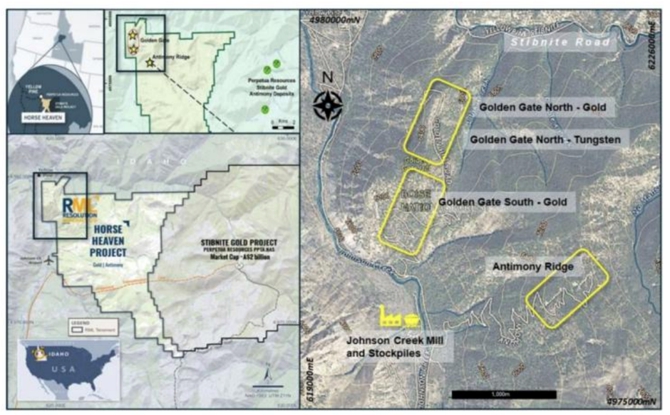
Geology and Mineralization
The project is located in the Salmon River Mountains in central Idaho. Bedrock in the region is classified based on age, lithology and stratigraphic relationships. In general, rock types in the region are subdivided into lithologies that are part of the pre-Cretaceous “basement,” the Cretaceous Idaho Batholith, Cenozoic intrusions and volcanics, and younger unconsolidated sediments derived from erosion of the older sequences and glacial materials.
The pre-Cretaceous basement rocks are a record of the development and tectonic activity along the western Laurentian continental margin, forming during a long period of rifting from Neoproterozoic through early Paleozoic time. This rifting event was coincided by deposition of rift and passive margin sediments along the western edge of ancestral North America. Limited, preserved portions of the rift and passive margin sedimentary sequences, exist in the region as fragmented roof pendants trending west to northwesterly belt adjacent to or as roof pendants within the Idaho Batholith extending from southeast Idaho to at least as far north as northern Idaho and beyond (Lund, 2004) and (Lewis & Others, 2012). These rocks record a long and varied sedimentary history spanning Proterozoic through Paleozoic time and likely correlate with the Mesoproterozoic Belt Supergroup, the Neoproterozoic Windermere Supergroup and the Neoproterozoic to lower to middle Paleozoic passive margin miogeoclinal successions. Due to the poor preservation of the limited remnants of the basement rocks after metamorphism, extensive faulting and folding and subsequent erosion, realistic reconstruction of thickness, stratigraphic position and facies relationships is difficult. Recent regional geological mapping combined with age determinations using detrital zircon dating methods, indicates the youngest metasedimentary formations within the region are correlative in part to rocks exposed in southeast Idaho and in the northwestern Panhandle of Idaho recording the Neoproterozoic rifting and the subsequent development of a passive margin. Current mapping and age dating are being conducted by the Idaho Geologic Survey (IGS) (Stewart & Others, 2020 (unpub)).
26
In local scale mapping, verification of past deformational events and identifying the multiple deformational events is difficult. Regional mapping reveals the Cretaceous-Cenozoic Sevier and Laramide orogenies. Each ensuing orogeny resulted in gradationally eastward shorting of the miogeoclinal sequence and underlying, older rift-related units. The Salmon River Suture Zone, situated west of the project area, marks the transition zone between Precambrian continental crust of the North American continent to the east and accreted Neoproterozoic to Paleozoic oceanic crust to the west, as defined by various petrologic and geochemical studies including isotope values and geophysical models (Lund & Others, 1988).
Gold and tungsten mineralization occur within the Golden Gate Fault Zone in an area of intense alteration with strong northeast structural control. Several stages of quartz-pyrite veins and intense silicification comprise the first stage of mineralization. Zones of quartz-pyrite veins and pervasive quartz-sericite-pyrite alteration occur adjacent to the silicified zones, and may be in part synchronous with them, but locally appear to postdate silicification. Gold mineralization occurs primarily in the zones of pervasive quartz-sericite-pyrite mineralization.
Stibnite mineralization occurs on Antimony Ridge along the Antimony Ridge Shear Zone (ARFZ), a splay off the JCSZ, trending northeast. Antimony mineralization is hosted in granodiorite within a structurally controlled northeast brittle shear zone, located approximately 4.23 km southeast of Yellow Pine, Idaho. The ARFZ is traceable along the surface nearly 2.7 km and is 0.3 m to 10s of m wide, striking N. 50° E. and dipping about 40° to the northwest.
Antimony Ridge Fault Zone
The Antimony Ridge Fault Zone hosts the Antimony Ridge Prospect (“Antimony Ridge”). Antimony Ridge has an approximate strike length of 1.2km and hosts known Au-Sb-Ag-W mineralization associated with hydrothermally altered and sheared granodiorite. Preliminary shallow drilling, trench mapping and rock chip channel sampling have returned significant antimony, gold and silver results, including the following:
| ● | In September 2025, two rock chip samples reported high grades of Sb and Ag and strong grades of gold: |
| ○ | grab sample 730253: 49.8% Sb, 1,420 g/t Ag and 3.12 g/t Au; and |
| ○ | grab sample 730255: 10.35% Sb, 68.5 g/t Ag and 4.43 g/t Au. |
| ● | In January 2026, we reported outstanding antimony and silver grades from five massive stibnite (an antimony sulphide mineral) grab samples collected in October 2025 as follows: |
| ○ | grab sample 732005: 48.7% Sb, 270 g/t Ag and 0.69 g/t Au; |
| ○ | grab sample 732006: 35.5% Sb, 223 g/t Ag and 1.07 g/t Au; |
| ○ | grab sample 732007: 42.0% Sb, 200 g/t Ag and 0.85 g/t Au; |
| ○ | grab sample 732008: 37.9% Sb, 890 g/t Ag and 0.81 g/t Au; and |
| ○ | grab sample 732009: 31.7% Sb, 567 g/t Ag and 1.19 g/t Au. |
27
These five rock samples averaged 39.2% Sb and 430 g/t Ag.
| ● | Antimony, gold and silver mineralization has been exposed at the surface along approximately 3,000 feet of historical trenching. |
| ● | 61 rock samples were systematically collected in 2022 and 2023, primarily consisting of chip transects across strike of mineralization. Over 60% of rock samples (n=61) > 1 g/t Au, with up to 5.9 g/t Au, 19% Sb and 367 ppm Ag. |
| ● | Significant antimony and silver associated with silica veins and replacements occur in the ridgetop and lower trench areas. |
| ● | The Antimony Ridge shear zone could represent a parallel structure to the Golden Gate shear zone, located 1.6km to the west. |
| ● | Limited historical drilling demonstrates along-strike continuity; untested at depth. |
We are applying for a permit for a large drill program to test extensions at depth and along strike of the known antimony, gold and silver mineralization at Antimony Ridge and a bulk sample program to remove a minimum of 500 tonnes of high-grade antimony from within and around the historic trenches that were mined in World War I, World War II and the Korean War. In October 2025, we trialed a man-portable drill rig to test shallow mineralization at Antimony Ridge, for which results are pending. We have also collected approximately 600kg of representative samples of stibnite mineralization from exposures at Antimony Ridge that will be used to conduct initial metallurgical test work and mineralization characterization studies.
In April 2026, Antimony Ridge was selected for inclusion in the FAST-41 Permitting Transparency Program. The Federal Permitting Improvement Steering Council (the “Council”) was established by the US Congress in 2015 under Title 41 of the Fixing America’s Surface Transportation Act (“FAST-41”) to improve the timeliness, predictability and transparency of the federal environmental review and authorization process for major projects. Antimony Ridge was added to FAST-41 in response to President Trump’s Executive Order on Immediate Measure to Increase American Mineral Production, which is aimed at reducing reliance on foreign adversaries for the supply of critical minerals. FAST-41 designation is expected to accelerate permitting timelines through enhanced inter-agency coordination, transparent milestone tracking and dedicated federal oversight. The Council coordinates environmental reviews and authorizations across multiple federal agencies, acting as a central project manager for qualifying projects. FAST-41 designated projects benefit from structured inter-agency coordination, defined permitting timelines and public tracking via the U.S. Federal Permitting Dashboard, which improves transparency for investors and stakeholders. The designation is expected to expedite the permitting process for our proposed bulk sampling and drilling activities at Antimony Ridge.
Golden Gate Fault Zone
The Golden Gate Fault Zone, which lies in a generally north-south orientation, hosts the Golden Gate Prospect (“Golden Gate”). Golden Gate has an approximate strike length of approximately 3.0km. It hosts known disseminated gold mineralization associated with hydrothermally altered and sheared granodiorite, and is host to the historic Golden Gate Tungsten Mine. The Golden Gate Fault Zone has been the subject of more historic drilling than the Antimony Ridge Fault Zone.
A Plan of Operation approved by the U.S. Forest Service allows for drilling up to 57 holes from 19 drill sites along an existing road network at Golden Gate. Following completion of bonding and receipt of a final Decision Notice from the U.S. Forest Service, Evolve Exploration Ltd (“Evolve”) was appointed to conduct an initial 10 hole Phase 1 drill program.
Phase 1 drilling at Horse Heaven involved approximately 3,000 meters of diamond core drilling over 10 holes with an average target depth of 300 meters per hole. The Phase 1 program was conducted on an existing Forest Service road at the Golden Gate target and focused primarily on gold and tungsten mineralization. A known antimony anomaly running parallel to known gold mineralization at Golden Gate will be the target of future drilling. The drilling program utilized exploration best-practices with a view to limit the program’s environmental footprint, maintain the highest level of safety and ensure compliance with the exploration permit.
To initiate the program, Evolve utilized a man-portable modular HQ diamond core drill rig. In October 2025, 2,770.6m of diamond core drilling across 10 holes was completed; results from all ten holes have been reported (see below).
In November 2025, a reverse circulation drill rig was mobilized at Golden Gate to undertake a four hole drill program to test strike, width and depth extensions of the continuous gold mineralization intersected in the first three discovery diamond holes. The reverse circulation drilling has been completed and all results have been released.
In May 2026, the Company commenced a substantially larger Phase 2 drilling program at Golden Gate. The program comprised up to 13,000 meters (45,000 feet) of diamond drilling across up to 45 holes, targeting both Golden Gate North and Golden Gate South and designed to further define the scale and extent of gold and tungsten mineralization.
28
Exploration drilling by Resolution Minerals has returned significant gold and tungsten, as detailed below:
| ● | In August 2026, results from the first three diamond core drill holes at Golden Gate South in Phase 2 drilling extended known gold mineralization at least 2,000 metres south of Golden Gate North, providing further evidence of the scale potential of the broader Golden Gate system: |
| ○ | Diamond core drill hole HH-GG26-003C: |
| ● | Down hole interval of 6.5m at 1.33g/t Au from 62m and 17.25m at 1.19g/t Au from 264.85m within: Down hole interval of 305.7m at 0.64g/t Au from surface. |
| ○ | Diamond core drill hole HH-GG26-002C: |
| ● | Down hole interval of 32.6m at 0.49 g/t Au from surface; and 87.87m at 0.52 g/t Au from 48.97m. |
| ○ | Diamond core drill hole HH-GG26-001C: |
| ● | Down hole interval of 49.5m at 0.58 g/t Au from surface; and 13.39m at 0.44 g/t Au from 208.1m. |
| ● | In February 2026, gold mineralization and tungsten mineralization were identified in the final assay results from the last of the holes drilled in 2025: |
| ○ | Reverse circulation drill hole HH-GG25-012R: |
| ● | Down hole interval of 8m at 0.14% tungsten from 79.3m within: Down hole interval of 21m at 0.06% tungsten from 70.1m |
| ● | Down hole interval of 99m at 0.23g/t Au from surface, including: 20m at 0.35g/t Au from 0m; and 9.1m at 0.65g/t Au from 89.9m. | |
| ● | Reverse circulation drill hole HH-GG25-012R ended in gold mineralization of 0.80g/t Au over 1.5m. |
| ○ | Reverse circulation drill hole HH-GG25-013R: |
| ● | Entire hole with down hole interval of 99.1m hosts gold mineralization at 0.38g/t Au from 0m, including 9.1m @ 0.54g/t Au. | |
| ● | Reverse circulation drill hole HH-GG25-013R ended in gold mineralization. |
| ○ | Reverse circulation drill hole HH-GG25-011R had near-top to bottom mineralization, with the entire down hole interval of the hole (50.3m) at 0.13g/t Au. |
| ○ | Reverse circulation drill hole HH-GG25-014R had near-top to bottom mineralization, with anomalous gold throughout the hole with low grade intervals including 9.1m at 0.35g/t Au. |
| ○ | Diamond core hole HH-GG25-006: |
| ● | Down hole interval of 103.5m at 0.37g/t Au from 0m; and | |
| ● | Down hole interval of 133.7m @ 0.55g/t Au from 376.5m, including 15.6m @ 1.10g/t Au from 166.7m. | |
| ● | Diamond core hole HH-GG25-006 had near-top to bottom mineralization. |
29
| ● | In February 2026, we also confirmed a second mineralized shear zone at Golden Gate South, expanding the Golden Gate system beyond the established Golden Gate North deposit to over 1.5km of strike length, including the following results: |
| ○ | Discovery hole HH-GG25-009C intersected a down hole interval of 172.2m @ 0.463 g/t Au, including 27.6m @ 0.89 g/t Au with a high of 3.3g/t over 1.5m and ended in mineralization. |
| ○ | Diamond core hole HH-GG25-010C intersected a top to bottom down hole interval of 225.5m @ 0.14g/t Au from surface to the end of the hole, confirming broad, near-surface mineralization. |
| ○ | All reported holes ended in mineralization, highlighting potential for extensions at depth. |
| ○ | Near-surface tungsten mineralization was intersected in multiple shallow veins, reinforcing the possibility of multi-commodity upside. |
| ● | In December 2025, continuous gold mineralization was identified from the surface in multiple holes, confirming a large intrusion-related gold system over a strike length of 600m in six diamond drill holes and at depth. Assay results from three diamond core holes include the following: |
| ○ | HH-GG25-004C: 240.8m @ 0.64g/t Au from surface to end-of-hole (“EOH”) 240.8m (open ended), including: |
| ● | 61.6m @ 0.98 g/t Au from 40.5m |
| ● | 35.8m @ 0.83 g/t Au from 119.5m |
| ○ | HH-GG25-005C: 283.5m @ 0.36 g/t Au from surface to EOH 283.5m (open ended), including: |
| ● | 4.7m @ 1.18 g/t gold from 10.1m |
| ● | 42.5m @ 0.72 g/t gold from 65.7m |
| ● | 4.2m @ 1.14 g/t gold from 131.1m |
| ● | 4.9m @ 0.76 g/t gold from 176.8m |
| ○ | HH-GG25-006C: 207.2m @ 0.42 g/t Au from surface, including: |
| ● | 4.45m @ 1.18 g/t Au from 50.7m; and |
| ● | 3.7m @ 2.65 g/t Au from 176.5m |
| ● | In October 2025, assay results from the first three holes drilled during the third quarter of 2025 and ten hole oriented core drill program at the Golden Gate returned strong gold mineralization as follows: |
| ○ | HH-GG25-001C: 189.2m @ 1.30g/t Au from 34.1m to 223.4m, ending in mineralization, including: |
| ● | 12.9m @ 2.32 g/t Au from 94.4m |
| ● | 29.6m @ 2.71 g/t Au from 131.8m |
| ● | 70.8m @ 2.24 g/t Au from 128.8m |
| ○ | HH-GG25-002C: 265.2m @ 0.60 g/t Au from surface to 265.2m, ending in mineralization, including: |
| ● | 89.9m @ 1.15g/t gold from 121.9m |
30
| ○ | HH-GG25-003C: 253.0m @ 1.50 g/t Au from surface to 253.0m, ending in mineralization, including: |
| ● | 111.9m @ 2.31 g/t Au from 130.5m; and |
| ● | 18.3m @ 3.98 g/t Au from 149.4m (with the highest assay result of 5.91 g/t gold over a down hole width of 1.5m) |
| ● | Mineralization begins near the surface and remains open to the north, south and at depth, highlighting the strong system scale potential for a large shear zone-hosted gold deposit. The gold mineralization is hosted in altered quartz-sericite to silicified monzonite, quartz-monzonite and granodiorite and is closely associated with pyrite and arsenopyrite, which occur throughout the hole. This mineralization confirms an Intrusion Related Gold System analogous to that of Perpetua’s Stibnite Gold Project, which is located just 16km due east of Horse Heaven. |
| ● | The predominant lithology encountered in drilling is a bleached, altered and locally oxidized quartz-sericite to silicified felsic granite, which is interpreted as being a granodiorite to monzonite of the Cretaceous Idaho Batholith. |
| ● | Established gold mineralization in soils throughout entire 3.0km length of the Golden Gate Prospect. |
| ● | Historic drilling targeted shallow, oxide mineralization; all holes were suspended at the oxide/sulfide boundary as prior operators were interested only in shallow, open-pit, heap leachable ore. |
| ● | Prior to 2025, no known historic holes were drilled longer than approx. 170 meters (500 feet); the real depth was much less as all holes were drilled on a dip of approximately 50 degrees. |
| ● | Golden Gate is currently a large, open-ended (in every direction) ore body that begins at surface. |
The Phase 1 and Phase 2 drill programs follow the ongoing mapping and sampling program currently underway at Golden Gate, Antimony Ridge and Vibika Creek closely. Additionally, in September 2025, we commenced a stream sediment sampling program at Horse Heaven, covering a projected 44km of stream length across an area of 59 km2 that will entail the collection of an estimated 100 stream sediment samples, to identify new gold-antimony-tungsten-silver targets near the interpreted intrusion that is believed to drive mineralization at both Horse Heaven and the adjacent Stibnite Gold Project operated by Perpetua Resources Corp.
The key objective of the Phase 1 drill program at Horse Heaven was to confirm historic shallow drilling at Golden Gate and test mineralization at depth and along strike, which remains open-ended at depth, laterally and on strike, and assay for antimony and tungsten, which were not sampled in prior drilling. The Phase 2 program is designed to define the scale of gold mineralization at Golden Gate North and Golden Gate South.
In October 2025, we initiated various initial baseline surveys to support the filing of a new Plan of Operation to conduct drilling activities with a larger footprint at Horse Heaven, which will include initial drilling and a large bulk sample at Antimony Ridge, expanded drilling at Golden Gate and other emerging targets. This expanded exploration plan will be permitted under an Environmental Assessment, which is expected to be approved in the second quarter of 2027.
In February 2026, we completed our acquisition of the Johnson Creek Tungsten & Antimony Mill and Antimony Camp properties for consideration of US$1,200,000 (A$1,693,594) in the form of cash and A$3,542,000 in the form of shares and options (inclusive of transaction costs of A$322,000). The 25 acres of private land adjoins Horse Heaven and contains a tungsten and antimony processing mill and machinery dating from the 1980s, electrical power, industrial water usage rights, as well as existing unprocessed tungsten stockpiles mined from the former Golden Gate Tungsten Mine, containing an estimated 2,000 tonnes of tungsten ore. The acquisition is critical to us as there is little to no available private land in the area and the site will provide, among other things, a location to conduct future processing activities (including potential downstream integration such as smelting, refining and product offtakes), a hub for exploration and drilling activities, suitable land for staff accommodations, facilities for storage, core cutting and related activities and industrial water rights.
We have engaged external advisors in Washington, DC to support our discussions with the U.S. federal government to access incentives in connection with the exploration and development of the Horse Heaven critical minerals project.
31
In January 2026, we retained Mr. David R. Hembree, CPG, a tungsten expert and the last mine geologist at Golden Gate when it was producing tungsten in the early 1980s, to accelerate our exploration and development activities.
In July 2026, Golden Gate was selected for inclusion in the FAST-41 Permitting Transparency Program. The designation is expected to expedite the permitting process for our proposed bulk sampling and drilling activities at Golden Gate. We expect the U.S. Forest Service to permit both the Antimony Ridge Plan of Operation and the Golden Gate Plan of Operation under one process in compliance with the National Environmental Protection Act, helping to streamline ongoing permitting at both projects.
Other Projects
While our current focus is on the Horse Heaven Project, we own several other projects in Australia. These are briefly discussed below.
The below map provides an overview of the location of our projects in Australia:
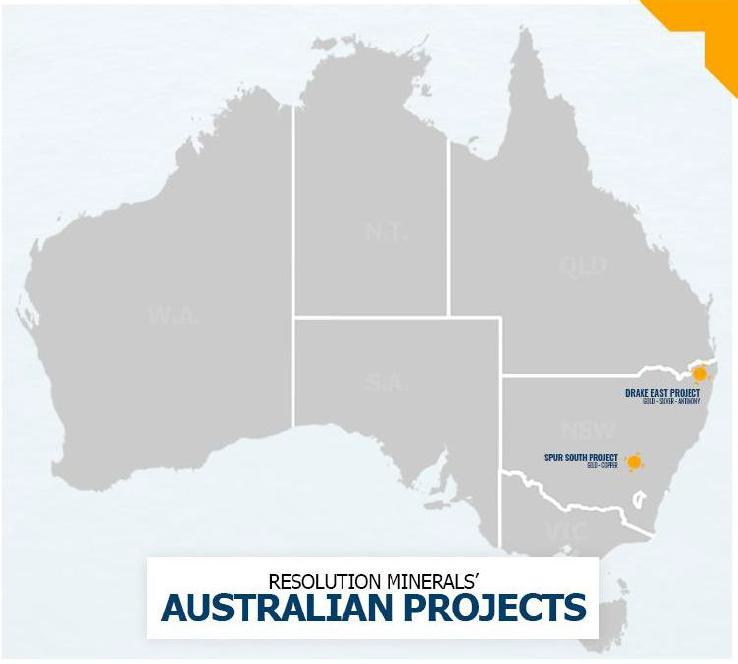
Drake East Project
The Drake East Project (“Drake East”) is located in New South Wales, Australia and is adjacent to the Drake Gold-Copper Project (owned by ASX-listed Legacy Minerals Holdings Ltd), where a large epithermal gold-copper mineralized system is under development. The Legacy Minerals’ project area also hosts 24 antimony occurrences that are concentrated close to the western boundary of Drake East, as shown in Figure 3. The Drake East Project hosts 14 known antimony occurrences. These antimony occurrences cover a large area with a NW-SE strike length of over 15km, as shown in Figures 3 and 4. The project also hosts over 50 gold occurrences, including a placer gold resource at Lanikai West. Drake East hosts high-grade antimony, gold and silver mineralization, including peak values of 5.72% Sb, 60.9 g/t Au and 214 g/t Ag from historical samples.
32
A significant antimony occurrence at Drake East is called the Mosquito Creek Antimony-Gold Reef. Antimony and gold here are associated with a vein system bearing 30° NE, 1,000 meters in length, cutting local geology (Emu Creek Formation mudstones and Jenny Lind Tonalite granites). Antimony and gold mineralization appear to be closely associated with NE-SW structures that spray from the Jump Up Fault.
Another significant antimony occurrence at Drake East is the Ball & Smiths Lode, centered in the southern half of the project area. Juxtaposed with several other antimony and gold occurrences, the Ball & Smiths Lode is a historic 1870’s mine (shafts and open pits). The style of mineralization is believed to be structurally controlled metahydrothermal vein Au-Ag-Te type. In these types of deposits, antimony characteristically occurs as the sulfide ore mineral stibnite (Sb2S3 with 73% mol weight antimony). Assays from sample number G00/363 report 5.72% Sb and 0.26 g/t Au.
From a regional perspective, we believe that the Drake East Project is well placed. Antimony is commonly found in the region in association with gold in epizonal orogenic systems. Many historical goldfields in northeast New South Wales are known to host high-grade antimony mineralization, including the Hillgrove Mine (owned by ASX-listed Larvotto Resources Limited) and the Wild Cattle Creek deposit (owned by ASX-listed Trigg Minerals Limited). The Hillgrove Mine is one of the 10 largest antimony resources globally and Australia’s largest antimony deposit.
In addition to developing the antimony potential of the Drake East Project, we intend to pursue the gold (as well as silver and copper) potential. Drake East has 56 documented historic gold occurrences, with assays at Pine Gully returning up to 60.9 g/t, and historic production at Bucklands Reef of 100 tonnes @ 32.6 g/t Au.
In April 2025, we received a final report for a Light Detection and Ranging (LiDAR) interpretation, which analyzed 791 mine workings, including 742 pits, 33 shafts and 16 adits. This report identified five areas with high concentrations of mine workings, including (i) the Hedley and Hensen Hills areas, which are believed to be a large NE-SW oriented antimony-gold mineral field that also includes the Lunatic Antimony Field (part of Legacy Minerals Holdings Limited’s Drake Project) and (ii) a concentration of placer gold mine workings covering an estimated area of 135,500m2 in the Lanikai Alluvial Prospect area.
Spur South Copper-Gold Project
Our Spur South Project in New South Wales, Australia comprises two granted exploration licences, EL9719 and EL9720. It is located in the prolific Macquarie Arc Metal Belt, home to 25 known gold-copper porphyry systems, on the western margin of the Molong Volcanic Belt within the Lachlan Transverse Zone, a prolifically mineralized structural corridor that hosts the Cadia-Ridgeway, Northparkes and Cargo porphyry and skarn systems. The area hosts six gold-copper mines. Situated within the Lachlan Fold Belt, our Spur South Project is surrounded by major deposits and prospective exploration projects that have shown recent discovery success.
The project-scale geological setting of our Spur South Project comprises regional fault-affected Silurian and Ordovician porphyritic volcanics and volcaniclastic sediments. A discrete 3.25km long magnetic anomaly coincides with a faulted margin of the Ordovician-aged Fairbridge Volcanics (porphyritic basalt and associated volcaniclastics) and Millambri Formation (volcaniclastic sandstones and siltstones).
Quality Assurance and Quality Control
We have established internal controls relating to Quality Assurance and Quality Control (QA/QC) as necessary in relation to our exploration of our properties. These protocols include, but are not limited to:
| ● | Establish a database for project data that will contain accurate, precise, and defensible data from which resource, reserve, and feasibility studies can be made; |
| ● | Conduct verification sampling of known mineralization; |
33
| ● | Ensure that surface or drill sampling results in the highest quality sample possible. This would include down-hole surveying of drill holes as necessary; |
| ● | Ensure the security and integrity of samples from point of origin to analytical laboratory; and |
| ● | Use industry-standard QA/QC for analytical work on sampling, including duplicate samples, inserting blanks and standards (samples with known assay values) into batches of samples being assayed, and checking the assay values from the original assay laboratory by submitting the same sample to a second laboratory. |
Qualified Persons
Scientific and technical information contained in this registration statement on Form 20-F was reviewed and approved by Ross Brown, Principal Geologist/director of exploration consulting firm, Riviere Minerals Pty Ltd, who is a member of the Australasian Institute of Mining and Metallurgy. Mr Brown is a “qualified person” as defined in subpart 1300 of Regulation S-K. Riviere Minerals Pty Ltd serves as our consultant.
United States – Australia Critical Minerals Framework
On October 20, 2025, U.S. President Donald Trump and Australian Prime Minister Anthony Albanese signed a Critical Minerals Framework aiming to support bilateral cooperation by accelerating investments into the development of mining, processing and recycling projects for critical minerals and rare earths, protecting strategic mineral assets and introducing price support mechanisms.
The United States and Australia have each committed to invest at least US$1 billion towards a US$8.5 billion pipeline of priority critical minerals projects in both countries in the near term. This includes investment by the Australian government of US$100 million equity investment in Arafura Rare Earths Ltd’s Nolans rare earths project in the Northern Territory, Australia. In addition, the U.S. Export-Import Bank has issued letters of interest to seven Australian companies that total more than US$2.2 billion in potential financing to advance critical minerals projects in Australia and strengthen supply-chain security.
Government and Environmental Regulations
Mining operations and exploration activities are subject to extensive national, state, and local laws and regulations in Australia and the United States that govern prospecting, development, mining, production, exports, taxes, labor standards, occupational health, waste disposal, protection of the environment, mine safety, hazardous substances and other matters. We plan to obtain the licenses, permits or other authorizations required to conduct our exploration or development programs, and we believe we are currently in material compliance with governing mining, health, safety and environmental statutes and regulations in Australia and United States.
34
Our operations are also subject to numerous environmental, health, and safety laws and regulations in the jurisdictions in which we operate. These laws and regulations may require us to take precautions with respect to threatened, endangered, or otherwise protected species and their habitats as well as other natural, historical, and cultural resources, perform environmental assessments or impact statements, implement siting and operational programs or best practices to minimize environmental impacts from our operations, perform investigatory and remedial obligations, and obtain federal, state, and local permits, licenses, or other approvals. Failure to comply with these laws and regulations could result in the imposition of significant fines or penalties. Additionally, we could experience significant opposition from third parties to our application for such permits or during the administrative agency review and appeal process after the issuance of such permits. Delays, denials of, or challenges to permits, or the imposition of costly and difficult to comply with conditions, may impair the development of our projects or curtail our planned operations. The following provides a summary of the more significant environmental, health, and safety laws and regulations which our operations are subject to and for which compliance with may have a material adverse impact on our business in Australia and the United States.
Australian Regulatory Matters
Our principal Australian project, the Drake East Project, is located in the Australian state of New South Wales (“NSW”). The discussion below discusses relevant Australian federal and NSW regulatory requirements. We note that other Australian states where we have project have similar state laws.
Our mining and explorations obligations in NSW are managed and conducted in compliance with the Mining Act 1992 (NSW), the Mining Regulations 2016 (NSW). All exploration and mining activity in New South Wales must be conducted in accordance with an authority issued under the Mining Act. The Mining Act, related laws and title conditions guide and restrict how we conduct exploration and other activities in our projects located in New South Wales. Our mining infrastructure and related developments in New South Wales are subject to state and local planning laws, including the Environmental Planning and Assessment Act 1979 (NSW) (“EP&A Act”), State Environmental Planning Policy (Resources and Energy) 2021 (NSW) and the Cobar Local Environmental Plan 2012 (NSW). These planning laws may require us to obtain other permits or consents and comply with conditions in connection with the operation and maintenance of our projects in New South Wales.
Our royalty liabilities in respect of any minerals recovered under the mining lease are regulated by NSW legislation. Under the Mining Act, we will be liable for the payment of royalties to the State of New South Wales for any publicly owned minerals which are recovered under the mining lease, with each mineral having a different prescribed rate of royalty. For antimony, copper and gold mined, an ad valorem royalty is calculated at 4% of the value of production less allowable deductions.
Australian federal environmental laws are established under the Environment Protection and Biodiversity Conservation Act 1999 (the “EPBC Act”), which provides a legal framework to protect and manage matters of national environmental significance. The EPBC Act applies to any activity that is likely to have a significant impact on identified matters of national significance. EPBC Act approval may be required for certain actions or activities that affect Australia’s environment, for example when our mining or exploration activities may impact water resources or endangered flora or fauna.
In addition to federal laws, our operations are also subject to New South Wales environmental law including the EP&A Act, the Protection of the Environment Operations Act 1997 (NSW) (“POEO Act”), the Water Act 1912 (NSW), Water Management Act 2000 (NSW), Biodiversity Conservation Act 2016 (NSW) and associated regulations. Our environmental impact is also governed by an Environment Protection License held under the POEO Act, which includes conditions that restrict our operations in New South Wales. Together, this regulatory framework and authorities govern our environmental performance within our operational footprint, including impacts on existing landforms, Australian biodiversity, the quality of ecosystems, Aboriginal heritage matters, water usage, environmental rehabilitation obligations, air emissions, wastewater discharges, air quality standards, greenhouse gas emissions, waste management, handling and disposal of hazardous and radioactive substances, remediation of soil and groundwater contamination, land use, the discharge of materials into the environment, groundwater quality and availability and the public’s interest in any of the aforementioned items.
35
Our operations in New South Wales are conducted in accordance with work health and safety regulations imposed under federal and state work health and safety legislation, the Work Health and Safety Act 2011 (Australian Commonwealth) and Work Health and Safety Act 2011 (NSW), the Work Health and Safety (Mines and Petroleum Sites) Act 2013 (NSW) and associated regulations, as amended. These laws impose minimum working and safety conditions that we must impose at our projects in New South Wales and to ensure its operations are generally maintained at a competent level to protect our employees and contractors.
Tailings dams are operated in accordance with the Dam Safety Act 2015 (NSW), which require emergency and operation plans be in place to mitigate any potential risks, and to report on incidents and annual operations.
Our use of land for mining and other operations activities is subject to the Native Title Act, which may limit our operations in areas that native title is found to exist. Where native title interests are identified, exploration and mining activities may be limited until a right to negotiate process is completed between us and the native title claimants and, in certain circumstances, an indigenous land use agreement (“Indigenous Land Use Agreement”) may be entered into. In addition, we have obligations under the National Parks and Wildlife Act 1974 (NSW) to refrain from harming Aboriginal objects and heritage places. We have in place policies and procedures to ensure our mining activities do not damage Aboriginal heritage sites.
Environmental, mining, safety and other laws and regulations continue to evolve and could require us to meet stricter standards and give rise to greater enforcement. Future laws, regulations, permits or legal requirements, as well as the interpretation or enforcement of existing requirements, could require substantial increases in capital or operating costs to achieve and maintain compliance or could otherwise delay, limit or prohibit our development plans and future operations, or place other restrictions upon, our development plans or future operations or result in the imposition of fines and penalties for failure to comply.
Complying with these regulations is complicated and requires significant attention and resources. While our employees have a significant amount of experience working with various federal, state and local authorities to address compliance with such laws, regulations and permits, we cannot be sure that we will be in compliance with such requirements at all times. We expect to continue to incur significant sums for ongoing regulatory expenditures, including salaries, and the costs for monitoring, compliance, remediation, reporting, pollution control equipment and permitting.
We are not aware of any probable Australian federal or state government regulations that would materially impact us at this time, however there can be no assurance that regulations may not arise in the future that may have a negative effect on our results of operations, earnings and competitive position.
U.S. Regulatory Matters
The material environmental, health and safety laws and regulations that we must comply with include, among others, the following U.S. federal laws and regulations:
| ● | Clean Air Act, which governs air emissions; |
| ● | Clean Water Act, which governs discharges to and excavations within the waters of the United States; |
| ● | Safe Drinking Water Act, which governs the underground injection and disposal of wastewater; |
| ● | National Environmental Protection Act, which requires careful evaluation of the environmental impacts of extraction operations that require federal approvals; |
| ● | Resource Conservation and Recovery Act, which governs the management of solid waste; |
| ● | Comprehensive Environmental Response, Compensation, and Liability Act, which imposes liability where hazardous substances have been released into the environment (commonly known as Superfund); |
| ● | Endangered Species Act; and |
| ● | Federal Mine Safety and Health Act, which established the primary safety and health standards regarding working conditions of employees engaged in extraction, related operations, and preparation and milling of the minerals extracted, as well as the Occupation Safety and Health Act, which regulates the protection of the health and safety of workers to the extent such protection is not already addressed by the Federal Mine Safety and Health Act. |
36
Our operations may also be subject to state environmental law and regulations, including laws and regulations related to the reclamation of mined lands that could require reclamation permits to be acquired prior to the commencement of minerals extraction operations and could require substantial financial guarantees to cover the cost of future reclamation activities.
Air Emissions
The federal Clean Air Act (“CAA”) and comparable state laws restrict the emission of air pollutants from numerous sources through the issuance of permits and the imposition of other requirements. Major sources of air pollutants are subject to more stringent, federally imposed permitting requirements. Air pollution regulations may require us to obtain pre-approval for the construction or modification of certain projects or facilities expected to produce or significantly increase air emissions, obtain air permits and comply with stringent permit requirements or utilize specific equipment or technologies to control emissions of certain pollutants. The need to obtain permits has the potential to delay our operations, and we may be required to incur capital expenditures for air pollution control equipment or other air emissions related obligations. Administrative enforcement actions for failure to comply strictly with air pollution regulations or permits are generally resolved by payment of monetary fines and correction of any identified deficiencies. Alternatively, regulatory agencies could require us to forego construction, modification or operation of certain air emission sources.
Climate Change
Numerous regulatory initiatives have been enacted, and are likely to continue to be developed, at the international, national, regional and state levels of government to monitor and limit existing emissions of greenhouse gases (“GHGs”) as well as to restrict or eliminate such future emissions. At the federal level, in December 2009, the EPA determined that emissions of carbon dioxide, methane and other GHGs endanger public health and the environment because emissions of such gases are, according to the EPA, contributing to warming of the earth’s atmosphere and other climatic changes. Based on these findings, the EPA began adopting and implementing regulations to restrict emissions of GHGs under existing provisions of the CAA.
Congress has from time to time considered adopting legislation to reduce emissions of GHGs, and a number of state and regional efforts have emerged that are aimed at tracking and/or reducing GHG emissions by means of cap-and-trade programs. Cap and trade programs typically require major sources of GHG emissions to acquire and surrender emission allowances in return for emitting those GHGs. The adoption of legislation or regulatory programs or other government action to reduce emissions of GHGs could require us to incur increased operating costs.
Clean Water Act
The Clean Water Act (“CWA”) imposes restrictions and strict controls regarding the discharge of wastes, including mineral processing wastes, into waters of the United States, a term broadly defined to include, among other things, certain wetlands. Permits must be obtained to discharge pollutants into federal waters. The CWA provides for civil, criminal and administrative penalties for unauthorized discharges, both routine and accidental, of pollutants. It imposes substantial potential liability for the costs of removal or remediation associated with discharges of oil or hazardous substances. State laws governing discharges to water also provide varying civil, criminal and administrative penalties, and impose liabilities in the case of a discharge of petroleum or its derivatives, or other hazardous substances, into state waters. In addition, the EPA has promulgated regulations that require permits to discharge storm water runoff, including discharges associated with construction activities. In the event of an unauthorized discharge of wastes, we may be liable for penalties and costs.
Pursuant to these laws and regulations, we may also be required to develop and implement spill prevention, control and countermeasure plans, also referred to as “SPCC plans,” in connection with on-site storage of significant quantities of oil. Some states also maintain groundwater protection programs that require permits for discharges or operations that may impact groundwater conditions. The CWA also prohibits the discharge of fill materials to regulated waters including wetlands without a permit from the USACE.
37
Underground Injection Control Permits
The federal Safe Drinking Water Act (“SDWA”) creates a nationwide regulatory program protecting groundwater. This Act is administered by the EPA. However, to avoid the burden of dual federal and state (or Indian tribal) regulation, the SDWA allows for the Underground Injection Control (“UIC”) permits issued by states (and Indian tribes determined eligible for treatment as states) to satisfy the UIC permit required under the SDWA under two conditions. First, the state’s program must have been granted primacy. Second, the EPA must have granted, upon request by the state, an aquifer exemption. The EPA may delay or decline to process the state’s application if the EPA questions the state’s jurisdiction over the mine site. Permits must be obtained before developing and using deep injection wells for the disposal or storage of produced fluids, and well casing integrity monitoring must be conducted periodically to ensure the well casing is not leaking produced fluids to groundwater. Contamination of groundwater by natural gas and oil drilling, production and related operations may result in fines, penalties, remediation costs and natural resource damages, among other sanctions and liabilities under the SDWA and other federal and state laws. In addition, third-party claims may be filed by landowners and other parties claiming damages for groundwater contamination, alternative water supplies, property impacts and bodily injury.
National Environmental Protection Act
The National Environmental Protection Act (“NEPA”) requires federal agencies to evaluate major agency actions having the potential to significantly impact the environment. The NEPA process involves public input through comments which can alter the nature of a proposed project either by limiting the scope of the project or requiring resource-specific mitigation. NEPA decisions can be appealed through the court system by process participants. This process may result in delaying the permitting and development of projects or increase the costs of permitting and developing some facilities.
Solid and Hazardous Waste
The Resource Conservation and Recovery Act (“RCRA”), as well as comparable state statutes, affect our operations by imposing regulations on the generation, transportation, treatment, storage, disposal and cleanup of hazardous wastes and on the disposal of non-hazardous wastes. Under the auspices of the United States Environmental Protection Agency (“EPA”), the individual states administer some or all the provisions of RCRA, sometimes in conjunction with their own, more stringent requirements.
In addition, the federal Superfund law can impose joint and several liability without regard to fault or legality of conduct on classes of persons who are statutorily responsible for the release of a hazardous substance into the environment. These persons can include the current and former owners, lessees or operators of a site where a release occurs, and anyone who disposes or arranges for the disposal of a hazardous substance. Under the Comprehensive Environmental Response, Compensation, and Liability Act (“CERCLA”), such persons may be subject to strict, joint and several liability for the entire cost of cleaning up hazardous substances that have been released into the environment and for other costs, including response costs, alternative water supplies, damage to natural resources and for the costs of certain health studies. Moreover, it is not uncommon for neighboring landowners, workers and other third parties to file claims for personal injury and property damage allegedly caused by hazardous substances released into the indoor or outdoor environment. Each state also has environmental cleanup laws analogous to CERCLA. Hazardous wastes may have been previously handled, disposed of, or released on or under properties currently or formerly owned or leased by us or on or under other locations to which we sent waste for disposal. These properties and any materials disposed or released on them may subject us to liability under CERCLA, RCRA and analogous state laws. Under such laws, we could be required to remove or remediate disposed wastes or property contamination, to contribute to remediation costs, or to perform remedial activities to prevent future environmental harm.
38
Endangered Species Act
The federal Endangered Species Act (“ESA”) restricts activities that may affect endangered and threatened species or their habitats. Some of our operations may be located in areas that are designated as habitats for endangered or threatened species. A critical habitat designation could result in further material restrictions to federal and private land use and could delay or prohibit land access or development. The United States Fish and Wildlife Service continues its effort to make listing decisions and critical habitat designations where necessary. The ESA has not previously had a significant impact on our operations. However, the designation of previously unprotected species as being endangered or threatened could cause us to incur additional costs or become subject to operating restrictions in areas where the species are known to exist.
Extraction Permits and Approvals
We currently have permits authorizing the exploration drilling activities with respect to Horse Heaven. We are required to obtain governmental permits for some of our exploration activities and may be required to renew the permits we already have. Prior to developing or extracting any mineralization that we discover, we will be required to obtain new governmental permits authorizing, among other things, further site development activities and site operating activities. Obtaining and renewing governmental permits is a complex and time-consuming process and involves numerous jurisdictions. public hearings and possibly costly undertakings. The timeliness and success of permitting efforts are contingent upon many variables not within our control, including the interpretation of permit approval requirements administered by the applicable permitting authority. We may not be able to obtain or renew permits that are necessary to our planned operations or the cost and time required to obtain or renew such permits may exceed our expectations. Any unexpected delays or costs associated with the permitting process could delay the exploration, development or operation of our properties. See “Item 3. Key Information – D. Risk Factors – Risks Related to Regulatory and Industry Matters – We will be required to obtain governmental permits in order to conduct development and minerals extraction operations, a process which is often costly and time-consuming.”
Our exploration operations are subject to extensive laws and regulations, which are overseen and enforced by multiple U.S. federal, state and local authorities. These laws govern exploration, development, production, exports, various taxes, labor standards, occupational health and safety, waste disposal, protection and remediation of the environment, protection of endangered and protected species and other matters. Mineral exploration operations are also subject to U.S. federal and state laws and regulations that seek to maintain health and safety standards by regulating the design and use of drilling methods and equipment. Various permits from government bodies are required for drilling operations to be conducted, and we cannot assure you such permits will be received. Environmental laws and regulations may also, among other things:
| ● | Require notice to stakeholders of proposed and ongoing operations. |
| ● | Require the installation of pollution control equipment. |
| ● | Restrict the types, quantities and concentration of various substances that can be released into the environment in connection with minerals extraction or drilling activities. |
| ● | Limit or prohibit extraction or drilling activities on lands located within wetlands, areas inhabited by endangered species and other protected areas, or otherwise restrict or prohibit activities that could impact the environment, including water resources. |
| ● | Impose substantial liabilities for pollution resulting from current or former operations. |
| ● | Require preparation of an Environmental Assessment or an Environmental Impact Statement. |
As of the date hereof, we have not been required to spend material amounts on compliance with environmental regulations. However, compliance with these laws and regulations may impose substantial costs on us, subject us to significant potential liabilities, and have an adverse effect upon our capital expenditures, results of operations or competitive position. Violations and liabilities with respect to these laws and regulations could result in significant administrative, civil, or criminal penalties, remedial clean-ups, natural resource damages, permit modifications or revocations, operational interruptions or shutdowns and other liabilities. The costs of remedying such conditions may be significant, and remediation obligations could adversely affect our business, results of operations and financial condition. Additionally, Congress and federal and state agencies frequently revise environmental laws and regulations, and any changes in these regulations could require us to expend significant resources to comply with new laws or regulations or changes to current requirements and could have a material adverse effect on our business operations.
39
| C. | Organizational Structure |
Below is a list of our significant subsidiaries, including our ownership percentage, its date of formation and its jurisdiction. These subsidiaries were established to allow us to conduct operations in Australia and the United States.
| Subsidiary | Ownership | Year of Formation / Acquisition | Jurisdiction | |||
| Xavier Resources Pty Ltd | 100% | 2017 | Australia | |||
| Curie Resources Pty Ltd | 100% | 2021 | Australia | |||
| Carrara Resources Pty Ltd | 100% | 2022 | Australia | |||
| Devil Prospecting Pty Ltd | 100% | 2024 | Australia | |||
| 1205 Pty Ltd | 100% | 2023 | Australia | |||
| Resolution Minerals Alaska Inc. | 100% | 2019 | United States | |||
| Resolution Minerals Gold LLC | 100% | 2018 | United States | |||
| 1503571 B.C. Ltd. | 100% | 2024 | Canada | |||
| 1262446 B.C. Ltd. | 100% | 2020 | Canada | |||
| Horse Heaven Holdings Inc. | 100% | 2020 | United States | |||
| Remington Capital Corporation | 100% | 2022 | Canada | |||
| Remington Idaho Inc. | 100% | 2025 | United States |
| D. | Property, Plant and Equipment |
We hold 100% interests in the following tenements:
| Tenement Name | Number of Claims/ Tenement Number | Location | Mineralization Prospects | |||
| Horse Heaven | 787 federal lode mining claims | Idaho, USA | antimony, gold, silver, tungsten | |||
| 5 patented mining claims | Idaho, USA | antimony, gold, silver, tungsten | ||||
| Drake East | EL9730 | New South Wales, Australia | antimony, gold | |||
| Spur South | EL9719 | New South Wales, Australia | gold, copper | |||
| Spur South | EL9720 | New South Wales, Australia | gold, copper |
At the Horse Heaven Project we also own the Antimony Camp, Johnson Creek Antimony and Tungsten Mill and associated infrastructure.
For further information regarding the properties where our projects are located, please see Item 4.B – Business Overview.
| Item 4a. | Unresolved Staff Comments |
None.
40
| Item 5. | Operating and Financial Review and Prospects |
Overview
Resolution Minerals Ltd is an early-stage exploration company focused on advancing two antimony and gold projects, each of which were mined last century, through targeted fieldwork. Our material mineral property is the Horse Heaven Project (antimony, gold, silver and tungsten) in Idaho, USA.
We have incurred net losses since inception and expect to incur substantial and increasing losses for the next several years as we increase our exploration activities and commence development of a project. The steps that we need to complete to reach the production stage of any project will require significant additional resources. To date, we have funded our operations primarily through the sale of our ordinary shares in capital raisings in Australia.
While we did not engage in substantial exploration activities over the past few fiscal years, exploration expenditure increased significantly in fiscal 2026 as we began drilling programs at our Horse Heaven Project in August 2025.
Under IFRS, exploration and evaluation costs on mining tenements are capitalized as deferred expenditure. If, however, exploration demonstrates a tenement is no longer prospective for economically recoverable reserves, or the exploration license is relinquished, then the value or cost of the tenement is immediately recognized as an expense in the income statement. We note that, if our financial statements were prepared under U.S. GAAP, all the exploration and evaluation costs would have been expensed.
| A. | Operating Results |
Results of Operations
Comparison of fiscal years 2026 to 2025
The following table sets forth our results of operations in Australian dollars for the year ended June 30, 2026 and year ended June 30, 2025.
| Year ended June 30, | ||||||||
| 2026 | 2025 | |||||||
| A$ | A$ | |||||||
| Interest income | 274,356 | 9,200 | ||||||
| Other income | - | 22,041 | ||||||
| Broker and investor relations | (2,666,972 | ) | (292,622 | ) | ||||
| Consulting fees | (834,229 | ) | (396,986 | ) | ||||
| Corporate advisory fees | (5,831,478 | ) | (931,850 | ) | ||||
| Depreciation | (6,248 | ) | - | |||||
| Employee benefits expense | (2,545,894 | ) | (904,217 | ) | ||||
| Employee benefits expense – share based payments | (10,991,330 | ) | (1,081,715 | ) | ||||
| Impairment reversal / (expense) - net | 244,542 | (2,101,321 | ) | |||||
| Interest expense | (225,019 | ) | - | |||||
| Legal fees | (1,073,889 | ) | (74,077 | ) | ||||
| Marketing and public relations | (3,386,199 | ) | - | |||||
| Other expenses | (2,311,192 | ) | (266,983 | ) | ||||
| Share based payments – corporate advisory | (23,954,518 | ) | - | |||||
| Share based payments – technical services | (8,548 | ) | (14,886 | ) | ||||
| Loss before tax | (53,316,618 | ) | (6,033,416 | ) | ||||
41
Interest income
Interest income increased from A$9,200 in the year ended June 30, 2025 to A$274,356 in the year ended June 30, 2026 due to A$39.8 million raised in the year ended June 30, 2026, resulting in a much higher cash balance in that year compared to the prior period generating additional interest income.
Other income
Other income decreased from A$22,041 in the year ended June 30, 2025 to nil in the year ended June 30, 2026. In the year ended June 30, 2025, we operated the Benmara joint operation, earning administrative and equipment rental fees from our joint venture partner, which were nil in the year ended June 30, 2026 since the joint venture ceased in the year ended June 30, 2025.
Broker and investor relations
Broker and investor relations expense increased from A$292,622 in the year ended June 30, 2025 to A$2,666,972 in the year ended June 30, 2026 due to increased investor relations activity and engagement of brokers via advisory mandates following our acquisition of the Horse Heaven Project during the year ended June 30, 2026.
Consulting fees
Consulting fees expense increased from A$396,986 in the year ended June 30, 2025 to A$834,229 in the year ended June 30, 2026 due to increased government relations and grant application activity in relation to the Horse Heaven Project during the year ended June 30, 2026.
Corporate advisory fees
Corporate advisory fees expense increased from A$931,850 in the year ended June 30, 2025 to A$5,831,478 in the year ended June 30, 2026 due to increased strategic, merger and acquisition advisory and corporate structuring activity during the year ended June 30, 2026 following the Horse Heaven Project acquisition.
Depreciation
Depreciation expense increased from nil in the year ended June 30, 2025 to A$6,248 in the year ended June 30, 2026 due to the acquisition of buildings at the Horse Heaven Project during the year ended June 30, 2026.
Employee benefits expense
Employee benefits expense increased from A$904,217 in the year ended June 30, 2025 to A$2,545,894 in the year ended June 30, 2026 primarily due to the hiring of more staff for the Horse Heaven Project, increased activities and short term incentives paid to key management personnel for achievement of milestones.
Employee benefits expense – share based payments
Employee benefits – share based payment expense increased from A$1,081,715 in the year ended June 30, 2025 to A$10,991,330 in the year ended June 30, 2026 primarily due to the hiring of more staff for the Horse Heaven Project and performance rights issued to directors and employees under the Company’s Employee Securities Incentive Plan, the majority of which was related to director remuneration and was approved by shareholders.
Impairment reversal / expense - net
Impairment reversal/(expense) - net changed from A$2,101,321 expense in the year ended June 30, 2025 to A$244,542 reversal in the year ended June 30, 2026. A$1,601,147 of impairment taken in fiscal year 2025 for the 64 North Project was reversed, bringing the carrying amount back to its disposal value. The sale of the 64 North Project was completed in February 2026. This was offset by the impairment of the Curie and Xavier projects in Australia which were relinquished during the year totaling A$1,356,605.
42
Interest expense
Interest expense increased from nil in the year ended June 30, 2025 to A$225,019 in the year ended June 30, 2026 due to a short-term working capital loan accessed in the year ended June 30, 2026.
Legal fees
Legal fees increased from A$74,077 in the year ended June 30, 2025 to A$1,073,889 in the year ended June 30, 2026 primarily due to increased contractual negotiations and activities following the acquisition of the Horse Heaven Project during the year ended June 30, 2026.
Marketing and public relations
Marketing and public relations expenses increased from nill in the year ended June 30, 2025 to A$3,386,199 in the year ended June 30, 2026 primarily due to increased promotional activities, to increase the public’s awareness of the Company’s projects in advance of the Nasdaq listing, following the acquisition of the Horse Heaven Project during the year ended June 30, 2026.
Other expenses
Other expenses increased from A$266,983 in the year ended June 30, 2025 to A$2,311,192 in the year ended June 30, 2026, primarily due to increased activities related to the acquisition of the Horse Heaven Project and Nasdaq listing application during the year ended June 30, 2026.
Share based payments – corporate advisory
Share based payments for corporate advisory services increased from nil in the year ended June 30, 2025 to A$23,954,518 in the year ended June 30, 2026 due to payments of equity for advisory support related to our acquisition of the Horse Heaven Project, Nasdaq listing application and other financing and corporate advice received during the year ended June 30, 2026. All issues of securities were approved by shareholders at General Meetings held during the year.
Share based payments – technical services
Share based payments decreased from A$14,886 in the year ended June 30, 2025 to A$8,548 in the year ended June 30, 2026 due to a change in the payment structures used for technical services.
Loss for the year
Loss for the year increased significantly from A$6,033,416 in the year ended June 30, 2025 to A$53,316,618 in the year ended June 30, 2026 primarily due to the advancement and promotion of our Horse Heaven Project during the year ended June 30, 2026 and the payment of consulting, advisory, marketing and legal fees and associated equity to persons who began working at our Horse Heaven Project during the year ended June 30, 2026 as detailed above. In particular, employee benefits expense – share based payments and share based payments – corporate advisory increased A$9,909,615 and A$23,954,518 respectively.
Comparison of fiscal years 2025 to 2024
The following table sets forth our results of operations in Australian dollars for the fiscal years ended June 30, 2025 and 2024.
| Year ended June 30, | ||||||||
| 2025 | 2024 | |||||||
| A$ | A$ | |||||||
| Interest income | 9,200 | 29,779 | ||||||
| Other income | 22,041 | 177,996 | ||||||
| Broker and investor relations | (292,622 | ) | (48,901 | ) | ||||
| Employee benefits expense | (1,985,932 | ) | (1,423,783 | ) | ||||
| Share based payments | (14,886 | ) | (56,633 | ) | ||||
| Impairment expense | (2,101,321 | ) | (15,316,813 | |||||
| Depreciation | - | (8,854 | ) | |||||
| Other expenses | (1,669,896 | ) | (341,472 | ) | ||||
| Loss for the year | (6,033,416 | ) | (16,988,681 | ) | ||||
43
Interest income
Interest income decreased from A$29,779 in fiscal 2024 to A$9,200 in fiscal 2025 due to lower bank funds on deposit in fiscal 2025.
Other income
Other income decreased from A$177,996 in fiscal 2024 to A$22,041 in fiscal 2025. In fiscal 2024, we operated the Benmara joint operation, earning administrative and equipment rental fees, which were reduced in fiscal 2025 since the joint venture ceased in December 2024.
Broker and investor relations
Broker and investor relations expense increased from A$48,901 in fiscal 2024 to A$292,622 in fiscal 2025 due to increased marketing of the company’s new projects in fiscal 2025.
Employee benefits expense
Employee benefits expense increased 39% from A$1,423,783 in fiscal 2024 to A$1,985,932 in fiscal 2025 primarily due to an increase in share based payments for directors and employees from A$666,757 in fiscal 2024 to A$1,081,715 in fiscal 2025, partially offset by a decrease in salaries and contract payments for directors and employees from A$1,139,395 in fiscal 2024 to A$904,217 in fiscal 2025.
Share based payments
Share based payments decreased from A$56,633 in fiscal 2024 to A$14,886 in fiscal 2025 due to a reduction in equity remuneration to consultants in fiscal 2025.
Impairment expense
Impairment expense decreased from A$15,316,813 in fiscal 2024 to A$2,101,321 in fiscal 2025. During fiscal 2024, the board agreed to sell the 64North Project for US$1.5 million resulting in an impairment charge of A$15,316,813. During fiscal 2025, we agreed with our joint venture partner, Alaska Energy Metals Corporation, to acquire the remaining 47% of the 64North Project that we did not already own for US$200,000 and we paid an initial US$10,000 for the transaction. In connection with the purchase of the remaining 47% of the project, we undertook an external valuation of the project, which resulted in a write down of its value on a 100% basis to A$640,000. This resulted in an impairment charge of A$1,333,915. The residual impairment of A$767,406 relates to the relinquishment of the Carrara and Xavier projects, which are located in Australia.
Depreciation
Depreciation decreased from A$8,854 in fiscal 2024 to nil in fiscal 2025 as our plant and equipment were fully depreciated during fiscal 2024.
44
Other expenses
Other expenses increased from A$341,472 in fiscal 2024 to A$1,669,896 in fiscal 2025, primarily due to an increase in corporate advisory expenses from nil in fiscal 2024 to $931,850 in fiscal 2025 and increase in consulting fees from A$12,500 in fiscal 2024 to A$396,987 in fiscal 2025, partially offset by a decrease in office expenses from A$61,378 in fiscal 2024 to A$17,988 in fiscal 2025. The corporate advisory expense related to fees associated with the engagement of a new advisor in conjunction with our newly acquired Horse Heaven Project and the consulting fees related to fees paid to our Chief Executive Officer and our Chief Financial Officer in lieu of salaries.
Loss for the year
Loss for the year decreased significantly from A$16,988,681 in fiscal 2024 to A$6,033,416 in fiscal 2025 primarily due to the impairment expense of A$15,316,813 in fiscal 2024, compared to A$2,101,321 in fiscal 2025.
Off-Balance Sheet Arrangements
During fiscal years 2026, 2025 and 2024, we did not have any relationships with unconsolidated entities or financial partnerships, such as entities often referred to as structured finance or special purpose entities, which would have been established for the purpose of facilitating off-balance sheet arrangements or other contractually narrow or limited purposes.
Contractual Obligations and Commitments
As of June 30, 2026, the company did not have any contractual obligations.
Capital and other commitments
As of June 30, 2026, we had no capital commitments.
In order to maintain rights of tenure for exploration permits, we have obligations to perform minimum exploration work and expend minimum amounts of money. Our exploration commitments were A$88,603 as of June 30, 2026.
Contingent liabilities
We did not have any material contingent liabilities outstanding as of June 30, 2026.
45
| B. | Liquidity and Capital Resources |
Since our inception, our operations have mainly been financed through the issuance of equity securities. Additional funding has come through interest earned from cash on term deposit.
Capital Requirements
As of June 30, 2026, we had cash of A$10,343,353.
In September 2025, we announced a private placement of ordinary shares and options to institutional and professional investors in Australia that will raise gross proceeds of approximately A$25.1 million, with A$18.4 million being received in September 2025. The remaining A$6.7 million was approved by shareholders at the 2025 annual general meeting and closed in December 2025.
In October 2025, we announced a private placement of 25,000,000 ordinary shares at A$0.08 per share and 25,000,000 options with a strike price of A$0.10 and 3-year expiry to Tribeca Capital Advisory Pty Ltd to raise A$2 million.
In April 2026, we announced a two-tranche private placement to institutional and sophisticated investors in Australia to raise gross proceeds of approximately A$20 million. Under the first tranche, 131,614,286 ordinary shares at A$0.07 per share were issued between May and July 2026 to raise net proceeds of A$8,660,220. The second tranche of 154,100,000 ordinary shares and up to 95,283,095 options that are exercisable at A$0.10 was subject to shareholder approval (which shareholder approval was obtained in September 2026) and is expected to raise gross proceeds of A$10,787,000. We have delayed the closing of the second tranche until November 2026.
In October 2026, we entered into a short-term unsecured debt facility with Harbour Capital Opportunities Fund Pty Ltd (the “Lender”) to borrow up to A$10,000,000 across four equal tranches, and immediately drew an initial tranche of A$2,500,000. A second tranche of A$2,500,000 is available at our election, with the third and fourth tranches of A$2,500,000 each available for drawdown upon mutual agreement with the Lender. Interest of 12% per annum is accrued monthly, payable at maturity, being 6 months from the date the funds are advanced. In addition, a fee of 15,000,000 RMLOD options per A$2.5 million advanced is payable to the Lender, along with a lead manager fee consisting of a 6% cash fee on funds drawn, 3% on the total facility issued as ordinary shares and 30 million RMLOD options. The RMLOD options are quoted on ASX and have an exercise price of A$0.10 and expire on November 30, 2029. The lead manager is Oakley Capital Partners Pty Limited, which is affiliated with the Lender. The issuance of shares and options is subject to shareholder approval. If approval is not granted, an equivalent in cash, for which the loan agreement does not provide a calculation, will be payable.
We anticipate that our current cash and funding facilities will be sufficient to fund our operations at least until April 2027. However, our forecast of the period of time through which our financial resources will be adequate to support our operations is a forward-looking statement that involves risks and uncertainties, and actual results could vary materially. If we are unable to raise additional capital when required or on acceptable terms, we may have to significantly delay, scale back or discontinue exploration at one or more of our projects.
We anticipate that we will require substantial additional funds in order to achieve our long-term goals and reach the production stage at our critical mineral projects. We do not expect to generate significant revenue until we reach such production stage. We therefore expect to continue to incur substantial losses in the near future.
Our future capital requirements are difficult to forecast and will depend on many factors, including the costs of our exploration and development activities and the costs of our feasibility studies.
Cash Flows
Comparison of cash flows for the fiscal year ended June 30, 2026, with the fiscal year ended June 30, 2025
The following table summarizes our cash flows for the periods presented:
Year ended June 30, | ||||||||
| 2026 | 2025 | |||||||
| A$ | A$ | |||||||
| Net cash used in operating activities | (17,947,997 | ) | (1,896,750 | ) | ||||
| Net cash used in investing activities | (10,364,334 | ) | (269,381 | ) | ||||
| Net cash provided by financing activities | 37,484,443 | 3,098,625 | ||||||
46
Operating Activities
Net cash used in operating activities increased significantly from A$1,896,750 in the year ended June 30, 2025 to A$17,947,997 in the year ended June 30, 2026, primarily due to payments made to suppliers and employees increasing by A$16,072,811 from A$1,906,287 in the year ended June 30, 2025 to A$17,979,098 in the year ended June 30, 2026 reflecting a substantial change in the scale of the business following our acquisition of the Horse Heaven Project during fiscal 2026. Payments to employees, advisors, consultants and legal counsel all increased in fiscal 2026 resulting from a significant activity around broker, investor, government and public relations and other advice around funding options, mergers and acquisition opportunities and corporate structuring. This was partially offset by an increase in interest received from A$10,137 in the year ended June 30, 2025 to A$274,356 in the year ended June 30, 2026.
Investing Activities
Net cash used in investing activities increased significantly from A$269,381 in the year ended June 30, 2025 to A$10,364,334 in the year ended June 30, 2026, primarily due to an increase in payments for capitalized exploration expenditure related to the Horse Heaven Project from A$243,098 in the year ended June 30, 2025 to A$10,087,296, partially offset by the proceeds of selling the 64North Project in Alaska in the year ended June 30, 2026.
Financing Activities
Net cash provided by financing activities increased significantly from A$3,098,625 in the year ended June 30, 2025 to A$37,484,443 in the year ended June 30, 2026, due to capital raisings completed in the year ended June 30, 2026 that raised proceeds of A$33,816,693 compared to A$3,346,307 in the year ended June 30, 2025.
Comparison of cash flows for the fiscal year ended June 30, 2025, with June 30, 2024
The following table summarizes our cash flows for the periods presented:
| Year ended June 30, | ||||||||
| 2025 | 2024 | |||||||
| A$ | A$ | |||||||
| Net cash used in operating activities | (1,896,750 | ) | (535,129 | ) | ||||
| Net cash used in investing activities | (269,381 | ) | (512,850 | ) | ||||
| Net cash provided by/(used in) financing activities | 3,098,625 | (22,312 | ) | |||||
Operating Activities
Net cash used in operating activities more than tripled from A$535,129 in fiscal 2024 to A$1,896,750 in fiscal 2025, primarily due to payments made to suppliers and employees increasing by A$1,056,460 from A$849,827 in fiscal 2024 to A$1,906,287 in fiscal 2025, which was partially offset by a decrease in other receipts from A$320,413 in fiscal 2024 to nil in fiscal 2025. Such other receipts in fiscal 2024 consisted primarily of joint venture partner contributions under an earn-in agreement that did not proceed into fiscal 2025.
Investing Activities
Net cash used in investing activities decreased A$243,469 from A$512,850 in fiscal 2024 to A$269,381 in fiscal 2025, primarily due to a decrease of A$2,236,081 in payments for capitalized exploration expenditure.
47
Financing Activities
Net cash provided by financing activities increased significantly from net cash used in financing activities of A$22,312 in fiscal 2024 to net cash provided by financing activities of A$3,098,625 in fiscal year 2025, due to capital raisings completed in fiscal 2025 that raised proceeds of A$3,346,307. In comparison, in fiscal 2024, financing activities related primarily to rental lease payments of A$22,509.
| C. | Research and Development, Patents and Licenses |
We are not currently engaged in any research and development activities.
| D. | Trend Information |
We are an exploration company and, as a result, it is not possible for us to predict with any degree of accuracy the outcome of our exploration and any future development activities.
Our primary expenditure involves administration, exploration and other related expenses. Increases or decreases in such expenditures should correlate with any increase or decrease of our exploration and development activities.
| E. | Critical Accounting Estimates |
The preparation of our consolidated financial statements requires management to make judgements, estimates and assumptions that affect the application of accounting policies and the reported amounts of assets, liabilities, income and expenses. Actual results may differ from these estimates. The estimates and underlying assumptions are reviewed on an ongoing basis. Revisions to accounting estimates are recognized in the period in which the estimate is revised if the revision affects only that period, or in the period of the revision and future periods if the revision affects both current and future periods. See Note 1 to our fiscal 2026 financial statements included in this Annual Report for a description of our other significant accounting policies.
In particular, information about significant areas of estimation uncertainty and critical judgements in applying accounting policies that have the most significant effect on the amount recognized in the financial statements are described below.
Impairment of assets
At the end of each half and full fiscal year, we review the carrying values of tangible and intangible assets to determine whether there is any indication that those assets have been impaired. If such indication exists, then the recoverable amount of the asset, being the higher of the asset’s fair value less costs of disposal and value in use, is compared to the asset’s carrying value. Any excess of the asset’s carrying value over its recoverable amount is expensed to profit and loss.
Where it is not possible to estimate the recoverable amount of an individual asset, then we estimate the recoverable amount of the cash-generating unit to which the asset belongs.
Share based payments
We provide share based compensation in the form of options and performance rights to officers, directors and consultants. The cost of these equity-settled transactions is measured by reference to the fair value at the date at which they are granted. The fair value of share options is determined using a Black-Scholes methodology depending upon the nature of the option terms. The fair value in relation to performance rights is calculated using either the Black Scholes or Monte Carlo Simulation if market-based vesting conditions exist.
The fair value of the options and performance rights granted is adjusted to reflect market vesting conditions. Non-market vesting conditions are included in assumptions about the number of options and performance rights that are expected to become exercisable / vested. At the end of each half and full fiscal year, we may revise our estimates of the number of options and performance rights that are expected to become exercisable / vested.
48
| Item 6. | Directors, Senior Management and Employees |
| A. | Directors and Senior Management |
The following table sets forth our directors and senior management and their positions. There are no family relationships among any of the members of our board of directors and our senior management.
| Name | Position | |
| Aharon Zaetz | Chief Executive Officer and Director | |
| Menachem Rogatsky | Executive Director | |
| Syed Alsagoff | Director, Chair of the Audit Committee | |
| Brett Lynch | Director, Member of the Audit Committee | |
| Jaroslaw (Jarek) Kopias | Chief Financial Officer and Company Secretary | |
| Dr. Adam Roper | Chief Metallurgist – Critical Metals Extraction | |
| Craig Lindsay | CEO, U.S. Operations |
Aharon Zaetz. Aharon Zaetz has been effectively our Chief Executive Officer and Director since December 2023. Mr. Zaetz has over 5 years of experience in the Australian and U.S. resource sector. Mr. Zaetz has also been a non-executive director of Gold Mountain Limited since March 2023. Mr. Zaetz has been a commercial lawyer since 2016, with experience in corporate law, mergers and acquisitions and business negotiations, including negotiating with tenement holders and landowners.
Menachem Rogatsky. Menachem Rogatsky has been an Executive Director since November 2023. As our Executive Director, Mr. Rogatsky has various management responsibilities at Resolution Minerals. Mr. Rogatsky has approximately 25 years’ experience in real estate development and construction. Mr. Rogatsky does not have any other directorships or business activities outside Resolution Minerals.
Jaroslaw (Jarek) Kopias. Jaroslaw (Jarek) Kopias has been our Chief Financial Officer and Company Secretary since March 2017. Mr. Kopias has approximately 25 years’ experience in finance and governance roles. Concurrent with his appointment as our Chief Financial Officer and Company Secretary, Mr. Kopias serves as Company Secretary of a number of ASX listed companies, including Austral Resources Australia Ltd, Altitude Minerals Ltd, Core Lithium Ltd, Iron Road Ltd, iTech Minerals Ltd and Patagonia Lithium Ltd.
Dr. Adam Roper. Dr. Adam Roper, PhD (Antimony Geochemistry) has been our Chief Metallurgist – Critical Metals Extraction since December 2025. Dr. Roper leads the development and implementation of our antimony, tungsten and gold processing strategy. Dr. Roper is a highly accomplished metallurgist and chemical processing specialist with over a decade of experience spanning process development, piloting, flowsheet optimization and the design of innovative extraction solutions for complex and strategic metals. Dr. Roper has 10 years of end-to-end process development for downstream production, spanning antimony, lithium, niobium, rare earths, base, precious and platinum group metals. Dr. Roper has held roles with ANSTO Minerals, where he acted as a consultant to the global mining sector on advanced chemical processing flowsheets for critical minerals.
Syed Alsagoff. Syed Alsagoff has been a Director since January 2024 and Chair of the Audit Committee since April 2026. Mr. Alsagoff has approximately 30 years’ experience in investment and corporate strategy in Asia and globally. Mr. Alsagoff has also been a non-executive director of Gold Mountain Limited since September 2019. Mr. Alsagoff is also currently a non-executive director at Al Wasatah Al Maliah (Closed Joint Stock Company) in Riyadh, Saudi Arabia. He joined the board of the organization in 2012 and is also the audit committee chairman of Al Wasatah. Prior to his appointment as Director, Mr. Alsagoff has served in various executive roles in various organizations in the United States of America, Australia and Malaysia.
Brett Lynch. Brett Lynch has been a Director and Member of the Audit Committee since August 2026. Mr. Lynch was previously our Senior Strategic Adviser between July 2025 and July 2026. Mr. Lynch has more than 30 years’ experience in the mining industry across Australia, North America and Asia, where he transformed and scaled resource companies and delivered operational outcomes. Mr. Lynch was previously the Managing Director of Sayona Mining Ltd (ASX: SYA) (now Elevra Lithium Ltd (ASX: ELV)), where he led the company’s acquisition of and restarted operations at its lithium project located in Quebec. In addition, Mr. Lynch has held senior operational and executive roles at resource companies including MIM Holdings Limited, New Hope Corporation Limited and Orica Limited, overseeing large-scale, multi-jurisdictional mining operations. Mr. Lynch is also the Chairman of Ionic Rare Earths Limited (ASX: IXR).
49
Craig Lindsay. Craig Lindsay has been CEO, U.S. Operations since July 2025, when we acquired the Horse Heaven Project. Mr. Lindsay has significant experience in developing resource projects in the United States, taking them from exploration stage to Preliminary Economic Assessment stage. He was a Founder and CEO of Magnum Uranium Corp. from October 2005 to June 2009 (when it was sold to Energy Fuels Inc.). He was also Founder and CEO of Otis Gold Corp. (or “Otis”) from June 2008 to April 2020, where he led the acquisition and development of the Kilgore Gold Project, located in Idaho, USA, including the completion of a maiden Preliminary Economic Assessment; Otis was sold to Excellon Resources Inc. in 2020. Mr. Lindsay has extensive experience in public markets, and currently is the Chairman of Electric Royalties Ltd. (TSXV:ELEC), a Director and Chair of the Audit Committee of Excellon Resources Inc. (TSXV:EXN), a Director and Chair of the audit committee of Revolve Renewable Power Corp (TSXV:REVV) and a Director of Silver North Resources Corp (TSXV:SNAG) Mr. Lindsay has a BComm degree from the University of British Columbia, an MBA degree from Dalhousie University and is a Chartered Financial Analyst.
| B. | Compensation |
Remuneration Principles
Our remuneration policy has been designed to align objectives of key management personnel with objectives of shareholders and the business, by providing a fixed remuneration component and offering specific long-term incentives through the issuances of options and / or performance rights. The Board believes the remuneration policy to be appropriate and effective in its ability to attract and retain the best key management personnel and Directors to run and manage the Company. The Board’s policy for determining the nature and amount of remuneration for its members and key management personnel is as follows:
| ● | The remuneration policy, setting the terms and conditions for the key management personnel, was developed by the Board. All key management personnel are remunerated on a consultancy or salary basis based on services provided by each person. The Board annually reviews the packages of key management personnel by reference to the Company’s performance and comparable information from industry sectors and other listed companies in similar industries. |
| ● | The Board may exercise discretion in relation to approving incentives, bonuses, options and performance rights. The policy is designed to attract the highest caliber of key management personnel and reward them for performance that results in long-term growth in shareholder wealth. |
| ● | Key management personnel are also entitled to participate in our Employee Securities Incentive Plan. |
| ● | The Board policy is to remunerate non-executive Directors at market rates for comparable companies for time, commitment and responsibilities. The Board determines payments to the non-executive Directors and reviews their remuneration annually, based on market practice, duties and accountability. Independent external advice is sought when required. The maximum aggregate amount of fees that can be paid to non-executive Directors is subject to approval by shareholders (currently A$1,500,000). Fees for non-executive Directors are not linked to the performance of the Company, except in relation to share price-based performance rights. However, to align Directors’ interests with shareholder interests, our Directors are encouraged to hold shares and are able to participate in our Employee Securities Incentive Plan. |
Consequences of performance on shareholder wealth
In considering the Company’s performance and benefits for shareholder wealth, the Board will have regard to a number of key performance metrics such as profitability, shareholders’ equity and the Company’s share price.
The following table shows the results of key performance indicators of the Company for the past 5 years:
| Year | Profit/(Loss) after tax A$ | Earnings per share (A$) | Share price at 30 June (A$) | |||||||||
| 2026 | (53,316,618 | ) | (2.97 | ) | 0.044 | |||||||
| 2025 | (6,033,416 | ) | (1.92 | ) | 0.052 | |||||||
| 2024 | (16,988,681 | ) | (1.26 | ) | 0.002 | |||||||
| 2023 | (8,760,320 | ) | (0.84 | ) | 0.004 | |||||||
| 2022 | (1,003,371 | ) | (0.16 | ) | 0.008 | |||||||
50
Executive Compensation
The following table sets forth the compensation paid to our directors and executive officers in fiscal 2026.
| Short-term Benefits | Post Employment Benefits | Long-term (share based payments) | Total | |||||||||||||||||||||
| June 30, 2026 | Cash salary and fees A$ | Cash bonus A$ | Non Monetary* A$ | Super- annuation A$ | Performance Rights, Shares and Options A$(7) | A$ | ||||||||||||||||||
| Aharon Zaetz | 491,992 | (1) | 713,736 | (4) | - | - | 4,850,000 | 6,055,728 | ||||||||||||||||
| Menachem Rogatsky | 534,713 | (2) | 240,579 | (5) | - | - | 4,850,000 | 5,625,292 | ||||||||||||||||
| Jaroslaw (Jarek) Kopias | 243,185 | (3) | 100,000 | (6) | - | - | 430,689 | 773,874 | ||||||||||||||||
| Syed Alsagoff | 41,008 | - | - | 4,992 | 200,000 | 246,000 | ||||||||||||||||||
| Craig Lindsay | 331,129 | - | - | - | 329,627 | 660,756 | ||||||||||||||||||
| 1,642,027 | 1,054,315 | - | 4,992 | 10,660,316 | 13,361,650 | |||||||||||||||||||
| (1) | This amount includes retroactive increases in pay of (i) A$44,000 for the period of December 2024 to November 2025 and (ii) A$98,000 for the period of December 2025 to June 2026, both of which were paid in a lump sum in July 2026. In May 2026, the Company’s Board of Directors agreed to retroactively increase Mr. Zaetz’s compensation for such periods. |
| (2) | This amount includes (i) retroactive increase in pay of A$44,000 for the period of December 2024 to November 2025, (ii) retroactive increase in pay of A$98,000 for the period of December 2025 to June 2026, both of which were paid in a lump sum in July 2026, and (iii) cash payment of A$42,713 for unused annual leave. In May 2026, the Company’s Board of Directors agreed to retroactively increase Mr. Rogatsky’s compensation for such periods. |
| (3) | This amount is based on fees calculated at an hourly rate. |
| (4) | This bonus amount was granted based on the following service and performance criteria: (i) completion of the Horse Heaven transaction in July 2025 (A$360,000); (ii) completion of a A$25.1 million private placement of ordinary shares in Australia in October 2025 (A$100,000) and (iii) completion of the sale of the Company’s 64North Project to Northern Star Resources Ltd for US$1.5 million in February 2026 (A$253,736). |
| (5) | This bonus amount was granted based on the following service and performance criteria: (i) completion of a A$25.1 million private placement of ordinary shares in Australia in October 2025 (A$100,000) and (ii) completion of the sale of the Company’s 64North Project to Northern Star Resources Ltd for US$1.5 million in February 2026 (A$140,579). |
| (6) | This bonus amount was a discretionary bonus awarded by the Company’s Board of Directors in its discretion taking into account the performance of Mr Kopias during fiscal 2026. |
| (7) | Such amounts represent issuances of performance rights that were approved by shareholders on September 2, 2025 and February 17, 2026. |
51
Employment and Service Agreements
The following executive officers have employment and service agreements:
| Aharon Zaetz | Chief Executive Officer | |
| Agreement commenced: | December 1, 2023 and amended and restated on May 28, 2026 | |
| Details | Mr. Zaetz has a consulting agreement with no fixed term. Each party can terminate at will by giving six months’ notice. However, if the termination is for cause, no notice is required. | |
| Annual base salary | A$448,000 | |
| Jaroslaw (Jarek) Kopias | Chief Financial Officer and Company Secretary | |
| Agreement commenced: | March 6, 2017 and amended and restated on July 1, 2026 | |
| Details | We have a service agreement with Mr. Kopias that has no fixed term. The service agreement can be terminated by either party at will by giving 1-month notice. | |
| Annual base salary | Mr Kopias is paid a monthly rate of A$20,000. | |
| Menachem Rogatsky | Executive Director | |
| Agreement commenced: | December 1, 2023 and amended and restated on May 28, 2026 | |
| Details | We have an employment agreement with Mr. Rogatsky that has no fixed term. This service agreement can be terminated by either party at will by giving notice of six months. | |
| Annual base salary | A$448,000 | |
| Dr. Adam Roper | Chief Metallurgist – Critical Metals Extraction | |
| Agreement commenced: | December 12, 2025 | |
| Details | This employment agreement has no fixed term. This employment agreement can be terminated by either party at will by giving notice of one month. | |
| Annual base salary | A$310,000 | |
| Craig Lindsay | Chief Executive Officer of U.S. Operations | |
| Agreement commenced: | July 1, 2025 | |
| Details | This consultancy agreement has no fixed term. This service agreement can be terminated by either party at will by giving notice of three months. | |
| Annual base salary | US$225,000 |
52
Equity Incentive Plan
Employee Securities Incentive Plan
We have established an incentive plan to reward directors, senior executives and other key employees and contractors for long-term performance. This plan provides for the issuance of shares, options or performance rights to subscribe for ordinary shares to eligible participants. The exercise price of the options is determined by the Board and may not be less than the weighted average sale price of ordinary shares sold on ASX during the five business days prior to the grant date or such other period as determined by the Board.
Options or performance rights are generally only of benefit if the person performs to the level whereby the value of the company increases sufficiently to warrant exercising the options or performance rights granted. Other than service-based vesting conditions (if any) and the exercise price required to exercise the options, there are no additional performance criteria on the options granted. Performance rights are issued with targeted market and non-market vesting conditions that may include a service-based condition.
Share based compensation during fiscal 2026
A total of 228,000,000 performance rights and 3,000,000 options were issued as compensation to our directors and executive officers during fiscal 2026, as follows:
| Number | Grant | Fair value at grant date in A$ | Expiration | |||||||||||||||||||
| Name | Criteria | Granted | Date | Per security | Full value | Date | ||||||||||||||||
| Performance Rights | ||||||||||||||||||||||
| Jaroslaw (Jarek) Kopias | 1 | 5,000,000 | (1) | 09/02/2025 | $ | 0.053 | (2) | $ | 265,000 | 07/31/2030 | ||||||||||||
| Jaroslaw (Jarek) Kopias | 2 | 4,000,000 | 02/26/2026 | $ | 0.040 | (3) | $ | 160,000 | 12/31/2030 | |||||||||||||
| Craig Lindsay | 3 | 4,000,000 | 09/02/2025 | $ | 0.057 | (3) | $ | 228,000 | 09/02/2030 | |||||||||||||
| Aharon Zaetz | 1 | 50,000,000 | 09/02/2025 | $ | 0.053 | (2) | $ | 2,650,000 | 07/31/2030 | |||||||||||||
| Aharon Zaetz | 2 | 55,000,000 | 02/17/2026 | $ | 0.040 | (3) | $ | 2,200,000 | 12/31/2030 | |||||||||||||
| Menachem Rogatsky | 1 | 50,000,000 | 09/02/2025 | $ | 0.053 | (2) | $ | 2,650,000 | 07/31/2030 | |||||||||||||
| Menachem Rogatsky | 2 | 55,000,000 | 02/17/2026 | $ | 0.040 | (3) | $ | 2,200,000 | 12/31/2030 | |||||||||||||
| Syed Alsagoff | 2 | 5,000,000 | 02/17/2026 | $ | 0.040 | (3) | $ | 200,000 | 12/31/2030 | |||||||||||||
| Total performance rights | 228,000,000 | |||||||||||||||||||||
| Options | ||||||||||||||||||||||
| Craig Lindsay | 1,000,000 | (1) | 07/17/2025 | $ | 0.0445 | (4a) | $ | 44,547 | 09/02/2030 | |||||||||||||
| Craig Lindsay | 1,000,000 | (1) | 07/17/2025 | $ | 0.0409 | (4b) | $ | 40,878 | 09/02/2030 | |||||||||||||
| Craig Lindsay | 1,000,000 | (1) | 07/17/2025 | $ | 0.0381 | (4c) | $ | 38,112 | 09/02/2030 | |||||||||||||
| Total options | 3,000,000 | |||||||||||||||||||||
| Shares | ||||||||||||||||||||||
| Craig Lindsay | 1,000,000 | (1) | 09/02/2025 | $ | 0.057 | (3) | $ | 57,000 | - | |||||||||||||
| Total shares | 1,000,000 | |||||||||||||||||||||
| 1 | Options and shares issued as part of remuneration package. |
| 2 | Monte Carlo pricing model used for calculation for valuation of Rights with the following inputs: |
| Share price value at grant / measurement date | Exercise price | Right Life | Expected Dividend yield | Expected share price volatility | Risk-free interest rate | ||||||||||||
| A$0.057 | n/a | 5.00 years | 0% | 100% | 3.66% | ||||||||||||
| 3 | Share price on grant date |
53
The issue of performance rights to directors was approved by shareholders at General Meetings held on September 2, 2025 and February 17, 2026.
| Criteria | Description |
| 1 | The first to occur of the following: (a) Company announces inferred Mineral resource under JORC of (i) at least 1,000,000 ounces of contained gold (for example approximately 15,600,000 tonnes at 2 grams per tonne); or (ii) of at least 100,000 tonnes of contained antimony (for example, 10,000,000 million tonnes at 1.0% Sb); or (iii) of at least 10,000 tonnes of contained tungsten (for example, 2 million tonnes at 0.5% WO3), or (b) the Company’s Shares achieving a volume weighted average price (VWAP) per Share of A$0.10 calculated over 20 consecutive trading days on which the Shares have actually traded. There is no requirement for the participant to remain employed until any of the relevant performance milestones are achieved. Criteria 1(b) was assessed as most likely to occur first. |
| 2 | The first to occur of the following: (a) the Company announcing a JORC compliant mineral resource estimate in at least an inferred category of not less than 1,500,000 ounces of contained gold; or (b) the Shares achieving a volume weighted average price of A$0.11 per Share calculated over seven (7) consecutive trading days on which the Shares have traded; or (c) inclusion of the Horse Heaven project onto the FAST 41 Permitting Dashboard; or (d) the Company being admitted to the official list of the Nasdaq and the Shares being quoted for trading on that market; or (e) the Company commencing small-scale operations on bulk mining permit in respect of antimony or tungsten. There is no requirement for the participant to remain employed until any of the relevant performance milestones are achieved. Criteria 2(c) was assessed as most likely to occur first and therefore the rights have been fair valued as those with non-market performance conditions. |
| 3 | 2,500,000 rights vest upon the employee remaining engaged with the Company 13 months after commencement date; and 1,500,000 rights vest upon the earlier of the employee remaining engaged by the Company for 13 months or completion of two substantial drilling programs. |
| 4 | Black Scholes pricing model used for calculation for valuation of Options with the following inputs: |
| Share price value at grant / measurement date | Exercise price | Right Life | Expected share price volatility | Risk-free interest rate | |||||||||
| (a) | A$0.063 | A$0.10 | 5.17 years | 100% | 3.52% | ||||||||
| (b) | A$0.063 | A$0.15 | 5.17 years | 100% | 3.52% | ||||||||
| (c) | A$0.063 | A$0.20 | 5.17 years | 100% | 3.52% | ||||||||
| C. | Board Practices |
Introduction
Our Board of Directors consists of four directors, including two executive directors.
Election of Directors
Directors are elected at our annual general meeting of shareholders (“AGM”). Under our Constitution, a director, other than a managing director (CEO), must not hold office for more than three years or beyond the third annual general meeting following his appointment (whichever is the longer period) without submitting himself for re-election. Our Board of Directors has the power to appoint any person to be a director, either to fill a vacancy or as an additional director (provided that the total number of directors does not exceed 9, the maximum allowed by our Constitution), and any director so appointed may hold office only until the next AGM when he or she shall be eligible for re-election.
54
The appointment and expiration dates of each director in office on June 30, 2026, are as follows:
| Name | Position | Year first appointed | Current term expires | |||
| Aharon Zaetz | Chief Executive Officer and Director | 2023 | 2026 | |||
| Menachem Rogatsky | Executive Director | 2023 | 2026 | |||
| Syed Alsagoff | Director | 2024 | 2027 |
Brett Lynch was appointed as a Director on August 17, 2026.
Corporate Governance
ASX Corporate Governance Principles
While we are listed on the ASX, there are no defined corporate governance structures and practices that we must observe given our size. Instead, the ASX Corporate Governance Council has published the Corporate Governance Principles and Recommendations that articulate eight core principles for companies to consider regarding corporate governance structures and practices. In light of our current size, we do not fully follow the Recommendations because the costs of doing so would outweigh the benefits.
Audit Committee
Given the small size of Resolution Minerals, our Board of Directors has established just one committee – the Audit Committee.
Nasdaq rules require Resolution Minerals, as a ‘foreign private issuer’, to establish an audit committee comprised of at least two members who are financially literate and satisfy the “independence” requirements of the SEC and one of whom has accounting or related financial management expertise at senior levels within a company. Our Audit Committee consists of two Board members, Syed Alsagoff and Brett Lynch, and our Board of Directors has determined that Mr. Alsagoff is a “financial expert” for purposes of these rules. In addition, our Board of Directors has determined that both Mr. Alsagoff and Mr. Lynch meet the criteria for independence of audit committee members as set forth in SEC Rule 10A-3(b)(1) of the Securities Exchange Act of 1934.
Our Audit Committee assists our Board of Directors in overseeing the accounting and financial reporting processes of our company and audits of our financial statements, including the integrity of our financial statements, compliance with legal and regulatory requirements, our independent public accountants’ qualifications and independence, and independent public accountants, and such other duties as may be directed by our Board of Directors.
The Audit Committee meets at least twice per year, in connection with our annual and half yearly reports.
Corporate Governance Requirements under Nasdaq listing rules
As Resolution Minerals Ltd is incorporated in Australia, we are allowed to follow Australian “home country” corporate governance practices in lieu of the otherwise applicable Nasdaq corporate governance standards, as long as we disclose each Nasdaq corporate governance standard that we do not follow and describe the home country practice that we follow instead.
We follow Australian corporate governance practices in lieu of the corporate governance requirements of the Nasdaq Marketplace Rules in respect of:
| ● | As a foreign private issuer incorporated in Australia, we have elected to follow home country practice and comply with the Nasdaq requirement to maintain an audit committee comprised of at two (rather than three) independent members. |
55
| ● | Nasdaq requirement under Rule 5605(d) that a compensation committee be constituted — The ASX Listing Rules do not have an express requirement that each issuer listed on ASX have a compensation committee. We do not have a compensation committee and, given differences between ASX and Nasdaq rules, we expect to rely on an exemption from the requirement to constitute a compensation committee under the Nasdaq listing rules and we seek to claim such exemption. |
| ● | Nasdaq requirement under Rule 5605(e) that a nominations committee be constituted — The ASX Listing Rules do not have an express requirement that each issuer listed on ASX have a nominations committee. We do not have a nomination committee and, given differences between ASX and Nasdaq rules, we expect to rely on an exemption from the requirement to constitute a nominations committee under the Nasdaq listing rules and we seek to claim such exemption. |
| ● | Nasdaq requirement under Rule 5620(c) that a quorum consist of holders of 33 1/3% of the outstanding ordinary shares — The ASX Listing Rules do not have an express requirement that each issuer listed on ASX have a quorum of any particular number of the outstanding ordinary shares but instead allow a listed issuer to establish its own quorum requirements. Our quorum is currently two persons who are entitled to vote. We believe this quorum requirement is consistent with the requirements of the ASX and is appropriate and typical of generally accepted business practices in Australia. |
| ● | Nasdaq requirements under Rules 5605(b)(1) and (2) relating to director independence, including the requirements that a majority of the board of directors must be comprised of independent directors and that independent directors must have regularly scheduled meetings at which only independent directors are present — The Nasdaq and ASX definitions of what constitute an independent director are not identical and the requirements relating to the roles and obligations of independent directors are not identical. The ASX, unlike Nasdaq, permits an issuer to establish its own materiality threshold for determining whether a transaction between a director and an issuer affects the director’s status as independent and it does not require that a majority of the issuer’s board of directors be independent, as long as the issuer publicly discloses this fact. In addition, the ASX does not require that the independent directors have regularly scheduled meetings at which only independent directors are present. We believe that our Board composition is consistent with the requirements of the ASX and that it is appropriate and typical of generally accepted business practices in Australia. |
| ● | The requirement prescribed by Nasdaq Listing Rules that issuers obtain shareholder approval prior to the issuance of securities in connection with certain acquisitions, private placements of securities, or the establishment or amendment of certain share option, purchase or other compensation plans. Applicable Australian law and the ASX Listing Rules differ from Nasdaq requirements, with the ASX Listing Rules providing generally for prior shareholder approval in numerous circumstances, including (i) issuance of equity securities exceeding 15% (or 25% under certain circumstances) of our issued share capital in any 12-month period (but, in determining the 15% limit, securities issued under an exception to the rule or with shareholder approval are not counted), (ii) issuance of equity securities to related parties (as defined in the ASX Listing Rules) and (iii) issuances of securities to directors or their associates under an employee incentive plan. |
Indemnification of Directors and Officers
Our Constitution provides that, we may indemnify a person who is, or has been, a director or an officer of our company, to the extent permissible by law, out of our property against any liability incurred by such person as a director or an officer in relation to the period during which that director or officer held his or her office in defending proceedings, whether civil or criminal, in which: (i) judgment is given in favor of that director or officer; or (ii) that director or officer is acquitted, or (iii) in connection with any proceedings in which relief is granted to that officer by a court under the Corporations Act.
In addition, our Constitution provides that to the extent permitted by law, we may pay, or agree to pay, a premium in respect of a contract insuring a person who is or has been a director or an officer of our company in relation to the period during which that director or officer held his or her office, including in respect of a liability for costs and expenses incurred by a person in defending civil or criminal proceedings whether or not the officer has successfully defended himself or herself in these proceedings, provided that:
| (a) | the provisions of the Corporations Act are complied with in relation to the payment of the premium; and |
| (b) | the liability does not arise out of conduct involving a willful breach of duty to the Company or a contravention under the Corporations Act. |
We maintain a directors’ and officers’ liability insurance policy. We have established a policy for the indemnification of our directors and officers against certain liabilities incurred as a director or officer, including costs and expenses associated in successfully defending legal proceedings.
56
| D. | Employees |
As of June 30, 2026, we had 1 employee, our Executive Director, Menachem Rogatsky, located in the United States. We also have consulting agreements with several of our officers and contractual agreements with other service providers. As at June 30, 2025, we had 1 employee and as at June 30, 2024, we had 2 employees.
Each of our full-time employees has entered into an agreement with an unlimited term. We may only terminate the employment of any of our employees in accordance with the relevant employee’s contract of employment.
Our standard contract of employment for full-time employees provides that we can terminate the employment of an employee without notice for serious misconduct or with one to six months’ notice without cause (as set out in the relevant employee’s contract of employment).
| E. | Share Ownership |
For a description of arrangements involving the employees in the capital of the company, including any arrangement that involves the issue or grant of options or shares or securities of the company, see “Item 6. Directors, Senior Management and Employees — B. Compensation — Equity Incentive Plan”.
Ownership of Senior Management and Directors
The following table sets forth certain information as of June 30, 2026, regarding the ownership of our ordinary shares by each of our directors and senior management and by all our directors and senior management as a group. The percentages shown are based on 2,239,650,858 ordinary shares issued and outstanding as of June 30, 2026.
| Name | Number of Ordinary Shares Owned | Percentage of Ownership | ||||||
| Aharon Zaetz(1) | 55,125,000 | 2.46 | % | |||||
| Menachem Rogatsky(2) | 45,240,625 | 2.02 | % | |||||
| Jaroslaw (Jarek) Kopias(3) | 287,143 | 0.01 | % | |||||
| Syed Alsagoff | - | - | ||||||
| Craig Lindsay(4) | 28,830,539 | 1.29 | % | |||||
| Dr. Adam Roper | - | - | ||||||
| All directors and executive officers as a group (6 persons) – | 129,483,307 | 5.78 | % | |||||
| (1) | Mr. Zaetz beneficially owned (i) 55,125,000 ordinary shares through Consult4nts Pty Ltd, Geoula Pty Ltd, controlled entities of which Mr. Zaetz is a director and shareholder and directly and (ii) 61,390,625 ordinary shares underlying options via the same entities that can be exercised within 60 days of June 30, 2026. |
| (2) | Mr. Rogatsky (i) held 45,240,625 ordinary shares directly and (ii) beneficially owned 60,155,079 ordinary shares underlying options that can be exercised within 60 days of June 30, 2026. |
| (3) | Mr. Kopias (i) held 287,143 ordinary shares directly and (ii) beneficially owned 4,035,894 ordinary shares underlying options that can be exercised within 60 days of June 30, 2026. |
| (4) | Mr. Lindsay (i) held 28,830,539 ordinary shares directly and (ii) beneficially owned 13,915,269 ordinary shares underlying options that can be exercised within 60 days of June 30, 2026. |
57
Share holdings
The number of ordinary shares of Resolution Minerals Ltd held, directly, indirectly or beneficially, by each Director and senior manager, including their personally-related entities as at reporting date:
| Directors and Senior Managers | Held at June 30, 2025 | Movement during year | Options / Rights exercised | Held at June 30, 2026 | ||||||||||||
| M Rogatsky1 | 43,240,625 | 2,000,000 | - | 45,240,625 | ||||||||||||
| A Zaetz1 | 53,125,000 | 2,000,000 | - | 55,125,000 | ||||||||||||
| J Kopias | 287,143 | - | - | 287,143 | ||||||||||||
| C Lindsay2 | - | 28,830,539 | - | 28,830,539 | ||||||||||||
| Total | 96,652,768 | 32,830,539 | - | 129,483,307 | ||||||||||||
| 1 | Shares acquired in placement as approved by shareholders at the Annual General Meeting held 28 November 2025. |
| 2 | 1,000,000 shares issued as remuneration on September 2, 2025 and 27,830,539 shares issued as one of the vendors of the Horse Heaven Project on July 29, 2025. |
Option holdings
The number of quoted options over ordinary shares in Resolution Minerals Ltd held, directly, indirectly or beneficially, by each specified Director and Senior Manager, including their personally-related entities as at reporting date, is as follows:
OPTIONS – Exercise price of A$0.12 and expiry of July 31, 2025 (quoted on ASX as RMLO)
| Directors and Senior Managers | Held at June 30, 2025 | Granted During Year | Lapsed during year1 | Held at June 30, 2026 | Vested and exercisable at June 30, 2026 | |||||||||||||||
| J Kopias | 893,572 | - | (893,572 | ) | - | - | ||||||||||||||
| M Rogatsky | 3,750,000 | - | (3,750,000 | ) | - | - | ||||||||||||||
| Total | 4,643,572 | - | (4,643,572 | ) | - | - | ||||||||||||||
| 1 | Movement represents lapse of unexercised options during the year |
58
OPTIONS – Exercise price of A$0.018 and expiry of July 31, 2028 (quoted on ASX as RMLOC)
| Directors and Senior Managers | Held at June 30, 2025 | Granted During Year | Disposed / lapsed during year | Held at June 30, 2026 | Vested and exercisable at June 30, 2026 | |||||||||||||||
| M Rogatsky | 36,655,079 | - | - | 36,655,079 | 36,655,079 | |||||||||||||||
| A Zaetz | 37,890,625 | - | - | 37,890,625 | 37,890,625 | |||||||||||||||
| J Kopias | 4,035,894 | - | - | 4,035,894 | 4,035,894 | |||||||||||||||
| C Lindsay1 | - | 13,915,269 | - | 13,915,269 | 13,915,269 | |||||||||||||||
| Total | 78,581,598 | 13,915,269 | - | 92,496,867 | 92,496,867 | |||||||||||||||
| 1 | Options granted as one of the vendors of the Horse Heaven Project on July 29, 2025. |
OPTIONS – Exercise price of A$0.10 and expiry of November 30, 2029 (quoted on ASX as RMLOD)
| Directors and Senior Managers | Held at June 30, 2025 | Granted During Year1 | Disposed / lapsed during year | Held at June 30, 2026 | Vested and exercisable at June 30, 2026 | |||||||||||||||
| M Rogatsky | - | 1,000,000 | - | 1,000,000 | 1,000,000 | |||||||||||||||
| A Zaetz | - | 1,000,000 | - | 1,000,000 | 1,000,000 | |||||||||||||||
| Total | - | 2,000,000 | - | 2,000,000 | 2,000,000 | |||||||||||||||
| 1 | Movement represents free attaching options connected to ordinary share placement approved by shareholders at the Annual General Meeting held November 28, 2025. |
OPTIONS – Exercise price of A$0.032 and expiry of March 26, 2029
| Directors and Senior Managers | Held at June 30, 2025 | Granted During Year | Disposed / lapsed during year | Held at June 30, 2026 | Vested and exercisable at June 30, 2026 | |||||||||||||||
| M Rogatsky | 22,500,000 | - | - | 22,500,000 | 22,500,000 | |||||||||||||||
| A Zaetz | 22,500,000 | - | - | 22,500,000 | 22,500,000 | |||||||||||||||
| Total | 45,000,000 | - | - | 45,000,000 | 45,000,000 | |||||||||||||||
OPTIONS – Exercise price of A$0.064 and expiry of June 30, 2026
| Directors and Senior Managers | Held at June 30, 2025 | Granted During Year | Disposed / lapsed during year 1 | Held at June 30, 2026 | Vested and exercisable at June 30, 2026 | |||||||||||||||
| M Rogatsky | 275,000 | - | (275,000 | ) | - | - | ||||||||||||||
| Total | 275,000 | - | (275,000 | ) | - | - | ||||||||||||||
| 1 | Movement represents unexercised options during the year |
59
Performance Rights holdings of key management personnel
| Directors and Senior Managers | Held at June 30, 2025 | Granted during year1 | Disposed / lapsed during year | Held at June 30, 2026 | Vested and exercisable at June 30, 2026 | |||||||||||||||
| M Rogatsky | - | 105,000,000 | - | 105,000,000 | 55,000,000 | |||||||||||||||
| A Zaetz | - | 105,000,000 | - | 105,000,000 | 55,000,000 | |||||||||||||||
| S Alsagoff | - | 5,000,000 | - | 5,000,000 | 5,000,000 | |||||||||||||||
| J Kopias | 4,375,000 | 9,000,000 | - | 13,375,000 | 8,375,000 | |||||||||||||||
| C Lindsay | - | 4,000,000 | - | 4,000,000 | - | |||||||||||||||
| Total | 4,375,000 | 228,000,000 | - | 232,375,000 | 123,375,000 | |||||||||||||||
| 1 | Grant of performance rights under Employee Securities Incentive Plan |
Code of Conduct
We have adopted a Code of Conduct applicable to all our directors, officers, employees and those we contract with to do work. Our Code of Conduct is available on our website at resolutionminerals.com. We post on our website all disclosures that are required by law or the listing standards of Nasdaq concerning any amendments to, or waivers from, any provision of the Code of Conduct. The reference to our website address does not constitute incorporation by reference of the information contained at or available through our website, and you should not consider it to be a part of, this Annual Report.
| F. | Disclosure of a registrant’s action to recover erroneously awarded compensation |
Not applicable.
| Item 7. | Major Shareholders and Related Party Transactions |
| A. | Major Shareholders |
As of June 30, 2026, there are no beneficial owners of more than 5% of our ordinary shares known to us.
As of June 30, 2026, there were 6,288 holders of record of our ordinary shares, of which 21 had registered addresses in the United States. These numbers are not representative of the number of beneficial holders of our shares nor are they representative of where such beneficial holders reside, as many of these ordinary shares were held of record by brokers or other nominees.
To our knowledge, we are not directly or indirectly controlled by another corporation, by any foreign government or by any other natural or legal person severally or jointly. There are no agreements known to us, the operation of which may at a subsequent date result in a change in control of Resolution Minerals. All shareholders have the same voting rights.
| B. | Related Party Transactions |
The following is a description of our related party transactions since July 1, 2023, and we note that all of them were negotiated at arm’s length.
In fiscal years 2026, 2025 and 2024, consulting fees of A$243,185, A$110,019 and A$83,581 were paid to Kopias Consulting for services provided by Jarek Kopias, our Chief Financial Officer and Company Secretary. Mr. Kopias is a director of Kopias Consulting. Mr. Kopias does not directly receive a salary for his services as our Chief Financial Officer and Company Secretary.
60
In fiscal years 2026, 2025 and 2024, consulting fees of A$491,992, A$350,000 and A$204,167 were paid to Consult4nts Pty Ltd for services provided by Aharon Zaetz, our Chief Executive Officer and a Director. A further A$320,441 was paid to Consult4nts Pty Ltd for metallurgical services in fiscal 2026. Mr. Zaetz is a director of Consult4nts Pty Ltd. Mr. Zaetz does not directly receive a salary for his services as our Chief Executive Officer.
In fiscal year 2025, Menachem Rogatsky, an Executive Director, paid A$25,000 for his purchase of the Allegra project from us.
In fiscal year 2026, Constr Supply LLC, an entity controlled by the spouse of Menachem Rogatsky, an Executive Director, was paid A$1,644,064 for providing exploration support services. Such services included accommodation for site personnel, establishing water supply at Antimony Camp and equipment rentals.
In July 2025, Craig Lindsay, CEO of U.S. Operations, who owned part of the Horse Heaven Project, received 27,830,539 shares valued at A$2,254,274 and 13,915,269 options with an exercise price of A$0.018 and expiry of July 31, 2028 valued at A$834,916, as consideration for his share of the Horse Heaven Project purchased by us.
| C. | Interests of Experts and Counsel |
Not applicable.
| Item 8. | Financial Information |
| A. | Consolidated Statements and Other Financial Information |
Our audited consolidated financial statements for the fiscal years ending June 30, 2026, 2025 and 2024 are included in Item 18 of this Annual Report on Form 20-F, which is found immediately following the text of this Annual Report on Form 20-F. The audit report of Grant Thornton Audit Pty Ltd as of June 30, 2026, 2025 and 2024, is included immediately preceding the financial statements.
Legal Proceedings
We are not involved in any legal or arbitration proceedings, including those relating to bankruptcy, receivership or similar proceedings and those involving any third party, which may have, or have had in the recent past, significant effects on our financial position or profitability. The Company is not involved in any governmental proceedings pending or known by us to be contemplated.
61
Dividend Distribution Policy
We have never paid cash dividends to our shareholders. We intend to retain future earnings for use in our business and do not anticipate paying cash dividends on our ordinary shares in the foreseeable future. Any future dividend policy will be determined by the Board of Directors and will be based upon various factors, including our results of operations, financial condition, current and anticipated cash needs, future prospects, contractual restrictions and other factors as the Board of Directors may deem relevant. There is no assurance that dividends will ever be paid.
| B. | Significant Changes |
No significant changes occurred since the date of the financial statements except as disclosed in Note 21 to our annual financial statements for the year ended June 30, 2026 and Note 22 to our annual financial statements for the year ended June 30, 2025.
| Item 9. | The Offer and Listing |
| A. | Offer and Listing Details |
Resolution Minerals Ltd was incorporated in Australia in March 2017 and its ordinary shares have traded on the ASX under the symbol “RML” since 2019.
Our ADSs have traded on the Nasdaq Capital Market under the symbol “RML” since September 9, 2026.
For a description of the rights of the ADSs, see “Item 12. Description of Securities Other Than Equity Securities—D. American Depositary Shares.”
| B. | Plan of Distribution |
Not applicable.
| C. | Markets |
Our ordinary shares are listed and traded on the ASX, under the symbol “RML”.
Our ADSs, each representing 200 of our ordinary shares, are listed and traded on the Nasdaq Capital Market under the symbol “RML”. The Bank of New York Mellon, acting as depositary, registers and delivers the ADSs.
| D. | Selling Shareholders |
Not applicable.
| E. | Dilution |
Not applicable.
| F. | Expenses of the Issue |
Not applicable.
62
| Item 10. | Additional Information |
| A. | Share Capital |
Not applicable.
| B. | Memorandum and Articles of Association |
General
Our constituent document is a Constitution. The Constitution is subject to the terms of the Listing Rules of ASX Limited and the Corporations Act 2001. The Constitution may be amended or repealed and replaced by special resolution of shareholders, which is a resolution of which notice has been given and that has been passed by at least 75% of the votes cast by shareholders entitled to vote on the resolution.
Purposes and Objects
As a public company we have all the rights, powers and privileges of a natural person. Our Constitution does not provide for or prescribe any specific objects or purposes.
The Powers of the Directors
Under the provision of our Constitution our directors may exercise all the powers of our company except any powers that the Corporations Act or the constitution attributes to Company.
Interested Directors
According to our constitution, as required by the Corporations Act, a director must give the directors notice of any material personal interest in a matter that relates to the affairs of the Company. No director shall be disqualified by his office from contracting with the Company whether as vendor, purchaser or otherwise, nor shall any such contract or any contract or arrangement entered into by or on behalf of the Company in which any director shall be in any way interested be avoided or prejudiced on that account, nor shall any director be liable to account to the Company for any profit arising from any such contract or agreement by reason only of such director holding that office or of the fiduciary relationship thereby established. A director who has a material personal interest in a matter that is being considered at a meeting of directors must not be present while the matter is being considered at the meeting or vote on that matter except where permitted by the Corporations Act. Our Constitution does not place on a Director any restrictions other than those required by the Corporations Act or the Listing Rules. Unless a relevant exception applies, the Corporations Act requires our directors to provide disclosure of certain interests or conflicts of interests and prohibits directors from voting on matters in which they have a material personal interest and from being present at the meeting while the matter is being considered. In addition, the Corporations Act and the ASX Listing Rules require shareholder approval of any provision of related party benefits to our directors.
Directors’ compensation
Our non-executive directors are paid remuneration for their services as directors which is determined in a general meeting of shareholders. The aggregate, fixed sum for directors’ remuneration is to be divided among the directors in such proportion as the directors themselves agree and in accordance with our Constitution. Our executive directors are paid remuneration for their services as directors which is determined by all directors.
Fees payable to our non-executive directors must be by way of a fixed sum and not by way of a commission on or a percentage of profits or operating revenue. Remuneration paid to our executive directors must also not include a commission or percentage of operating revenue.
In addition to other remuneration provided in our Constitution, all of our directors are entitled to be paid by us for reasonable travel accommodation and other expenses incurred by the directors in attending general meetings, board meetings, committee meetings or otherwise in connection with the performance of their duties as directors.
In addition, in accordance with our Constitution, a director may be paid a retirement benefit as determined by our board of directors subject to the limits set out in the Corporations Act and the ASX Listing Rules which broadly restrict our ability to pay our officers a termination benefit in the event of a change of control of the Company or our subsidiaries as well as impose requirements for shareholder approval to be obtained to pay certain retirement benefits to our officers.
63
Borrowing Powers Exercisable by Directors
Pursuant to our Constitution, the management and control of our business affairs are vested in our board of directors. Thus, our board of directors has the power to raise or borrow money, and charge any of our property or business or any uncalled capital, and may issue debentures or give any other security for any of our debts, liabilities or obligations or of any other person, in each case, in the manner and on terms it deems fit.
Retirement of Directors
Pursuant to our Constitution and the ASX Listing Rules, each director, other than the managing director, must not hold office for more than three years or beyond the third annual general meeting following his or her appointment (whichever is longer). Further, one third or the number nearest to one third of the directors are required to retire by rotation at each annual general meeting (such director being the director who has been longest in office since their last election). Directors who retire by rotation are eligible for a re-election to the board of directors unless disqualified from acting as a director under the Corporations Act or our Constitution.
Rights Attached to Our Ordinary Shares
The concept of authorized share capital no longer exists in Australia and as a result, our authorized share capital is unlimited. All our outstanding ordinary shares are validly issued, fully paid and non-assessable. The rights attached to our ordinary shares are as follows:
Dividend Rights.
The directors may declare that a dividend be paid to the members according to the shareholders’ pro rata shareholdings and the directors may fix the amount, the time for payment and the method of payment. No dividend is payable except in accordance with the Corporations Act as amended from time to time and no dividend carries interest as against the Company.
Voting Rights.
Holders of ordinary shares have one vote for each ordinary share held on all matters submitted to a vote of shareholders. Such voting rights may be affected by the grant of any special voting rights to the holders of a class of shares with preferential rights that may be authorized in the future.
The quorum required for an ordinary meeting of shareholders consists of at least two shareholders present in person, or by proxy, attorney or representative appointed pursuant to our Constitution. A meeting adjourned for lack of a quorum generally is adjourned to a date and at the time and place to be fixed by the Directors. At the reconvened meeting, the required quorum consists of any two members present in person, or by proxy, attorney or representative appointed pursuant to our Constitution. The meeting is dissolved if a quorum is not present within 30 minutes from the time appointed for the meeting.
An ordinary resolution, such as a resolution for the declaration of dividends, requires approval by the holders of a majority of the voting rights represented at the meeting, in person, by proxy, or by written ballot and voting thereon. Under our Constitution, the Corporations Act and the ASX Listing Rules, certain matters must be passed by way of a special resolution. A special resolution must be passed by at least 75% of the votes cast by shareholders entitled to vote on the resolution and who vote at the meeting in person. Matters which are not required to be passed by special resolution are required to be passed by ordinary resolution.
Rights in Our Profits.
Our shareholders have the right to share in our profits distributed as a dividend and any other permitted distribution.
Rights in the Event of Liquidation.
In the event of our liquidation, after satisfaction of liabilities to creditors, our assets will be distributed to the holders of ordinary shares in proportion to the shares held by them respectively, irrespective of the amount paid-up or credited as paid-up on the shares. This right may be affected by the grant of preferential dividend or distribution rights to the holders of a class of shares with preferential rights, such as the right in winding up to payment in cash of the amount then paid up on the share, and any arrears of dividend in respect of that share, in priority to any other class of shares.
Directors May Make Calls.
Our Constitution provides that subject to the terms on which the shares have been issued directors may by resolution make calls on a shareholder for amounts unpaid on shares held by that shareholder, other than monies payable at fixed times under the conditions of allotment.
Changing Rights Attached to Shares
According to our Constitution, the rights attached to any class of shares, unless otherwise provided by the terms of the class, may be varied with either the written consent of the holders of not less than 75% of the issued shares of that class or the sanction of a special resolution passed at a separate general meeting of the shares of that class.
64
Annual and Extraordinary Meetings
Our directors must convene an annual meeting of shareholders at least once every calendar year. Notice of at least 28 days prior to the date of the meeting is required. A general meeting may be convened by any director, or shareholders in compliance with the Corporations Act.
Limitations on the Rights to Own Securities in Our Company
Subject to certain limitations on the percentage of shares a person may hold in our company, neither our Constitution nor the laws of the Commonwealth of Australia restrict in any way the ownership or voting of shares in our company.
Changes in Our Capital
Under to the ASX Listing Rules, our directors may in their discretion issue securities to persons who are not related parties of our company, without the approval of shareholders, if such issue, when aggregated with securities issued by our company during the previous 12-month period would be an amount that would not exceed 15% of our issued capital at the commencement of the 12-month period. Other allotments of securities require approval by an ordinary resolution of shareholders.
| C. | Material Contracts |
Except as discussed below, we have not entered into any material contracts, other than contracts entered into in the ordinary course of business.
In November 2024, we entered into an engagement letter with Oakley Capital Partners Pty Limited (“Oakley Capital”), as amended in May 2025 and July 2025 and extended in April 2026 (the “Engagement Letter”).
Under the Engagement Letter, Oakley Capital provides corporate advisory services to us in exchange for (i) a monthly retainer fee of A$50,000; (ii) 6% of the gross proceeds in the form of cash of any capital raising for which Oakley Capital is lead manager; (iii) 6% of the gross proceeds in the form of shares of any capital raising for which Oakley Capital is lead manager; (iv) 32,250,000 shares (following the 1:8 share consolidation) issued upon completion of the first successful capital raising for which Oakley Capital was lead manager and (v) a success fee of A$250,000 in cash (or in shares if mutually agreed) if (A) an advisory agreement is executed with Dominari Securities LLC and/or Revere Securities LLC, and such agreement is announced to the ASX, and (B) an aggregate amount of A$7 million is raised via debt or equity by the Company after July 23, 2025.
The Engagement Letter also provides Oakley Capital with the right of first refusal with respect to providing similar services relating to any of our capital raising transactions in Australia until November 29, 2028. In addition, in the event of a takeover offer for our shares or any of our assets, we must pay Oakley Capital a transaction fee equal to 10% of the transaction size payable in shares or in cash if mutually agreed. Such transaction fee will be 3% if any takeover bid is received and announced but not completed or if a transaction is initiated by the Company. Such 3% fee, when converted into shares, may not exceed 19.9% of our issued share capital.
The Engagement Letter will expire on November 29, 2028. The services provided by Oakley Capital may be terminated with or without cause by Oakley Capital by written notice without liability or continuing obligation.
In October 2026, we entered into a short-term unsecured debt facility with Harbour Capital Opportunities Fund Pty Ltd (the “Lender”) to borrow up to A$10,000,000 across four equal tranches, and immediately drew an initial tranche of A$2,500,000. A second tranche of A$2,500,000 is available at our election, with the third and fourth tranches of A$2,500,000 each available for drawdown upon mutual agreement with the Lender. Interest of 12% per annum is accrued monthly, payable at maturity, being 6 months from the date the funds are advanced. In addition, a fee of 15,000,000 RMLOD options per A$2.5 million advanced is payable to the Lender, along with a lead manager fee consisting of a 6% cash fee on funds drawn, 3% on the total facility issued as ordinary shares and 30 million RMLOD options. The RMLOD options are quoted on ASX and have an exercise price of A$0.10 and expire on November 30, 2029. The lead manager is Oakley Capital, which is affiliated with the Lender. The issuance of shares and options is subject to shareholder approval. If approval is not granted, an equivalent in cash, for which the loan agreement does not provide a calculation, will be payable.
| D. | Exchange Controls |
Australia has largely abolished exchange controls on investment transactions. The Australian dollar is freely convertible into U.S. dollars. In addition, there are currently no specific rules or limitations regarding the export from Australia of profits, dividends, capital or similar funds belonging to foreign investors, except that certain payments to non-residents must be reported to the Australian Cash Transaction Reports Agency, which monitors such transaction, and amounts on account of potential Australian tax liabilities may be required to be withheld unless a relevant taxation treaty can be shown to apply.
The Foreign Acquisitions and Takeovers Act 1975
Under Australian law, in certain circumstances foreign persons are prohibited from acquiring more than a limited percentage of the shares in an Australian company without approval from the Australian Treasurer. These limitations are set forth in the Australian Foreign Acquisitions and Takeovers Act 1975 (Cth) (“FATA”), associated legislation and regulations. These limitations are in addition to the more general overarching Takeovers Prohibition of an acquisition of more than a 20% interest in a public company (in the absence of an applicable exception) under the takeover provisions of Australia’s Corporations Act by any person whether foreign or otherwise.
If an investment is subject to foreign investment approval, it may have compulsory prior notification requirements, being a “notifiable action” or “notifiable national security action” or voluntary prior notification requirements being a “significant action” or “reviewable national security action”. If an investment falls in this voluntary application category, the seeking of approval will extinguish certain future rights the Australian Treasurer has to review and approve the investment. Not applying for approval where the voluntary notification provisions apply will not be a breach of the FATA.
65
The Australian foreign investment regime applies differently to ‘foreign government investors’ and private foreign persons. Broadly, entities are considered as foreign persons if (i) a foreign holder (together with its associates) holds a direct or indirect interest of 20% or more in the entity or (ii) multiple foreign holders hold an aggregate interest (direct or indirect) of at least 40%. An entity will be a ‘foreign government investor’ if (i) a foreign government or foreign government owned entity, or a number of foreign government owned entities from the same country own a direct or indirect interest of 20% or (ii) or multiple foreign governments or foreign government owned entities from any country own a direct or indirect interest of 40% is held by foreign government investors from multiple countries.
Under the FATA, foreign persons are required to notify and obtain prior approval from the Foreign Investment Review Board for a range of acquisitions of an interest in an Australian entity on a mandatory basis, including:
| ● | acquisitions of a direct interest (generally 10% or more) by a foreign government investor in an Australian entity, irrespective of value; |
| ● | acquisitions by any foreign person of: |
| - | a ‘substantial interest’ (generally 20% or more) in an Australian entity valued above the relevant monetary threshold. This is generally A$281 million (indexed annually) or A$1,216 million in case of U.S. investors, in each case calculated by the higher of the total asset value and the total value of the issued securities of the Australian entity; or |
| - | a direct interest in a ‘national security business’ or entity that carries on a national security business, or holds ‘national security land’, irrespective of value; and |
| ● | acquisitions of interests in Australian entities operating in sensitive industries (such as media, telecommunications, and encryption and security technologies), land-rich Australian entities or agribusiness Australian entities. |
Each foreign person seeking to acquire holdings in excess of the above caps (including their associates) would need to complete an application form setting out the proposal and relevant particulars of the acquisition/shareholding and pay the relevant application fees. The Australian Treasurer then has 30 days to consider the application and make a decision and a further 10 days to notify the applicant. However, the Australian Treasurer has broad powers to extend this time period, including extending the period by up to a further 90 days by publishing an interim order. Most commonly, the Australian Treasurer will request an applicant agree to an extension to avoid needing to publish the interim order, such agreement is usually in the best interest of the applicant as interim orders are made public and by agreeing to an extension the application process is kept confidential. Otherwise applications are strictly confidential and not released to the public.
The Australian Foreign Investment Review Board, an Australian advisory board to the Australian Treasurer has provided a guideline titled Australia’s Foreign Investment Policy, which provides an outline of the policy. As for the risk associated with seeking approval, the policy provides, among other things, that the Treasurer will reject an application if it is contrary to the national interest.
If an application is made to the Australian Treasurer (whether voluntary or compulsory), the Australian Treasurer may either issue a non-objection notice, a non-objection notice with conditions or a rejection notice.
If the necessary approvals are not obtained, the Treasurer has a range of enforcement powers, including the power to make an order requiring the acquirer to dispose of the shares it has acquired within a specified period of time. Once a foreign person (together with any associate) holds a direct interest or a substantial interest in an entity, any further acquisition of interests, including in the course of trading in the secondary market, would require a new FIRB approval unless an exemption applies.
Once granted, a FIRB approval is valid for a 12 month period, meaning the proposed acquisition which was the subject of an application can occur any time during that 12 month period
| E. | Taxation |
The following is a discussion of Australian and United States tax consequences material to our shareholders. To the extent that the discussion is based on tax legislation which has not been subject to judicial or administrative interpretation, the views expressed in the discussion might not be accepted by the tax authorities in question or by court. The discussion is not intended, and should not be construed, as legal or professional tax advice and does not exhaust all possible tax considerations.
66
Holders of the ADSs should consult their own tax advisors as to the United States, Australian or other tax consequences of the purchase, ownership and disposition of ADSs, including, in particular, the effect of any foreign, state or local taxes
Australian Taxation
In this section we discuss the material Australian tax considerations that apply to non-Australian tax residents with respect to the acquisition, ownership and disposal of the absolute beneficial ownership of ordinary shares, which are represented by ADSs. This discussion is based upon existing Australian tax law as of the date of this Annual Report, which is subject to change, possibly retrospectively. This discussion does not address all aspects of Australian income tax law which may be important to particular investors in light of their individual investment circumstances, such as ADSs or shares held by investors subject to special tax rules (for example, financial institutions, insurance companies or tax exempt organizations). In addition, this summary does not discuss any foreign or state tax considerations, other than stamp duty. Prospective investors are urged to consult their tax advisors regarding the Australian and foreign income and other tax considerations of the purchase, ownership and disposition of the ADSs or shares.
Nature of ADSs for Australian Taxation Purposes
Holders of ADSs are treated as the owners of the underlying ordinary shares for Australian income tax and capital gains tax purposes. Therefore, dividends paid on the underlying ordinary shares will be treated for Australian tax purposes as if they were paid directly to the owners of ADSs, and the disposal of ADSs will be treated for Australian tax purposes as the disposal of the underlying ordinary shares. In the following analysis we discuss the application of the Australian income tax and capital gains tax rules to non-Australian resident holders of ADSs.
Taxation of Dividends
Australia operates a dividend imputation system under which dividends may be declared to be “franked” to the extent they are paid out of company profits that have been subject to income tax. Fully franked dividends are not subject to dividend withholding tax. Dividends that are not franked or are partly franked and are paid to non-Australian resident shareholders are subject to dividend withholding tax, but only to the extent the dividends are not franked.
Dividends paid to a non-resident shareholder are subject to withholding tax (a) except to the extent they have been franked and (b) at 30%, unless the shareholder is a resident of a country with which Australia has a double taxation agreement.
In accordance with the provisions of the Double Taxation Convention between Australia and the United States, the maximum rate of Australian tax on any unfranked portion of a dividend to which a resident of the United States is beneficially entitled is 15%, where the U.S. resident holds less than 10% of the voting rights in our company, or 5% where the U.S. resident holds 10% or more of the voting rights in our company. Special rules apply to Regulated Investment Companies and Real Estate Investment Trusts that hold shares and receive dividends. The Double Taxation Convention between Australia and the United States does not apply to limit the tax rate on dividends where the ADSs are effectively connected to a permanent establishment or a fixed base carried on by the owner of the ADSs in Australia through which the shareholder carries on business or provides independent personal services, respectively.
Tax on Sales or other Dispositions of Shares — Capital Gains Tax
Australian capital gains derived by non-Australian residents in respect of the disposal of capital assets that are not taxable Australian property will be disregarded. Non-Australian resident shareholders will not be subject to Australian capital gains tax on the capital gain made on a disposal of our shares, unless they, together with associates, hold 10% or more of our issued capital, tested either at the time of disposal or over any continuous 12- month period in the 24 months prior to disposal, and the value of our shares at the time of disposal is principally attributable to Australian real property assets.
Australian capital gains tax applies to net capital gains at a taxpayer’s marginal tax rate but for certain shareholders a discount capital gain may apply if the shares have been held for 12 months or more. For individuals, this discount is 50%. Net capital gains are calculated after reduction for capital losses (including certain prior year capital losses), which may only be offset against capital gains.
67
Tax on Sales or other Dispositions of Shares — Shareholders Holding Shares on Revenue Account
Some non-Australian resident shareholders may hold shares on revenue rather than on capital account, for example, share traders. These shareholders may have the gains made on the sale or other disposal of the shares included in their assessable income under the ordinary income provisions of the income tax law, if the gains are sourced in Australia.
Non-Australian resident shareholders assessable under these ordinary income provisions in respect of gains made on shares held on revenue account would be assessed for such gains at the Australian tax rates for non-Australian residents, which start at a marginal rate of 32.5% for non-Australian resident individuals. Some relief from the Australian income tax may be available to such non-Australian resident shareholders under the Double Taxation Convention between the United States and Australia, for example, because the shareholder does not have a permanent establishment in Australia.
To the extent an amount would be included in a non-Australian resident shareholder’s assessable income under both the capital gains tax provisions and the ordinary income provisions, the capital gain amount would generally be reduced, so that the shareholder would not be subject to double tax on any part of the income gain or capital gain.
Dual Residency
If a shareholder were a resident of both Australia and the United States under those countries’ domestic taxation laws, that shareholder may be subject to tax as an Australian resident. If, however, the shareholder is determined to be a U.S. resident for the purposes of the Double Taxation Convention between the United States and Australia, the Australian tax applicable would be limited by the Double Taxation Convention. Shareholders should obtain specialist taxation advice in these circumstances.
Stamp Duty
A transfer of shares of a company listed on the Australian Securities Exchange is not subject to Australian stamp duty.
Australian Death Duty
Australia does not have estate or death duties. No capital gains tax liability is realized upon the inheritance of a deceased person’s shares. The disposal of inherited shares by beneficiaries, may, however, give rise to a capital gains tax liability.
Goods and Services Tax
The issue or transfer of shares will not incur Australian goods and services tax.
U.S. Taxation
The following is a summary of material U.S. federal income tax consequences that generally apply to U.S. Holders (as defined below) who hold ADSs as capital assets within the meaning of Section 1221 of the Internal Revenue Code of 1986, as amended (the “Code”). This summary is based on the Code, its legislative history, final, temporary and proposed United States Treasury regulations promulgated thereunder, published rulings and court decisions, and the bilateral income tax convention between Australia and the United States (the “Treaty”), all as in effect on the date hereof and all of which are subject to change, or changes in interpretation, either prospectively or retroactively. This discussion does not address all of the tax consequences relating to the purchase, ownership, and disposition of ADSs and does not take into account U.S. Holders who may be subject to special rules, including: financial institutions, insurance companies, tax-exempt organizations, real estate investment trusts, regulated investment companies, grantor trusts, non-resident aliens of the United States or taxpayers whose functional currency is not the U.S. dollar, persons who hold the ADSs through partnerships or other pass-through entities, persons who acquired their ADSs through the exercise or cancellation of any employee share options or otherwise as compensation for their services, investors that actually or constructively own 10% or more of our shares, dealers or traders in securities or currencies, certain former citizens or long-term residents of the United States, dual resident corporations, persons that generally mark their securities to market for United States federal income tax purposes, persons who are residents of Australia for Australian income tax purposes, and investors holding ADSs as part of a straddle or appreciated financial position or as part of a hedging or conversion transaction. This summary does not address the Medicare tax imposed on certain investment income, any state, local and foreign tax considerations or any U.S. federal estate, gift or alternative minimum tax considerations relevant to the purchase, ownership and disposition of the ADSs. In addition, this discussion is based in part upon the assumption that each obligation in the deposit agreement and any related agreements will be performed according to its terms.
68
If a partnership or an entity or arrangement treated as a partnership for U.S. federal income tax purposes owns ADSs, the U.S. federal income tax treatment of its partners will generally depend upon the status of the partner and the activities of the partnership. A partnership should consult its tax advisors regarding the U.S. federal income tax consequences applicable to it and its partners of the purchase, ownership and disposition of ADSs.
For purposes of this summary, the term “U.S. Holder” means a beneficial owner of ADSs that is for U.S. federal income tax purposes: an individual who is a citizen or resident of the United States; a corporation that is created or organized in or under the laws of the United States or any U.S. state or other jurisdiction; an estate whose income is subject to U.S. federal income tax regardless of its source; or a trust if (a) a court within the United States is able to exercise primary supervision over administration of the trust, and one or more U.S. persons have the authority to control all substantial decisions of the trust or (b) it has a valid election in effect under applicable U.S. Treasury regulations to be treated as a U.S. person.
Distributions
For U.S. federal income tax purposes, a U.S. Holder of ADSs will be treated as owning the ordinary shares underlying the ADSs. Subject to the passive foreign investment company rules discussed below, the gross amount of any distribution received by a U.S. Holder with respect to our ordinary shares or ADSs, including the amount of any Australian taxes withheld therefrom, will be included in gross income as a dividend to the extent the distribution is paid out of our current or accumulated earnings and profits (as determined under U.S. federal income tax principles). Distributions in excess of our earnings and profits will be treated first as a non-taxable return of capital to the extent of a U.S. Holder’s tax basis in the ADSs and thereafter will be treated as gain from the sale or exchange of the ADSs. We have not maintained and do not plan to maintain calculations of earnings and profits for U.S. federal income tax purposes. As a result, a U.S. Holder may need to include the entire amount of any such distribution in income as a dividend. Dividends will not, however, be eligible for the “dividends received deduction” generally allowed to corporate shareholders with respect to dividends received from U.S. corporations.
The U.S. dollar value of any distribution on the ADSs made in Australian dollars generally should be calculated by reference to the spot exchange rate between the U.S. dollar and the Australian dollar in effect on the date the distribution is actually or constructively received by the U.S. Holder regardless of whether the Australian dollars so received are in fact converted into U.S. dollars. A U.S. Holder who receives payment in Australian dollars and converts those Australian dollars into U.S. dollars at an exchange rate other than the rate in effect on such day may have a foreign currency exchange gain or loss, which would generally be treated as ordinary income or loss from sources within the United States for U.S. foreign tax credit purposes.
Subject to complex limitations and certain holding period requirements, a U.S. Holder may elect to claim a credit for Australian tax withheld from distributions against its U.S. federal income tax liability. The limitations set out in the Code include computational rules under which foreign tax credits allowable with respect to specific classes of income cannot exceed the U.S. federal income taxes otherwise payable with respect to each such class of income. Dividends generally will be treated as foreign-source passive category income for U.S. foreign tax credit purposes or in the case of certain U.S. Holders as foreign source “general category” income. A U.S. Holder that does not elect to claim a U.S. foreign tax credit may instead claim a deduction for Australian tax withheld.
Subject to certain limitations, dividends received by a non-corporate U.S. Holder are subject to tax at a reduced maximum tax rate of 20 percent if the dividends are “qualified dividends”. Dividends are qualified dividends if: (a)(i) the issuer is entitled to benefits under the Treaty or (ii) the shares are readily tradable on an established securities market in the United States and (b) certain other requirements are met. We believe that we are entitled to benefits under the Treaty and that the ADSs currently are readily tradable on an established securities market in the United States. However, no assurance can be given that the ADSs will remain readily tradable. Further, the reduced rate does not apply to dividends if we are a PFIC in the year prior to or the year in which the dividend is paid.
69
The U.S. Treasury has expressed concerns that intermediaries in the chain of ownership between the holder of an ADS and the issuer of the security underlying the ADS may be taking actions that are inconsistent with the claiming of foreign tax credits for U.S. Holders of ADSs. Such actions would also be inconsistent with the claiming of the reduced rate of tax, described above, applicable to dividends received by certain non-corporate holders. Accordingly, the analysis of the creditability of Australian taxes and the availability of the reduced tax rate for dividends received by certain non-corporate holders, each described above, could be affected by actions taken by intermediaries in the chain of ownership between the holder of an ADS and the Company.
Disposition of ADSs
If you sell or otherwise dispose of ADSs, you will recognize gain or loss for U.S. federal income tax purposes in an amount equal to the difference between the U.S. dollar value of the amount realized on the sale or other disposition and your adjusted tax basis in the ADSs. Subject to the passive foreign investment company rules discussed below, such gain or loss generally will be capital gain or loss and will be long-term capital gain or loss if you have held the ADSs for more than one year at the time of the sale or other disposition. In general, any gain that you recognize on the sale or other disposition of ADSs will be gain from U.S. sources for purposes of the foreign tax credit limitation; losses will generally be allocated against U.S. source income. The deduction of capital losses is subject to certain limitations under the Code.
In the case of a cash-basis U.S. Holder who receives Australian dollars in connection with the sale or other disposition of ADSs, the amount realized will be calculated based on the U.S. dollar value of the Australian dollars received as determined by reference to the spot rate in effect on the settlement date of such exchange. A U.S. Holder who receives payment in Australian dollars and converts Australian dollars into U.S. dollars at a conversion rate other than the rate in effect on the settlement date may have foreign currency exchange gain or loss that would be treated as ordinary income or loss from sources within the United States for U.S. foreign tax credit purposes.
An accrual-basis U.S. Holder may elect the same treatment required of cash-basis taxpayers with respect to a sale or disposition of ADSs, provided that the election is applied consistently from year to year. Such election may not be changed without the consent of the Internal Revenue Service (“IRS”). In the event that an accrual-basis U.S. Holder does not elect to be treated as a cash-basis taxpayer (pursuant to the Treasury regulations applicable to foreign currency transactions), such U.S. Holder may have foreign currency gain or loss for U.S. federal income tax purposes because of differences between the U.S. dollar value of the currency received prevailing on the trade date and the settlement date. Any such currency gain or loss would be treated as ordinary income or loss from sources within the United States for U.S. foreign tax credit purposes. However, if foreign currency is converted into U.S. dollars on the date received by the U.S. Holder, a cash-basis or electing accrual-basis U.S. Holder should not recognize any gain or loss on such conversion.
Passive Foreign Investment Companies
There is a risk that we may be a passive foreign investment company(“PFIC”), for U.S. federal income tax purposes. Our treatment as a PFIC could result in a reduction in the after-tax return to the U.S. Holders of the ADSs and may cause a reduction in the value of such securities.
For U.S. federal income tax purposes, we will be classified as a PFIC for any taxable year in which (i) 75% or more of our gross income is passive income, or (ii) at least 50% of the average value of all of our assets for the taxable year produce or are held for the production of passive income. For this purpose, cash is considered to be an asset which produces passive income. Passive income for these purposes generally includes dividends, interest, royalties, rents, annuities and the excess of gains over losses from the disposition of assets which produce passive income. In making a PFIC determination, we will be treated as owning our proportionate share of the assets and earning our proportionate share of the income of any other corporation in which we own, directly or indirectly, 25% or more (by value) of the share capital. Based on the composition of our assets and income, we believe that Resolution Minerals Ltd should be treated as a PFIC for U.S. federal income tax purposes with respect to fiscal year 2026 and could be a PFIC in fiscal 2027. However, the determination of PFIC status is a factual determination that must be made annually at the close of each taxable year and, therefore, there can be no certainty as to our status in this regard until the close of the current or any future taxable year. Changes in the nature of our income or assets or a decrease in the trading price of the ADSs may cause us to be considered a PFIC in the current or any subsequent year. If we were a PFIC in any year during a U.S. Holder’s holding period for the ADSs, we would ordinarily continue to be treated as a PFIC for each subsequent year during which the U.S. Holder owned the ADSs.
70
Under the default PFIC “excess distribution” regime, if we are a PFIC in any taxable year during which a U.S. Holder owns ADSs, such U.S. Holder could be liable for additional taxes and interest charges upon (i) certain distributions by us (generally any distribution paid during a taxable year that is greater than 125 percent of the average annual distributions paid in the three preceding taxable years, or, if shorter, the U.S. Holder’s holding period for the ADSs), and (ii) any gain realized on a sale, exchange or other disposition, including a pledge, of the ADSs, whether or not we continue to be a PFIC for the year of the disposition. In these circumstances, the tax will generally be determined by allocating such distributions or gain ratably over the U.S. Holder’s holding period for the ADSs. The amount allocated to the current taxable year and any year prior to the first taxable year in which we are a PFIC will be taxed as ordinary income (rather than capital gain) earned in the current taxable year. The amount allocated to other taxable years will be taxed at the highest applicable marginal rates for the year and an interest charge at the rate applicable to underpayments of tax will also be imposed on the amount of taxes allocated to such other taxable years.
An indirect shareholder may be taxed on a distribution paid to the direct owner of a PFIC and on a disposition of the share indirectly owned. Indirect shareholders are strongly urged to consult their tax advisors regarding the application of these rules.
If we are a PFIC and subsequently cease to be a PFIC in a future year, a U.S. Holder may avoid the continued application of the tax treatment described above by electing to be treated as if it sold its ADSs on the last day of the last taxable year in which we were a PFIC. Any gain would generally be recognized and subject to tax under the excess distribution regime described above. Loss would not be recognized. A U.S. Holder’s basis in its ADSs would be increased by the amount of gain, if any, recognized on the deemed sale. A U.S. Holder would be required to treat its holding period for its ADSs as beginning on the day following the last day of the last taxable year in which we were a PFIC.
If the ADSs are considered “marketable stock” and if a U.S. Holder properly elects to “mark-to-market” its ADSs in a timely fashion, the U.S. Holder would not be subject to tax under the excess distribution regime described above. Instead, the U.S. Holder would generally include in income any excess of the fair market value of the ADSs at the close of each tax year over the adjusted tax basis of the ADSs. If the fair market value of the ADSs had depreciated below the adjusted basis at the close of the tax year, the U.S. Holder would be entitled to deduct the excess of the adjusted basis of the ADSs over their fair market value at that time. However, such deductions generally would be limited to the net mark-to-market gains, if any, the U.S. Holder included in income with respect to such ADSs in prior years. Income recognized and deductions allowed under the mark-to-market provisions, as well as any gain or loss on the disposition of ADSs with respect to which the mark-to-market election is made, is treated as ordinary income or loss (except that loss is treated as capital loss to the extent the loss exceeds the net mark-to-market gains, if any, that a U.S. Holder included in income with respect to such ordinary shares in prior years). However, gain or loss from the disposition of ADSs (as to which a “mark-to-market” election was properly made) in a year in which we are no longer a PFIC, will be capital gain or loss. Our ordinary shares or ADSs will be “marketable” stock as long as they remain regularly traded on a national securities exchange, such as the Nasdaq, or a foreign securities exchange regulated by a governmental authority of the country in which the market is located and which meets certain requirements, including that the rules of the exchange effectively promote active trading of listed stocks. If such stock is traded on such a qualified exchange or other market, such stock generally will be “regularly traded” for any calendar year during which such stock is traded, other than in de minimis quantities, on at least 15 days during each calendar quarter, but no assurances can be given in this regard. Our ordinary shares are traded on the ASX, which may qualify as an eligible foreign securities exchange for this purpose. Because a mark-to-market election cannot be made for any lower-tier PFICs that we may own, a U.S. Holder may continue to be subject to the PFIC rules with respect to such holder’s indirect interest in any investments held by us that are treated as an equity interest in a PFIC for U.S. federal income tax purposes, including shares in any of our subsidiaries that are treated as PFICs.
A U.S. Holder of ADSs should not be able to avoid the tax consequences described above by electing to treat us as a qualified electing fund. In general, a qualified electing fund is, with respect to a U.S. person, a PFIC if the U.S. person has elected to include its proportionate share of a company’s ordinary earnings and net capital gains in U.S. income on an annual basis. A qualified electing fund election can only be made with respect to us if we provide U.S. Holders with certain information on an annual basis and we do not intend to prepare the information that U.S. Holders would need to make the qualified electing fund election.
71
Backup Withholding and Information Reporting
Payments in respect of ADSs may be subject to information reporting to the IRS and to U.S. backup withholding tax (at a rate of 24% under current law). Backup withholding will not apply, however, if a U.S. Holder (i) is a corporation, (ii) satisfies an applicable exemption, or (iii) furnishes correct taxpayer identification.
Backup withholding is not an additional tax. Amounts withheld under the backup withholding rules may be credited against a U.S. Holder’s U.S. tax liability, and a U.S. Holder may obtain a refund of any excess amounts withheld under the backup withholding rules by filing the appropriate claim for refund with the IRS.
| F. | Dividends and Paying Agents |
Not applicable.
| G. | Statement by Experts |
Not applicable.
| H. | Documents on Display |
We are subject to the reporting requirements of the U.S. Securities Exchange Act of 1934, as amended, or the Exchange Act, as applicable to “foreign private issuers” as defined in Rule 3b-4 under the Exchange Act. As a foreign private issuer, we are exempt from certain provisions of the Exchange Act. Accordingly, our proxy solicitations are not subject to the disclosure and procedural requirements of regulation 14A under the Exchange Act, transactions in our equity securities by our officers and directors are exempt from the “short-swing” profit recovery provisions contained in Section 16 of the Exchange Act. In addition, we are not required under the Exchange Act to file periodic reports and financial statements as frequently or as promptly as U.S. companies whose securities are registered under the Exchange Act. However, we file with the U.S. Securities and Exchange Commission an annual report on Form 20-F containing financial statements that have been examined and reported on, with an opinion expressed by an independent registered public accounting firm, and we submit reports to the U.S. Securities and Exchange Commission on Form 6-K containing (among other things) press releases and unaudited financial information for the first six months of each fiscal year. We post our annual and half-year reports on our website promptly following their filing with the U.S. Securities and Exchange Commission. The information contained on our website or available through our website is not incorporated by reference into and should not be considered a part of this Annual Report on Form 20-F, and the reference to our website in this Annual Report on Form 20-F is an inactive textual reference only.
This document and the exhibits thereto and any other document we file pursuant to the Exchange Act may be inspected without charge and copied at prescribed rates at the U.S. Securities and Exchange Commission public reference room at 100 F Street, N.E., Room 1580, Washington D.C. 20549. You may obtain information on the operation of the Securities and Exchange Commission’s public reference room in Washington, D.C. by calling the U.S. Securities and Exchange Commission at 1-800-SEC-0330.
The U.S. Securities and Exchange Commission maintains a website at www.sec.gov that contains reports, proxy and information statements and other information regarding registrants that make electronic filings with the U.S. Securities and Exchange Commission using its EDGAR (Electronic Data Gathering, Analysis, and Retrieval) system.
The documents concerning the Company that are referred to in this document may also be inspected at our office located at Level 21, 91 King William Street, Adelaide, South Australia 5000, Australia.
| I. | Subsidiary Information |
See Item 4C
| J. | Annual Report to Security Holders |
Not applicable.
72
| Item 11. | Quantitative and Qualitative Disclosures about Market Risk |
Our cash consists entirely of cash held in interest-bearing accounts with banks in Australia and the United States with at least an A credit rating. We have a direct exposure to foreign currency exchange risk as a significant amount of our cash is denominated in U.S. dollars while our financial statements are presented in Australian dollars. For information about our exposure to market risk, see Note 18 to our fiscal 2026 financial statements included in this Annual Report.
| Item 12. | Description of Securities Other Than Equity Securities |
| A. | Debt Securities |
Not applicable.
| B. | Warrants and Rights |
Not applicable.
| C. | Other Securities |
Not applicable.
| D. | American Depositary Shares |
American Depositary Shares
The Bank of New York Mellon, as depositary, will register and deliver American Depositary Shares, also referred to as ADSs. Each ADS represents 200 shares (or a right to receive 200 shares) deposited with The HSBC Bank Australia Limited, as custodian for the depositary in Australia. Each ADS also represents any other securities, cash or other property that may be held by the depositary. The deposited shares together with any other securities, cash or other property held by the depositary are referred to as the deposited securities. The depositary’s office at which the ADSs will be administered and its principal executive office are located at 240 Greenwich Street, New York, New York 10286.
You may hold ADSs either (A) directly (i) by having an American Depositary Receipt, also referred to as an ADR, which is a certificate evidencing a specific number of ADSs, registered in your name, or (ii) by having uncertificated ADSs registered in your name, or (B) indirectly by holding a security entitlement in ADSs through your broker or other financial institution that is a direct or indirect participant in The Depository Trust Company, also called DTC. If you hold ADSs directly, you are a registered ADS holder, also referred to as an ADS holder. This description assumes you are an ADS holder. If you hold the ADSs indirectly, you must rely on the procedures of your broker or other financial institution to assert the rights of ADS holders described in this section. You should consult with your broker or financial institution to find out what those procedures are.
Registered holders of uncertificated ADSs will receive statements from the depositary confirming their holdings.
As an ADS holder, we will not treat you as one of our shareholders and you will not have shareholder rights. Australian law governs shareholder rights. The depositary will be the holder of the shares underlying your ADSs. As a registered holder of ADSs, you will have ADS holder rights. A deposit agreement among us, the depositary, ADS holders and all other persons indirectly or beneficially holding ADSs sets out ADS holder rights as well as the rights and obligations of the depositary. New York law governs the deposit agreement and the ADSs.
73
Fees and Expenses
As an ADS holder, you will be required to pay the following service fees to the depositary bank and certain taxes and governmental charges (in addition to any applicable fees, expenses, taxes and other governmental charges payable on the deposited securities represented by any of your ADSs):
Holders or persons depositing or withdrawing shares, | For: | |
| $10.00 (or less) per 100 ADSs (or portion of 100 ADSs) | Issuance of ADSs, including issuances resulting from a distribution of shares or rights or other property or in relation to a change in the number of shares represented by ADSs Surrender of ADSs for the purpose of withdrawal or cancellation of ADSs, including if the deposit agreement terminates or in relation to a change in the number of shares represented by ADSs | |
| $.10 (or less) per ADS | Any cash distribution to ADS holders | |
| A fee equivalent to the fee that would be payable if securities distributed to you had been shares and the shares had been deposited for issuance of ADSs | Distribution of securities distributed to holders of deposited securities (including rights) that are distributed by the depositary to ADS holders | |
| Fees assessed from time to time, but not exceeding $.10 per ADS during any calendar year | Depositary services | |
| Registration or transfer fees | Transfer and registration of shares on our share register to or from the name of the depositary or its agent when you deposit or withdraw shares | |
| Expenses of the depositary | Cable (including SWIFT) and facsimile transmissions (when expressly provided in the deposit agreement) Converting foreign currency to U.S. dollars | |
| Taxes and other governmental charges the depositary or the custodian has to pay on any ADSs or shares underlying ADSs, such as stock transfer taxes, stamp duty or withholding taxes | As necessary | |
| Any charges incurred by the depositary or its agents for servicing the deposited securities | As necessary |
74
The depositary collects its fees for delivery and surrender of ADSs directly from investors depositing shares or surrendering ADSs for the purpose of withdrawal or from intermediaries acting for them. The depositary collects fees for making distributions to investors by deducting those fees from the amounts distributed or by selling a portion of distributable property to pay the fees. The depositary may collect fees for depositary services by deduction from cash distributions or by directly billing investors or by charging the book-entry system accounts of participants acting for them. While aggregate fees for depositary services will not exceed $.10 per ADS in a calendar year, an investor may be charged more than one such fee in a consecutive 12-month period. The depositary may collect any of its fees by deduction from any cash distribution payable (or by selling a portion of securities or other property distributable) to ADS holders that are obligated to pay those fees. The depositary may generally refuse to provide fee-attracting services until its fees for those services are paid.
From time to time, the depositary may make payments to us to reimburse us for costs and expenses generally arising out of establishment and maintenance of the ADS program, waive fees and expenses for services provided to us by the depositary or share revenue from the fees collected from ADS holders. In performing its duties under the deposit agreement, the depositary may use brokers, dealers, foreign currency dealers or other service providers that are owned by or affiliated with the depositary and that may earn or share fees, spreads or commissions.
The depositary may convert currency itself or through any of its affiliates, or the custodian or we may convert currency and pay U.S. dollars to the depositary. Where the depositary converts currency itself or through any of its affiliates, the depositary acts as principal for its own account and not as agent, advisor, broker or fiduciary on behalf of any other person and earns revenue, including, without limitation, transaction spreads, that it will retain for its own account. The revenue is based on, among other things, the difference between the exchange rate assigned to the currency conversion made under the deposit agreement and the rate that the depositary or its affiliate receives when buying or selling foreign currency for its own account. The depositary makes no representation that the exchange rate used or obtained by it or its affiliate in any currency conversion under the deposit agreement will be the most favorable rate that could be obtained at the time or that the method by which that rate will be determined will be the most favorable to ADS holders, subject to the depositary’s obligation to act without negligence or bad faith. The methodology used to determine exchange rates used in currency conversions made by the depositary is available upon request. Where the custodian converts currency, the custodian has no obligation to obtain the most favorable rate that could be obtained at the time or to ensure that the method by which that rate will be determined will be the most favorable to ADS holders, and the depositary makes no representation that the rate is the most favorable rate and will not be liable for any direct or indirect losses associated with the rate. In certain instances, the depositary may receive dividends or other distributions from us in U.S. dollars that represent the proceeds of a conversion of foreign currency or translation from foreign currency at a rate that was obtained or determined by us and, in such cases, the depositary will not engage in, or be responsible for, any foreign currency transactions and neither it nor we make any representation that the rate obtained or determined by us is the most favorable rate and neither it nor we will be liable for any direct or indirect losses associated with the rate.
See Exhibit 2.3 to this Annual Report on Form 20-F for additional information on the ADSs.
75
PART II
| Item 13. | DEFAULTS, DIVIDEND ARREARAGES AND DELINQUENCIES |
Not applicable.
| Item 14. | MATERIAL MODIFICATIONS TO THE RIGHTS OF SECURITY HOLDERS AND USE OF PROCEEDS |
Not applicable.
| Item 15. | CONTROLS AND PROCEDURES |
Evaluation of Disclosure Controls and Procedures
Our management, with the participation of our Chief Executive Officer and our Chief Financial Officer, evaluated the effectiveness of our disclosure controls and procedures as of June 30, 2026. “Disclosure controls and procedures,” as defined in Rules 13a-15(e) under the Exchange Act, are designed to ensure that information required to be disclosed by a company in the reports that it files or submits under the Exchange Act is (i) recorded, processed, summarized and reported within the time periods specified in the Securities and Exchange Commission’s rules and forms and (ii) accumulated and communicated to the company’s management, including its principal executive officer and principal financial officer, as appropriate to allow timely decisions regarding required disclosure.
Based on the evaluation of our disclosure controls and procedures and considering the substantial overlap with internal controls over financial reporting, our Chief Executive Officer and Chief Financial Officer concluded that our disclosure controls and procedures were not effective as of June 30, 2026.
Management’s Report on Internal Control over Financial Reporting
Our management is responsible for establishing and maintaining adequate internal control over financial reporting, as defined in Rule 13a-15(f) and 15d-15(f) under the Exchange Act. Our management conducted an assessment of the effectiveness of our internal control over financial reporting as of June 30, 2026 based on the criteria set forth in Internal Control-Integrated Framework (2013) issued by the Committee of Sponsoring Organizations of the Treadway Commission.
We are a small exploration company with limited accounting personnel and other resources with which to address our internal controls and procedures. In preparing our consolidated financial statements as of and for the year ended June 30, 2026, we identified material weaknesses in our internal control over financial reporting. As a result of lacking an effective accounting review process, material adjustments were made to the consolidated financial statements for the fiscal years ended June 30, 2025, and 2024, in order to be in conformity with IFRS Accounting Standards. In connection with these material adjustments, we also identified a significant deficiency relating to insufficient review of non-routine and judgmental transactions and inadequate controls.
These material weaknesses resulted in identified material misstatements to the consolidated financial statements. As a result of these material weaknesses persisting through fiscal 2026, our management, under the supervision of the Audit Committee and with participation of our Chief Executive Officer and Chief Financial Officer, concluded that our internal control over financial reporting was not effective as of June 30, 2026. Subsequent to June 30, 2026 we have employed additional financial accounting resources to remedy material weaknesses in our internal control over financial reporting.
This annual report does not include a report of management’s assessment regarding internal control over financial reporting or an attestation report of the company’s registered public accounting firm due to a transition period established by rules of the Securities and Exchange Commission for newly public companies.
Changes in Internal Control over Financial Reporting
There were no changes to our internal control over financial reporting that occurred during the period covered by this Form 20-F that have materially affected, or are reasonably likely to materially affect, our internal control over financial reporting.
| Item 16. | RESERVED |
Not applicable.
| Item 16a. | Audit Committee Financial Expert |
Syed Alsagoff is a member of our board of directors and serves on our audit committee. Our board has determined that Syed Alsagoff is an audit committee financial expert and satisfies the “independence” requirements of the U.S. Securities and Exchange Commission and the Nasdaq Marketplace Rules.
76
| Item 16b. | Code of Ethics |
We have adopted a code of conduct that applies to our directors, chief executive officer and all senior financial officers of our company, including the chief financial officer, chief accounting officer or controller, or persons performing similar functions. The code of conduct is publicly on our website at https://resolutionminerals.com/wp-content/uploads/2026/10/12-Resolution-Minerals-Code-of-Business-Conduct-and-Ethics.pdf. The reference to our website address does not constitute incorporation by reference of the information contained at or available through our website, and you should not consider it to be a part of, this Annual Report.
Written copies are available upon request. If we make any substantive amendment to the code of conduct or grant any waivers, including any implicit waiver, from a provision of the code of conduct, we will disclose the nature of such amendment or waiver on our website.
| Item 16c. | Principal Accountant Fees and Services |
We retained Grant Thornton Audit Pty Ltd as our independent registered public accounting firm. Set forth below is a summary of the fees paid to Grant Thornton Australia, including Grant Thornton Audit Pty Ltd, for services provided in fiscal years 2026 and 2025:
| Fiscal 2026 | Fiscal 2025 | |||||||
| A$ | A$ | |||||||
| Audit fees – Grant Thornton Audit Pty Ltd | 546,703 | 73,230 | ||||||
| Other non-audit related fees | 9,660 | 6,180 | ||||||
| Total remuneration of Grant Thornton Australia | 556,363 | 79,410 | ||||||
Audit fees
Audit fees consist of services that would normally be provided in connection with statutory and regulatory filings or engagements, including services that generally only the independent accountant can reasonably provide.
Other non-audit related fees
Other audit-related fees consist of services that are not normally provided in connection with statutory and regulatory filings or engagements including US regulatory filings. Tax compliance services were provided by Grant Thornton Australia Limited during fiscal 2026 and fiscal 2025.
Pre-Approval Policies and Procedures
Our audit committee has adopted policies and procedures for the pre-approval of audit and non-audit services rendered by our independent registered public accounting firm. Pre-approval of an audit or non-audit service may be given as a general pre-approval, as part of the audit committee’s approval of the scope of the engagement of our independent registered public accounting firm, or on an individual basis. Any proposed services exceeding general pre-approved levels also requires specific pre-approval by our audit committee. The policy prohibits retention of the independent registered public accounting firm to perform the prohibited non-audit functions defined in Section 201 of the Sarbanes-Oxley Act or the rules of the Securities and Exchange Commission, and also requires the audit committee to consider whether proposed services are compatible with the independence of the registered public accounting firm.
| Item 16d. | Exemptions from the Listing Standards for Audit Committees |
Not applicable.
| Item 16e. | Purchases of Equity Securities by the Issuer and Affiliated Purchasers |
Not applicable.
| Item 16f. | Change in Registrant’s Certifying Accountant |
Not applicable.
| Item 16g. | Corporate Governance |
Under Nasdaq Stock Market Rule 5615(a)(3), foreign private issuers, such as our company, are permitted to follow certain home country corporate governance practices instead of certain provisions of the Nasdaq Stock Market Rules. A foreign private issuer that elects to follow a home country practice instead of any such Nasdaq rules must submit to Nasdaq, in advance, a written statement from an independent counsel in such issuer’s home country certifying that the issuer’s practices are not prohibited by the home country’s laws. We submitted such a written statement to Nasdaq. See “Item 6. Directors, Senior Management and Employees—C. Board Practices— Corporate Governance Requirements under Nasdaq listing rules” for a summary of such differences.
| Item 16h. | Mine Safety Disclosure |
Not applicable.
77
| Item 16I. | Disclosure Regarding Foreign Jurisdictions that Prevent Inspections |
Not applicable.
| ITEM 16J. | INSIDER TRADING POLICIES |
We have a Securities Trading Policy that sets out the policy and procedures governing the purchase, sale and other dispositions of the Company’s securities and applies to directors, officers, employees, contractors and consultants of the Company and its subsidiaries (“Resolution Minerals Personnel”).
Our Securities Trading Policy aims to (i) restrict Resolution Minerals Personnel in possession of “inside information” from trading in our securities and (ii) ensure compliance with all applicable securities laws, and listing standards. We have filed our Securities Trading Policy as Exhibit 11.1 to this Annual Report on Form 20-F.
| Item 16K. | Cybersecurity |
The Company’s approach to cybersecurity focuses on managing risks across our technology systems, governance processes, and workforce. Cybersecurity considerations form part of our broader operational risk management activities.
The Company has not yet established a formal cybersecurity risk management framework, and our current processes are evolving as our operations grow. We do not have dedicated cybersecurity personnel, nor do we engage any third-party provider to conduct continuous cybersecurity monitoring. Instead, cybersecurity responsibilities are overseen by a small number of staff members who manage prevention, detection, mitigation, and remediation activities as part of their general operational and compliance duties. These employees have experience in risk management and IT oversight and have been responsible for cybersecurity and IT matters since joining the Company.
Our Board of Directors entrusts its Audit Committee with overseeing Resolution Minerals’ cybersecurity risk management, including ensuring that management has established processes to evaluate and manage cybersecurity risks. The Audit Committee receives periodic updates from internal staff regarding IT and cybersecurity matters, supporting ongoing awareness of the Company’s cyber risk profile and related initiatives.
In fiscal year 2026, we did not identify any cybersecurity threats that have materially impacted or are likely to materially impact our business strategy, operational results, or financial condition. However, despite our proactive measures, we cannot entirely eliminate cybersecurity risks or guarantee that no undetected incidents have occurred.
78
PART III
| Item 17. | Financial Statements |
We have elected to furnish financial statements and related information specified in Item 18.
| Item 18. | Financial Statements |
The following financial statements are filed as part of this Annual Report on Form 20-F.
79
Resolution Minerals Ltd
Index to Consolidated Financial Statements
| Page | ||
| Consolidated Financial Statements for the years ended June 30, 2026 and 2025 | ||
| Report of Independent Registered Public Accounting Firm (Grant Thornton Audit Pty Ltd – PCAOB ID | F-2 | |
| Statement of Profit and Loss and Other Comprehensive Income | F-3 | |
| Statement of Financial Position | F-4 | |
| Statement of Changes in Equity | F-5 | |
| Statement of Cash Flows | F-7 | |
| Notes to the Financial Statements | F-8 |
| Page | ||
| Consolidated Financial Statements for the years ended June 30, 2025 and 2024 | ||
| Report of Independent Registered Public Accounting Firm (Grant Thornton Audit Pty Ltd – PCAOB ID 2233) | F-37 | |
| Statement of Profit or Loss and Other Comprehensive Income | F-38 | |
| Statement of Financial Position | F-39 | |
| Statement of Changes in Equity | F-40 | |
| Statement of Cash Flows | F-41 | |
| Notes to the Financial Statements | F-42 |
| F-1 |
Consolidated Financial Statements for the years ended June 30, 2026 and 2025
REPORT OF INDEPENDENT REGISTERED PUBLIC ACCOUNTING FIRM
Board of Directors and Shareholders
Resolution Minerals Ltd
Opinion on the financial statements
We have audited the accompanying consolidated statements of financial position of Resolution Minerals Ltd (the “Company”) as of June 30, 2026 and 2025, the related consolidated statements of profit or loss and other comprehensive income, changes in equity, and cash flows for each of the two years in the period ended June 30, 2026, and the related notes (collectively referred to as the “consolidated financial statements”). In our opinion, the consolidated financial statements present fairly, in all material respects, the financial position of the Company as of June 30, 2026 and 2025, and the results of its operations and its cash flows for each of the two years in the period ended June 30, 2026, in conformity with International Financial Reporting Standards, as issued by the International Accounting Standards Board.
Going concern
The accompanying consolidated financial statements have been prepared assuming that the Company will continue as a going concern. As discussed in Note 1(a) to the financial statements, the Company incurred a net loss of $53,316,618 and operating and investing cash outflows of $28,312,331 during the year ended June 30, 2026. These conditions, along with other matters set forth in Note 1(a), raise substantial doubt about the Company’s ability to continue as a going concern. Management’s plans in regard to these matters are also described in Note 1(a). The financial statements do not include any adjustments that might result from the outcome of this uncertainty.
Basis for opinion
These consolidated financial statements are the responsibility of the Company’s management. Our responsibility is to express an opinion on the Company’s consolidated financial statements based on our audits. We are a public accounting firm registered with the Public Company Accounting Oversight Board (United States) (“PCAOB”) and are required to be independent with respect to the Company in accordance with U.S. federal securities laws and the applicable rules and regulations of the Securities and Exchange Commission and the PCAOB.
We conducted our audits in accordance with the standards of the PCAOB. Those standards require that we plan and perform the audit to obtain reasonable assurance about whether the financial statements are free of material misstatement, whether due to error or fraud. The Company is not required to have, nor were we engaged to perform, an audit of its internal control over financial reporting. As part of our audits we are required to obtain an understanding of internal control over financial reporting but not for the purpose of expressing an opinion on the effectiveness of the Company’s internal control over financial reporting. Accordingly, we express no such opinion.
Our audits included performing procedures to assess the risks of material misstatement of the financial statements, whether due to error or fraud, and performing procedures that respond to those risks. Such procedures included examining, on a test basis, evidence regarding the amounts and disclosures in the financial statements. Our audits also included evaluating the accounting principles used and significant estimates made by management, as well as evaluating the overall presentation of the financial statements. We believe that our audits provide a reasonable basis for our opinion.
/s/ GRANT THORNTON AUDIT PTY LTD
We have served as the Company’s auditor since 2017.
Adelaide, Australia
October 30, 2026
| F-2 |
RESOLUTION MINERALS LTD
ACN: 617 789 732
Statement of Profit or Loss and Other Comprehensive Income
For the year ended 30 June 2026
| Notes | 30 June A$ |
30 June A$ |
|||||||||
| Interest income | 274,356 | 9,200 | |||||||||
| Other income | 22,041 | ||||||||||
| Broker and investor relations | (2,666,972 | ) | (292,622 | ) | |||||||
| Depreciation | 7 | (6,248 | ) | ||||||||
| Employee benefits expense | 16 | (2,545,894 | ) | (904,217 | ) | ||||||
| Employee benefits expense – share based payments | 16 | (10,991,330 | ) | (1,081,715 | ) | ||||||
| Impairment reversal / (expense) – net | 6 | 244,542 | (2,101,321 | ) | |||||||
| Interest expense | (225,019 | ) | |||||||||
| Legal fees | (1,073,889 | ) | (74,077 | ) | |||||||
| Marketing and public relations | (3,386,199 | ) | |||||||||
| Consulting fees | (834,229 | ) | (396,986 | ) | |||||||
| Corporate advisory fees | (5,831,478 | ) | (931,850 | ) | |||||||
| Share based payments – corporate advisory | 11 | (23,954,518 | ) | ||||||||
| Share based payments – technical services | 11 | (8,548 | ) | (14,886 | ) | ||||||
| Other expenses | 2 | (2,311,192 | ) | (266,983 | ) | ||||||
| Loss before tax | (53,316,618 | ) | (6,033,416 | ) | |||||||
| Income tax benefit | 3 | ||||||||||
| Loss for the year | (53,316,618 | ) | (6,033,416 | ) | |||||||
| Items that may be reclassified to profit and loss | |||||||||||
| Foreign currency (loss) / gain on translation of foreign operations | (35,540 | ) | 240 | ||||||||
| Items that will not be reclassified to profit and loss | |||||||||||
| Changes in the fair value of equity investments at fair value through other comprehensive income | 11,604 | (124,419 | ) | ||||||||
| Total Comprehensive loss for the year attributable to owners of the parent | (53,340,554 | ) | (6,157,595 | ) | |||||||
| Earnings Per Share | |||||||||||
| Basic and diluted loss – dollars per share | 4 | (0.03 | ) | (0.02 | ) | ||||||
This statement should be read in conjunction with the notes to the financial statements.
| F-3 |
Statement of Financial Position
As at 30 June 2026
| Notes | 30 June A$ |
30 June A$ |
|||||||||
| ASSETS | |||||||||||
| Current assets | |||||||||||
| Cash and cash equivalents | 5 | 10,343,353 | 1,171,241 | ||||||||
| Other assets | 8 | 2,274,571 | 579,702 | ||||||||
| Total current assets | 12,617,924 | 1,750,943 | |||||||||
| Non-current assets | |||||||||||
| Exploration and evaluation expenditure | 6 | 74,352,440 | 2,403,881 | ||||||||
| Property, plant and equipment | 7 | 455,231 | |||||||||
| Financial assets | 279,761 | 43,566 | |||||||||
| Total non-current assets | 75,087,432 | 2,447,447 | |||||||||
| TOTAL ASSETS | 87,705,356 | 4,198,390 | |||||||||
| LIABILITIES | |||||||||||
| Current liabilities | |||||||||||
| Trade and other payables | 9 | 3,330,851 | 1,189,313 | ||||||||
| Employee provisions | 34,462 | 42,633 | |||||||||
| Total current liabilities | 3,365,313 | 1,231,946 | |||||||||
| TOTAL LIABILITIES | 3,365,313 | 1,231,946 | |||||||||
| NET ASSETS | 84,340,043 | 2,966,444 | |||||||||
| EQUITY | |||||||||||
| Issued capital | 10 | 124,880,846 | 37,325,655 | ||||||||
| Other contributed equity | 10 | 2,661,900 | |||||||||
| Reserves | 11 | 45,489,833 | 1,994,007 | ||||||||
| Accumulated losses | (88,692,536 | ) | (36,353,218 | ) | |||||||
| TOTAL EQUITY | 84,340,043 | 2,966,444 | |||||||||
This statement should be read in conjunction with the notes to the financial statements.
| F-4 |
Statement of Changes in Equity
For the year 30 June 2026
| 2026 | Issued capital A$ |
Other contributed equity1 A$ |
Share based payments reserve A$ |
Other reserves A$ |
Accumulated losses A$ |
Total equity A$ |
||||||||||||||||||
| Balance at 1 July 2025 | 37,325,655 | 2,838,205 | (844,198 | ) | (36,353,218 | ) | 2,966,444 | |||||||||||||||||
| Share placements | 33,816,693 | 33,816,693 | ||||||||||||||||||||||
| Subscriptions received | 2,661,900 | 2,661,900 | ||||||||||||||||||||||
| Fair value of shares issued for project acquisition – Horse Heaven | 44,686,382 | 17,406,388 | 62,092,770 | |||||||||||||||||||||
| Fair value of shares issued for employee remuneration | 57,000 | 57,000 | ||||||||||||||||||||||
| Fair value of shares / options issued for advisory and marketing services | 839,000 | 472,516 | 1,311,516 | |||||||||||||||||||||
| Fair value of broker fee share / options | 612,000 | 1,476,923 | 2,088,923 | |||||||||||||||||||||
| Shares issued on exercise of shareholder options | 3,341,342 | 3,341,342 | ||||||||||||||||||||||
| Performance Rights exercised | 9,358,644 | (9,358,644 | ) | |||||||||||||||||||||
| Fair value of options issued for employee remuneration | 130,648 | 130,648 | ||||||||||||||||||||||
| Fair value of performance rights issued | 34,396,882 | 34,396,882 | ||||||||||||||||||||||
| Share issue transaction costs | (5,155,870 | ) | (5,155,870 | ) | ||||||||||||||||||||
| Lapse of options | (960,020 | ) | 960,020 | |||||||||||||||||||||
| Lapse/forfeiture of rights | (44,931 | ) | 17,280 | (27,651 | ) | |||||||||||||||||||
| Transactions with owners | 87,555,191 | 2,661,900 | 43,519,762 | 977,300 | 134,714,153 | |||||||||||||||||||
| Comprehensive income: | ||||||||||||||||||||||||
| Total profit or loss for the year | (53,316,618 | ) | (53,316,618 | ) | ||||||||||||||||||||
| Foreign currency movements on translation of foreign operations | (35,540 | ) | (35,540 | ) | ||||||||||||||||||||
| Changes in fair value of equity investments at fair value through other comprehensive income | 11,604 | 11,604 | ||||||||||||||||||||||
| Total other comprehensive income for the year | (23,936 | ) | (53,316,618 | ) | (53,340,554 | ) | ||||||||||||||||||
| Balance 30 June 2026 | 124,880,846 | 2,661,900 | 46,357,967 | (868,134 | ) | (88,692,536 | ) | 84,340,043 | ||||||||||||||||
| 1 | Amounts reported in Other contributed equity of $2,661,900 represent subscriptions received prior to 30 June 2026 for 38,027,143 shares valued $0.07 which had not been issued at reporting date. The shares were issued on 8 July 2026 and amounts were reclassified to Issued capital at that time. |
| F-5 |
| 2025 | Issued capital A$ |
Share based payments reserve A$ |
Other reserves A$ |
Accumulated losses A$ |
Total equity A$ |
|||||||||||||||
| Balance at 1 July 2024 | 33,346,081 | 1,789,100 | (720,019 | ) | (30,319,802 | ) | 4,095,360 | |||||||||||||
| Share placements | 3,346,307 | 3,346,307 | ||||||||||||||||||
| Fair value of shares issued to Executive Director | 687,500 | 687,500 | ||||||||||||||||||
| Fair value of shares issued for project acquisition – Drake / Spur South | 279,091 | 279,091 | ||||||||||||||||||
| Fair value of shares issued for advisory and marketing services | 792,444 | 792,444 | ||||||||||||||||||
| Shares issued on exercise of shareholder options | 16,073 | 16,073 | ||||||||||||||||||
| Option / rights exercise | 6,540 | (6,540 | ) | |||||||||||||||||
| Fair value of options issued | 1,004,673 | 1,004,673 | ||||||||||||||||||
| Fair value of rights issued | 82,099 | 82,099 | ||||||||||||||||||
| Share issue transaction costs | (1,148,381 | ) | (1,148,381 | ) | ||||||||||||||||
| Lapse of options / rights | (31,127 | ) | (31,127 | ) | ||||||||||||||||
| Transactions with owners | 3,979,574 | 1,049,105 | 5,028,679 | |||||||||||||||||
| Comprehensive income: | ||||||||||||||||||||
| Total profit or loss for the year | (6,033,416 | ) | (6,033,416 | ) | ||||||||||||||||
| Foreign currency movements on translation of foreign operations | 240 | 240 | ||||||||||||||||||
| Changes in fair value of equity investments at fair value through other comprehensive income | (124,419 | ) | (124,419 | ) | ||||||||||||||||
| Total other comprehensive income for the year | (124,179 | ) | (6,033,416 | ) | (6,157,595 | ) | ||||||||||||||
| Balance 30 June 2025 | 37,325,655 | 2,838,205 | (844,198 | ) | (36,353,218 | ) | 2,966,444 | |||||||||||||
This statement should be read in conjunction with the notes to the financial statements.
| F-6 |
Statement of Cash Flows
For the year ended 30 June 2026
| Notes | 30 June 2026 A$ |
30 June 2025 A$ |
|||||||||
| Operating activities | |||||||||||
| Interest received | 274,356 | 10,137 | |||||||||
| Interest expense | (225,019 | ) | |||||||||
| Exploration expense | (18,236 | ) | (600 | ) | |||||||
| Payments to employees | (2,260,063 | ) | (534,162 | ) | |||||||
| Payments to suppliers | (15,719,035 | ) | (1,372,125 | ) | |||||||
| Net cash used in operating activities | 12(a) | (17,947,997 | ) | (1,896,750 | ) | ||||||
| Investing activities | |||||||||||
| Receipts from sale of investments | 22,500 | ||||||||||
| Receipts from joint operation partner | 11,593 | ||||||||||
| Proceeds from sale of exploration asset | 2,241,147 | 25,000 | |||||||||
| Payments for capitalised exploration expenditure | (10,087,296 | ) | (243,098 | ) | |||||||
| Payments for project acquisition costs | (1,832,115 | ) | (85,376 | ) | |||||||
| Payments for property, plant and equipment | (461,479 | ) | |||||||||
| Purchase of financial assets | (224,591 | ) | |||||||||
| Net cash used in investing activities | (10,364,334 | ) | (269,381 | ) | |||||||
| Financing activities | |||||||||||
| Proceeds from issue of share capital | 33,816,693 | 3,346,307 | |||||||||
| Proceeds from exercise of options | 3,341,342 | 16,073 | |||||||||
| Proceeds from subscriptions received | 2,660,248 | ||||||||||
| Proceeds from short term working capital loans | 875,000 | ||||||||||
| Repayment of short term working capital loans | (875,000 | ) | |||||||||
| Payments for capital raising transaction costs | (2,333,840 | ) | (263,755 | ) | |||||||
| Net cash from financing activities | 37,484,443 | 3,098,625 | |||||||||
| Net change in cash and cash equivalents | 9,172,112 | 932,494 | |||||||||
| Cash and cash equivalents, beginning of the year | 1,171,241 | 238,747 | |||||||||
| Cash and cash equivalents, end of year | 5 | 10,343,353 | 1,171,241 | ||||||||
This statement should be read in conjunction with the notes to the financial statements.
| F-7 |
Notes to the financial statements
For the year ended 30 June 2026
1. STATEMENT OF MATERIAL ACCOUNTING POLICIES
These general purpose financial statements of the Group have been prepared in accordance with the requirements of the Corporations Act 2001 (Cth), Australian Accounting Standards and other authoritative pronouncements of the Australian Accounting Standards Board. Compliance with Australian Accounting Standards results in full compliance with the International Financial Reporting Standards (IFRS) as issued by the International Accounting Standards Board (IASB). Resolution Minerals Ltd is a listed public company, registered and domiciled in Australia. Resolution Minerals Ltd is a for profit entity for the purpose of preparing the financial statements.
These financial statements for the year ended 30 June 2026 were approved and authorised by the Board of Directors.
The Financial Report has been prepared on an accruals basis, and is based on historical costs, modified by the measurement at fair value of selected Non-current assets, financial assets and financial liabilities.
All amounts are in Australian dollars unless otherwise stated.
The material policies which have been adopted in the preparation of this financial report are summarised below.
a) Going concern basis of accounting
The financial statements are prepared on the going concern basis which assumes continuity of normal business activities and the realisation of assets and settlement of liabilities and commitments in the normal course of business.
During the year ended 30 June 2026 the Group recognised a loss of $53,316,618 and had net cash outflows from operating and investing activities of $28,312,331. The continuation of the company as a going concern is dependent upon its ability to generate sufficient net cash inflows from operating and financing activities and manage the level of exploration and other expenditure within available cash resources.
The directors consider that the going concern basis of accounting is appropriate, as the company has the following options:
| ● | The ability to issue share capital under the Corporations Act 2001, by a share purchase plan, share placement or rights issue; | |
| ● | The ability to raise short-term unsecured debt funding; |
| ● | The ability to source grant funding in relation to the Group’s assets; |
| ● | The option of farming out all or part of its assets; |
| ● | The option of selling interests in the Group’s assets; and |
| ● | The option of relinquishing or disposing of rights and interests in certain assets. |
In the event that the company is unsuccessful in implementing one or more of the funding options listed above, such circumstances would indicate that a material uncertainty exists that may cast significant doubt as to whether the company will continue as a going concern and therefore whether it will realise its assets and discharge its liabilities in the normal course of business and at the amounts stated in the financial report.
This financial report does not include any adjustments relating to the recoverability and classification of recorded asset amounts or to the amounts and classification of liabilities that might be necessary should the company not continue as a going concern.
b) Principles of consolidation
Subsidiaries
The Group financial statements consolidate those of the parent company and all of its subsidiary undertakings drawn up to 30 June 2026. Subsidiaries are all entities (including structured entities) over which the Group controls. The Group controls an entity and has the ability to affect those returns through its power to direct the activities of the entity. Subsidiaries are fully consolidated from the date on which control is fully transferred to the Group. Subsidiaries are deconsolidated from the date that control ceases. All subsidiaries have a reporting date of 30 June.
| F-8 |
A list of controlled entities is contained in note 17 to the Financial Statements.
All transactions and balances between Group companies are eliminated on consolidation, including unrealised gains and losses on transactions between Group companies. Where unrealised losses on intra-group asset sales are reversed on consolidation, the underlying asset is also tested for impairment from a Group perspective. Amounts reported in the financial statements of subsidiaries have been adjusted, where necessary, to ensure consistency with the accounting policies adopted by the Group.
Profit or loss of subsidiaries acquired or disposed of during the reporting period are recognised from the effective date of acquisition, or up to the effective date of disposal, as applicable.
Non-controlling interests, presented as part of equity, represent the portion of a subsidiary’s profit or loss and net assets that is not held by the Group. The Group attributes total comprehensive income or loss of subsidiaries between the owners of the parent and the non-controlling interests based on their respective ownership interests.
c) Operating segments
An operating segment is a component of an entity that engages in business activities from which it may earn revenues and incur expenses (including revenues and expenses relating to transactions with other components of the same entity), whose operating results are regularly reviewed by the entity’s chief operating decision maker to make decisions about resources to be allocated to the segment and assess its performance and for which discrete financial information is available. This includes start-up operations which are yet to earn revenues. Management will also consider other factors in determining operating segments such as the existence of a line manager and the level of segment information presented to the Board of Directors.
Operating segments have been identified based on the information provided to the chief operating decision makers, which given the size of the Group is the Board. The Group aggregates two or more operating segments when they have similar economic characteristics, and the segments are similar in the nature of the minerals targeted.
Operating segments that meet the quantitative criteria, as prescribed by AASB 8, are reported separately. However, an operating segment that does not meet the quantitative criteria is still reported separately where information about the segment would be useful to users of the financial statements.
The Directors have considered the requirements of AASB 8 – Operating Segments and the internal reports that are reviewed by the Board on a regular basis in allocating resources and assessing segment performance have determined that there are two separately identifiable segments based on the level of expenditure, namely the Group’s US based operations and Australian based operations. The Board uses profit/(loss) before tax directly attributable to the segment when assessing performance. A reconciliation to the Group’s consolidated result is provided in Note 20.
The Board monitors segment assets only to the extent they relate to capitalised exploration and evaluation assets, location specific property, plant and equipment and segment-specific working capital balances (such as trade receivables and prepayments). Corporate assets, including cash, are not allocated to segments. Segment liabilities relate to segment specific working capital balances (such as trade payables). Corporate liabilities are not allocated to segments.
d) Finance income and expense
Interest income is recognised as it accrues in profit or loss, using the effective interest rate method.
Finance expenses comprise interest charges on financial liabilities.
e) Exploration and evaluation expenditure
Exploration and evaluation expenditure incurred is accumulated in respect of each identifiable area of interest. These costs are only carried forward to the extent that right of tenure is current and those costs are expected to be recouped through the successful development of the area (or, alternatively by its sale) or where activities in the area have not yet reached a stage which permits reasonable assessment of the existence of economically recoverable reserves and operations in relation to the area are continuing.
Accumulated costs, in relation to an abandoned area, are written off in full against profit in the period in which the decision to abandon the area is made.
| F-9 |
f) Financial instruments
Recognition, initial measurement and derecognition
Financial assets and financial liabilities are recognised when the Group becomes a party to the contractual provisions of the financial instrument, and are measured initially at fair value adjusted by transactions costs, except for those carried at fair value through profit or loss, which are measured initially at fair value. Subsequent measurement of financial assets and financial liabilities are described below.
Financial assets are derecognised when the contractual rights to the cash flows from the financial asset expire, or when the financial asset and all substantial risks and rewards are transferred. A financial liability is derecognised when it is extinguished, discharged, cancelled or expires.
Classification and subsequent measurement of financial assets
Except for those trade receivables that do not contain a significant financing component and are measured at the transaction price in accordance with AASB 15, all financial assets are initially measured at fair value adjusted for transaction costs (where applicable).
For the purpose of subsequent measurement, financial assets are classified into the following categories upon initial recognition:
| - | amortised cost |
| - | fair value through profit or loss (FVPL) |
| - | equity instruments at fair value through other comprehensive income (FVOCI) |
| - | debt instruments at fair value through other comprehensive income (FVOCI) |
All income and expenses relating to financial assets that are recognised in profit or loss are presented within finance costs, finance income or other financial items.
Classifications are determined by both:
| - | The entity business model for managing the financial asset |
| - | The contractual cash flow characteristics of the financial assets |
Subsequent measurement financial assets
Financial assets at amortised cost
Financial assets are measured at amortised cost if the assets meet the following conditions (and are not designated as FVPL):
| - | they are held within a business model whose objective is to hold the financial assets and collect its contractual cash flows |
| - | the contractual terms of the financial assets give rise to cash flows that are solely payments of principal and interest on the principal amount outstanding |
After initial recognition, these are measured at amortised cost using the effective interest method. Discounting is omitted where the effect of discounting is immaterial. The Group’s cash and cash equivalents, trade and most other receivables fall into this category of financial instruments.
Financial assets at fair value through profit or loss (FVPL)
Financial assets that are held within a different business model other than ‘hold to collect’ or ‘hold to collect and sell’ are categorised at fair value through profit and loss. Further, irrespective of business model financial assets whose contractual cash flows are not solely payments of principal and interest are accounted for at FVPL.
Impairment of Financial assets
AASB 9’s impairment requirements use forward looking information to recognise expected credit losses – the ‘expected credit losses (ECL) model’. Instruments in scope of these requirements included financial assets measured at amortised cost and trade receivables.
The Group considers a range of information when assessing credit risk and measuring expected credit losses, including past events, current conditions, reasonable and supportable forecasts that affect the expected collectability of the future cash flows of the instrument.
| F-10 |
In applying this forward-looking approach, a distinction is made between:
| a) | financial instruments that have not deteriorated significantly in credit quality since initial recognition or that have low credit risk (‘Stage 1’) and |
| b) | financial instruments that have deteriorated significantly in credit quality since initial recognition and whose credit risk is not low (‘Stage 2’). |
| c) | ‘Stage 3’ would cover financial assets that have objective evidence of impairment at the reporting date. |
‘12-month expected credit losses’ are recognised for the first category while ‘lifetime expected credit losses’ are recognised for the second category.
Measurement of the expected credit losses is determined by a probability-weighted estimate of credit losses over the expected life of the financial instrument.
Classification and measurement of financial liabilities
The Group’s financial liabilities include borrowings and trade and other payables.
Financial liabilities are initially measured at fair value, and, where applicable, adjusted for transaction costs unless the Group designated a financial liability at fair value through profit or loss.
Subsequently, financial liabilities are measured at amortised cost using the effective interest method.
All interest-related charges and, if applicable, changes in an instrument’s fair value that are reported in profit or loss are included within finance costs or finance income.
g) Other Financial Assets
Investments and other financial assets are initially measured at fair value. Transaction costs are included as part of the initial measurement, except for financial assets at fair value through profit or loss. Such assets are subsequently measured at either amortised cost or fair value depending on their classification. Classification is determined based on both the business model within which such assets are held and the contractual cash flow characteristics of the financial asset unless an accounting mismatch is being avoided.
Financial assets are derecognised when the rights to receive cash flows have expired or have been transferred and the consolidated entity has transferred substantially all the risks and rewards of ownership. When there is no reasonable expectation of recovering part or all of a financial asset, its carrying value is written off.
Financial assets at fair value through other comprehensive income
Upon initial recognition, the Group can elect to classify irrevocably its equity instruments as equity instruments designated at fair value through OCI when they meet the definition of equity under AASB 132 Financial Instruments: Presentation, and are not held for trading. The classification is determined on an instrument-by-instrument basis.
Gains and losses on these financial assets are never recycled to profit or loss. Dividends are recognised as other income in statement of profit or loss when the right of payment has been established, except when the Group benefits from such proceeds as a recovery of part of the cost of the financial asset, in which case, such gains are recorded in OCI. Equity instruments designated at fair value through OCI are not subject to impairment assessment.
The Group elected to classify irrevocably its unlisted entity investments under this category.
Fair value hierarchy
Certain accounting policies and disclosures require the measurement of fair value, for both financial and nonfinancial assets and liabilities. The Group uses observable data as much as possible when measuring the fair value of an asset or liability. Fair value of assets or liabilities are categorised into different levels in the fair value hierarchy based on the lowest input used in the valuation techniques as follows:
| > | Level 1: quoted prices (unadjusted) in active markets for identical assets or liabilities |
| > | Level 2: inputs other than quoted prices included within Level 1 that are observable for the asset or liability, either directly (i.e. as prices) or indirectly (i.e. derived from prices) |
| > | Level 3: inputs for the asset or liability that is not based on observable market data (unobservable inputs) |
| F-11 |
h) Asset acquisitions
Where an acquisition does not meet the definition of a business combination under AASB 3, the transaction is accounted for as an asset acquisition. The consideration transferred for the acquisition of an asset comprises the fair values of the assets transferred, the liabilities incurred, and the equity interests issued by the Group. Acquisition related costs with regard to the acquisition are capitalised. Identifiable assets acquired and liabilities assumed in the acquisition are measured at their relative fair values at the acquisition date.
i) Impairment of assets
At each reporting date, the Group reviews the carrying values of its tangible and intangible assets to determine whether there is any indication that those assets have been impaired. If such an indication exists, the recoverable amount of the asset, being the higher of the asset’s fair value less costs of disposal and value in use, is compared to the asset’s carrying value. Any excess of the asset’s carrying value over its recoverable amount is expensed to profit or loss.
Where it is not possible to estimate the recoverable amount of an individual asset, the Group estimates the recoverable amount of the cash-generating unit to which the asset belongs.
j) Assets Held for Sale
Assets classified as “held for sale” are measured at the lower of their carrying amount immediately prior to their classification as held for sale and their fair value less costs to sell. Assets classified as held for sale are not subject to depreciation or amortisation.
k) Trade and other payables
Trade and other payables represent liabilities for goods and services provided to the Group prior to the end of the reporting period which are unpaid. The amounts are unsecured and are usually paid within 30 days of recognition. Trade and other payables are presented as current liabilities unless payment is not due within 12 months from the reporting date. They are recognised initially at their fair value and subsequently amortised cost using the effective interest rate method.
Trade and other payables are stated at amortised cost.
l) Income Tax
Tax expense recognised in profit or loss comprises the sum of deferred tax and current tax not recognised in other comprehensive income or directly in equity.
Current income tax assets and/or liabilities comprise those obligations to, or claims from, the Australian Taxation Office (ATO) and other fiscal authorities relating to the current or prior reporting periods, that are unpaid at the reporting date. Current tax is payable on taxable profit, which differs from profit or loss in the financial statements.
Calculation of current tax is based on tax rates and tax laws that have been enacted or substantively enacted by the end of the reporting period.
Deferred income taxes are calculated using the liability method on temporary differences between the carrying amounts of assets and liabilities and their tax bases. Deferred tax on temporary differences associated with investments in subsidiaries and joint ventures is not provided if reversal of these temporary differences can be controlled by the Group and it is probable that reversal will not occur in the foreseeable future.
Deferred tax assets and liabilities are calculated, without discounting, at tax rates that are expected to apply to their respective period of realisation, provided they are enacted or substantively enacted by the end of the reporting period. Deferred tax liabilities are always provided for in full.
Deferred tax assets are recognised to the extent that it is probable that future taxable profits will be available against which deductible temporary differences can be utilised.
Deferred tax assets and liabilities are offset only when the Group has a right and intention to set-off current tax assets and liabilities from the same taxation authority.
| F-12 |
Changes in deferred tax assets or liabilities are recognised as a component of tax income or expense in profit or loss, except where they relate to items that are recognised in other comprehensive income or directly in equity, in which case the related deferred tax is also recognised in other comprehensive income or equity, respectively.
The Company and its wholly-owned Australian resident subsidiaries have formed a tax-consolidated group. As a consequence, these entities are taxed as a single entity and the deferred tax assets and liabilities of these entities are set off in the consolidated financial statements.
m) Cash and cash equivalents
Cash and cash equivalents in the statement of financial position comprise cash at bank and in hand and short-term deposits with an original maturity of three months or less.
n) Property, plant and equipment
Property, plant and equipment is stated at cost less accumulated depreciation and accumulated impairment. Cost includes expenditure that is directly attributable to the acquisition of the item. In the event that settlement of all or part of the purchase consideration is deferred, cost is determined by discounting the amounts payable in the future to their present value as at the date of acquisition.
Depreciation is provided on buildings, plant and equipment. Depreciation is calculated on a straight line basis so as to write off the cost of each asset over its expected useful life to its estimated residual value. The estimated useful lives, residual values and depreciation method are reviewed at the end of each annual reporting period.
Estimated useful lives of 10-40 years are used in the calculation of depreciation for buildings.
o) Earnings per share
Basic earnings per share
Basic earnings per share is calculated by dividing the profit attributable to equity holders of the Company, excluding costs of servicing equity other than ordinary shares, by the weighted average number of ordinary shares outstanding during the financial year, adjusted for bonus elements in ordinary shares issued during the year.
Diluted earnings per share
Diluted earnings per share adjusts the figures used in the determination of basic earnings per share to take into account the after tax effect and other financing costs associated with dilutive potential ordinary shares and the weighted average number of additional ordinary shares that would have been outstanding assuming the conversion of all dilutive potential ordinary shares.
p) Share based payments
The Group has provided payment to employees, contractors and consultants in the form of share based compensation, whereby employees, contractors and consultants render services in exchange for shares or rights over shares (‘equity-settled transactions’). The cost of these equity-settled transactions is measured by reference to the fair value at the date at which they are granted. The fair value of share options and performance rights is determined using either the Black Scholes valuation method or Monte Carlo Simulation.
The Black Scholes option pricing model takes into account the exercise price, the term of the option, the share price at grant date and expected price volatility of the underlying share, the expected dividend yield and the risk free interest rate for the term of the option.
The Monte Carlo simulation used in pricing the performance rights takes into account the target share price resulting from meeting the KPI, the term of the right, the share price at grant date and expected price volatility of the underlying share and the risk free interest rate for the term of the option.
The fair value of the options and performance rights granted is adjusted to reflect market vesting conditions and non-vesting conditions, but excludes the impact of any non-market vesting conditions. Non-market vesting conditions are included in assumptions about the number of options and performance rights that are expected to become exercisable / vested. At each reporting date, the entity revises its estimates of the number of options and performance rights that are expected to become exercisable / vested.
| F-13 |
The cost of equity-settled transactions is recognised, together with a corresponding increase in equity, over the period in which the performance conditions are fulfilled, ending on the date on which the relevant parties become fully entitled to the award (‘vesting date’).
The cumulative expense recognised for equity-settled transactions at each reporting date until vesting date reflects (i) the extent to which the vesting period has expired and (ii) the number of awards that, in the opinion of the directors of the Group, will ultimately vest. This opinion is formed based on the best available information at reporting date. No adjustment is made for the likelihood of market performance conditions being met as the effect of these conditions is included in the determination of fair value at grant date.
Where the terms of an equity-settled award are modified, as a minimum an expense is recognised as if the terms had not been modified. In addition, an expense is recognised for any increase in the value of the transaction as a result of the modification, as measured at the date of modification.
Equity-settled share based payments to parties other than employees and those providing similar services are measured at the fair value of goods and services received, except where the fair value cannot be estimated reliably, in which the transaction is measured at the fair value of the equity instruments granted on the date the goods or services are received.
q) Employee benefits
Wages and salaries, annual leave and sick leave
A liability is recognised for benefits accruing to employees in respect of wages and salaries, annual leave, long service leave, and sick leave when it is probable that settlement will be required, and they are capable of being measured reliably.
Liabilities recognised in respect of short-term employee benefits are measured at their nominal values using the remuneration rate expected to apply at the time of settlement. Liabilities recognised in respect of long-term employee benefits are measured as the present value of the estimated future cash outflows to be made by the consolidated entity in respect of services provided by employees up to reporting date
Short-term employee benefits
Liabilities for wages and salaries, including non-monetary benefits, annual leave and long service leave expected to be settled wholly within 12 months of the reporting date are measured at the amounts expected to be paid when the liabilities are settled.
Other long-term employee benefits
Liabilities for annual leave and long service leave not expected to be settled within 12 months of the reporting date are deemed to be Other long-term employee benefits and therefore measured at the present value of expected future payments to be made in respect of services provided by employees up to the reporting date using the projected unit credit method. Consideration is given to expected future wage and salary levels, experience of employee departures and periods of service. Expected future payments are discounted using market yields at the reporting date on corporate bonds with terms to maturity and currency that match, as closely as possible, the estimated future cash outflows.
| F-14 |
r) Critical accounting estimates and judgements
The Directors evaluate estimates and judgements incorporated into the financial report based on historical knowledge and best available current information. Estimates assume a reasonable expectation of future events and are based on current trends of economic data, obtained both externally and within the Group.
i) Key estimates and judgements – exploration and evaluation expenditure and impairment
The future recoverability of capitalised exploration and evaluation expenditure is assessed at each reporting date and is dependent on a number of factors, including whether the Group decides to exploit the related lease itself or, if not, whether it successfully recovers the related exploration and evaluation asset through sale.
Factors that could impact the future recoverability include the level of reserves and resources, future technological changes, which could impact the cost of mining, future legal changes (including changes to environmental restoration obligations) and changes to commodity prices. To the extent that capitalised exploration and evaluation expenditure is determined not to be recoverable in the future, profits and net assets will be reduced in the period in which this determination is made through the impairment of the exploration and evaluation asset.
In addition, exploration and evaluation expenditure is capitalised if activities in the area of interest have not yet reached a stage that permits a reasonable assessment of the existence or otherwise of economically recoverable reserves. To the extent it is determined in the future that this capitalised expenditure should be written off, profits and net assets will be reduced in the period in which this determination is made.
ii) Key estimates and judgements - Share based payment transactions
The Group measures the cost of equity-settled transactions with management and other parties by reference to the fair value of the equity instruments at the date at which they are granted. The fair value of share options is determined by the Board of Directors with reference to the Black-Scholes valuation method taking into account the terms and conditions upon which the equity instruments were granted. The fair value of performance rights including market based performance conditions is calculated using a Monte Carlo simulation. The assumptions in relation to the valuation of the equity instruments involve estimation and judgement and are detailed in Note 11. The accounting estimates and assumptions relating to equity-settled share based payments would have no impact on the carrying amounts of assets and liabilities within the next annual reporting period but may impact expenses and equity.
iii) Key judgements – income taxes
The Group makes significant judgements in determining the provision for income taxes and the recognition of deferred tax assets.
Income tax expense is recognised based on an assessment of the estimated tax payable on taxable income for the period, together with an evaluation of temporary differences between the accounting and tax treatment of certain items. Deferred tax assets are recognised only where it is considered probable that future taxable profits will be available against which the deductible temporary differences or carried-forward tax losses can be utilised. There are many transactions and calculations undertaken during the ordinary course of business for which the ultimate tax determination is uncertain. The Group estimates its tax liabilities based on the Group’s understanding of the tax law. Where the final tax outcome of these matters is different from the amounts that were initially recorded, such differences will impact the current and deferred income tax assets and liabilities in the period in which such determination is made.
s) Adoption of the new and revised accounting standards
There are no new or amended Accounting Standards and Interpretations issued by the Australian Accounting Standards Board (‘AASB’) that are mandatory for the current reporting period.
| F-15 |
t) Recently issued accounting standards to be applied in future accounting periods
Any new or amended Accounting Standards or Interpretations that are not yet mandatory have not been early adopted.
The following Accounting Standards and Interpretations are most relevant to the Group:
AASB 18 Presentation and Disclosure in Financial Statements
Effective for annual reporting periods beginning on or after 1 January 2027. AASB 18 will replace AASB 101 Presentation of Financial Statements. Earlier application is permitted.
AASB 18 has been issued to improve how entities communicate in their financial statements, with a particular focus on information about financial performance in the statement of profit or loss. The key presentation and disclosure requirements established by AASB 18 are:
| ● | The presentation of newly defined subtotals in the statement of profit or loss |
| ● | The disclosure of management-defined performance measures (MPM) |
| ● | Enhanced requirements for grouping information (i.e., aggregation and disaggregation) |
AASB 18 is accompanied with limited consequential amendments to the requirements in other accounting standards, including AASB 107. AASB 18 introduces three new categories for classification of all income and expenses in the statement of profit or loss: operating, investing and financing. Additionally, entities will be required to present subtotals for ‘operating profit or loss’, ‘profit or loss before financing and income taxes’ and ‘profit or loss’.
For the purposes of classifying income and expenses into one of the three new categories, entities will need to assess their main business activity, which will require judgement. There may be more than one main business activity.
AASB 18 also requires several disclosures in relation to MPMs, such as how the measure is calculated, how it provides useful information and a reconciliation to the most comparable subtotal specified by AASB 18 or another standard.
u) Comparatives
Comparative information for 2026 is for the full year commencing on 1 July 2025.
2. OTHER EXPENSES
2026 A$ | 2025 A$ | |||||||
| Compliance | 679,245 | 118,948 | ||||||
| Community relations expenses | 696,455 | |||||||
| Exploration expenses | 18,237 | 1,244 | ||||||
| Office expenses | 78,232 | 17,987 | ||||||
| Insurance | 86,038 | 49,147 | ||||||
| Travel | 562,565 | 1,473 | ||||||
| Loss on foreign exchange | 34,277 | |||||||
| Loss on sale of assets | 25,826 | |||||||
| Other expenses | 156,143 | 52,358 | ||||||
| Total other expenses | 2,311,192 | 266,983 | ||||||
There has been separate disclosure of certain other expenditures from the prior period to align to the current year disclosures.
| F-16 |
3. INCOME TAX BENEFIT / (LOSS)
2026 A$ | 2025 A$ | |||||||
| (a) The components of income tax expense comprise: | ||||||||
| Current income tax expense / (benefit) | ||||||||
| (b) The prima facie tax loss before income tax is reconciled to the income tax (benefit) / expense as follows: | ||||||||
| Net (loss) for before income tax | (53,316,618 | ) | (6,033,416 | ) | ||||
| Income tax rate | 30 | % | 25 | % | ||||
| Prima facie tax benefit on loss from activities | (15,994,985 | ) | (1,508,354 | ) | ||||
| Non-assessable / non-deductible amounts: | ||||||||
| Share based payments | 10,486,319 | 474,834 | ||||||
| Impairment | 406,982 | 191,852 | ||||||
| Other non-deductible amounts | 503,284 | |||||||
| Deferred tax in respect of current year tax losses and temporary differences | 4,598,400 | 841,668 | ||||||
| Income tax expense | ||||||||
| (c) Deferred tax assets have not been recognised in respect of the following: | ||||||||
| Total tax losses | 29,967,342 | 17,671,593 | ||||||
| Deferred tax asset not recognised | 8,990,203 | 4,417,898 | ||||||
A net deferred tax asset of $8,990,203 (2025: of $4,417,898) has not been recognised as it is not probable that within the immediate future that taxable profits will be available against which temporary differences and tax losses can be utilised. The Group is subject to income taxes in Australia, Canada and United States. Significant judgement is required in determining the provision of income taxes. There are many transactions and calculations undertaken during the ordinary course of business for which the ultimate tax determination is uncertain. The Group estimates its tax liabilities based on the Group’s understanding of the tax law. Where the final tax outcome of these matters is different from the amounts that were initially recorded, such differences will impact the current and deferred income tax assets and liabilities in the period in which such determination is made.
4. EARNINGS PER SHARE
The weighted average number of shares for the purpose of diluted earnings per share can be reconciled to the weighted average number of ordinary shares used in the calculation of basic earnings per share as follows:
| 2026 | 2025 | |||||||
| Net loss for the period | 53,316,618 | 6,033,416 | ||||||
| Weighted average number of shares used in basic earnings per share | 1,793,797,820 | 314,858,547 | ||||||
| Weighted average number of shares used in diluted earnings per share | 1,793,797,820 | 314,858,547 | ||||||
| Profit / (loss) per share – basic and diluted (A$) | (0.03 | ) | (0.02 | ) | ||||
There were 1,502,380,263 options and performance rights outstanding at the end of the year (2025: 435,410,433) that have not been taken into account in calculating diluted EPS due to their effect being anti-dilutive.
| F-17 |
5. CASH AND CASH EQUIVALENTS
Cash and cash equivalents include the following:
2026 A$ | 2025 A$ | |||||||
| Cash at bank and in hand | 10,343,353 | 1,171,241 | ||||||
| Cash and cash equivalents | 10,343,353 | 1,171,241 | ||||||
6. EXPLORATION AND EVALUATION EXPENDITURE
2026 A$ | 2025 A$ | |||||||
| Opening balance | 2,403,881 | 3,856,035 | ||||||
| Expenditure on exploration during the year | 10,355,054 | 7,160 | ||||||
| Acquisition of projects – Cash / payable (i) | 2,232,115 | 250,000 | ||||||
| Acquisition of projects – Shares and options (i) | 61,376,232 | 429,844 | ||||||
| Exploration expenditure impaired (ii) | (1,356,605 | ) | (2,101,321 | ) | ||||
| Exploration expenditure impairment reversal (iii) | 1,601,147 | |||||||
| Contributions from joint operations | (11,593 | ) | ||||||
| Assets disposed (iii) | (2,241,147 | ) | (25,000 | ) | ||||
| Exploration expensed | (18,237 | ) | (1,244 | ) | ||||
| Closing balance | 74,352,440 | 2,403,881 | ||||||
| Expenditure is capitalised as follows: | ||||||||
| Group owned assets | 74,352,440 | 1,763,881 | ||||||
| Joint operations | 640,000 | |||||||
| Total exploration and evaluation expenditure | 74,352,440 | 2,403,881 | ||||||
| i. | On 29 July 2025, the Group completed acquisition of the Horse Heaven Project for the following consideration: |
| - | Issue of 444,812,889 shares with a fair value of $36,029,884 and 222,406,445 RMLOC options with a fair value of $13,344,388. |
| - | Total cash paid at settlement date of $600,000. |
| - | Total cash remaining to be paid 9 months after completion, which has been recognised as a current liability of $400,000. |
| - | Transaction costs associated with the acquisition satisfied by the issue of 60,000,000 ordinary shares with a fair value of $4,860,000 and 60,000,000 RMLOC options with a fair value of $3,600,000 were capitalised as exploration and evaluation expenditure during the year. |
On 27 February 2026, the Company acquired a private landholding of ~25 acres comprising five patented mining claims adjacent to the claims that form the initial Horse Heaven Project through the purchase of 100% interest in Remington Capital Corporation. The Johnson Creek Antimony and Tungsten Mill, stockpiles of Tungsten ore and Antimony Camp are located on the property.
| F-18 |
This addition to the Horse Heaven Project has provided a strategic base of operations including industrial water rights and electrical infrastructure. Consideration for the acquisition was:
| - | Issue of 77,000,000 shares with a fair value of $3,080,000 and 38,500,000 RMLOD options with a fair value of $462,000 |
| - | Cash of $1,693,594 |
| - | Total consideration of $5,235,594 was allocated to Exploration and Evaluation $4,774,115, Land $276,073 and Buildings $185,406. |
In line with relevant accounting standards, the Group treated the acquisitions of Horse Heaven Project and Remington as asset acquisition transactions. Where an acquisition does not meet the definition of a business combination under AASB 3, the transaction is accounted for as an asset acquisition. The consideration transferred for the acquisition of an asset comprises the fair values of the assets transferred, the liabilities incurred, and the equity interests issued by the Group. Acquisition related costs with regard to the acquisition are capitalised. Identifiable assets acquired and liabilities assumed in the acquisition are measured at their relative fair values at the acquisition date.
In the year ended 30 June 2025, the Company completed acquisition of the Drake East Antimony-Gold project (NSW), the Spur South Gold-Copper Project (NSW) and the Neardie Antimony-Gold project (QLD)
| - | Issue of 25,000,000 shares with a fair value of $250,000. |
| - | Total cash paid at settlement of $70,000. |
| - | Transaction costs associated with the acquisition satisfied by the issue of 32,000 shares with a fair value of $29,091 and 56,363,636 RMLOC options with a fair value of $25,301 were capitalised as exploration and evaluation expenditure during the year. |
| ii. | During the year ended 30 June 2025 the Group impaired its 64North and Allegra projects in Alaska and in the year to 30 June 2026 the impairment related to the relinquishment of tenements at its Benmara and George projects in the Northern Territory and South Australia. |
| iii. | In the year ended 30 June 2026, an impairment reversal was recognised in relation to the 64 North exploration project which was reclassified to non-current assets held for sale as at 31 December 2025 prior to its sale in February 2026. The Company completed the sale of its non-core 64North Project in Alaska to a wholly owned subsidiary of Northern Star Resources Limited for $2,241,147 in cash. The divestment enabled the Company to monetise a non-core asset and direct additional capital and management attention toward Horse Heaven. |
7. PROPERTY, PLANT AND EQUIPMENT
Land $ | Buildings $ | Total $ | ||||||||||
| Opening value – 1 July 2025 | ||||||||||||
| Additions 1 | 276,073 | 185,406 | 461,479 | |||||||||
| Balance as at 30 June | 276,073 | 185,406 | 461,479 | |||||||||
| Depreciation expense | (6,248 | ) | (6,248 | ) | ||||||||
| Balance as at 30 June | (6,248 | ) | (6,248 | ) | ||||||||
| Net carrying amount | 276,073 | 179,158 | 455,231 | |||||||||
There were movements or balances in property, plant and equipment cost or accumulated depreciation in the year ended 30 June 2025.
| 1 | During the year the Group acquired land and associated buildings as part of a strategic acquisition of 100% interest in Remington Capital Corporation – see Note 6 for further information. |
| F-19 |
8. OTHER ASSETS
Other assets include the following:
2026 A$ | 2025 A$ | |||||||
| Prepayments 1 | 2,158,906 | 428,455 | ||||||
| Exploration bonds | 33,868 | |||||||
| Other assets | 115,665 | 117,379 | ||||||
| Total other assets | 2,274,571 | 579,702 | ||||||
| 1 | Prepayments at 30 June 2026 primarily comprises accommodation costs paid in advance and a deposit for drilling services in relation to exploration activities at Horse Heaven. In the prior year prepayments mainly comprises marketing and public relations costs paid in advance. |
9. TRADE AND OTHER PAYABLES
2026 A$ | 2025 A$ | |||||||
| Trade payables | 2,451,133 | 741,202 | ||||||
| Deferred consideration – refer note 6(i) | 400,000 | |||||||
| Other payables | 479,718 | 448,111 | ||||||
| Total trade and other payables | 3,330,851 | 1,189,313 | ||||||
All amounts are short term and the carrying values are considered to be a reasonable approximation of fair value.
| F-20 |
10. ISSUED CAPITAL
2026 Number | 2026 A$ | |||||||
| (a) Issued and paid up capital | ||||||||
| Fully paid ordinary shares | 2,239,650,858 | 124,880,846 | ||||||
| Number | A$ | |||||||
| (b) Movements in fully paid shares | ||||||||
| Balance at 30 June 2024 | 1,610,021,807 | 33,346,081 | ||||||
| Share Consolidation1 | (1,408,768,931 | ) | ||||||
| Shares on issue post consolidation | 201,252,876 | |||||||
| Share Placements | 284,855,805 | 3,346,307 | ||||||
| Shares issued as director remuneration | 62,500,000 | 687,500 | ||||||
| Fair value of shares issued for project acquisition | 27,909,091 | 279,091 | ||||||
| Fair value of shares issued for services / fees | 80,579,546 | 792,444 | ||||||
| Options exercised | 892,969 | 16,073 | ||||||
| Performance rights exercised | 136,250 | 6,540 | ||||||
| Capital raising costs | (1,148,381 | ) | ||||||
| Balance at 30 June 2025 | 658,126,537 | 37,325,655 | ||||||
| Share Placements | 653,953,279 | 33,816,693 | ||||||
| Fair value of shares issued for Horse Heaven project acquisition | 581,812,889 | 44,686,382 | ||||||
| Fair value of shares issued for services / fees | 43,990,000 | 1,508,000 | ||||||
| Share options exercised | 184,671,503 | 3,341,342 | ||||||
| Performance rights exercised | 117,096,650 | 9,358,644 | ||||||
| Capital raising transaction costs | (5,155,870 | ) | ||||||
| Balance at 30 June 2026 | 2,239,650,858 | 124,880,846 | ||||||
| 1 | During the year there was a consolidation of share capital through a conversion of every eight (8) existing securities into one (1) security. |
| F-21 |
(c) Other Contributed Equity
Amounts reported in Other contributed equity of $2,661,900 represent subscriptions received prior to 30 June 2026 for 38,027,143 shares valued $0.07 which had not been issued at reporting date. The shares were issued on 8 July 2026 and amounts were reclassified to Issued capital at that time.
The share capital of Resolution Minerals Ltd consists only of fully paid ordinary shares. All shares are eligible to receive dividends and the repayment of capital and represent one vote at the shareholders’ meeting of Resolution Minerals Ltd.
The shares do not have a par value and the Company does not have a limited amount of authorised capital.
In the event of winding up the Company, ordinary shareholders rank after all creditors and are fully entitled to any proceeds of liquidation.
(d) Capital management
Management effectively manages the Group’s capital by assessing the Group’s financial risks and adjusting its capital structure accordingly. The Board’s policy is to maintain a strong capital base so as to maintain investor, creditor and market confidence and to sustain future development of the business. The Group’s capital is shown as issued capital in the statement of financial position.
11. RESERVES
2026 A$ | 2025 A$ | |||||||
| Share Option Reserve | 21,208,868 | 2,682,413 | ||||||
| Performance Rights Reserve | 25,149,099 | 155,792 | ||||||
| Total share based payment reserve | 46,357,967 | 2,838,205 | ||||||
| Other reserves | (868,134 | ) | (844,198 | ) | ||||
| Total reserves | 45,489,833 | 1,994,007 | ||||||
| F-22 |
Share based payments are in line with the Resolution Minerals Ltd remuneration policy. Listed below are summaries of options and performance rights granted:
| Share Option Reserve | Number of Options | A$ | Weighted average exercise price | |||||||||
| Balance at 30 June 20241 | 140,044,475 | 1,680,217 | $ | 0.088 | ||||||||
| Granted – Director remuneration | 62,500,000 | 332,734 | $ | 0.018 | ||||||||
| Granted – Employees | 5,000,000 | 25,395 | $ | 0.018 | ||||||||
| Granted – Brokers | 15,409,091 | 91,846 | $ | 0.018 | ||||||||
| Granted – Advisors | 87,613,636 | 554,700 | $ | 0.018 | ||||||||
| Granted – free attaching placement / bonus to shareholders | 120,164,487 | $ | 0.018 | |||||||||
| Exercised | (892,969 | ) | $ | 0.018 | ||||||||
| Lapsed | (2,765,750 | ) | (2,479 | ) | $ | 0.038 | ||||||
| Balance at 30 June 2025 | 427,072,970 | 2,682,413 | $ | 0.0397 | ||||||||
| Granted – Purchase of Horse Heaven project | 282,406,445 | 16,944,388 | $ | 0.018 | ||||||||
| Granted – Purchase of Horse Heaven project | 38,500,000 | 462,000 | $ | 0.100 | ||||||||
| Granted – Employees | 3,000,000 | 130,648 | $ | 0.200 | ||||||||
| Granted – Brokers | 34,615,385 | 1,476,923 | $ | 0.048 | ||||||||
| Granted – Advisors | 24,500,000 | 472,516 | $ | 0.060 | ||||||||
| Granted – free attaching placement / bonus to shareholders | 465,571,902 | $ | 0.083 | |||||||||
| Exercised | (184,671,503 | ) | $ | 0.018 | ||||||||
| Lapsed | (91,903,686 | ) | (960,020 | ) | $ | 0.013 | ||||||
| Balance at 30 June 2026 | 999,091,513 | 21,208,868 | $ | 0.055 | ||||||||
All options vested upon issue.
| 1 | During the year there was a consolidation of share capital through a conversion of every eight (8) existing securities into one (1) security. |
| Performance Rights Reserve | Number of Rights | A$ | ||||||
| Balance at 30 June 20241 | 11,936,213 | 108,881 | ||||||
| Granted – KMP, employees and consultants | 5,000,000 | 55,000 | ||||||
| Granted in prior year and expensed in current period | 27,099 | |||||||
| Exercised | (136,250 | ) | (6,540 | ) | ||||
| Forfeited | (8,462,500 | ) | (28,648 | ) | ||||
| Balance at 30 June 2025 | 8,337,463 | 155,792 | ||||||
| Granted – KMP, employees and consultants | 235,000,000 | 10,824,090 | ||||||
| Granted – Advisors | 377,550,000 | 23,565,550 | ||||||
| Granted in prior year and expensed in current period | 7,242 | |||||||
| Exercised | (117,096,650 | ) | (9,358,644 | ) | ||||
| Lapsed – employees | (127,063 | ) | (17,280 | ) | ||||
| Forfeited - employees | (375,000 | ) | (27,651 | ) | ||||
| Balance at 30 June 2026 | 503,288,750 | 25,149,099 | ||||||
| 1 | During the year there was a consolidation of share capital through a conversion of every eight (8) existing securities into one (1) security. |
| F-23 |
| Reconciliation of share based payments reserve movements | 2026 A$ | 2025 A$ | ||||||
| Options issued to directors / employees | 130,648 | 355,650 | ||||||
| Rights issued to directors / employees | 10,831,333 | 60,165 | ||||||
| Forfeited performance rights - employees | (27,651 | ) | (21,600 | ) | ||||
| Employee benefits expense - share based payments1 | 10,934,330 | 394,215 | ||||||
| Options issued - corporate advisory | 397,516 | |||||||
| Rights issued - corporate advisory | 23,557,002 | |||||||
| Share based payments - corporate advisory | 23,954,518 | |||||||
| Rights issued - technical services | 8,548 | 21,934 | ||||||
| Rights forfeited - technical services | (7,048 | ) | ||||||
| Share based payments – technical services | 8,548 | 14,886 | ||||||
| Other | 74,999 | 356,846 | ||||||
| Total movement recongnised in Statement of Profit or Loss and Other Comprehensive Income | 34,972,395 | 765,947 | ||||||
| Capitalised as exploration and evaluation expenditure | ||||||||
| Options for project acquisition - Horse Heaven | 17,406,388 | |||||||
| Capital raising costs | ||||||||
| Options issued to brokers | 1,476,923 | 289,698 | ||||||
| Transfer to issued capital | ||||||||
| Performance rights exercised | (9,358,644 | ) | (6,540 | ) | ||||
| Transfer to accumulated losses | ||||||||
| Lapsed performance rights - employees | (17,280 | ) | ||||||
| Lapsed options | (960,020 | ) | ||||||
| Total transfer to accumulated losses | (977,300 | ) | ||||||
| Total movement in share based payment reserve | 43,519,762 | 1,049,105 | ||||||
| 1 | excluding shares issued to employees as remuneration |
| F-24 |
During the fiscal year ended 30 June 2026, the Group issued 383,021,830 Share options, excluding free attaching options and 612,550,000 Performance Rights with varying terms and conditions. The details are summarised below:
Options
| Number of options granted | Grant date | Vesting date and exercisable date | Tranche | Fair value per option at grant date | Exercise Price | Vesting Condition | ||||||||||||||
| Contractor – A Zinsser | 500,000 | 30.06.2025 | Refer vesting condition | A | $ | 0.008 | $ | 0.150 | Commencement of 2 drill programs on the Horse Heaven project. | |||||||||||
| Contractor – A Zinsser | 500,000 | 30.06.2025 | Refer vesting condition | B | $ | 0.005 | $ | 0.200 | Commencement of 2 drill programs on the Horse Heaven project. | |||||||||||
| Contractor – A Zinsser | 500,000 | 30.06.2025 | Refer vesting condition | C | $ | 0.004 | $ | 0.250 | Commencement of 2 drill programs on the Horse Heaven project. | |||||||||||
| Contractor – A Zinsser | 500,000 | 30.06.2025 | Refer vesting condition | D | $ | 0.003 | $ | 0.300 | Commencement of 2 drill programs on the Horse Heaven project. | |||||||||||
| Project Acquisition | 55,601,611 | 25.07.2025 | 25.07.2025 | RMLOC Option price on date of issue | $ | 0.060 | $ | 0.018 | N/A | |||||||||||
| Project Acquisition | 55,601,611 | 25.07.2025 | 25.07.2025 | RMLOC Option price on date of issue | $ | 0.060 | $ | 0.018 | N/A | |||||||||||
| Project Acquisition | 55,601,611 | 25.07.2025 | 25.07.2025 | RMLOC Option price on date of issue | $ | 0.060 | $ | 0.018 | N/A | |||||||||||
| Project Acquisition | 55,601,612 | 25.07.2025 | 25.07.2025 | RMLOC Option price on date of issue | $ | 0.060 | $ | 0.018 | N/A | |||||||||||
| Project Acquisition - Brokers | 60,000,000 | 25.07.2025 | 25.07.2025 | RMLOC Option price on date of issue | $ | 0.060 | $ | 0.018 | N/A | |||||||||||
| Brokers Fees | 22,115,385 | 25.07.2025 | 25.07.2025 | RMLOC Option price on date of issue | $ | 0.060 | $ | 0.018 | N/A | |||||||||||
| Advisors | 12,500,000 | 25.07.2025 | 25.07.2025 | RMLOC Option price on date of issue | $ | 0.060 | $ | 0.018 | N/A | |||||||||||
| Advisors | 10,000,000 | 25.07.2025 | 25.07.2025 | E | $ | 0.039 | $ | 0.091 | N/A | |||||||||||
| Staff – C Lindsay | 1,000,000 | 17.07.2025 | 17.07.2026 | F | $ | 0.045 | $ | 0.100 | Remain engaged for 12 months | |||||||||||
| Staff – C Lindsay | 1,000,000 | 17.07.2025 | 17.07.2026 | G | $ | 0.041 | $ | 0.150 | Remain engaged for 12 months | |||||||||||
| Staff – C Lindsay | 1,000,000 | 17.07.2025 | 17.07.2026 | H | $ | 0.038 | $ | 0.200 | Remain engaged for 12 months | |||||||||||
| Purchase of property | 38,500,000 | 27/02/2026 | 27.02.2026 | RMLOD Option price on date of issue | $ | 0.012 | $ | 0.100 | N/A | |||||||||||
| Brokers | 12,500,000 | 27/02/2026 | 27.02.2026 | RMLOD Option price on date of issue | $ | 0.012 | $ | 0.100 | N/A | |||||||||||
| Total | 383,021,830 | |||||||||||||||||||
| F-25 |
With the exception of Tranches F to H there are no ongoing service conditions.
For the options granted (and vested) during the period, which were not listed options with an observable trading price (RMLOC) and where the fair value of services provided was unable to be otherwise determined, the Black Scholes model was used to calculate estimated fair values for the options.
Details of the options and inputs used to determine the estimated fair value of the contractor and staff options at the grant / measurement date were as follows:
| Tranche | Grant date | Original Expiry date | Share price value at grant / measurement date | Exercise price | Dividend yield | Risk-free interest rate | Fair value at grant date | |||||||||||||||
| A | 30.06.2025 | 02.09.2026 | $ | 0.052 | $ | 0.15 | 3.27 | % | $ | 0.008 | ||||||||||||
| B | 30.06.2025 | 02.09.2026 | $ | 0.052 | $ | 0.20 | 3.27 | % | $ | 0.005 | ||||||||||||
| C | 30.06.2025 | 02.09.2026 | $ | 0.052 | $ | 0.25 | 3.27 | % | $ | 0.004 | ||||||||||||
| D | 30.06.2025 | 02.09.2026 | $ | 0.052 | $ | 0.30 | 3.27 | % | $ | 0.003 | ||||||||||||
| E | 06.08.2025 | 02.09.2028 | $ | 0.067 | $ | 0.09 | 3.38 | % | $ | 0.039 | ||||||||||||
| F | 17.07.2025 | 02.09.2030 | $ | 0.063 | $ | 0.10 | 3.52 | % | $ | 0.045 | ||||||||||||
| G | 17.07.2025 | 02.09.2030 | $ | 0.063 | $ | 0.15 | 3.52 | % | $ | 0.041 | ||||||||||||
| H | 17.07.2025 | 02.09.2030 | $ | 0.063 | $ | 0.20 | 3.52 | % | $ | 0.038 | ||||||||||||
The expected volatility is 100%.
Performance Rights
| Number | Grant / measurement Date | Expiry Date | Tranche | Fair value per right | Total fair value | |||||||||||||
| Advisors1 | 115,000,000 | 25.07.2025 | 31.10.2027 | A | $ | 0.081 | $ | 9,315,000 | ||||||||||
| Advisors | 85,000,000 | 02.09.2025 | 31.10.2027 | B | $ | 0.057 | $ | 4,845,000 | ||||||||||
| Advisors | 4,500,000 | 02.09.2025 | 02.09.2030 | C | $ | 0.053 | $ | 238,500 | ||||||||||
| Advisors | 3,000,000 | 02.09.2025 | 02.09.2030 | D | $ | 0.051 | $ | 153,000 | ||||||||||
| Advisors | 2,250,000 | 02.09.2025 | 02.09.2030 | E | $ | 0.049 | $ | 110,250 | ||||||||||
| Advisors | 1,800,000 | 02.09.2025 | 02.09.2030 | F | $ | 0.046 | $ | 82,800 | ||||||||||
| Contractors – A Zinsser | 1,000,000 | 02.09.2025 | 31.12.2026 | G | $ | 0.057 | $ | 57,000 | ||||||||||
| Directors | 100,000,000 | 02.09.2025 | 31.07.2030 | H | $ | 0.053 | $ | 5,300,000 | ||||||||||
| J Kopias | 5,000,000 | 02.09.2025 | 31.07.2030 | H | $ | 0.053 | $ | 265,000 | ||||||||||
| Other staff | 1,000,000 | 02.09.2025 | 31.07.2030 | H | $ | 0.053 | $ | 53,000 | ||||||||||
| Other Staff | 4,000,000 | 02.09.2025 | 02.09.2030 | I | $ | 0.057 | $ | 228,000 | ||||||||||
| Advisors | 6,500,000 | 11.11.2025 | 31.12.2027 | J | $ | 0.080 | $ | 520,000 | ||||||||||
| Advisors | 12,500,000 | 11.03.2026 | 31.12.2027 | J | $ | 0.050 | $ | 625,000 | ||||||||||
| Directors | 115,000,000 | 17.02.2026 | 31.12.2030 | K | $ | 0.040 | $ | 4,600,000 | ||||||||||
| J Kopias | 4,000,000 | 17.02.2026 | 31.12.2030 | K | $ | 0.040 | $ | 160,000 | ||||||||||
| Advisors | 55,000,000 | 12.03.2026 | 31.12.2030 | K | $ | 0.051 | $ | 2,805,000 | ||||||||||
| Advisors | 55,000,000 | 30.03.2026 | 31.12.2030 | K | $ | 0.048 | $ | 2,640,000 | ||||||||||
| Advisors | 10,000,000 | 31.03.2026 | 31.12.2030 | K | $ | 0.051 | $ | 510,000 | ||||||||||
| Other Staff | 2,000,000 | 17.02.2026 | 27.02.2031 | L | $ | 0.040 | $ | 80,000 | ||||||||||
| Other Staff | 2,000,000 | 17.02.2026 | 27.02.2031 | M | $ | 0.040 | $ | 80,000 | ||||||||||
| Other Staff | 2,000,000 | 17.02.2026 | 27.02.2031 | N | $ | 0.040 | $ | 80,000 | ||||||||||
| Advisors | 26,000,000 | 30.04.2026 | 31.12.2030 | O | $ | 0.064 | $ | 1,664,000 | ||||||||||
| Total | 612,550,000 | $ | 34,411,550 | |||||||||||||||
| 1 | These performance rights vested and were exercised during the reporting period. |
| F-26 |
The issue of performance rights to directors was approved by shareholders at General Meetings held on 2 September 2025 and 17 February 2026.
A Performance Right is the right to acquire a Share in the company with no exercise price, subject to satisfaction of performance milestones (if any). Performance Rights have been valued by reference to their grant-date fair value where granted to employees and others providing similar services and to non-employees where the fair value of the services cannot be reliably measured. With the exception of tranches G & I, there is no requirement for the counterparty to remain in service until any of the relevant performance milestones are achieved, and therefore these performance milestones are non-vesting conditions. Non-vesting conditions are taken into account in the grant-date fair value of the performance rights. Accordingly, where rights become exercisable upon satisfaction of one of multiple performance outcomes, the condition assessed as most likely to occur first has been incorporated into the fair value.
The following tranches have been valued using the Monte Carlo Simulation as they include market based performance conditions:
| Tranche | Share price value at grant / measurement date | Exercise price | Right Life | Expected | Expected share price volatility | Risk-free interest rate | Fair value at grant date | |||||||||||||||||
| C / H | $ | 0.057 | 5.00 years | 100 | % | 3.66 | % | $ | 0.053 | |||||||||||||||
| D | $ | 0.057 | 5.00 years | 100 | % | 3.66 | % | $ | 0.051 | |||||||||||||||
| E | $ | 0.057 | 5.00 years | 100 | % | 3.66 | % | $ | 0.049 | |||||||||||||||
| F | $ | 0.057 | 5.00 years | 100 | % | 3.66 | % | $ | 0.046 | |||||||||||||||
All other rights have been valued at the share price on grant date.
| Tranche | Performance Rights Criteria |
| A | Vest upon the first to occur of the following: (a) the volume weighted share price of the Company’s shares, as traded on ASX, being equal to or exceeding $0.08 per share over 10 consecutive trading day period; or (b) the Company successfully listing on Nasdaq; or (c) the Company raising a minimum of A$20 million in equity, debt or quasi-debt funding (d) a bona fide takeover bid or scheme of arrangement under the Corporations Act 2001 (Cth) (Corporations Act) having been made or publicly announced in respect of the Company at a price per Share equal to or exceeding A$0.09 per Share; or (e) the Company receiving an offer (which is announced to ASX) valuing one or more of the Company’s assets at a value equal to or greater than A$90 million. |
| B | The first to occur of the following: (a) the volume weighted share price of the Company’s fully paid ordinary shares (Shares), as traded on ASX, being equal to or exceeding $0.10 per Share over a 10 consecutive trading day period; (b) the Company raising a minimum of A$40 million in equity, debt or quasi-debt funding; (c) a bona fide takeover bid or scheme of arrangement under the Corporations Act 2001 (Cth) (Corporations Act) having been made or publicly announced in respect of the Company at a price per Share equal to or exceeding A$0.12 per Share; or (d) the Company receiving an offer (which is announced to ASX) valuing one or more of the Company’s assets at a value equal to or greater than A$150 million |
| F-27 |
| C | Vest upon the Company’s Shares achieving a volume weighted average price (VWAP) per Share of $0.10 calculated over 20 consecutive trading days on which the Shares have actually traded |
| D | Vest upon the Company’s Shares achieving a VWAP of $0.15 calculated over 20 consecutive trading days on which the Shares have actually traded |
| E | Vest upon the Company’s Shares achieving a VWAP of $0.20 calculated over 20 consecutive trading days on which the Shares have actually traded |
| F | Vest upon the Company’s Shares achieving a VWAP of $0.25 calculated over 20 consecutive trading days on which the Shares have actually traded |
| G | Vest upon the 12-month anniversary of employment with the Company, or upon the Company’s shares trading at a minimum $0.20 for a continuous period of 20 trading days. |
| H | Vest upon the first to occur of the following: (a) Company announces Inferred Mineral Resource in accordance with the JORC Code in respect of (i) at least 1,000,000 ounces of contained gold (for example approximately 15,600,000 tonnes at 2 grams per tonne); or (ii) at least 100,000 tonnes of contained antimony (for example, 10,000,000 million tonnes at 1.0% Sb); or (iii) at least 10,000 tonnes of contained tungsten (for example, 2 million tonnes at 0.5% WO3), or (b) the Company’s Shares achieving a volume weighted average price (VWAP) per Share of $0.10 calculated over 20 consecutive trading days on which the Shares have actually traded. |
| I | 2,500,000 vest upon remaining engaged by company for 13 months 1,500,000 vest upon remaining engaged by company for 13 months or completion of 2 x substantial drilling programs |
| J | The first to occur of the following: (a) the volume weighted share price of the Company’s fully paid ordinary shares (Shares), as traded on ASX, being equal to or exceeding $0.10 per Share over a 10 consecutive trading day period; (b) the Company raising a minimum of A$40 million in equity, debt or quasi-debt funding; (c) a bona fide takeover bid or scheme of arrangement under the Corporations Act 2001 (Cth) (Corporations Act) having been made or publicly announced in respect of the Company at a price per Share equal to or exceeding A$0.12 per Share; or (d) the Company receiving an offer (which is announced to ASX) valuing one or more of the Company’s assets at a value equal to or greater than A$150 million |
| F-28 |
| K | The first to occur of the following: (a) the Company announcing a JORC compliant mineral resource estimate in at least an inferred category of not less than 1,500,000 ounces of contained gold; (b) the Shares achieving a volume weighted average price of $0.11 per Share calculated over seven (7) consecutive trading days on which the Shares have traded; (c) inclusion of the Horse Heaven project onto the FAST 41 Permitting Dashboard; (d) the Company being admitted to the official list of the Nasdaq Stock Market LLC and the Shares being quoted for trading on that market; or (e) the Company commencing small-scale operations on a bulk mining permit in respect of antimony or tungsten. |
| L | First tranche, measured no later than 18 months after the Commencement Date (15 December 2025) – delivering and operating a demonstration plant for the processing of antimony (stibnite) from the Company’s Project, to produce antimony metal. |
| M | Second tranche, measured at the end of the second year after the Commencement Date (15 December 2025) – delivering and operating a full scale plant for the processing of antimony (stibnite) from the Company’s Project, to produce antimony metal |
| N | Third tranche, measured at the end of the third year after the Commencement Date (15 December 2025) – operating a full scale plant for the processing of antimony (stibnite) from the Company’s Project, to produce at least 300 tonnes of antimony metal or antimony end products at a quality approved and qualified by end users |
| O | Vesting on the Company being admitted to the official list of the Nasdaq Stock Market LLC. |
With the exception of Tranches G and I, there are no ongoing service requirements attached to the performance rights and as such the full fair value has been expensed in the current financial year.
Movements in other reserves during the current financial year are set out below:
2026 A$ | 2025 A$ | |||||||
| Opening Balance | (844,198 | ) | (720,019 | ) | ||||
| Foreign currency movements | (35,540 | ) | 240 | |||||
| Fair value movements in FVOCI investments | 11,604 | (124,419 | ) | |||||
| Balance 30 June | (868,134 | ) | (844,198 | ) | ||||
Nature and purpose of other reserves
The reserves are used to record foreign currency translation movements/differences arising from the translation of the financial statements of subsidiaries which do not have a functional currency of Australian Dollars. In addition, the reserve maintains the revaluation movements in the financial asset investment of Rapid Critical Metals Ltd and NT Minerals Limited.
| F-29 |
12(a). RECONCILIATION OF CASH FLOWS FROM OPERATING ACTIVITIES
2026 A$ | 2025 A$ | |||||||
| Loss after tax | (53,316,618 | ) | (6,033,416 | ) | ||||
| Share based payments - net | 34,972,395 | 765,947 | ||||||
| Depreciation | 6,248 | |||||||
| Exploration costs expensed | 18,236 | 1,244 | ||||||
| Impairment expense / reversal (net) | (244,542 | ) | 2,101,321 | |||||
| Foreign exchange loss | 34,277 | |||||||
| Add: Non cash proceeds from assets held for sale | 25,000 | |||||||
| Net change in working capital | 582,007 | 1,243,154 | ||||||
| Net cash used in operating activities | (17,947,997 | ) | (1,896,750 | ) | ||||
12(b). MATERIAL NON-CASH TRANSACTIONS
Material non-cash investing and financing activities disclosed in other notes are:
| 2026 A$ | 2025 A$ | |||||||
| Project acquisition costs partially settled by issue of shares – see Note 10 | 44,686,382 | 279,091 | ||||||
| Project acquisition costs partially settled by issue of options – see Note 11 | 17,406,388 | |||||||
| Shares issued to employees and consultants for service / fees – See Note 10 | 1,508,000 | 792,444 | ||||||
| Performance rights and options issued to employees under the Employee Share Incentive Pan – see Note 11 | 10,934,330 | 394,213 | ||||||
| Options and rights issued for corporate advisory services – see Note 11 | 23,954,518 | |||||||
| 13. | AUDITOR REMUNERATION |
| 2026 A$ | 2025 A$ | |||||||
| Audit services | ||||||||
| Auditors of Resolution Minerals Ltd – Grant Thornton Audit Pty Ltd | ||||||||
| Audit and review of Financial Reports1 | 546,703 | 73,230 | ||||||
| Audit services remuneration | 546,703 | 73,230 | ||||||
| Other services | ||||||||
| Auditors of Resolution Minerals Ltd – Grant Thornton | ||||||||
| Taxation compliance | 9,660 | 6,180 | ||||||
| Total other services remuneration | 9,660 | 6,180 | ||||||
| Total remuneration received by Grant Thornton | 556,363 | 79,410 | ||||||
| 1 | Total audit fees include $272,217 in additional fees for the year associated with the re-audits of prior period in conjunction with the proposed Nasdaq listing application |
| F-30 |
| 14. | COMMITMENTS AND CONTINGENCIES |
In order to maintain rights of tenure to exploration permits, the Group has certain obligations to perform minimum exploration work and expend minimum amounts of money. The Group’s exploration licence tenements are renewable on an annual basis at various renewal dates throughout the year and the amount of each expenditure covenant is set by the relevant state’s Minister at the time of each renewal grant.
The Group’s exploration commitments are related to the Group’s exploration tenements and are detailed below:
2026 A$ | 2025 A$ | |||||||
| Within one year | 31,937 | 505,266 | ||||||
| Within two years to five years | 56,666 | 397,634 | ||||||
| 88,603 | 902,900 | |||||||
There are no specific exploration commitments for exploration claims in the USA.
| 15. | RELATED PARTIES |
The Company’s related party transactions include its key management personnel.
Key management personnel have been determined to be:
| Directors | CFO/Company Secretary: |
| Menachem Rogatsky – Executive Director | Jaroslaw (Jarek) Kopias |
| Aharon Zaetz – Executive Director | |
| Syed Alsagoff – Non Executive Director |
(a) Transactions with key management personnel
2026 A$ | 2025 A$ | |||||||
| Short-term benefits | 2,365,213 | 541,670 | ||||||
| Post-employment benefits | 4,992 | 2,682 | ||||||
| Share based payments | 10,330,689 | 1,068,538 | ||||||
| Termination benefits | ||||||||
| Total remuneration | 12,700,894 | 1,612,890 | ||||||
| (a) | Other transactions |
Other transactions with key management personnel during the year were as follows:
| Related party | Relationship to Key Management Personnel/Director | Services Provided | 2026 $ | 2025 $ | ||||||||
| Consult4nts Pty Ltd1 | A business of which A Zaetz is a Director | Metallurgical services | 320,441 | |||||||||
| M Rogatsky2 | Direct | Purchase of Asset | 25,000 | |||||||||
| Constr Supply LLC3 | A business controlled by the spouse of M Rogatsky | Exploration support services | 1,644,064 | |||||||||
| 1. | The total amount of fees due to Consult4nts as at 30 June 2026 for Metallurgical Services was $25,833. |
| 2. | During the previous year the Allegra project was sold to M Rogatsky |
| 3. | The total amount of fees due to Constr Supply LLC as at 30 June 2026 was $106,439 |
| F-31 |
| 16. | EMPLOYEE REMUNERATION |
2026 A$ | 2025 A$ | |||||||
| Employee Benefit Expenses recognised for employee benefits are analysed below: | ||||||||
| Salaries / contract payments for Directors and employees | 3,105,313 | 904,217 | ||||||
| Defined contribution superannuation expense | 26,029 | |||||||
| Other employee expenses | 137,876 | |||||||
| Less: Capitalised to exploration assets | (723,324 | ) | ||||||
| Employee benefits expense – other | 2,545,894 | 904,217 | ||||||
| Movement in share based payments reserve – refer Note 11 | 10,934,330 | 394,215 | ||||||
| Issue of shares as remuneration | 57,000 | 687,500 | ||||||
| Total employee benefits expense - share based payments | 10,991,330 | 1,081,715 | ||||||
| Total | 13,537,224 | 1,985,932 | ||||||
| 17. | INVESTMENTS IN CONTROLLED ENTITIES |
Controlled Entities
The Company has the following subsidiaries:
| Type of | Country of | Tax | Class of | Percentage held | ||||||||||||
| Name of Subsidiary | Entity | Incorporation | Residence | Shares | 2026 | 2025 | ||||||||||
| Carrara Resources Pty Ltd | Body Corporate | Australia | Australia | Ordinary | 100 | % | 100 | % | ||||||||
| Curie Resources Pty Ltd | Body Corporate | Australia | Australia | Ordinary | 100 | % | 100 | % | ||||||||
| Xavier Resources Pty Ltd | Body Corporate | Australia | Australia | Ordinary | 100 | % | 100 | % | ||||||||
| Devil Prospecting Pty Ltd | Body Corporate | Australia | Australia | Ordinary | 100 | % | 100 | % | ||||||||
| 1205 Pty Ltd | Body Corporate | Australia | Australia | Ordinary | 100 | % | 100 | % | ||||||||
| Resolution Minerals Gold LLC | Body Corporate | USA | USA | Ordinary | 100 | % | 100 | % | ||||||||
| Resolution Minerals Alaska Inc | Body Corporate | USA | USA | Ordinary | 100 | % | 100 | % | ||||||||
| 1503571 B.C. Ltd1 | Body Corporate | Canada | Canada | Ordinary | 100 | % | ||||||||||
| 1262446 B.C. Ltd1 | Body Corporate | Canada | Canada | Ordinary | 100 | % | ||||||||||
| Horse Heaven Holdings Inc.1 | Body Corporate | USA | USA | Ordinary | 100 | % | ||||||||||
| Remington Capital Corporation1 | Body Corporate | Canada | Canada | Ordinary | 100 | % | ||||||||||
| Remington Idaho Inc.1 | Body Corporate | USA | USA | Ordinary | 100 | % | ||||||||||
| 1 | Subsidiary companies acquired during the year. |
| F-32 |
| 18. | FINANCIAL RISK MANAGEMENT AND CAPITAL MANAGEMENT |
The Group’s financial instruments consist mainly of deposits with banks and accounts payable.
The total for each category of financial instruments are as follows:
| Note | 2026 A$ | 2025 A$ | ||||||||||
| Financial assets | ||||||||||||
| Cash and cash equivalents | 5 | 10,343,353 | 1,171,241 | |||||||||
| Investments – listed1 | 55,170 | 43,566 | ||||||||||
| Investments – unlisted3 | 224,591 | |||||||||||
| 10,623,114 | 1,214,807 | |||||||||||
| Financial liabilities | ||||||||||||
| Trade payables | 9 | 2,451,133 | 741,202 | |||||||||
| Other payables | 879,718 | 448,111 | ||||||||||
| 3,330,851 | 1,189,313 | |||||||||||
| 1 | designated at fair value through other comprehensive income utilise Level 1 of AASB13’s fair value hierarchy. |
| 2 | designated at fair value through other comprehensive income utilise Level 3 of AASB13’s fair value hierarchy. |
Financial risk management policy
Risk management is carried out by the Managing Director under policies approved by the Board of Directors. The Board provides written principles for overall risk management, as well as policies covering specific areas, such as interest rate and credit risk.
| a) | Liquidity risk |
Liquidity risk arises from the possibility that the Group might encounter difficulty in settling its debts or otherwise meeting its obligations related to financial liabilities.
The Group manages liquidity risk by monitoring forecast cash flows and ensuring that adequate working capital is maintained for the coming months. Upcoming capital needs and the timing of raisings are assessed by the board.
Financial liabilities are expected to be settled within 12 months.
| b) | Interest rate risk |
The Group’s exposure to interest rate risk is the risk that a financial instrument’s value will fluctuate as a result in changes in market interest rates. Cash is the only asset affected by interest rate risk as cash is the Group’s only financial asset exposed to fluctuating interest rates.
The Group is exposed to interest rate risk on cash balances and term deposits held in interest bearing accounts. The Board constantly monitors its interest rate exposure and attempts to maximise interest income by using a mixture of fixed and variable interest rates, whilst ensuring sufficient funds are available for the Group’s operating activities. The Group’s net exposure to interest rate risk at 30 June 2026 would not have a material effect on the results.
| F-33 |
| c) | Sensitivity analysis |
Interest rate
The Group has performed a sensitivity analysis relating to its exposure to interest rate risk at reporting date. This sensitivity analysis demonstrates the effect on the current year results and equity which could result from a change in these risks.
2026
| Effect on: | ||||||||||||
Sensitivity* | Profit A$ | Equity A$ | ||||||||||
| Interest rate | +1.65 | % | +147,492 | +147,492 | ||||||||
| -1.65 | % | -147,492 | -147,492 | |||||||||
2025
| Effect on: | ||||||||||||
Sensitivity* | Profit A$ | Equity A$ | ||||||||||
| Interest rate | +1.65 | % | +5,247 | +5,247 | ||||||||
| -1.65 | % | -5,247 | -5,247 | |||||||||
| * | The method used to arrive at the possible change of 165 basis points (2025: 165 basis points) was based on the analysis of the absolute nominal change of the Reserve Bank of Australia (RBA) monthly issued cash rate. Historical rates indicate that for the past five financial years, interest rate movements ranged between 0 to 165 basis points. It is considered that 165 basis points a ‘reasonably possible’ estimate as it accommodates for the maximum variations inherent in the interest rate movement over the past five years. |
The fair values of all financial assets and liabilities of the Group approximate their carrying values.
| d) | Foreign exchange risk |
Foreign exchange risk arises from the possibility that the Group might encounter fluctuations in the exchange rate from the time a contract is executed to the time of settlement. The Group manages foreign exchange risk by monitoring forecast foreign cash flows and ensuring that where appropriate foreign currency is purchased to meet future foreign cash flow needs. The Group does not actively hedge currency and assesses the appropriateness of future foreign currency contracts on a case by case basis.
| 2026 | Effect on: | |||||||||||
Sensitivity* | Profit A$ | Equity A$ | ||||||||||
| Exchange rate variance | +10 | % | +185,220 | +185,220 | ||||||||
| -10 | % | -185,220 | -185,220 | |||||||||
| 2025 | Effect on: | |||||||||||
Sensitivity* | Profit A$ | Equity A$ | ||||||||||
| Exchange rate variance | +10 | % | ||||||||||
| -10 | % | |||||||||||
| e) | Net fair values of financial assets and financial liabilities |
Fair value represents the price that would be received to sell an asset or paid to transfer a liability in an orderly transaction between market participants at the measurement date. The carrying values of all financial assets and liabilities of the Group approximate their fair values.
| F-34 |
| 19. | PARENT ENTITY INFORMATION |
Information relating to Resolution Minerals Ltd (the parent entity).
2026 A$ | 2025 A$ | |||||||
| Statement of financial position | ||||||||
| Current assets | 11,308,185 | 1,621,990 | ||||||
| Total assets | 85,638,159 | 3,765,187 | ||||||
| Current and total liabilities | 1,470,169 | 790,621 | ||||||
| Net Assets | 84,167,990 | 2,974,566 | ||||||
| Issued capital | 124,880,846 | 37,325,655 | ||||||
| Other contributed equity | 2,661,900 | |||||||
| Retained losses | (88,862,393 | ) | (36,316,391 | ) | ||||
| Reserves | 45,487,637 | 1,965,302 | ||||||
| Total Equity | 84,167,990 | 2,974,566 | ||||||
| Statement of profit or loss and other comprehensive income | ||||||||
| Loss for the year | 53,523,301 | 6,080,067 | ||||||
| Total comprehensive loss for the year | 53,523,301 | 6,080,067 | ||||||
All contingent liabilities and contractual commitments disclosed elsewhere in this report are entered into by the parent entity. There are no guarantees entered into in relation to debts of subsidiaries.
| 20. | SEGMENT INFORMATION |
Results by business segment based on geographical location are:
| 1. | Australia Gold and Antimony project exploration |
| 2. | United States Gold and Antimony exploration |
| 3. | Unallocated corporate expenditure. |
| F-35 |
| 2026 | ||||||||||||||||
Australia A$ | USA A$ | Unallocated A$ | Total A$ | |||||||||||||
| Income | ||||||||||||||||
| Interest income | 274,356 | 274,356 | ||||||||||||||
| Other income | ||||||||||||||||
| Expenses | ||||||||||||||||
| Exploration expense | (18,237 | ) | (18,237 | ) | ||||||||||||
| Impairment expense | (1,356,605 | ) | (1,356,605 | ) | ||||||||||||
| Impairment reversal | 1,601,147 | 1,601,147 | ||||||||||||||
| Depreciation | (6,248 | ) | (6,248 | ) | ||||||||||||
| Total expenses | (53,811,031 | ) | (53,811,031 | ) | ||||||||||||
| Profit / (Loss) before tax | (1,374,842 | ) | 1,601,147 | (53,542,923 | ) | (53,316,618 | ) | |||||||||
| Balance sheet | ||||||||||||||||
| Exploration and evaluation | 424,956 | 73,927,484 | 74,352,440 | |||||||||||||
| Other assets | 1,290,664 | 12,062,252 | 13,352,916 | |||||||||||||
| Total assets | 424,956 | 75,218,148 | 12,062,252 | 87,705,356 | ||||||||||||
| Total liabilities | 1,866,303 | 1,499,010 | 3,365,313 | |||||||||||||
| Net assets | 424,956 | 73,351,845 | 10,563,242 | 84,340,043 | ||||||||||||
| Capital expenditure | 17,678 | 74,388,963 | - | 74,406,641 | ||||||||||||
| 2025 | ||||||||||||||||
Australia A$ | USA A$ | Unallocated A$ | Total A$ | |||||||||||||
| Income | ||||||||||||||||
| Interest income | 9,200 | 9,200 | ||||||||||||||
| Other income | 22,041 | 22,041 | ||||||||||||||
| Expenses | ||||||||||||||||
| Exploration expense | (1,012 | ) | (232 | ) | (1,244 | ) | ||||||||||
| Impairment | (767,406 | ) | (1,333,915 | ) | (2,101,321 | ) | ||||||||||
| Total expenses | (3,962,092 | ) | (3,962,092 | ) | ||||||||||||
| Profit / (Loss) before tax | (768,418 | ) | (1,334,147 | ) | (3,930,851 | ) | (6,033,416 | ) | ||||||||
| Balance sheet | ||||||||||||||||
| Exploration and evaluation | 1,763,881 | 640,000 | 2,403,881 | |||||||||||||
| All other assets | 1,794,510 | 1,794,510 | ||||||||||||||
| Total assets | 1,763,881 | 640,000 | 1,794,510 | 4,198,390 | ||||||||||||
| Total liabilities | 106,085 | 1,125,861 | 1,231,946 | |||||||||||||
| Net assets | 1,657,796 | 640,000 | 668,649 | 2,966,444 | ||||||||||||
| Capital expenditure | 414,230 | 259,935 | - | 674,165 | ||||||||||||
| F-36 |
| 21. | EVENTS ARISING SINCE THE END OF THE REPORTING PERIOD |
No matters or circumstances have arisen since the end of the financial year which significantly affected or may significantly affect the operations of the Group, the results of those operations or the state of affairs of the Group in subsequent financial years except those noted below.
The following events occurred after the reporting date:
| ● | On 17 August 2026, the Company appointed Mr Brett Lynch as a Non-Executive Director. | |
| ● | On 9 September 2026 (U.S. time), trading in the Company’s American depositary shares commenced trading on the Nasdaq Capital Market under the ticker code RML. | |
| ● | Since 30 June 2026, the Company has issued 569,500,000 unquoted performance rights as remuneration to employees and consultants and 310,736,750 ordinary shares upon the exercise of vested performance rights. | |
| ● | Since 30 June 2026, 2,410,450 RMLOC options were exercised into ordinary shares and 2,000,000 unquoted options lapsed unexercised. | |
| ● | On 28 October, 2026, the Company entered into a short-term unsecured debt facility with Harbour Capital Opportunities Fund Pty Ltd (the “Lender”) to borrow up to A$10,000,000 across four equal tranches, and immediately drew an initial tranche of A$2,500,000. A second tranche of A$2,500,000 is available at our election, with the third and fourth tranches of A$2,500,000 each available for drawdown upon mutual agreement with the Lender. Interest of 12% per annum is accrued monthly, payable at maturity, being 6 months from the date the funds are advanced. In addition, a fee of 15,000,000 RMLOD options per A$2.5 million advanced is payable to the Lender, along with a lead manager fee consisting of a 6% cash fee on funds drawn, 3% on the total facility issued as ordinary shares and 30 million RMLOD options. The RMLOD options are quoted on ASX and have an exercise price of A$0.10 and expire on 30 November, 2029. The lead manager is Oakley Capital, which is affiliated with the Lender. The issuance of shares and options is subject to shareholder approval. If approval is not granted, an equivalent in cash, for which the loan agreement does not provide a calculation, will be payable. |
| F-37 |
Consolidated Financial Statements for the years ended June 30, 2025 and 2024
REPORT OF INDEPENDENT REGISTERED PUBLIC ACCOUNTING FIRM
Board of Directors and Shareholders
Resolution Minerals Ltd
Opinion on the financial statements
We have audited the accompanying consolidated statements of financial position of Resolution Minerals Ltd (the “Company”) as of June 30, 2025 and 2024, the related consolidated statements of profit or loss and other comprehensive income, changes in equity, and cash flows for each of the two years in the period ended June 30, 2025, and the related notes (collectively referred to as the “consolidated financial statements”). In our opinion, the consolidated financial statements present fairly, in all material respects, the financial position of the Company as of June 30, 2025 and 2024, and the results of its operations and its cash flows for each of the two years in the period ended June 30, 2025, in conformity with International Financial Reporting Standards, as issued by the International Accounting Standards Board.
Going concern
The accompanying consolidated financial statements have been prepared assuming that the Company will continue as a going concern. As discussed in Note 21 to the financial statements, the Company incurred a net loss of $6,033,416 and operating and investing cash outflows of $2,166,131 during the year ended June 30, 2025. These conditions, along with other matters set forth in Note 21, raise substantial doubt about the Company’s ability to continue as a going concern. Management’s plans in regard to these matters are also described in Note 21. The financial statements do not include any adjustments that might result from the outcome of this uncertainty.
Basis for opinion
These consolidated financial statements are the responsibility of the Company’s management. Our responsibility is to express an opinion on the Company’s consolidated financial statements based on our audits. We are a public accounting firm registered with the Public Company Accounting Oversight Board (United States) (“PCAOB”) and are required to be independent with respect to the Company in accordance with the U.S. federal securities laws and the applicable rules and regulations of the Securities and Exchange Commission and the PCAOB.
We conducted our audits in accordance with the standards of the PCAOB. Those standards require that we plan and perform the audit to obtain reasonable assurance about whether the financial statements are free of material misstatement, whether due to error or fraud. The Company is not required to have, nor were we engaged to perform, an audit of its internal control over financial reporting. As part of our audits we are required to obtain an understanding of internal control over financial reporting but not for the purpose of expressing an opinion on the effectiveness of the Company’s internal control over financial reporting. Accordingly, we express no such opinion.
Our audits included performing procedures to assess the risks of material misstatement of the financial statements, whether due to error or fraud, and performing procedures that respond to those risks. Such procedures included examining, on a test basis, evidence regarding the amounts and disclosures in the financial statements. Our audits also included evaluating the accounting principles used and significant estimates made by management, as well as evaluating the overall presentation of the financial statements. We believe that our audits provide a reasonable basis for our opinion.
/s/ GRANT THORNTON AUDIT PTY LTD
We have served as the Company’s auditor since 2017.
Perth, Australia
March 16, 2026
| F-38 |
RESOLUTION MINERALS LTD
ACN: 617 789 732
Consolidated Statement of Profit or Loss and Other Comprehensive Income
For the year ended 30 June 2025
| Notes | 30 June 2025 A$ | 30 June 2024 A$ | |||||||||
| Interest income | 9,200 | 29,779 | |||||||||
| Other income | 22,041 | 177,996 | |||||||||
| Broker and investor expense | (292,622 | ) | (48,901 | ) | |||||||
| Employee benefits expense | 16 | (1,985,932 | ) | (1,423,783 | ) | ||||||
| Share based payments | (14,886 | ) | (56,633 | ) | |||||||
| Impairment expense | 6 | (2,101,321 | ) | (15,316,813 | ) | ||||||
| Depreciation expense | (8,854 | ) | |||||||||
| Other expenses | 2 | (1,669,896 | ) | (341,472 | ) | ||||||
| Loss before tax | (6,033,416 | ) | (16,988,681 | ) | |||||||
| Income Tax (expense) / benefit | 3 | ||||||||||
| Loss for the year | (6,033,416 | ) | (16,988,681 | ) | |||||||
| Foreign Currency Gain/(Loss) | 240 | (16,377 | ) | ||||||||
| Changes in the fair value of equity investments at fair value through other comprehensive income | (124,419 | ) | (757,517 | ) | |||||||
| Total Comprehensive loss for the year | (6,157,595 | ) | (17,762,575 | ) | |||||||
| Earnings Per Share | |||||||||||
| Basic and diluted loss – dollars per share | 4 | (0.02 | ) | (0.10 | ) |
This statement should be read in conjunction with the notes to the financial statements.
| F-39 |
RESOLUTION MINERALS LTD
ACN: 617 789 732
Consolidated Statement of Financial Position
As at 30 June 2025
| Notes | 30 June 2025 A$ |
30 June 2024 A$ |
|||||||||
| ASSETS | |||||||||||
| Current assets | |||||||||||
| Cash and cash equivalents | 5 | 1,171,241 | 238,747 | ||||||||
| Other assets | 7 | 579,702 | 349,051 | ||||||||
| Total current assets | 1,750,943 | 587,798 | |||||||||
| Non-current assets | |||||||||||
| Exploration and evaluation expenditure | 6 | (a) | 2,403,881 | 3,856,035 | |||||||
| Plant and equipment | 3,461 | ||||||||||
| Investments | 8 | 43,566 | 212,986 | ||||||||
| Total non-current assets | 2,447,447 | 4,072,482 | |||||||||
| TOTAL ASSETS | 4,198,390 | 4,660,280 | |||||||||
| LIABILITIES | |||||||||||
| Current liabilities | |||||||||||
| Trade and other payables | 9 | 1,189,313 | 564,920 | ||||||||
| Provisions | 42,633 | ||||||||||
| Total current liabilities | 1,231,946 | 564,920 | |||||||||
| TOTAL LIABILITIES | 1,231,946 | 564,920 | |||||||||
| NET ASSETS | 2,966,444 | 4,095,360 | |||||||||
| EQUITY | |||||||||||
| Issued capital | 10 | 37,325,655 | 33,346,081 | ||||||||
| Reserves | 11 | 1,994,007 | 1,069,081 | ||||||||
| Accumulated losses | (36,353,218 | ) | (30,319,802 | ) | |||||||
| TOTAL EQUITY | 2,966,444 | 4,095,360 | |||||||||
This statement should be read in conjunction with the notes to the financial statements.
| F-40 |
RESOLUTION MINERALS LTD
ACN: 617 789 732
Consolidated Statement of Changes in Equity
For the year ended 30 June 2025
| 2025 | Issued capital A$ |
Share based payments reserve A$ |
Other reserves A$ |
Accumulated losses A$ |
Total equity A$ |
|||||||||||||||
| Opening balance | 33,346,081 | 1,789,100 | (720,019 | ) | (30,319,802 | ) | 4,095,360 | |||||||||||||
| Share placements | 3,346,307 | 3,346,307 | ||||||||||||||||||
| Fair value of shares issued to Executive Directors | 687,500 | 687,500 | ||||||||||||||||||
| Fair value of shares issued for project acquisition | 279,091 | 279,091 | ||||||||||||||||||
| Fair value of shares issued for services | 792,444 | 792,444 | ||||||||||||||||||
| Funds raised on issue of options | 16,073 | 16,073 | ||||||||||||||||||
| Option / rights exercised | 6,540 | (6,540 | ) | |||||||||||||||||
| Fair value of options issued | 1,004,673 | 1,004,673 | ||||||||||||||||||
| Fair value of rights issued | 82,099 | 82,099 | ||||||||||||||||||
| Issue costs | (1,148,381 | ) | (1,148,381 | ) | ||||||||||||||||
| Lapse of options / rights | (31,127 | ) | (31,127 | ) | ||||||||||||||||
| Transactions with owners | 3,979,574 | 1,049,105 | 5,028,679 | |||||||||||||||||
| Comprehensive income: | ||||||||||||||||||||
| Total profit or loss for the reporting year | (6,033,416 | ) | (6,033,416 | ) | ||||||||||||||||
| Foreign currency movements | 240 | 240 | ||||||||||||||||||
| Changes in fair value of equity investments at fair value through other comprehensive income | (124,419 | ) | (124,419 | ) | ||||||||||||||||
| Total other comprehensive income for the reporting year | (124,179 | ) | (6,033,416 | ) | (6,157,595 | ) | ||||||||||||||
| Balance 30 June 2025 | 37,325,655 | 2,838,205 | (844,198 | ) | (36,353,218 | ) | 2,966,444 | |||||||||||||
| 2024 | Issued capital A$ |
Share based payments reserve A$ |
Other reserves A$ |
Accumulated losses A$ |
Total equity A$ |
|||||||||||||||
| Opening balance | 32,614,902 | 1,289,032 | 53,875 | (13,523,463 | ) | 20,434,346 | ||||||||||||||
| Fair value of shares issued to Executive Directors in lieu of fees | 700,037 | 700,037 | ||||||||||||||||||
| Funds raised on issue of options | 375 | 375 | ||||||||||||||||||
| Option / rights exercise | 30,945 | (30,945 | ) | |||||||||||||||||
| Fair value of options issued | 988,345 | 988,345 | ||||||||||||||||||
| Issue costs | (178 | ) | (178 | ) | ||||||||||||||||
| Lapse of options / rights | (457,332 | ) | 192,342 | (264,990 | ) | |||||||||||||||
| Transactions with owners | 731,179 | 500,068 | 192,342 | 1,423,589 | ||||||||||||||||
| Comprehensive income: | ||||||||||||||||||||
| Total profit or loss for the reporting year | (16,988,681 | ) | (16,988,681 | ) | ||||||||||||||||
| Foreign currency movements | (16,377 | ) | (16,377 | ) | ||||||||||||||||
| Changes in fair value of equity investments at fair value through other comprehensive income | (757,517 | ) | (757,517 | ) | ||||||||||||||||
| Total other comprehensive income for the reporting year | (773,894 | ) | (16,988,681 | ) | (17,762,575 | ) | ||||||||||||||
| Balance 30 June 2024 | 33,346,081 | 1,789,100 | (720,019 | ) | (30,319,802 | ) | 4,095,360 | |||||||||||||
This statement should be read in conjunction with the notes to the financial statements.
| F-41 |
RESOLUTION MINERALS LTD
ACN: 617 789 732
Consolidated Statement of Cash Flows
For the year ended 30 June 2025
| Notes | 30 June 2025 A$ |
30 June 2024 A$ |
||||||||||
| Operating activities | ||||||||||||
| Interest received | 10,137 | 29,194 | ||||||||||
| Other receipts | 320,413 | |||||||||||
| Exploration expense | (600 | ) | (34,909 | ) | ||||||||
| Payments to employees | (534,162 | ) | (534,938 | ) | ||||||||
| Payments to suppliers | (1,372,125 | ) | (314,889 | ) | ||||||||
| Net cash used in operating activities | 12 | (1,896,750 | ) | (535,129 | ) | |||||||
| Investing activities | ||||||||||||
| Receipts from sale of investments | 22,500 | 77,713 | ||||||||||
| Receipts from joint operation partner | 11,593 | 1,718,206 | ||||||||||
| Proceeds from sale of exploration asset | 25,000 | |||||||||||
| Payments for capitalised exploration expenditure | (243,098 | ) | (2,479,179 | ) | ||||||||
| Tenement acquisition costs | (85,376 | ) | ||||||||||
| Payments for plant and equipment | (3,918 | ) | ||||||||||
| Proceeds from sale of plant and equipment | 174,328 | |||||||||||
| Net cash used in investing activities | (269,381 | ) | (512,850 | ) | ||||||||
| Financing activities | ||||||||||||
| Proceeds from issue of share capital | 3,346,307 | |||||||||||
| Proceeds from exercise of options | 16,073 | 375 | ||||||||||
| Payments for capital raising costs | (263,755 | ) | (178 | ) | ||||||||
| Rental lease payments | (22,509 | ) | ||||||||||
| Net cash from financing activities | 3,098,625 | (22,312 | ) | |||||||||
| Net change in cash and cash equivalents | 932,494 | (1,070,291 | ) | |||||||||
| Cash and cash equivalents, beginning of the year | 238,747 | 1,309,038 | ||||||||||
| Cash and cash equivalents, end of year | 5 | 1,171,241 | 238,747 | |||||||||
This statement should be read in conjunction with the notes to the financial statements.
| F-42 |
RESOLUTION MINERALS LTD
ACN: 617 789 732
Notes to the consolidated financial statements
For the year ended 30 June 2025
| 1. | MATERIAL ACCOUNTING POLICIES |
These general purpose financial statements of Resolution Minerals Ltd (the Company) and its controlled subsidiaries (the Group) have been prepared in accordance with the requirements of the Corporations Act 2001 (Cth), Australian Accounting Standards and other authoritative pronouncements of the Australian Accounting Standards Board. Compliance with Australian Accounting Standards results in full compliance with the International Financial Reporting Standards (IFRS) as issued by the International Accounting Standards Board (IASB). Resolution Minerals Ltd is a listed public company, registered and domiciled in Australia. Resolution Minerals Ltd is a for profit entity for the purpose of preparing the financial statements.
The financial statements for the year ended 30 June 2025 were approved and authorised by the Board of Directors on 7 August 2025.
The Financial Report has been prepared on an accruals basis, and is based on historical costs, modified by the measurement at fair value of selected non-current assets, financial assets and financial liabilities.
All amounts are in Australian dollars unless otherwise stated.
Comparatives
Comparative information for 2024 is for the full year commencing on 1 July 2023.
The significant policies which have been adopted in the preparation of this financial report are summarised below.
| a) | Principles of consolidation |
Subsidiaries
The Group financial statements consolidate those of the parent company and all of its subsidiary undertakings drawn up to 30 June 2025. Subsidiaries are all entities (including structured entities) over which the Group control. The Group controls an entity when it has exposure to the entity’s variable returns and has the ability to affect those returns through its power to direct the activities of the entity. Subsidiaries are fully consolidated from the date on which control is fully transferred to the Group. They are deconsolidated from the date that control ceases. All subsidiaries have a reporting date of 30 June.
A list of controlled entities is contained in note 17 to the Financial Statements.
All transactions and balances between Group companies are eliminated on consolidation, including unrealised gains and losses on transactions between Group companies. Where unrealised losses on intra-group asset sales are reversed on consolidation, the underlying asset is also tested for impairment from a Group perspective. Amounts reported in the financial statements of subsidiaries have been adjusted, where necessary, to ensure consistency with the accounting policies adopted by the Group.
Profit or loss of subsidiaries acquired or disposed of during the reporting period are recognised from the effective date of acquisition, or up to the effective date of disposal, as applicable.
Non-controlling interests, presented as part of equity, represent the portion of a subsidiary’s profit or loss and net assets that is not held by the Group. The Group attributes total comprehensive income or loss of subsidiaries between the owners of the parent and the non-controlling interests based on their respective ownership interests.
Joint Arrangements
Under AASB11 Joint Arrangements investments in joint arrangements are classified as either joint operations or joint ventures. The classification depends on the contractual rights and obligations of each investor, rather than the legal structure of the joint arrangement. The Group currently has a joint arrangement in relation to its 64North Project in Alaska, USA and has treated the project as a joint operation.
The Group recognises its direct right to the assets, liabilities, revenues and expenses of joint operations and its share of jointly held or incurred assets, liabilities, revenues and expenses. These have been incorporated into the financial statements under the appropriate headings. Details of the joint operations are set out in note 6.
| F-43 |
RESOLUTION MINERALS LTD
ACN: 617 789 732
| b) | Operating segments |
An operating segment is a component of an entity that engages in business activities from which it may earn revenues and incur expenses (including revenues and expenses relating to transactions with other components of the same entity), whose operating results are regularly reviewed by the entity’s chief operating decision maker to make decisions about resources to be allocated to the segment and assess its performance and for which discrete financial information is available. This includes start-up operations which are yet to earn revenues. Management will also consider other factors in determining operating segments such as the existence of a line manager and the level of segment information presented to the Board of Directors.
Operating segments have been identified based on the information provided to the chief operating decision makers – being the Board.
The Group aggregates two or more operating segments when they have similar economic characteristics, and the segments are similar in the nature of the minerals targeted.
Operating segments that meet the quantitative criteria, as prescribed by AASB 8, are reported separately. However, an operating segment that does not meet the quantitative criteria is still reported separately where information about the segment would be useful to users of the financial statements.
The Directors have considered the requirements of AASB 8 – Operating Segments and the internal reports that are reviewed by the Board in allocating resources have determined that there are two separately identifiable segments based on the level of expenditure, namely the Group’s US based operations and Australian based operations.
| c) | Exploration and evaluation expenditure |
Exploration and evaluation expenditure incurred is accumulated in respect of each identifiable area of interest. These costs are only carried forward to the extent that right of tenure is current and those costs are expected to be recouped through the successful development of the area (or, alternatively by its sale) or where activities in the area have not yet reached a stage which permits reasonable assessment of the existence of economically recoverable reserves and operations in relation to the area are continuing.
Accumulated costs, in relation to an abandoned area, are written off in full against profit in the period in which the decision to abandon the area is made. The Group assesses impairment at each reporting date by evaluating conditions specific to the Group that may lead to impairment of assets. Where an impairment trigger exists, the recoverable amount of the asset is determined. Impairment in the audited periods relates to exploration and evaluation expenditure.
| d) | Financial instruments |
Recognition, initial measurement and derecognition
Financial assets and financial liabilities are recognised when the Group becomes a party to the contractual provisions of the financial instrument, and are measured initially at fair value adjusted by transactions costs, except for those carried at fair value through profit or loss, which are measured initially at fair value. Subsequent measurement of financial assets and financial liabilities are described below.
Financial assets are derecognised when the contractual rights to the cash flows from the financial asset expire, or when the financial asset and all substantial risks and rewards are transferred. A financial liability is derecognised when it is extinguished, discharged, cancelled or expires.
Classification and subsequent measurement of financial assets
Except for those trade receivables that do not contain a significant financing component and are measured at the transaction price in accordance with AASB 15, all financial assets are initially measured at fair value adjusted for transaction costs (where applicable).
For the purpose of subsequent measurement, financial assets other than those designated and effective as hedging instruments are classified into the following categories upon initial recognition:
| - | amortised cost |
| - | fair value through profit or loss (FVPL) |
| F-44 |
RESOLUTION MINERALS LTD
ACN: 617 789 732
| - | equity instruments at fair value through other comprehensive income (FVOCI) |
| - | debt instruments at fair value through other comprehensive income (FVOCI) |
Classifications are determined by both:
| - | The entity business model for managing the financial asset |
| - | The contractual cash flow characteristics of the financial assets |
Subsequent measurement financial assets
Financial assets at amortised cost
Financial assets are measured at amortised cost if the assets meet the following conditions (and are not designated as FVPL):
| - | they are held within a business model whose objective is to hold the financial assets and collect its contractual cash flows |
| - | the contractual terms of the financial assets give rise to cash flows that are solely payments of principal and interest on the principal amount outstanding |
After initial recognition, these are measured at amortised cost using the effective interest method. Discounting is omitted where the effect of discounting is immaterial. The Group’s cash and cash equivalents, trade and most other receivables fall into this category of financial instruments.
Financial assets at fair value through profit or loss (FVPL)
Financial assets that are held within a different business model other than ‘hold to collect’ or ‘hold to collect and sell’ are categorised at fair value through profit and loss. Further, irrespective of business model financial assets whose contractual cash flows are not solely payments of principal and interest are accounted for at FVPL.
Impairment of Financial assets
AASB 9’s impairment requirements use forward looking information to recognize expected credit losses – the ‘expected credit losses (ECL) model’. Instruments in scope of these requirements included loans and other debt-type financial assets measured at amortised cost and FVOCI, trade receivables, contract assets recognised and measured under AASB 15 and loan commitments and some financial guarantee contracts (for the issuer) that are not measured at fair value through profit or loss.
The Group considers a range of information when assessing credit risk and measuring expected credit losses, including past events, current conditions, reasonable and supportable forecasts that affect the expected collectability of the future cash flows of the instrument.
In applying this forward-looking approach, a distinction is made between:
| a) | financial instruments that have not deteriorated significantly in credit quality since initial recognition or that have low credit risk (‘Stage 1’) and |
| b) | financial instruments that have deteriorated significantly in credit quality since initial recognition and whose credit risk is not low (‘Stage 2’). |
| c) | ‘Stage 3’ would cover financial assets that have objective evidence of impairment at the reporting date. |
‘12-month expected credit losses’ are recognised for the first category while ‘lifetime expected credit losses’ are recognised for the second category.
Measurement of the expected credit losses is determined by a probability-weighted estimate of credit losses over the expected life of the financial instrument.
Classification and measurement of financial liabilities
The Group’s financial liabilities include borrowings and trade and other payables.
Financial liabilities are initially measured at fair value, and, where applicable, adjusted for transaction costs unless the Group designated a financial liability at fair value through profit or loss.
| F-45 |
RESOLUTION MINERALS LTD
ACN: 617 789 732
Subsequently, financial liabilities are measured at amortised cost using the effective interest method except for derivatives and financial liabilities designated at FVPL, which are carried subsequently at fair value with gains or losses recognised in profit or loss (other than derivative financial instruments that are designated and effective as hedging instruments).
| e) | Other financial assets |
Investments and other financial assets are initially measured at fair value. Transaction costs are included as part of the initial measurement, except for financial assets at fair value through profit or loss. Such assets are subsequently measured at either amortised cost or fair value depending on their classification. Classification is determined based on both the business model within which such assets are held and the contractual cash flow characteristics of the financial asset unless an accounting mismatch is being avoided.
Financial assets are derecognised when the rights to receive cash flows have expired or have been transferred and the consolidated entity has transferred substantially all the risks and rewards of ownership. When there is no reasonable expectation of recovering part or all of a financial asset, its carrying value is written off.
Financial assets at fair value through other comprehensive income
Upon initial recognition, the Group can elect to classify irrevocably its equity instruments as equity instruments designed at fair value through OCI when they meet the definition of equity under AASB 132 Financial Instruments: Presentation, and are not held for trading. The classification is determined on an instrument-by-instrument basis.
Unrealised gains and losses on these financial assets are never recycled to profit or loss. Dividends are recognised as other income in statement of profit or loss when the right of payment has been established, except when the Group benefits from such proceeds as a recovery of part of the cost of the financial asset, in which case, such gains are recorded in OCI. Equity instruments designated at fair value through OCI are not subject to impairment assessment.
The Group elected to classify irrevocably its unlisted entity investments under this category.
Impairment of financial assets
For financial assets mandatorily measured at fair value through other comprehensive income, the loss allowance is recognised in other comprehensive income with a corresponding expense through profit or loss. In all other cases, the loss allowance reduces the asset’s carrying value with a corresponding expense through profit or loss.
Fair value hierarchy
Certain accounting policies and disclosures require the measurement of fair value, for both financial and nonfinancial assets and liabilities. The Group uses observable data as much as possible when measuring the fair value of an asset or liability. Fair value of assets or liabilities are categorised into different levels in the fair value hierarchy based on the lowest input used in the valuation techniques as follows:
| > | Level 1: quoted prices (unadjusted) in active markets for identical assets or liabilities |
| > | Level 2: inputs other than quoted prices included within Level 1 that are observable for the asset or liability, either directly (i.e. as prices) or indirectly (i.e. derived from prices) |
| > | Level 3: inputs for the asset or liability that is not based on observable market data (unobservable inputs) |
| f) | Impairment of assets |
At each reporting date, the Group reviews the carrying values of its tangible and intangible assets to determine whether there is any indication that those assets have been impaired. If such an indication exists, the recoverable amount of the asset, being the higher of the asset’s fair value less costs of disposal and value in use, is compared to the asset’s carrying value. Any excess of the asset’s carrying value over its recoverable amount is expensed to profit or loss.
Where it is not possible to estimate the recoverable amount of an individual asset, the Group estimates the recoverable amount of the cash-generating unit to which the asset belongs.
| g) | Assets Held for Sale |
Assets classified as “held for sale” are measured at the lower of their carrying amount immediately prior to their classification as held for sale and their fair value less costs to sell. Assets classified as held for sale are not subject to depreciation or amortisation.
| F-46 |
RESOLUTION MINERALS LTD
ACN: 617 789 732
| h) | Trade and other payables |
Trade and other payables represent liabilities for goods and services provided to the Group prior to the end of the reporting period which are unpaid. The amounts are unsecured and are usually paid within 30 days of recognition. Trade and other payables are presented as current liabilities unless payment is not due within 12 months from the reporting date. They are recognised initially at their fair value and subsequently amortised cost using the effective interest rate method.
Trade and other payables are stated at amortised cost.
| i) | Income tax |
Tax expense recognised in profit or loss comprises the sum of deferred tax and current tax not recognised in other comprehensive income or directly in equity.
Current income tax assets and/or liabilities comprise those obligations to, or claims from, the Australian Taxation Office (ATO) and other fiscal authorities relating to the current or prior reporting periods, that are unpaid at the reporting date. Current tax is payable on taxable profit, which differs from profit or loss in the financial statements.
Calculation of current tax is based on tax rates and tax laws that have been enacted or substantively enacted by the end of the reporting period.
Deferred income taxes are calculated using the liability method on temporary differences between the carrying amounts of assets and liabilities and their tax bases. Deferred tax on temporary differences associated with investments in subsidiaries and joint ventures is not provided if reversal of these temporary differences can be controlled by the Group and it is probable that reversal will not occur in the foreseeable future.
Deferred tax assets and liabilities are calculated, without discounting, at tax rates that are expected to apply to their respective period of realisation, provided they are enacted or substantively enacted by the end of the reporting period. Deferred tax liabilities are always provided for in full.
Deferred tax assets are recognised to the extent that it is probable that future taxable profits will be available against which deductible temporary differences can be utilised.
Deferred tax assets and liabilities are offset only when the Group has a right and intention to set-off current tax assets and liabilities from the same taxation authority.
Changes in deferred tax assets or liabilities are recognised as a component of tax income or expense in profit or loss, except where they relate to items that are recognised in other comprehensive income (such as the revaluation of land) or directly in equity, in which case the related deferred tax is also recognised in other comprehensive income or equity, respectively.
The Company and its wholly-owned Australian resident subsidiaries have formed a tax-consolidated group. As a consequence, these entities are taxed as a single entity and the deferred tax assets and liabilities of these entities are set off in the consolidated financial statements.
| j) | Cash and cash equivalents |
Cash and cash equivalents in the statement of financial position comprise cash at bank and in hand and short-term deposits with an original maturity of three months or less.
| k) | Earnings per share |
Basic earnings per share
Basic earnings per share is calculated by dividing the profit attributable to equity holders of the Company, excluding costs of servicing equity other than ordinary shares, by the weighted average number of ordinary shares outstanding during the financial year, adjusted for bonus elements in ordinary shares issued during the year.
Diluted earnings per share
Diluted earnings per share adjusts the figures used in the determination of basic earnings per share to take into account the after tax effect and other financing costs associated with dilutive potential ordinary shares and the weighted average number of additional ordinary shares that would have been outstanding assuming the conversion of all dilutive potential ordinary shares.
| F-47 |
RESOLUTION MINERALS LTD
ACN: 617 789 732
| l) | Share based payments |
The Group has provided payment to related parties in the form of share based compensation, whereby related parties render services in exchange for shares or rights over shares (‘equity-settled transactions’). The cost of these equity-settled transactions is measured by reference to the fair value at the date at which they are granted. The fair value of share options is determined using a Black Scholes methodology depending on the nature of the option terms. The fair value in relation to performance rights is calculated using a Monte Carlo simulation.
The Black Scholes option pricing model takes into account the exercise price, the term of the option, the impact of dilution, the share price at grant date and expected price volatility of the underlying share, the expected dividend yield and the risk free interest rate for the term of the option.
The Monte Carlo simulation used in pricing the performance rights takes into account the target share, the term of the right, the share price at grant date and expected price volatility of the underlying share and the risk free interest rate for the term of the option.
The fair value of the options and performance rights granted is adjusted to reflect market vesting conditions, but excludes the impact of any non-market vesting conditions. Non-market vesting conditions are included in assumptions about the number of options and performance rights that are expected to become exercisable / vested. At each reporting date, the entity revises its estimates of the number of options and performance rights that are expected to become exercisable / vested.
The cost of equity-settled transactions is recognised, together with a corresponding increase in equity, over the period in which the performance conditions are fulfilled, ending on the date on which the relevant parties become fully entitled to the award (‘vesting date’).
The cumulative expense recognised for equity-settled transactions at each reporting date until vesting date reflects (i) the extent to which the vesting period has expired and (ii) the number of awards that, in the opinion of the directors of the Group, will ultimately vest. This opinion is formed based on the best available information at reporting date. No adjustment is made for the likelihood of market performance conditions being met as the effect of these conditions is included in the determination of fair value at grant date.
Where the terms of an equity-settled award are modified, as a minimum an expense is recognised as if the terms had not been modified. In addition, an expense is recognised for any increase in the value of the transaction as a result of the modification, as measured at the date of modification.
Equity-settled share based payments to other parties are measured at the fair value of goods and services received, except where the fair value cannot be estimated reliably, in which the transaction is measured at the fair value of the equity instruments granted on the date the goods or services are received.
| m) | Critical accounting estimates and judgements |
The Directors evaluate estimates and judgements incorporated into the financial report based on historical knowledge and best available current information. Estimates assume a reasonable expectation of future events and are based on current trends of economic data, obtained both externally and within the Group.
| F-48 |
RESOLUTION MINERALS LTD
ACN: 617 789 732
| i) | Key judgements – exploration and evaluation expenditure |
The future recoverability of capitalised exploration and evaluation expenditure is dependent on a number of factors, including whether the Group decides to exploit the related lease itself or, if not, whether it successfully recovers the related exploration and evaluation asset through sale.
Factors that could impact the future recoverability include the level of reserves and resources, future technological changes, which could impact the cost of mining, future legal changes (including changes to environmental restoration obligations) and changes to commodity prices. To the extent that capitalised exploration and evaluation expenditure is determined not to be recoverable in the future, profits and net assets will be reduced in the period in which this determination is made.
In addition, exploration and evaluation expenditure is capitalised if activities in the area of interest have not yet reached a stage that permits a reasonable assessment of the existence or otherwise of economically recoverable reserves. To the extent it is determined in the future that this capitalised expenditure should be written off, profits and net assets will be reduced in the period in which this determination is made.
| ii) | Key estimate -share based payment transactions |
The Group measures the cost of equity-settled transactions with management and other parties by reference to the fair value of the equity instruments at the date at which they are granted. The fair value of share options is determined by the Board of Directors with reference to quoted market prices or using the Black-Scholes valuation method taking into account the terms and conditions upon which the equity instruments were granted. The fair value of performance rights is calculated using a Monte Carlo simulation. The assumptions in relation to the valuation of the equity instruments are detailed in note 11 and note 16. The accounting estimates and assumptions relating to equity-settled share based payments would have no impact on the carrying amounts of assets and liabilities within the next annual reporting period but may impact expenses and equity.
| n) | Adoption of the new and revised accounting standards |
New and revised standards that are effective for these consolidated financial statements
The consolidated entity has adopted all of the new or amended Accounting Standards and Interpretations that are mandatory for the current reporting period. The adoption of these standards did not result in a material impact on the Group’s consolidated financial statements.
| o) | Recently issued accounting standards to be applied in future accounting periods |
Impact of standards issued but not yet applied
At the date of authorization of the consolidated financial statements, the Group has not applied the following new and revised Australian Accounting Standards, Interpretations and amendments that have been issued but are not yet effective:
| New or revised requirement | Description | Effective | ||
| AASB 2014-10, IFRS 10 and IAS 28 | Sale or Contribution of Assets between an Investor and its Associates or Joint Venture | 1 January 2025 | ||
| IFRS 9 and IFRS 7 | Classification and Measurement of Financial Instruments | 1 January 2026 | ||
| AASB 18 and IFRS 18 | Presentation and Disclosure in Financial Statements | 1 January 2027 | ||
| IFRS 19 | Subsidiaries without Public Accountability: Disclosures | 1 January 2027 |
The amendments to the individual Standards may be applied early, separately from the amendments to the other Standards, where feasible.
We do not anticipate that the amendments will have a material impact on the Group but may change the disclosure of accounting policies included in the consolidated financial statements.
| F-49 |
RESOLUTION MINERALS LTD
ACN: 617 789 732
| 2. | OTHER EXPENSES |
| 2025 $ | 2024 $ | |||||||
| Compliance | 118,948 | 99,801 | ||||||
| Office expenses | 17,987 | 61,378 | ||||||
| Legal, insurance and registry | 170,085 | 151,984 | ||||||
| Corporate Advisory | 931,850 | |||||||
| Consulting Fees | 396,986 | 12,500 | ||||||
| Exploration expense | 1,244 | 55,104 | ||||||
| (Gain)/loss on sale of assets | 25,826 | (66,408 | ) | |||||
| Other expenses | 6,970 | 27,113 | ||||||
| Total other expenses | 1,669,896 | 341,472 | ||||||
| 3. | INCOME TAX |
| 2025 $ | 2024 $ | |||||||
| The components of income tax expense comprise: | ||||||||
| (a) Current income tax expense / (benefit) | ||||||||
| (b) The prima facie tax loss before income tax is reconciled to the income tax (benefit) / expense as follows: | ||||||||
| Net loss for Resolution Minerals Ltd | (6,033,416 | ) | (16,988,681 | ) | ||||
| Income tax rate | 25 | % | 25 | % | ||||
| Prima facie tax benefit on loss from activities before income tax | (1,508,354 | ) | (4,247,170 | ) | ||||
| Non-deductible amounts: | ||||||||
| U.S non-deductible expenses | 335,687 | |||||||
| Share based payments | 474,834 | 250,665 | ||||||
| Impairment | 191,852 | 4,079,858 | ||||||
| Tax effect of temporary differences not brought to account | (151,722 | ) | (182,468 | ) | ||||
| Deferred tax asset not recognised as criteria not met | 657,703 | 99,115 | ||||||
| Income tax expense attributable to entity | ||||||||
| (c) Deferred tax assets have not been recognised in respect of the following: | ||||||||
| Total tax losses | 17,671,593 | 15,040,780 | ||||||
| Deferred tax asset not recognised | 4,417,898 | 3,760,195 | ||||||
| F-50 |
RESOLUTION MINERALS LTD
ACN: 617 789 732
A net deferred tax asset of $4,417,898 (2024: of $3,760,195) has not been recognised as it is not probable that within the immediate future that taxable profits will be available against which temporary differences and tax losses can be utilised. The Group is subject to income taxes in Australia. Significant judgement is required in determining the provision of income taxes. There are many transactions and calculations undertaken during the ordinary course of business for which the ultimate tax determination is uncertain. The Group estimates its tax liabilities based on the Group’s understanding of the tax law. Where the final tax outcome of these matters is different from the amounts that were initially recorded, such differences will impact the current and deferred income tax assets and liabilities in the period in which such determination is made. The Group’s subsidiary, Resolution Minerals Alaska Inc, is subject to income taxes in the USA based on the expenditures on the 64North project and consequently the net loss reported above only relates to the Australian tax consolidated group.
| 4. | EARNINGS PER SHARE |
The weighted average number of shares for the purpose of diluted earnings per share can be reconciled to the weighted average number of ordinary shares used in the calculation of basic earnings per share as follows:
| 2025 | 2024 | |||||||
| Net Loss (A$) | (6,033,416 | ) | (16,988,681 | ) | ||||
| Weighted average number of shares used in basic earnings per share share (#) | 314,858,547 | 168,938,126 | ||||||
| Weighted average number of shares used in diluted earnings per share share (#) | 314,858,547 | 168,938,126 | ||||||
| Profit / (Loss) per share – basic and diluted (dollars) | (0.02 | ) | (0.10 | ) | ||||
There were 435,410,433 options, performance rights and performance shares outstanding at the end of the year (2024: 151,980,688) that have not been taken into account in calculating diluted EPS due to their effect being anti-dilutive.
Since 30 June 2025, the Group has issued 1,361,367516 in ordinary shares and 911,796,932 potential ordinary shares as performance rights or options issued. Of the potential ordinary shares as performance rights or options issued, 249,511,313 have been converted into shares.
| 5. | CASH AND CASH EQUIVALENTS |
Cash and cash equivalents include the following:
| 2025 $ | 2024 $ | |||||||
| Cash at bank and in hand | 1,171,241 | 238,747 | ||||||
| Cash and cash equivalents | 1,171,241 | 238,747 | ||||||
| (a) Reconciliation of cash at the end of the period. | ||||||||
| The above figures are reconciled to cash at the end of the financial year as shown in the statement of cash flows as follows: | ||||||||
| Cash and cash equivalents | 1,171,241 | 238,747 | ||||||
| F-51 |
RESOLUTION MINERALS LTD
ACN: 617 789 732
| 6a. | EXPLORATION AND EVALUATION EXPENDITURE |
| 2025 $ | 2024 $ | |||||||
| Opening balance | 3,856,035 | 18,288,855 | ||||||
| Expenditure on exploration during the year | 7,160 | 2,489,724 | ||||||
| Acquisition of projects – cash and options | 400,753 | |||||||
| Acquisition of projects – Shares | 279,091 | |||||||
| Exploration expenditure impaired (i) | (2,101,321 | ) | (15,316,813 | ) | ||||
| Contributions from joint operations | (11,593 | ) | (1,459,138 | ) | ||||
| Grant income | (136,364 | ) | ||||||
| Transferred assets held for sale (6b) | (25,000 | ) | ||||||
| Exploration expensed | (1,244 | ) | (10,229 | ) | ||||
| Closing balance | 2,403,881 | 3,856,035 | ||||||
| Expenditure is capitalised as follows: | ||||||||
| Group owned assets | 1,763,881 | 2,247,704 | ||||||
| Joint operations | 640,000 | 1,608,331 | ||||||
| Total exploration and evaluation expenditure | 2,403,881 | 3,856,035 | ||||||
| (i) | Impairment |
During the year, the Group, has agreed, with joint venture partner, Alaska Energy Metals, to acquire the remaining 47% of the 64North Project for US$200k and has paid an initial US$10k for the transaction. Completion of the acquisition is expected to be completed prior to the end of August 2025. Due to the value of the purchase of the remaining 47% of the project, the Company impaired the project down to the value of the sale (100% basis) in accordance with AASB 6 Exploration for and Evaluation of Mineral Resources.
Additionally, a number of tenements were relinquished across the Group’s other project areas.
| F-52 |
RESOLUTION MINERALS LTD
ACN: 617 789 732
| 6b. | ASSETS CLASSIFIED AS HELD FOR SALE |
The wholly owned Allegra Project has been sold. As a result, an exploration asset has consequently been written down to the expected value of the sales proceeds (fair value less costs to sell). The excess carrying value of the exploration & evaluation asset has been impaired prior to the asset being classified into assets held for sale.
| 2025 $ | 2024 $ | |||||||
| Assets classified as held for sale | 250,000 | |||||||
| Carrying value of selected exploration & evaluation asset | 25,000 | |||||||
| Proceeds / Shares (transferred to Investments) received | (25,000 | ) | (250,000 | ) | ||||
| Assets classified as held for sale | ||||||||
| 7. | OTHER ASSETS |
Other assets include the following:
| 2025 $ | 2024 $ | |||||||
| Prepayments | 428,455 | 311,449 | ||||||
| Exploration bonds | 33,868 | 33,868 | ||||||
| Other assets | 117,379 | 3,734 | ||||||
| Total other assets | 579,702 | 349,051 | ||||||
No receivables are considered past due and / or impaired.
| F-53 |
RESOLUTION MINERALS LTD
ACN: 617 789 732
| 8. | INVESTMENTS |
| 2025 $ | 2024 $ | |||||||
| Unlisted ordinary shares | 98,360 | |||||||
| Listed ordinary shares | 43,566 | 114,626 | ||||||
| Total fair value of investments designated at fair value through OCI | 43,566 | 212,986 | ||||||
Reconciliation
Reconciliation of the fair values at the beginning and end of the current and previous financial period are set out below:
| 2025 $ | 2024 $ | |||||||
| Opening fair value | 212,986 | 798,385 | ||||||
| Additions | 200,000 | |||||||
| Revaluation | (124,419 | ) | (757,517 | ) | ||||
| Disposals | (45,001 | ) | (27,882 | ) | ||||
| Closing fair value | 43,566 | 212,986 | ||||||
All financial assets designated at fair value through other comprehensive income utilise Level 1 of AASB13’s fair value hierarchy.
Sensitivity analysis
| 2025 $ | 2024 $ | |||||||
| Listed investment in Rapid Critical Metals Ltd | ||||||||
| Increase in traded price by 10% | 22,394 | 108,196 | ||||||
| Decrease in traded price by 10% | 18,322 | 88,524 | ||||||
| Listed investment in NT Minerals | ||||||||
| Increase in traded price by 10% | 25,529 | 126,088 | ||||||
| Decrease in traded price by 10% | 20,887 | 103,163 | ||||||
| 9. | TRADE AND OTHER PAYABLES |
| 2025 $ | 2024 $ | |||||||
| Trade creditors | 741,202 | 249,290 | ||||||
| Payroll liabilities | 4,420 | |||||||
| Joint Venture cash calls | 33,868 | 264,731 | ||||||
| Accrued expenses – other | 409,823 | 50,899 | ||||||
| Total trade and other payables | 1,189,313 | 564,920 | ||||||
All amounts are short term and the carrying values are considered to be a reasonable approximation of fair value.
| F-54 |
RESOLUTION MINERALS LTD
ACN: 617 789 732
| 10. | ISSUED CAPITAL |
| (a) | Issued and paid up capital |
| 2025 $ | 2024 $ | |||||||
| Fully paid ordinary shares | 37,325,655 | 33,346,081 | ||||||
| 37,325,655 | 33,346,081 | |||||||
| (b) | Movements in fully paid shares |
| Number | $ | |||||||
| Balance at 30 June 2023 | 157,161,476 | 32,614,902 | ||||||
| Fair value of shares issued as director remuneration | 43,750,000 | 700,037 | ||||||
| Option and rights exercise (including fair value of options and rights exercised) | 341,250 | 31,320 | ||||||
| Capital raising costs | (178 | ) | ||||||
| Balance at 30 June 2024 | 201,252,726 | 33,346,081 | ||||||
| Share consolidation rounding adjustment | 150 | |||||||
| Shares on issue post consolidation | 201,252,876 | |||||||
| Share placements | 284,855,805 | 3,346,307 | ||||||
| Shares issued as director remuneration | 62,500,000 | 687,500 | ||||||
| Fair value of share issued for project acquisition | 27,909,091 | 279,091 | ||||||
| Fair value of shares issued for services / fees | 80,579,546 | 792,444 | ||||||
| Option and rights exercise (including fair value of options and rights exercised) | 1,029,219 | 22,613 | ||||||
| Capital raising costs | (1,148,381 | ) | ||||||
| Balance at 30 June 2025 | 658,126,537 | 37,325,655 | ||||||
| F-55 |
RESOLUTION MINERALS LTD
ACN: 617 789 732
The share capital of Resolution Minerals Ltd consists only of fully paid ordinary shares. All shares are eligible to receive dividends and the repayment of capital and represent one vote at the shareholders’ meeting of Resolution Minerals Ltd. The share capital of the company was consolidated on a 1 for 8 basis in December 2024. The prior periods have been adjusted such that all equity is disclosed on a pre-consolidation basis to allow for comparability.
The shares do not have a par value and the Company does not have a limited amount of authorised capital.
In the event of winding up the Company, ordinary shareholders rank after all creditors and are fully entitled to any proceeds of liquidation.
| (c) | Capital management |
Management effectively manages the Group’s capital by assessing the Group’s financial risks and adjusting its capital structure accordingly. The Board’s policy is to maintain a strong capital base so as to maintain investor, creditor and market confidence and to sustain future development of the business. The Group’s capital is shown as issued capital in the statement of financial position.
| 11. | RESERVES |
Share based payments are in line with the Resolution Minerals Ltd remuneration policy. Listed below are summaries of options and performance rights granted:
| Share Option Reserve | Number of Options | $ | Weighted average exercise price | |||||||||
| Balance at 30 June 2023 | 107,643,592 | 1,121,175 | $ | 0.16 | ||||||||
| Granted – Director remuneration | 45,000,000 | 720,000 | $ | 0.032 | ||||||||
| Granted – Contractors | 6,668,750 | 31,421 | $ | 0.088 | ||||||||
| Exercised | (3,125 | ) | (37 | ) | $ | 0.12 | ||||||
| Lapsed | (19,264,844 | ) | (192,342 | ) | $ | 0.592 | ||||||
| Share consolidation rounding adjustment1 | 102 | |||||||||||
| Balance at 30 June 2024 | 140,044,475 | 1,680,217 | $ | 0.088 | ||||||||
| Granted – Director remuneration | 62,500,000 | 332,734 | $ | 0.018 | ||||||||
| Granted – Employees | 5,000,000 | 25,395 | $ | 0.018 | ||||||||
| Granted – Brokers | 15,409,091 | 91,846 | $ | 0.018 | ||||||||
| Granted – Advisors | 87,613,636 | 554,700 | $ | 0.018 | ||||||||
| Granted – attaching placement / bonus to shareholders | 120,164,487 | $ | 0.018 | |||||||||
| Exercised2 | (892,969 | ) | $ | 0.018 | ||||||||
| Lapsed | (2,765,750 | ) | (2,479 | ) | $ | 0.038 | ||||||
| Balance at 30 June 2025 | 427,072,970 | 2,682,413 | $ | 0.0397 | ||||||||
All options vested and exercisable upon issue.
| 1 | During the year there was a consolidation of share capital through a conversion of every eight (8) existing securities into one (1) security. Adjusted in the securities prior to consolidation timing. |
| 2 | For share options exercised during the period, the weighted average share price at the date of exercise $0.4 cents |
| Performance Rights Reserve | Number of Rights | $ | ||||||
| Balance at 1 July 2023 | 5,439,338 | 167,855 | ||||||
| Granted – KMP, employees and consultants | 17,756,250 | 252,261 | ||||||
| Exercised | (338,125 | ) | (30,945 | ) | ||||
| Forfeited | (10,921,250 | ) | (280,290 | ) | ||||
| Balance at 30 June 20241 | 11,936,213 | 108,881 | ||||||
| Granted – KMP, employees and consultants | 5,000,000 | 55,000 | ||||||
| Granted in prior year and expensed in current period | 27,099 | |||||||
| Exercised | (136,250 | ) | (6,540 | ) | ||||
| Forfeited | (8,462,500 | ) | (28,648 | ) | ||||
| Balance at 30 June 2025 | 8,337,463 | 155,792 | ||||||
| F-56 |
RESOLUTION MINERALS LTD
ACN: 617 789 732
| Reconciliation of share based payments reserve movements | 2025 $ | 2024 $ | ||||||
| Rights issued to directors / employees / contractors | 82,099 | 252,261 | ||||||
| Options issued to directors / employees / contractors | 358,129 | 751,421 | ||||||
| Options issued to brokers / consultants | 646,544 | |||||||
| Options / rights exercised | (6,540 | ) | (30,982 | ) | ||||
| Forfeited performance rights | (28,648 | ) | (280,290 | ) | ||||
| Lapsed options | (2,479 | ) | (192,342 | ) | ||||
| Total share based payments | 1,049,105 | 500,068 | ||||||
| Options / rights recognised in the statement of financial position | (283,158 | ) | 223,324 | |||||
| Net share based payments recognised in the statement of profit and loss (inclusive of forfeitures not relevant to key management personnel) | 765,947 | 723,392 | ||||||
| Share based payments classified as employee benefit expense or other expenses in profit or loss | (751,061 | ) | (666,759 | ) | ||||
| Share based payment expense | 14,886 | 56,633 | ||||||
During the 2024/25 year the following options and performance rights were issued.
Options
| Number of options granted | Grant Date | Fair value per option at grant date | Vesting date and exercisable date | Tranche | Exercise Price | Vesting Condition | ||||||||||||||
| Brokers | 12,500,000 | 10/12/2024 | $ | 0.005 | 10/12/2024 | A | $ | 0.018 | Successful Placement | |||||||||||
| Brokers | 2,909,091 | 10/03/2025 | $ | 0.009 | 10/03/2025 | B | $ | 0.018 | Successful Placement | |||||||||||
| Advisors/ Brokers | 87,613,636 | 13/03/2025 | $ | 0.006 | 13/03/2025 | C | $ | 0.018 | N/A | |||||||||||
| Shareholders | 12,500,000 | 10/12/2024 | $ | 0.005 | 10/12/2024 | D | $ | 0.018 | N/A | |||||||||||
| Shareholders | 107,209,933 | 19/03/2025 | 19/03/2025 | E | $ | 0.018 | Free attaching | |||||||||||||
| Shareholders | 454,546 | 01/04/2025 | 01/04/2025 | F | $ | 0.018 | Free attaching | |||||||||||||
| M Rogatsky | 31,250,000 | 10/12/2024 | $ | 0.005 | 10/12/2024 | A | $ | 0.018 | N/A | |||||||||||
| A Zaetz | 31,250,000 | 10/12/2024 | $ | 0.005 | 10/12/2024 | A | $ | 0.018 | N/A | |||||||||||
| J Kopias | 4,000,000 | 18/03/2025 | $ | 0.006 | 31/07/2025 | G | $ | 0.018 | Engaged by RML until 31 Jul-25 | |||||||||||
| Other Staff & Contractors | 1,000,000 | 18/03/2025 | $ | 0.006 | 31/07/2025 | G | $ | 0.018 | Engaged by RML until 31 Jul-25 | |||||||||||
For the options granted (and vested) during the year, where the fair value of services provided was unable to be otherwise determined, the Black-Scholes model was used to calculated estimated fair values for the options issued to brokers. Fees for brokerage and advisory are variable based on the success of related capital raises and other variable events, as a result ascribed value was not assigned based on the value of the service but rather the agreed value of options issued.
| F-57 |
RESOLUTION MINERALS LTD
ACN: 617 789 732
Details of the options and inputs used to determine the estimated fair value of the broker options at the grant date were as follows:
| Tranche | Grant date | Expiry date | Share price value at grant date | Exercise price | Expected volatility | Dividend yield | Risk-free interest rate | Fair value at grant date | ||||||||||||||||||
| A | 10/12/2024 | 31/07/2028 | $ | 0.013 | $ | 0.018 | 100 | % | 4.07 | % | $ | 0.005 | ||||||||||||||
| B | 10/03/2025 | 31/07/2028 | $ | 0.011 | $ | 0.018 | 100 | % | 4.76 | % | $ | 0.009 | ||||||||||||||
| C | 13/03/2025 | 31/07/2028 | $ | 0.011 | $ | 0.018 | 100 | % | 4.76 | % | $ | 0.006 | ||||||||||||||
| D | 10/12/2024 | 31/07/2028 | $ | 0.013 | $ | 0.018 | 100 | % | 4.07 | % | $ | 0.005 | ||||||||||||||
| G | 18/03/2025 | 31/07/2028 | $ | 0.011 | $ | 0.018 | 100 | % | 3.76 | % | $ | 0.006 | ||||||||||||||
Performance Rights
| Number | Grant Date | Expiry of milestone achievement | Tranche | Fair value per right | Total fair value | |||||||||||||
| J Kopias | 4,000,000 | 18/03/2025 | 31/05/2025 | STI | $ | 0.011 | $ | 44,000 | ||||||||||
| Other Staff & Contractors | 1,000,000 | 18/03/2025 | 31/05/2025 | STI | $ | 0.011 | $ | 11,000 | ||||||||||
Movements in each class of reserve during the current financial year are set out below:
| Reconciliation of reserves | 2025 $ | 2024 $ | ||||||
| Opening Balance | (720,019 | ) | 53,875 | |||||
| Foreign currency movements | 240 | (16,377 | ) | |||||
| Fair value movements in FVOCI investments | (124,419 | ) | (757,517 | ) | ||||
| Balance 30 June | (844,198 | ) | (720,019 | ) | ||||
Nature and purpose of reserves
The reserves are used to record foreign currency translation movements/differences arising from the translation of the financial statements of subsidiaries which do not have a functional currency of Australian Dollars. In addition, the reserve maintains the revaluation movements in the financial asset investment of Rapid Critical Metals Ltd and NT Minerals Limited.
| 12. | RECONCILIATION OF CASH FLOWS FROM OPERATING ACTIVITIES |
Operating activities
| 2025 $ | 2024 $ | |||||||
| Loss after tax | (6,033,416 | ) | (16,988,681 | ) | ||||
| Share based payments (net) | 765,947 | 723,392 | ||||||
| Depreciation | 8,854 | |||||||
| Exploration costs expensed | 1,244 | 55,104 | ||||||
| Impairment expense | 2,101,321 | 15,316,813 | ||||||
| Add: Non cash proceeds from assets held for sale | 25,000 | |||||||
| Net change in working capital | 1,243,154 | 349,389 | ||||||
| Net cash used in operating activities | (1,896,750 | ) | (535,129 | ) | ||||
| F-58 |
RESOLUTION MINERALS LTD
ACN: 617 789 732
| 13. | AUDITOR REMUNERATION |
| 2025 $ | 2024 $ | |||||||
| Audit services | ||||||||
| Auditors of Resolution Minerals Ltd – Grant Thornton | ||||||||
| Audit and review of Financial Reports | 73,230 | 54,605 | ||||||
| Audit services remuneration | 73,230 | 54,605 | ||||||
| Other services | ||||||||
| Auditors of Resolution Minerals Ltd – Grant Thornton | ||||||||
| Taxation compliance | 6,180 | 7,725 | ||||||
| Total other services remuneration | 6,180 | 7,725 | ||||||
| Total remuneration received by Grant Thornton | 79,410 | 62,330 | ||||||
| 14. | COMMITMENTS AND CONTINGENCIES |
In order to maintain rights of tenure to exploration permits, the Group has certain obligations to perform minimum exploration work and expend minimum amounts of money. The Group’s exploration licence tenements are renewable on an annual basis at various renewal dates throughout the year and the amount of each expenditure covenant is set by the relevant state’s Minister at the time of each renewal grant.
The Group’s exploration commitments are related to the Group’s exploration tenements and are detailed below:
| 2025 $ | 2024 $ | |||||||
| Within one year | 505,266 | 40,071 | ||||||
| Within two years to five years | 397,634 | 2,078,000 | ||||||
| 902,900 | 2,118,071 | |||||||
| 15. | RELATED PARTY TRANSACTIONS |
The Company’s related party transactions include its key management personnel.
(a) Transactions with key management personnel
| 2025 $ | 2024 $ | |||||||
| Short-term benefits | 541,670 | 245,593 | ||||||
| Post-employment benefits | 2,682 | 12,218 | ||||||
| Share based payments | 1,068,538 | 1,250,393 | ||||||
| Total remuneration | 1,612,890 | 1,508,204 | ||||||
| F-59 |
RESOLUTION MINERALS LTD
ACN: 617 789 732
Transactions with key management personnel representing balances are unsecured.
| Related Party | Relationship to Key Management Personnel/Director | Services Provided | 2025 $ | 2024 $ | ||||||||
| Magill Consulting | A business of which D Chessell is a Director | Consulting Fees | 29,167 | |||||||||
| Magill Consulting | A business of which D Chessell is a Director | Vehicle hire / Sale of Motor Vehicle | 11,464 | |||||||||
| Kopias Consulting1 | A business of which J Kopias is a Director | Consulting Fees | 110,019 | 83,581 | ||||||||
| Consult4ants Pty Ltd2 | A business of which A Zaetz is a Director | Consulting Fees | 350,000 | 350,000 | ||||||||
| S Alsagoff3 | Direct | Director fees | 23,318 | 10,592 | ||||||||
| M Rogatsky4 | Purchase of Asset | 25,000 | ||||||||||
| 1. | The total amount of fees due to Kopias Consulting as at 30 June 2025 was $18,525. |
| 2. | The total amount of fees due to Consult4ants Pty Ltd as at 30 June 2025 was $38,412. |
| 3. | The total amount of fees due to S Alsagoff as at 30 June 2025 was $592. |
| 4. | During the year the Allegra project has been sold to M Rogatsky. There is outstanding amount as at 30 June 2025. |
| 16. | EMPLOYEE REMUNERATION |
(a) Employee benefits expense
| 2025 $ | 2024 $ | |||||||
| Expenses recognised for employee benefits are analysed below: | ||||||||
| Salaries / contract payments for Directors and employees | 904,217 | 1,139,395 | ||||||
| Share based payments | 1,081,715 | 666,757 | ||||||
| Defined contribution superannuation expense | 54,607 | |||||||
| Other employee expenses | 19,117 | |||||||
| Less: Transfer to exploration assets | (456,093 | ) | ||||||
| 1,985,932 | 1,423,783 | |||||||
Share based employee remuneration
As at 30 June 2025 the Group maintained a share option plan and performance share plan for employee and director remuneration. During the year there were 5,000,000 performance rights granted as key management personnel KMP, employee and consultant remuneration.
The table below outlines the inputs used in the Black Scholes fair value calculation for the options:
| Range of values | ||||
| Exercise price | ||||
| Right life | 3.3 years | |||
| Underlying share price | $ | 0.011 | ||
| Expected share price volatility | 100 | % | ||
| Risk free interest rate | 3.76 | % | ||
| Weighted average fair value per right | $ | 0.011 | ||
| Weighted average contractual life | 3.3 years | |||
| F-60 |
RESOLUTION MINERALS LTD
ACN: 617 789 732
Details of rights issued to KMP and employees are provided in the table below. All unvested Performance Rights will lapse within 3 months of the officer ceasing to be engaged by the Company.
| Granted | Fair value at grant date | First | Last | |||||||||||||||
| 2025 | Number granted | Grant date | per right2 | Full value $ | vesting date1 | vesting date | ||||||||||||
| J Kopias1 | 4,000,000 | 18/03/2025 | $ | 0.011 | 44,000 | 31 May 2025 | 31 March 2030 | |||||||||||
| K Stecca1 | 1,000,000 | 18/03/2025 | $ | 0.011 | 44,000 | 31 May 2025 | 31 March 2030 | |||||||||||
| TOTAL | 5,000,000 | |||||||||||||||||
| 1 | The vesting of the performance rights is subject to engagement by the Company at 31 May 2025 and later. |
| 2 | Share price at grant dated |
Fair value of options granted
The fair value at grant date of the Director options has been determined using the Black Scholes option pricing model that takes into account the exercise price, the term of the option, the impact of dilution, the non-tradeable nature of the option, the share price at grant date and expected price volatility of the underlying share, the expected dividend yield and the risk-free interest rate for the term of the option.
Fair value of performance rights granted
The fair value at grant date of the Director, KMP and employee performance rights, subject to market based vesting conditions has been determined using a Monte Carlo pricing model that takes into account the term of the right, the impact of dilution, the impact of the KPI on the underlying share price, the non-tradeable nature of the right, the share price at grant date and expected price volatility of the underlying share, the expected dividend yield and the risk-free interest rate for the term of the right.
| 17. | INVESTMENTS IN CONTROLLED ENTITIES |
Controlled Entities
The Company has the following subsidiaries:
| Type of | Country of | Tax | Class of | Percentage held | ||||||||||||
| Name of Subsidiary | Entity | Incorporation | Residence | Shares | 2025 | 2024 | ||||||||||
| Carrara Pty Ltd | Body Corporate | Australia | Australia | Ordinary | 100 | % | 100 | % | ||||||||
| Curie Resources Pty Ltd | Body Corporate | Australia | Australia | Ordinary | 100 | % | 100 | % | ||||||||
| Xavier Resources Pty Ltd | Body Corporate | Australia | Australia | Ordinary | 100 | % | 100 | % | ||||||||
| Devil Prospecting Pty Ltd1 | Body Corporate | Australia | Australia | Ordinary | 100 | % | ||||||||||
| 1205 Pty Ltd1 | Body Corporate | Australia | Australia | Ordinary | 100 | % | ||||||||||
| N23 LLC2 | Body Corporate | USA | USA | Ordinary | 100 | % | ||||||||||
| Resolution Minerals Gold LLC | Body Corporate | USA | USA | Ordinary | 100 | % | 100 | % | ||||||||
| Resolution Minerals Alaska Inc | Body Corporate | USA | USA | Ordinary | 100 | % | 100 | % | ||||||||
| 1 | Subsidiary companies acquired during the year. |
| 2 | N23 LLC was sold during the year. |
| F-61 |
RESOLUTION MINERALS LTD
ACN: 617 789 732
| 18. | FINANCIAL RISK MANAGEMENT AND CAPITAL MANAGEMENT |
The Group’s financial instruments consist mainly of deposits with banks and accounts receivable and payable.
The total for each category of financial instruments are as follows:
| Note | 2025 $ | 2024 $ | ||||||||||
| Financial assets | ||||||||||||
| Cash and cash equivalents | 5 | 1,171,241 | 238,747 | |||||||||
| Other assets | ||||||||||||
| Investments | 8 | 43,566 | 212,986 | |||||||||
| 1,214,807 | 451,733 | |||||||||||
| Financial liabilities | ||||||||||||
| Trade payables | 9 | 1,189,313 | 564,920 | |||||||||
| Lease Liabilities | ||||||||||||
| 1,189,313 | 564,920 | |||||||||||
Financial risk management policy
Risk management is carried out by the Managing Director under policies approved by the Board of Directors. The Board provides written principles for overall risk management, as well as policies covering specific areas, such as interest rate and credit risk.
| a) | Liquidity risk |
Liquidity risk arises from the possibility that the Group might encounter difficulty in settling its debts or otherwise meeting its obligations related to financial liabilities.
The Group manages liquidity risk by monitoring forecast cash flows and ensuring that adequate working capital is maintained for the coming months. Upcoming capital needs and the timing of raisings are assessed by the board.
Financial liabilities are expected to be settled within 12 months.
| b) | Interest rate risk |
The Group’s exposure to interest rate risk is the risk that a financial instrument’s value will fluctuate as a result in changes in market interest rates. Cash is the only asset affected by interest rate risk as cash is the Group’s only financial asset exposed to fluctuating interest rates.
The Group is exposed to interest rate risk on cash balances and term deposits held in interest bearing accounts. The Board constantly monitors its interest rate exposure and attempts to maximise interest income by using a mixture of fixed and variable interest rates, whilst ensuring sufficient funds are available for the Group’s operating activities. The Group’s net exposure to interest rate risk at 30 June 2025 would not have a material effect on the results.
| c) | Sensitivity analysis |
Interest rate
The Group has performed a sensitivity analysis relating to its exposure to interest rate risk at reporting date. This sensitivity analysis demonstrates the effect on the current year results and equity which could result from a change in these risks.
2025
| Effect on: | ||||||||||||
| Sensitivity* | Profit $ | Equity $ | ||||||||||
| Interest rate | +1.65 | % | +5,247 | +5,247 | ||||||||
| -1.65 | % | -5,247 | -5,247 | |||||||||
| F-62 |
RESOLUTION MINERALS LTD
ACN: 617 789 732
2024
| Effect on: | ||||||||||||
| Sensitivity* | Profit $ | Equity $ | ||||||||||
| Interest rate | +1.65 | % | +11,871 | +11,871 | ||||||||
| -1.65 | % | -11,871 | -11,871 | |||||||||
| * | The method used to arrive at the possible change of 165 basis points (2024: 165 basis points) was based on the analysis of the absolute nominal change of the Reserve Bank of Australia (RBA) monthly issued cash rate. Historical rates indicate that for the past five financial years, interest rate movements ranged between 0 to 165 basis points. It is considered that 165 basis points a ‘reasonably possible’ estimate as it accommodates for the maximum variations inherent in the interest rate movement over the past five years. |
The fair values of all financial assets and liabilities of the Group approximate their carrying values.
| d) | Foreign exchange risk |
Foreign exchange risk arises from the possibility that the Group might encounter fluctuations in the exchange rate from the time a contract is executed to the time of settlement. The Group manages foreign exchange risk by monitoring forecast foreign cash flows and ensuring that where appropriate foreign currency is purchased to meet future foreign cash flow needs. The Group does not actively hedge currency and assesses the appropriateness of future foreign currency contracts on a case by case basis.
| e) | Net fair values of financial assets and financial liabilities |
Fair value represents the price that would be received to sell an asset or paid to transfer a liability in an orderly transaction between market participants at the measurement date. The carrying values of all financial assets and liabilities of the Group approximate their fair values.
| 19. | PARENT ENTITY INFORMATION |
Information relating to Resolution Minerals Ltd (the parent entity).
| 2025 $ | 2024 $ | |||||||
| Statement of financial position | ||||||||
| Current assets | 1,621,990 | 412,440 | ||||||
| Total assets | 3,765,187 | 4,430,207 | ||||||
| Current and total liabilities | 790,621 | 288,871 | ||||||
| Issued capital | 37,325,655 | 33,346,081 | ||||||
| Retained losses | 36,316,391 | 30,236,324 | ||||||
| Share based payments reserve | 2,838,206 | 1,789,100 | ||||||
| Statement of profit of loss and other comprehensive income | ||||||||
| Loss for the year | 6,080,067 | 16,990,288 | ||||||
| Total comprehensive loss for the year | 6,080,067 | 16,990,288 | ||||||
All contingent liabilities and contractual commitments disclosed elsewhere in this report are entered into by the parent entity. There are no guarantees entered into in relation to debts of subsidiaries.
| F-63 |
RESOLUTION MINERALS LTD
ACN: 617 789 732
| 20. | OPERATING SEGMENTS |
Contributions by business segment based on geographical location are:
| 1. | Exploration Australia: Benmara, Carrara Range, George and Drake East Projects – base metals, manganese, silica and uranium exploration. |
| 2. | Exploration USA: 64North and Allegra Projects – gold and nickel exploration. |
| 3. | Unallocated corporate expenditure. |
2025
| Exploration | ||||||||||||||||
| Australia $ | USA $ | Unallocated $ | Total $ | |||||||||||||
| Income | ||||||||||||||||
| Interest income | 9,200 | 9,200 | ||||||||||||||
| Other income | 22,041 | 22,041 | ||||||||||||||
| Expenses | ||||||||||||||||
| Exploration expense | (1,012 | ) | (232 | ) | (1,244 | ) | ||||||||||
| Impairment | (767,406 | ) | (1,333,915 | ) | (2,101,321 | ) | ||||||||||
| Employee benefits expense | (1,985,932 | ) | (1,985,932 | ) | ||||||||||||
| Total other expenses | (1,976,160 | ) | (1,976,160 | ) | ||||||||||||
| Profit / (Loss) before tax | (768,418 | ) | (1,334,147 | ) | (3,930,851 | ) | (6,033,416 | ) | ||||||||
| Balance sheet | ||||||||||||||||
| Exploration and evaluation | 1,763,881 | 640,000 | 2,403,881 | |||||||||||||
| All other assets | 1,794,510 | 1,794,510 | ||||||||||||||
| Total assets | 1,763,881 | 640,000 | 1,794,510 | 4,198,390 | ||||||||||||
| Total liabilities | 106,085 | 1,125,861 | 1,231,946 | |||||||||||||
| Net assets | 1,657,796 | 640,000 | 668,649 | 2,966,444 | ||||||||||||
2024
| Exploration | ||||||||||||||||
| Australia $ | USA $ | Unallocated $ | Total $ | |||||||||||||
| Income | ||||||||||||||||
| Interest income | 29,779 | 29,779 | ||||||||||||||
| Other income | 177,996 | 177,996 | ||||||||||||||
| Impairment | ||||||||||||||||
| Expenses | ||||||||||||||||
| Exploration expense | (55,104 | ) | (55,104 | ) | ||||||||||||
| Impairment | (15,316,813 | ) | (15,316,813 | ) | ||||||||||||
| Employee benefits expense | (1,423,783 | ) | (1,423,783 | ) | ||||||||||||
| Total other expenses | (400,756 | ) | (400,756 | ) | ||||||||||||
| Profit / (Loss) before tax | (55,104 | ) | (15,316,813 | ) | (1,616,764 | ) | (16,988,681 | ) | ||||||||
| Balance sheet | ||||||||||||||||
| Exploration and evaluation | 2,247,703 | 1,608,332 | 3,856,035 | |||||||||||||
| All other assets | 804,245 | 804,245 | ||||||||||||||
| Total assets | 2,247,703 | 1,608,332 | 804,245 | 4,660,280 | ||||||||||||
| Total liabilities | 142,364 | 422,556 | 564,920 | |||||||||||||
| Net assets | 2,105,339 | 1,608,332 | 381,689 | 4,095,360 | ||||||||||||
| F-64 |
RESOLUTION MINERALS LTD
ACN: 617 789 732
| 21. | GOING CONCERN BASIS OF ACCOUNTING |
The financial report has been prepared on the basis of a going concern. During the year ended 30 June 2025 the Group recorded a net cash outflow from operating and investing activities of $2,166,131 and an operating loss of $6,033,416. These conditions give rise to a material uncertainty that may cast significant doubt upon the Group’s ability to continue as a going concern.
The ability of the Group to continue to pay its debts as and when they fall due is dependent upon the entity successfully continuing the development of its exploration assets and raising additional funds which may be from a variety of means inclusive of, but not limited to issue of new equity, debt, asset sales or entering into joint venture arrangements on mineral properties.
The Directors believe it is appropriate to prepare these accounts on a going concern basis because Directors will not commit to expenditure unless sufficient funding has been sourced. Resolution intends to fund ongoing operations via a number of strategies, including, but not limited to, raising further funds, support from directors in providing short term loan funding if required, sale of listed investments, reduction in commitments through sale or JV of existing tenure.
If additional capital is not obtained, the going concern basis may not be appropriate, with the result that the group may have to realise its assets and extinguish its liabilities, other than in the ordinary course of business and at amounts different from those stated in the financial report. No allowance for such circumstances has been made in the financial report.
| 22. | EVENTS ARISING SINCE THE END OF THE REPORTING PERIOD |
No matters or circumstances have arisen since the end of the financial year which significantly affected or may significantly affect the operations of the Group, the results of those operations or the state of affairs of the Group in subsequent financial years except those noted below.
From 3 July 2025 to the date of this report, the Company issued 249,511,352 shares on exercise of 132,414,702 options and 117,096,650 performance rights.
On 29 July 2025, the Company issued the following securities related to the acquisition of the Horse Heaven Project and completion of a share placement:
| - | 444,812,889 shares and 222,406,445 RMLOC options (quoted options with an exercise price of $0.018 and expiry of July 31, 2028) to the project vendors. |
| - | 27,207,121 shares to raise $353k under tranche 2 of the $1.9 million placement announced in June 2025. |
| - | 73,076,902 RMLOC options attaching to the $1.9 million placement shares. |
| - | 93,846,154 shares and 107,115,385 RMLOC options as fees related to the project acquisition and placement. |
| - | 12,500,000 RMLOC options as investor relations fees. |
On 2 September 2025, the Company issued 6,000,000 shares, 13,000,000 options and 206,550,000 performance rights as director, employee and consultant remuneration.
On 3 October 2025, the Company issued 368,000,000 shares to raise $18.4 million under tranche 1 of the $25.1 million placement announced in September 2025.
On 3 November 2025, the Company issued 25,000,000 shares to raise $2.0M under a placement to Tribeca Investment Partners.
On 23 December 2025, the Company issued:
| - | 134,000,000 shares to raise $6.7 million under tranche 2 of the $25.1 million placement announced in September 2025 |
| - | 11,990,000 fee shares |
| - | 159,148,200 options. |
The company’s focus is the Horse Heaven Project, which has been further enhanced by the acquisition of the Johnson Creek Tungsten mill and associated tungsten stockpiles via a payment of US$1,250,000 and the issue of 77,000,000 RML shares and 38,500,000 RMLOD options as project consideration and associated fees on February 27, 2026. The Horse Heaven Project acquisition will have a material impact on the USA exploration segment in future periods.
The company continues to assess the prospectivity of the Drake East Project, which was acquired in fiscal 2025, while the primary focus remains on the Horse Heaven Project.
| F-65 |
| Item 19. | Exhibits |
The following exhibits are filed as part of this Annual Report on Form 20-F:
EXHIBIT INDEX
| 80 |
SIGNATURES
The registrant hereby certifies that it meets all the requirements for filing on Form 20-F and that it has duly caused and authorized the undersigned to sign this Annual Report on its behalf.
| Resolution Minerals Ltd | ||
| By: | /s/ Aharon Zaetz | |
| Name: | Aharon Zaetz | |
| Title: | Chief Executive Officer | |
Date: October 30, 2026
| 81 |