Table of Contents
UNITED STATES
SECURITIES AND EXCHANGE COMMISSION
Washington, D.C. 20549
SCHEDULE 14A
Proxy Statement Pursuant to Section 14(a) of
the Securities Exchange Act of 1934 (Amendment No.   )
Filed by the Registrant 
☒
Filed by a Party other than the Registrant 
☐
Check the appropriate box:
☐
Preliminary Proxy Statement
☐
Confidential, for Use of the Commission Only (as permitted by Rule
14a-6(e)(2))
☒
Definitive Proxy Statement
☐
Definitive Additional Materials
☐
Soliciting Material under
§240.14a-12
Cannae Holdings, Inc.
(Name of Registrant as Specified In Its Charter)
(Name of Person(s) Filing Proxy Statement, if other than the Registrant)
Payment of Filing Fee (Check the appropriate box):
☒
No fee required.
☐
Fee paid previously with preliminary materials.
☐
Fee computed on table in exhibit required by Item 25(b) per Exchange Act Rules 14a6(i)(1) and
0-11

Table of Contents

LOGO

CANNAE HOLDINGS, INC.

1701 VILLAGE CENTER CIRCLE

LAS VEGAS, NEVADA 89134

October 30, 2026

Dear Shareholder:

On behalf of the Board of Directors, I cordially invite you to attend the annual meeting of the shareholders of Cannae Holdings, Inc. (Cannae). The meeting will be held virtually on December 11, 2026, at 10 a.m. Pacific Time. Instructions for accessing the virtual meeting platform online are included in the accompanying Notice of Annual Meeting of Shareholders and Proxy Statement for the 2026 Annual Meeting of Shareholders.

The Notice of Annual Meeting and Proxy Statement contain more information about the annual meeting, including:

•

who can vote; and

•

the different methods you can use to vote, including the telephone, Internet, and traditional paper proxy card.

Whether or not you plan to attend the virtual annual meeting, please vote by one of the outlined methods to ensure that your shares are represented and voted in accordance with your wishes.

We are proud to have a dynamic, effective and diverse board of directors with the right mix of skills, experiences and backgrounds at Cannae. Additional information about our Company is available on our website, www.cannaeholdings.com.

On behalf of the Board of Directors, I thank you for your support.

Sincerely,

LOGO

Ryan R. Caswell

Chief Executive Officer


Table of Contents

NOTICE OF ANNUAL MEETING OF SHAREHOLDERS

To the Shareholders of Cannae Holdings, Inc.:

This Notice of Annual Meeting is hereby given that the 2026 Annual Meeting of Shareholders (including any adjournments, postponements, or continuations thereof, the Annual Meeting) of Cannae Holdings, Inc. (Cannae or the Company) will be held via live webcast on December 11, 2026, at 10 a.m., Pacific Time. We encourage you to allow ample time for online check-in, which will open at 9:45 a.m. Pacific Time. Please note that there will not be a physical location for the 2026 Annual Meeting and that you will only be able to attend the meeting by means of remote communication. We designed the format of our virtual annual meeting to ensure that our shareholders who attend will have the same rights and opportunities to participate as they would at an in-person meeting, including the ability to ask questions. This Notice of our Annual Meeting and our Proxy Statement are first being sent to shareholders on or about October 30, 2026.

ANNUAL MEETING DETAILS

LOGO LOGO LOGO
DATE AND TIME LOCATION WHO CAN VOTE

December 11, 2026

10 a.m., Pacific Time

You can attend the Annual Meeting online, vote your shares electronically, and submit your questions during the Annual Meeting by visiting www.virtualshareholdermeeting.
com/CNNE2026 and using your 16-digit control number, where you will be able to listen to the meeting live and vote online.

Shareholders of record at the close of business on October 27, 2026 (the Record Date) are entitled to notice of, and to vote at, the Annual Meeting.

ITEMS OF BUSINESS

Proposal

No.

 1. To elect four director nominees for a one-year term ending at the 2027 annual meeting of shareholders.
 2. To approve, on an advisory (non-binding) basis, the 2025 compensation paid to our named executive officers.
 3. To ratify the appointment of Grant Thornton LLP as our independent registered public accounting firm for the 2026 fiscal year.

 Cannae Holdings, Inc. 


Table of Contents

At the meeting, we will also transact such other business as may properly come before the Annual Meeting or any postponement or adjournment thereof.

Please see “How may I participate in the virtual Annual Meeting?” in the accompanying proxy statement for further instructions. Shareholders as of the Record Date will be able to attend the virtual Annual Meeting by visiting the link noted above, where such shareholders will be able to listen to the meeting live, submit questions, and vote.

All shareholders are cordially invited to attend the annual meeting. Please read these proxy materials and cast your vote on the matters that will be presented at the annual meeting. You may vote your shares through the Internet, by telephone, or by mailing your proxy card. Instructions for our registered shareholders are described under the question “How do I vote?” in the accompanying the proxy statement.

Sincerely,

LOGO

Michael L. Gravelle

Corporate Secretary

Las Vegas, Nevada

October 30, 2026

PLEASE COMPLETE, DATE AND SIGN THE PROXY AND MAIL IT PROMPTLY IN THE ENVELOPE (OR VOTE VIA TELEPHONE OR INTERNET) TO ASSURE REPRESENTATION OF YOUR SHARES.

IMPORTANT NOTICE REGARDING THE AVAILABILITY OF PROXY MATERIALS FOR THE ANNUAL MEETING TO BE HELD ON DECEMBER 11, 2026: The Company’s Notice of Annual Meeting, Proxy Statement, and the Annual Report on Form 10-K and Form 10-K/A for the fiscal year ended December 31, 2025, are available online free of charge at www.cannaeholdings.com/financial-information/sec-filings.

 Cannae Holdings, Inc.


Table of Contents

TABLE OF CONTENTS

SECTION

PG

Proxy Statement

1

Forward Looking Statements

1

General Information About The Company

2

Business Highlights

3

General Information About The Annual Meeting

7

Corporate Governance Highlights

14

Corporate Governance And Related Matters

16

Certain Information About Our Directors

26

Certain Information About Our Executive Officers

40

Proposal No. 1: Election Of Directors

42

Compensation Discussion And Analysis And Executive And Director Compensation

43

Executive Compensation

64

Director Compensation

79

Proposal No. 2: Advisory Vote On Executive Compensation

81

Proposal No. 3: Ratification Of The Independent Registered Public Accounting Firm

82

Security Ownership Of Certain Beneficial Owners, Directors And Executive Officers

85

Certain Relationships And Related Person Transactions

87

Shareholder Proposals And Nominations

91

Additional Information Regarding Our Annual Meeting

92

Other Matters

92

Available Information

92

 Cannae Holdings, Inc. 

 i 


Table of Contents

PROXY STATEMENT

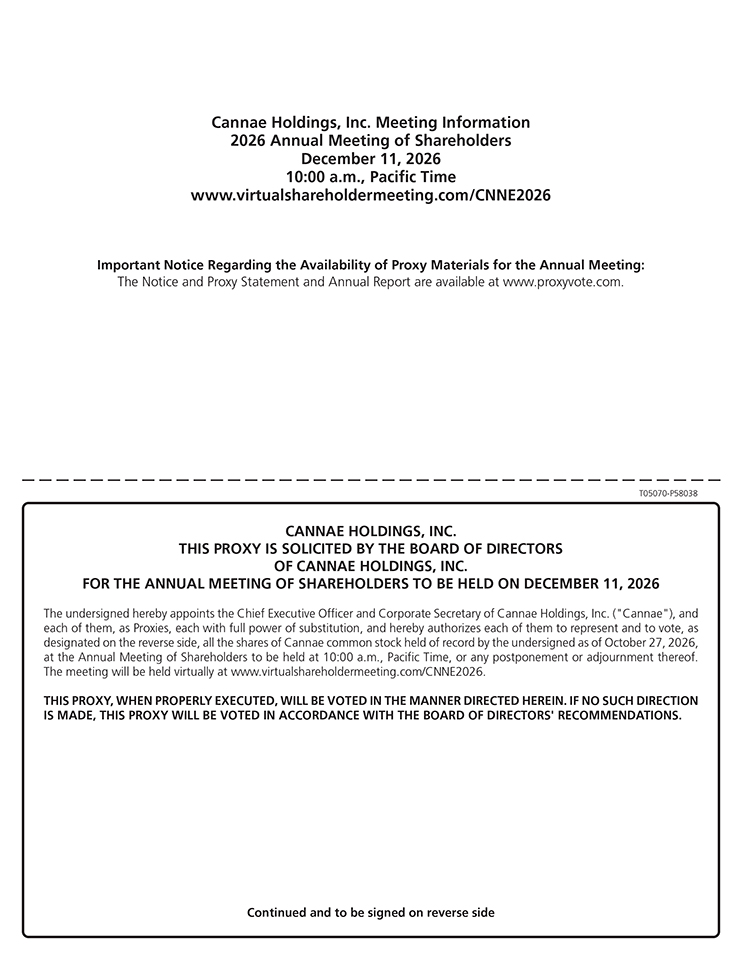
The proxy is being solicited by the Board of Directors (the Board) of Cannae Holdings, Inc. (Cannae or the Company) for use at the 2026 Annual Meeting of Shareholders (including any adjournments, postponements, or continuations thereof, the Annual Meeting) to be held on December 11, 2026, at 10 a.m., Pacific Time for the purposes set forth herein and in the accompanying Notice of Annual Meeting of Shareholders. The Annual Meeting will be held virtually at www.virtualshareholdermeeting.com/CNNE2026.

This proxy statement (the Proxy Statement) and the accompanying form of proxy are first being mailed on or about October 30, 2026, to all shareholders entitled to vote at the Annual Meeting. An annual report on Form 10-K for the year ended December 31, 2025 (Annual Report) is enclosed with this Proxy Statement. Electronic copies of this Proxy Statement and Annual Report are available online free of charge at https://www.cannaeholdings.com/financial-information/sec-filings.

The Company’s principal executive offices are located at 1701 Village Center Circle, Las Vegas, Nevada 89134, and its telephone number at that address is (702) 323-7330.

FORWARD LOOKING STATEMENTS

This Proxy Statement includes forward-looking statements within the meaning of the “safe harbor” provisions of the Private Securities Litigation Reform Act of 1995. These statements are not historical facts, but instead represent only our beliefs regarding future events, many of which, by their nature, are inherently uncertain and outside of our control. Forward-looking statements include statements about our business, strategic plans, future performance, return of capital, and the impact of our actions on shareholder value, as well as sustainability targets, goals, and commitments outlined in this Proxy Statement or elsewhere. These statements can be identified by words such as “anticipates,” “intends,” “plans,” “seeks,” “believes,” “estimates,” “expects” and similar references to future periods, or by the inclusion of forecasts or projections. We caution readers not to place undue reliance on forward-looking statements. We expect that certain disclosures made in this Proxy Statement may be amended, updated or revised in the future as the quality and completeness of our data and methodologies continue to improve. Important factors that could cause actual results to differ materially from expectations are described under the heading “Risk Factors” in our most recent Annual Report on Form 10-K and in other filings we make with the Securities and Exchange Commission (the SEC). Forward-looking statements speak only as of the date they are made, and we undertake no obligation to update publicly or otherwise revise any forward-looking statements, whether as a result of new information, future events or other factors, except where we are expressly required to do so by law. References in this Proxy Statement to materials available on our website or a third-party website, including website links, are for informational purposes only. The information available on our website or accessible through any website links included herein is not a part of, nor incorporated by reference into, this Proxy Statement.

1 

 Cannae Holdings, Inc.


Table of Contents

GENERAL INFORMATION ABOUT THE COMPANY

We are a diversified holding company that offers shareholders a unique opportunity to generate returns through owning a portfolio of operating businesses. Cannae is transitioning its portfolio to focus on sports and entertainment-related assets, with the goal of building a more concentrated and synergistic portfolio to generate long-term investment returns and stock price appreciation for our shareholders. We believe our permanent capital base, long-term ownership and active involvement in the management and operations of our companies help maximize the value of those businesses for our shareholders.

The Company conducts its business through its wholly owned subsidiary, Cannae Holdings, LLC (Cannae LLC), a Delaware limited liability company, under the oversight of our Board. From August 2019 until May 12, 2025, the Company’s business operations were managed by Trasimene Capital Management, LLC (Trasimene or our Manager) pursuant to a Management Services Agreement dated as of August 27, 2019 among the Company, Cannae LLC and our Manager (as amended and restated, the Management Services Agreement). The Management Services Agreement terminated in its entirety on May 12, 2025, and Trasimene no longer manages the Company’s business operations.

Our assets as of December 31, 2025 included our ownership interests in Black Knight Football Club US, LP (Black Knight Football or BKFC), which owns 100% of AFC Bournemouth (AFCB) and FC Lorient (FCL) and a majority interest in Moreirense FC (MFC); JANA Partners Capital, LLC, JANA Partners Management, LP and JANA Partners GP, LLC (together JANA or JANA Partners); Alight, Inc. (Alight, NYSE: ALIT); O’Charley’s Holdings, LLC (O’Charley’s) and 99 Restaurants Holdings, LLC (99 Restaurants and together with O’Charley’s, the Restaurant Group); Watkins Holdings, LLC (Watkins); Computer Services, Inc. (CSI); High Sierra Distillery, LP (Minden Mill); AmeriLife Group, LLC (AmeriLife); and various other controlled companies and minority equity ownership interests. In 2026, we acquired 100% of Exeter Rugby Group (Exeter) and disposed of our interests in Watkins and Brasada Ranch.

 Cannae Holdings, Inc. 

 2 


Table of Contents

BUSINESS HIGHLIGHTS

We are a diversified holding company that offers shareholders a unique opportunity to generate returns through owning a portfolio of operating businesses. Cannae is transitioning its portfolio to focus on sports and entertainment-related assets, with the goal of building a more concentrated and synergistic portfolio to generate long-term investment returns and stock price appreciation for our shareholders. We believe our permanent capital base, long-term ownership and active involvement in the management and operations of our companies help maximize the value of those businesses for our shareholders.

Our Board and management team have a proven track record of identifying, operating and monetizing businesses to drive returns. We historically targeted a broad range of industries to find businesses with compelling cases for growth in value and/or strong cash flow characteristics, where we could leverage our access to unique, proprietary investment opportunities, and acquire control and/or governance rights, and then work actively with portfolio company management to optimize performance. Our results have been strongest where we hold meaningful ownership positions in private companies and actively partner with management. Our permanent capital structure and long-term investment horizon allows us to hold investments without preset time constraints and to monetize them when we believe doing so will maximize returns for our shareholders. Since our founding as a tracking stock of FNF in 2014 through September 30, 2026, this approach has generated approximately $2.9 billion in realized value for Cannae, or a 1.7x multiple on invested capital.

Beginning in 2024 and through the third quarter of 2025, our Board and management team began executing a strategic transformation of Cannae with four primary objectives. The first was a transformation of our portfolio to focus on proprietary investments that are both otherwise inaccessible to most public market investors and where we can take a significant position and partner with management. The second was to reduce operating costs and complexity while further aligning management with shareholders. The third was to return a significant amount of capital to shareholders through share repurchases and quarterly dividends. The fourth was to restructure our leadership while retaining and adding key Board members to oversee execution.

We made substantial progress on each of these objectives in 2024.

We sold approximately $472 million of shares in our public portfolio companies, invested $195 million in proprietary private investments and returned $252 million of capital to shareholders. Capital returns to shareholders included both a $222 million Dutch tender offer, and in May 2024 we initiated a quarterly cash dividend of $0.12 per share, resulting in $22 million in dividends to shareholders in 2024.

We also restructured our Management Services Agreement with Trasimene in February 2024 to provide for a phased termination of our prior external management structure. This reduced annual management fees from $37.7 million in 2023 to $7.6 million annually beginning in July 2024 and the termination fee from $40 million to $20 million. In 2025 we accelerated the termination of the external management structure, and it has now been completely eliminated. In conjunction with the transition from external to internal management, we also shifted the majority of the compensation for our key executives from cash to restricted stock, tying management’s rewards directly to the long-term value we create for shareholders. In 2024, we also added Doug Ammerman to our Board as a new, independent director.

3 

 Cannae Holdings, Inc.


Table of Contents

Further to the initiatives we began in 2024, in May 2025 we transitioned our management team with a new chief executive officer and independent chairman of the Board, and in November 2025 our Board directed management to accelerate the transformation of our portfolio to concentrate primarily on sports and entertainment-related assets, where Cannae has demonstrated a differentiated competitive advantage. Our Board and management believe these assets have strong macroeconomic tailwinds and unique characteristics that support long term value creation. Cannae has proven experience operating these assets, and proprietary access to investment opportunities in the sector, which will allow us to build a more focused, efficient portfolio of synergistic assets.

In February 2026, our Board built on these 2024 initiatives and established a new set of strategic priorities designed to provide greater clarity and drive sustained long-term value creation based on four tenets: (1) portfolio transformation and strategic focus; (2) enhanced operating performance and transparency; (3) disciplined return of capital to shareholders; and (4) continued evolution and enhancement of our corporate governance. These priorities are designed to increase our net asset value and narrow the discount at which our common shares trades relative to that value. Our progress against each priority follows.

2025 AND 2026 YEAR-TO-DATE PROGRESS AGAINST OUR STRATEGIC PRIORITIES

Portfolio Transformation and Strategic Focus

•

Monetized non-core assets. From January 1, 2025 through September 30, 2026, we generated approximately $793 million of proceeds from sales of non-core assets, including approximately $630 million from the 2025 sale of our interest in Dun & Bradstreet Holdings, Inc. (Dun & Bradstreet or DNB) in connection with its acquisition by Clearlake Capital Group, L.P., and $90 million from the July 2026 sale of our interest in Watkins. We also sold Brasada Ranch to a company owned by our Vice Chairman William P. Foley in 2026, eliminating the put right held by Mr. Foley under the Director Services Agreement between the Company and Mr.Foley to sell 50% of his common shares back to the Company (the “Put Right”), which freed up approximately $47 million of capital by removing the contingent obligation. As a result, the Company has funded additional share repurchases, dividends and targeted new investments.

•

Redeployed capital into sports and entertainment. We invested an additional $50 million in BKFC in 2025 and an additional $36 million through September 30, 2026, and in June 2026 acquired 100% of Exeter, owner of the Exeter Chiefs of Gallagher PREM Rugby and the 15,000-seat Sandy Park stadium and conference center, for $26 million (£19.6 million). Exeter extends our sports platform and is located only 80 miles from Bournemouth, allowing us to leverage commercial and operational synergies and lessons we’ve learned operating Bournemouth to create value at Exeter.

•

Expanded our strategic partnership with JANA. In September 2025, we acquired an additional 30% interest in JANA, a leader in engaged investing, increasing our ownership to 50%. Our investment provides cash flows from JANA’s management and performance fees and access to proprietary investment opportunities to the extent they align with our strategic priorities.

 Cannae Holdings, Inc. 

 4 


Table of Contents

Enhanced Operating Performance and Transparency

•

Expanded portfolio company disclosure. Beginning with our fourth quarter 2025 letter to shareholders, we provide asset-level operating results and value creation updates for our significant portfolio companies, and in 2026 we published a dedicated investor presentation on Black Knight Football.

•

Success at portfolio companies. AFCB finished sixth in the 2025/26 Premier League season, the highest finish in the club’s 127-year history, up from 15th in its first season under BKFC ownership, and qualified for European competition for the first time, materially expanding the club’s commercial opportunities. AFCB’s revenue increased more than 50% over the course of our ownership, from £141 million for the fiscal year ended June 30, 2023, the first fiscal year we acquired the club, to £212 million for the fiscal year ended June 30, 2026. While the club’s performance on the pitch has improved each season, the club also generated approximately £160 million from player transfers in the last two fiscal years.

•

Reduced corporate operating expenses. Cannae reduced corporate other operating expenses by $6.8 million, or 10.2%, in 2025, compared to 2024, excluding $5.4 million of one-time costs related to the contested solicitation in 2025. Corporate operating expenses have continued to decrease in 2026 compared to 2025. We have decreased corporate holding company expenses by $57.1 million, or 76.2%, in the first half of 2026 compared to 2025. Driven by a decrease in personnel costs and the elimination of management fees, our Board and management remain focused on cost reduction.

•

Shareholder engagement. We engaged with numerous shareholders on various actions we took in 2025 and 2026, including the strategic priorities outlined in this section. Over the past couple of years, we engaged with numerous shareholders, including 8 of the top 10 third-party holders representing nearly 60% of shares held by shareholders other than executives and directors at year-end 2025. Our Board listens to and values the diverse views and input of our shareholders and considers all shareholder feedback as a regular part of Board discussions. Our Board evaluates all feedback from our shareholders in light of our strategic direction, then acts on any feedback that our Board believes will create shareholder value, enhance our governance practices, or otherwise result in corporate changes that benefit all shareholders.

Disciplined Return of Capital

•

Repurchased shares. We repurchased $317 million of our common shares in 2025, representing approximately 27% of shares outstanding, and $92 million from January 1, 2026 through September 30, 2026.

•

Increased our dividend. In August 2025, we increased our quarterly cash dividend by 25%, from $0.12 to $0.15 per common share. The current dividend returns approximately $25 million per year to shareholders and has returned approximately $72 million since its initiation.

Continued Governance Evolution

•

Refreshed our Board and leadership. Four new independent directors have joined the Board in 2025 and 2026: William T. Royan and Woodrow Tyler in June 2025, and Mona Aboelnaga Kanaan and Chérie L. Schaible in December 2025. In February 2026, the Board reconstituted its committees such that all of these new directors now sit on one or more

5 

 Cannae Holdings, Inc.


Table of Contents

Board committee. In 2025, we also executed a leadership succession plan with the appointment of Doug Ammerman as our new independent Chairman and Ryan Caswell as our new Chief Executive Officer, with William P. Foley, II continuing as Vice Chairman, allowing for continued access to Mr. Foley’s leadership while creating the role of an independent Chairman and separating the roles of Chairman and Chief Executive Officer.

•

Declassifying our Board. At our 2025 Annual Meeting, shareholders approved the phased declassification of our Board. As a result, directors will be elected annually beginning with the class up for election at this 2026 Annual Meeting.

•

Internalized management. We accelerated the termination of the Management Services Agreement on May 12, 2025, which formally internalized all management and investment functions, significantly reducing Cannae’s management expenses.

•

Strengthened related person transaction oversight. In 2026, as part of our continued focus on governance and in response to shareholder feedback, our Board adopted two amendments to the Related Person Transaction Policy that further strengthen the review and approval of related person transactions. In August 2026, the policy was revised to enhance the role of the Company’s outside counsel, including by having outside counsel, together with the chair of the Related Person Transaction Committee, make the initial determination of whether a transaction could be a related person transaction. Furthermore, a two-stage process was introduced where the Related Person Transaction Committee must grant preliminary approval before the Company may negotiate a proposed related person transaction. During negotiations, the Company must provide the Related Person Transaction Committee with regular updates regarding deal terms and summarizing the negotiations. The Related Person Transaction Committee may make recommendations, participate in negotiations through the Committee Chair or outside counsel, request modifications, or terminate negotiations. If such negotiations lead to a finalized transaction approved by the Committee, the transaction is then presented to the independent and disinterested members of the Board for approval. No Related Person Transaction may be presented for Board approval without the Related Person Transaction Committee’s recommendation and approval. The second amendment was implemented in October 2026 and prohibits any members of the Committee from participating in a related person transaction as long as they serve on the Related Person Transaction Committee. The Related Person Transaction Committee met eight times during 2025 and six times year-to-date through September 30, 2026.

 Cannae Holdings, Inc. 

 6 


Table of Contents

GENERAL INFORMATION ABOUT THE ANNUAL MEETING

WHY DID I RECEIVE THIS PROXY STATEMENT?

You are receiving this Proxy Statement and the enclosed proxy card because you were a holder of our common shares as of the Record Date, and the Board is soliciting your proxy to vote your shares of our common stock on all matters scheduled to come before the Annual Meeting, whether or not you attend the Annual Meeting.

ON WHAT AM I VOTING?

Our Annual Meeting will be held for the following purposes:

Proposal No. 1 asks you to elect four directors to our Board to serve until the 2027 Annual Meeting to our Board and until their successors are duly elected and qualified, or until such director’s earlier death, resignation, or removal.

Proposal No. 2 asks you to approve, on an advisory (non-binding) basis, the compensation paid to our named executive officers as disclosed in this Proxy Statement (also known as the Say-on-Pay Proposal). The Say-on-Pay Proposal will provide us with important feedback from our shareholders about our executive compensation philosophy, objectives, and program. The Board and the Compensation Committee value the opinions of our shareholders and expect to consider the outcome of the vote when considering future executive compensation decisions and when evaluating the Company’s executive compensation program.

Proposal No. 3 asks you to ratify the selection by the audit committee of the Board (Audit Committee) of Grant Thornton as our independent registered public accounting firm for fiscal year 2026.

HOW DOES THE BOARD RECOMMEND THAT I VOTE ON THESE PROPOSALS?

The Board recommends that you vote “FOR ALL” director nominees in Proposal No. 1 and “FOR” Proposal Nos. 2 and 3.

WHO IS ENTITLED TO VOTE?

The close of business on October 27, 2026 has been fixed as the Record Date for the determination of our shareholders entitled to notice of, and to vote at, the Annual Meeting. We have one class of voting common stock, which has one vote per share. On the Record Date, we had 39,548,388 common shares outstanding.

WHAT CONSTITUTES A QUORUM? HOW MANY SHARES MUST BE PRESENT TO CONDUCT BUSINESS AT THE ANNUAL MEETING?

A quorum is present if shareholders holding at least a majority of the voting power of the Company’s common shares are represented in person or by proxy, regardless of whether the proxy has authority to vote on any matter. If there are not sufficient shares present or

7 

 Cannae Holdings, Inc.


Table of Contents

represented by proxy at the Annual Meeting to constitute a quorum, the Annual Meeting may be adjourned by a majority of the voting power represented in person or by proxy or by the person presiding at the Annual Meeting to permit further solicitation of proxies in order to achieve a quorum. Based on the number of Company common shares outstanding on October 27, 2026, the Record Date, shares representing 19,774,195 votes must be present at the Annual Meeting, virtually or by proxy, to constitute a quorum. If you vote, including by Internet or proxy card, your shares voted will be counted towards the quorum for the Annual Meeting. Abstentions and “broker non-votes,” if any, are counted as present for the purpose of determining a quorum.

HOW DO I VOTE?

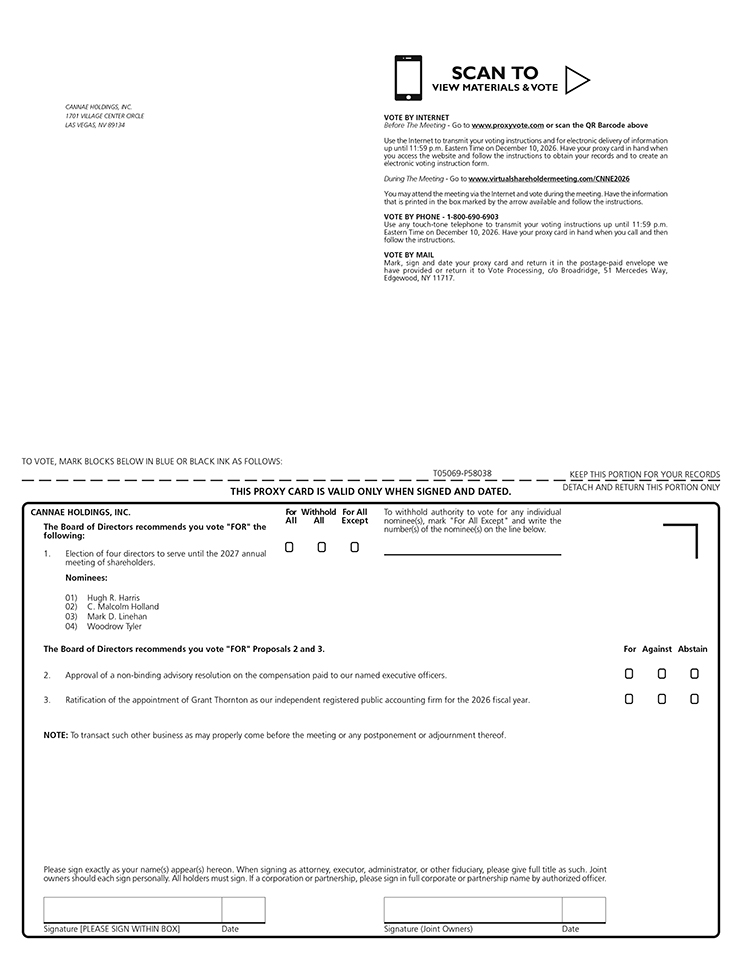
You may vote using any of the following methods:

•

At the virtual annual meeting. All shareholders may vote at the virtual annual meeting. Please see “How may I participate in the virtual annual meeting?” for additional information on how to vote at the annual meeting.

•

By proxy. If you are a beneficial owner, you must obtain a “legal proxy” from your broker, bank, or other nominee to vote during the Annual Meeting. There are three ways to vote by proxy:

•

By mail, using your proxy card and return envelope;

•

By telephone, using the telephone number printed on the proxy card and following the instructions on the proxy card; or

•

By the Internet, using a unique control number printed on your proxy card and following the instructions on the proxy card.

Even if you expect to attend the annual meeting virtually, please vote by proxy to assure that your shares will be represented.

WHAT IS A PROXY? WHAT SHARES ARE REPRESENTED BY A PROXY CARD?

A proxy is your legal designation of another person to vote the stock you own, with such other person being called a proxy. If you designate someone as your proxy in a written document, that document is also called a proxy or a proxy card. Our Board has designated Ryan R. Caswell, Chief Executive Officer, and Michael L. Gravelle, Executive Vice President, General Counsel and Corporate Secretary as the Company’s proxies for the Annual Meeting.

Each proxy or voting instruction form represents the shares registered to you as of the close of business on the Record Date. You may receive more than one proxy or voting instruction form if you hold your shares in multiple accounts, some of your shares are registered directly in your name with the Company’s transfer agent, or some of your shares are held in street name through a broker, bank, or other nominee. Please vote the shares on each proxy card or voting instruction form to ensure that all of your shares are counted at the Annual Meeting.

HOW MAY I PARTICIPATE IN THE VIRTUAL ANNUAL MEETING?

At the virtual annual meeting, shareholders will be able to listen to the meeting live and vote. To be admitted to the virtual annual meeting at www.virtualshareholdermeeting.com/CNNE2026

 Cannae Holdings, Inc. 

 8 


Table of Contents

you must enter the 16-digit control number available on your proxy card if you are a shareholder of record or included in your voting instruction card and voting instructions you received from your broker, bank or other nominee. Although you may vote online during the annual meeting, we encourage you to vote via the Internet, by telephone or by mail as outlined in the Notice of Internet Availability of Proxy Materials or on your proxy card to ensure that your shares are represented and voted. The meeting webcast will begin promptly at 10:00 a.m., Pacific Time, on December 11, 2026, and we encourage you to access the meeting prior to the start time.

WILL I BE ABLE TO ASK QUESTIONS DURING THE VIRTUAL ANNUAL MEETING?

We will provide our shareholders the opportunity to ask questions. Questions submitted during the meeting pertinent to meeting matters will be answered during the meeting, subject to time and procedural constraints. Instructions for submitting questions and making statements will be posted on the virtual meeting website at www.virtualshareholdermeeting.com/CNNE2026. This question and answer session will be conducted in accordance with certain rules of conduct that will be posted on our Annual Meeting website.

HOW CAN I REQUEST TECHNICAL ASSISTANCE DURING THE VIRTUAL ANNUAL MEETING?

A technical support line will be available on the meeting website for any questions on how to participate in the virtual annual meeting or if you encounter any difficulties accessing the virtual meeting.

HOW MANY VOTES MUST EACH PROPOSAL RECEIVE TO BE ADOPTED?

The following votes must be received:

•

For Proposal No. 1 regarding the election of directors, a plurality of votes of our common shares cast is required to elect a director. This means that the four director nominees receiving the highest number of “for” votes cast by the shares entitled to vote at the Annual Meeting will be elected as directors. Withheld votes and broker non-votes, if any, are not counted as votes cast and will have no effect on the outcome of this proposal.

•

For Proposal No. 2 regarding the advisory (non-binding) vote to approve the compensation paid to our named executive officers, the affirmative vote of a majority of our common shares represented in person or by proxy and entitled to vote at the Annual Meeting is required to approve this proposal. Abstentions and broker non-votes, if any, will have the effect of a vote “against” the outcome of this proposal. Because the vote on Proposal No. 2 is advisory and therefore will not be binding on the Company, the Board will review the voting result and take it into consideration when making future decisions regarding the compensation paid to our named executive officers.

•

For Proposal No. 3 regarding the ratification of the appointment of Grant Thornton, the affirmative vote of a majority of our common shares represented in person or by proxy and entitled to vote at the Annual Meeting is required to approve this proposal. This proposal would typically be considered a “routine” matter for which a broker may vote in their discretion on this proposal on behalf of beneficial owners who have not furnished voting instructions.

9 

 Cannae Holdings, Inc.


Table of Contents

WHAT EFFECT DO ABSTENTIONS OR WITHHOLDS HAVE?

With respect to Proposal No. 1, directions to withhold authority are not considered “votes cast” and will not be included in vote totals and will therefore not affect the outcome of the vote. With respect to Proposal Nos. 2 and 3, since these proposals require an affirmative vote of the majority of the shares represented in person or by proxy and entitled to vote at the Annual Meeting, abstentions will have the effect of a vote “against” such proposals.

WHAT IS A BROKER NON-VOTE?

If you hold your common shares in “street name” (that is, through a broker, bank or other holder of record), you are considered a “beneficial owner,” of shares held in street name. As the beneficial owner, you have the right to direct your broker, bank or other holder of record on how to vote your shares by using the voting instruction form included in the mailing or by following their instructions for voting via the Internet or by telephone. If you are a street name holder and your shares are registered in the name of a broker, the New York Stock Exchange (the NYSE) rules applicable to brokers who have record ownership of listed Company stock determine whether your broker may vote your shares in its discretion, even if it does not receive voting instructions from you (so called discretionary voting authority).

A “broker non-vote” occurs when a broker submits a proxy on behalf of a beneficial owner for a shareholder meeting but does not vote on a particular proposal because such broker does not have discretionary voting authority with respect to that proposal and has not received voting instructions from the beneficial owner. Broker non-votes, if any, will be included in the calculation of the number of votes considered to be present for the purpose of determining a quorum.

Under the NYSE rules, the election of directors proposal and the Say-on-Pay Proposal are considered “non-routine” matters for which brokers may not exercise discretionary voting authority. In contrast, under the NYSE rules, the ratification of the selection of the independent registered public accounting firm is typically a “routine” matter as to which a broker will have discretionary authority to vote shares if they have not received voting instructions at least 10 days prior to the Annual Meeting.

We urge you to instruct your broker, bank, or other nominee how you wish your shares to be voted.

WHAT IF I SHARE A HOUSEHOLD WITH ANOTHER SHAREHOLDER?

As permitted by the Exchange Act, we may deliver a single copy of the Annual Report and this Proxy Statement to multiple record shareholders sharing an address. This is known as “householding.” If you would like a separate copy of this Proxy Statement or the Annual Report now or in the future, or if you are receiving multiple copies and would like to receive only one copy for your household, you may contact: Georgeson LLC at (877) 568-7601.

WHO PAYS THE COST OF SOLICITING PROXIES?

We are making this solicitation and will pay the cost of the solicitation of proxies, including preparing and mailing the proxy materials to shareholders of record and street name

 Cannae Holdings, Inc. 

 10 


Table of Contents

shareholders. Following the mailing of this proxy statement, directors, officers and other employees of the Company may solicit proxies by telephone or other personal contact. Such persons will receive no additional compensation for such services. We may also solicit proxies by email from shareholders who are our employees or who previously requested to receive proxy materials electronically. Brokerage houses and other nominees, fiduciaries, and custodians who are holders of record of our common shares will be requested to forward proxy soliciting material to the beneficial owners of such shares and will be reimbursed by the Company for their charges and expenses in connection therewith at customary and reasonable rates.

The Company has retained Georgeson Inc. to assist in the solicitation of proxies for an estimated fee of $12,000 plus reimbursement of expenses.

If you choose to access the proxy materials or vote over the internet, however, you are responsible for internet access charges you may incur. In addition to the mailing of these proxy materials, the solicitation of proxies or votes may be made in person, by telephone, or by electronic communication by our directors, officers and employees, who will not receive any additional compensation for such solicitation activities. We will request banks, brokers, nominees, custodians, and other fiduciaries who hold shares of our stock in street name, to forward these proxy solicitation materials to the beneficial owners of those shares and we will reimburse the reasonable out-of-pocket expenses they incur in doing so.

HOW WILL MY SHARES BE VOTED ON THE PROXY CARD? WILL MY SHARES BE VOTED IF I DO NOT PROVIDE VOTING INSTRUCTIONS?

The shares represented by any proxy card that is properly completed, validly executed, and received by the Company prior to or at the Annual Meeting will be voted in accordance with the specifications made on the card, whether it is returned by mail, Internet or telephone. If you hold shares as the shareholder of record and submit a validly executed proxy card without giving specific voting instructions on a proposal, then your shares will be voted in accordance with the recommendations of our Board as to that proposal. Our Board recommends that shareholders vote “FOR” the director nominees listed in Proposal No. 1; “FOR” the approval of, on an advisory basis, our executive compensation in Proposal No. 2; and “FOR” the ratification of the appointment of our independent registered public accounting firm for the year ending December 31, 2026, in Proposal No. 3; and in accordance with the discretion of the named proxies on other matters brought before the Annual Meeting.

The Board is not aware of any other matters that are likely to be brought before the Annual Meeting. If any other matter is properly presented for action at the Annual Meeting, the persons identified as having the authority to vote the proxies will vote on such matter at their own discretion.

If you do not provide your broker, bank, or other nominee specific voting instructions, such firm may not have the authority to vote your shares with respect to certain proposals. Please see “What is a broker non-vote?”for more information.

11 

 Cannae Holdings, Inc.


Table of Contents

WILL MY SHARES BE VOTED IF I DO NOTHING?

If you are a shareholder of record and do not cast your vote, no votes will be cast on your behalf on any of the items of business at the Annual Meeting. If you are a beneficial holder and do not instruct your broker, bank, or other nominee how to vote your shares, your broker may not be able to vote on your behalf without instruction as to any matter that is considered non-routine under the NYSE rules. For more information, please see “What is a broker non-vote?” in this Proxy Statement.

WHAT IF I RECEIVE MORE THAN ONE PROXY CARD OR SET OF PROXY MATERIALS FROM THE COMPANY?

If your shares are held in more than one account, you will receive more than one proxy card, and in that case, you can and are urged to vote all of your shares by completing, signing, dating, and returning all proxy cards you receive from the Company in the postage-paid envelope provided. If you choose to vote via the Internet, please vote using each proxy card you receive to ensure that all of your shares are voted. Only your latest dated proxy for each account will count. Please sign each proxy card exactly as your name or names appear on the proxy card. For joint accounts, each owner should sign the proxy card. When signing as an executor, administrator, attorney, trustee, guardian, or other representative, please print your full name and title on the proxy card.

WHAT IF I SUBMIT A PROXY AND LATER CHANGE MY MIND?

If your shares are registered directly in your name, you may change your vote or revoke your proxy by:

•

Delivering written notice of revocation to the Corporate Secretary at c/o Cannae Holdings, Inc., 1701 Village Center Circle, Las Vegas, Nevada 89134, that is received on or before 11:59 Pacific Time on December 10, 2026;

•

Delivering a properly executed proxy card bearing a later date than the proxy that you wish to revoke;

•

Submitting a later dated proxy over the Internet in accordance with the instructions on the proxy card; or

•

Voting your shares electronically during the Annual Meeting.

If you are the beneficial owner of shares held through a broker, bank, or other nominee, then you must follow the specific instructions, including applicable deadlines, provided to you by your broker, bank, or other nominee to change or revoke any instructions you have already provided to your broker, bank, or other nominee. If you have obtained a voter instruction form from your broker, bank, or other nominee that holds your shares giving you the right to vote the shares, you may change your vote by attending the virtual Annual Meeting and voting electronically if you attach to your ballot a legal proxy from your broker, bank or other nominee saved as a PDF or image file.

Attendance at the Annual Meeting, in and of itself, will not constitute a revocation of a proxy.

 Cannae Holdings, Inc. 

 12 


Table of Contents

WHAT HAPPENS IF THE ANNUAL MEETING IS ADJOURNED?

Unless a new record date is fixed, your proxy will still be valid and may be used to vote our common shares at the adjourned Annual Meeting. You will still be able to change or revoke your proxy until it is used to vote your shares.

WHO WILL COUNT THE VOTES?

The Company has retained First Coast Results, Inc. to serve as independent judge of election. In such capacity, First Coast Results, Inc. will count, tabulate and certify votes at the Annual Meeting.

WHERE CAN I FIND THE RESULTS OF THE VOTING?

We intend to announce preliminary voting results at the Annual Meeting and will publish final results through a Current Report on Form 8-K to be filed with the SEC within four business days after the Annual Meeting.

WHAT IF I HAVE SHARES REGISTERED IN MY NAME AND ALSO HAVE SHARES IN A BROKERAGE ACCOUNT?

Shares that you hold in street name are not included in the total number of shares set forth on your proxy card. Your broker, bank, or other nominee will send you instructions on how to vote those shares.

DO I HAVE ANY DISSENTERS’ OR APPRAISAL RIGHTS WITH RESPECT TO ANY OF THE MATTERS TO BE VOTED ON AT THE ANNUAL MEETINGS?

No, shareholders do not have any dissenter’s or appraisal rights with respect to the matters to be voted on at the Annual Meeting.

HOW DO I OBTAIN A PAPER OR ELECTRONIC COPY OF THE PROXY MATERIALS?

A copy of our proxy materials, as filed with the SEC, is available, without charge, by mailing a request to Cannae Holdings, Inc. at 1701 Village Center Circle, Las Vegas, Nevada 89134, Attention: Investor Relations or by e-mailing a request to Investor Relations at [email protected].

The proxy materials are also posted free of charge on our website at https://www.cannaeholdings.com/financial-information/sec-filings and are available from the SEC free of charge at its website, www.sec.gov.

13 

 Cannae Holdings, Inc.


Table of Contents

CORPORATE GOVERNANCE HIGHLIGHTS

Our Board has adopted governance practices which promote the long-term interests of our shareholders and support accountability of our Board and management. Our Board has implemented the following measures to improve our overall governance practices. See “Corporate Governance and Related Matters” below for more detail on our governance practices.

•

Phased-In declassification of our Board, approved at the 2025 Annual Meeting

•

Active Board refreshment, with four new independent directors in 2025, adding deep investment management, audit experience and corporate governance to the Board

•

Eleven of twelve directors are independent under NYSE rules

•

Separate roles of Chairman and CEO, with an Independent Chairman

•

Independent Chairs of the Board and each of the Audit, Compensation, Corporate Governance and Nominating, and Related Person Transaction Committees

•

Average director tenure of approximately five years

•

Related Person Transaction Committee consisting of four independent directors, including two directors appointed in 2025, and a related person transaction policy (Related Person Transaction Policy) providing enhanced governance over review of transactions with certain covered persons, including the Company’s directors, officers and other related persons

•

Board and committee oversight of risk, including risk as it relates to, among other things, information security, cybersecurity, human capital management, sustainability, and health and safety risks

•

We have three Audit Committee financial experts as defined by the rules of the SEC: Messrs. Ammerman, Linehan and Ms. Aboelnaga Kanaan.

•

Robust stock ownership guidelines for our executive officers and directors

•

Shareholders may seek to act by written consent at a 15% threshold

•

No supermajority voting requirement for shareholders to act

•

Ongoing shareholder engagement on a variety of topics, including our corporate governance, investment strategy, capital allocation, and executive compensation, as described below

SHAREHOLDER ENGAGEMENT

We are committed to hearing and responding to the views of our shareholders on various matters. We regularly engage with our shareholders and hold meetings with our investors who express an interest in engaging with us where we discuss a variety of topics. We report on and discuss our investor meetings, and key topics from the meetings, with our Board or Board committees, as applicable.

 Cannae Holdings, Inc. 

 14 


Table of Contents

Over the past couple of years, we engaged with numerous shareholders, including 8 of the top 10 third-party holders representing nearly 60% of shares held by shareholders other than executives and directors at year-end 2025. We took various actions in 2025 and 2026 in response to such engagement, including the changes related to our strategic priorities, capital returns to shareholders, and governance changes noted above in the “Business Highlights” section. Our Board listens to and values the diverse views and input of our shareholders and considers all shareholder feedback as a regular part of Board discussions. Our Board evaluates all feedback from our shareholders in light of our strategic direction, then acts on any feedback that our Board believes will create shareholder value, enhance our governance practices, or otherwise result in corporate changes that benefit all shareholders.

15 

 Cannae Holdings, Inc.


Table of Contents
CORPORATE GOVERNANCE AND RELATED MATTERS
CORPORATE GOVERNANCE GUIDELINES
Our Corporate Governance Guidelines provide, along with the charters of the committees of the Board, a framework for the functioning of the Board and its committees and establishes a common set of expectations as to how the Board should perform its functions. The Corporate Governance Guidelines address a number of areas including the size and composition of the Board, Board membership criteria and director qualifications, director responsibilities, Board agenda, roles of the Chairman of the Board and the Chief Executive Officer, meetings of independent directors, committee responsibilities and assignments, Board member access to management and independent advisors, director communications with third parties, director compensation, director orientation and continuing education, evaluation of senior management and management succession planning. The Corporate Governance Guidelines also provide that our Board will consider all aspects of diversity of viewpoints, background, experience, and other demographics in selecting nominees for director. A copy of our Corporate Governance Guidelines is available for review on the Corporate Governance Overview page of our website at
www.cannaeholdings.com/corporate-governance
.
CODES OF ETHICS
Our Board has adopted a Code of Ethics for Senior Financial Officers, which is applicable to our Chief Executive Officer, President, Chief Financial Officer and Chief Accounting Officer, and a Code of Business Conduct and Ethics, which is applicable to all of our directors, officers and employees. The purpose of these codes is to: (i) promote honest and ethical conduct, including the ethical handling of conflicts of interest; (ii) promote full, fair, accurate, timely and understandable disclosure; (iii) promote compliance with applicable laws and governmental rules and regulations; (iv) ensure the protection of our legitimate business interests, including corporate opportunities, assets and confidential information; and (v) deter wrongdoing. Our codes of ethics were adopted to reinforce our commitment to our longstanding standards for ethical business practices. Our reputation for integrity is one of our most important assets and each of our employees and directors is expected to contribute to the care and preservation of that asset. Under our codes of ethics, an amendment to or a waiver or modification of any ethics policy applicable to our directors or executive officers must be disclosed to the extent required under SEC and/or NYSE rules. We intend to disclose any such amendment or waiver by posting it on the Corporate Governance Overview page of our website at
www.cannaeholdings.com/corporate-governance
.
Our Code of Business Conduct and Ethics and our Code of Ethics for Senior Financial Officers are available for review on the Corporate Governance Overview page of our website at
www.cannaeholdings.com/corporate-governance
.
POLICY ON INSIDER TRADING
Our Board has adopted an Insider Trading and Tipping Policy prohibiting insider trading and providing related procedures governing the purchase, sale, and other dispositions of the
 Cannae Holdings, Inc. 
 16 

Table of Contents
Company’s securities reasonably designed to promote compliance with insider trading laws, rules and regulations and the listing requirements of the New York Stock Exchange (
NYSE
). This policy also prohibits tipping or disclosing material nonpublic information (
MNPI
) to outsiders. This policy is applicable to all directors, officers, employees, their immediate family, and any entities controlled by them who have regular access to MNPI. The Company also does not trade in Company securities in violation of applicable securities laws or NYSE listing standards. A copy of the Insider Trading and Tipping Policy is filed as Exhibit 19.1 to the Annual Report.
OUR BOARD
Our Board includes Douglas K. Ammerman, William P. Foley, II, Mona Aboelnaga Kanaan, Hugh R. Harris, C. Malcolm Holland, Mark D. Linehan, Frank R. Martire, Barry B. Moullet, William T. Royan, Chérie L. Schaible, James B. Stallings, Jr., and Woodrow Tyler. In May 2025, Mr. Ammerman was appointed as
non-executive
Chairman of the Board and Mr. Foley was appointed as Vice Chairman of the Board. Additionally, Mr. Royan and Mr. Tyler were appointed as directors effective June 2025 and Ms. Aboelnaga Kanaan and Ms. Schaible were elected as directors in December 2025.
In 2025 and
year-to-date
through September 30, 2026, our Board held six and nine meetings, respectively. All directors attended at least 75% of the meetings of the Board and of the committees on which they served during 2025 and 2026. Our Board met quarterly and our
non-management
directors met periodically in executive sessions without management. We do not, as a general matter, require our Board to attend our annual meeting of shareholders, although each of our directors is invited to attend. Nine of our directors attended our 2025 annual meeting of shareholders (the
2025 Annual Meeting
).
We believe that Mr. Foley is able to fulfill his roles and devote sufficient time and attention to his duties as our Vice Chairman and as a director and/or officer of other companies.
DIRECTOR INDEPENDENCE
The Board determined that Douglas K. Ammerman, Mona Aboelnaga Kanaan, Hugh R. Harris, C. Malcolm Holland, Mark D. Linehan, Frank R. Martire, Jr., Barry B. Moullet, William T. Royan, Chérie L. Schaible, James B. Stallings, Jr. and Woodrow Tyler are independent under the criteria established by the NYSE and our Corporate Governance Guidelines. The Board also considered the additional NYSE independence considerations for Compensation Committee members and determined that current members Messrs. Harris, Holland and Royan are independent for purposes of service on the Compensation Committee.
In determining independence, the Board considered all relationships that might bear on our directors’ independence from Cannae. The Board determined that Mr. Foley is not independent because he was our Chairman of the Board, Chief Executive Officer, Chief Investment Officer and an employee of the Company through May 12, 2025.
17 
 Cannae Holdings, Inc.

Table of Contents
In considering the independence of our independent directors, the Board considered the following factors:
•
Mr. Harris owns a minority interest in Black Knight Sports and Entertainment LLC (
BKSE
), which owns the Vegas Golden Knights. Mr. Foley is the majority owner and is Executive Chairman and Chief Executive Officer of BKSE.
•
Mr. Ammerman served as a director of Dun & Bradstreet until August 2025, is a director of Fidelity National Financial, Inc. (“FNF”) and F&G Annuities & Life, Inc. (“F&G”), and holds minority interests in BKSE, BKFC and Minden Mill.
•
Mr. Martire is a Managing Director of entities affiliated with BGPT Catalyst LP, which has invested alongside CSI, and holds a minority interest in BKSE, BKFC and Minden Mill.
The Board determined that these relationships were not of a nature that would impair the independence of the members involved.
DIRECTOR RESIGNATION POLICY
In the event any incumbent director does not receive a majority of the votes cast and tenders his or her resignation to the Board, the Corporate Governance and Nominating Committee will consider and recommend to the Board whether to accept or reject the tendered resignation, or whether other action should be taken.
COMMITTEES OF THE BOARD
The Board has four standing committees: an audit committee, a compensation committee, a corporate governance and nominating committee and a related person transaction committee. The charter of each of the Audit, Compensation, Corporate Governance and Nominating, and Related Person Transaction Committees is available on the Corporate Governance Overview page of our website at
www.cannaeholdings.com/corporate-governance
. Each committee reviews its charter annually. Shareholders also may obtain a copy of any of these charters by writing to the Corporate Secretary at the address set forth under
Available Information
.
RELATED PERSON TRANSACTION COMMITTEE
The functions of the Related Person Transaction Committee include reviewing and approving, if appropriate, transactions that arise under the Company’s Related Person Transaction Policy and conducting an annual review of all related person transactions. In 2026, our Board adopted two amendments to the Related Person Transaction Policy that further strengthens the review and approval of related person transactions.
The first amendment was implemented in August 2026 in response to shareholder feedback and recommended by the Related Person Transaction Committee. As part of the revised policy changes noted above, outside counsel, together with the Committee Chair, now makes the initial determination of whether a transaction could be a related person transaction. Furthermore, a
two-stage
process was introduced where the Related Person Transaction Committee must grant preliminary approval before the Company may negotiate a proposed related person transaction. During negotiations, the Company provides the Related Person Transaction
 Cannae Holdings, Inc. 
 18 

Table of Contents
Committee with interim updates detailing deal terms and summarizing the negotiations as specified in the policy. The Related Person Transaction Committee may make recommendations, participate in negotiations through the Committee Chair or outside counsel, request modifications, or terminate negotiations. If such negotiations lead to a finalized transaction approved by the Committee, the transaction is then presented to the independent and disinterested members of the Board for approval. No Related Person Transaction may be presented to the Board without the Related Person Transaction Committee’s recommendation and approval.
The second amendment was implemented in October 2026 and prohibits any members of the Committee from participating in a related person transaction as long as they serve on the Related Person Transaction Committee.
Our Related Person Transaction Policy applies to any person (each a
Related Person
) who at any time since the beginning of the last fiscal year was:
•
a director, officer, senior employee or nominee for director of the Company and an immediate family member of the foregoing persons;
•
a security holder known by the Company to beneficially own more than five percent of any class of the Company’s voting securities and, if such security holder is a natural person, an immediate family member of such security holder;
•
any firm, corporation or other entity in which a director or executive officer of the Company is a partner, principal, managing member or executive officer, or in which such person has a 50% or greater beneficial ownership interest; or
•
the Manager or any member of the Manager who has a 50% or greater ownership interest in the Manager.
Pursuant to the Related Person Transaction Policy, all transactions or series of transactions and arrangements where the amount involved exceeds $120,000 and in which the Company (including its direct and indirect subsidiaries and controlled entities) participates and a Related Person has a direct or indirect interest are reviewed by our Related Person Transaction Committee.
Our Related Person Transaction Committee Charter and Related Person Transaction Policy are available for review on the Corporate Governance Overview page of our website at
www.cannaeholdings.com/corporate-governance
.
The members of the Related Person Transaction Committee are Barry B. Moullet (Chair), Chérie L. Schaible, James B. Stallings Jr., and Woodrow Tyler. Each current member of the Related Person Transaction Committee was deemed to be independent by the Board. The Related Person Transaction Committee met eight times during 2025 and six times
year-to-date
through September 30, 2026. Our Related Person Transaction Committee reviews its charter annually.
19 
 Cannae Holdings, Inc.

Table of Contents
CORPORATE GOVERNANCE AND NOMINATING COMMITTEE
The members of the Corporate Governance and Nominating Committee are C. Malcolm Holland (Chair), Hugh R. Harris, William T. Royan, and James B. Stallings Jr. Each of Messrs. Holland, Harris, Royan, and Stallings was deemed to be independent by the Board, as required by the New York Stock Exchange. Our Corporate Governance and Nominating Committee reviews its charter annually. The Corporate Governance and Nominating Committee met seven times in 2025 and met one time
year-to-date
through September 30, 2026.
The primary functions of the Corporate Governance and Nominating Committee, as identified in its charter, are:
•
Identifying individuals qualified to become members of the Board and making recommendations to the Board regarding nominees for election;
•
Reviewing the independence of each director and making a recommendation to the Board with respect to each director’s independence;
•
Developing and recommending to the Board the corporate governance principles applicable to us and reviewing our Corporate Governance Guidelines at least annually;
•
Making recommendations to the Board for directors to fill vacancies in the membership of the Audit, Compensation and Corporate Governance and Nominating Committees;
•
Overseeing the evaluation of the performance of the Board and its committees on a continuing basis, including an annual self-evaluation of the performance of the Corporate Governance and Nominating Committee;
•
Considering director nominees recommended by shareholders; and
•
Reviewing our overall corporate governance and reporting to the Board on its findings and any recommendations.
AUDIT COMMITTEE
The members of the Audit Committee are Douglas K. Ammerman (Chair), Mark D. Linehan and Mona Aboelnaga Kanaan.
The Board has determined that each of the current Audit Committee members is financially literate and independent as required by the rules of the SEC and the New York Stock Exchange and each is an audit committee financial expert, as defined by the rules of the SEC. Our Audit Committee reviews its charter annually. The Audit Committee met seven times in 2025 and four times
year-to-date
through September 30, 2026.
The primary functions of the Audit Committee include:
•
Appointing, compensating and overseeing our independent registered public accounting firm;
•
Reviewing and approving the annual audit plan for the Company;
 Cannae Holdings, Inc. 
 20 

Table of Contents
•
Overseeing the integrity of our financial statements and our compliance with legal and regulatory requirements;
•
Discussing the annual audited financial statements and unaudited quarterly financial statements with management and the independent registered public accounting firm;
•
Establishing procedures for the receipt, retention and treatment of complaints (including anonymous complaints) we receive concerning accounting, internal accounting controls, auditing matters or potential violations of law;
•
Approving audit and
non-audit
services provided by our independent registered public accounting firm;
•
Discussing earnings press releases before they are issued and the nature of the financial information provided to analysts and rating agencies;
•
Discussing with management our policies and practices with respect to risk assessment and risk management, enterprise risk, information technology, cybersecurity and sustainability risk oversight, including as it relates to human capital management and health and safety risk;
•
Except to the extent authority has been delegated to the Related Person Transaction Committee, reviewing any material transaction between the Company and each of our Chief Financial Officer and Chief Accounting Officer, as applicable, that has been approved by the General Counsel in accordance with our Code of Ethics for Senior Financial Officers, and providing prior written approval of any material transaction between us and our Chief Executive Officer or President, as applicable; and
•
Producing an annual report for inclusion in our proxy statement, in accordance with applicable rules and regulations.
REPORT OF THE AUDIT COMMITTEE
The Audit Committee of the Board submits the following report on the performance of certain of its responsibilities for the year 2025 and through September 30, 2026:
The primary function of our Audit Committee is oversight of (i) the quality and integrity of our financial statements and related disclosures, (ii) our compliance with legal and regulatory requirements, (iii) the independent registered public accounting firm’s qualifications and independence, and (iv) the performance of our internal audit function and independent registered public accounting firm. Our Audit Committee acts under a written charter and reviews the adequacy of its charter at least annually. Our Audit Committee is comprised of the three directors named below, each of whom has been determined by the Board to be independent as defined by New York Stock Exchange independence standards. In addition, our Board has determined that each of Messrs. Ammerman, Linehan and Ms. Aboelnaga Kanaan is an audit committee financial expert as defined by the rules of the SEC.
In May 2025, the Audit Committee approved the dismissal of Deloitte as the Company’s independent registered public accounting firm and the appointment of Grant Thornton to serve as the Company’s independent registered public accounting firm for the fiscal year ending December 31, 2025.
21 
 Cannae Holdings, Inc.

Table of Contents
In performing our oversight function, we reviewed and discussed with management and Grant Thornton, our independent registered public accounting firm for 2025, our audited financial statements as of and for the year ended December 31, 2025. Management and Grant Thornton reported to us that our consolidated financial statements present fairly, in all material respects, the consolidated financial position and results of operations and cash flows of Cannae and its subsidiaries in conformity with generally accepted accounting principles. We also discussed with Grant Thornton the matters required to be discussed by the applicable requirements of the Public Company Accounting Oversight Board (
PCAOB
) and the SEC.
We have received and reviewed the written disclosures and the letter from Grant Thornton required by applicable requirements of the PCAOB regarding the independent accountant’s communications with the Audit Committee concerning independence and have discussed with Grant Thornton their independence. In addition, we have considered whether Grant Thornton’s provision of
non-audit
services to us is compatible with their independence.
Finally, we discussed with our internal auditors and Grant Thornton the overall scope and plans for their respective audits. We met with Grant Thornton at each meeting. Management was present for some, but not all, of these discussions. These discussions included the results of their examinations, their evaluations of our internal controls and the overall quality of our financial reporting.
Based on the reviews and discussions referred to above, we recommended to our Board that the audited financial statements referred to above be included in our Annual Report.
In carrying out our responsibilities, we look to management and the independent registered public accounting firm. Management is responsible for the preparation and fair presentation of Cannae’s financial statements and for maintaining effective internal control. Management is also responsible for assessing and maintaining the effectiveness of internal control over the financial reporting process. The independent registered public accounting firm is responsible for auditing Cannae’s annual financial statements and expressing an opinion as to whether the statements are fairly stated in conformity with generally accepted accounting principles. The independent registered public accounting firm performs its responsibilities in accordance with the standards of the PCAOB. Our members are not professionally engaged in the practice of accounting or auditing and are not experts under the Exchange Act in either of those fields or in auditor independence.
The foregoing report is provided by the following independent directors, who constitute the committee:
AUDIT COMMITTEE
Douglas K. Ammerman
Mona Aboelnaga Kanaan
Mark D. Linehan
 Cannae Holdings, Inc. 
 22 

Table of Contents
COMPENSATION COMMITTEE
The members of the Compensation Committee are Hugh R. Harris (Chair), C. Malcolm Holland and William T. Royan. Each member of the Compensation Committee was deemed to be independent by the Board, as required by the New York Stock Exchange. The Compensation Committee met six times during 2025 and three times
year-to-date
through September 30, 2026. Our Compensation Committee reviews its charter annually. The functions of the Compensation Committee include the following:
•
Reviewing and approving corporate goals and objectives relevant to the Chief Executive Officer’s compensation, evaluating their performance in light of those goals and objectives, and setting the Chief Executive Officer’s compensation level based on this evaluation;
•
Setting salaries and approving incentive compensation and equity awards, as well as compensation policies, for all other officers who are designated as Section 16 officers by our Board;
•
Making recommendations to the Board with respect to equity-based plans that are subject to Board approval;
•
Approving any employment or severance agreements with our Section 16 officers;
•
Granting any awards under equity compensation plans and annual bonus plans to our Chief Executive Officer and Section 16 Officers;
•
Administering and interpreting the Company’s incentive-based recovery policy;
•
Approving the compensation of our directors; and
•
Producing an annual report on executive compensation for inclusion in our proxy statement, in accordance with applicable rules and regulations.
For more information regarding the responsibilities of the Compensation Committee, please refer to the section of this Proxy Statement entitled “Compensation Discussion and Analysis” and “Executive and Director Compensation.”
BOARD LEADERSHIP STRUCTURE
The Board believes that shareholders are best served by the Board, having flexibility to consider and determine the best leadership structure for the Company based on current relevant facts and circumstances rather than by adhering to a formal standing policy on the subject. The Board periodically reviews its leadership structure to evaluate whether the structure remains appropriate to effectively address the specific needs of our business and the long-term interests of our shareholders. In May 2025, Mr. Ammerman was appointed as our Chairman. Mr. Foley serves as our Vice Chairman in recognition of his unique skills to both drive the vision of our long-term strategy and focus our management team on execution to achieve our long- and short-term strategic goals.
Mr. Ammerman has extensive board governance experience and a deep understanding of the Company’s business. As our Chairman of the Board, he coordinates the activities of the other
non-employee
directors and performs such other duties and responsibilities as the Board may
23 
 Cannae Holdings, Inc.

Table of Contents
determine. The Board believes that there are advantages to having an independent Chairman of the Board. Mr. Ammerman has a strong understanding of board governance and a knowledge of our business gained during his tenure on multiple public company boards that helps ensure strong and independent oversight and effective collaboration among our directors. These responsibilities include:
•
Presiding at meetings of the Board;
•
Calling and presiding over all executive meetings of
non-employee
directors and independent directors and reporting to the Board, as appropriate, concerning such meetings;
•
Reviewing information sent to the Board, as well as board meeting agendas and schedules to ensure that there is sufficient time for discussion of all agenda items and recommend matters for the Board to consider and review information to be provided to the Board;
•
Serving as the principal liaison for consultation and communication between the
non-employee/independent
directors and shareholders;
•
Retaining advisors and consultants who report directly to the Board; and
•
Being available to major shareholders for consultation and direct communication.
The Board believes this leadership structure fosters effective oversight of the Company and that shareholders are best served by our current leadership structure. The Board regularly reviews its leadership structure and may determine to change such structure based on evolving circumstances.
ROLE IN RISK OVERSIGHT
The Board administers its risk oversight function directly and through committees. The Audit Committee oversees our financial reporting process and risk management program, including as it relates to information technology and cybersecurity, sustainability, human capital management and health and safety risks, legal and regulatory compliance, performance of the independent public accounting firm, internal audit function, and financial and disclosure controls. The Audit Committee also receives quarterly reports on compliance matters.
On an ongoing basis, management identifies strategic risks of Cannae and aligns both its disclosure controls and procedures and its annual audit plan with the identified and addressable risks. Risks are evaluated over various timeframes; however, the focus of management’s risk assessment is on risks to the long-term viability of Cannae. Risks with the potential for an adverse impact to the Company in the near term are prioritized to the extent they present a risk to the viability of the Company. Management presents updates on the current year progress of the Company’s risk management program to the Audit Committee quarterly. At least annually (or more frequently in the event of material changes to the Company) the update to the Audit Committee includes a summary of management’s complete reassessment of the Company’s risk and control environment.
 Cannae Holdings, Inc. 
 24 

Table of Contents
Our Board has a strong focus on cybersecurity. At each regular meeting of the Audit Committee of our Board, management provides reports relating to existing and emerging risk at our companies, including, as appropriate, cyber and data security risks. Management also periodically reports to the Audit Committee on matters relating to our environmental sustainability policies and programs. Our Audit Committee chairman reports on these discussions to our Board on a quarterly basis.
The Corporate Governance and Nominating Committee considers the adequacy of our governance structures and policies, including as they relate to sustainability. The Compensation Committee reviews and approves our compensation and other benefit plans, policies and programs and those of our various companies and considers whether any of those plans, policies or programs creates risks that are likely to have a material adverse effect on Cannae. Each committee provides reports on its activities to the full Board.
CONTACTING THE BOARD
Any shareholder or other interested person who desires to contact any member of the Board or the
non-management
members of the Board as a group may do so by writing to: Board of Directors, c/o Corporate Secretary, Cannae Holdings, Inc., 1701 Village Center Circle, Las Vegas, Nevada 89134. Communications received are distributed by the Corporate Secretary to the appropriate member or members of the Board.
25 
 Cannae Holdings, Inc.

Table of Contents

CERTAIN INFORMATION ABOUT OUR DIRECTORS

DIRECTOR CRITERIA, QUALIFICATIONS AND EXPERIENCE AND PROCESS FOR SELECTING DIRECTORS

Our Board and management are focused on executing our long-term strategy of continuing our activities with respect to our various businesses to achieve superior financial performance to maximize the value of those assets and shareholder returns.

Our Board and the Corporate Governance and Nominating Committee are committed to include the best available candidates for nomination for election to our Board based on merit. Our Board and our Corporate Governance and Nominating Committee will continuously evaluate our Board’s composition with the goal of developing a Board that meets our strategic goals, and one that includes diverse, experienced and highly qualified individuals.

The Corporate Governance and Nominating Committee does not set specific, minimum qualifications that nominees must meet in order for the committee to recommend them for election to the Board, but rather believes that each nominee should be evaluated based on his or her individual merits, taking into account our needs and the overall composition of the Board. In accordance with our Corporate Governance Guidelines, the Corporate Governance and Nominating Committee considers, among other things, the following criteria in fulfilling its duty to recommend nominees for election as directors:

•

Personal qualities and characteristics, accomplishments and reputation in the business community;

•

Current knowledge and contacts in the communities in which we do business, in our industry, or in other industries relevant to our business;

•

Ability and willingness to commit adequate time to the Board and committee matters;

•

The fit of the individual’s skills and personality with those of other directors and potential directors in building a Board that is effective, collegial and responsive to our needs; and

•

Diversity of viewpoints, background, experience, and other demographics, and all aspects of diversity in order to enable the Board to perform its duties and responsibilities effectively.

Each year in connection with the nomination of candidates for election to the Board, the Corporate Governance and Nominating Committee evaluates the background of each candidate, including candidates who may be submitted by shareholders.

BOARD COMPOSITION, TENURE AND RECENT REFRESHMENT

We believe that the current composition of our Board will serve us well and that our current directors possess a strong mix of relevant experience, skills and qualifications that will result in a well-functioning board that effectively oversees our long-term strategy. Our Board, which is composed of directors who have a strong understanding of our business, operational and strategic goals, as well as the risks we face, will be crucial to our ability to effectively execute on our long-term strategy.

 Cannae Holdings, Inc. 

 26 


Table of Contents

Since becoming a public company in 2017, we have refreshed our Board and added individuals with diversity of skills and expertise to oversee our long-term strategy. In June 2025, William T. Royan and Woodrow Tyler were appointed as directors and in December 2025, Mona Aboelnaga Kanaan and Chérie L. Schaible were elected by the shareholders at the annual meeting. All of these individuals further strengthen the Board with their extensive investment management and corporate governance experience.

The Company’s average director tenure of approximately five years is within the typical range.

Of our 12 directors, two are women and three identify as having diverse backgrounds.

The Corporate Governance and Nominating Committee considers qualified candidates suggested by current directors, management and our shareholders in a substantially similar manner. Shareholders can suggest qualified candidates for director to the Corporate Governance and Nominating Committee by writing to our Corporate Secretary at 1701 Village Center Circle, Las Vegas, Nevada 89134. The submission must provide the information required by, and otherwise comply with the procedures set forth in our bylaws (as amended from time to time, our Bylaws). Our Bylaws require that the nomination notice be submitted by a prescribed time in advance of the meeting. See “Shareholder Proposals and Nominations” below.

GOVERNANCE AND BOARD STRUCTURE

Our Board has adopted good governance practices, which promote the long-term interests of our shareholders and support accountability of our Board and management. See “Corporate Governance Highlights” above for measures implemented by our Board to improve our overall governance practices.

In May 2025 we announced our intention to declassify our Board which was approved by shareholders at our 2025 annual meeting. We are implementing annual elections of directors using a phased-in approach beginning with the class standing for election at the 2026 Annual Meeting and expect that our Board will be fully declassified commencing with our 2028 annual meeting.

INFORMATION ABOUT THE DIRECTOR NOMINEES AND CONTINUING DIRECTORS

The following tables list the skills and experience that we consider most important for our continuing directors in light of our current business and structure. In addition, biographical information for our nominees proposed for election at the annual meeting as nominees for directors of the Company (formerly Class III directors), as well as our continuing Class I and Class II directors, including each directors’ relevant experience, qualifications and skills, are included below.

  NOMINEES FOR DIRECTOR – TERM EXPIRING 2027 (IF ELECTED)

  Name

Position with Cannae

Age

Hugh R. Harris Chairman of the Compensation Committee and Member of the Corporate Governance and Nominating Committee 75
C. Malcolm Holland Chairman of the Corporate Governance and Nominating Committee and Member of the Compensation Committee 66
Mark D. Linehan Member of the Audit Committee 64
Woodrow Tyler Member of the Related Person Transaction Committee 68

27 

 Cannae Holdings, Inc.


Table of Contents

Hugh R. Harris, Independent Director

Director since: 2017

Age: 75

Board Committees:

Compensation
(Chair)

Corp. Governance and Nominating

Relevant Expertise

Mr. Harris brings executive leadership in financial services technology, having served as President & CEO of Lender Processing Services, Inc. (LPS) and President of FNF’s Financial Services Technology division, demonstrating a strong history of successfully guiding large operations. His expertise enhances Board oversight of the Company’s corporate strategy, operational oversight, mergers and acquisitions and corporate governance.

Career Highlights

◾  President, CEO and Director, Lender Processing Services, Inc. (2011 until acquired by FNF in 2014)

◾  President, Financial Services Technology, FNF (2003 – 2007)

◾  Executive roles at HomeSide Lending including:

o  Chief Executive Officer (1999 – 2001)

o  President and Chief Operating Officer (1991 – 1999)

Other Prior Board Service

◾  Austerlitz Acquisition Corp. I (NYSE: AUS): (2021 – 2022)

◾  Austerlitz Acquisition Corp. II (NYSE: ASZ) (2021 – 2022)

◾  Foley Trasimene Acquisition Corp. (NYSE: WPF) (2020 – 2021)

Why He Was Renominated

Mr. Harris’ qualifications to serve on our Board include his extensive experience successfully leading large, complex public companies, his deep knowledge of our businesses and strategies gained during his tenure as a director of the Company, and his financial literacy and extensive experience in financial services and capital transactions. Mr. Harris’ experience enhances Board oversight of the Company’s corporate strategy, operational oversight, mergers and acquisitions and corporate governance.

Key Skills, Qualifications and Experience

Finance/Capital Allocation

LOGO

Risk

Management

LOGO

Transactions Experience

LOGO

Public Company Leadership

LOGO

Public Board

Experience

LOGO

Entrepreneur/ Business Growth

LOGO

Regulatory/

Legal

LOGO

International

LOGO

 Cannae Holdings, Inc. 

 28 


Table of Contents

C. Malcolm Holland, Independent Director

Director since: 2017

Age: 66

Board Committee:

Corp. Governance and Nominating (Chair)

Compensation

Relevant Expertise

Mr. Holland has over 40 years of banking expertise and a strong track record of leading complex financial organizations, including as founder, Chair & CEO of Veritex Holdings. Mr. Holland’s deep understanding of our industry helps to guide the Company’s strategic investments to maximize shareholder value creation.

Career Highlights

◾  Founder, Chairman and CEO, Veritex Holdings, Inc. (NDAQ: VBTX) (2009 – 2025)

◾  Chairman, Chief Executive Officer and President, Veritex Bank (since 2010)

◾  Chief Executive Officer, Texas Region of Colonial Bank (2003 – 2009)

◾  President, First Mercantile Bank (2000 until acquired by Colonial Bank in 2002)

◾  Senior roles at regional banks (1982 – 2000)

Other Prior Board Service

◾  Foley Trasimene Acquisition Corp. II (NYSE: BFT) (2020 – 2021)

Why He Was Renominated

Mr. Holland’s qualifications to serve on our Board include his strong track record of leading complex financial organizations, his deep knowledge of our businesses and strategies gained during his tenure as a director of the Company, and his financial literacy and expertise in capital allocation, capital market transactions and as an entrepreneur. Mr. Holland’s deep understanding of the Company and our industry enhances the oversight of our business and helps to guide the Company’s strategic investments to maximize shareholder value creation.

Key Skills, Qualifications and Experience

Finance/Capital Allocation LOGO

Risk

Management

LOGO Transactions Experience LOGO Public Company Leadership LOGO

Public Board

Experience

LOGO Entrepreneur/ Business Growth LOGO

Regulatory/

Legal

LOGO

International

LOGO

29 

 Cannae Holdings, Inc.


Table of Contents

Mark D. Linehan, Independent Director

Director since: 2019

Age: 64

Board Committee:

Audit (Financial Expert)

Relevant Expertise

Mr. Linehan contributes extensive expertise in real estate investing, having served as Founder, President & CEO of Wynmark Company. Mr. Linehan’s background as a CPA and experience as a public company director provide the Board with valuable financial acumen and governance oversight.

Career Highlights

◾  Founder, President and CEO, Wynmark Company (since 1993)

◾  Senior Vice President, Trammell Crow Company (1987 – 1993)

◾  Kenneth Leventhal & Co., Los Angeles-based public accounting firm specializing in the real estate industry now part of Ernst & Young LLP (1985 – 1987)

Other Prior Board Service

◾  Hudson Pacific Properties, Inc. (NYSE: HPP) (2010 – 2026)

◾  Austerlitz Acquisition Corp. I (NYSE: AUS): (2021 – 2022)

◾  Austerlitz Acquisition Corp. II (NYSE: ASZ) (2021 – 2022)

◾  Foley Trasimene Acquisition Corp. II (NYSE: BFT) (2020 – 2021)

◾  Condor Hospitality Trust (NDAQ: CDOR) (2016 – 2017)

Why He Was Renominated

Mr. Linehan’s qualifications to serve on our Board include his experience founding and leading a successful real estate investment firm, and his extensive financial literacy and experience in public company governance. Mr. Linehan’s background as a CPA and experience as a public company director provide the Board with valuable financial acumen and governance oversight.

Key Skills, Qualifications and Experience

Finance/Capital Allocation LOGO

Risk

Management

LOGO Transactions Experience LOGO Public Board Experience LOGO
Entrepreneur/ Business Growth LOGO Regulatory/Legal LOGO

 Cannae Holdings, Inc. 

 30 


Table of Contents

Woodrow Tyler, Independent Director

Director since: 2025

Age: 68

Board Committee:

Related Person Transaction

Relevant Expertise

Mr. Tyler offers significant experience as an accomplished investment executive, most recently as CIO of the Detroit Police & Fire Pension, where he managed a $2.7 billion fund. Mr. Tyler’s public and private investment experience enhances Board oversight of capital allocation and the Company’s portfolio strategy.

Career Highlights

◾  Chief Investment Officer, Detroit Police & Fire Pension, a $2.7B public retirement plan (2022 – 2024)

◾  Executive-level and investment roles with:

o  Investment Committee, Detroit General Fund (since 2025)

o  Investment Committee, Michigan Health Endowment Fund (since 2023)

o  Michigan Bureau of Investments (2014 – 2022)

o  UAW Retiree Medical Benefit Trust (2009 – 2014)

o  State of Michigan Pension Fund (1995 – 2009)

Why He Was Renominated

Mr. Tyler’s qualifications to serve on our Board include his significant experience as an accomplished investment executive and his extensive experience in financial oversight roles. Mr. Tyler’s public and private investment experience enhances Board oversight of capital allocation and the Company’s portfolio strategy.

Key Skills, Qualifications and Experience

Finance/Capital Allocation LOGO

Risk

Management

LOGO Transactions Experience LOGO Regulatory/Legal LOGO

International

LOGO

31 

 Cannae Holdings, Inc.


Table of Contents

CLASS I DIRECTORS – TERM EXPIRING 2027

Name

Position with Cannae

Age

Douglas K. Ammerman Chairman of the Board and Chairman of the Audit Committee 74
William P. Foley, II Vice Chairman of the Board 81
Frank R. Martire Director 78
William T. Royan Member of the Corporate Governance and Nominating Committee and Member of the Compensation Committee 59

Douglas K. Ammerman, Chairman of the Board and Independent Director

Director since: 2024

Age: 74

Board Committee:

Audit (Chair) (Financial Expert)

Relevant Expertise

Mr. Ammerman provides significant financial leadership stemming from his three-decade tenure at KPMG LLP, including serving as National Practice Partner. Mr. Ammerman’s financial and accounting background and public board service enhances independent Board oversight and provides strong Board leadership.

Career Highlights

◾  Partner, KPMG LLP (1984 – 2002)

Other Current Board Service

◾  Chairman, Stantec Inc. (TSE: STN) (since 2011)

◾  Fidelity National Financial (NYSE: FNF) (since 2005)

◾  F&G Annuities & Life, Inc. (NYSE: FG) (since 2022)

Other Prior Board Service

◾  Dun & Bradstreet Holdings, Inc. (NYSE: DNB) (2019 – 2025)

◾  J. Alexander’s Holdings, Inc. (NYSE: JAX) (2015 until sale in 2021)

◾  Foley Trasimene Acquisition Corp. (NYSE: WPF) (2020 – 2021)

Key Skills, Qualifications and Experience

Finance/Capital Allocation LOGO

Risk

Management

LOGO Transactions Experience LOGO

Public Board

Experience

LOGO

Regulatory/

Legal

LOGO

International

LOGO Public Company Leadership LOGO

 Cannae Holdings, Inc. 

 32 


Table of Contents

William P. Foley, II, Vice Chairman of the Board

Director since: 2017

Age: 81

Relevant Expertise

Mr. Foley brings extensive executive leadership and a proven track record of creating shareholder value. Mr. Foley has a storied history of leading successful transactions and driving transformations across many industries, including FNF’s rise to the nation’s largest title insurance company. His long and deep knowledge of our business and industry, strategic vision, experience as a board member and executive officer of public and private companies in a wide variety of industries, and a strong track record of building and maintaining shareholder value and successfully negotiating and implementing mergers and acquisitions enhances Board oversight of the design of, and management’s execution of, the Company’s strategic plans.

Career Highlights

◾  Senior executive roles at Cannae Holdings since 2017 including:

o  Vice Chairman (since 2025)

o  Chairman, Chief Executive Officer and Chief Investment Officer (2024 – 2025)

o  Chairman (2018 – 2024)

o  Executive Chairman (2017 – 2018)

o  Executive and/or Director at Cannae portfolio companies including DNB, Alight, and Black Knight Football

◾  Senior executive roles at FNF including:

o  Chief Executive Officer (1986 – 2007)

o  President (1984 – 1994)

Other Current Board Service

◾  Chairman, Fidelity National Financial (NYSE: FNF) (since 1984)

◾  Executive Chairman, F&G Annuities & Life, Inc. (NYSE: FG) (since 2022)

◾  Alight, Inc. (NYSE: ALIT) (since 2021)

◾  Jena Acquisition Corporation II (NYSE: JENA) (since May 2025)

◾  Foley Wines Ltd. (NZX: FWL) (since 2012)

Other Prior Board Service

◾  Dun & Bradstreet Holdings, Inc. (NYSE: DNB) (2019 – 2025)

o  Chairman (Feb. 2019 – Feb. 2022), Executive Chairman (2022 – 2025)

◾  Foley Trasimene Acquisition Corp. (NYSE: WPF) (2020 – 2021)

◾  Paysafe Ltd. (NYSE: PSFE) (2021 – 2022)

◾  Foley Trasimene Acquisition Corp. II (NYSE: BFT) (2020 – 2021)

◾  Austerlitz Acquisition Corp. I (NYSE: AUS) (2020 – 2021)

◾  Austerlitz Acquisition Corp. II (NYSE: ASZ) (2020 – 2021)

◾  Trebia Acquisition Corp. (NYSE: TREB) (2020 – 2022)

◾  System 1 (NYSE: SST) (2022 – 2023)

Key Skills, Qualifications and Experience

Finance/Capital Allocation

LOGO

Risk

Management

LOGO

Transactions Experience

LOGO

Public Company Leadership

LOGO

Public Board

Experience

LOGO

Entrepreneur/ Business Growth

LOGO

Regulatory/

Legal

LOGO

International

LOGO

33 

 Cannae Holdings, Inc.


Table of Contents

Frank R. Martire, Independent Director

Director since: 2017

Age: 78

Relevant Expertise

Mr. Martire provides extensive executive leadership and a proven track record of driving growth in the financial technology sector. As the founder of Bridgeport Partners and CEO & Chairman roles at FIS and Metavante, he offers invaluable expertise and enhances Board oversight of the Company’s strategic growth priorities.

Career Highlights

◾  Founder, Executive Chairman at Bridgeport Partners, a private investment firm with a long-term, value-oriented approach to investing (since 2023)

◾  Executive at Fidelity National Information Services, Inc. (NYSE: FIS) including:

o  Chairman (2017 – 2018)

o  Executive Chairman (2015 – 2016)

o  Chairman and Chief Executive Officer (2012 – 2015)

o  President and Chief Executive Officer (2009 – 2012)

◾  Chairman and Chief Executive, Metavante (2003 until 2009 acquisition by FIS)

◾  President and Chief Operating Officer, Financial Institution Systems and Services Group, of Fiserv, Inc. (1991 – 2001)

Other Prior Board Service

◾  System 1 (NYSE: SST) (2022 – 2026)

◾  Executive Chairman, NCR Corporation (2018 – 2023)

◾  Chairman, J. Alexander’s Holdings, Inc. (NYSE: JAX) (2015 – 2019), and Lead Independent Director (2019 until sale in 2021)

◾  Trebia Acquisition Corp. (NYSE: TREB) (2020 – 2022)

Key Skills, Qualifications and Experience

Finance/Capital Allocation LOGO

Risk

Management

LOGO Transactions Experience LOGO Public Company Leadership LOGO

Public Board

Experience

LOGO Entrepreneur/ Business Growth LOGO

Regulatory/

Legal

LOGO

International

LOGO

 Cannae Holdings, Inc. 

 34 


Table of Contents

William T. Royan, Independent Director

Director since: 2025

Age: 59

Board Committees:

Corp. Governance and Nominating

Compensation

Relevant Expertise

Mr. Royan provides extensive investment experience, having served as Founding Partner of Markets Infrastructure Partners and GPI Capital and holding a leadership role at Ontario Teachers’ Pension Plan, where he also was responsible for their ownership of Glass Lewis, the shareholder advisory services company. Mr. Royan’s direct investing expertise provides the Board with a shareholder perspective as it provides independent oversight.

Career Highlights

◾  Founding Partner, Markets Infrastructure Partners, a specialist in alternative asset management dedicated to investments in the global financial markets infrastructure sector (since 2024)

◾  Founding Partner, Chair of the Investment Committee at GPI Capital, a growth-oriented, structured equity alternative investment firm (since 2016)

◾  Head of Relationship Investing, Ontario Teachers’ Pension Plan (2008 – 2014)

Other Board Service

◾  Zeta Global Holdings (NYSE: ZETA) (since 2017)

Other Prior Board Service

◾  TMX Group (TSX: X) (2012 – 2014)

◾  BTG Pactual (BZ: BPAC 11) (2012 – 2016)

Key Skills, Qualifications and Experience

Finance/Capital Allocation LOGO

Risk

Management

LOGO Transactions Experience LOGO

Public Board

Experience

LOGO
Entrepreneur/ Business Growth LOGO

Regulatory/

Legal

LOGO

International

LOGO

35 

 Cannae Holdings, Inc.


Table of Contents

CLASS II DIRECTORS – TERM EXPIRING 2028

Name

Position with Cannae

Age

Mona Aboelnaga Kanaan Member of the Audit Committee 58
Barry B. Moullet Chairman of the Related Person Transaction Committee 68
James B. Stallings, Jr. Member of the Corporate Governance and Nominating Committee and Member of Related Person Transaction Committee 71
Chérie L. Schaible Member of the Related Person Transaction Committee 47

Mona Aboelnaga Kanaan, Independent Director

Director since: 2025

Age: 58

Board Committee:

Audit (Financial Expert)

Relevant Expertise

Ms. Aboelnaga Kanaan brings more than 30 years of experience as a chief executive, entrepreneur, private equity investor and corporate director in global finance and investment. She was the founder and CEO of Proctor Investment Managers and is now Managing Partner of K6 Investments. Her investment management expertise and experience serving on the boards of U.S. and international public financial services companies strengthen the Board’s oversight of capital allocation, financial reporting, portfolio strategy, and strategic transactions.

Career Highlights

◾  Managing Partner, K6 Investments LLC, a private investment firm investing across financial services, technology and consumer products (since 2011)

◾  Co-founder, President and Chief Executive Officer, Proctor Investment Managers LLC, a private equity firm investing in traditional and alternative asset managers which was sold to National Bank of Canada in 2006 (2002 – 2013)

Other Current Board Service

◾  Perpetual Limited (ASX: PPT) (since 2021)

◾  Acting Chairperson, Egyptian American Enterprise Fund (since 2024)

◾  Trustee, Fashion Institute of Technology of the State University of New York (since 2019)

Other Prior Board Service

◾  Webster Financial Corporation (formerly NYSE: WBS) (2022 until sale to Santander in 2026)

◾  Mondee Holdings, Inc. (formerly NASDAQ: MOND) (2022 until sale in 2025)

o  Lead Independent Director (2024 – 2025)

◾  Sterling Bancorp (formerly NYSE: STL) (2019 until merger with Webster in 2022)

◾  FinTech Acquisition Corp. VI (formerly NASDAQ: FTVI) (2021 – 2022)

Key Skills, Qualifications and Experience

Finance/Capital Allocation

LOGO

Risk

Management

LOGO

Transactions Experience

LOGO

International

LOGO

Public Board

Experience

LOGO

Entrepreneur/ Business Growth

LOGO

Regulatory/

Legal

LOGO

 Cannae Holdings, Inc. 

 36 


Table of Contents

Barry B. Moullet, Independent Director

Director since: 2021

Age: 68

Board Committee:

Related Person Transaction (Chair)

Relevant Expertise

Mr. Moullet adds over 30 years of leadership experience in the foodservice industry, one of our core portfolio investment areas. Mr. Moullet’s deep operational insights directly benefit Company’s portfolio companies by driving efficiency and maximizing value.

Career Highlights

◾  Principal, BBM Executive Insights, LLC which specializes in the optimization of supply chain management activities for foodservice clients (since 2012)

◾  Chief Supply Chain Officer, Focus Brands Inc. (2013 – 2014)

◾  Executive roles at Darden Restaurants, including Chief Supply Chain Officer and Chief Development Officer (NYSE: DRI) (1996 – 2012)

◾  Vice President of Purchasing for Restaurant Services Inc. (1992 – 1996)

◾  Vice President of Purchasing for Kentucky Fried Chicken (1989 – 1992)

Other Current Board Service

◾  RockSpoon Inc. (Private) (since 2015)

Other Prior Board Service

◾  Cici’s Pizza (Private) (2017 – 2020)

◾  Advisory Board, Cornell University’s School of Hotel Administration

◾  University of Wisconsin – Eau Claire Foundation Board

◾  University of Wisconsin – Eau Claire Real Estate Board

Key Skills, Qualifications and Experience

Finance/Capital Allocation LOGO Risk Management LOGO Transactions Experience LOGO Public Company Leadership LOGO
Entrepreneur/ Business Growth LOGO

Regulatory/

Legal

LOGO

International

LOGO

37 

 Cannae Holdings, Inc.


Table of Contents

James B. Stallings, Jr., Independent Director

Director since: 2018

Age: 71

Board Committees:

Corp. Governance and Nominating

Related Person Transaction

Relevant Expertise

Mr. Stallings draws on over 25 years of leadership and investing experience in the IT sector, one of the principal areas of our portfolio investments. Mr. Stallings’ expertise in strategy, enterprise systems, and investing helps to identify and grow high-potential technology companies.

Career Highlights

◾  Managing Partner, PS27 Ventures, LLC, a private investment fund focused on technology companies (since 2013)

◾  Various roles at IBM Corporation (NYSE: IBM) (2002 – 2013 and 1984 – 1996), including as General Manager of Global Markets, Systems and Technology Group (2009 until his retirement in 2013)

◾  Founder, E House, a consumer technology company (2000 – 2002)

Other Current Board Service

◾  Fidelity National Information Services (NYSE: FIS) (since 2013)

Other Prior Board Service

◾  Trebia Acquisition Corp. (NYSE: TREB) (2020 – 2022)

◾  UGI Corporation (NYSE: UGI) (2015 – 2023)

Key Skills, Qualifications and Experience

Finance/Capital Allocation LOGO Risk Management LOGO Public Company Leadership LOGO Public Board Experience LOGO
Entrepreneur/ Business Growth LOGO

Regulatory/

Legal

LOGO Transactions Experience LOGO

International

LOGO

 Cannae Holdings, Inc. 

 38 


Table of Contents

Chérie L. Schaible, Independent Director

Director since: 2025

Age: 47

Board Committee:

Related Person Transaction

Relevant Expertise

Ms. Schaible brings more than two decades of legal, corporate governance and investment management experience. She is the founder of CLS Advisory, which provides legal consulting, fractional and interim general counsel and board advisory services. She currently serves as the interim General Counsel at STG Logistics, Thrasio, and Alvaria. Previously, she served as the interim General Counsel of New Era Technology and the General Counsel of Ankura Consulting Group. Earlier in her career, she was a managing director and associate general counsel at AIG Investments and practiced law at Shearman & Sterling (now A&O Shearman). Her experience spans complex transactions, bankruptcy and restructuring, corporate governance and legal risk management. This breadth of experience strengthens the Board’s oversight of related person transactions, strategic initiatives, corporate governance, and legal and regulatory risk.

Career Highlights

◾  Founder, CLS Advisory, LLC, which provides legal consulting, fractional general counsel and board services (since 2024)

◾  Interim General Counsel, Thrasio (since 2025)

◾  Interim General Counsel, Alvaria (since 2025)

◾  Interim General Counsel, STG Logistics (since 2026)

◾  Interim General Counsel, New Era Technology (2025 – 2026)

◾  General Counsel and Senior Managing Director, Ankura Consulting Group, LLC (2016 – 2023)

◾  Senior legal roles at American International Group (NYSE: AIG), including:

o  Associate General Counsel and Managing Director, AIG Investments (2010 – 2016)

o  Assistant General Counsel and Vice President, AIG (2007 – 2010)

◾  Associate, Bankruptcy and Reorganization practice, Shearman & Sterling LLP (2001 – 2007)

Other Current Board Service

◾  Heritage Operating, LLC (Heritage Family) (Private) (since 2025)

◾  ACI Group Holdings, Independent and Disinterested Board Member (2025 – 2026)

◾  Her Justice (non-profit), Secretary and Co-Chair of the Nominating and Governance Committee (since 2021)

Other Prior Board Service

◾  Junior Partner, Women in Need (non-profit) (2014 – 2022)

Key Skills, Qualifications and Experience

Finance/Capital Allocation LOGO

Risk

Management

LOGO Transactions Experience LOGO Public Company Leadership LOGO

Public Board

Experience

LOGO Entrepreneur/ Business Growth LOGO

Regulatory/

Legal

LOGO

39 

 Cannae Holdings, Inc.


Table of Contents

CERTAIN INFORMATION ABOUT OUR EXECUTIVE OFFICERS

The executive officers of the Company as of the date of this proxy statement are set forth in the table below, together with biographical information.

   Name

  Position with Cannae

Age

Ryan R. Caswell Chief Executive Officer   43  

Brett A. Correia Interim Chief Financial Officer   39  
Peter T. Sadowski Executive Vice President and Chief Legal Officer   71  
Michael L. Gravelle Executive Vice President, General Counsel and Corporate Secretary   65  

Ryan R. Caswell has served as our Chief Executive Officer since May 2025, and as our President from February 2023 to May 2025. He previously served as Senior Vice President of Corporate Finance from September 2020 to February 2023. Mr. Caswell previously served as Senior Vice President of Corporate Finance of Austerlitz Acquisition Corporation I (AUS; formerly NYSE: AUS) and Austerlitz Acquisition Corporation II (ASZ; formerly NYSE: ASZ) from January 2021 through December 2022. Mr. Caswell also serves, or has previously served, on the boards of Cannae investments including AmeriLife, Black Knight Football entities, CorroHealth, JANA Partners, System1, TripleTree Holdings, Exeter Rugby Group, and Watkins, among others. Prior to joining Cannae, Mr. Caswell was a Managing Director at BofA Securities, Inc. where he worked from 2008 to 2020.

Brett A. Correia has served as our interim Chief Financial Officer since June 2026 and previously served as our Chief Accounting Officer from August 2019 to June 2026. Mr. Correia served as a Board member of Watkins from October 2024 through June 2026. Mr. Correia has over 15 years of relevant accounting and finance experience across a variety of industries. Previously, Mr. Correia was Chief Financial Officer of Foley Family Wines & Spirits and Minden Mill Distilling from November 2024 through June 2026. Prior to joining Cannae, Mr. Correia was in accounting and financial reporting roles with Fidelity National Financial, Inc. (FNF) from March 2015 through August 2019 and an auditor with Deloitte from October 2010 through March 2015.

Peter T. Sadowski has served as Executive Vice President, Chief Legal Officer of Cannae since April 2017. Mr. Sadowski has also served as Executive Vice President and Chief Legal Officer of FNF since 2008 and served as Executive Vice President and General Counsel of FNF from 1999 until 2008. Mr. Sadowski is a Trustee of the Folded Flag Foundation, the Vegas Golden Knights Foundation and the Vegas Silver Knights Foundation.

Michael L. Gravelle. Mr. Gravelle has served as the Executive Vice President, General Counsel and Corporate Secretary of Cannae since April 2017. He has served as Executive Vice President and General Counsel of FNF since January 2010 and as Corporate Secretary of FNF since April 2008. Mr. Gravelle joined FNF in 2003, serving as a Senior Vice President. Mr. Gravelle joined a subsidiary of FNF in 1993. Mr. Gravelle has served as Executive Vice President, General Counsel and Corporate Secretary of F&G since May 2024 and General Counsel and Corporate Secretary of Jena Acquisition Corporation II since March 2025.

 Cannae Holdings, Inc. 

 40 


Table of Contents

Mr. Gravelle previously served as Executive Vice President and General Counsel of Black Knight, Inc. (Black Knight) and its predecessors from January 2014 until December 2023, where he also served as Corporate Secretary from January 2014 until May 2018. He previously served as General Counsel and Corporate Secretary of AUS and ASZ from January 2021 through December 2022, of FTAC II from July 2020 through March 2021 and of FTAC from March 2020 to July 2021.

41 

 Cannae Holdings, Inc.


Table of Contents

PROPOSAL NO. 1:

ELECTION OF DIRECTORS

The Articles of Incorporation and the Bylaws of the Company provide that our Board shall consist of at least one and no more than twelve (12) directors. Our Board currently consists of twelve (12) directors. The Board determines the number of directors within these limits.

At the 2025 Annual Meeting, the Company’s shareholders approved the amendment of the Company’s Articles of Incorporation to declassify the Board of Directors (the Declassification). The Declassification will eliminate the classification of the Board of Directors over a three-year period starting in 2026 and result in the annual election of all directors beginning at our 2028 annual meeting of shareholders. At the 2026 Annual Meeting, the Class III directors whose terms are expiring will be elected to serve a one-year term. At the 2027 annual meeting of shareholders, the Class I directors whose terms expire at such time, as well as the former Class III directors, will be elected to serve a one-year term. At the 2028 annual meeting of shareholders and each annual meeting thereafter, all directors will be elected annually.

AT THIS ANNUAL MEETING, THE PERSONS LISTED BELOW HAVE BEEN NOMINATED TO STAND FOR ELECTION TO THE BOARD FOR A ONE-YEAR TERM EXPIRING IN 2027.

•

Hugh R. Harris

•

C. Malcolm Holland

•

Mark D. Linehan

•

Woodrow Tyler

THE BOARD RECOMMENDS THAT THE SHAREHOLDERS VOTE “FOR” THE ELECTION OF EACH OF THE LISTED NOMINEES.

 Cannae Holdings, Inc. 

 42 


Table of Contents

COMPENSATION DISCUSSION AND ANALYSIS AND EXECUTIVE AND DIRECTOR COMPENSATION

COMPENSATION DISCUSSION AND ANALYSIS

The following discussion and analysis of compensation programs should be read with the compensation tables and related disclosures that follow. This discussion contains forward-looking statements that are based on our current plans and expectations regarding future compensation programs. Actual compensation programs that we adopt may differ materially from the programs summarized in this discussion. The following discussion may also contain statements regarding corporate performance targets and goals. These targets and goals are disclosed in the limited context of our compensation programs and should not be understood to be statements of management’s expectations or estimates of results or other guidance. We specifically caution investors not to apply these statements to other contexts.

OVERVIEW

In this compensation discussion and analysis, we provide an overview of our named executive officers’ (Named Executive Officer or NEO) compensation for fiscal year 2025.

In 2025, our named executive officers were:

•

Ryan R. Caswell, Chief Executive Officer (beginning May 12, 2025)

•

Bryan D. Coy, former Chief Financial Officer (until June 10, 2026)

•

Peter T. Sadowski, Executive Vice President and Chief Legal Officer

•

Michael L. Gravelle, Executive Vice President, General Counsel and Corporate Secretary

•

William P. Foley, II, Vice Chairman of the Board, former Chief Executive Officer (until May 12, 2025)

On May 12, 2025, the Board appointed Ryan Caswell to serve as Chief Executive Officer replacing William P. Foley, II, who transitioned to Cannae’s Vice Chairman of the Board.

On June 10, 2026, Bryan D. Coy resigned from his position as Executive Vice President and Chief Financial Officer of Cannae. Also on June 10, 2026, the Board appointed Brett A. Correia to serve as interim Chief Financial Officer of the Company. In this role, Mr. Correia will serve as the Company’s principal financial and accounting officer.

EXTERNAL MANAGEMENT TRANSITION

Cannae is no longer externally managed.

On February 27, 2024, we announced an agreement to wind down Cannae’s Management Services Agreement, which originally became effective September 1, 2019, by and among Cannae, Cannae LLC and Trasimene Capital Management, LLC (Trasimene or the Manager) in connection with Mr. Foley’s transition to being Chief Executive Officer of Cannae and on May 12, 2025, the Management Services Agreement was terminated in its entirety. Mr. Foley was our only named executive officer who was a member of the Manager in 2025.

43 

 Cannae Holdings, Inc.


Table of Contents

Effective July 2, 2024, the Management Services Agreement was amended and restated (the Terminal MSA), principally to provide for the termination of the Management Services Agreement effective June 30, 2027 (the Termination Date) and the below described roll-off new management fee and termination fee. Under the Terminal MSA, the Manager will receive $7.6 million for each of the following three years (the New Management Fee), which amount is a significant reduction from the $37 million paid for management fees in the trailing twelve months ended June 30, 2024. The Terminal MSA also provided for a $20 million termination fee payable in installments over three years (the Termination Fee), which amount and payment timing are also a significant reduction from the maximum $40 million termination fee under the prior Management Services Agreement.

On May 12, 2025, the Company, Cannae LLC and the Manager entered into the Management Services Agreement Termination Agreement, which terminated the Management Services Agreement in its entirety as of that date without any further obligations or liabilities other than certain obligations relating to the continuing indemnification and limitation on liability and the remaining obligations of the Company and/or Cannae LLC, as applicable, to pay the Manager the New Management Fee and Termination Fee due under the Terminal MSA.

As of September 30, 2026, no further New Management Fees are due and owing. The last installment of fees was paid on July 1, 2026, after which no further roll-off payments under the Management Services Agreement will be made.

REDUCED CORPORATE OPERATING EXPENSES

In connection with our ongoing review of operating costs, we reduced corporate operating expenses in 2025. Excluding $5.4 million of one-time costs related to the contested solicitation in 2025, Cannae reduced corporate other operating expenses (excluding Restaurant Group) by $6.8 million, or 10.2%, in 2025, compared to 2024. Corporate operating expenses have continued to decrease in 2026 compared to 2025. Corporate holding company expenses were $17.8 million and $74.9 million in the six months ended June 30, 2026 and 2025, respectively. The decrease of $57.1 million, or 76.2%, in 2026 was driven by a decrease in personnel costs, including in executive compensation in 2026, and the elimination of management fees and reflects our Board and management’s focus on cost reduction.

SIGNIFICANT GOVERNANCE IMPROVEMENTS

We have taken significant actions to improve our corporate governance profile. In May 2025, William P. Foley transitioned from his roles as Chief Executive Officer, Chief Investment Officer and Chairman of the Board to serve as the Board’s non-executive Vice Chairman. At that time, Douglas K. Ammerman was appointed as independent Chairman of the Board and Ryan R. Caswell, the Company’s President, began serving as the Company’s Chief Executive Officer. In addition, our board of directors was refreshed with the addition of four new independent directors: Mona Aboelnaga Kanaan, William T. Royan, Chérie L. Schaible and Woodrow Tyler. As part of the refreshment, we evaluated the membership of our board committees and made changes to add new voices to the important discussions that take place within our committees. Ms. Aboelnaga Kanaan joined the audit committee; Ms. Schaible and Mr. Tyler joined the related person transaction committee; Mr. Holland and Mr. Royan joined the compensation committee; and Mr. Royan joined the corporate governance and nominating committee.

 Cannae Holdings, Inc. 

 44 


Table of Contents

At our 2025 Annual Meeting of Shareholders, our shareholders approved a proposal to amend our Articles of Incorporation to declassify our board of directors over a three-year phase in period beginning with our 2026 Annual Meeting. As a result, all of our directors will be elected annually at our 2028 Annual Meeting (the Declassification).

In 2026, our Board adopted revisions to the Related Person Transaction Policy that further strengthen the review and approval of related person transactions.

The Board remains committed to continuous evaluation and enhancement of our governance policies and procedures consistent with best practices.

EXECUTIVE SUMMARY

BUSINESS AND FINANCIAL HIGHLIGHTS

We are a diversified holding company that offers shareholders a unique opportunity to generate returns through owning a portfolio of operating businesses. Cannae is transitioning its portfolio to focus on sports and entertainment-related assets, with the goal of building a more concentrated and synergistic portfolio to generate long-term investment returns and stock price appreciation for our shareholders. We believe our permanent capital base, long-term ownership and active involvement in the management and operations of our companies help maximize the value of those businesses for our shareholders.

Our Board and management team have a proven track record of identifying, operating and monetizing businesses to drive returns. We historically targeted a broad range of industries to find businesses with compelling cases for growth in value and/or strong cash flow characteristics, where we could leverage our access to unique, proprietary investment opportunities, and acquire control and/or governance rights, and then work actively with portfolio company management to optimize performance. Our results have been strongest where we hold meaningful ownership positions in private companies and actively partner with management. Our permanent capital structure and long-term investment horizon allows us to hold investments without preset time constraints and to monetize them when we believe doing so will maximize returns for our shareholders. Since our founding as a tracking stock of FNF in 2014 through September 30, 2026, this approach has generated approximately $2.9 billion in realized value for Cannae, or a 1.7x multiple on invested capital.

Beginning in 2024 and through the third quarter of 2025, our Board and management team began executing a strategic transformation of Cannae with four primary objectives. The first was a transformation of our portfolio to focus on proprietary investments that are both otherwise inaccessible to most public market investors and where we can take a significant position and partner with management. The second was to reduce operating costs and complexity while further aligning management with shareholders. The third was to return a significant amount of capital to shareholders through share repurchases and quarterly dividends. The fourth was to restructure our leadership while retaining and adding key Board members to oversee execution.

We made substantial progress on each of these objectives in 2024.

We sold approximately $472 million of shares in our public portfolio companies, invested $195 million in proprietary private investments and returned $252 million of capital to

45 

 Cannae Holdings, Inc.


Table of Contents

shareholders. Capital returns to shareholders included both a $222 million Dutch tender offer, and in May 2024 we initiated a quarterly cash dividend of $0.12 per share, resulting in $22 million in dividends to shareholders in 2024.

We also restructured our Management Services Agreement with Trasimene in February 2024 to provide for a phased termination of our prior external management structure. This reduced annual management fees from $37.7 million in 2023 to $7.6 million annually beginning in July 2024 and the termination fee from $40 million to $20 million. In 2025 we accelerated the termination of the external management structure, and it has now been completely eliminated. In conjunction with the transition from external to internal management, we also shifted the majority of the compensation for our key executives from cash to restricted stock, tying management’s rewards directly to the long-term value we create for shareholders. In 2024, we also added Doug Ammerman to our Board as a new, independent director.

Further to the initiatives we began in 2024, in May 2025 we transitioned our management team with a new chief executive officer and independent chairman of the Board, and in November 2025 our Board directed management to accelerate the transformation of our portfolio to concentrate primarily on sports and entertainment-related assets, where Cannae has demonstrated a differentiated competitive advantage. Our Board and management believe these assets have strong macroeconomic tailwinds and unique characteristics that support long term value creation. Cannae has proven experience operating these assets, and proprietary access to investment opportunities in the sector, which will allow us to build a more focused, efficient portfolio of synergistic assets.

In February 2026, our Board built on these 2024 initiatives and established a new set of strategic priorities designed to provide greater clarity and drive sustained long-term value creation based on four tenets: (1) portfolio transformation and strategic focus; (2) enhanced operating performance and transparency; (3) disciplined return of capital to shareholders; and (4) continued evolution and enhancement of our corporate governance. These priorities are designed to increase our net asset value and narrow the discount at which our common shares trades relative to that value. Our progress against each priority follows.

2025 AND 2026 YEAR-TO-DATE PROGRESS AGAINST OUR STRATEGIC PRIORITIES

Portfolio Transformation and Strategic Focus

•

Monetized non-core assets. From January 1, 2025 through September 30, 2026, we generated approximately $793 million of proceeds from sales of non-core assets, including approximately $630 million from the 2025 sale of our interest in Dun & Bradstreet Holdings, Inc. (Dun & Bradstreet or DNB) in connection with its acquisition by Clearlake Capital Group, L.P., and $90 million from the July 2026 sale of our interest in Watkins. We also sold Brasada Ranch to a Company owned by our Vice Chairman William P. Foley in 2026, eliminating the Put Right held by Mr. Foley and freeing up approximately $47 million of capital by removing the contingent obligation. As a result, the Company has funded additional share repurchases, dividends and targeted new investments.

•

Redeployed capital into sports and entertainment. We invested an additional $50 million in BKFC in 2025 and an additional $36 million through September 30, 2026, and in June 2026 acquired 100% of Exeter, owner of the Exeter Chiefs of Gallagher PREM Rugby and

 Cannae Holdings, Inc. 

 46 


Table of Contents

the 15,000-seat Sandy Park stadium and conference center, for $26 million (£19.6 million). Exeter extends our sports platform and is located only 80 miles from Bournemouth, allowing us to leverage commercial and operational synergies and lessons we’ve learned operating Bournemouth to create value at Exeter.

•

Expanded our strategic partnership with JANA. In September 2025, we acquired an additional 30% interest in JANA, a leader in engaged investing, increasing our ownership to 50%. Our investment provides cash flows from JANA’s management and performance fees and access to proprietary investment opportunities to the extent they align with our strategic priorities.

Enhanced Operating Performance and Transparency

•

Expanded portfolio company disclosure. Beginning with our fourth quarter 2025 letter to shareholders, we provide asset-level operating results and value creation updates for our significant portfolio companies, and in 2026 we published a dedicated investor presentation on Black Knight Football.

•

Success at portfolio companies. AFCB finished sixth in the 2025/26 Premier League season, the highest finish in the club’s 127-year history, up from 15th in its first season under BKFC ownership, and qualified for European competition for the first time, materially expanding the club’s commercial opportunities. AFCB’s revenue increased more than 50% over the course of our ownership, from £141 million for the fiscal year ended June 30, 2023, the first fiscal year we acquired the club, to £212 million for the fiscal year ended June 30, 2026. While the club’s performance on the pitch has improved each season, the club also generated over £160 million from player transfers in the last two fiscal years.

•

Shareholder engagement. We engaged with numerous shareholders on various actions we took in 2025 and 2026, including the strategic priorities outlined in this section. Over the past couple of years, we engaged with numerous shareholders, including 8 of the top 10 third-party holders representing nearly 60% of shares held by shareholders other than executives and directors at year-end 2025. Our Board listens to and values the diverse views and input of our shareholders and considers all shareholder feedback as a regular part of Board discussions. Our Board evaluates all feedback from our shareholders in light of our strategic direction, then acts on any feedback that our Board believes will create shareholder value, enhance our governance practices, or otherwise result in corporate changes that benefit all shareholders.

Disciplined Return of Capital

•

Repurchased shares. We repurchased $317 million of our common stock in 2025, representing approximately 27% of shares outstanding, and $92 million from January 1, 2026 through September 30, 2026.

•

Increased our dividend. In August 2025, we increased our quarterly cash dividend by 25%, from $0.12 to $0.15 per common share. The current dividend returns approximately $25 million per year to shareholders and has returned approximately $72 million since its initiation.

47 

 Cannae Holdings, Inc.


Table of Contents

Continued Governance Evolution

•

Refreshed our Board and leadership. We added four independent directors, William T. Royan and Woodrow Tyler in June 2025 and Mona Aboelnaga Kanaan and Chérie L. Schaible in December 2025, and in February 2026 our Board reconstituted its committees to include Ms. Aboelnaga Kanaan and Ms. Schaible on the Audit Committee and the Related Person Transaction Committee, respectively. We also executed a leadership succession plan with the appointment of Doug Ammerman as our new independent Chairman and Ryan Caswell as our new Chief Executive Officer, with William P. Foley, II continuing as Vice Chairman, allowing for continued access to Mr. Foley’s leadership while separating the roles of Chairman and Chief Executive Officer.

•

Declassifying our Board. At our 2025 Annual Meeting, shareholders approved the phased declassification of our Board, which moves to annual director elections beginning with the class standing for election at the 2026 Annual Meeting.

•

Internalized management. Termination of the Management Services Agreement on May 12, 2025 internalized all management and investment functions, significantly reducing Cannae’s management expenses and further aligning incentives by shifting compensation for key executives primarily to Cannae stock.

•

Strengthened related person transaction oversight. In 2026, as part of our continued focus on governance and in response to shareholder feedback, our Board adopted two amendments to the Related Person Transaction Policy that further strengthens the review and approval of related person transactions. In August 2026, the policy was revised to enhance the role of the Company’s outside counsel, including by having outside counsel, together with the chair of the Related Person Transaction Committee, make the initial determination of whether a transaction could be a related person transaction. Furthermore, a two-stage process was introduced where the Related Person Transaction Committee must grant preliminary approval before the Company may negotiate a proposed related person transaction. During negotiations, the Company must provide the Related Person Transaction Committee with regular updates regarding deal terms and summarizing the negotiations. The Related Person Transaction Committee may make recommendations, participate in negotiations through the Committee Chair or outside counsel, request modifications, or terminate negotiations. If such negotiations lead to a finalized transaction approved by the Committee, the transaction is then presented to the independent and disinterested members of the Board for approval. No Related Person Transaction may be presented for Board approval without the Related Person Transaction Committee’s recommendation and approval. The second amendment was implemented in October 2026 and prohibits any members of the Committee from participating in a related person transaction as long as they serve on the Related Person Transaction Committee. The Related Person Transaction Committee met eight times during 2025 and six times year-to-date through September 30, 2026.

 Cannae Holdings, Inc. 

 48 


Table of Contents

Historical Value Creation

By implementing our approach of generating shareholder value through our active involvement with our acquired companies, our executive management team has created approximately $2.9 billion in realized value for Cannae and its predecessor’s shareholders through September 30, 2026, as summarized in the following table (in order of the earliest event).

Cannae Significant Monetization and Value Creation Milestones (in millions)
Initial
Acquisition
Event Timing Company1 Event Type

Cash or
Other Value
Received

($)

Original
Investment -
Cost ($)
Realized
Value in
Excess
(Deficit) of
Cost ($)
Dec. 2007 Jan. 2015 Remy2 Spin-off to
shareholders
332.0 83.8 248.2
Sep. 2012 Sep. 2015 J. Alexander’s3 Spin-off to
shareholders
128.0 79.0 49.0
Nov. 2007 2015 –2016 Comdata /
Fleetcor4
Sale 386.5 — 386.5
Dec. 2012 Jun. 2017 One Digital Sale 560.0 101.0 459.0
Nov. 2007 Nov. 2018 –
Sep. 2024
Dayforce5 Sale 2,446.6 547.9 1,898.7
Dec. 2019 Oct. 2020 –
Feb. 2021
CoreLogic Sale 481.7 292.1 189.6
Feb. 2019 Jun. 2021 –
Aug. 2025
Dun &
Bradstreet
Sale 1,067.6 1,126.4 (58.8 )
Sep. 2020 Feb. 2022 Optimal Blue6 Sale 578.0 289.0 289.0
Mar. 2020 Sep. 2022 Amerilife Partial sale 242.5 90.3 152.2
Jun. 2020 Sep. 2022 –
Nov. 2025
Paysafe Sale 80.6 544.5 (463.9 )
Jun. 2020 Dec. 2024 Alight Partial sale 89.0 112.5 (23.5 )
Dec. 2024 Jul. 2026 Watkins Sale 90.0 80.0 10.0
Various Various Other7 Sale 409.9 634.2 (224.3 )
Total $ 6,892.4 $ 2,911.7
1.

Refer to Cannae’s Annual Reports on Form 10-K covering the periods indicated for further information on each acquisition and subsequent value realization.

2.

Based on $19.98 closing price per Remy International, Inc. (“Remy”) share at spin-off on January 2, 2015. Remy was later acquired by BorgWarner Inc. on November 10, 2015 for $29.50 per share.

3.

Based on $9.73 closing price per J. Alexander’s Holdings, Inc. share at spin-off on September 29, 2015.

4.

Represents Cannae and its predecessor’s cash proceeds from Dayforce’s sale of Comdata Inc. (“Comdata”) to FleetCor, subsequent sales of FleetCor stock, and sales of Lifeworks.

5.

Cost for Dayforce represents gross initial cost without factoring in historical distributions of Lifeworks Corporation Ltd. (“Lifeworks”) and FleetCor Technologies (“Fleetcor”). Lifeworks and Fleetcor were acquired as distributions through our ownership in Dayforce with no additional cash outlay by the Company.

6.

Black Knight acquired Cannae’s 20% interest in Optimal Blue for $144.5 million in cash and 21.8 million shares of DNB stock on February 15, 2022.

7.

Primarily attributable to T-Systems in 2019, Triple Tree and Colt sales in 2021, distributions from CSI in 2023, sales of System1 in 2023 and 2025, and partial sale of Sightline in 2025.

49 

 Cannae Holdings, Inc.


Table of Contents

The following is a summary of the significant 2025 and 2026 monetization events.

Watkins. On July 30, 2026, Cannae completed the sale of its 49.3% ownership interest in Watkins to KDSA Investment Partners for $90.0 million in cash proceeds.

Dun & Bradstreet. On March 24, 2025, DNB entered into a definitive agreement to be acquired by Clearlake Capital Group, L.P. (the DNB Sale). Under the terms of the agreement, DNB shareholders received $9.15 in cash for each share of common stock they own upon closing of the DNB Sale. During the year ended December 31, 2025, we sold 10.0 million shares of common stock of DNB, and Cannae received proceeds of $89.5 million. On August 26, 2025, the DNB Sale closed, and Cannae completed the disposition of its remaining ownership interests in Dun & Bradstreet for aggregate proceeds of $540.3 million in cash in exchange for our remaining 59,048,691 shares of common stock. As of December 31, 2025, Cannae no longer has any ownership interest in Dun & Bradstreet. Subsequent to the announcement of the DNB Sale through September 30, 2026, we have returned to shareholders $408.9 million through share repurchases and $49.6 million through quarterly cash dividends and the paid off $141.0 million of Cannae corporate debt.

OUR COMPENSATION PROGRAMS ARE DRIVEN BY OUR BUSINESS OBJECTIVES

Our Compensation Committee believes in a pay-for-performance compensation model that aligns our executives’ compensation to shareholder value and rewards our executives for value returned to shareholders. Our Compensation Committee believes this approach incentivizes management to continue to seek to identify companies and strategic assets with attractive value propositions and structures and to operate businesses to maximize their value.

For 2025, our executive compensation approach was designed with the following goals:

•

Sound Program Design. We designed our compensation programs to fit with our company, our strategy and our culture. In light of our business model, and the unpredictable and often extended periods over which we hold our businesses, traditional annual cash incentives tied to financial performance metrics and performance-based vesting provisions in equity incentive awards with fixed, one to three-year performance periods would generally not provide the incentives needed to achieve our business objectives and maximize returns to our shareholders. We aim to deliver a sound compensation program, reflecting our business model and goal of achieving superior financial performance and maximizing the value of our businesses.

•

Pay for Performance. Our compensation programs are designed to incentivize management to maximize shareholder returns by aligning the financial interests of employees with the value of the Company’s equity that inure to the benefit of investors. We believe alignment with shareholders is the optimal means of paying our executives for performance given the unique structure of the Company. Our executives’ compensation actually earned upon vesting of equity awards increases as total shareholder returns increase.

•

Competitiveness. Total compensation is intended to be competitive in order to attract, motivate and retain highly qualified and effective executives who can build shareholder value over the long term.

 Cannae Holdings, Inc. 

 50 


Table of Contents
•

Incentive Pay Balance. Incentive compensation opportunities should reward the appropriate balance of short- and long-term financial and strategic business results. Short-term incentives should not come at the detriment of potential long-term returns. The Company pays short-term incentives based on a robust review of our executives annual performance by our Board of Directors. The Company’s compensation program is heavily weighted toward equity compensation with vesting periods designed to incentive management to maximize long-term returns to shareholders.

•

Shareholder Alignment and Risk Assumption. We place a strong emphasis on delivering long-term results for our shareholders and discourage excessive risk-taking by our executive officers.

The Compensation Committee believes that our compensation programs are structured to foster these goals. Our Compensation Committee takes great care to design and refine an executive compensation program that recognizes its stewardship responsibility to our shareholders while ensuring that our talent supports a culture of growth, innovation and performance without taking undue risk. We believe it is important to deliver strong results for our shareholders, and we believe our practice of linking compensation with corporate performance will help us to accomplish that goal.

COMPENSATION BEST PRACTICES

We take a proactive approach to compensation governance. Our Compensation Committee regularly reviews our compensation programs and makes adjustments that are believed to be in the best interests of our company and our shareholders. As part of this process, we review compensation trends and consider current best practices, and have designed our compensation programs, all with the goal of continually improving our approach to executive compensation.

Things we do:

LOGO

Retain an independent compensation consultant that reports solely to our Compensation Committee and does not provide our Compensation Committee services other than executive compensation consulting.

LOGO

Maintain robust stock ownership requirements.

LOGO

Maintain a clawback policy for incentive-based compensation, in compliance with NYSE listing standards.

LOGO

Require that any dividends or dividend equivalents on equity awards are subject to the same underlying vesting requirements applicable to the awards – that is, no payment of dividends or dividend equivalents are made unless and until the award vests

LOGO

Undertake an annual review of compensation risk.

LOGO

Limit perquisites.

LOGO

Have transparent executive compensation disclosures in our annual proxy statements.

LOGO

A policy that annual grants of restricted stock will utilize a vesting schedule of not less than three years.

51 

 Cannae Holdings, Inc.


Table of Contents

Things we do not do:

LOGO

No hedging and pledging transactions by our employees, executives or directors as applicable involving our securities without approval by the board.

LOGO

No tax gross ups or reimbursement of taxes.

LOGO

No supermajority voting provisions in our Articles of Incorporation.

LOGO

No modified single-trigger severance arrangements for our executives – which provide severance upon a voluntary termination of employment following a change in control.

2025 SHAREHOLDER ENGAGEMENT AND CHANGES TO OUR EXECUTIVE COMPENSATION PROGRAM

At our 2025 annual meeting of shareholders held in December 2025, we held a non-binding advisory vote, also called the Say-on-Pay Vote, on the compensation of our named executive officers as disclosed in the 2025 proxy statement. In connection with our 2025 Annual Meeting, Carronade Capital launched a campaign to elect four director nominees. At our 2025 Annual Meeting, two Carronade Capital nominees were elected. Our shareholders rejected our Say-on-Pay Proposal, with 51.8% of the votes cast against the proposal. In each of the previous three years, shareholder support for the Say-On-Pay Proposal exceeded 85%.

We regularly engage with our top shareholders to discuss various topics including corporate governance, investment strategy, capital allocation, and executive compensation. We also review written comments from proxy advisory firms, advice from our independent compensation consultant and other consultants, and consider market practices at peer companies. We are committed to hearing and responding to the views of our shareholders. We report on and discuss our investor meetings with our Board or Board committees, as applicable.

During 2025, in connection with our regular engagement program, as well as the proxy contest, our Board and management engaged with numerous shareholders, including 8 of the top 10 third-party holders representing nearly 60% of shares outstanding held by outsiders at year-end, on various actions we took in 2025.

The primary concern expressed by our shareholders regarding our pay practices was related to the overall quantum of compensation received by our executives. Based on this feedback from our shareholders and the results of the 2025 Say-on-Pay Vote, we made changes to our compensation programs in 2026, primarily in the form of reductions in overall pay, as described in more detail below. In addition, following shareholder feedback received prior to the 2025 Say-on-Pay Vote, the Cannae Board previously:

(a)

terminated the Management Services Agreement with Trasimene, Cannae’s external manager;

(b)

reduced total 2025 compensation of our named executive officers, including Mr. Foley, by $21.9 million, or 42.3%, in 2025 from 2024;

(c)

reduced corporate other operating expenses (excluding Restaurant Group) by $6.8 million, or 10.2%, in 2025 compared to 2024, excluding one-time cost related to the contested solicitation in 2025 and in part related to reductions in executive compensation; and

(d)

changed Cannae’s compensation structure to more closely align with the practices of other public companies, as described in more detail below.

 Cannae Holdings, Inc. 

 52 


Table of Contents

Our Board values the input of our shareholders and considers our shareholders’ feedback as a regular part of board discussions. Cannae has engaged, and plans to continue to engage, with our shareholders to better understand our shareholders’ perspectives related to our executive compensation program.

Changes to our 2025 and 2026 Compensation Program

In 2025, Cannae updated its executive compensation program to more closely align with the practices of other public companies and adopted a traditional base salary, discretionary annual cash bonus and long-term time-based equity model. As part of this alignment, we reduced the total compensation of our continuing NEOs (which excludes Mr. Foley) by 31% in 2025 compared to 2024. Total compensation for Mr. Foley, our Vice Chairman and former Chief Executive Officer through May 12, 2025, was reduced 46% in 2025 compared to 2024. Mr. Foley’s 2025 compensation reflects primarily one-time payments made based on his employment agreement in connection with his transition to a non-executive role as Vice Chairman of the Board as described in detail below. We expect total compensation for our continuing executive officers to decrease again in 2026 compared to 2025, and that we will see the run-off of multiple one-time expenses associated with Mr. Foley’s transition to non-executive Vice-Chairman, the termination process of the Management Services Agreement, and termination of our Investment Success Incentive Program (ISIP), as detailed below.

Total 2025 compensation of our named executive officers, including Mr. Foley, during the period of 2025 when he served as Cannae’s Chief Executive Officer and the subsequent period where he has served as Vice Chairman of the Board, decreased by $21.9 million, or 46%, in 2025 from 2024. This decrease was driven by (i) the change in mix of Mr. Foley’s compensation related to the transition from our external management structure in 2024 and contractual payments under his employment agreement made upon his transition from CEO to non-executive Vice Chairman of the Board in 2025, (ii) a decrease in the value of annual long-term equity incentive awards granted to Messrs. Caswell, Coy and Sadowski in 2025, and (iii) the termination of our ISIP in 2024 resulting in no payments made to Messrs. Foley and Gravelle under the ISIP in 2025.

Total 2025 compensation of our executive officers, excluding Mr. Foley, decreased by $3.9 million, or 31%, in 2025 from 2024, attributable to (i) a decrease in the value of the long-term equity incentive awards made to Messrs. Caswell, Coy and Sadowski as compared to 2024, (ii) no Watkins profits interest units granted to Mr. Caswell in 2025, and (iii) no ISIP bonus paid to Mr. Gravelle in 2025 due to termination of the ISIP in 2024.

While we believe the reductions in compensation in 2025 were significant and responsive to shareholder feedback, including the 2025 Say-on-Pay vote, we further reduced compensation in 2026.

We expect total compensation for our named executive officers to decrease in 2026 compared to 2025 primarily due to lower long-term equity awards granted during 2026. In the first quarter of 2026, we granted restricted stock awards and restricted stock units with an aggregate grant date fair value of $2.5 million to our continuing named executive officers (other than Mr. Foley), which represents a $2.8 million, or 53%, reduction from the value of the grants awarded in 2025. We do not expect to make further grants of equity to our named executive officers in 2026 and we expect total compensation of our named executive officers to decrease overall in 2026.

53 

 Cannae Holdings, Inc.


Table of Contents

Other Changes to our Compensation Program

In addition to the modest reductions we made to our executives’ compensation described above, we have made the following changes to our executive compensation program, in part, in response to our 2024 and 2025 shareholder engagement programs as well as our previous engagement efforts.

Termination of External Manager. We are no longer externally managed. On May 12, 2025, the Management Services Agreement was terminated in its entirety as further described below.

Transition Payments to Mr. Foley. As described further below, prior to the 2025 Say-on-Pay Vote and in connection with the transition on May 12, 2025 of Mr. Foley to Vice Chair and based on the terms in the Foley Employment Agreement, Mr. Foley received a one-time lump-sum payment of $3.0 million, representing an amount equal to 300% of Mr. Foley’s annual base salary, a lump-sum payment of $14.2 million, representing an amount equal to 300% of the highest annual bonus paid to Mr. Foley in the preceding three years, and all of Mr. Foley’s outstanding but unvested equity awards were accelerated. These payments were made because, upon Mr. Foley’s transition to a Vice Chair role, he became eligible to terminate his employment for good reason and receive severance benefits under his existing employment agreement. Considering the desire to retain Mr. Foley as Vice Chair, the Compensation Committee determined that the Company should make payments to Mr. Foley in connection with the transition to Vice Chair that would give him the same economic benefits as those he would have received had he terminated his employment with the Company for good reason.

As part of this transition, Mr. Foley (a) gave up his right to terminate his employment at Cannae in the event that a director is elected to the Cannae Board without his consent, (b) will be primarily focused on Cannae’s sports and entertainment and spirits businesses, including Black Knight Football Club and Minden Mill, (c) entered into a new Directors Services Agreement through Cannae’s 2027 annual shareholders meeting, and (d) agreed to not sell any of his shares in Cannae until at least January 2026 in exchange for a put right on his shares where he could sell half of his Cannae shares back to the Company at certain defined prices after January 2026. Mr. Foley has not sold any of his shares in Cannae through the filing date of this proxy statement.

Termination of ISIP. Beginning in September 2019, we limited our previous ISIP to only Dayforce. In 2024, we sold our remaining holdings of Dayforce, made our final payments under the ISIP, and terminated the ISIP program.

Discretionary Bonus Program. In 2024, we replaced the ISIP with a discretionary bonus program. In light of our business model, and the unpredictable and often extended periods over which we hold our businesses, our Compensation Committee believes that traditional annual cash incentives tied to financial performance metrics would not provide the incentives needed to achieve our business objectives and maximize returns to our shareholders. We utilize short-term bonuses as part of our executive compensation program in order to provide competitive total compensation to our executives that is in line with our competitors. Short-term bonuses are generally a small percentage of our named executive officers’ total compensation. In determining the bonuses paid to our executives, our Compensation Committee considers our progress in executing on actions to increase shareholder value, strategically deploy our capital and generate operating cost savings. We made considerable progress toward these goals in 2025, as discussed above under “Business and Financial Highlights.”

 Cannae Holdings, Inc. 

 54 


Table of Contents

While we continue to refine our programs to further align them with the interests of our shareholders, the Compensation Committee believes that the Company’s executive compensation programs are designed to be appropriately aligned with our results, appropriately align pay and performance and enable the Company to attract and retain talented executives within our industry.

OVERVIEW OF OUR COMPENSATION PROGRAMS

PRINCIPAL COMPONENTS OF COMPENSATION

We link a significant portion of our named executive officer’s total compensation to the performance of our investments and our common shares. The following chart illustrates the principal elements of the named executive officer compensation program paid by Cannae in 2025:

Category of
Compensation

Type of
Compensation
Purpose of the Compensation
Cash Compensation Salary For our executives who receive a base salary, it is intended to provide a level of assured, regularly paid, cash compensation.
Long-term Equity Incentives Time-based Restricted Stock Time-based restricted stock and restricted stock units help to tie our named executive officers’ long-term financial interests to the long-term financial interests of our shareholders, as well as to retain key executives through a three-year vesting period and maintain a market competitive position for total compensation.
Bonus Cash Bonus Program Our short-term cash bonuses are designed to incentivize and reward employees for annual performance. Short-term cash awards provide cash bonus compensation consistent with peer companies and are designed to help attract and retain employees.

Our Compensation Committee determines our executives’ compensation after considering each named executive officer’s level of responsibility, the individual skills, experience and potential contribution of each executive, the ability of each executive to impact company-wide performance and create long-term value, and market compensation.

55 

 Cannae Holdings, Inc.


Table of Contents

ALLOCATION OF TOTAL COMPENSATION FOR 2025

The following table shows the average allocation of 2025 total compensation reported in the Summary Compensation Table paid by Cannae among the components of our compensation programs for Messrs. Caswell, Sadowski, Coy, Gravelle and Foley:

Name Salary   Bonus  

Equity  

Awards  

Other  

Comp  

Total  

Comp  

from  

Cannae  

Performance  -
Based Comp  

Equity and  

Performance  -
Based Comp  

Ryan R. Caswell 15.0% 11.0% 72.0% 1.0% 100.0% —% 72.0%
Bryan D. Coy 74.0% 8.0% 16.0% 3.0% 100.0% —% 16.0%
Peter T. Sadowski 9.0% 32.0% 55.0% 4.0% 100.0% —% 55.0%
Michael L. Gravelle 38.0% 23.0% 39.0% —% 100.0% —% 39.0%
William P. Foley II 2.0% —% 15.0% 83.0% 100.0% —% 15.0%

Our compensation committee believes a significant portion of an executive officer’s compensation should be allocated to compensation that effectively aligns the interests of our executives with the long-term interests of our shareholders. Accordingly, the committee has allocated a majority of the compensation of our named executive officers to long-term restricted stock awards tied to the value of the common shares of the Company.

ROLE OF OUR MANAGER IN 2025

As discussed above, in 2025, only Mr. Foley was a member and equity holder of the Manager and had an interest in the fees paid to the Manager and received cash distributions from our Manager periodically. None of our other named executive officers were members of the Manager in 2025 and none received distributions from our Manager.

Our Manager is not obligated to pay or allocate any portion of the Management Fee or Termination Fee to Mr. Foley for his services to Cannae or otherwise. The amount of distributions by the Manager to Mr. Foley is derived by the Manager and is not within our control. See “External Management Transition” above for further details about the termination of the Management Services Agreement and related termination fees.

Compensation Information from Our Manager; Fixed and Variable Compensation. Our Manager has provided us with certain information to help to put into context the amounts paid or distributed to Mr. Foley in 2025 by our Manager in relation to the Management Fee and the Termination Fee.

Our Manager estimates the total amount paid or distributed by our Manager to Mr. Foley that was reasonably associated with his support of Cannae was $10.4 million in the year ended December 31, 2025. Such amounts represented 38.5% of the aggregate of the Management Fees and Termination Fee earned by our Manager in 2025 and a 68% decrease from the amount paid to executive officers in 2024. Of the total compensation paid to Mr. Foley by our Manager in 2025 that was reasonably associated with his support of Cannae, 100% was considered variable pay from the Manager associated with performance of Mr. Foley.

 Cannae Holdings, Inc. 

 56 


Table of Contents
ANALYSIS OF COMPENSATION COMPONENTS
BASE SALARY
Base salaries reflect the fixed component of the compensation for a named executive officer’s ongoing contribution to the operating performance of our companies and his area of responsibility. For our named executive officers who receive base salaries, the salaries are intended to provide them with a level of assured, regularly paid cash compensation. Our compensation committee reviews salary levels annually as part of our performance review process, as well as in the event of promotions or other changes in our named executive officers’ positions or responsibilities. When establishing base salary levels, our compensation committee considers the peer compensation data provided by our compensation consultant, Mercer, as well as a number of qualitative factors, including the named executive officer’s experience, knowledge, skills, level of responsibility and performance.
For 2025, our named executive officers received the following amounts in base salaries: Mr. Caswell $1,000,000, Mr. Coy $700,000, Mr. Sadowski $30,000, Mr. Gravelle $248,000, and Mr. Foley $384,615 (for the portion of 2025 during which he served).
LONG-TERM EQUITY INCENTIVES
In 2025, we granted time-based restricted stock or restricted stock units under our omnibus incentive plan to our named executive officers that vest over a three-year period. We do not attempt to time the granting of awards to any internal or external events. Our general practice is for our compensation committee to grant equity awards to directors and employees during the first quarter of each year. We also may grant awards in connection with significant new hires, promotions or changes in duties. Moreover, the Company did not time the disclosure of material nonpublic information for the purpose of affecting the value of executive compensation.
Our compensation committee’s determinations are not formulaic; rather, in the context of competitive market compensation data and our stated pay philosophy, our compensation committee determines the share amounts on a subjective basis in its discretion after considering the advice of our compensation consultant and award amounts may differ among individual executive officers in any given year.
On February 26, 2025, Messrs. Caswell and Foley each received a grant of a time-based equity incentive of award in the form of 150,000 restricted stock units, and Messrs. Sadowski, Coy and Gravelle received time-based restricted stock awards of 8,965, 7,684, and 12,807 common shares, respectively. On August 13, 2025, following his promotion to CEO, Mr. Caswell received a grant of a time-based equity incentive of award in the form of 100,000 restricted stock units.
Generally, the restricted stock awards and units granted in 2025 vest over three years so long as the executive remains employed by the Company. We believe time-based equity awards provide strong alignment between our executives and shareholders as it aligns the value of our named executive officers’ compensation with shareholder returns and provides strong incentive to retain key executives. In light of our business model, and the unpredictable and often extended periods over which we hold our businesses, our Compensation Committee believes
57 
 Cannae Holdings, Inc.

Table of Contents
that traditional annual cash incentives tied to financial performance metrics and performance-based vesting provisions in equity incentive awards with fixed, one to three-year performance periods would not provide the incentives needed to achieve our business objectives and maximize returns to our shareholders. Our long-term equity incentives are designed to incentivize management to maximize shareholder returns by aligning the financial interests of employees with the value of the Company’s equity that inure to the benefit of investors. We believe alignment with shareholders is the optimal means of paying our executives for performance given the unique structure of the Company. Our executives’ compensation actually earned upon vesting of equity awards increases as total shareholder returns increase, and vice versa.
BONUS PROGRAM
Following the termination of the Company’s previous ISIP in 2024, we began awarding annual cash bonuses to our named executive officers based upon the Compensation Committee’s assessment of their performance and the performance of the Company. In light of our business model, and the unpredictable and often extended periods over which we hold our businesses, the Compensation Committee believes that traditional annual cash incentives tied to financial performance metrics would not provide the incentives needed to achieve our business objectives and maximize returns to our shareholders. We utilize short-term bonuses as part of our executive compensation program in order to provide competitive total compensation to our executives that is in line with our competitors. Short-term bonuses are generally a small percentage of our named executive officers’ total compensation.
In determining the bonuses paid to our executives, our Compensation Committee considers our progress in executing on actions to increase shareholder value, strategically deploy our capital and generate operating cost savings. We made considerable progress toward these goals in 2025, as discussed above under “Business and Financial Highlights.”
BENEFIT PLANS
401(k) Plan.
We sponsor a defined contribution savings plan that is intended to be qualified under Section 401(a) of the Internal Revenue Code. The plan contains a cash or deferred arrangement under Section 401(k) of the Internal Revenue Code. Participating employees may contribute up to statutory limits, which were generally $23,500 in 2025.
Other
. Cannae provides compensation and broad-based retirement and health and welfare benefit plans in which our named executive officers and other executives and employees were entitled to participate in 2025. We did not provide pensions, deferred compensation plans, supplemental executive retirement plans or other employee benefits to our named executive officers in 2025. For security reasons, Mr. Foley may travel on private aircraft for business and personal purposes. Under Mr. Foley’s Director Services Agreement, Cannae pays for 50% of the cost of personal aircraft travel.
 Cannae Holdings, Inc. 
 58 

Table of Contents

COMPENSATION AS COMPANY DESIGNEES TO PORTFOLIO COMPANIES

From time to time our executive officers receive compensation from our portfolio companies in their roles as the Company’s designees to the board of directors or other governing body of the portfolio company. In December 2024, Messrs. Foley and Caswell received a one-time award of 249,050 and 101,280 profits interest units, respectively, of Watkins for their roles as Cannae designees to its’ Board of Managers, which had a grant date fair value of $1,329,927 and $540,835, respectively. The profits interest awards were not subject to any vesting conditions. The grant date fair value of $5.34 per unit was calculated in accordance with ASC 718. The amount of the profits interests award was determined by the Watkins’ Board of Managers and the awards only have economic value if the value of Watkins increases after the date of grant. See the narrative following the “Summary Compensation Table” below.

In September 2026, Messrs. Foley and Caswell’s awards were redeemed by Watkins for $155,151 and $63,094, respectively, in conjunction with Cannae’s sale of its interest in Watkins.

In August 2026, the Board implemented a policy requiring that all new Cannae designated portfolio company directors and employees will waive any fees associated such future appointments or allocate the fees to Cannae.

EMPLOYMENT AGREEMENTS AND POST-TERMINATION COMPENSATION AND BENEFITS

We have entered into employment agreements with certain of our executive officers. These agreements provide us and the executives with certain rights and obligations during and following a termination of employment, and in some instances, following a change in control.

We believe these agreements are necessary to protect our legitimate business interests, as well as to protect the executives in the event of certain termination events. For a discussion of the material terms of the agreements, see the narrative following “Grants of Plan-Based Awards, Potential Payments Upon Termination or Change in Control and Employment Agreements” below.

ROLE OF COMPENSATION COMMITTEE, COMPENSATION CONSULTANT AND EXECUTIVE OFFICERS

Our compensation committee is responsible for reviewing, approving and monitoring all compensation programs for our named executive officers. Our compensation committee is also responsible for administering our omnibus incentive plan and approving individual grants and awards under those plans for our executive officers.

Our compensation committee engages Mercer, an independent compensation consultant, to conduct a review of our compensation programs for our named executive officers and other key executives and our board. Mercer is selected, and its fees and terms of engagement are approved, by our compensation committee. Mercer reports directly to the compensation committee, receives compensation only for services related to executive compensation issues and neither it nor any affiliated company provides any other services to us. The compensation committee reviewed the independence of Mercer in accordance with the rules of the NYSE

59 

 Cannae Holdings, Inc.


Table of Contents

regarding the independence of consultants to the compensation committee and affirmed Mercer’s independence and that no conflicts of interest existed. Mercer also assists our compensation committee in its annual review of a compensation risk assessment.

The Chairman of our compensation committee and our Chief Executive Officer participated in the 2025 executive compensation process by making recommendations with respect to our named executive officers’ base salaries, and equity-based incentive compensation awards. In addition, Mr. Gravelle, our Executive Vice President, General Counsel and Corporate Secretary, coordinated with our compensation committee members and Mercer in preparing the committee’s meeting agendas and, at the direction of the committee, assisted Mercer in gathering our financial information and information on our executives’ existing compensation arrangements for inclusion in Mercer’s reports to our compensation committee. Our executive officers, including our Chief Executive Officer, do not make recommendations to our compensation committee with respect to their own compensation.

While our compensation committee carefully considers the information provided by, and the recommendations of Mercer and the individuals who participate in the compensation process, our compensation committee retains complete discretion to accept, reject or modify any compensation recommendations.

ESTABLISHING EXECUTIVE COMPENSATION LEVELS

We operate in a highly competitive industry and compete with our peers and in other talent markets to attract and retain highly skilled executives within that industry. To attract and retain talented executives with the leadership abilities and skills necessary for building long-term value, motivate our executives to perform at a high level and reward outstanding achievement, our executives’ compensation levels are set at levels that our compensation committee believes to be competitive in our market.

Our compensation committee considered a number of important qualitative and quantitative factors in setting executive compensation including:

•

The named executive officer’s experience, knowledge, skills, level of responsibility and potential to influence company performance;

•

The business environment and our business objectives and strategy;

•

The named executive officer’s ability to impact the Company’s achievement of the goals for which the compensation program was designed, including achieving the Company’s long- term financial goals and increasing shareholder value;

•

Marketplace compensation levels and practices; and

•

Other corporate governance and regulatory factors related to executive compensation, including discouraging our named executive officers from taking unnecessary risks.

Our compensation decisions are not formulaic, and the members of our compensation committee did not assign precise weights to the factors listed above. Our compensation committee utilized their individual and collective business judgment to review, assess and approve compensation for our named executive officers.

 Cannae Holdings, Inc. 

 60 


Table of Contents

To assist our compensation committee, Mercer conducts marketplace reviews of the compensation we pay to our executive officers. It gathers marketplace compensation data on total compensation, which consists of annual salary, annual incentives, long-term incentives, pay mix and other key statistics. The marketplace review is also instructive to our use of an external manager. The marketplace compensation data provides a point of reference for our compensation committee, but our compensation committee ultimately makes subjective compensation decisions based on all of the factors described above.

For 2025, Mercer assessed companies of similar size and industry focus to Cannae. The peer group consisting of similarly structured companies was based on a total asset range of 0.6 to 4.3 times the total assets for Cannae (which at the time was estimated to be approximately $1.3 billion).

Data disclosed by those peer companies is helpful to the compensation committee when reviewing our executive compensation. The 2025 Cannae peer groups consisted of:

Artisan Partners Asset Management

Hamilton Lane

Capital Southwest

Hercules Capital

Compass Diversified

Main Street Capital

Federated Hermes

StepStone Group

GCM Grosvenor

Trinity Capital

The marketplace compensation information in this discussion is not deemed filed or a part of this compensation discussion and analysis for certification purposes.

OUR NAMED EXECUTIVE OFFICERS HAVE SIGNIFICANT OWNERSHIP STAKES

Our named executive officers and our Board maintain significant long-term investments in our company. Collectively, as reported in the table Security Ownership of Management and Directors, they beneficially own an aggregate of 6,598,620 common shares, which in total is equal to 16.7% of our outstanding shares as of October 27, 2026, entitled to vote. The fact that our executives and directors hold such a large investment in our shares is part of our company culture and our director compensation philosophy. Management’s sizable investment in our shares aligns their economic interests directly with the interests of our shareholders, and their wealth will rise and fall as our share price rises and falls. This promotes teamwork among our management team and strengthens the team’s focus on achieving long-term results and increasing shareholder return.

We maintain formal stock ownership guidelines for all corporate officers, including our named executive officers and members of our Board. The guidelines were established to encourage such individuals to hold a multiple of their base salary (or annual retainer) in our common shares and, thereby, align a significant portion of their own economic interests with those of our shareholders.

61 

 Cannae Holdings, Inc.


Table of Contents

The guidelines call for the executive or director to reach the ownership multiple within five years. Shares of restricted stock count toward meeting the guidelines. The guidelines, including those applicable to non-employee directors, are as follows:

Position

Minimum Aggregated Value

Chairman 7 x annual cash retainer
CEO 3 x base salary
Officers 2 x base salary
Members of the Board 5 x annual cash retainer

As of December 31, 2025, each of our named executive officers and our non-employee directors (except for Messrs. Linehan, Royan, and Tyler and Mmes. Aboelnaga Kanaan and Schaible) meet or significantly exceed these stock ownership guidelines. Pursuant to our stock ownership guidelines, directors and officers have five years from their appointment to meet the ownership level listed above. Messrs. Royan and Tyler were appointed as directors in June 2025 and Mses. Aboelnaga Kanaan and Schaible were elected as directors in December 2025, and we would expect them to exceed the ownership thresholds in 2030. Mr. Linehan was appointed as director in September 2019. The Company did not grant equity awards to its directors in 2023 due to blackout restrictions in place at the time we would typically make such awards during the fourth quarter and expects Mr. Linehan’s ownership to exceed the thresholds in 2026. Our Vice Chairman, Mr. Foley, holds shares equal to 12.6% of our common shares as of October 27, 2026.

The ownership levels of our directors and executive officers are shown in the “Security Ownership of Management and Directors” table below.

HEDGING AND PLEDGING POLICY

In order to more closely align the interests of our directors and executive officers with those of our shareholders and to protect against inappropriate risk taking, we maintain a hedging and pledging policy, which prohibits our executive officers and directors from taking any of the following actions without obtaining approval from our board of directors: engaging in hedging or monetization transactions with respect to our securities, engaging in short-term or speculative transactions in our securities that could create heightened legal risk and/or the appearance of improper or inappropriate conduct or holding Company securities in margin accounts or pledging them as collateral for loans.

CLAWBACK POLICY

Our compensation committee maintains a clawback policy that complies with the NYSE listing rules regarding recoupment of incentive compensation which became effective in 2023. The policy requires that we recover incentive-based compensation when (i) a material noncompliance with financial reporting requirements includes any required accounting restatement to correct an error in previously issued financial statements (excluding restatements resulting from a change in accounting rules) and (ii) incentive-based compensation includes any

 Cannae Holdings, Inc. 

 62 


Table of Contents

compensation granted, earned or vested which is based solely or in part upon the attainment of a financial reporting measure, stock price or total shareholder return. No clawbacks were made in 2025.

TAX AND ACCOUNTING CONSIDERATIONS

Our compensation committee considers the impact of tax and accounting treatment when determining executive compensation.

Section 162(m) of the Internal Revenue Code places a limit of $1,000,000 on the amount that can be deducted in any one year for compensation paid to certain executive officers. While our compensation committee considers the deductibility of compensation as one factor in determining executive compensation, the compensation committee also looks at other factors in making its decisions, as noted above, and retains the flexibility to award compensation that it determines to be consistent with the goals of our executive compensation program even if the awards are not deductible for tax purposes.

Our compensation committee also considers the accounting impact when structuring and approving awards. We account for share-based payments in accordance with ASC Topic 718, which governs the appropriate accounting treatment of share-based payments under GAAP.

COMPENSATION COMMITTEE REPORT

The Compensation Committee has reviewed and discussed the Compensation Discussion and Analysis required by Item 402(b) of Regulation S-K with management, and the Compensation Committee recommended to the board that the Compensation Discussion and Analysis be included in this proxy statement and incorporated by reference into the Company’s Annual Report on Form 10-K for the year ended December 31, 2025.

THE COMPENSATION COMMITTEE

Hugh R. Harris (Chairman)

C. Malcolm Holland

William T. Royan

63 

 Cannae Holdings, Inc.


Table of Contents

EXECUTIVE COMPENSATION

The following table contains information concerning the cash and non-cash compensation awarded to or earned by our named executive officers for the years indicated.

2025 SUMMARY COMPENSATION TABLE

The following table sets forth certain information with respect to compensation awarded to, earned by or paid to our Chief Executive Officer, our former Chief Financial Officer, and our three other most highly compensated executive officers for the three years ended December 31, 2025, as well as Mr. Foley, who served as our Chief Executive Officer from February 2024 until May 2025 (together, our named executive officers).

Name and
Principal Position

Fiscal
Year
Salary
($)
Bonus
($)
1
Stock
Awards
($)
2
Non-Equity
Incentive Plan
Compensation
($)
3
All Other
Compensation
($)
4
Total
($)

Ryan R. Caswell,

Chief Executive Officer (Since May 2025)

2025

1,000,000

750,000

4,753,000

—

66,595

6,569,595

2024

884,615

750,000

6,240,002

—

554,635

8,429,252

2023

224,588

—

2,999,992

—

8,984

3,233,564

Bryan D. Coy,

Former Chief Financial Officer

(Through June 2026)

2025

700,000

75,000

149,992

—

26,108

951,100

2024

700,000

75,000

1,050,019

—

13,800

1,838,819

2023

628,846

—

1,050,003

—

13,200

1,692,049

Peter T. Sadowski,

Executive Vice President and Chief Legal Officer

2025

30,000

100,000

174,997

—

11,367

316,364

2024

30,000

—

750,017

—

1,108

781,125

2023

30,000

—

602,400

—

1,200

633,600

Michael L. Gravelle,

Executive Vice President, General Counsel and Corporate Secretary

2025

248,000

148,000

249,993

—

1,807

647,800

2024

225,231

148,000

250,005

663,779

960

1,287,975

2023

100,000

—

—

389,833

—

489,833

William P. Foley II,

Vice Chairman of the Board, Former Chief Executive Officer (from February 2024 until May 2025)

2025

384,615

—

3,178,004

—

17,814,910

21,377,529

2024

826,923

4,732,200

21,600,000

10,546,705

1,678,861

39,384,689

1.

Reflects annual cash bonus.

2.

Represents the grant date fair value of time-based restricted stock awards and units granted to named executive officers, computed in accordance with ASC Topic 718, excluding forfeiture assumptions. See “Grants of Plan-Based Awards” below.

3.

Reflects payouts pursuant to the Company’s ISIP.

4.

All Other Compensation for Mr. Caswell, Mr. Coy, and Mr. Sadowski represent matching contributions under our 401(k) plan and payment of accrued dividends upon vesting of restricted stock awards. All other compensation for Mr. Gravelle represents payment of accrued dividends upon vesting of restricted stock awards. All other compensation for Mr. Foley includes payments made upon his transition from CEO to non-executive Vice Chairman in accordance with Mr. Foley’s prior employment agreement ($17.2 million), personal aircraft usage cost ($0.2 million), payment of accrued dividends upon vesting of restricted stock awards ($0.3 million) and director fees earned subsequent to his transition from CEO to Vice Chairman ($0.1 million). See the section “Employment Agreements”below for further discussion of transition payments to Mr. Foley. For Messrs. Foley and Caswell, the amounts listed for 2024 were updated to include the grant date fair value of 249,050 and 101,280 profits interests units, respectively granted by Watkins, computed in accordance with ASC Topic 718. No awards from Watkins existed in 2025, so 2025 amounts may not be comparable. As of December 31, 2025, we owned an approximate 49% interest in Watkins and account for it under the equity method.

 Cannae Holdings, Inc. 

 64 


Table of Contents

2025 GRANTS OF PLAN-BASED AWARDS TABLE

CANNAE RESTRICTED STOCK

The following tables set forth information concerning awards granted to the named executive officers during the fiscal year ended December 31, 2025. One-third (1/3) of the awards granted to Messrs. Caswell, Coy, Sadowski, Gravelle and Foley vest on each of the first three anniversaries of the date of grant.

GRANTS OF PLAN-BASED EQUITY AWARDS
  Name Grant Date

Number of Shares

of Stock (#)

Grant Date Fair
Value ($)

 Ryan R. Caswell

2/26/2025 150,000 2,928,000
8/13/2025 100,000 1,825,000

 Bryan D. Coy

2/26/2025 7,684 149,992

 Peter T. Sadowski

2/26/2025 8,965 174,997

 Michael L. Gravelle

2/26/2025 12,807 249,993

 William P. Foley

2/26/2025 150,000 2,928,000
11/12/2025 15,635 250,004

The Company did not award any performance-based equity awards or stock options to its named executive officers in the fiscal year ended December 31, 2025. Moreover, the Company did not time the disclosure of material nonpublic information for the purpose of affecting the value of executive compensation.

65 

 Cannae Holdings, Inc.


Table of Contents

OUTSTANDING EQUITY AWARDS AT 2025 YEAR-END TABLE

The following table sets forth certain information with respect to outstanding equity awards held by our named executive officers as of December 31, 2025.

OUTSTANDING RESTRICTED STOCK AWARDS AT FISCAL YEAR-END

 Name

Grant
Date

Number of
Shares
That Have
Not Vested (#)1

Market Value of
Shares That
Have
Not Vested ($)2

Ryan R. Caswell 8/13/2025 100,000 1,573,000
2/26/2025 150,000 2,359,500
2/28/2024 192,593 3,029,488
3/15/2023 49,801 783,370
Bryan D. Coy 2/26/2025 7,684 120,869
2/28/2024 32,408 509,778
3/15/2023 17,431 274,190
Peter T. Sadowski 2/26/2025 8,965 141,019
2/28/2024 23,149 364,134
3/15/2023 10,000 157,300
Michael L. Gravelle 2/26/2025 12,807 201,454
3/19/2024 7,528 118,415
William P. Foley 11/12/2025 15,635 245,939
1.

One-third (1/3) of the award vests on each of the first three anniversaries of the date of grant.

2.

Market value is based on the December 31, 2025 closing price for our common shares of $15.73 per share.

2025 STOCK VESTED TABLE

The following table sets forth information concerning each vesting of restricted stock during the fiscal year ended December 31, 2025, for each of the named executive officers on an aggregated basis.

  Name

Number of Shares

  Acquired on Vesting (#)  

Value Realized on Vesting ($) 
Ryan R. Caswell 146,097  2,743,022
Bryan D. Coy  33,634    609,360
Peter T. Sadowski  31,574    586,643
Michael L. Gravelle  3,764    63,913
William P. Foley 750,000 13,350,000

 Cannae Holdings, Inc. 

 66 


Table of Contents

EMPLOYMENT AGREEMENTS

We have entered into employment agreements with certain of our named executive officers. These agreements provide us and the executives with certain rights and obligations during and following a termination of employment, and in some instances, following a change in control.

Ryan R. Caswell

In connection with Mr. Caswell’s appointment as Cannae’s President, we entered into a new three-year employment agreement with Mr. Caswell effective as of February 26, 2024, with a provision for automatic one-year extensions each year following the effective date and continuing thereafter unless the Company provides timely notice that the term should not be extended. Mr. Caswell’s employment agreement provides for a minimum annual base salary of $1,000,000 and an initial grant of time-based equity incentive award in the form of 150,000 restricted-stock units which will vest in three equal annual installments beginning one year from the grant date. Mr. Caswell’s employment agreement also provides for a minimum annual grant of 150,000 restricted stock units on or prior to March 31, 2025 and March 31, 2026, subject to the approval of the compensation committee of the Company’s Board, each vesting in three equal annual installments beginning one year from their respective grant dates. Mr. Caswell’s employment agreement also provides for eligibility for a target annual incentive bonus of $750,000 which may be periodically reviewed and increased at the discretion of the compensation committee of the Board. The restricted stock units granted to Mr. Caswell will contain pass-through voting rights and rights to accrued dividends (if any are declared by the Company during the vesting period) payable upon vesting of the restricted stock units.

Michael L. Gravelle

We entered into a three-year employment agreement with Mr. Gravelle, effective as of March 18, 2024, with a provision for automatic one-year extensions each year following the effective date and continuing thereafter unless the Company provides timely notice that the term should not be extended. Mr. Gravelle’s employment agreement provides for a minimum annual salary of $248,000 and an initial grant of time-based equity incentive award with a value of $250,000 which will vest in three equal annual installments beginning one year from the grant date. Mr. Gravelle’s employment agreement also provides for a minimum annual grant of $250,000 of restricted stock on or prior to March 31, 2025, and March 31, 2026, subject to the approval of the compensation committee of the Company’s Board, each vesting in three equal annual installments beginning one year from their respective grant dates. Mr. Gravelle’s employment agreement also provides for eligibility for a target annual incentive bonus of $148,000 which may be periodically reviewed and increased at the discretion of the compensation committee of the Board.

Peter T. Sadowski

We entered into a three-year employment agreement with Mr. Sadowski, effective as of March 17, 2025, with a provision for automatic one-year extensions each year following the effective date and continuing thereafter unless the Company provides timely notice that the term should not be extended. Mr. Sadowski’s employment agreement provides for a minimum annual salary of $30,000. Mr. Sadowski’s employment agreement also provides for an annual

67 

 Cannae Holdings, Inc.


Table of Contents

discretionary incentive bonus and participation in the Company’s equity incentive plans, as determined by the compensation committee of the Board.

William P. Foley

In connection with Mr. Foley’s appointment as Cannae’s Chief Executive Officer, Chief Investment Officer and Chairman of the Board, we entered into a three-year Employment Agreement with Mr. Foley effective as of February 26, 2024 and as amended on March 17, 2025 (the Foley Employment Agreement), with a provision for automatic annual extensions each year following the effective date and continuing thereafter unless the Company provides timely notice that the term should not be extended. Pursuant to the Foley Employment Agreement, his minimum annual base salary was $1,000,000 and he received the 2024 Award. The Foley Employment Agreement also provided for a minimum annual grant of 150,000 restricted stock units on or prior to March 31, 2025, and March 31, 2026, each vesting in three equal annual installments beginning one year from their respective grant dates. The restricted stock units granted to Mr. Foley contained pass-through voting rights and rights to accrued dividends (if any are declared by the Company during the vesting period) payable upon vesting of the restricted stock units. Mr. Foley was also eligible to receive an annual cash bonus at the discretion of the Compensation Committee of the Board.

On March 17, 2025, we entered into an amended and restated employment agreement with Mr. Foley primarily to provide that if Mr. Foley terminates his employment for Good Reason (as defined in the agreement and summarized below), the Company has agreed that it will purchase half of Mr. Foley’s common shares of the Company for a price equal to the greater of (i) $19.50 per share or (ii) 20% greater than the closing price of the Company’s common shares on the date of such termination of employment.

In connection with Mr. Foley’s transition to Vice Chairman of our Board in May 2025, the Foley Employment Agreement was replaced with a non-executive Director Services Agreement (the Director Services Agreement), which provides that Mr. Foley will serve as non-executive Vice Chairman of the Board for a term to continue at least until the Company’s 2027 Annual Meeting. Mr. Foley will receive (1) an annual board retainer of at least $200,000, (ii) an annual equity award with a grant date fair value of at least $250,000, and (iii) a continuation of Mr. Foley’s right under the Foley Employment Agreement to receive in 2026 an equity award in the amount of 150,000 shares of time vested restricted common stock units, vesting in three equal annual installments, and (iv) certain other benefits as provided in the Director Services Agreement. In connection with the transition and based on the provisions in the Foley Employment Agreement, Mr. Foley received a lump-sum payment of $3,000,000, representing an amount equal to 300% of Mr. Foley’s annual base salary, a lump-sum payment of $14,196,000, representing an amount equal to 300% of the highest annual bonus paid to Mr. Foley in the preceding three years, and all of Mr. Foley’s outstanding but unvested equity awards were accelerated. At the time, Mr. Foley also agreed not to sell any of his common shares until January 2026. The Director Services Agreement provided that beginning in January 2026, Mr. Foley could sell half of his common shares of the Company back to Cannae for a price equal to the greater of (i) $19.50 per share or (ii) 20% greater than the closing price of the Company’s common shares thirty days prior to the closing date of such sale. Mr. Foley has not sold any of his shares in Cannae through the filing date of this proxy statement.

 Cannae Holdings, Inc. 

 68 


Table of Contents

In July 2026, in connection with the Company’s sale of Brasada Ranch to a company owned by Mr. Foley, the Company and Mr. Foley entered into a letter agreement amending the Director Services Agreement to delete the provision that had permitted Mr. Foley, beginning in January 2026, to sell half his common shares of the Company’s back to the Company at the prices described above. As a result, that right terminated effective July 15, 2026. See “Certain Relationship and Related Person Transactions”.

The Foley Employment Agreement and Director Services Agreement were reviewed and approved by the Company’s Compensation Committee and Related Person Transaction Committee.

Each of the above-described employment agreements and the Foley Director Services Agreement contain provisions related to the payment of benefits upon certain termination events. The details of these provisions are set forth in the “Potential Payments Upon Termination or Change in Control” section below.

POTENTIAL PAYMENTS UPON TERMINATION OR CHANGE IN CONTROL

In this section, we discuss the nature and estimated value of payments we would provide to our named executive officers in the event of termination of employment or a change in control if one had occurred during 2025. The amounts described in this section reflect amounts that would have been payable under (i) our plans, and (ii) where applicable, their employment agreements if termination had occurred on December 31, 2025.

The types of termination situations include a voluntary termination by the executive with good reason, a termination by us either for cause or not for cause and termination in the event of disability or death. We also describe the estimated payments and benefits that would be provided upon a change in control without a termination of employment. The actual payments and benefits that would be provided upon a termination of employment would be based on the named executive officers’ compensation and benefit levels at the time of the termination of employment and the value of accelerated vesting of share-based awards would be dependent on the value of the underlying stock.

For each type of employment termination, the named executive officers would be entitled to benefits that are available generally to our domestic salaried employees, such as distributions under our 401(k) savings plan, certain disability benefits and accrued vacation. We have not described or provided an estimate of the value of any payments or benefits under plans or arrangements that do not discriminate in scope, terms or operation in favor of a named executive officer and that are generally available to all salaried employees.

On June 10, 2026, Bryan D. Coy resigned from his position as Executive Vice President and Chief Financial Officer of Cannae. In connection with Mr. Coy’s resignation and in order to provide Mr. Coy a bridge to new employment and in recognition of his 5 years of service to the Company, the Company agreed to (i) accelerate the vesting of 21,327 restricted shares of the Company’s common stock; and (ii) pay Mr. Coy up to six months of base salary ($350,000) (the “Transition Payments”), provided, however, that if Mr. Coy finds other employment during the six month period then the Transition Payments will cease and Mr. Coy will repay any overpayments of his base salary for any period that occurs after such new employment commences.

69 

 Cannae Holdings, Inc.


Table of Contents

POTENTIAL PAYMENTS UNDER EMPLOYMENT AGREEMENTS AND THE FOLEY DIRECTOR SERVICES AGREEMENT

As discussed above, we have entered into employment agreements with Messrs. Caswell Sadowski and Gravelle and into the Foley Director Services Agreement. The agreements contain provisions for the payment of severance benefits following certain termination events.

Below is a summary of the payments and benefits that the named executive officers would receive in connection with various employment or service termination scenarios if their terminations had occurred on December 31, 2025 based on their employment agreements in effect at that time. None of our named executive officers would receive payments upon a change of control without a related termination of employment.

  Termination Payment Without Cause or by the Executive for Good Reason

Death or

Disability1

 For Cause or by the Executive Without Good Reason
  Employment Agreements
Accrued obligations (earned unpaid base salary, annual bonus payments relating to the prior year, and any unpaid expense reimbursements) ✓ ✓ ✓
Prorated Annual Bonus 2 based on the actual incentive the named executive officer would have earned for the year of termination ✓ ✓ x
Lump-sum Payment 3 equal to a percentage of the sum of the executive’s (a) annual base salary and (b) the target bonus opportunity in the year in which the termination of employment occurs ✓ x x
Right to convert any life insurance provided by us into an individual policy, plus a lump-sum cash payment equal to 36 months of premiums ✓ x x
COBRA coverage (so long as the executive pays the premiums) for a period of three years or, if earlier, until eligible for comparable benefits from another employer, plus a lump-sum cash payment equal to the sum of monthly COBRA premium payments ✓ x x
Vesting of all stock options, restricted stock and other equity-based incentive awards ✓ x x
Foley Director Services Agreement
Accrued obligations (earned unpaid base salary, annual bonus payments relating to the prior year, and any unpaid expense reimbursements) ✓ ✓ ✓
Vesting of all stock options, restricted stock and other equity-based incentive awards ✓ x x

 Cannae Holdings, Inc. 

 70 


Table of Contents
1.

An executive will be deemed to have a “disability” if he is entitled to receive long-term disability benefits under our long-term disability plan.

2.

The prorated annual bonus is based on the following:

•  In the event of a termination without Cause or by the executive for Good Reason, the actual incentive the named executive officer would have earned for the year of termination and the fraction of the year the executive was employed by us.

• In the event of a termination for death or disability, (a) the target annual bonus opportunity in the year in which the termination occurs or the prior year if no target annual bonus opportunity has yet been determined and (b) the fraction of the year the executive was employed.

3.

The percentage for the lump sum payment for each executive is as follows: Mr. Foley 300%, Mr. Caswell 200%, and Mr. Gravelle 100%. The bonus used for the lump-sum payment is the higher of (1) the target bonus opportunity for the year of termination or (2) the highest annual bonus paid to the executive within the preceding three years.

Definition: Cause. The definition of “Cause” in the Foley Director Services Agreement means conviction of, or pleading nolo contendere to, criminal or other illegal activities involving dishonesty, material breach of his director services agreement, or failure to materially cooperate with or impeding an investigation authorized by the Board. The definition of “Cause” in each of Messrs. Caswell, Gravelle and Sadowski’s employment agreement means persistent failure to perform duties consistent with a commercially reasonable standard of care, willful neglect of duties, conviction of, or pleading nolo contendere to, criminal or other illegal activities involving dishonesty, material breach of their employment agreement, or failure to materially cooperate with or impeding an investigation authorized by the Board.

Definition: Good Reason. In general, the definition of “Good Reason” in each of Messrs. Foley, Caswell, Gravelle and Sadowski’s agreements means material diminution in the executive’s title; a material diminution of the executive or director’s contractual compensation; a material breach of any of our obligations under the employment agreement; or within six months immediately following a change of control: (i) a material adverse change in the executive’s status, authority or responsibility, (ii) material adverse change in the position to whom the executive or direct reports or to the executive or director’s service relationship as a result of such reporting structure change, or a material diminution in the authority, duties or responsibilities of the position to whom the executive or director reports, (iii) a material diminution in the budget over which the executive has managing authority; (iv) a relocation of the executive or director’s place of employment outside of Las Vegas, Nevada or (v) a material breach by the Company of its obligations under the agreements.

Definition: Change of Control. The definition of “Change of Control” in each of Messrs. Foley, Caswell, Gravelle and Sadowski’s agreements includes (i) an acquisition by an individual, entity or group of more than 50% of our voting power; (ii) a merger in which we are not the surviving entity, unless our shareholders immediately prior to the merger hold more than 50% of the combined voting power of the resulting corporation after the merger; (iii) a reverse merger in which we are the surviving entity but in which more than 50% of the combined voting power is transferred to persons different from those holding the securities immediately prior to such merger; (iv) during any period of two consecutive years during the employment term, a change in the majority of our board, unless the changes are approved by two-thirds of the directors then in office; (v) a sale, transfer or other disposition of our assets that have a total fair market value equal to or more than 1/3 of the total fair market value of all of our assets immediately before the sale, transfer or disposition, other than a sale, transfer or disposition to an entity (a) which

71 

 Cannae Holdings, Inc.


Table of Contents

immediately after the sale, transfer or disposition owns 50% of our voting stock or (b) 50% of the voting stock of which is owned by us after the sale, transfer or disposition; or (vi) our shareholders approve a plan or proposal for the liquidation or dissolution of our Company.

The agreements also contain provisions relating to the excess parachute payment excise tax under Sections 280G and 4999 of the Internal Revenue Code. The agreements provide that if any payments or benefits to be paid to the named executive officer would be subject to the excise tax on excess parachute payments, then the executive may elect for such payments to be reduced to one dollar less than the amount that would constitute a “parachute payment” under Section 280G of the Internal Revenue Code. If the executive does not elect to have such payments reduced, the executive is responsible for payment of any excise tax resulting from such payments. None of the agreements provide for a gross-up payment for the excise tax.

POTENTIAL PAYMENTS UNDER OUR OMNIBUS INCENTIVE PLAN

In addition to the post-termination rights and obligations set forth in the employment agreements of certain of our named executive officers, our omnibus incentive plan provides for the potential acceleration of vesting and/or payment of equity awards in connection with a change in control. Under our omnibus incentive plan, except as otherwise provided in a participant’s award agreement, upon the occurrence of a change in control any and all outstanding options and stock appreciation rights will become immediately exercisable, any restriction imposed on restricted stock, restricted stock units and other awards will lapse, and any and all performance shares, performance units and other awards with performance conditions will be deemed earned at the target level, or, if no target level is specified, the maximum level.

For purposes of our omnibus incentive plan, the term “change in control” is defined as the occurrence of any of the following events:

•

An acquisition by an individual, entity or group of 50% or more of our voting power (except for acquisitions by us or any of our employee benefit plans),

•

During any period of two consecutive years, a change in the majority of our board, unless the change is approved by two-thirds of the directors then in office,

•

A reorganization, merger, share exchange, consolidation or sale or other disposition of all or substantially all of our assets; excluding, however, a transaction pursuant to which we retain specified levels of stock ownership and board seats, or

•

Our shareholders approve a plan or proposal for our liquidation or dissolution.

ESTIMATED CASH PAYMENTS UPON TERMINATION OF EMPLOYMENT

The table below includes the cash severance amounts that would have been payable to our named executive officers with employment agreements in the event of a termination of employment by us not for cause, a termination by the executive for good reason or a termination due to death or disability. None of our executives would have received a cash termination payment if their employment had been terminated on December 31, 2025 for cause or without good reason by the executive. Our estimate of the cash severance amounts that would be provided to each executive assumes that their employment terminated on December 31, 2025. The severance amounts do not include a prorated 2025 annual incentive bonus since the

 Cannae Holdings, Inc. 

 72 


Table of Contents

named executive officers would have been paid based on their service through the end of the year and therefore would have received the annual incentive whether or not the termination occurred.

  Reason for Payment

Caswell

Sadowski

Gravelle

Foley

Termination by Company without Cause

$3,563,671

$130,000

$396,000

$50,000

Termination by Executive for Good Reason

$3,563,671

$130,000

$396,000

$50,000

Termination due to Death or Disability

$3,500,000

$130,000

$396,000

$50,000

ESTIMATED EQUITY PAYMENTS UPON TERMINATION OF EMPLOYMENT OR CHANGE IN CONTROL

The table below includes the estimated values of the Cannae restricted stock awards and units held by our named executive officers that would vest in the event of a termination of employment by us not for cause, a termination by the executive for good reason, a termination due to the death or disability of the executive, or a change in control, in each case assuming such event occurred on December 31, 2025. The amounts below were determined based upon the number of unvested shares of restricted stock held by each executive as of December 31, 2025 (as set forth in the Outstanding Equity Awards at Fiscal Year End table above), multiplied by $15.73 per share, which was the closing price of our common shares on December 31, 2025, the last trading day of the year. None of our named executive officers held any unvested stock options as of December 31, 2025.

 Reason for Payment

Caswell

Coy1

Sadowski

Gravelle

Foley

Termination without Cause or by Executive for Good Reason $7,987,251    $— $685,195 $330,851 $248,284
Death or Disability $7,987,251 $485,390 $685,195 $330,851 $248,284
Change in Control $7,987,251 $935,899 $685,195 $330,851 $248,284
1.

Mr. Coy resigned as our Chief Financial Officer on June 10, 2026. The amounts shown for Mr. Coy assume a termination on December 31, 2025, as required, and do not reflect the arrangements entered into in connection with his resignation, under which we accelerated the vesting of 21,327 restricted shares and agreed to pay up to six months of base salary.

COMPENSATION COMMITTEE INTERLOCKS AND INSIDER PARTICIPATION

Our compensation committee is currently composed of Hugh R. Harris (Chair), C. Malcolm Holland and William T. Royan. During fiscal year 2025, no member of the compensation committee was an officer or employee of Cannae or any of its subsidiaries. In addition, none of our executive officers served (i) as a member of the compensation committee or board of directors of another entity, one of whose executive officers served on our compensation committee, or (ii) as a member of the compensation committee of another entity, one of whose executive officers served on our Board.

DISCUSSION OF OUR COMPENSATION POLICIES AND PRACTICES AS THEY RELATE TO RISK MANAGEMENT

We reviewed our compensation policies and practices for all employees including our named executive officers and determined that our compensation programs are not reasonably likely to

73 

 Cannae Holdings, Inc.


Table of Contents

have a material adverse effect on our Company. In conducting the analysis, we reviewed the structure of our executive incentive programs and the internal controls and risk abatement processes that are in place for each program.

On an ongoing basis, we review the mix of our named executive officers’ cash and variable incentive compensation in order to align our compensation practices with delivering value to our shareholders. We consider the unique structure of the Company and alter the mix of compensation provided to our officers in order to meet the changing needs of our executives, provide flexibility to the Company or in other unforeseen circumstances including changing conditions in the market or at the Company.

We believe that several design features of our executive compensation program mitigate risk. For our named executive officers who receive base salaries, these salaries are set at levels that provide our employees with assured cash compensation that is appropriate to their job duties and level of responsibility and that, when taken together with incentive awards, motivate them to perform at a high level without encouraging inappropriate risk-taking to achieve a reasonable level of secure compensation.

With respect to discretionary cash bonuses, our Compensation Committee considers the annual performance of our executives and market compensation of the Company’s peers. For our named-executive officers, cash bonuses are generally set at levels much lower than long-term equity incentive awards.

With respect to our executives’ equity compensation, we believe that our use of time-based restricted stock with three-year vesting periods provide valuable incentives to help retain key executives and align the incentives of our executives with the returns of our shareholders. We believe long-term equity awards are the ideal mechanism to reward our executives for performance given the unique structure of our business because as our long-term total shareholder return increases, our executives’ compensation actually earned upon vesting increases.

PEO PAY RATIO

As required by the Dodd-Frank Wall Street Reform and Consumer Protection Act and Regulation S-K of the Exchange Act, we are providing the following information about the relationship of the 2025 annual total compensation of our principal executive officer and the median of the annual total compensation of our other employees, which we refer to as the PEO pay ratio. Our PEO pay ratio information is a reasonable good faith estimate calculated in a manner consistent with Item 402(u) of Regulation S-K. Mr. Caswell was the Company’s PEO as of December 31, 2025 and, in accordance with Instruction 10 of Item 402(u) of Regulation S-K, his compensation has been used in determining the PEO pay ratio for the Company.

As of December 31, 2023, our employee population consisted of approximately 8,000 individuals working for Cannae. The vast majority of these employees are part-time restaurant employees. The median employee is a part-time employee in our Restaurant Group and was selected as described below. The Company’s median employee compensation as calculated in the manner described below was $43,423. The Company paid our principal executive officer, Mr. Caswell, $6,569,595 in compensation in fiscal year 2025. As a result, the ratio for 2025 was 151 to 1.

 Cannae Holdings, Inc. 

 74 


Table of Contents

This information is being provided for compliance purposes. Neither the compensation committee nor the Manager used the pay ratio measure in making any compensation decisions.

Methodology for Determining Our Median Employee. For purposes of the pay ratio disclosure, we are required to identify a median employee based on our entire workforce, without regard to their location, compensation arrangements, or employment status (full-time versus part-time).

The median employee is determined by identifying the employee whose compensation is at the middle of the compensation of our employee population (excluding our principal executive officer). Under the pay ratio rules, we may retain the same median employee for up to three years for purposes of determining the ratio (unless the overall employee population or compensation programs change significantly). We previously selected December 31, 2023 as the date on which to identify our median employee for fiscal 2023 (such date, the “2023 Determination Date”). Since the 2023 Determination Date and through December 31, 2025, there have been no significant changes in the Company’s employee population or employee compensation arrangements that we believe would significantly impact the pay ratio disclosure and, accordingly, our pay ratio has been calculated utilizing the same methodology from the 2023 Determination Date.

The following outlines the methodology, material assumptions, and estimates used to determine the median employee for 2023:

Employee Population. We determined that, as of December 31, 2023, the date we selected to identify the median employee, our employee population consisted of approximately 8,000 individuals working for Cannae. The vast majority of these employees, including the median employee, are part-time restaurant employees.

Compensation Measure Used to Identify the Median Employee. To identify the median employee, we selected base salary/wages and overtime pay, plus paid incentive bonus through December 31, 2023, as the compensation measure. In identifying the median employee, we annualized the compensation of any new hires in 2023 as if they were hired at the beginning of the fiscal year, as permitted by Securities Exchange Commission rules. As all of our employees are domiciled in the United States, we did not make any cost-of-living adjustments in identifying the median employee.

Annual Total Compensation of Median Employee. The median of the annual total compensation of all employees (other than our principal executive officer), calculated in accordance with the requirements of Item 402(c)(2)(x) of Regulation S-K, was $43,423.

75 

 Cannae Holdings, Inc.


Table of Contents
PAY VERSUS PERFORMANCE
As required by Item 402(v) of Regulation S-K, we are providing the following information about the relationship between executive compensation actually paid to our principal executive officer (PEO) and other NEOs and certain financial performance metrics of the Company.
We are no longer externally managed. On May 12, 2025, the Management Services Agreement was terminated in its entirety as further described below. Prior to the transition our named executive officers (other than Mr. Gravelle) generally received most of their compensation from the Manager by virtue of being members of the Manager. Beginning in the year ended December 31, 2023, we began paying our named executive officers from the Company and our named executive officers generally began receiving most of their compensation from the Company. The following table does not reflect any interests of any of our named executive officers, as applicable, relating to fees paid to the Manager through the Management Fee and the MIP. For further information concerning the Company’s executive compensation philosophy and how the Company aligns executive compensation with the Company’s performance, refer to the section entitled “Executive Compensation” in the Compensation Discussion and Analysis of this Proxy Statement.
2025 PAY VERSUS PERFORMANCE TABLE
Value of $100
Investment Based on:4
Year
Summary
Comp
Table Total
for PEO #1
($)1
Comp
Actually
Paid
to PEO #1
($)1,2
Summary
Comp
Table
Total
for PEO #2
($)1
Comp
Actually
Paid
to PEO #2
($)1,2
Average
Summary
Comp
Table
Total for
Non-PEO
NEOs
($)3
Average
Comp
Actually
Paid to
Non-PEO
NEOs
($)4
Total
Shareholder
Return
(TSR)
($)
Peer
Group
Total
Shareholder
Return
(TSR)
($)5
Net
Income
(Loss)
($ in
millions)6
Total
Shareholders’
Equity
($ in
millions)6
2025
6,569,595
4,144,627
21,377,529
21,265,464
638,421
395,412
37.33
175.80
(513.2
)
1,023.8
2024
39,384,688
36,314,761
2,000,000
2,000,000
2,949,084
2,803,103
45.72
171.66
(304.6
)
1,836.5
2023
1
1
389,833
389,833
1,598,255
1,554,765
44.07
126.80
(313.4
)
2,324.5
2022
762,749
762,749
419,403
367,883
46.65
91.32
(428.1
)
2,718.8
2021
2,028,114
1,979,862
760,923
731,833
79.40
121.97
(287.0
)
3,335.3
1.
Compensation information shown is based on the Company’s PEO(s) for the year presented. For 2025, PEO #1 was Mr. Caswell, who became CEO in May 2025 and PEO #2 was Mr. Foley, who served as CEO until Mr. Caswell’s appointment. For 2024, PEO #1 was Mr. Foley who became CEO in February 2024 and PEO #2 was Mr. Massey who served until Mr. Foley’s appointment. For 2023, PEO #1 was Mr. Massey who became CEO in February 2023 and PEO #2 was Mr. Ducommun who served until Mr. Massey’s appointment. For 2022 and 2021, PEO #1 was Mr. Ducommun who served as CEO beginning in January 2021 and there was no PEO #2 for 2022 or 2021.
2.
The dollar amounts reported in these columns represent the amount of “compensation actually paid” to our PEO or the average for our non-PEO NEOs as a group, as computed in accordance with Item 402(v) of Regulation S-K. The dollar amounts do not reflect the actual amount of compensation earned by or paid to our NEOs as a group during the applicable year. In accordance with the requirements of Item 402(v) of Regulation S-K, adjustments were made to the total compensation of the PEOs and the other NEOs as a group for each year to reflect the change in fair value of stock-based compensation. Refer to “Compensation Actually Paid – Equity Adjustments” below for further detail.
3.
Compensation information shown represents the average compensation of the following named executive officers as a group (excluding the applicable PEO for that year): Messrs. Coy, Sadowski and Gravelle for 2025; Messrs. Caswell, Coy, Sadowski and Gravelle for 2024; Messrs. Caswell, Coy, Sadowski and Curley for 2023; Messrs. Massey, Coy and Gravelle for 2022 and 2021. Refer to Executive Compensation – Summary Compensation Table for additional information.
4.
Represents the value of a fixed $100 invested on December 31, 2020 in the Company’s stock or a basket of securities of our peer group, including reinvestment of dividends.
 Cannae Holdings, Inc. 
 76 
5.
Represents the weighted peer group TSR, weighted according to the respective companies’ stock market capitalization at the beginning of each period for which a return is indicated. Peer group consists of the following companies: Artisan Partners Asset Management, Capital Southwest, Compass Diversified, Federated Hermes, GCM Grosvenor, Hamilton Lane, Hercules Capital, Main Street Capital, StepStone Group and Trinity Capital. The stock performance included in this table is not necessarily indicative of future stock price performance.
6.
Represents the Company’s net income (loss) and total shareholders’ equity as determined directly from the Company’s audited financial statements for the year presented.
Compensation Actually Paid – Equity Award Adjustments.
The dollar amounts reported as “compensation actually paid” to our named executive officers in 2025 are computed in accordance with Item 402(v) of Regulation
S-K.
The dollar amounts do not reflect the actual amount of compensation earned by or paid to our named executive officers during 2025. In accordance with the requirements of Item 402(v) of Regulation
S-K,
the following adjustments were made to our PEO and
non-PEO
named executive officers’ total compensation for each year to determine the compensation actually paid:
PRINCIPAL EXECUTIVE OFFICER
Year
Reported Summary
Compensation Table
Total for PEO ($)
Less: Reported
Value of Equity
Awards ($)1
Equity Award
Adjustment ($)1
Compensation
Actually
Paid to PEO ($)
2025 (Caswell) 6,569,595 (4,753,000) 2,328,032 4,144,627
2025 (Foley) 21,377,529 (3,178,004) 3,065,939 21,265,464
1.
For Messrs. Caswell and Foley, the reported value of equity awards represents the total of the amounts reported in the Stock Awards column in the Summary Compensation Table for the applicable year. The equity award adjustments include the addition (or subtraction, as applicable) of the following: (i) the year-end fair value of any equity awards granted in the applicable year that are outstanding and unvested as of the end of the year; (ii) the amount of change as of the end of the applicable year (from the end of the prior fiscal year) in fair value of any awards granted in prior years that are outstanding and unvested as of the end of the applicable year; and (iii) for awards granted in prior years that vest in the applicable year, the amount equal to the change as of the vesting date (from the end of the prior fiscal year) in fair value. The valuation assumptions used to calculate fair value were the same as those disclosed at the time of grant and are calculated in accordance with Accounting Standards Codification Topic 718. The amounts deducted or added in calculating the equity award adjustments are as follows:
Year
Year End Fair Value of
Outstanding and
Unvested Equity
Awards
Granted in Year ($)
Year over Year Change in
Fair Value of Outstanding
and Unvested Equity
Awards ($)
Vest Date Fair Value of
Equity Awards
Granted and Vested in
Year ($)
Total Equity Award
Adjustments ($)
2025 (Caswell) 3,932,500 (1,604,468) — 2,328,032
2025 (Foley) 245,939 — 2,820,000 3,065,939
NON-PEO NAMED EXECUTIVE OFFICER
 Year
Reported Summary
Compensation Table
Average for Non-
PEOs ($)
Less: Reported Value
of Equity Awards ($)1
Equity Award
Adjustments ($)1
Compensation
Actually Paid –
Average for Non-
PEOs ($)
2025 638,421 (191,661) (51,348) 395,412
1.
The reported value of equity awards represents the total of the amounts reported in the “Stock Awards” column in the Summary Compensation Table for the applicable year. The equity award adjustments for each applicable year include the addition (or
77 
 Cannae Holdings, Inc.

Table of Contents
subtraction, as applicable) of the following: (i) the
year-end
fair value of any equity awards granted in the applicable year that are outstanding and unvested as of the end of the year; (ii) the amount of change as of the end of the applicable year (from the end of the prior fiscal year) in fair value of any awards granted in prior years that are outstanding and unvested as of the end of the applicable year; and (iii) for awards granted in prior years that vest in the applicable year, the amount equal to the change as of the vesting date (from the end of the prior fiscal year) in fair value. The valuation assumptions used to calculate fair value were the same as those disclosed at the time of grant and are calculated in accordance with Accounting Standards Codification Topic 718. The amounts deducted or added in calculating the equity award adjustments are as follows:
Year
Year End Fair Value of
Outstanding and
Unvested Equity
Awards
Granted in Year ($)
Year over Year
Change in Fair Value
of Outstanding
and Unvested Equity
Awards ($)
Vest Date Fair Value
of Equity Awards
Granted and Vested
in Year ($)
Total Equity Award
Adjustments ($)
2025
154,448 (205,796) — (51,348)
COMPENSATION ACTUALLY PAID AND PERFORMANCE MEASURES
As described in greater detail in the section entitled “Executive Compensation” in the Compensation Discussion and Analysis, the Company’s executive compensation program reflects a core philosophy of compensating each executive officer based on their individual skill set, experience and ability to impact Company performance.
In accordance with Item 402(v) of Regulation
S-K,
the Company is providing the following descriptions of the relationships between the compensation actually paid to our named executive officers and the financial performance measures presented in the Pay Versus Performance Table.
Cumulative Total Shareholder Return (TSR). The Company’s cumulative TSR over the five-year period presented in the table was (62.7)%. The cumulative TSR of the peer group presented for this purpose was 75.8% over the five years presented in the table. Over the five-year period presented in the table, the aggregate compensation actually paid to our PEOs changed from $1,979,862 in 2021 to $25,410,091 in 2025. The change was primarily attributable to one-time payments to Mr. Foley related to his transition from CEO to non-executive Vice Chairman of the Board which were derived from Mr. Foley’s prior employment agreement. From 2024 to 2025, our PEOs aggregate compensation as a group decreased from $38,314,761 to $25,410,091, or approximately 33.7%, compared to an 18.4% decrease in the Company’s TSR from 2024. While both 2024 and 2025 included one-time awards or transition payments, the decrease was greater than the Company’s change in TSR. The average compensation actually paid to our NEOs as a group (excluding our PEO) decreased by 46.0%, directionally consistent with the decrease in the Company’s cumulative TSR, over the five-year period.
Net Income (Loss). The Company does not use net income (loss) as a performance measure in its overall executive compensation program. As noted above, there was an increase in the amount of compensation actually paid to our principal executive officers, and a decrease in the Company’s net income (loss) over the five years presented in the table. The compensation actually paid to our PEOs in 2025 was primarily attributable to one-time payments made to Mr. Foley related to his transition to non-executive Vice Chairman of the Board which were derived from Mr. Foley’s employment agreement. Between 2021 and 2025 the average compensation actually paid to our NEOs as a group (excluding our PEO) decreased by 46.0%, directionally consistent with the change in the Company’s net income (loss), over the five-year period.
 Cannae Holdings, Inc. 
 78 

Table of Contents
Total Shareholders’ Equity.
The Company does not focus on any company-wide financial performance metrics in determining our executive compensation. However, we believe linking executive compensation actually paid to our named executive officers to the Company’s total shareholder’s equity determined in accordance with GAAP best reflects the core tenets of our compensation programs because value realized on any of the Company’s businesses will ultimately be reflected in the Company’s net shareholders’ equity. As seen in the Pay Versus Performance Table, decreases in compensation actually paid to our PEOs through 2023 and to our NEOs as a group (excluding our PEO) from 2021 through 2025 generally aligned with decreases in total shareholders’ equity. The compensation actually paid to our PEOs in 2025 was primarily attributable to
one-time
payments made to Mr. Foley related to his transition to
non-executive
Vice Chairman of the Board and which were based on the provisions included in Mr. Foley’s employment agreement. Accordingly, such payments are generally uncorrelated to the Company’s total shareholders’ equity.
DIRECTOR COMPENSATION
Prior to May 9, 2025, all
non-employee
directors received an annual cash retainer of $100,000. Effective May 9, 2025, the annual cash retainers for the Vice Chairman and Chairman of the Board were increased to $200,000 and $300,000, respectively.
The chairman of the audit committee receives an additional annual leadership supplemental retainer of $50,000 and each member of the audit committee receives an additional annual fee of $25,000 for their service on the audit committee. The chairman of the compensation committee receives an additional annual leadership supplemental annual retainer of $20,000, and each member of the compensation committee receives an additional annual fee of $10,000 for their service on the committee. The chairman of the nominating and governance committee receives an additional annual leadership retainer of $15,000 and each member of the nominating and governance committee receives an additional annual fee of $10,000 for their service on the committee. The chairman of the Related Person Transaction Committee receives an additional annual leadership retainer of $50,000, and each member of the Related Person Transaction Committee receives an additional annual fee of $25,000 for their service on the committee.
All annual retainers and committee fees paid to our directors for service on our Board or its committees are paid quarterly in arrears and our directors have the option to receive all or a portion of their fees in cash or Company stock.
In 2025, Mr. Ammerman as the Chairman received an award of 23,453 time-based restricted shares with a value of approximately $375,000. Mr. Foley as the Vice Chairman received an award of 15,635 time-based restricted shares with a value of approximately $250,000. Messrs. Harris, Holland, Linehan, Martire, Moullet, Royan, Stallings, Tyler, Willey and Ms. Meinhardt as other
non-employee
directors each received an award of 7,818 time-based restricted shares with a value of approximately $125,000. Mmes. Aboelnaga Kanaan and Schaible commenced services in December 2025 and each received 4,616 time-based restricted shares with a value of approximately $75,000. All of these restricted stock awards were granted under our omnibus incentive plan and
one-third
of the award vests on each of the first three anniversaries of the date of grant, subject to continued service.
On March 14, 2025, the Compensation Committee and Related Person Transaction Committee approved a change to the terms of the restricted stock awards granted to each of our
79 
 Cannae Holdings, Inc.

Table of Contents
non-employee
directors which provides that the outstanding and unvested restricted stock awards will become immediately vested if that director is not reelected by a vote of the Company’s shareholders.
We also reimburse each of our directors for all reasonable
out-of-pocket
expenses incurred in connection with attendance at board and committee meetings, as well as with any director education programs they attend relating to their service on our Board.
NON-EMPLOYEE
DIRECTOR COMPENSATION
The following table sets forth information concerning the compensation of our
non-employee
directors for the fiscal year December 31, 2025, except for Mr. Foley whose director compensation is included in the Summary Compensation Table above because he served as Chief Executive Officer of the Company until May 12, 2025.
Name
Fees Paid
in Cash ($)
1
Fees Paid
in Stock ($)
2
All Other
Compensation
($)
3
Total ($)
Mona Aboelnaga Kanaan
4
— 75,010 — 75,010
Doug K. Ammerman
94,986 507,500 1,456 603,942
Hugh R. Harris
65,000 190,010 2,265 257,275
C. Malcolm Holland
115,000 125,010 2,265 242,275
Mark D. Linehan
125,000 125,010 2,265 252,275
Frank R. Martire
75,000 150,010 2,265 227,275
Erika Meinhardt
5
67,500 192,510 6,131 266,141
Barry B. Moullet
150,000 125,010 2,265 277,275
William Royan
6
44,876 125,010 — 169,886
Chérie L. Schaible
4
— 75,010 — 75,010
James B. Stallings Jr
135,000 125,010 2,265 262,275
Woodrow Tyler
6
20,776 145,786 — 166,562
Frank P. Willey
5
125,000 125,010 6,131 256,141
1.
Amounts include the cash portion of annual board and committee retainers paid for services as a director in 2025.
2.
Amounts shown for all directors represent the grant date fair value of restricted stock awards granted in 2025, computed in accordance with FASB ASC Topic 718. For all
non-employee
directors, these amounts include a grant date fair value of $15.99 with respect to awards of time-based restricted shares granted on November 12, 2025, except for Mmes. Aboelnaga Kanaan and Schaible whose shares were granted on December 15, 2025 and have a grant date fair value of $16.25, all of which vest over a period of three years from the grant date. As of December 31, 2025, our directors held restricted shares of our stock as follows: Ms. Aboelnaga Kanaan 4,616 shares; Mr. Ammerman 29,849 shares; Mr. Harris 11,898 shares; Mr. Holland 11,898 shares; Mr. Linehan 11,898 shares; Mr. Martire 11,898 shares; Ms. Meinhardt 11,898 shares; Mr. Moullet 11,898 shares; Mr. Royan 11,785 shares; Ms. Schaible 4,616 shares; Mr. Stallings 11,898 shares; Mr. Tyler 11,785 shares; and Mr. Willey 11,898 shares. In addition, the amounts include the value of the stock portion of annual board and committee retainers paid for services as a director in 2025.
3.
Represents the cash paid to directors for dividends on their restricted stock which vested in 2025.
4.
Commenced services in December 2025.
5.
Departed in December 2025.
6.
Commenced services in June 2025.
 Cannae Holdings, Inc. 
 80 

Table of Contents

PROPOSAL NO. 2:

ADVISORY VOTE ON EXECUTIVE

COMPENSATION

In accordance with Section 14A of the Exchange Act and Rule 14a-21(a) promulgated thereunder, we are asking our shareholders to approve, on an advisory (non-binding) basis, the compensation paid to our named executive officers as disclosed in this Proxy Statement pursuant to Item 402 of Regulation S-K.

We urge our shareholders to read the Compensation Discussion and Analysis section of this proxy statement, which describes in detail the changes to our executive compensation program in 2025, our compensation philosophy and how our compensation programs operate and are designed to achieve our business and compensation objectives, as well as the Summary Compensation Table and other related compensation tables and disclosures, which provide detailed information on the compensation of our named executive officers.

The Company has taken numerous steps to enhance our compensation program in 2025 and 2026 that we believe are responsive to shareholder feedback from our prior “say on pay” vote. See discussion under the headers “2025 Shareholder Engagement and Changes to our Executive Compensation Program” and “Changes to our 2025 and 2026 Compensation Program” for further details.

We ask our shareholders to vote on the following resolution at the annual meeting:

RESOLVED, that the Company’s shareholders approve, on an advisory basis, the compensation of the named executive officers, as disclosed in the Company’s Proxy Statement for the 2026 Annual Meeting of Shareholders pursuant to the compensation disclosure rules of the SEC, including the Compensation Discussion and Analysis and Executive and Director Compensation section, the 2025 Summary Compensation table and other related tables and disclosures.

The vote on this resolution is not intended to address any specific element of compensation; rather, the vote relates to the compensation of our named executive officers, as described in this proxy statement in accordance with the compensation disclosure rules of the SEC. As this is an advisory vote, the results will not be binding on the Company, the Board or the Compensation Committee, and will not require us to take any action. The final decision on the compensation of our named executive officers remains with our Compensation Committee and the Board, although the Compensation Committee and the Board will consider the outcome of this vote when making compensation decisions. Our next “say on pay” vote will occur in 2027.

THE BOARD RECOMMENDS THAT SHAREHOLDERS VOTE “FOR” THE APPROVAL OF EXECUTIVE COMPENSATION ON AN ADVISORY BASIS AS DISCLOSED IN THIS PROXY STATEMENT.

81 

 Cannae Holdings, Inc.


Table of Contents

PROPOSAL NO. 3: RATIFICATION OF THE INDEPENDENT REGISTERED PUBLIC ACCOUNTING FIRM

GENERAL INFORMATION ABOUT GRANT THORNTON LLP

Although shareholder ratification of the appointment of our independent registered public accounting firm is not required by our Bylaws or otherwise, we are submitting the selection of Grant Thornton to our shareholders for ratification as a matter of good corporate governance practice.

Even if the selection is ratified, our Audit Committee in its discretion may select a different independent registered public accounting firm at any time if it determines that such a change would be in the best interests of the Company and our shareholders. If our shareholders do not ratify the Audit Committee’s selection, the Audit Committee will take that fact into consideration, together with such other factors it deems relevant, in determining its next selection of our independent registered public accounting firm.

In choosing our independent registered public accounting firm, our Audit Committee conducts a comprehensive review of the qualifications of those individuals who will lead and serve on the engagement team, the quality control procedures the firm has established, and any issue raised by the most recent quality control review of the firm. The review also includes matters required to be considered under the SEC rules on “Auditor Independence,” including the nature and extent of non-audit services to ensure that they will not impair the independence of the accountants.

Representatives of Grant Thornton are expected to be present at the annual meeting. These representatives will have an opportunity to make a statement if they so desire and will be available to respond to appropriate questions.

CHANGE IN AUDITOR

On May 22, 2025, the Audit Committee approved (1) the dismissal of Deloitte as the Company’s independent registered public accounting firm, and (2) the appointment of Grant Thornton to serve as the Company’s independent registered public accounting firm for the fiscal year ending December 31, 2025, which became effective upon completion of Grant Thornton’s client acceptance procedures on May 27, 2025.

The audit reports of Deloitte on the Company’s financial statements as of and for fiscal year 2024 and fiscal year 2023 did not contain any adverse opinion or disclaimer of opinion, nor were they qualified or modified as to uncertainty, audit scope or accounting principles.

During fiscal year 2024, fiscal year 2023, and the subsequent interim period through May 22, 2025, there were (i) no “disagreements,” as described in Item 304(a)(1)(iv) of Regulation S-K, with Deloitte on any matter of accounting principles or practices, financial statement disclosure, or auditing scope or procedure, which disagreements, if not resolved to the satisfaction of Deloitte, would have caused Deloitte to make reference to the subject matter of the

 Cannae Holdings, Inc. 

 82 


Table of Contents

disagreement in its reports on the Company’s consolidated financial statements for such years and (ii) no “reportable events” (as such term is defined in Item 304(a)(1)(v) of Regulation S-K).

The Company informed Deloitte of their dismissal on May 22, 2025. The Company provided Deloitte with a copy of the disclosures regarding the dismissal contained in our Current Report on Form 8-K filed with the SEC on May 27, 2025 (the May 2025 Current Report) and received a letter from Deloitte regarding the statements contained in the May 2025 Current Report. This letter was filed as Exhibit 16.1 to the May 2025 Current Report.

On May 27, 2025, Grant Thornton confirmed their client acceptance procedures were complete. During fiscal year 2024, fiscal year 2023, and the subsequent interim period through May 27, 2025, the Company did not consult with Grant Thornton regarding either (i) the application of accounting principles to a specific completed or proposed transaction, the type of audit opinion that might be rendered on the Company’s financial statements, or other written or oral information provided that was an important factor considered by the Company in reaching a decision as to an accounting, auditing, or financial reporting issue or (ii) any matter that was either the subject of a disagreement, as that term is defined in Item 304(a)(1)(iv) of Regulation S-K and the related instructions to Item 304 of Regulation S-K, or a “reportable event,” as that term is defined in Item 304(a)(1)(v) of Regulation S-K.

PRINCIPAL ACCOUNTANT FEES AND SERVICES

The audit committee appointed Grant Thornton to audit the consolidated financial statements of the Company for the 2025 fiscal year. Previously, Deloitte had acted as our independent registered public accounting firm from January 2017 to May 2025.

We were billed the following fees for services rendered to us by Grant Thornton during or in connection with our year ended December 31, 2025 and by Deloitte during or in connection with our year ended December 31, 2024 (in thousands):

2025 2024

Audit Fees

$1,028 $1,619

Audit-Related Fees

— —

Tax Fees

— 739

All Other Fees

— —

Audit Fees. Audit fees consisted principally of fees for the audits of the Company’s financial statements including periodic reports and other filings, and audits of the Company’s subsidiaries, including billings for out-of-pocket expenses incurred.

Audit-Related Fees. Audit-Related Fees consist of fees for assurance and related services that are reasonably related to the performance of the audit or review of the Company’s financial statements and are not reported under Audit Fees. This category includes fees related to audit and attest services not required by statute or regulations; due diligence related to mergers, acquisitions, and investments; and consultations concerning financial accounting and reporting standards. No such fees were incurred in fiscal year 2025 and fiscal year 2024.

Tax Fees. Tax fees for 2024 consisted principally of fees for tax compliance, tax planning and tax advice.

83 

 Cannae Holdings, Inc.


Table of Contents

All Other Fees. All Other Fees consist of fees for permitted services other than those that meet the criteria above. No such fees were incurred in fiscal year 2025 and fiscal year 2024.

APPROVAL OF ACCOUNTANTS’ SERVICES

In accordance with the requirements of the Sarbanes Oxley Act of 2002, all audit and audit-related work and all non-audit work performed by our independent registered public accounting firm is approved in advance by the Audit Committee, including the proposed fees for such work. Our pre-approval policy provides that, unless a type of service to be provided by our independent registered public accounting firm has been generally pre-approved by the Audit Committee, it will require specific pre-approval by the Audit Committee. In addition, any proposed services exceeding pre-approved maximum fee amounts also require pre-approval by the Audit Committee.

Our pre-approval policy provides that specific pre-approval authority is delegated to our Audit Committee chairman, provided that the estimated fee for the proposed service does not exceed a pre-approved maximum amount set by the committee. Our Audit Committee chairman must report any pre-approval decisions to the Audit Committee at its next scheduled meeting.

THE BOARD RECOMMENDS THAT SHAREHOLDERS VOTE “FOR” THE RATIFICATION OF GRANT THORNTON AS OUR INDEPENDENT REGISTERED PUBLIC ACCOUNTING FIRM FOR THE 2026 FISCAL YEAR.

 Cannae Holdings, Inc. 

 84 


Table of Contents

SECURITY OWNERSHIP

OF CERTAIN BENEFICIAL OWNERS,

DIRECTORS AND EXECUTIVE OFFICERS

The number of our common shares beneficially owned by each individual or group is based upon information in documents filed by such person with the SEC, other publicly available information or information available to us. Percentage ownership in the following tables is based on 39,548,388 shares of our common stock outstanding plus outstanding restricted stock units which grant the holder pass-through voting rights over underlying shares, as applicable, as of October 27, 2026. Unless otherwise indicated, each of the shareholders has sole voting and investment power with respect to the shares of our common stock beneficially owned by that shareholder. The number of shares beneficially owned by each shareholder is determined under rules issued by the SEC.

SECURITY OWNERSHIP OF CERTAIN BENEFICIAL OWNERS

The following table sets forth information regarding beneficial ownership of our common stock by each shareholder who is known by the Company to beneficially own 5% or more of such class:

 Name

Shares of Common

Stock Beneficially

Owned1

Percent of

Outstanding Common

Stock Owned2

William P. Foley, II3

1701 Village Center Circle, Las Vegas, NV 89134

4,992,348 12.6%

Carronade Capital Management, LP4

17 Old Kings Highway, Suite 140, Darien, CT 06820

3,533,733 8.9%

Newtyn Management LLC5

60 East 42nd Street, 9th Floor, New York, NY 10165

3,169,631 8.0%

BlackRock Portfolio Management LLC6

50 Hudson Yards, New York, NY 10001

2,522,312 6.4%

Private Management Group, Inc.7

15635 Alton Parkway, Suite 400, Irvine, CA 92618

2,404,943 6.1%
1.

Based on most recent information that has been publicly filed with the SEC as of October 27, 2026.

2.

Applicable percentages based on 39,548,388 shares of our common stock outstanding as of October 27, 2026, plus outstanding restricted stock units which grant the holder pass-through voting rights over underlying shares, as applicable.

3.

Includes 150,000 restricted stock units held in a “Rabbi Trust” that grants Mr. Foley pass-through voting rights over the underlying common stock, 2,849,803 shares of common stock held by Foley Family Enterprises, 748,299 shares of common stock held by Folco Development Corporation, of which 700,000 are pledged as collateral. Mr. Foley and his spouse are the sole shareholders of Folco Development Corporation. Includes 236,011 shares of common stock owned by the Foley Family Charitable Foundation.

4.

According to its Schedule 13D/A, filed with the SEC on October 5, 2026, Carronade Capital Management, LP has sole voting power with respect to no shares of common stock, shared voting power with respect to 3,533,733 shares of common stock, sole investment power with respect to no shares of common stock, and shared investment power with respect to 3,533,733 shares of common stock.

5.

According to its Schedule 13F, filed with the SEC on August 14, 2026, Newtyn Management, LLC has sole voting power with respect to 3,169,631 shares of common stock, shared voting power with respect to no shares of common stock, sole investment power with respect to 3,169,631 shares of common stock, and shared investment power with respect to no shares of common stock.

6.

According to its Schedule 13G, filed with the SEC on October 27, 2026, BlackRock Portfolio Management LLC has sole voting power with respect to 2,313,903 shares of common stock, shared voting power with respect to no shares of common stock, sole investment power with respect to 2,522,312 shares of common stock, and shared investment power with respect to no shares of common stock.

85 

 Cannae Holdings, Inc.


Table of Contents
7.

According to its Schedule 13F, filed with the SEC on July 31, 2026, Private Management Group Inc. has sole voting power with respect to 2,291,282 shares of common stock, shared voting power with respect to no shares of common stock, sole investment power with respect to 2,404,943 shares of common stock, and shared investment power with respect to no shares of common stock.

SECURITY OWNERSHIP OF MANAGEMENT AND DIRECTORS

The following table sets forth information regarding beneficial ownership as of October 27, 2026, of our common stock by:

•

Each of our directors and nominees for director;

•

Each of the named executive officers as defined in Item 402(a)(3) of Regulation S-K promulgated by the SEC; and

•

All of our executive officers and directors as a group.

 Name1

Shares of Common Stock

Beneficially Owned

Percent of

Outstanding CommonStock Owned

Ryan R. Caswell2

676,565

1.7%

Brett A. Correia3

48,965

*

Michael L. Gravelle

182,912

*

Peter Sadowski4

155,111

*

Mona Aboelnaga Kanaan5

6,027

*

Douglas K. Ammerman

74,878

*

William P. Foley, II6

4,992,348

12.6%

Hugh R. Harris

71,506

*

C. Malcolm Holland, III7

44,976

*

Mark D. Linehan

28,818

*

Frank R. Martire

207,437

*

Barry B. Moullet

32,753

*

William T. Royan

11,785

*

Chérie Schaible

12,899

*

James B. Stallings, Jr.

34,279

*

Woodrow Tyler

17,361

*

All current directors and executive officers (16 persons)

6,598,620

16.7%

*

Represents less than 1% of our common stock.

1.

The business address of such beneficial owner is c/o Cannae Holdings, Inc. 1701 Village Center Circle, Las Vegas, Nevada 89134.

2.

Includes 366,667 restricted stock units held in a “Rabbi Trust” that grants Mr. Caswell pass-through voting rights over the underlying common stock.

 Cannae Holdings, Inc. 

 86 


Table of Contents
3.

On June 10, 2026, Bryan D. Coy resigned from his position as Executive Vice President and Chief Financial Officer of Cannae. Also on June 10, 2026, the Board appointed Brett A. Correia to serve as interim Chief Financial Officer of the Company. In this role, Mr. Correia will serve as the Company’s principal financial and accounting officer.

4.

Includes 53,640 shares owned by Sadowski Living Trust.

5.

Includes 900 shares owned by Ms. Aboelnaga Kanaan through a defined benefit plan.

6.

Includes 150,000 restricted stock units held in a “Rabbi Trust” that grants Mr. Foley pass-through voting rights over the underlying common stock, 2,849,803 shares of common stock held by Foley Family Enterprises, 748,299 shares of common stock held by Folco Development Corporation, of which 700,000 are pledged as collateral. Mr. Foley and his spouse are the sole shareholders of Folco Development Corporation. Includes 236,011 shares of common stock owned by the Foley Family Charitable Foundation.

7.

Includes 22,981 shares owned by MAH Living Trust, and 8,058 shares owned by an IRA.

CERTAIN RELATIONSHIPS AND RELATED PERSON TRANSACTIONS

MANAGEMENT SERVICES AGREEMENT

As discussed above, the Company, Cannae LLC, and the Manager, entered into the Management Services Agreement (MSA) which became effective September 1, 2019 (as amended), which sets forth the terms and conditions of our relationship with our Manager. Mr. Foley was the only member of the Manager in the year ended December 31, 2025. The terms of the MSA are described above in the Compensation Discussion and Analysis section under “External Management Transition”. On May 12, 2025, the MSA was terminated in its entirety and we are no longer externally managed.

Pursuant to the terms of the MSA, the Company pays the Manager the Management Fee and the Termination Fee. The total Management Fee and Termination Fee for the year ended December 31, 2025, incurred by Cannae LLC to our Manager was $17.1 million and $9.9 million, respectively, of which a total of $16.9 million was accrued and payable as of December 31, 2025. The Company paid the $16.9 million accrued Management Fee and Termination Fee in the nine months ended September 30, 2026. No further fees have been incurred in 2026 and there will be no payments of management or termination fees to the Manager.

In the year ended December 31, 2025 we paid $2.7 million to Trasimene for use and maintenance of its corporate aircraft. For the year-to-date through September 30, 2026, we paid $1.8 million to Trasimene for use and maintenance of its corporate aircraft.

FIDELITY NATIONAL FINANCIAL

William P. Foley, II, our Vice Chairman, is the non-executive Chairman of the Board of FNF. Michael L. Gravelle, our Executive Vice President, General Counsel and Corporate Secretary, serves as Executive Vice President, General Counsel and Corporate Secretary of FNF and its subsidiary FG. Peter T. Sadowski, our Executive Vice President and Chief Legal Officer, serves as Executive Vice President and Chief Legal Officer of FNF. Douglas K. Ammerman, our Chairman of the Board, is a director at FNF and its subsidiary FG.

On November 17, 2017, FNF issued to Cannae a revolver note in the aggregate principal amount of up to $100.0 million. On May 12, 2022, FNF and Cannae amended and restated the revolver note to, among other things, limit the use of proceeds for borrowings thereunder to the repurchase of our own shares of common stock from FNF (as amended and restated, the FNF

87 

 Cannae Holdings, Inc.


Table of Contents

Revolver). The FNF Revolver accrued interest at one-month adjusted SOFR plus 450 basis points. On June 28, 2022, we completed the repurchase of all of our common stock previously held by FNF. On January 29, 2024, the FNF Revolver was amended to (i) reduce the borrowing capacity to $60.0 million and (ii) change the interest rate to a fixed rate of 7.0% per annum. Cannae also repaid $25.0 million of outstanding principal under the FNF Revolver in 2024, resulting in an outstanding principal balance of $59.7 million.

On March 20, 2025, the FNF Revolver was amended to (i) reduce the borrowing capacity to $47.5 million, (ii) change the interest rate to a fixed rate of 5.0% per annum, and (3) extend the maturity date to November 17, 2030 with the maturity date automatically extended for additional one-year terms unless notice of non-renewal is otherwise provided by either FNF or Cannae, in their sole discretion. In the year ended December 31, 2025, Cannae also sold real estate to FNF in exchange for a $12.2 million reduction of outstanding principal under the FNF Revolver. As of December 31, 2025 and September 30, 2026, there was a $47.5 million outstanding principal balance under the FNF Revolver which incurred interest at 5.0%. In the year ended December 31, 2025, we incurred $2.8 million of interest expense with FNF under the FNF Revolver. For the year-to-date through September 30, 2026, we incurred $1.8 million of interest expense with FNF under the FNF Revolver.

We are party to a corporate services agreement (CSA) with FNF in which we pay for certain back-office support such as legal, insurance administration, information technology support, treasury management and other services. These services are provided at a rate of FNF’s cost plus ten percent, which we believe are the same or lower than what Cannae could obtain in the open market from a third-party vendor. In the year ended December 31, 2025, we paid FNF $0.3 million under the CSA. For the year-to-date through September 30, 2026, we paid FNF $0.2 million under the CSA.

In the year ended December 31, 2025, we paid FNF $0.8 million for leased office space and use of its corporate aircraft. For the year-to-date through September 30, 2026, we paid FNF $0.5 million for leased office space and use of its corporate aircraft.

BLACK KNIGHT FOOTBALL

In the year ended December 31, 2025, we invested $50.0 million in BKFC and subsequently we made additional investments of $36 million through September 30, 2026. BKFC used the proceeds from investments from Cannae and others to further invest in its infrastructure and clubs. Mr. Foley is the general partner of, and holds an approximately 22% and 19% economic interest in, BKFC as of December 31, 2025 and September 30, 2026, respectively.

MINDEN MILL

In the year ended December 31, 2025, we invested $5.0 million (including paid in-kind interest) in debt of Minden Mill, bringing the total balance to $9.5 million at December 31, 2025. We invested an additional $4 million in the current year through September 30, 2026 and may invest additional amounts from time to time. Minden Mill, through its wholly owned subsidiaries, owns and operates an estate distillery and related hospitality venues. Entities affiliated with Mr. Foley are the general partner of Minden Mill and manage all aspects of its operation.

 Cannae Holdings, Inc. 

 88 


Table of Contents

BRASADA RANCH

On July 15, 2026, Cannae closed on the sale of its interest in Brasada Ranch to a company owned by Mr. Foley. Cannae sold its 87% equity interest for $20.7 million, which represents an estimated enterprise value for Brasada Ranch of approximately $40 million, including the assumption by the buyer of approximately $17 million of debt on the property. The sales price was satisfied in exchange for the termination of Mr. Foley’s Put Right.

In connection with the sale, the Company and Mr. Foley entered into a letter agreement dated July 15, 2026 that amends the Director Services Agreement to delete the Put Right in its entirety. The sale was reviewed and unanimously approved by our Related Person Transaction Committee and by our Board of Directors, and Mr. Foley did not participate in the Board’s deliberations or vote on the sale.

BOARD APPROVAL

Our Audit Committee and Related Person Transaction Committee reviewed and approved each of the transactions described above in accordance with the terms of our Code of Conduct or the Related Person Transaction Policy, as applicable, which are described below. Our Board approved the Management Services Agreement.

REVIEW, APPROVAL OR RATIFICATION OF TRANSACTIONS WITH RELATED PERSONS

Pursuant to our codes of ethics, a “conflict of interest” occurs when an individual’s private interest interferes or appears to interfere with our interests, and can arise when a director, officer or employee takes actions or has interests that may make it difficult to perform his or her work objectively and effectively. Anything that would present a conflict for a director, officer or employee would also likely present a conflict if it were related to a member of his or her family. Our code of ethics states that clear conflict of interest situations involving directors, executive officers and other employees who occupy supervisory positions or who have discretionary authority in dealing with any third party specified below may include the following:

•

Any significant ownership interest in any supplier or customer;

•

Any consulting or employment relationship with any customer, supplier or competitor; and

•

Selling anything to us or buying anything from us, except on the same terms and conditions as comparable directors, officers or employees are permitted to purchase or sell.

According to our Related Person Transaction Policy, all transactions or series of transactions in which the Company (including its subsidiaries and controlled entities) participates, the amount involved exceeds $120,000 and a Related Person has a direct or indirect interest are reviewed by the Related Person Transaction Committee (the Committee). Related Persons include our directors, officers, senior employees and director nominees, their immediate family members, holders of more than five percent of any class of our voting securities, and certain affiliated entities. A Related Person must report any transaction that could be a Related Person Transaction in advance, at the earliest possible opportunity, to the Chair of the Committee, any member of the Committee or our outside counsel. Our outside counsel, together with the Chair

89 

 Cannae Holdings, Inc.


Table of Contents

of the Committee, reviews reported transactions and, if one could be a Related Person Transaction, reports it, with a summary of the material facts, to the full Committee for review and preliminary approval.

The Company may negotiate the transaction only after the Committee provides preliminary approval, and must give the Committee interim updates on the deal terms and the negotiations weekly or within two business days of any material change in deal terms. The Committee may make recommendations, request that the deal terms be modified, or terminate negotiations. If the negotiations lead to a finalized transaction, the Committee may approve it, request that it be further modified as a condition of approval, or reject it, considering whether the transaction is in, or not inconsistent with, the best interests of the Company and its shareholders. If the Committee approves a Related Person Transaction, it is presented to the independent and disinterested members of our Board for approval, and no Related Person Transaction may be presented to the Board unless the Committee has recommended and approved it. Members of the Committee, for so long as they serve on the Committee, may not participate in a Related Person Transaction, and any Committee or Board member with an interest in a transaction must recuse himself or herself from all deliberations and voting on it.

With respect to our Chief Executive Officer, Chief Financial Officer and Chief Accounting Officer, our codes of ethics require that each such officer:

•

Discuss any material transaction or relationship that could reasonably be expected to give rise to a conflict of interest with our General Counsel;

•

In the case of our Chief Financial Officer and Chief Accounting Officer, obtain the prior written approval of our General Counsel for all material transactions or relationships that could reasonably be expected to give rise to a conflict of interest; and

•

In the case of our Chief Executive Officer, obtain the prior written approval of the audit committee for all material transactions that could reasonably be expected to give rise to a conflict of interest.

In the case of any material transactions or relationships involving our Chief Financial Officer or our Chief Accounting Officer, the General Counsel must submit a list of any approved material transactions semi-annually to the audit committee for its review.

Under SEC rules, certain transactions in which we are or will be a participant and in which our directors, executive officers, certain shareholders and certain other related persons had or will have a direct or indirect material interest are required to be disclosed in this section. Related Person Transactions are reviewed and approved by the Committee as described above. The committee makes these decisions based on its consideration of all relevant factors. The review may be before or after the commencement of the transaction. If a transaction is reviewed and not approved or ratified, the committee may recommend a course of action to be taken.

 Cannae Holdings, Inc. 

 90 


Table of Contents

SHAREHOLDER PROPOSALS AND NOMINATIONS

Any proposal that a shareholder wishes to be considered for inclusion in the Company’s proxy and proxy statement relating to the 2027 Annual Meeting pursuant to Rule 14a-8 of the Exchange Act (Rule 14a-8) must be received by the Secretary of the Company no later than July 2, 2027. Any such proposal must comply with the requirements of Rule 14a-8.

Our Bylaws also establish an advance notice procedure for shareholders who wish to present a proposal or director nomination that a shareholder wishes to bring before the 2027 Annual Meeting without inclusion of such matter in the Company’s proxy statement. Such notice must be received by the Secretary of the Company no later than July 2, 2027. However, in the event that the 2027 Annual Meeting is called for a date that is not within 30 days before or after the anniversary date of the immediately preceding annual meeting, notice by the shareholder, in order to be timely, must be so received not later than the close of business on the 10th day following the day on which public disclosure of the date of the 2027 Annual Meeting was first made. Such notice must contain the information required by the Company’s Bylaws. The persons designated as proxies by the Company in connection with the 2027 Annual Meeting will have discretionary voting authority with respect to any shareholder proposal or director nomination for which the Company does not receive timely notice.

In addition to satisfying the foregoing requirements, to comply with the universal proxy rules, shareholders who intend to solicit proxies in reliance on the SEC’s universal proxy rule for director nominees must provide notice that sets forth the information required by Rule 14a-19 under the Exchange Act of 1934, as amended, no later than October 12, 2027, and must comply with the additional requirements of Rule 14a-19(b).

All notices of proposals or nominations must be addressed to Cannae Holdings, Inc. c/o Corporate Secretary, 1701 Village Center Circle, Las Vegas, Nevada 89134.

91 

 Cannae Holdings, Inc.


Table of Contents

ADDITIONAL INFORMATION REGARDING OUR ANNUAL MEETING

OTHER MATTERS

The Company knows of no other matters to be submitted at the meeting. If any other matters properly come before the meeting, your proxy card confers discretionary authority on the persons named in the proxy card to vote as they deem appropriate on such matters. It is the intention of the persons named in the proxy card to vote the shares in accordance with their best judgment.

AVAILABLE INFORMATION

The Company files annual reports with the SEC. Copies of all of the Company’s filings with the SEC can also be found on the Investor Relations page of the Company’s website at www.cannaeholdings.com/financial-information/sec-filings. A copy of the Annual Report (except for certain exhibits thereto), including our audited financial statements and financial statement schedules, may be obtained, free of charge, upon written request by any shareholder to Cannae Holdings, Inc., 1701 Village Center Circle, Las Vegas, Nevada 89134, Attention: Investor Relations. Copies of all exhibits to the Annual Report on Form 10-K are available upon a similar request, subject to reimbursing the Company for its expenses in supplying any exhibit.

By Order of the Board of Directors

LOGO

Ryan R. Caswell

Chief Executive Officer

Dated: October 30, 2026

 Cannae Holdings, Inc. 

 92 


Table of Contents

LOGO

CANNAE HOLDINGS, INC.

1701 VILLAGE CENTER CIRCLE

LAS VEGAS, NEVADA 89134

(702) 323-7330


Table of Contents

LOGO

CANNAE HOLDINGS, INC. 1701 VILLAGE CENTER CIRCLE LAS VEGAS, NV 89134 VOTE BY INTERNET Before The Meeting - Go to www.proxyvote.com or scan the QR Barcode above Use the Internet to transmit your voting instructions and for electronic delivery of information up until 11:59 p.m. Eastern Time on December 10, 2026. Have your proxy card in hand when you access the website and follow the instructions to obtain your records and to create an electronic voting instruction form. During The Meeting - Go to www.virtualshareholdermeeting.com/CNNE2026 You may attend the meeting via the Internet and vote during the meeting. Have the information that is printed in the box marked by the arrow available and follow the instructions. VOTE BY PHONE—1-800-690-6903 Use any touch-tone telephone to transmit your voting instructions up until 11:59 p.m. Eastern Time on December 10, 2026. Have your proxy card in hand when you call and then follow the instructions. VOTE BY MAIL Mark, sign and date your proxy card and return it in the postage-paid envelope we have provided or return it to Vote Processing, c/o Broadridge, 51 Mercedes Way, Edgewood, NY 11717. TO VOTE, MARK BLOCKS BELOW IN BLUE OR BLACK INK AS FOLLOWS: T05069-P58038 T05069-P58038 THIS PROXY CARD IS VALID ONLY WHEN SIGNED AND DATED. DETACH AND RETURN THIS PORTION ONLY CANNAE HOLDINGS, INC. The Board of Directors recommends you vote “FOR” the following: For All Withhold All For All Except To withhold authority to vote for any individual nominee(s), mark “For All Except” and write the number(s) of the nominee(s) on the line below. 1. Election of four directors to serve until the 2027 annual meeting of shareholders. Nominees: Hugh R. Harris C. Malcolm Holland Mark D. Linehan Woodrow Tyler The Board of Directors recommends you vote “FOR” Proposals 2 and 3. 2. Approval of a non-binding advisory resolution on the compensation paid to our named executive officers. 3. Ratification of the appointment of Deloitte as our independent registered public accounting firm for the 2026 fiscal year. NOTE: To transact such other business as may properly come before the meeting or any postponement or adjournment thereof. For Against Abstain Please sign exactly as your name(s) appear(s) hereon. When signing as attorney, executor, administrator, or other fiduciary, please give full title as such. Joint owners should each sign personally. All holders must sign. If a corporation or partnership, please sign in full corporate or partnership name by authorized officer. Signature [PLEASE SIGN WITHIN BOX] Date Signature (Joint Owners) Date


Table of Contents

LOGO

Cannae Holdings, Inc. Meeting Information 2026 Annual Meeting of Shareholders December 11, 2026 10:00 a.m., Pacific Time www.virtualshareholdermeeting.com/CNNE2026 Important Notice Regarding the Availability of Proxy Materials for the Annual Meeting: The Notice and Proxy Statement and Annual Report are available at www.proxyvote.com. T05070-P58038 CANNAE HOLDINGS, INC. THIS PROXY IS SOLICITED BY THE BOARD OF DIRECTORS OF CANNAE HOLDINGS, INC. FOR THE ANNUAL MEETING OF SHAREHOLDERS TO BE HELD ON DECEMBER 11, 2026 The undersigned hereby appoints the Chief Executive Officer and Corporate Secretary of Cannae Holdings, Inc. (“Cannae”), and each of them, as Proxies, each with full power of substitution, and hereby authorizes each of them to represent and to vote, as designated on the reverse side, all the shares of Cannae common stock held of record by the undersigned as of October 27, 2026, at the Annual Meeting of Shareholders to be held at 10:00 a.m., Pacific Time, or any postponement or adjournment thereof. The meeting will be held virtually at www.virtualshareholdermeeting.com/CNNE2026. THIS PROXY, WHEN PROPERLY EXECUTED, WILL BE VOTED IN THE MANNER DIRECTED HEREIN. IF NO SUCH DIRECTION IS MADE, THIS PROXY WILL BE VOTED IN ACCORDANCE WITH THE BOARD OF DIRECTORS’ RECOMMENDATIONS. Continued and to be signed on reverse side